...and I have been playing NHL games since. It didn't matter whether it was EA or another game like 2K in the 2000s; I loved hockey games and still do, but is NHL 27 a step in the right direction?
With these annual seasonal renewals of the sports season comes the related video games as well, and the question reviewers such as myself always face is this: Is this year’s game worth purchasing one year after the last one? My answer? Yes, absolutely. NBA fans are going to almost certainly enjoy NBA 2K27.
Midnight Moments is a cozy cyberpunk diorama-building game that is stunning. Unlike games that require you to complete quests or take out assailants or even solve challenging puzzles, this one only requires one thing: imagination.
Isle of Reveries is a top down 2D action adventure game that made my nostalgia for old school Zelda games flare up really hard. A good blending of puzzle, exploration, and combat, Isle of Reveries is a wonderful title to experience inside and out.
Let me tell you about this cozy game my daughter and I are playing together called Outbound. Now, I've been following this game from the initial Kickstarter back in April 2025 to its full release in May 2026. The best Mother's Day gift for myself and my first ever collector's edition in a physical copy!
In OVER REQUIEMZ Yuhiru is thrown into the castle of Oz and is immediately accused of trying to assassinate the King and shoved into the dungeon. Not only is she treated like a criminal...
Today we’re looking at what has rapidly become an absolute favorite in the open-world RPG genre for me. An interesting story, memorable NPCs, stunning visuals, and a setting absolutely dripping with flavor, Dread Delusion sets its tone immediately and sticks with it.
...Now Milestone, the original developer of the two Hot Wheels Unleashed games, is back, and I was hoping it would be as fun as the last two Hot Wheels games they made...
Asdivine Knot is the latest title in the Kemco JRPG library. Following protagonist Verselio, who's on the run from the church that they once served, he'll be accompanied by an odd selection of party members as they all find a reason to band together…
Our story begins in Akihabra, Tokyo Japan. The protagonist Okarin… Or rather Rintaro Okabe, (Voiced by Mamoru Minyano) is a recent high school graduate who rents an apartment with his best friend and resident computer hacker, Itaru ‘Daru’ Hashida (Voiced by Tomokazu Seki) during the summer of 2010.
Samobor, Croatia – August 10, 2023 – Hello, and welcome test subjects. Your first task is to escape. The upcoming Portal Escape Chamber from our colleagues at Escape Simulator is designed to test your anti-containment and cooperation skills. Please escape in a timely manner, as the effects of prolonged exposure to deadly neurotoxins are not part of this test… or take your time if you really want. Coming to Escape Simulator for free on September 7th!
Co-op puzzle game Escape Simulator’s upcoming Portal Escape Chamber DLC takes you behind the scenes at the Aperture Science Computer-Aided Enrichment Center with a Portal-themed escape room. In this new DLC designed by Pine Studio with permission from Valve, a minor workplace incident involving thermal discouragement beam emitters has the Aperture Laboratories on lockdown with you (and up to nine other players) trapped inside. Please don’t panic, as you may distract your fellow test subjects. You’ll need to solve puzzles, repair a Personality Core, reunite with old cubed-shaped friends, and break Aperture Laboratories' safety protocols to escape. And this time around, the cake is not a lie. We promise.
The Portal Escape Chamber DLC will launch for free September 7th on Steam.
Solve puzzles. Face a growing collection of interactive escape rooms, spread across seven weird and wonderful locations: "Labyrinth of Egypt," "Adrift in Space," "Edgewood Mansion," “Omega Corporation,” "Steampunk Airship,” “Leonardo’s Workshop” and "Wild West."
Team up with friends. Every Escape Simulator room supports online co-op! Join forces with friends to test your teamwork & tackle puzzles together.
Powered by the community. Use the Room Editor to build your very own *dream* escape room. Or dive into one of the 3,500+ custom rooms built by our creative community.
Dress to impress. Wear silly hats, customize your character & wear a series of themed outfits, tailor-made for each puzzle environment.
Cause chaos! Smash vases. Melt locks. Rearrange the furniture. Make a mess! If it's not nailed down, you can pick it up (and inevitably throw it at your friends).
About Pine Studio
Pine Studio is a Croatian game studio, with a passion for crafting awesome puzzle games. Best known for Escape Simulator, Cats in Time & the Faraway series, as well as the cult PC classic SEUM: Speedrunners From Hell, the developers have brought beautifully-crafted indie gems to over 30 million players worldwide.
Half-Life by developer Valve Corporation and publisher Sierra Studios—PC Throwback Thursday retro reflection written by Hamza. 1990.
Estimated reading time: 4 minutes.
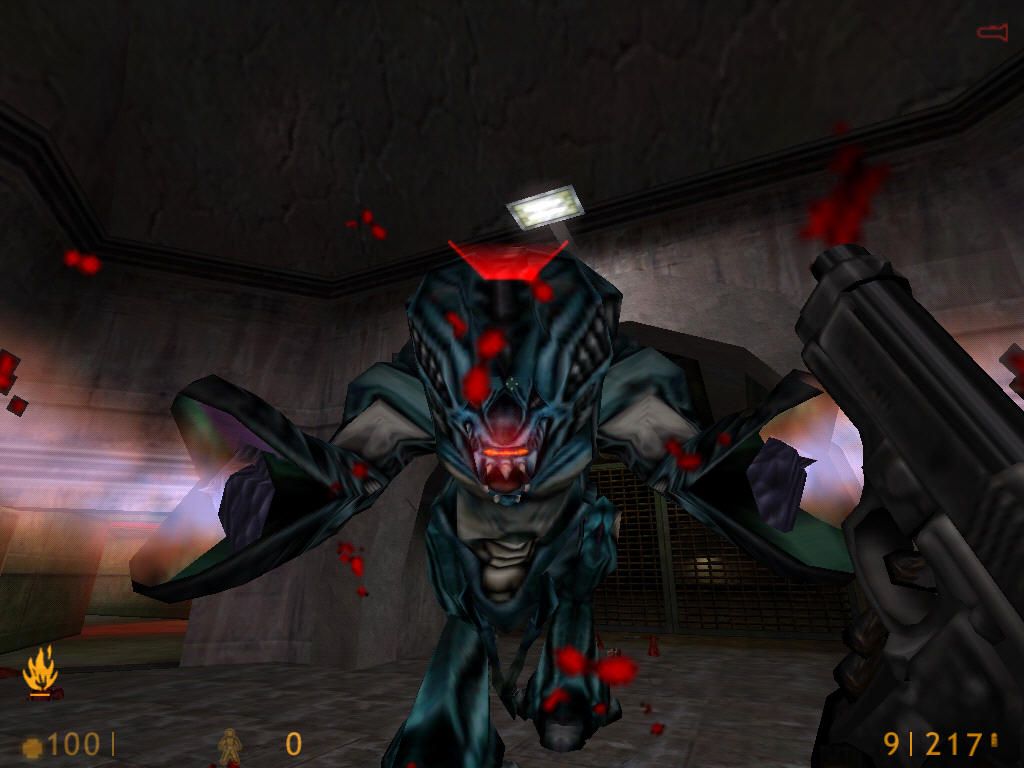
Calling Half-Life great is a gross understatement. It is The Godfather of video games. In the same way how the film forever changed the face of crime and gangster movies, Half-Life set an everlasting benchmark for anything first-person shooter.
Originality is rarely seen in every video game, even less when it’s your debut in the medium: but a couple of ex-Microsoft employees with a borrowed game engine raised the bar by which all future fps’ were judged. When programmer Mike Abrash left Microsoft to work on the Quake title at id Software, Gabe Newell and Mike Harrington followed suit and founded Valve Corporation. In 1998, they released Half-Life.
Half-Life’s release on the PC caused waves of gigantic proportions across the world. Never had anyone seen anything like it. Never had anyone felt so immersed in a first-person shooter ever before. The introductory three-minute long train ride with a cool female voice addressing various issues and updates to the player is easily among the greatest intros in video gaming, with it also being an example of a cinematic experience in video games. In a scripted-manner, the various robots, helicopters, scientists and guards go about their jobs, often coming in the way of the train, causing it to slow down a little or come to a complete halt. This feeling of a grandiose environment quickly tells the player that Half-Life is not just about the character; but also the world at large and that they play an equally important role in the in-universe as you.
When the ride’s over, the still-impressive facial movements and motions are witnessed. Though a majority of them have only a few lines and really don’t seem to be doing anything other than going through some rote animations, the atmosphere is that of a living, breathing, realistic world. As realistic as a world soon-to-be-populated-with-aliens anyway.
Officially, the actual storyline gets triggered when you trigger the resonance cascade. Unofficially, when Gordon Freeman picks up the crowbar. What follows after is an onslaught of headcrabs, Vortigaunts, houndeyes, zombies, bull squids, and effectively eerie cameo appearances of the G-Man. When I first saw him standing on the top platform just when the first houndeye appeared, I was terrified beyond words. So emphatically spooky was his first appearance that the houndeye killed me and I had to restart the game.
What separated Half-Life from the rest back in the day was its omitting of cut-scenes entirely, thus resulting in a flowing narrative. You walked from one chapter into another without even realising it. In Doom, for example, you had to reach a checkpoint to clear that chapter, then your achievements would be tallied up on a separate screen. There’s no such score keeping in Half-Life. Apart from a few chapters closing with a fade to black, there’s practically no loading screen either. The game never rests, just slows down occasionally and for justifiable reasons.
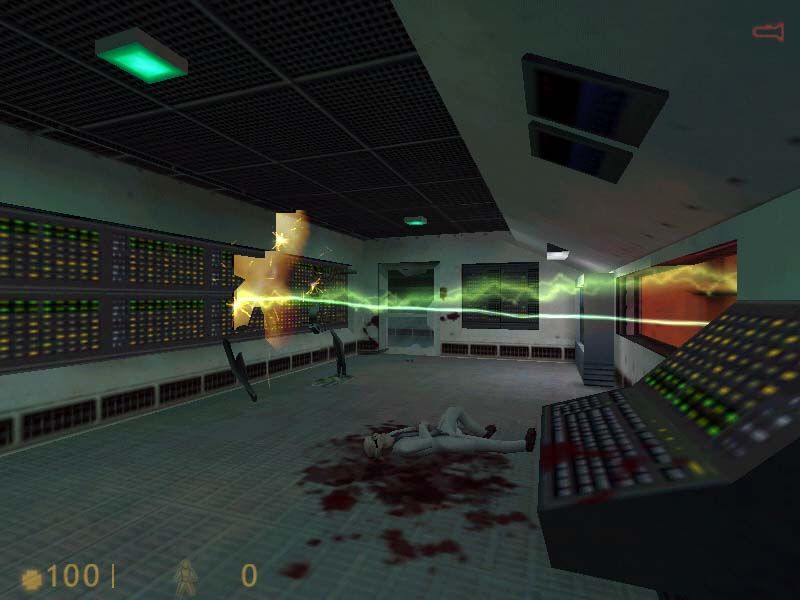
The story is strictly seen through Gordon Freeman’s eyes. Although the scientists and security guards have scripted dialogues that they keep repeating over, a few of them have ‘special’ lines that reveal more about the backstory of the current chapter. In the Questionable Ethics chapter, for example, a group of fellow scientists are trapped and cornered by headcrabs, houndeyes, and the rogue assault team. When you clear the area of them, one of the scientists will tell you everything that happened offscreen. This mechanic constantly serves as a reminder that whatever that’s happening in out-of-reach areas or ‘on the other side of the fence’ are equal to whatever that’s happening in your line of sight, and are equally as ‘real’ and ‘happening’. It also further reinforces the philosophically larger-than-life vibe of the game perfectly.
The one thing Half-Life excels in is the memorable scenes. The three-minute long introduction perfectly sets the mood and character of the game, but it’s just a taste for all the wonderful things to come. The first real bite granted to you I believe is when you’re in the first-quarter of the Unforeseen Circumstances - roughly 20 minutes into the game. There’s a part where you have to take a freight elevator to a lower level. Fans of the Akira manga know exactly what I’m talking about. As you’re slowly descending, a seemingly endless horde of headcrabs rain upon you. In my initial playthrough I had no bullets, so I had to fend for myself with the crowbar. To say I was all sweaty would be an understatement.
In conclusion, Half-Life is a sublime product by a superb, dedicated team. The spectacular level designs, then-rich textures and graphics, and an unusually steady balance of slow, quiet moments and quick one-off bloody battles all contribute to a rich and satisfying experience.
Note: Screenshots from all platforms that were available at the time can be found here at Moby Games.
When you get off the tram in the original game, a security guard by
the name of Barney greets you. Among the many things he says in his
short appearance, he mentions something about buying you a beer after
when the shift's over. But, as we all know, the day soon takes an
unexpected turn via the cataclysmic resonance cascade and sets in
motion the raison d'etre of Half-Life proper; thus Barney and his
proposal is all but forgotten. The friendly guard quickly becomes a
distant and unimportant memory the more you progressive into the
game, until comes a point where you cannot remember him unless
reminded so - at which your face takes on the expression of someone
lost in an ancestral memory.
Now, in Half-Life 2, as soon as you get off the train you're taken to
an interrogation room where a Combine soldier is waiting for you.
When the soldier closes the door to the room and turns off the CCTV
cameras, he then takes off his headgear and, while revealing himself
to be Barney, reminds you of his long-due promise of the beer he owes
you. The mere mention of the word 'beer' brings back the nostalgic
memory of meeting him for the very first time. Seeing him again is
like running into an old, dear friend, and given the context it could
not be more fitting and relieving. While this brief surprise is
rather nondescript in front of the bleak and terrorizing world you
get to witness, it is precisely because of this that his unexpected
appearance makes you want to venture on with renewed confidence...
and appreciate the game just a little more for staying true to its
larger than life approach to the Half-Life universe. Just because we
never get to see Barney for the remainder of the original game
doesn't mean he met with the inevitable cliché. Valve's intent was
to make believable, realistic characters, and Barney was one.
Anything could've happened to him, and out of all the scenarios that
come to mind, this one - that he survived - is the one I like best.
You are in City 17. You arrive here from an unknown location with two
other passengers, and with the mysterious G-Man and his cryptic
sentences once again in the picture, you know it's going to be yet
another strange day at the office. Once you step off the train and
witness a Combine soldier harassing a citizen (and then later you),
you realize that the two ends of the spectrum have successfully
balanced out. In the original you were a respectable scientist who
was the cause of the trouble; now you're the victim of it, reduced to
the lowest common denominator. In this introductory level, the signs
are all but clear: an Orwellian nightmare has froze over and there's
nothing you can publicly do about it. You must plan your moves in the
shadows and move with caution. Right from the outset - with the
Combine bullying you, with them forcefully breaking into citizen's
dwelling areas and ram shackling it - the game masterfully conjures
up a deafening silence before the storm.
The second you open the double doors to the majestic looking center
of City 17, you just know you stepped into something both
philosophically and literally bigger than yourself. The tightly
packed tenements are a mix of different era Eastern European
architecture and they palpably invoke a sense of Orwellian society -
which is not far from the truth, given the numerous flying scanners
and Dr. Breen's Big Brother-esque ubiquity over the City. Citizens
with frightened expressions and hunched shoulders slowly make their
way to their destinations while several Combine soldiers stand
uprooted menacingly. Approaching them alerts their awareness of you.
Stay in their line of sight slightly too long and you'll receive a
smack on the head with their electric probes. Since you're not armed,
you cannot hit back - and this marks as prove of the game's unmatched
realism and tangibility. City 17 is easily one of the most impressive
locations in a video game ever. The use of mute colors (ie: brown)
brilliantly accentuate the desolation, forlornness and trapped nature
of the city and its denizens. Never before have I entered a location
and felt exactly like the habitants and have had this euphoric
phenomena called fernweh - where a person becomes homesick for a
place he's never been to. This is great work on Valve's part, and
possible madness on mine!
Right from the outset this game tells you that it will be providing a
much bigger playground to traverse in than the one you were used to
in the original. While Half-Life 2 does have its claustrophobic
moments, the larger areas never feel like they're being replaced nor
do they lose their touch. The only complaint I have regarding the
size of the locations is how vulnerable you suddenly become to enemy
attack. Whenever you emerge from, let's say, a house or underground
dwelling, to a more open landscape you're exposed to enemy attack
like an exposed nerve - because they appear from multiple directions
and often-times one of them would be in a difficult position. This
"invisible shooter" has been a thorn on my side from the
Ravenholm chapter onward, and the number one cause of unfair death
and/or ungodly level of low health.
The primary gameplay remains the same. You make your way through
various locations - and from it - battling enemy forces and
occasionally encountering a rebel hideout. The latter is a new
feature in the game, and through it further portions of the backstory
get uncovered. In the original you had scared-stiff scientists and
lone security guards; here now you get groups of rebel fighters who
are more than capable of holding the fort all by themselves. This is
an interesting change of pace, as it makes the in-game world a little
more alive and varied than it already is. The shooting aspect is now
more refined and aggressive. Compared to the first game, the guns and
hitting power feel more heavy and weighted - but they still have a
slight "floaty" feel to them that makes them far from
robust. While the subtle technicalities make for a better playing
experience the second time around, nothing expresses the power of
freedom more explosively than the driving aspects of the game.
As still one of the few first-person shooters to include driving
sequences from a first-person perspective (others tend to switch to
third-person), the driving parts, though executed in a nice way, have
me sharply divided. You see the game uses the same physics mechanic
for driving as it does for the characters, and the translation
doesn't go over too well. In fact they feel too uncomfortable,
uncontrollable and awkward. The mudskipper (water boat) sequence is
fine, no serious complaints there, but it is when you man the dune
buggy that you acquire in the Highway 17 chapter that the trouble
starts. The physics engine is so sensitive that any bump with a rock
or an Antlion sends it flying across the screen, losing viable health
and time along the way. Just a few minutes into the buggy and already
I had begun loathing it. When I finally had enough of turning it over
via the Gravity Gun - of which you'll have to do constantly - I
ditched it and continued the adventure on foot. Imagine my anger (the
one I usually reserve for the 30 second ads before every YouTube
video) when I found out that in order to proceed to the next area I
had to be on the friggin' buggy. Since I had ditched it a long way
back, I had to travel all the way back to retrieve it, all four
minutes of it. Bringing it to the close-off point took longer than
making coffee. Had it had better physics model, who knows I might be
crying about lack of more driving sequences; but since there aren't
many, all I can say is Good Riddance!!
Graphically the game is beyond awesome looking, even to this day.
Many of the locales look absolutely gorgeous - even if they aren't
gorgeous in the traditional sense, they do invoke a sense associated
with the word. The entire Ravenholm chapter not only stands as
testament to the graphical prowess of the game, but is also perhaps
one of the most intimidating and creepiest areas ever designed for a
video game. To sum it up Ravenholm is a negative copy of City 17.
While the latter isn't exactly flowers and sunshine, it is well
maintained and horrors contained. Ravenholm is like a living carcass,
a rejected Silent Hill location. Crawling to the brim with even
darker versions of zombies and headcrabs, Ravenholm effectively
conjures up a feeling of palpable dread and insecurity only matched
by a certain few, like Doom 3 and F.E.A.R. The heavy use of grotesque
props - such as mutilated bodies and large pools of blood - only add
to the already scary atmosphere. Really, I could go on and on about
this particular chapter but such praise will go pointless if you
don't (or won't) experience it for yourself. It will be like you
stepped into another different game altogether.
The voice acting is simply amazing and definitely an improvement over
its predecessor. Not to say the first game didn't have good voice
overs (it did actually) it's just this time around they've definitely
gotten richer and rounded. The tigress' share of the adulation
obviously goes to Merle Dandridge for her masterful and iconic
portrayal of Alyx Vance, the first female protagonist of the
Half-Life universe, as well as the first fully fledged supporting
character. Merle did such an excellent job that she forever ensured
Alyx's position in the annals of the video game industry as a
legendary character. A job finely done, I must say. The rest of the
supporting cast, major and minor, also provide various shades of
appropriate realistic emotions and tones and they're all worthy of
two thumbs up. Half-Life 2 may very well be one of the very few video
games to have great voice-acting from virtually everyone - something
I last noticed in Broken Sword: Shadow of the Templars and its third
sequel, Angel of Death.
With all being said and done, Half-Life 2 is a technical and
graphical milestone in the video-game industry. It is one impressive
looking shooter that has brains as well as brawns. Rarely has there
been a sequel that is as epic as this one… but still, the original
is miles better in my book. Maybe it's the B-movie feel to it, maybe
it's the cult look to it; I really don't know what is it about the
original that reels me in, but perhaps I've already given a solid
reason: that it reels me in. Whereas this one doesn't.
Score: N/A
Note: Screenshots from all platforms that were available at the time can be found here at Moby Games.
Calling Half-Life great is a gross understatement. It is The
Godfather of video games. The reason why I call it that is simple:
crime and gangster films were a-plenty until 1972, but the release of
The Godfather changed the face and name of the genre, becoming the
new benchmark for every major and minor crime film that followed. The
first-person shooter genre was only in its fifth year and already a
titan of a smasher emerged in the form of Half-Life. Originality and
blockbuster-level success comes rarely in video gaming, even less
when it’s your debut in the medium; but a couple of ex-Microsoft
employees with a borrowed game engine defied all odds, conquered all
impossibilities, and not only raised the bar by which all future
first-person shooters are judged, but also quickly became the go-to
name for a robust, reliable FPS. Half-Life’s release on the PC
caused waves of gigantic proportions across the world. Never had
anyone seen anything like it. Never had anyone felt so immersed in a
first-person shooter ever before. If the previous first-person
shooters had a following, Half-Life had an audience.
The introduction - a three-minute long train ride with a cool female
voice addressing various issues and updates to the player - is easily
among the greatest intros in video gaming, with it also being an
example of cinematic experience in video games. In scripted pieces,
the various robots, helicopters, scientists and guards go about their
jobs, often coming in the way of the train, causing it to slow down a
little or come to a complete halt. This feeling of a grandiose
environment only confirms to the player that Half-Life is not just
about the character; but also the world at large and that they play
an equally important role in the in-universe as you. Plus, the
introduction also gives you a valid reason to how you got there in
the first-place. The others often start in media res, with you often
wondering how in the heck you landed in that situation in the first
place.
When the ride’s over, the still-impressive facial movements and
motions are witnessed. Though a majority of them have only few lines
and really don’t seem to be doing much other than walking around,
the atmosphere is of a living, breathing, and most importantly,
realistic world. Even if it's one inhabitated with aliens. The
interaction with fellow scientists and not-so-fellow guards feel for
once honest and expected. They beg of you to leave them alone, give
zero advice, alert you of your tardiness, or generally say a random
word or two, before shooing you away like a bird. Many times they
wouldn’t even look in your direction when addressing you, instead
squinting on the corner they fear holds danger. The intelligent and
working A.I. and their then-unprecedented facial movements still has
me impressed… just as how they had done when I played it for the
first time back in 1999.
Although the actual storyline gets set into motion when you trigger
the resonance cascade, us players know Half-Life really gains flesh
when Gordon Freeman picks up the crowbar just mere minutes after the
accident. What follows after is an onslaught of headcrabs,
Vortigaunts, houndeyes, zombies, bullsquids, and effectively eerie
cameo appearances of the silent and ghost-like G-Man. When I first
saw him standing on the top platform just when the first houndeye
appeared, I was terrified beyond words. So emphatically spooky was
his first appearance I forgot I was in a room full of enemies.
What separated Half-Life from the rest back in the day was its
seamless, flowing narrative. You walked from one chapter into another
without even realizing it. In Doom, you had to reach a checkpoint to
clear that chapter, then your achievements would be tallied up.
That’s not the case in Half-Life. There are no scores, no
checkpoints and apart from few chapters resulting in blackouts, no
loading screen to bog down the action nor a cutscene to pry your
fingers off the keyboard. The action is always kinetic, and if the
game has to slow down it is always justified. Hey, even Kratos needed
to lay off some steam after countless violent deicides.
The story and the carnage is seen through Gordon Freeman’s eyes.
Although the scientists and security guards have scripted dialogues
that they keep repeating over, a few of them have ‘special’ lines
that reveal more about the backstory of the chapter you’re
currently in plus few suggestions on what to expect and how to deal
with it. In the Questionable Ethics chapter, for example, a group of
fellow scientists are trapped and are being hunted down by the rogue
assault team plus a few Headcrabs and Houndeyes. When you take all of
them out and ask one scientist to accompany you to the retinal scan
as to open the door, he will reveal what happened thus far –
meaning all the action that took place off-screen.
Having non-playable characters retell the (often) disastrous events
that took place and then receiving a rebuttal in reply when asked to
accompany Freeman, all give great deal of life to the atmosphere of
the world. It is a continuous reminder that whatever that’s
happening in out-of-reach areas or ‘on the other side of the fence’
are equal to whatever that’s happening in your line of sight, and
are equally as ‘real’ and ‘happening’. It is a reminder, over
and again, that not everything is revolving around Gordon Freeman.
The point I’m trying to make is that the feeling Half-Life gives is
as if the game randomly decided to make the first person it laid its
eyes on as its protagonist… and it happened to be Gordon Freeman.
A puzzle game at heart, you will often find yourself flipping levers,
turning on switches and devising a quick-plan involving boxes and
trip-wires… often-times a combination of three and in that order.
For every rational puzzle, you get an intense battle with the
enemies, usually Vortigaunts, which, depending on their mood, either
come running at you a la Serious Sam style or shoot lasers which
cause devastating damage. But even more fearsome in my opinion are
the Headcrabs.
Even before performing the resonance cascade, you can see them locked
in glass chambers, making them the first enemy you see and encounter
in the game. Heck, even before you pick up your trusty crowbar, they
start attacking you. The Headcrabs have this tendency to jump right
at your face, a la the Facehuggers in Alien. Their intent is to
convert you into the zombified creatures you encounter several times
in the game. Since many appear at one time, even one lonesome
Headcrab is capable of decreasing your health by a huge amount.
They’re small, they’re nifty, and definitely the most feared.
The one thing Half-Life excels in is the memorable scenes. The
three-minute long introduction perfectly sets the mood and character
of the game, but it’s just a taste for all the wonderful things to
come. The first real bite granted to you I believe is when you’re
in the first-quarter of the Unforeseen Circumstances – that’s
like twenty-five minutes into the game. There’s a part where you
have to take a freight elevator to a lower level. While slowly
descending, a seemingly endless horde of Headcrabs rain upon you.
Though many of them just slide off the elevator and into the water
below, the shock of turning around and finding them falling on you by
the truckload is damn scary. With only a crowbar to protect yourself
(or a handgun if you haven’t run out of bullets) the crushing
acknowledgement that a couple of deformed, mutated Mexican jumping
beans are able to make you take a hypothetical crap is too
pressurizing. Once the ride’s over, a lone Houndeye awaits you, but
he’s no problem. In fact I found them cute (in that bizarre manner
of course) and honestly felt bad about killing some of them, since
they resemble no more than alien bulldogs without any heads…
In conclusion, Half-Life is a sublime product by a superb, dedicated
team. Whether you’re familiar with the concept or not, this game
will break away all conventional stereotypes or notions you’ve come
to associate with the genre – though of course it does have them,
but little in number. The spectacular level designs, rich textures
and graphics, and an unusually steady balance of slow, quiet moments
and quick one-off bloody battles all contribute to a rich and
satisfying experience. I have virtually no gripes with the game, but
I don’t think I can still digest the fact how could Valve
seamlessly disguise obvious B-Movie and snuff-film aesthetics in a
video game and present it as one.
Steam released a blog post about their new direction with respect to its store. Let's break down the post.
Note from Editor: No links in this opinion have been embedded so you know exactly where the below mentioned URLs are taking you.
New Policy
June 6th marked the day where Steam addressed what games will be allowed on their platform. You can check it out here https://store.steampowered.com/news/?feed=steam_blog but I'll summarize some of what is said and reflect upon it. Let's face it, the post brings up many questions and concerns.
Pros
Allows freedom for game developers to launch their games without a long Greenlight process
Let's users curate their own game choices by using various tools (for example: the 'not interested' button)
Steam gets to negate or avoid potential legal battles with game developers by opening the floodgates
Steam employees will have more time to develop better tools to help developers and users make gaming decisions
Cons
Possibility of young people seeing content not suitable for their age/maturity level
Could destroy jobs at Steam because there are less jobs required for curation
Incomplete games could be released on the platform
Possibility of the Greenlight system collapsing (because that was the primary way that indie devs created presence for their games)
Clear lines need to be drawn on what games will be deemed illegal and/or trolling
In the above post, Steam acknowledged that legality is difficult to determine and decided that it wasn't their job to curate games. As a result, there are two camps regarding Steams' new open arms policy.
Either gamers want the freedom to access any game on the market or they are extremely salty.
Many gamers jumped into the ring, arguing for access to pornographic games, however, many are forgetting that those aren't the only types of game that will now be permitted. So long as a game isn't deemed illegal or trolling, many titles will launch on Steam like games that cover controversial topics such as politics, sexuality, gender, and racism. These will get a free pass. What's worse than that is games that don't even fall under the definition of a game can also be released. How about terribly done asset flippers? Apparently, the general populous of gamers don't care about any of that. They only care about, and are excited for, sexually explicit games - as if they couldn't find these games in other places.
That says a lot, doesn't it?
Question about Steam
One could argue that Steam has never been great with its curation or direction. Steam reviews still end up being heaping piles of garbage, making consumers wonder whether or not this new direction will force game review to be more integral in buying decisions.
I get it. Curation on Steam, through their needlessly borked Greenlight system, has been spotty at best. As a result, I have a ton of questions like:
What will happen to your Greenlight system?
Are these games still going to be curated if Greenlight continues to exist?
What happens with badly ported games? Do we rely on that two hour refund policy and hope Steam honors their own agreement?
With respect to adult games, how will they be regulated so that young viewers aren't exposed to the content without proper parental consent?
Why couldn't you launch a new platform specifically designed for more mature titles?
Will Steam continue with the date of birth feature as adequate protection or will there be better ways to protect our families?
Will the controversial content be hidden in any way?
Will the controversial content be featured on the front page?
What 'tools' are you talking about in your blog post? Wouldn't you release those tools before opening the floodgates?
Will games like Conan Exiles be re-classified? How about Hunie Pop or the Sakura Games?
Will you release adult content games with a filter like you have in the past?
How will you determine 'illegal or trolling' content? Are we talking about murder and prostitution? Do most games suddenly fear getting the boot? (Oh wait.. we aren't curating anymore...)
What do you constitute as trolling? Do you mean parody games like some of the presidential games offered on Steam?
What will you do about hate speech content?
What will Steam do about games being review bombed for any game that gets released on the platform?
Legalities
In the passage below, I have a ton of other questions like, who's definition of 'illegal' are you going by? Because yes, each place in the world has socially acceptable behaviors that other places deem illegal. For example, did you know that rape is legal in some countries? How about the places where women or gender fluid persons have no legal rights? Did you know that people in the Netherlands tend to be racist? (I'm not saying everyone in the country is racist, I'm simply saying that it is a well known issue.)
The reason why laws are broad is because law is not meant to be black and white! Having gone to school for law, I can tell you that legal decisions are challenging due to a variety of factors (no matter what type of law we look at). The fact that law is not a cut and dry system is actually a good thing. And while I'd love to give examples, I won't because of time constraints and confidentiality.
"What's considered acceptable discussion / behavior / imagery varies significantly around the world, socially and legally. Even when we pick a single country or state, the legal definitions around these topics can be too broad or vague to allow us to avoid making subjective and interpretive decisions. The harsh reality of this space, that lies at the root of our dilemma, is that there is absolutely no way we can navigate it without making some of our players really mad."
Trolling Content
Now that we dealt with the illegal question, what do you deem to be trolling content?
I ask that question because I'm a Twitch chat moderator. After years of doing this, I've had several discussions with other moderators about what should be timed out and what shouldn't. One of the channels that I used to moderate for had a ton of people trolling in chat. Myself and one of the other moderators deemed the comments to be hindering the chat experience, so we timed it out. Later we were chewed out by the streamer because of our actions. This situation presented a couple of interesting questions like what do people consider to be trolling? And when does trolling become an issue? How can you viably determine what trolling is without some kind of guideline? Does Steam even have a game plan for determining that?
Personally, I'm having an extremely hard time thinking about what Steam does from here without running into much more backlash. So far, the blog post isn't reassuring.
LGBT Content
Through a friend, I was informed that while Steam has opted to allow any kind of content, they have also restricted access to others. As labeled above, I'm referring to the LGBT content on Steam. When I looked up the tag for LGBT content, I found two pages worth of games. However, none of the games have the LGBT tag which used to be available. That's right, Steam has decided to censor its content anyways. So, they'll let anything get on their platform but will hide it. No. They aren't curating content at all... They said it in the blog post, therefore it must be true.
It's appalling that they are allowing a battle royale game with all gay characters because the whole purpose of a battle royale game is to be the last one standing. In effect, this game is telling players they have to kill all other gays to win. WTF STEAM?! Who decided this was acceptable? Even still, who made this decision prior to the new policy? What kind of curation did you have before that would allow such a game? ARGH!
Oh, but don't worry fellow gamers, Steam has other LGBT content available! Let's take a look at the other titles shall we? How about 'Your Royal Gayness'... I'm skeptical about it but I take a look at the store page anyways. And instead of giving you an impression without playing the title, I'll leave you with one reviewers comments. I quite literally don't have words.
"MARRIAGE/ROMANCE - I HATED the 'are you acting straight enough' meter. It was gross. I don't know why not a single person on the development team went 'maybe this perpetuates stereotypes/might hurt people who face this very real fear of getting disowned/beaten/killed if they don't act straight enough.' And there was no romance at all. Like, one prince showed up, but I couldn't impress him because I didn't have enough Nerve."
You can't see me, but I'm making an angry face.
What Now?
Assuming our readers don't want to give more money to a platform that no longer curates their content, here is a list of other platforms where games can be purchased or played on:
Keep in mind that the above options have pros and cons. Origin is a platform developed by EA. Uplay is developed by Ubisoft. Both of them have questionable reputations, but I'm not here to tell you what to do. These are simply alternative platforms to Steam.
Gamers can also buy directly from the developer websites. If there are indie developers you want to support, some use Kickstarter. Again, do some research before backing an undeveloped project. This has also had dicey results.
Another option is to attend gaming events where players can interact directly with indie developers. Sometimes they have free codes to give out.
There is one more site I can think of which provides a different sale on a game each day and that is https://chrono.gg
If you are looking specifically for LGBT friendly games, here are a couple of useful links:
The power is in your hands. If you no longer wish to support Steam, then find other ways to support your favorite developers. If you decide to remain on the platform, know the risks. Watch Let's Players or Twitch Streams to get an indication before purchasing a game. Consider reading various reviews from respected sources. The information is out there. Use it to your advantage.
Final Thoughts
Steam's official blog post does paint a terrible picture, in my opinion. Those who have used the platform for long periods of time have been burned before. And the fact that Steam is going to place the onus on the consumer to cover their own assess does not mean that Steam, as the largest game distribution center, gets to absolve themselves of consumer responsibility.
I understand that there is a lot of pressure to do right by all parties, but I honestly doubt this was the right way of going about it. While I'm all for freedom of choice, I don't think that opening the floodgates is best for consumer retention. By allowing a free reign system, Steam gives the impression that it doesn't matter how poor a game is, intent is to make more money.
Steam would have been better suited revising their greenlight system in a more favorable way to game developers without doing a disservice to the consumer. Furthermore, they could have designed a similar platform specifically for mature content. Those two ideas would have gained the industry's respect and would have maintained Steams' integrity.
At first glance, it seems that Steam is looking for an easy way out from making difficult decisions. They are sick and tired of battling game developers and consumers on what games should be allowed. And, instead of setting certain standards, they are effectively allowing users to become the scapegoats.
Don't just take my word for it. Jim Sterling released a video where he rants about the decision. Parents take note, he doesn't hold back. Check that out
When a title describes itself with the following “With combat inspired from classics such as Diablo and Torchlight, this hack n' slash roguelike RPG puts you in the shoes of a powerful hero on the rise.” I can’t help but be interested from the get go being a huge fan of the Hack and Style / Roguelike styles. Currently within Early Access on Steam, Herolike is an interesting merger of different ideas that gives it not only a unique feel, but is loads of fun to play for hours on end.
Still within its alpha stages there are currently two playable character types offered in the form of the up close and personal Guardian and the long ranged Shaman with magic as well as projectiles from her staff. Each character type offers simultaneously a different but familiar experience with skills that while distinctly different, function along the same lines. The Guardian for example has a powerful shockwave while the shaman has tracking magic missiles that will find their targets even if you are currently looking the wrong way you can still claim that you got them. Where things become a bit more similar is in the third and fourth skills that increase armors and turn our characters into Avatars of power which is a lot of fun to do. Having currently gone this route allows for similar styles to be played while still offering enough of a difference to make having different classes worthwhile. It’ll be interesting to see how the rest of the classes play out over time.
Unlike Diablo, Torchlight, Titan’s Quest, Grim Dawn, Victor Vran, Van Helsing (you obviously get the point by now), Herolike has a different approach for Hacking and Slashing elements that works perfectly in the Roguelike world which is all about chance as even the best strategies can be sunk by elements out of our control. Instead of being provided an open or even open-like world to explore, players will instead be treated to instances that follow different tenants depending on how the world map is designed for that play through.
The world map is one of the first Roguelike elements that makes its appearance with various possible styled scenarios built across the screen horizontally in the form of a branching path. Hostile (pure Hack and Slash events), Tower Defense, Role Playing, and taking a Gamble are the options spread out for players to choose as they cross the map. The layout of the options is randomized for every new character as are what actually happens within which spices things up a bit. Currently ranging from one to three options sometimes the options being random are two Hostile and one Tower Defense really giving the player one of two choices. The interesting thing however is with everything being randomized, Hack and Slash Option A can be completely different than Hack and Slash Option B.
Right now both the Role Playing as well as Hostile are the two styles of events that contain the most amount of variety. Role Playing is exactly that with a variety of situation that your character can find themselves in up to even the point of deciding if it’s worth getting involved or not. Your actions along with current reputation will determine the outcome of the reward in the form of gold and more renown. Hack and Slash is exactly that and unlike the Tower Defense in which a point must be protected, Hack and Slash is simply surviving without worrying about defending a point but instead staying alive through a variety of different locations each with their own traits.
A cold landscape reduces the speed of movement as it’s freaking cold (looks outside at our current Canadian weather and I can’t blame our characters), a dark cave reduces the visibility until the enemy is right upon you, and a graveyard may spawn patches of darkness that will suck your health away. Add in a desert with sand tornados and there’s more than just the enemies that can kill you. Death you ask? This is a Roguelike but if you die, you’re dead and must start everything all over again from the beginning. Don’t worry though, if you were smart about it death isn’t all that bad as your heros essentially have a keep in which they can build up with various merchants in order to make the next run just a little bit easier.
The town in which the Keep is located in can be viewed as a base of operations which isn’t necessary to always go back to unless you yourself deem it important. This was a great move on Games Hut part as if there was nothing to do why would I have to go back there only to leave again? The town plays host to a variety of shops for gear both offensive and defensive purposes, items such as healing potions and gold magnets, a station to boost the starting level and funding, an alter or resurrection, and finally for the cost of renown sending out other adventurers to hopefully find gold and materials. To build these shops is where the Keep itself comes in as it produces a set quantity of materials for every point completed on the world map. Once enough materials have been amassed then buildings can be then put into place which become permanent even after a character death which makes the next playthrough that much easier as better gear can be accessed quicker. Once established, the shops like the Keep can be upgraded to provide both a better range of equipment and more materials respectively.
Being in Early Access and within the Alpha no less the amount of content currently available is impressive. Being in said Early Access however it is to be expected to see some bugs such as random crashes or it crashing once character death has occurred. Nothing is honestly game breaking as things load back up fairly quickly but it should be expected that the game will crash instead of returning to the main menu in order to create another character.
Herolike is already on its way to become something great taking ideas from two different veins and creating something fresh that is great to play for long periods on end even if you die to a chest because you figured the poison would have all been out and you wanted to know if something actually WAS inside of that chest. Alas… it was but my first of many deaths.
Game Information
Platform:
PC Developer(s):
Games Hut Publisher(s):
Black Shell Media Genre(s):
RPG
Roguelike Mode(s):
Single Player Other Platform(s):
NA
Half-Life was such a memorable and unforgettable experience for many, for me, for you, for anyone who played it and left with a huge smile of satisfaction on their faces. Naturally, people wanted more of said experience; a sequel was imperative. But Valve, the developer, not exactly known for their punctuality (bluntly speaking, they're worse at keeping time than John Romero), they finally came up with a sequel 6 years later (which was totally, totally worth the wait). That's a lot of years - so many in fact that you need an extra hand to count on - and a lot of the fans were getting impatient.
This one's been out for a few years, so I'm giving it the slightly more lightweight treatment, which is fare because as good as the game is, there is not a ton of meat on its bones. For starters, this is not a game that is meant to be played in single player. I can't imagine trying to enjoy this game fully if you do not have an Xbox Live Gold account. My son loves shooters like this, and I tend to enjoy them as well - we both enjoyed this title, though he definitely got more mileage out of it than I did (using my account because he does not have Gold).
The key to this game is the multiplayer, and to that end it is pitch perfect in a lot of ways. The title's about three or four years old now so the graphics tend to look a bit dated for this generation of console, but the lightning effects are appropriately creepy and it handles the massive amount of movement (ie: ranging zombie hordes) very well.
The music and voice work add a movie-like quality to this title. I am a bit of a sucker for zombie survival movies and shows, and I felt like Left 4 Dead definitely nailed the particular vibe. The game plays pretty smoothly. It is a survival shooter, and the controls are fairly smooth and even now there are people playing it. My son fired it up about a month ago and still immediately found a match to participate in. Considering the game can be had for about $10 new, that is not a bad value. There is a lot of replay to be had here, which is good since there really are not very many scenarios/maps.
I wouldn't toss a little kid in front of it - it is rated M for Mature for blood, gore, intense violence and language. My son handles his content pretty well, being a teenager now (and therefore making me feel very old, but that's an entirely different post), but I wouldn't let my youngest daughter who is 10 probably play it. Not a bad way to get together with some online friends and kill time. I haven't however, had a chance to try the sequel, which I hear is even better than this and might make for a better investment depending on cost.