• Gobliiins Collection - Switch Review

    In the early 90s, Coktel Vision (which later became Sierra On-Line) released a quirky point and click adventure game titled Gobliiins which had players bouncing between three different Goblins to find a cure for good King Angoulafre.

  • The Core - PC Preview

    Sometimes when you are browsing the internet for information on how to do something, you stumble upon ideas or projects or even games that people might be working on...

  • Cat Mail Co. - PC Review

    What a meow-gnificent evening it is to send your paw-rcels out to those family and friends! Are mew looking to pick up an item or send something out? Well at Cat Mail Co. we can send and receive all your deliveries!

  • Volontes - Nintendo Switch Review

    Have you ever grown up feeling like you don't belong? For our Heroine, that's the feeling she lives with everyday in her small farming village. But it's not her only secret...

  • STARSEEKER: Astroneer Expeditions - PC Preview

    STARSEEKER: Astroneer Expeditions is just that! Massively co-operative and not an MMO! When you first run the game you are instantly into the tutorial...

  • Dread Delusion - Xbox Series X|S Review

    Today we’re looking at what has rapidly become an absolute favorite in the open-world RPG genre for me. An interesting story, memorable NPCs, stunning visuals, and a setting absolutely dripping with flavor, Dread Delusion sets its tone immediately and sticks with it.

  • House Flipper Remastered Collection - PC Review

    I enjoy simulation-type games, and I enjoyed the original release of House Flipper, but I never got around to getting the DLC. When the remastered version of the game was released, I figured it would be the best way to experience the DLC while checking out how the base game was upgraded.

  • GranBlue Fantasy: ReLink Endless Ragnarok - PS5 Review

    GranBlue Fantasy: ReLink released in 2024 bringing the GranBlue universe to an action adventure JRPG format. With a party of up to four members, this band of skyfarers set out for new skies, adventures, and dangers. Two years later, Endless Ragnarok...

  • 70s-Style Robot Anime Geppy-X - PS5 Review

    70s-Style Robot Anime Geppy-X is a mouthful of a title, but you know what? It’s quite the challenging game to describe as well. At its core, 70s-Style Robot Anime Geppy-X is a shooter...

Showing posts with label Ravenscourt. Show all posts

Dice Legacy: Corrupted Fates Review


Dice Legacy: Corrupted Fates
by developer DESTINYbit and publisher RavenscourtNintendo Switch review written by Hayden with a copy provided by the publisher.

Estimated reading time: 5 minutes 


Dice Legacy: Corrupted Fates by developer DESTINYbit and publisher Ravenscourt is the first DLC offering for this unique take on the city builder genre. Based around the classic DLC fodder of letting the player experience the game from the “bad guys” point of view, Corrupted Fates brings a number of welcome changes to the game. This relatively low-cost DLC (only $8.99 CDN at publishing time) expands the world of Dice Legacy with new mechanics and a new storyline, keeping the game fresh some eight months after its original release.

For those unfamiliar with the franchise, here is my review of the original base game.

Dice Legacy: Corrupted Fates brings a number of new options that are immediately visible upon starting a new game, some of which address criticisms of the original game. In particular, players starting a new game will have a new difficulty setting available. Peaceful mode aims to keep the stress of constant invasions to a minimum. In peaceful mode, the player will only come under attack when they deliberately provoke an enemy by initiating an attack on an encampment or similar.

The second new set of options helps control how the game speed functions. Settings for disabling the ability to pause (labeled as the way the game was intended to be played) are here, as well as going all the way to the other extreme where the player can not only pause the game at will but also manipulate and assign their dice while paused. Returning to the game again after a while away, this last setting was a true savior. Finally with this setting I had time to not only read tooltips but to actually grab a drink or go to the bathroom without having to save and quit out to the main menu.
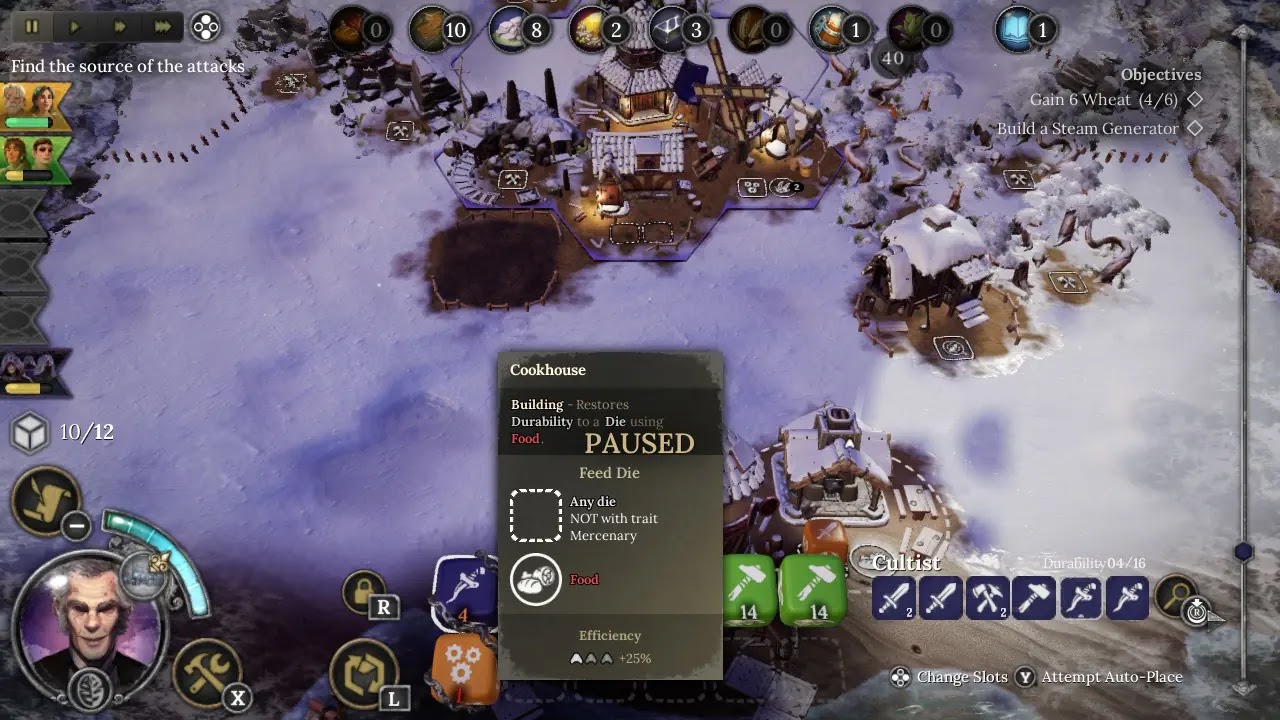
The next immediately visible addition to the game is a new leader - the Vicar - who begins with and uses a new class of dice, the cultist. Cultists are a fairly aggressive class of dice with plenty of attack options, but they also gain a new tech tree oriented around sacrificing one die to empower others. In addition, Cultists enable new options for ways to interact with encampments you find during your exploration, for good or ill. This of course also means that the player now has another dice class to balance the approval of, play politics with, and generally have even more options on how you want to approach your game.

Overall, the new game setup options resolve a number of issues I had with the game at original release. One big pet peeve remained front and center during my time with Dice Legacy: Corrupted Fates, however - UI clutter. Dice Legacy: Corrupted Fates does its very best to support players with a plethora of tool tips that pop up when your cursor passes over each building, and to an extent this is helpful in how it shows exactly which die faces and resources are needed to operate a structure. When faced with the small screen area of the Nintendo Switch in handheld mode, however, these tooltips quickly transformed from being a boon to a persistent irritant.


The game centers around quick and efficient manipulation of the dice shown in the ‘tray’ in the bottom center of the screen, so this is a critical item to always be able to see. Dice Legacy: Corrupted Fates' tooltips pop into existence in front of this UI, blocking off the player’s ability to see their dice and effectively use them. The easy solution would be to make the tooltips slide “under” the die tray UI element.

Instead, these tooltips have remained “over” the die tray UI element both in the original release and the Dice Legacy: Corrupted Fates DLC.  The only way to restore visual access to the UI is to scroll the world map around so that the building’s pop-out tooltip is slid out of the way. This can be a potentially fatal time sink when playing the “as intended” original unpausable game, and remains highly annoying even in game modes where pausing is possible.

Dice Legacy: Corrupted Fates also adds a new game mode, playable after progressing a sufficient distance into the basic campaign. This mode allows players to turn the tables and play from the perspective of the “Others”, offering new story and exploration options. This is a common trope for games for the solid reason that it lets players see an alternate perspective. Dice Legacy: Corrupted Fates uses this for that very reason, and players will appreciate the new viewpoint. As this is the marquee feature of the DLC’s campaign, however, I won’t go into much detail of the revealed story here, however, for fear of ruining the exploration of it for players.

 Summary

Dice Legacy: Corrupted Fates provides a good balance of new and updated features and additional content for the price point it has launched at. Extra game options address criticisms of the base game for being somewhat stressful as the campaign progresses, and the addition of a new dice class can make even the original campaign play differently this time through. Additional leader and political options further refresh the title, making this DLC a solid addition for players who enjoyed the original game.

Score: 8.5 / 10

Share:

Dice Legacy - Switch Review


Dice Legacy
by developer DESTINYbit and publishers RavenscourtNintendo Switch review written by Hayden with a copy provided by the publisher.

Estimated reading time: 9 minutes


When I started up Dice Legacy with a long history of city builders and colony management games behind me, I thought I was in for another rehash of the same old tropes – build some structures, grow your population, research everything you can, and play the micromanagement game in balancing production to consumption. It quickly became apparent that while those elements are perhaps unavoidably present, Dice Legacy has put a unique and memorable spin on them that kept me off balance and rendered previous experience with city builders irrelevant. There are two elements that Dice Legacy brings us that really stand out from the crowd and make this a game worth buying: action control via dice, and a world that feels reminiscent of a 2d side-scroller while maintaining 3d-like artwork.

In Dice Legacy, the population is represented by classic six-sided dice, each face of which enables it to perform a given type of task. Icons for construction, harvesting, combat, exploration, research and others vary in their type and frequency depending on what type of citizens you have, and only the “top” face when the rolled is usable. The player seems to be hard limited to a maximum of 12 dice in their available-for-assignment tray at a given time, although it is possible to have a greater population than this if you can react fast enough that only 12 are awaiting reassignment at any given moment. React too slowly, and any dice past 12 that try to return to the tray are irrevocably lost – potentially a pricey mistake as higher-tier dice can represent a significant investment.

If the dice faces simply allowed the player to assign that die permanently to a job, we would be back near classic city-builder territory, but here in Dice Legacy these assignments only last for a single action/production cycle. After being used, the die returns to the assignment tray and must be rerolled before it can be used again. The result of this is a situation where the player can’t really plan far ahead – if you need more food or lumber or stone to do something, you just have to hope that your next roll gives you the die faces you need to perform those actions. If you don’t get them, you’ll need to either change your plans on the fly and do whatever you can with what you did get, or reroll your dice – but every reroll brings the dice a step closer to death, so spamming rerolls to get a particular face brings risks and challenges of its own!

The second element that Dice Legacy uses to stand out from the crowd is a world that feels in many respects like a 2d side-scroller. The world map is formed like a ring, with the playing space being on the inside face. Width is quite limited, so you’ll constantly be scrolling “up” and “down” to move through your city, expand your borders and react to the events that the game frequently tosses your way. From bandit invasions that require specific combat-faced dice to repel, to freezing temperature, sickness and unhappiness that you favored one die type over another, Dice Legacy doesn’t really give you time to rest.

Did I mention that this city builder is very RTS-styled? Every action in Dice Legacy takes a certain amount of time – usually less than a minute, and often less than 30 seconds. Events have timers as well, and if the player doesn’t react in time – with the correct die-face action – there can be repercussions like lost resources or destroyed buildings. At the outset of the game when the player is handling only half a dozen dice in a limited area, this feels easily manageable and there are enough times when all the dice are assigned that you can free a hand to grab a drink. By the time you’re an hour into the game with a full tray of twelve dice, the pace feels anything but relaxed as you struggle to keep all the dice working across an expanding city area while bouncing between events that beset your borders!

Visually, Dice Legacy has made good use of contrasting colors and simple, clear iconography that makes the user interface easy to understand, even when playing on the small screen of the Nintendo Switch when used as a handheld. The buildings are visually distinct enough from each other that the player can quickly learn which is which, and there are button reminders on all UI elements in case you forget what does what. If there is a downside here, it is that in making the UI large and clear it can at times feel like it has taken up too much of the play area. Tooltips pop up every time the cursor passes over one of your buildings, and between the UI scale and the size of the tooltips I felt like I was fighting to see what I was doing at times, especially as the city developed and I had multiple buildings in close proximity to each other. While an option to adjust the UI scale manually (or an automatic adjustment when docked) would probably resolve the issue, this wasn’t listed in the game menus on the Nintendo Switch client at review time.

Sound design in the game is also very nicely done, and woven so well into the experience that it simply becomes part of the play experience. Music and the ambient soundscape blend pretty seamlessly, and have enough variety that you won’t find yourself hearing the same few musical phrases over and over. That said, if you’re a fan of hearing catchphrases or humorous reactions when you repeatedly click on your minions, you won’t find it here.

Summary

Overall, Dice Legacy is a very fresh and creative entry in a genre that can often feel like every game is just a reskin of another. The use of dice to randomize the actions available and the steady pace of external events changes this from a game of long-term strategy to one of improvisation and reaction. Clean, visually appealing art style wars with a slightly too large UI scale that can obscure much of the play area. Great for people who like to think on their feet and maintain a decent rate of action and excitement for extended periods. Not an at-your-own pace city builder like Cities: Skylines or other descendants of SimCities, however, so look elsewhere if you’re after a quiet, relaxing time.

Score: 8.5 / 10


Share:

Random posts

Our Streamers

Susan "Jagtress" N.


S.M. Carrière

Aldren


Affiliates

JenEricDesigns – Coffee that ships to the US and Canada

JenEricDesigns – Coffee that ships to the US and Canada
Light, Medium and Dark Roast Coffee available.

Blog Archive

Labels