• Culdcept the First - Xbox Review

    Culdcept the First (also attributed as Culdcept the First Saturn Tribute) is a very fun game, that does show its age. This is basically a re-issue of the 1997 Sega Saturn game that mashes together deckbuilding (think Magic: The Gathering) and boardgames (such as Monopoly).

  • NBA 2K27 - PlayStation 5 Review

    With these annual seasonal renewals of the sports season comes the related video games as well, and the question reviewers such as myself always face is this: Is this year’s game worth purchasing one year after the last one? My answer? Yes, absolutely. NBA fans are going to almost certainly enjoy NBA 2K27.

  • Midnight Moments - PC Steam Review

    Midnight Moments is a cozy cyberpunk diorama-building game that is stunning. Unlike games that require you to complete quests or take out assailants or even solve challenging puzzles, this one only requires one thing: imagination.

  • Isle of Reveries - PC Review

    Isle of Reveries is a top down 2D action adventure game that made my nostalgia for old school Zelda games flare up really hard. A good blending of puzzle, exploration, and combat, Isle of Reveries is a wonderful title to experience inside and out.

  • Outbound - PC Review

    Let me tell you about this cozy game my daughter and I are playing together called Outbound. Now, I've been following this game from the initial Kickstarter back in April 2025 to its full release in May 2026. The best Mother's Day gift for myself and my first ever collector's edition in a physical copy!

  • OVER REQUIEMZ - Nintendo Switch Review

    In OVER REQUIEMZ Yuhiru is thrown into the castle of Oz and is immediately accused of trying to assassinate the King and shoved into the dungeon. Not only is she treated like a criminal...

  • Dread Delusion - Xbox Series X|S Review

    Today we’re looking at what has rapidly become an absolute favorite in the open-world RPG genre for me. An interesting story, memorable NPCs, stunning visuals, and a setting absolutely dripping with flavor, Dread Delusion sets its tone immediately and sticks with it.

  • NHL 27 - PS5 Review

    ...and I have been playing NHL games since. It didn't matter whether it was EA or another game like 2K in the 2000s; I loved hockey games and still do, but is NHL 27 a step in the right direction?

  • Asdivine Knot - PS5 Review

    Asdivine Knot is the latest title in the Kemco JRPG library. Following protagonist Verselio, who's on the run from the church that they once served, he'll be accompanied by an odd selection of party members as they all find a reason to band together…

  • STEINS;GATE RE:BOOT - PC Review

    Our story begins in Akihabra, Tokyo Japan. The protagonist Okarin… Or rather Rintaro Okabe, (Voiced by Mamoru Minyano) is a recent high school graduate who rents an apartment with his best friend and resident computer hacker, Itaru ‘Daru’ Hashida (Voiced by Tomokazu Seki) during the summer of 2010.

Showing posts with label Retro Reflections. Show all posts

The Stanley Parable - Retro Reflections

The Stanley Parable by developer Galactic Cafe and publishers Galactic Cafe, Kiel Software—PC retro reflection written by Hamza.

Estimated reading time: 5 minutes


This game tells the story of Employee 427: a seemingly nondescript 9-to-5 office worker consigned to pushing random buttons in a small room at an office that is disturbingly labyrinthine, infinitely complex, and seemingly multiversal. One day, Employee 427 wakes up from his thankless job only to find all of his co-workers missing. Even his boss is gone, as he shortly discovers. He is then thrown into a series of surreal encounters of Kafkaesque and Orwellian proportions. This is the story of a man named Stanley.

Choice. Free will. Determinism. Control. Destiny. These are the topics that have befuddled mankind since Day 1 of our blue marble's history. When man learned to make music, he populated these curiosities alongside treble and bass clefs. When man learned the art of film, he made countless movies arguing and debating these conundrums; and when man learned how to push pixels around, he started to push these issues along with them, too. These topics, as well as more moral and philosophical themes, are continuously being tackled by contemporary games—the Modern Warfare arc of Call of Duty are good examples of this, as are the Army of Two and 3D Grand Theft Auto.

2011's The Stanley Parable is not a second coming so much as a satirical look into the concept and psychology of video games—though it does possess an identical layer of intricate, compelling narrative. This is a game that breaks the fourth wall more than Deadpool and confuses and confounds the player more than Face/Off and The Usual Suspects combined. By the end of a single playthrough, your perception of what is real and what is not will be forever shattered.


Played from a first-person perspective, The Stanley Parable starts with the titular character finding himself suddenly all alone in his workplace. His extraordinary, multi-faceted journeys begin from his room: 427. Every time a possible ending is reached, or when the Narrator resets the game, the player is transported right back to this room. Although it seems like a normal office building, it is gradually revealed to be alien in nature—possibly a puppet theater prop for a deep-shadow conspiracy. Or is it? Is it really linked to a parallel universe? Is Stanley such a vivid daydreamer and fantasist that everything is literally coming true for him? Or is the ubiquitous and acerbic Narrator (who may or may not be Stanley's boss, or—gasp—Stanley himself!) some sort of Silent Hill-esque personification tormenting the mute protagonist?

These theories, crazy as they sound, are both true and untrue. You see, this game has multiple, non-linear endings, and they can be unlocked in any order. A few of them end on a positive (albeit somewhat ambiguous) note, while others are less than happy. One possible ending will literally drive you insane, requiring you to save a cardboard cutout image of a baby and a puppy from a real fire for four straight hours. I could not make this up if I tried. If you somehow manage to accomplish that (may God rest your soul), you get an "I love you" message that I am pretty sure you will leave unread, as your mind will probably have melted like a fried egg by then!


The true beauty of The Stanley Parable, however, lies in the excellent narration by Kevan Brighting. They say anything uttered in an English accent becomes important in tone and automatically more believable than a news headline reading "Scientists have discovered..."—and here, this maxim has never been truer. Mr. Brighting's exceptionally brilliant voice carries just the right amount of cold sarcasm and mentor-like warmth. He is both your guiding ally and a slightly cruel observer who taunts you. In short, the relationship between Stanley (and, by extension, you) and the Narrator works like that of a test subject and an analyst in some grand psychological experiment. Beyond this, the narration is truly impeccable. Everything—from a small quip to a minute-long monologue—is fantastic to listen to. Standing in one place for an extended period just to hear a well-delivered line of sarcasm is worth every single second of being idle.

Before I played The Stanley Parable, I had always thought of it as a puzzle game. I was expecting complex, esoteric puzzles—you know, brain-twisting stuff. Funnily enough, for a clever title with smart commentary and intelligent design, this game contains absolutely no puzzles, nor any Half-Life 2-type interactive actions like pulling switches or connecting wires. Well, it does have you pushing buttons, but not in the same context, and definitely not with a puzzle design in mind. Seeing how the game turned out, I am rather glad it has no puzzles.

The production value is also impressive. I played the HD version, and I have to say: it is among the most attractive-looking games I've had the pixel-pleasure of experiencing on the PC. The office looks simply gorgeous, with the boss's room full of sexy glamour. The chamber full of TV screens is breathtaking, instantly reminding you of Cerebro from the X-Men films. In fact, virtually every accessible area drips with gorgeousness like oil from a frying pan. The museum is not just the highlight of the game, but one of those rare places in a video game that I desperately want to visit, if only for the architecture. It is simply too beautiful to describe in simple words, so I will just say what reviewers like to say most: "experience it for yourself," and leave it at that. You just have to turn left at the "Escape" sign. Easy.


In conclusion, The Stanley Parable is one of those rare games that you always hear about but seldom encounter. It is one of those experiences that forbids you from playing other games for a long, long time because of its addictive and demanding quality. It is a game that will stay with you forever. It rubs its magic on you—the rare kind. And anytime you should encounter a set of two doors, the prospect of taking the right one will be very compelling. Even if it means coming home to a mannequin that sounds like your significant other. 


Share:

Depth Dwellers - Retro Reflections


Depth Dwellers by developer and publisher Trisoft—MS-DOS retro reflection written by Hamza.

Estimated reading time: 3 minutes 


To describe it in one line, Depth Dwellers is a massive eyesore. Back in '94, when id Software released their magnum opus, Doom, suddenly everyone wanted to hop on the new wagon that had driven into town and create a Doom-clone of their own. Some achieved success, others not so much—and this game is decidedly the latter.

Attacking you head-on with spelling mistakes and a story no one bothered to read, Depth Dwellers starts off just like any other shooter. You begin in a room, wondering how you got there, and—blast!—you get killed by the very first enemy you encounter, in this case, the one on your right. The POV is first-person, naturally, but it is so heavily zoomed in that it feels as if you are playing through a fishbowl or a magnifying glass. The level designs are mediocre at best, confusing at their absolute worst, and completely uninspiring. I mean, Zork has better mazes than this. Did I just commit social suicide by mentioning a legendary classic in a review of a mediocre game such as this?


If it took you 20 minutes to finish the first level and you only got lost about 151 times, then yes, you're actually playing it correctly—because you were playing it "normally," the way you would play any other game. Apparently, Depth Dwellers calls for something else entirely, and what that is, I do not want to know.

However, not every aspect of Depth Dwellers is legendarily bad, no matter the impression it might give you. The music, for example, is pretty good. The same short, ambiguous track keeps looping in the background; and though it doesn't fit the overall violence and horror theme of the game at all, if you were to take it independently, the music is quite nice. The other redeeming factor is how Depth Dwellers excels at capturing a horrific, dread-forsaken atmosphere. This is evident the second you are thrown into the game.


The ominous moans of tortured prisoners that occasionally break the moody silence, coupled with the use of muted, dull colors like black, brown, and grey, all contribute to a memorable horror setting... but unfortunately, the execution just isn't strong. Thus, Depth Dwellers falls short of both playability and likability. It had the time to gather its resources, but not the common sense to use them correctly or in the way intended.

In short, as one of the earliest Doom-clones from before the genre even got a proper name, Depth Dwellers should have succeeded where it utterly failed, but it so happened that it utterly failed where it should have succeeded. It became such a massive eyesore that one can rightly call it the Bubsy 3D of the FPS genre.

Note: Screenshots from all platforms that were available at the time can be found here at Moby Games.  


Share:

Rise of the Triad - Retro Reflections


Rise of the Triad by developer and publisher Apogee Software—MS-DOS retro reflection written by Hamza.

Estimated reading time: 4 minutes 


Apogee. Gosh darn it, modern gaming culture will never understand the thrill of booting up a computer, typing an Apogee game's executable into MS-DOS, and seeing that logo fly across the screen with the immortal tagline, "Apogee means action." Damn right! Apogee may have fallen out of style and recognition lately, but their 3D Realms banner is still flying high, responsible for the first two Max Payne games, Prey, and the ill-fated Duke Nukem Forever.

Having grown up playing Apogee games, the company holds a soft spot in my heart and will forever remain one of my many gaming heroes—even if their games aren't exactly ultra-classics, barring Duke Nukem 3D and Rise of the Triad. Despite lacking a consistent one-two punch, several of their games are indeed highly enjoyable, such as the side-scrollers Bio-Menace and Monster Bash. Rise of the Triad was not only the first Apogee game I ever played, but it was also my very first exposure to first-person shooters. That's right, my interest and morbid addiction to all things FPS originated here. ROTT FTW!


Right from their inception, Apogee dabbled in the silly and absurd; with ROTT, they waded deep into surrealism—an unprecedented feat in a then-infant genre that had no guarantee of becoming the next big thing. With id Software being deathly serious about their titles, it is safe to say Apogee brought much-needed humor to the genre. It consists of Shadow Warrior (a parody of Eastern martial arts movies), Duke Nukem 3D (a parody of over-the-top action films), Rise of the Triad (a parody of violent gangster movies), and Blood (a parody of horror films, mostly cheap B-movies). At their heyday, these four were true rivals to id Software, but now they exist solely to provide old-school, over-the-top, violent action for those curious and brave enough to dive headfirst into an era that wasn't yet filled to the brim with dime-a-dozen WWII shooters.

Rise of the Triad follows a strict rule of exciting gameplay and fast, gun-toting action. Mere seconds into the game, you are handed a heat-seeker. After depleting that sweet carrier of carnage, you switch back to your primary weapon—a handgun with unlimited ammo. You never have an excuse for running around wide-eyed trying to find extra bullets. Although it is the weakest weapon, the mere fact that it is bottomless makes it beyond awesome.

One major crutch that has permeated a great many FPSs is the god-mode cheat. Those scared stiff by a Cyberdemon's haunting footsteps to the point they couldn't move have had no choice but to jam in the now-legendary IDDQD code. Those unlucky enough to be prancing down SHODAN's corridors with a sweaty complexion also had no option but to grant themselves invulnerability to protect against her "creations." However, in ROTT, god-mode is neither a cheat nor an unlockable; it is an actual, glorified, free-of-cost power-up weapon. Like I said before, ROTT is crazy and anything goes. With your godly powers, you can smite your foes and mash them down into gory giblets.


If you think that isn't crazy enough, take a bite of this: you get to play as a dog. Once again, your eyes do not deceive you. Getting to play as a hound in this hilarious, gory, and surreal romp is the wackiest concept I have seen since the playable killer rat option in Die Hard: Viva Las Vegas, where John McClane and his enemies are oversized rodents. Though the dog plays only slightly differently than its human counterparts, it possesses the incredibly cool ability to kill foes just by barking at them. Excluding the games by ShinyEntertainment, very few games on the market present themselves as this silly and actually relish in it. ROTT is one of them, and the man to thank is none other than Tom Hall.

As one of the chief founders of id Software, Hall was responsible for some of the company's biggest breakthroughs, including Wolfenstein 3D, Doom, and the immensely likable Commander Keen games. He is also the creator of the iconic Dopefish—the unofficial mascot of pre-success id Software. Due to creative differences, he left id Software and joined Apogee, serving as a designer for Rise of the Triad. Though not his absolute best industry contribution (that honor goes to Anachronox), it remains one of his creative high points. Here, he was able to exercise his wildest and craziest ideas. With two creative forces like Tom Hall and Apogee working together, ROTT was bound to be ultra-wacky and insane. And boy, was it ever.

In conclusion, Rise of the Triad is a definite must-try for fans of the genre. As one of my ultimate gaming guilty pleasures, ROTT remains completely satisfying until it wears out its welcome, and engaging for as long as you, the player, decide to call it quits. Don't let its dated, sometimes embarrassing looks deceive you; it is a great shooter. And delightfully gory, too.


Note: Screenshots from all platforms that were available at the time can be found here at Moby Games. 


Share:

Twisted Metal 2 - Retro Reflections

Twisted Metal 2 by developer SingleTrac and publisher Sony Computer Entertainment—PC retro reflection written by Hamza.

Estimated reading time: 4 minutes 


David Jaffe has always been the man for chaos and destruction. Before he swept the world and put his name firmly on the video gaming map with God of War and its sequel, he was known as the genius behind Twisted Metal. Simply put, Twisted Metal is Unreal Tournament with vehicles. The first title in the series has aged considerably — though with dignity — and remains a classic of the vehicular combat genre, so much so that it's often the first name to roll off the tongue at any mention of it. But it is perhaps Twisted Metal 2 that is most fondly remembered by fans of the series. What makes this installment more attractive is straightforward: whatever problems and limitations were present in the original have been rectified in the sequel. There is more to destroy, more space to roam freely, and an unprecedented sense of openness that is almost too vast to take in all at once. The graphics, too, are a step up — sitting snugly somewhere between comic-style and cel-shading. The signature humour is intact, as is the wacky, often punishing gameplay. In short, David Jaffe delivered a sequel that stayed true to everything Twisted Metal had proven itself to be. All he did was turn the power up to 11.


The core of the game is engaging in a twisted version of destruction derby and being the last driver standing — or rather, still driving. The backstory goes something like this: following a tragic accident that cost him his wife and daughter, Calypso — in true Shao Kahn and Heihachi Mishima fashion — established an annual tournament called Twisted Metal, where head-to-head competition is taken almost too literally. From a roster of rough-and-tough drivers, you select your particular maniac of mayhem and enter tournaments across arenas that range from farm fields and snow-capped mountains to the depths of Hell itself. Scattered throughout each arena are power-ups and upgrades to use to your advantage, allowing you to dispatch your enemies with greater efficiency. Your primary weapon is a sub-machine gun with infinite ammo — your most reliable companion in the arena — though it quickly becomes a tired old workhorse once the rocket launchers and other ballistic weapons enter the picture.

The standout feature of every Twisted Metal game is the vehicles. Inventive and iconic in their own right, they resemble a cross between Hot Wheels and Carmageddon, but stripped of the grandeur and fitted instead with mounted weapons. The series' most iconic vehicle — Sweet Tooth, the ice cream truck — is sadly absent from this entry and can only be unlocked via a cheat code. Its exclusion is somewhat compensated for, however, by the introduction of two new vehicles: Twister and Axel. The former boasts a hurricane special move that can pull you out of tight spots while also serving as a formidable offensive weapon when things get too hot. The latter is a two-wheeled contraption with the driver positioned in the middle — think of it as a Segway fitted with monster truck wheels. In my opinion, Twister and Outlaw 2 — an LAPD police car — are the two best choices for newcomers, being quick and sturdy enough for the player to get real mileage out of them early on.


Regrettably, the game loses its momentum all too quickly. By the third arena, you're all but fed up. It is only the trademark darkly humorous endings that keep the player going through at least one full playthrough. Playing with different vehicles, uncovering their weaknesses and unleashing your own strengths is fun and engaging the first time around, but on a second run the fun is steadily consumed by repetition.

In conclusion, though the series has seen a fair amount of tweaking and improvement over the years, it is the original two entries that still stand out as the best — with Twisted Metal 2 being arguably the most balanced in terms of exciting gameplay, satisfying combat and good old-fashioned fun.


Note: Screenshots from all platforms that were available at the time can be found here at Moby Games.

Share:

Fantasy World Dizzy - Retro Reflections

Fantasy World Dizzy by developer The Oliver Twins and publisher Codemasters—PC retro reflection written by Hamza. Game release year 1989.

Estimated reading time: 6 minutes


If there is one forgotten video game character who deserves a solid comeback (besides Alex Kidd), it has to be Dizzy. The main protagonist of an excellent series that saw its greatest success in the home computer market. Each and every title is an enduring classic — as challenging as it is an absolute blast to play through. Developed by The Oliver Twins and published by Codemasters in their humble early years, the Dizzy series was one of Europe's most well-known and profitable properties. As is the case with all great video game series, it took a couple of titles to get the format right and establish the blueprint for subsequent installments. Fantasy World Dizzy — the third entry in the series — was that template-defining title upon which most future Dizzy games were built.

A sleeper hit upon its release in 1989, the C64, Amstrad CPC and ZX Spectrum versions of Fantasy World Dizzy quickly became popular among gamers. Although the Spectrum version is the most well-known (and the first result that comes up when you search for it), the slightly lesser-known MS-DOS version is perhaps the prettiest and most robust iteration of the game. To justify that claim with a direct comparison: the Dizzy that appears in the MS-DOS version has far more detail than his Speccy counterpart. Rather than a plain oval white shape with round limbs, this Dizzy is clad in a fedora hat, red boots and red gloves — all of which give him a distinct personality. The rest of the cast is equally detailed and better animated. Speaking of which, the rat that greets you in the opening level has an actual walking animation that is decidedly superior to its Speccy equivalent, which — in all honesty — moves and looks like a Roomba.


The comparisons don't begin and end with animations and sprite detail: the graphics are also superior in the MS-DOS version. The colours are brighter, the game looks vibrant, and even the background — black in all other versions — receives a pleasant makeover in a nice shade of blue. The only fault this version is guilty of is its complete lack of music. Playing without any music at all makes for a lonely experience, but at least the few sound effects that are present — a jump here, a coin pickup there — are quite memorable and keep you from dwelling on the absence for too long.

The story of Fantasy World Dizzy follows Daisy — the protagonist's beloved — who has been "eggnapped" (as Dizzy puts it) by the evil King Troll. Naturally, you set off on an adventure to rescue her, braving peril and puzzles along the way, meeting the Yolkfolk, and collecting 30 coins that later play a crucial role in the gameplay. This game marked the debut of Dizzy's kin: the Yolkfolk — namely Daisy, Denzil, Dozy, Dylan and Grand-Dizzy — whose names allude to their respective personalities. Dylan, for instance, is a hippie clearly inspired — as evidenced by his name, his ever-present headband and his off-kilter trance — by the typical Flower Power participant of the 1960s. Dozy's naming, on the other hand, is far less subtle and probably needs no explanation. The distinct personalities given to each character, greatly accentuated by the never-failing British humour and the detailed sprites, lend the game a unique flavour that sets it apart from most of its contemporaries. Even today, more than two decades on, Fantasy World Dizzy feels alive and active — despite its minimal dialogue and small cast.


The gameplay strikes a wonderful balance between puzzle-solving and hazard-evading. Most games of this type tip the scales in one direction and gradually downplay the other — sometimes neglecting both by the time the credits roll. This game does neither, balancing things perfectly to deliver the best of both worlds. The puzzles aren't always logical, but they do require strategy if you're to solve them successfully. For example, the game initially allows you to carry three items at once. You must decide which items to bring in order to progress through a current puzzle, and which to leave behind for use in later ones. Since you can drop an item anywhere, thoughtful placement allows for easy retrieval when the time comes. An upgrade midway through the game increases your carrying capacity to four items — but by that point, you're so accustomed to managing your inventory strategically that the upgrade actually undermines a neat game mechanic. That said, this is a fairly minor gripe and not everyone will share it. On the whole, the inventory system is solid and well-implemented, with everything working as it should and no ambiguity whatsoever.

That is, until you collect the four golden keys. A rather interesting elevator puzzle near the end of the game requires you to locate the keys and use them on controls to activate several elevators. On paper, this sounds laughably straightforward — and it is. What makes it irritating in practice, however, is that each key corresponds to a specific control and cannot be used arbitrarily. Since neither the controls nor the keys have any distinguishing markings, you are left trying every key on every control until you land on the right combination, which quickly becomes frustrating. The remaining puzzles, thankfully, are well-designed and easy to understand.


Now we come to the difficulty. Make no mistake: Fantasy World Dizzy is one of the most unforgiving games ever made. It employs a one-hit kill system, which means you'll be dying often if you're not exceptionally careful. With only three lives at your disposal, losing all of them sends you back to the very start — so vigilance is strongly advised. If the difficulty proves too much, there is a handy trick to ease the burden: accumulate at least 10,000 points (which is simple enough) and then lose all your lives. When prompted to enter your name, type IMMORTAL, and unlimited lives are yours.

In conclusion, Fantasy World Dizzy — despite its difficulty and lack of music — is a game remarkably free of major faults. I would go as far as to call it one of the most complete games ever made. It offers great, addictive gameplay that encourages you to return to it time and again. While the game and its character may not be as fondly remembered by the casual public as Mario or Sonic, its distinct humour and fiendishly addictive gameplay make for a very eggcellent — pardon the pun — alternative.

Note: Screenshots from all platforms that were available at the time can be found here at Moby Games.


Share:

Retro Reflections - Warhammer 40,000: Space Marine

Warhammer 40,000: Space Marine by developer Relic Entertainment and publisher THQ—PC retro reflection written by Hamza. Game release year 2011.

Estimated reading time: 9 minutes


Armed with a Combat Knife and Bolt Pistol, and adorned to the neck in sexy blue Power Armour, our hero of the day is Captain Titus, alongside his brave squad of one pessimist and one gung-ho. This motley trio must brave peril—which happens to be an Ork invasion—and save the world (or the universe, even) from unspeakable destruction and possible extinction. This plot and its variants have been done to death in all their glory and stagnation in a dime-a-dozen games, so much so that the mere whisper of "invasion" or "tough heroes" is enough to elicit a series of frustrated moans from gamers and critics alike. Though many have taken different approaches to this gaming trope—ranging from subtle to not-so-subtle—few have actually succeeded in making their creations unique or different.

For example, a developer might introduce an unprecedented game mechanic, or perhaps downsize or blow up an already existing feature, culminating in an experience worthy of going through at least once. Relic Entertainment did exactly that; they blew up the one quality of hack 'n' slash games that matters most—a copious amount of gore and creative death executions—amped it up to 11, and presented a devastatingly entertaining, masochistic, and challenging game. While it bears a strong resemblance to other shooters in terms of story, it is strictly Warhammer 40,000: Space Marine in terms of intense violence, bad-assery, and robust controls. Simply put: Space Marine is the God of War experience I've always wanted on the PC!

Space Marine starts off in a very typical manner: you are responding to a threat because, apparently, the last line of defense and everyone's hope is you. With your armory and squad's status in check, you bravely plunge into the eye of the storm, putting your foot so far up your enemies' asses that they not only become numb, but cease to be asses. While you start armed with relatively weak weapons and the initial enemies are easy one-shot kills, jaded players know that in games like this, everything gets progressively buffed up. What they aren't able to predict, however, is how fast or slow it takes for that to happen. Needless to say, in Space Marine, the transition happens rather quickly, and you go from a general waste-layer to a crater-maker in a matter of minutes.

As soon as you get off the spaceship and reunite with your squad members, a weapon portal (a recurring object in the game) grants you a chainsword. This melee weapon is exactly what the name implies and is easily one of the coolest, bloodiest weapons you get in the game due to its carnage effectiveness and combos. Just as the game hands you a shiny new toy to lay waste with, it conjures a Slugga Nob into the tiny battlefield, perfectly balancing out the two ends of the spectrum. A Slugga Nob is a huge barbarian akin to the greenskin seen on the cover of Cyanide's 2009 fantasy football game, Blood Bowl (which just happens to be a Warhammer spin-off). If you are a newbie, your first few rounds with this new bad boy won't be easy, but after a few tries, you will get the hang of it.

If this generic approach to battling larger specimens is starting to turn you off, do yourself a favor and don't let it. The enemy A.I. is surprisingly smart; they will evade your attacks and take cover if things get too hot. Granted, the smaller greenskins brainlessly sprint in your general direction like pigs excited to get slaughtered, but the bigger ones act almost as a mirror to you and your squad—so taking them out, for the most part, won't be a cinch. I found this welcoming as it gave me a reason to frequently change my weapon to better suit the mannerisms of the enemy. The game also features a loosely executed interactive environment, in the sense that you can shoot flammable canisters (red barrels, basically) and pipe systems to trigger explosions. I hesitate to use the term "destructible environment" because you don't get the option to turn the battlefield layout to your favor, which, in a game like this, could have been an awesome mechanic.

The battles themselves, although starting off nicely and with hints of something new, more or less transition into generic, everyday fights. The purpose of the battles varies slightly, as does the buildup of the momentum, but the premise thoroughly remains the same: a handful of guys against a massive army of greenskins. Sometimes you're left to venture alone for a while while your squad members escort a side character, leaving you more vulnerable and sensitive to greenskin attacks. It is in these "el solo lobo" moments that I found the perfect opportunity to test out my latest acquired purity seal or melee weapon.

Speaking of purity seals and weapons, they aren't exactly original or unlike anything you've ever seen before. But they are, however, executed much better than most. Take the main weapons for example—after a few missions into the game, you get to carry four weapons in your inventory. The first one will be a relatively weak and small weapon with minimal damage power, but it has the advantage of infinite ammo. The second weapon from the primary group was perhaps the most ridiculously overpowered gun of the bunch, and it often emerged as the best choice throughout the campaign mode. At least for me it did. The third and fourth secondary weapons will mostly consist of one-shot-kill weapons that are heavy on damage but low on reload speed and ammo capacity.

In fact, the Meltagun (arguably one of the most devastating guns acquired in the game) may have the awesome power to stun a Slugga Nob in just one hit and obliterate it in three, but it has severely limited ammo and a lengthy recharge time. This makes it ineffective amid a greenskin horde or when many Shoota Nobz or Rokkit Boyz are around. In the melee weapons department, you get your standard hack 'n' slash paraphernalia specifically designed for head-chopping and gut-slicing. Though they get replaced rather infrequently, your lengthy outings with each of them means you will eventually get to know them, caress them, and love them equally. Parting with one will make you feel as if you're waving goodbye to a loyal subject. It's emotional stuff, and there's nothing we can do about it.

Purity seals are a bit curious, and interesting to boot. Curious in the sense of how eerily identical they operate to the power-ups you get in the God of War games. I guess there should be no surprises there, as some of the crew behind this game had also worked on God of War and apparently Gears of War as well. I just wish the logic and implementation of the purity seals had some originality or distinctive features to them; every time Captain Titus bellowed to the heavens while getting covered in a dark goldenrod aura, the image of Kratos preparing to cook up a violent storm always appeared in my head. Also disappointingly, they only last for a few seconds. Lastly, they are interesting in regard to how out of place they look. Fine, science fiction with a touch of fantasy (alien or not) is always appreciated, but fusing Harry Potter with The Terminator leaves one in confusion, with a "WTF" exclamation hovering above their head. Although it's a minor issue and one that quickly gets forgotten in a short passage of time, it remains a worrisome reminder of the faults of the game.

Which is what, you may ask? For starters, originality in this game is about as long as the word itself, and only goes so far. As mentioned before, several of the crew behind Space Marine were also behind the creation of other (more successful) hack 'n' slash and shooter games, but this shouldn't have been an excuse for getting lazy and stealing from their own previous works. When the legendary team behind the first-person Ultima games (which included Warren Spector and Doug Church) shifted to the making of the original System Shock and Thief, they indeed borrowed several elements from the Ultima games they had worked on, but they also radically changed everything from top to toe so that no two games were alike. And while even a toddler could easily distinguish between Space Marine and, say, God of War, the micro and subtle features mutual to both stick out like a sore thumb! Chief among the other faults are the at-times repetition and the seriously non-existent A.I. of your squad members. When you're up against a horde, try to count how many greenskins your buddies manage to kill. Rarely will it go beyond two, as they take the same amount of time to kill a simple greenskin as it would take you to kill a boss Nob!

The voice-overs are decent enough, with Mark Strong—who portrays Captain Titus—understandably emerging as the clear standout. Strong brings a good sense of a weathered warrior feel to the role, instead of opting to choose the readily available "rough hero" or "always complaining badass" cliché. Titus's loyalty to his code and mission, his seemingly incorruptible nature, and the fact that he doesn't bitch and moan about every negative activity that takes place all made for a character I found more accessible and likable than his snarling, realistic, gear-head counterpart, Marcus Fenix. The latter always whines about the minutiae of things and almost never steps down from being the guy who screams "I didn't sign up for this shit!" whenever faced with something 20 times bigger than him. However, Captain Titus is not a fully developed character and isn't given much of a personality to work with. The little that he is programmed with indeed makes him likable, but also monotonous and slightly one-sided. The rest of the cast, unfortunately, exists only to populate the in-game world with stereotypical characters.

Before gearing up for a relatively dangerous mission or meeting up with a person of interest, a cutscene occurs. While I was expecting them to be average at best, they actually surprised me with their weight and animations. In fact, the animation and facial movement of the character models reminded me of those in Half-Life 2—and I believe this is the best compliment I can give regarding the cutscenes. Where Gears of War emphasized cinematic explosions and slow motion, Space Marine uses its brief cinematic moments to further the story at a steady, brisk pace. While they may be brief and very few and far between, they are well done.

In conclusion, Warhammer 40k: Space Marine is one of the more impressive third-person shooters on the PC. A combination of gory gameplay and rewarding progression, Space Marine is a good example of how maxing out one element of a game can make for a great experience. While it may have its faults and may come off as repetitive for the most part, Space Marine is nevertheless a fun, energetic, on-your-toes hack 'n' slasher that you may perhaps want to revisit!

Note: Screenshots from all platforms that were available at the time can be found here at Moby Games.


Share:

Ultima: Exodus - Retro Reflections

Ultima: Exodus by developers Origin Systems and Newtopia Planning and publisher FCI —Nintendo Entertainment System.

Estimated reading time: 5 minutes


There are two times of the year that tend to get me reflecting on games of old. One is near the end of spring, around my birthday and the other is near Christmas. The connection here should be obvious, as when I was a kid – most of the video games I played were gifted to me during one of those two yearly occasions.

In prior articles, I’ve touched on some of these gifts. Unabashed link-fest coming up, but I still have some strong memories and emotions tied to when I received my Nintendo Entertainment System (and Joust – I’ll have to reminisce on that one soon) from my Uncle Ken for Christmas. That same year my parents got me Elevator Action and Dragon Power as gifts, and my Grandpa Joe and Grandma Bev got me Double Dribble. A few years later, my Grandma Barb picked up Tecmo Basketball for Christmas. Before that my parents had gotten me into gaming with a TI99/4a, and years later my Uncle Ken again came through with the win, giving me a Sega Genesis for my birthday (and a ton of games such as Columns, Altered Beast, Sonic the Hedgehog and an EA golfing game). 

Okay, that was a lot of nostalgia. But when I think of Ultima: Exodus, I get hit pretty hard with nostalgia as well. This wasn’t year one of me having my NES – it was a couple after I received it. This title got released on over a dozen platforms, with some variance in the naming such as Exodus: Ultima III and Ultima III: Exodus, but as it was the first release on the Nintendo Entertainment System, they simply went with the title Ultima: Exodus.

I had never heard of this game, and I’m not entirely sure what inspired my parents to pick it up. I vaguely recall my dad saying that he thought the cover of the box looked interesting and he was well aware that I was a big fan of the fantasy genre. This however, was also my true introduction to the roleplaying genre. Dragon Warrior wouldn’t be too far behind – I wound up borrowing that from a friend a few months after discovering my love for grinding through oodles of turn-based battles. This was well before I was introduced to Dungeons & Dragons or played my first Final Fantasy.

Now, in retrospect, Ultima: Exodus is a pretty flawed but still fun game. I’ve played it in somewhat recent years, and sure – any game release in 1989 is going to struggle when held up to today’s standards more than three decades later. I’m not talking about the graphics and sound (it is surprising how quickly the music tickled the back of my brain, but I logged dozens and dozens of hours with this game back in the day, so that music’s apparently been burned into my brain by now.

But even comparing this game to some of its contemporaries from around the same time, such as the first Dragon Warrior and Final Fantasy titles, Ultima: Exodus just had a lot of rough edges. Several things were poorly explained (somewhat common for the time), leading to a lot of wandering about and happening on to the next steps in the journey. The number scaling was off too, as experience for leveling was far easier to come by than the gold needed to purchase leveling. Those two things feel out of sorts with one another, despite being tied to the same progression system.

Also, the way the world handled levels was a little oddly inconsistent as the overworld scaled with your level but the dungeons were more set to level ranges, leading to an uneven experience if you grind a lot early on. Combat had a sort of weird hit / miss frame thing that was more about timing than the more traditional behind the scenes dice rolling. 

However, there was a flexibility to Ultima: Exodus that felt somewhat ahead of its time as well. Character creation was incredibly flexible compared to similar titles. You had greater control over the way you could interact with characters, with commands to attack, attempt to steal or even bribe NPCs. You could even pick a fight with the king (though you’d lose – he’s indestructible). I did a lot of saving back then – but there were a lot of things that you could try – and screw up. Reviving characters is expensive, which makes the game feel more punitive than most of the era.

It's also worth noting that when you discover the hidden land of Ambrosia, the game opened up in a new and unexpected way, including better character progression. That’s sort of the theme of Ultima: Exodus. It was a dense game with a lot of systems that often were not well explained, and there was precious little handholding done. It’s not one of the hardest NES games in the traditional sense, but a lot of hours and perseverance is needed to see it through to the finale.

In the end, however, for all its foibles, Ultima: Exodus is more than just the game it is – at least to me. It’s another set of memories tied to a Christmas gift from loved ones, and it also introduced me to one of my favorite video game genres ever. I think those things make Ultima: Exodus something far more special.

Article by: Nick

Share:

Double Dribble - Retro Reflections


Double Dribble by developer and publisher Konami—Nintendo Entertainment System retro reflection written by Nick.

Estimated reading time: 4 minutes

Double Dribble represents the first basketball video game I ever played. It was an incredibly basic title too, which is what you’d probably expect from a sports game from the 80’s. As a product of its time, Double Dribble is a serviceable take on the game. It’s traditional five versus five gameplay where you pass, shoot, steal, block and rebound. It covers all of the basics, even if it has few of the frills found in the more modern basketball games.

Now I remember this game incredibly fondly. It was a gift from two of my grandparents the year I got my NES (also a Christmas gift). I guess that would make this a holiday edition of Retro Reflections. Now, I’ve talked about a few of the other games I got to play right off of the bat that year, having received Elevator Action and Dragon Power from my parents as well. I was only just starting to get into sports around this time, most notably basketball and football, and I enjoyed some snowy days off of school learning my way around Double Dribble.

For one, it’s not a licensed product. That leaves us with four teams that are meant to resemble their real-life counterparts without running afoul of the actual NBA. The Double Dribble teams are the Chicago Ox, Los Angeles Breakers, Boston Frogs and New York Eagles. These fictional teams leverage the colors of their real-life counterparts (green for Boston and red for Chicago), but that’s really about as close as we get to the real thing. There’s no recognizable players here, you’re not getting Larry Bird from the Boston team for example. In fact, your players don’t show any distinctive traits at all, and you have no roster or substitution control here. 


The gameplay is similarly simple. That makes it easy to pick up, but the lack of nuance can make things feel a bit finicky as well. You only have two buttons on the old NES controllers, so Konami did what they could with the game. Fouls happen early and often as I figured things out, but once I got the hang of things, I was able to keep that to a minimum. Your AI teammates are pretty erratic as they move around, with little to no rhyme or reason to their on-court movement. But, like the fouling, I learned my way around it and was able to win far more often than not, even at the higher levels of difficulty once I got a feel for things.

The game starts off well enough, with some garbled ‘Double Dribble’ spoken, fans filing into the stadium and a quickly shown anthem to set the stage. From there though, the presentation gets dramatically more spartan. There’s no in-game music, just the sound of a repeatedly bouncing ball and some squeaking sneakers creating a sort of repetitive backdrop that does very little to excite after the first five minutes or so. 

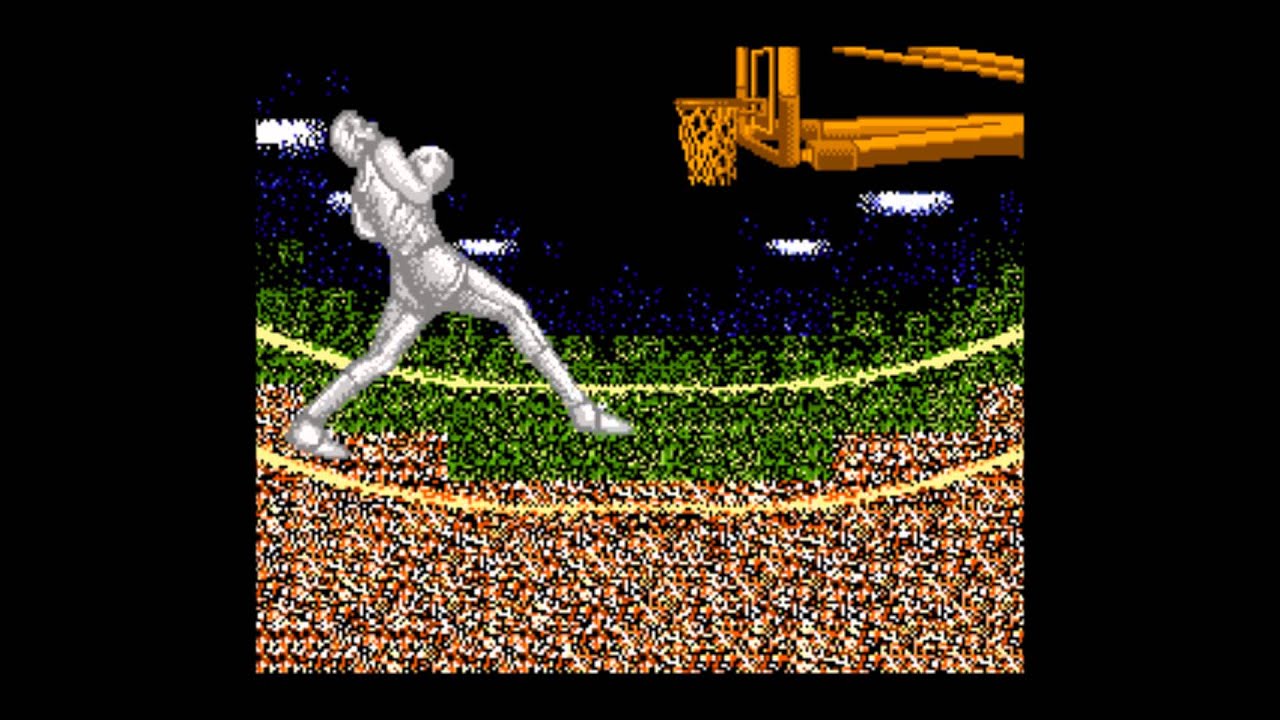
The visuals aren’t a whole lot better, with one exception. The characters look fine given their age, but the arenas are pretty dull and lifeless. Perhaps the worst part of the presentation is that the NES was not known for being able to handle tons of sprites on the screen at once and by having ten total players on the screen, there was a lot of flickering that occurred. The only time Double Dribble’s visuals really come to life is in the sort of close-up cutscene-like dunking animations when you jump close enough to the hoop to trigger one. These look pretty great and add a cinematic touch, though with only a few variations to play out, they can lose their luster after a handful of games. 


Despite all of these flaws, there’s an undeniable charm to Double Dribble. Does it hold up to more modern basketball games? No, not in the least. However, I have some rosy tinted holiday glasses I can put on and comfortably enjoy this title despite it’s flaws. Heck, flaws doesn’t really feel fair to say – but limitations. Double Dribble is a product of its time, and I spent a lot of hours enjoying it. Even if that first night, while the family was gathered around in the living room as I played it, I recall them asking me to turn it off or at least turn down the sound because the sound effects were kind of driving everyone bonkers. I opted to turn down the sound, at least until they all left. Then I turned it back up and went back to enjoying my first sports video game.
Article by: Nick
Share:

End of. N+ - Retro Reflections - TBT


End of. N+ by developers SilverBirch Studios, Metanet Software and publisher Atari—Nintendo DS Throwback Thursday review written by Hamza. 2008.

Estimated reading time: 3 minutes


Not only is N+ difficult, but sarcastic as well. It’s Queen Elizabeth with tight-lipped irony. When you misjudge a jump, fall from a great height, or get struck down by a laser or bullet; the message reads “nice one.” Ported to the handheld, this version, PSP, and console Xbox, from the Adobe flash-powered game, simply titled N, it should not surprise or shock anyone by its feel and touch of an online-game. When you play other games on the aforementioned handhelds and console, they feel ‘real’, genuine – they were made for playing. N+, however, feels like an anti-game, just like how the other online, or casual, games are. You may be offended, o’ reader, but this is the impression they give me.


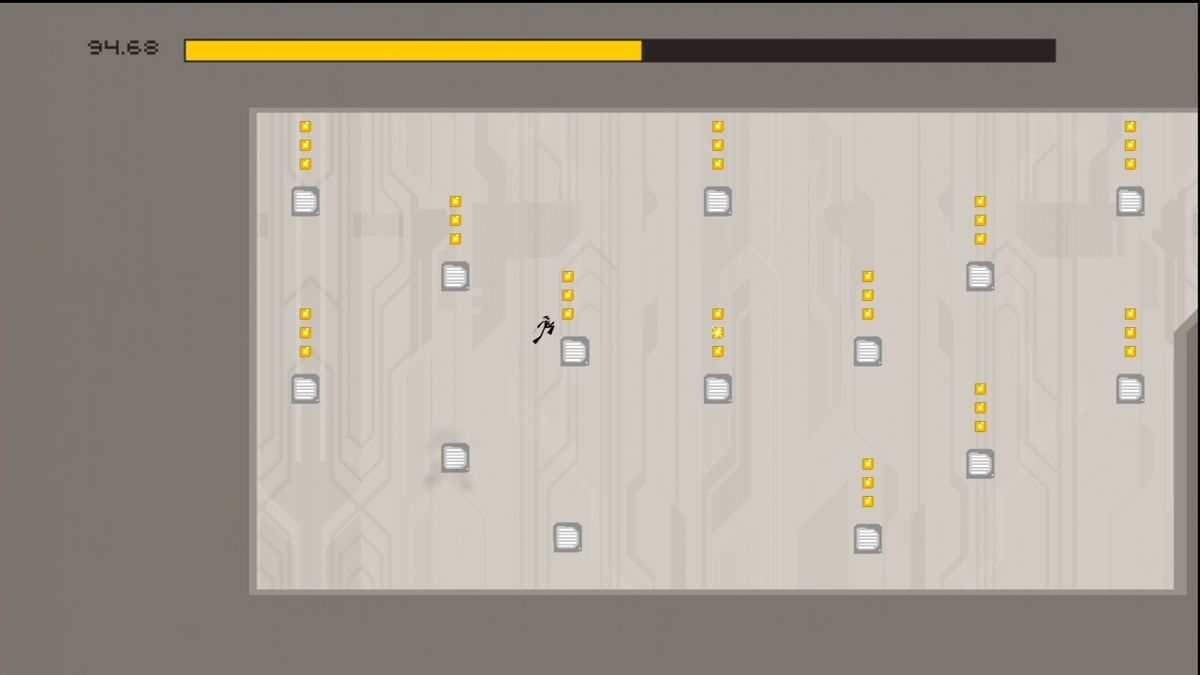
With nary an originality to boast of, N+ has a wickedly simple premise, but a devilishly difficult gameplay. You control a ninja, initially black, but new costumes are unlocked the more you progress. The new costumes don’t bring power-ups or speed, but style and respite from monotony. Your goal is simple; unlock the door and get to it to finish off the level. If this game were that simple, then it would’ve effectively been the opposite of what games are supposed to be about. You see, scattered throughout the levels are pieces of gold and a myth goes that the ninja you control has a short metabolism and a craving for gold. Though this game doesn’t have a timer, the closest it has to one is the ever-decreasing ‘health’ of the ninja. The more gold you collect, the more it will increase. Me thinks someone took the definition of ‘gold fever’ a little too literally.

With parkourmovements, you character can jump very high and scale walls. If Ninja Five-O were a physics-based game, then it would be this. The physics are very loose and the control of the character is very floaty. If you let go of the movement button, the ninja won’t stop immediately, but will slide a little more; just how Mario did in the GBC port of Super Mario Bros. This will result in unfair deaths or a snakes-and-ladders moment. Whether intentional or not, I did not thoroughly enjoy this effect and at many points in the game made me flare up in anger.

As I said before, this game isn’t original and long-time gamers will know it is a mixture of bygone platform and puzzle games, with chances being it was inspired by the names that immediately come to your head. Not that it is a complaint, but since I’d already played similar games with similar difficulty, N+ did not immediately strike a chord with me. Come to think about it now, it still doesn’t altogether strike a chord with me. This game’s other silhouette-heavy and minimal-in-heart cousins, Canabaltand Vector, struck the Hendrix Chord with me.


But I enjoyed what the game offered, and its borderline-intense challenge was a relief to me personally because I had lately been playing easy, casual games. With more than 200 levels and each level having 4 parts, N+ kept me muttering to myself, “just one more try. Just one more”; and though it rewarded me with merely a color change and some new animations, I was satisfied with what I got. Playing N+ was as if I was playing Char Studio’s Flow all over again. Both of these games hardly reward you, but you feel great when you clear a level!
While N+ does take good use of the the handheld’s dual-screen – one shows the action, the other the map – and has enough clever and intricate levels to give even the cast and crew of Inception a run for their money.

This game was indeed fun, and even with added features that come later the more you progress,N+ doesn’t reach to the level of addiction or cool. It’s a fun game, but only just. So, I guess what I’m trying to say isNinja Five-O’s protagonistis still the best ninja on a handheld!


Note: Screenshots from all platforms that were available at the time can be found here at Moby Games.
 

Score: 7.5 / 10

Share:

Meat Boy - Retro Reflections - TBT

Meat Boy by developer and publisher Jonathan Mcentee, Edmund McMillen—Windows PC Throwback Thursday review written by Hamza. 2008.

Estimated reading time: 3 minutes

After watching the excellent Indie Game: the Movie by Swirsky & Pajot, I got a craving for meat... Meat Boy!!! Yea... *sigh*. Anyway, this flash platformer is universally over-shadowed by its more detailed and ‘meaty’ successor Super Meat Boy; and rightly so. This game is traditional platformer in the truest sense but is also unfinished and flawed, something the developers later rectified in its Super successor. Meat Boy’s roots go all the way back to when challenging platform games weren’t something to be taken for granted; but at the same time its soul is firmly in the present. And because of this, this little title will serve as a great connector between the bygone era of gaming and the current, fresh one. Meat Boy is challenging and fast but also full of charm and with that intangible groovy vibe to it. This game will transport the playerback to a time before platformers were taken for granted and will act as a great reminder that though the genre has had been tampered with countless times, its one aspect, difficulty, hasn’t rusted one bit. And that is precisely what this game excels in.

The story, reminiscent of fairy tales and folklore, sees Dr. Fetus kidnapping Bandaid Girl, who happens to be the lover of Meat Boy – the protagonist. Thus, Meat Boy has to brave danger – bullets, salt, Hell – and rescue his girlfriend... only to be kidnapped by the doctor every-time. The love story between a boy with no skin and a girl who is seemingly made up of bandages is one of modern games most cute and they indeed make a lovable couple... in that odd, bizarre way of course! There’s a certain 80’s game I want to mention, but I’m not going to, because by this time the name should be on the tip of your tongue. If not... *sigh*.


The levels are divided into two categories; static levels and scrolling levels. The static levels I can manage, but the scrolling ones I have to have nimble fingers, something I’m still working on. With the core of the gameplay still the same and the execution different, Meat Boy is simultaneously similar and distinct from its contemporaries and influences. Except for the scrolling levels, the other levels either see you descending down and rescuing your girlfriend; or ascending. The well structured levels are a recurring pattern throughout the game. And just when you’re thinking it will rehash one of its own designs, it surprises you by either an unprecedented childishly simple one or a devilishly timely one.

I must admit – I was quite intimidated by Meat Boy’s unabashed difficulty, but somehow, with its offbeat charm and likability, it won me over and seemed to whisper in my ear, “Look, I may be difficult, but once the tough exterior is penetrated, the interior is like an oyster bed, ya’ hear?” Going back to the game, I truly am glad of the fact that it had no timer whatsoever... and unlimited lives... and non-linear completion.

The ability to complete the game or a chapter in a non-linear fashion pleased me very much. There are a few levels which still I cannot finish, but I have made it to the end of the game. I was afraid of this game pulling a SkyRoads over me; and my fears were confirmed. Now, as surprising as it may sound, considering how many times I’ve mentioned the difficulty factor, but I found myself dying more often due to the sensitive nature of the controls than the dangers that plagued the levels throughout.


The controls are very sensitive, very reminiscent of an earlier game I reviewed, N+ on the NDS. Honestly, the sensitivity frustrated me. Over time I began to fear the handling more than the missiles and pouring salt. Yea. You heard that correctly! I saw this as unprofessional and an unnecessary banging of the nail on the coffin, seeing Meat Boy is difficult enough as it is. But through countless trial-and-error and blood and sweat, I managed to work my around the sensivitiy by slowing down my computer just enough so that the game was almost running in slow motion. Call me chicken, but that’s what you’d’ve done!

In conclusion, Super Meat Boy may be widely loved, but its unfinished and flawed little brother in the shadows, Meat Boy, is deserving of near-equal praise because of its accessibility and endless replay value. Seeing it is both free to play online and offline, everyone should take time off and play it. I recommend it!


Note: Screenshots from all platforms that were available at the time can be found here at Moby Games.
 

Score: 9.0 / 10

Share:

OutRun 2006: Coast 2 Coast - Retro Reflections - TBT


OutRun 2006: Coast 2 Coast by developer Sumo Digital and publisher Sega AM2—PSP Throwback Thursday review written by Hamza. 2006.

Estimated reading time: 3 minutes.


Designed as a racer but advertised and marketed as a driving experience, the original OutRun won the hearts of contemporary gamers and became a perennial classic over time – even acquiring the status of an unofficial synecdoche for racing games. Flash-forward a few good years, some major technical and graphical advancement later, and you get OutRun 2006: Coast 2 Coast– one of the most beautiful racing/driving games ever made… and still hold up to this day.


Everything about the game is care-free and relaxing... that is until you get into the later stages of the races. The sound of the rushing sea that greets you in the menu system is too blissful for words. The Hawaiian-reminiscent atmosphere that permeates the game provokes a sonorous feeling, an absolutely unheard of thing in a racing game. The truly resplendent production of the game halted me from frustrating myself silly every time I lost a race or failed to reach the specified target. Speaking of which, one of the missions is called Heart Attack Mode, in which you have to keep your girlfriend happy by adhering to her bizarre demands that often border on Symphorophilia.

If you're wanting an example to convince you, well one of the many things she asks you to do is ram into as many vehicles as possible. The more vehicles you comically collide into, the more happy she becomes. Next she will ask you to drift. With that done, she will then ask you to dribble a gigantic beach ball with your car until the end comes in sight... or hit as many ghosts as possible... or keep overtaking a long line of convoy!

This is exactly why I sometimes love games that relish in their silliness. Typing of the Dead - another Sega masterpiece - is not only borderline absurd; but almost a masterpiece in what it aims to be, and a serious contender in my book for the most entertaining video game ever made. Coast 2 Coast takes the improbability of an arcade racer and gives it a charm all of its own.


Most racing games, especially the modern ones, let you control and finetune several technical and cosmetic aspects of your vehicle. That much is standard. But hardly any racer lets you pick your own passenger, choose which track to burn rubber on mid-race, and which one music to listen to in the background. OK fine, maybe the latter is a standard feature in many racing games, but none of them contain the insanely irresistible, perfect-for-long-drives Magical Sound Shower.

It's surprising how I made it this far into the review without even mentioning Ferrari anywhere. The OutRun series have always stood out from the rest due to their licensed, and sublime, use of Ferraris as the player's only mode of transport. The original OutRun did for Ferrari Testarossa what Goldfinger did for the Aston Martin DB5. Just as how 007 made the DB5 synonymous with espionage and gadgetry, OutRun created an icon out of the Testarossa, and the poster car for all that is exotic, scenic, and gorgeous. I swear I could look at a Testarossa in real life and just watch the world of Coast 2 Coast whizz by in the car's windows. Other vehicles that are included in the game, but not limited to; the aggressive Enzo, the vintage Dino 260 GTS, the stylish 250 GTO, and the perennial world-wide favourite, the F50.


In conclusion, Coast 2 Coast is a very attractive racing game and a splendid title on the handheld. While it certainly has its shortcomings, namely the questionable collision detection and occasional flicker and lag, the overall product is a thing of undeniable beauty.


Score: 9 / 10

Note: Screenshots from all platforms that were available at the time can be found here at Moby Games.

Share:

Random posts

Our Streamers

Susan "Jagtress" N.


S.M. Carrière

Aldren


Affiliates

JenEricDesigns – Coffee that ships to the US and Canada

JenEricDesigns – Coffee that ships to the US and Canada
Light, Medium and Dark Roast Coffee available.

Blog Archive

Labels