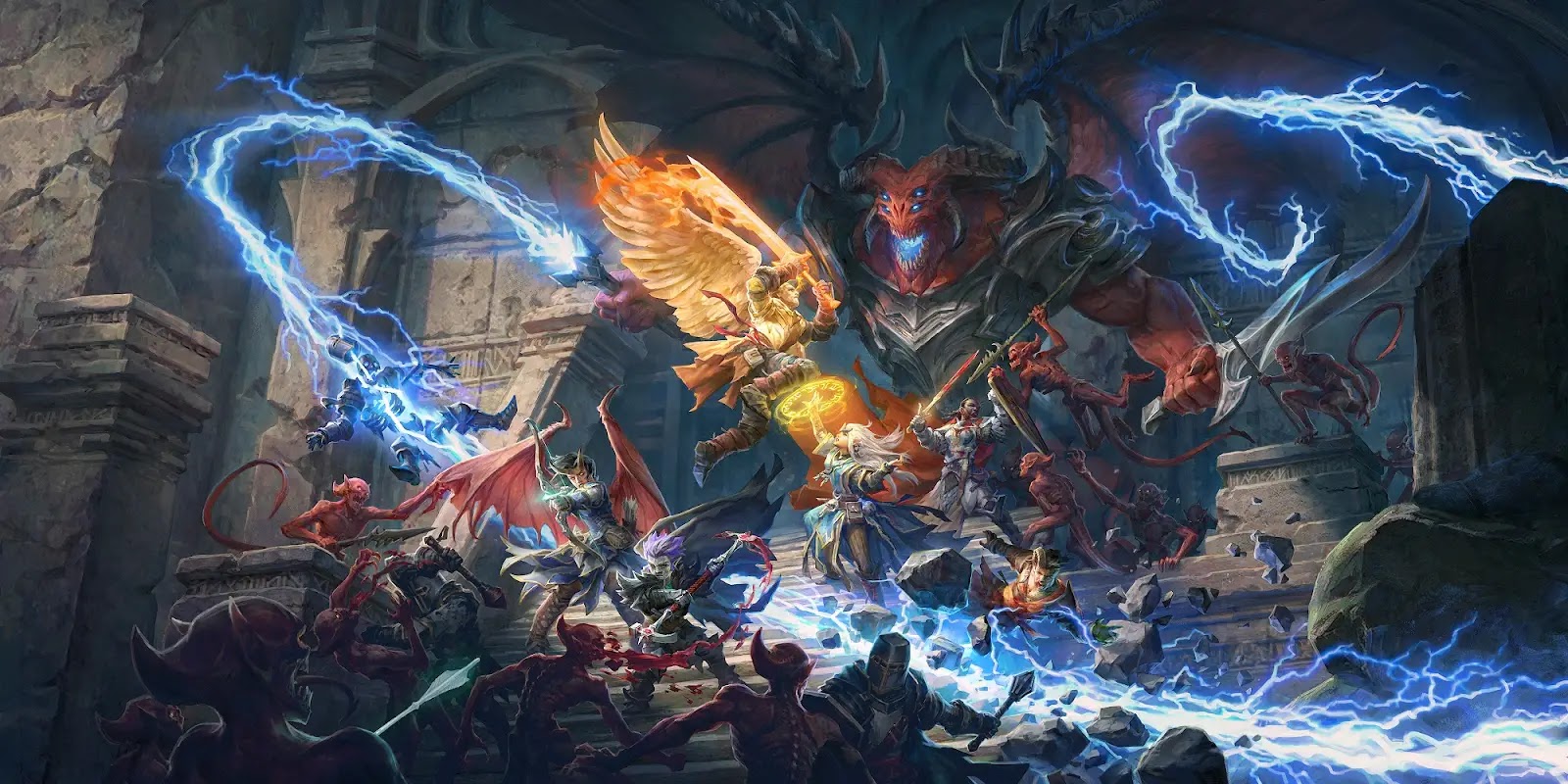
Pathfinder: Kingmaker - Definitive Edition by developer Owlcat
Games and publisher Deep
Silver—Microsoft
Xbox One review written by David
with a copy provided by the publisher.
Estimated reading time: 17 minutes
I’m a fan of tabletops, that’s no secret. In my upcoming article
on Baldur’s Gate: Enhanced Edition, I even managed to gush about
the migraine that is Advanced Dungeons & Dragons: 2nd Edition. I
started in third edition, but really got going with the revised
ruleset that came in 2003. Already a sizeable catalogue, Wizards of
the Coast pumped out content for D&D 3.5 like there was no
tomorrow, and no small part of that would be Dungeon and
Dragon Magazines. Though long time staples for the game, WotC
had its hands pretty full in general, and in 2004 they passed off the
game-aid and news magazines to Paizo Publishing (Paizo Inc since
2014). Paizo was another Western Washington based company, and their
love for the game was evident from day one. Along with Dragon
and Dungeon magazines, they created their own campaign setting
and supplementary ruleset, The Pathfinder Chronicles, set in
their own fictional world that would become, in my opinion, a
fantastically cohesive kitchen-sink of a world, Golarion.
In 2008, Wizards of the Coast put out what was easily the single most
divisive release in their history to date, Dungeons and Dragons:
Fourth Edition. I could harp on 4e all day, I’m not a fan, and this
article could easily just become one of those for a chunk, but it was
really a great move long term. While 4e wasn’t my cup of tea, what
it excelled at was being accessible. D&D was at its most
popular point (at the time, Fifth Edition is ridiculously
popular), but it had a mountain full of content, and for new
players it was a labyrinth.
I have a folder in my google drive that’s roughly 40 gigs, and it’s
*literally* only .pdf files of third edition content. It’s
fantastic content, but Bruenor’s Beard was there a lot of
it, and rules, races, and classes scattered across obscure secondary
releases. Fourth Edition was the answer, it refreshed everyone on the
same level, and the game was organized to function comparable to an
MMO. The mechanics for the later MMO release Neverwinter by Cryptic
Studios needed very little adjustment from the tabletop 4e
rules, in fact. The game was very newbie, and cinematic, friendly. It
was way more attractive for new players, especially those who
preferred the smooth action of a videogame, but a lot of the
old players weren’t fond of it.
In 2009, Paizo Publishing answered with a full, this-is-our-own-game
release based on their campaign setting, and fully compatible with
3rd edition rules with some pretty minor conversions (even included a
handy guide both directions); The Pathfinder Roleplaying Game.
Pathfinder, as it turned out, would be the tabletop I lived in for
the next decade. I played other games; a decent amount of Shadowrun,
a smattering of Cyberpunk 2020, some 4th and more 3rd edition D&D,
I even playtested what was then called “D&D Next” that became
Fifth Edition (which has *exploded* into the mainstream), but
Pathfinder took the cake. Fans of third edition
only-sort-of-jokingly called it 3.75 (Editor's Note (PY): Can
confirm), as there were enough similarities to be easily
converted between each other, but the game worked much more smoothly
overall. Even some of the most basic things had enough flare to be
interesting.
Picking Human Fighter was way easier to be cool and customized
in Pathfinder than it was in 3.5, and while you can flavour your
roleplay however you like, PF had the mechanics to back up
that customization. Fast-forward a bit, and we get a kickstarter
for some folks I’d never heard of with an awesome plan. Owlcat
Games was going to make a CRPG out of Pathfinder, and the Baldur’s
Gate fan in me went off the wall. Pathfinder: Kingmaker, one
of the more interesting premade Adventure Paths that had been
released for the tabletop. In the AP with the same name, you’re set
to clear and establish a kingdom in a tumultuous region of Golarion
known as the River Kingdoms, a prime spot for such a tale as it’s a
region defined by wildly varied and not always cooperative
city-states who were sometimes little more than a name on a signpost.
I have been excited for this opportunity since that kickstarter was
announced, so let’s move on from my ravings about tabletop history
and get to the reason we’re all here.
The first thing I did with this game actually was go to the settings.
Figured I’d take care of the Subtitles preferences right away. What
I found instead was the single most customizable CRPG I’ve ever
seen. Some of it is standard, tutorial messages, font size,
language, autosave, but then it goes farther. Custom number of
auto-save and quick-save slots, from 0 to 25 each. Autopausing for 21
separate triggers, the ability to replace blood splatter in the game
with “Critters,” and then a lot of functions for turn-based mode.
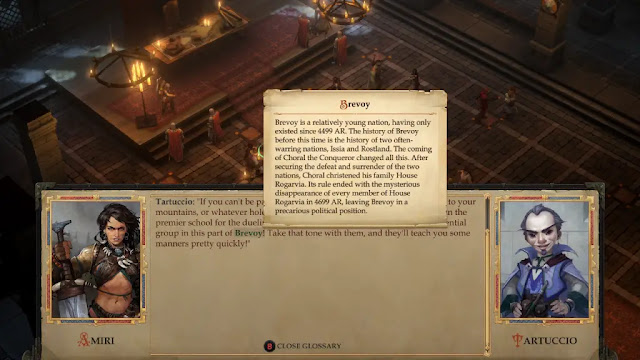 |
| While Amiri and Tartuccio argue, you
get to learn! |
Pathfinder: Kingmaker does another thing I really like, and it
shares this quality with Obsidian’s Pillars of Eternity; the
ability to choose between Real Time With Pause and Turn Based
combat. Jumping into a New Game we’re met with a range of
difficulties. Lowest is Story Mode, which I always like to see just
because some stories are just better told through this medium, and
not all stories need skill to complete. This mode’s pretty
comparable to other Story Mode setups, 80% damage reduction, you
can’t be crit, no character death (but if your whole party goes
unconscious it’s still Game Over). Along with the ability to
customize a list of aspects of the game for your own personalized
difficulty, the game also goes all the way past Insane difficulty to
one I love the label of: Unfair.
For all three of the above-Normal difficulties you get the warning
“Choosing this difficulty is NOT RECOMMENDED for the players not
familiar with the Pathfinder system,” which, by itself, excites the
hell out of me. Unfair goes substantially farther though with it’s
warning. “Choosing this difficulty is NOT RECOMMENDED for the
players not familiar with the Pathfinder system, as well as the
Pathfinder: Kingmaker battle system, and those who are not willing to
suffer. The enemies will not forgive any mistakes made during
combats, and your characters’ builds must be no less than perfect.”
I’ve played campaigns on the table that were unforgiving in the
extreme, and that is definitely getting played. For purposes
of this article, I’ll be writing about the Challenging difficulty,
as it appears to be intended as the one closest to the tabletop
mechanics. Note, I’ve not actually played the Kingmaker adventure
path, so everything but the setting and the mechanics will be fresh
to me. HERE WE GO!
Character creation is nice and varied, Definitive Edition is the
console release and comes with all the add-ons the PC players had to
wait for. Pathfinder: Kingmaker includes five premade characters each
fitting a different role, or you can create your own. While
Pathfinder has as many playable “races” as it has sapient
creatures (as well as rules for custom ones), Kingmaker settles on
nine. Likewise, Pathfinder boasts forty classes to pick from
(with rules to build your own), and while Kingmaker shaves that down,
they keep it at a solid sixteen to choose from, with
multiclassing available at each level. At this stage, you can even
choose a premade build for your customized character, so long as you
don’t choose an "archetype" for your class. This will,
however, turn on auto-leveling, which will take your control at
level-up away. In a true “this is your game” approach, however,
even that decision isn’t set in stone. At level-up, you
still review the new character sheet. If you change anything, it
simply turns auto-level off.
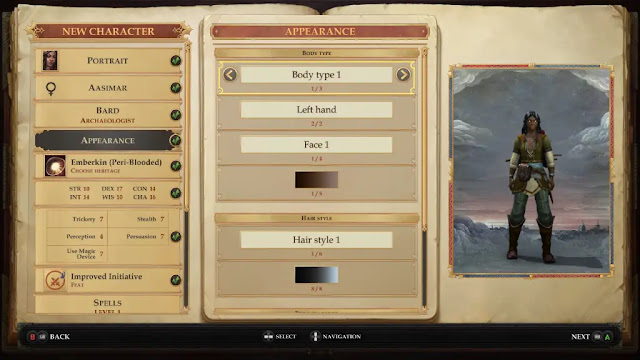 |
| Characters so customizable the game
acknowledges lefties are real. |
My favorite part of Pathfinder’s Class system is its Archetypes, a
variation on the way each class works. Usually this keeps the core
class concept and shifts it, but some go substantially farther than
that, and it's nice to see the mechanic represented. The number of
archetypes varies per class in the tabletop, but Owlcat included
three for each, in addition to the base version. With the limit on
archetypes, I knew a number of my favorites would be cut. Many are
little more than flavor, and even more would be functionally useless
in a video game. Some, like the Rogue’s Knife Master, which grants
the rogue bonuses on their sneak attack with dagger-sized blades, I’d
not been surprised to see. Others I’ hoped but not been sure of,
like the Magus archetype Eldritch Scion, which switches the Magus
from casting Prepared, (more spells known but has to plan each day)
like a Wizard to Spontaneous (fewer known, but more flexibility) like
a Sorcerer.
One that I’d fully not expected though, was the Bard archetype that
takes away Performing, the Archaeologist. This bard archetype
takes a smattering of Rogue traits, switching the class’s role
potential entirely away from crowd control and party buffs it
traditionally is. I created my most recent Pathfinder character, a
little Dragon-Blooded Gnome mage/thief named Khaz. He’s manifested
a few different ways on the tabletop, most of them readily available
in Kingmaker. This time, we went with Knife Master for his starting
class, and we’d level him into Eldritch Scion at 2, giving him his
Blue Dragon sorcerer bloodline and his ability to grow claws.
His original incarnation is almost doable in the game, and
most of his alternates are, but they’re all minor flavor changes.
This build gives him a bit more combat ability than most of his
incarnations. The biggest reason I still play Pathfinder more than
any other TTRPG is the character customization, and it is here in
this game deliciously. Two of the other races, Aasimar and
Tiefling, even come with six subraces for further flavor-and-ability
shifting, in addition to the base version. I’d be doing you a
disservice if I didn’t tell you I played the opening level ten
times just making characters, some new, and some old favorites.
 |
| Bardic Inspiration goes farther than
one might expect. |
The game opens up in the great hall of a manor house, where dozens
have gathered in answer to a call for adventurers. You’re in the
great hall of the manor belonging to Swordlord Jamandi Aldori, and
with her is the Mayor of the city you’re in, Restov, Ioseph
Sellemius. They want you all to go and take out a bandit king and his
followers, and when you’re done, whoever the group chooses gets the
land and a title to do what they want with it, and a lucrative
trade deal with Brevoy, of course. Throughout the expositional
dialogue, and all dialogue throughout the game, pretty much any
setting/Pathfinder related terms will be highlighted in Green in the
text on screen, and there is an ever-present glossary button to
answer questions you might have, like what a Swordlord is, or why
Brevoy matters.
Announcement ends, “Go to bed and head out at our expense in the
morning.” and the game centers back to you, but you’re not in
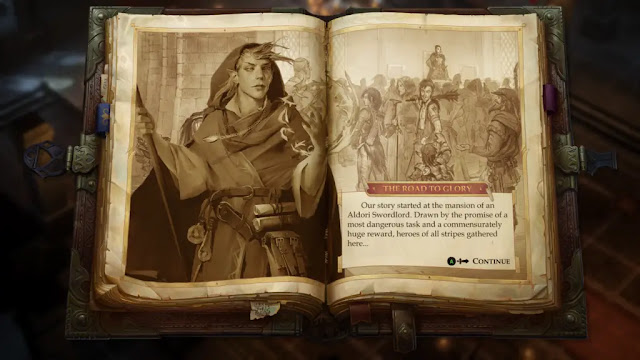
control yet. First you meet Linzi, a halfling bard who’s actually
writing a book about this adventure. The whole game is framed as this
book, actually. The menus, skill checks, loading screens; there are
all-text decision-making sequences, usually at story-relevant points,
that look like a book page, often with an illustration, and it’s
clear the story is from her perspective, but you are the hero
of her tale.
I love the way this was done, and applaud it each time it pops
up. Owlcat uses a solid mixture of in-game scripted action, enforcing
one-off circumstantial rules, dialogue, and these little
decision-making and skill check moments to capture more of the feel
of that tabletop experience. Introductions over, setting established,
you head to bed, only to be awoken by Linzi busting into your room,
talking about an attack. A scream is heard, she rushes out, and an
assassin rushes in. it’s here you get your first tutorial, and it’s
pretty good at explaining what’s about to happen.
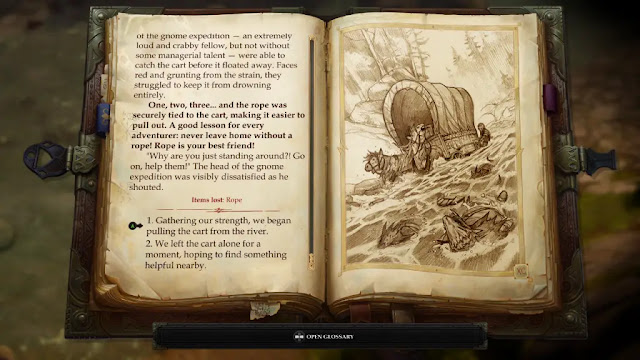 |
| Don't forget your adventuring gear! |
However your preferred style, Turn Based or Real-Time-With-Pause, you
can switch it on a whim with the press of a thumbstick. I find myself
using both, RTwP roaming around and dispatching trash mobs, and
switching to Turn based when I want to really focus and allocate
everything myself. For RTwP, the game has a pretty good AI you can
attach to the whole party, including your character, and just sit
back while they play out the fight their way. They went all in with
the Real-Time aspect too. one round in the Pathfinder Roleplaying
Game represents six seconds. Likewise, during RTwP, action types take
up a specific amount of time. Something that’s a “Full Round
Action” in Turn Based really will take six seconds in RTwP.
Once you’re out of your room, you head toward Linzi (or explore the
room the other way, your choice), and you find Tartuccio, a gnome you
heard earlier in the great hall, held captive by a pair of assassins.
After this, you gain Linzi and Tartuccio as party members you can
control directly. You’ll fight your way through the manor, making a
couple of moral decisions along the way, a variety of skill checks
and the trapfinding mechanic, and gain a couple more party members
before the big fight at the end, where you see this is a very
planned attack, as they have a trio of mages channeling a barrier
and summoning powerful monsters to trap Jamandi Aldori and Mayor
Sellemius and keep them occupied, there are a lot of units
here, and turn based takes some time to get through at this level.
After it’s all clear, it’s revealed that somebody present
is a spy, but that the mission will go on regardless, split into two
teams instead. Your actions, and explanation for them, determine who
goes with you from here, and you’re given your deadline. Three
months. ninety days to find the Stag king, kill him and his bandits,
and claim the Stolen Lands for yourself, and Restov will pay for the
construction of your capital city, and you’ll instantly be landed
nobility.
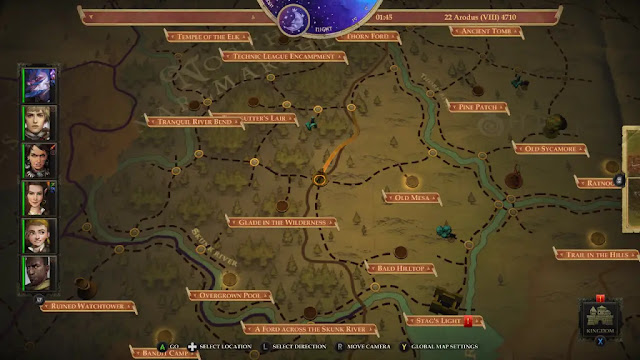 |
| More roads and locations open up as
you explore. |
"Travel takes time" is the biggest kicker in this
adventure. You need to sleep, you need to eat, regardless of
difficulty, you’ll find yourself becoming fatigued, and you’ll
have to rest. If you’re not in a dungeon, you can hunt with the
Knowledge (Nature) skill, and this can be done any time resting is
triggered from the travel map as well. Like most CRPGs, Kingmaker is
split into limited squarish regions to explore at a time, and they
can vary in size quite a bit. There’s not a ton of sidetasks
in these, but there’s enough to keep you wandering around to see
what there is to see. Sometimes it’s just somebody else’s story.
One example is when I found a “Lonely Shambling Mound,” and
nearby was a corpse, and a lab journal, and what happened became
clear. I had a genuine emotional response from this easily-ignored
little spot that contained nothing particularly useful. I think there
were a couple potions I didn’t really need, I wasn’t really
paying attention to that part because I got to find out why this
non-aggressive Shambling Mound is also Lonely, and it made the world
feel more whole, more cohesive, and more alive.
Your base until you establish your kingdom is Oleg’s Trading Post,
which is being attacked by the Stag King’s goons when you arrive.
After a chance to explore and set up for an ambush, you’ll see
directly how what you say can affect what happens going forward, and
then your first safe rest since leaving Restov. You encounter the
spirit of a nymph here, and you get your first hint at a bigger story
than “Kill the bandit king,” and more chances to shift the game
and your alignment. As you go, you’ll find the Stag King’s
childhood home, the lost sister of Oleg’s wife, a group of warring
Mites and Kobolds that Khaz convinced to stop fighting and worship
him, giving them each a glove to serve as new sacred relics.
Pay attention to the dialogue in this game, it has such a strong pull
on what happens. The combat is fairly frequent, but it’s definitely
secondary. The fighting is something active to do to get you from A
to B in the story, and it really does work like a tabletop in that
way. Especially when there’s thirty units on the screen each
taking a separate six second turn (you can tap a button and make it
speed up through the NPCs).
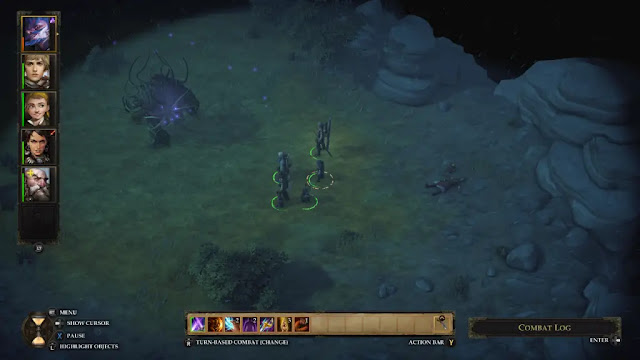 |
| A lonely Shambling Mound paces near
a body. |
I hit the Stag King around hour thirty, which is probably pretty
slow. I like to explore, and there’s a fair bit of it. Besides,
Khaz and I had a cult to start. His isn't a fight to snub your nose
at either. Not only is his base chock full of lesser bandits, the
actual fight with him includes a whole party of class-leveled
baddies, so you'd better be ready. Rest and spell preparation is a
major part of the game as well. I've always been a "spontaneous"
caster in these games, and always forget to arrange my Wizard's
spells, while my Sorcerers just refill what they know. Resting
requires food, which means rations or someone to hunt, and you can't
hunt in dungeons.
The rest of the game is a mixture of kingdom management and continued
adventure as you continue diving into the mysteries of these wild
lands; of the slave-hunting Technic League, and what is here that the
agents of Pitax were willing to kill dozens at that meeting back in
Restov over? Keep an eye on the calendar as you dive into the Stolen
Lands and your new Barony, as everything is on a schedule that
you’re free to ignore, but not without consequences. There’s a
handy automated mode for the management, however, so it’s much more
smooth if you’re uninterested in that part of the game. Again,
Owlcat really leaned into the ability to customize your experience.
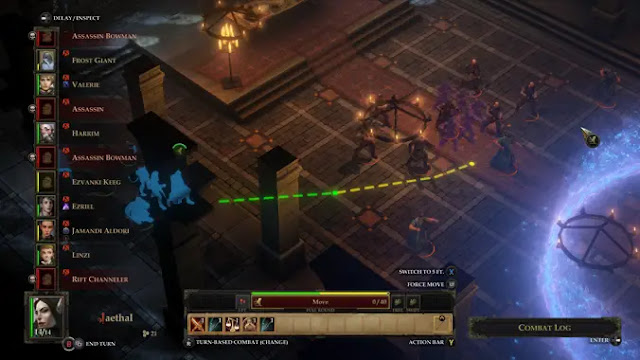 |
| The ability to switch between Real
Time and Turn Based is a life saver. |
Along with the main story, the Definitive Edition that is the console
version includes the additional adventure Varnhold's Lot, in which
you take the role of the Right Hand of the new Baron of Varnhold,
your main-game neighbor to the east. This adventure starts at the
ceremony during which you're granted your title in the main game, and
carries on in this other barony run by a mercenary group you help
lead.
Shortly after release a major patch was put out that cleared a lot of
early-reported bugs, with more patches said to come, but even so, it
was a pretty smooth port from PC in my play experience. The love for
this game and where it came from shows through so clearly, and in
such a genuinely fun way, I know I’ll be dumping
hours into this game long into the future.
 |
| Where you camp is nearly as
important as who you place in camp roles |
Summary
Will you be a benevolent lord of a safe frontier city? Or the
iron-fisted tyrant of a horror in a haunted land? The choice really
is yours, right from the beginning, with plenty of chances to change
your path along the way, and Owlcat made sure you can do it exactly
how you want in this incredible, beautifully source-faithful CRPG.
Score: 8.5 / 10