• Blue Reflection Quartet - PS5 Review

    The Blue Reflection series by Gust is a high school slice of life with apocalyptic level situations and magical girls. With the world on the brink of destruction, it'll be up to a select few to tackle those that wish to destroy it, all while managing the emotions of their friends, fellow students, and themselves…

  • Gobliiins Collection - Switch Review

    In the early 90s, Coktel Vision (which later became Sierra On-Line) released a quirky point and click adventure game titled Gobliiins which had players bouncing between three different Goblins to find a cure for good King Angoulafre.

  • Cat Mail Co. - PC Review

    What a meow-gnificent evening it is to send your paw-rcels out to those family and friends! Are mew looking to pick up an item or send something out? Well at Cat Mail Co. we can send and receive all your deliveries!

  • Volontes - Nintendo Switch Review

    Have you ever grown up feeling like you don't belong? For our Heroine, that's the feeling she lives with everyday in her small farming village. But it's not her only secret...

  • STARSEEKER: Astroneer Expeditions - PC Preview

    STARSEEKER: Astroneer Expeditions is just that! Massively co-operative and not an MMO! When you first run the game you are instantly into the tutorial...

  • Dread Delusion - Xbox Series X|S Review

    Today we’re looking at what has rapidly become an absolute favorite in the open-world RPG genre for me. An interesting story, memorable NPCs, stunning visuals, and a setting absolutely dripping with flavor, Dread Delusion sets its tone immediately and sticks with it.

  • House Flipper Remastered Collection - PC Review

    I enjoy simulation-type games, and I enjoyed the original release of House Flipper, but I never got around to getting the DLC. When the remastered version of the game was released, I figured it would be the best way to experience the DLC while checking out how the base game was upgraded.

  • GranBlue Fantasy: ReLink Endless Ragnarok - PS5 Review

    GranBlue Fantasy: ReLink released in 2024 bringing the GranBlue universe to an action adventure JRPG format. With a party of up to four members, this band of skyfarers set out for new skies, adventures, and dangers. Two years later, Endless Ragnarok...

  • 70s-Style Robot Anime Geppy-X - PS5 Review

    70s-Style Robot Anime Geppy-X is a mouthful of a title, but you know what? It’s quite the challenging game to describe as well. At its core, 70s-Style Robot Anime Geppy-X is a shooter...

  • Gunvolt Chronicles: Luminous Avenger iX 1+2 Dual Collection - PS5 Review

    Are you ready for the package deal for the Azure Striker spin-offs before the third title in the spinoff series drops? Do you love the Megaman X games but want something fresh and musical? Do you wanna feel totally inadequate when you get a crappy score rating after beating what you thought was a tough fight?

Showing posts with label FuRyu. Show all posts

Crymachina - PS4 Review


Crymachina by developer FuRyu and Aquria and publisher NIS AmericaPS4 review written by Richard with a copy provided by the publisher.
 
Estimated reading time: 9 minutes
Initialize -> RealHumanProduction.exe
Install -> HumanPersonalityData_LebenDistel; E.V.E. startup

HelloWorld, welcome to the world of Crymachina, a world set in a future where humanity has had some rather serious survival issues. A sort of sequel to Crystar, Crymachina expands on the gameplay in a new setting.


The world of Crymachina takes place in a (hopefully) far off future, where humanity has died out. In their last moments, they have sent a space vessel to the stars, loaded with the pinnacle of humanity's technological advancement in the form of eight super advanced AI machines. These machines, or the Dei ex Machina, are tasked with reproducing humanity through an advanced method that's basically the equivalent of "rolling dice till you get a result you like", and each has their own area of expertise that they're in charge of. Created through the personality data of simulated beings, three subjects have been chosen to become "Real Humans" as defined by the Dei ex Machina in charge of defining humanity.

So you spawn in as Leben Distel, a young girl who has a vague memory of maybe who she is, installed in a mechanical body. Unfortunately for her, some of the Dei ex Machina have decided to fight amongst themselves. The Dei ex Machina that produced Leben, Enoa, is the one in charge of trying to reproduce humanity, and Leben is her most recent, and probably last available, attempt, as the other Dei ex Machina have driven her into a corner.

As Leben is joined by Mikoto and Ami, two other human potentials, referred to as E.V.E., she decides to strive to be labelled as a "True Human" in order to secure a future for herself. Unfortunately, the other Dei ex Machina are generally more than willing to create warriors out of other personality data in an attempt to crush them, and Enoa, under heel. As such, not only do the E.V.E. subjects need to become human, they also need to fight in order to survive, hopefully becoming more human in the process.


Crymachina is, in retrospect, a very interesting look into what it truly means to be "human", and whether or not that definition even matters in the end. There is a lot of discussion, both amongst the E.V.E., as well as the Dei ex Machina who have almost all developed a form of consciousness and personality despite being machines, about what defines who they are and what should define their existence. Not gonna lie, there were some rather potent philosophical moments as well as heartfelt moments. Despite this, I do have to warn you that your enjoyment will probably depend mostly on how you play games in general, as opposed to any given aspect of the game really.

Gameplay through the main story will follow a basic loop of completing a stage, returning to your base and chatting amongst yourselves, and then heading back out into a new stage to fight your way through. Most of your time will probably be spent in stages, where you will have to get to the end and then fight a boss type enemy in order to proceed. This ends up being an interesting style that's fairly similar to Crystar, or if you haven't played Crystar then it's a 3D action style hack and slash type gameplay, although with fewer enemies at one time than you would normally see in these genres.

When in a stage, you will be in control of the E.V.E. that is generally selected for you on your first run, or your chosen character any time afterwards or for free stages. You move around a 3D map, doing some light platforming, avoiding traps, triggering switches, and fighting enemies. When you do encounter enemies, you will usually be trapped in a barrier and need to defeat the enemies in order to proceed.


Combat is an interesting function in Crymachina. You have some of your standards, such as a jump, a dash/dodge, a guard counter, and your standard attack combos. You also have two auxiliary pieces of equipment, support moves Enoa can use to help you, charged moves, and some interesting mechanics. Fighting is actually a really interesting activity, as there are some mechanics involved that are pretty interesting. Basically, stage bosses have two types of guard gauges, and usually have auxiliary weapons similar to the player. One gauge is a barrier that prevents flinching, and another is to put an enemy in a "weak" state. You can launch "weak" enemies, and if they get "downed" you can use a finisher move. Some enemy moves can be countered, some need to be dodged, and finding enemy patterns and adopting a playstyle is a pretty fancy dance.

Auxiliary weapons are a cool idea, as they have gauges with points you expend when using an auxiliary that refills over time. Each action with an auxiliary weapon is slotted in an action bar specific to the weapon equipped that can have different slots for moves. As an example, you can get two of the same weapon, one with three slots for a normal combo in a row, and another may only have one. There are also EX combo lines that have different possible requirements, such as "enemy is 'x' distance away" or "health below 'x' percent". Each use of auxiliary move consumes points from the auxiliary weapon gauge, and will refill over time. You can get a lot of customization, as not only are there a fair number of different weapons, each with different attack move types associated with the weapons, but you can also find what are called "sentiments", which is what you slot in to your weapon combo bars.


Once you beat the boss of the stage, you're rewarded with personality data from the boss. Once you return to your home base, you can have Enoa analyze the data. This will turn into equipment for you, as well as unlock some backstory info about the person the data from the boss was based on. It's really cool seeing the backstory info, as most of it is all related to each other in some form or another. What you get from analyzing personality data is a little temperamental, as you could get some really bad gear, or some really good gear.

Now, here's where I have to stop for a minute to make a bit of a point. Well, two points, really. First off, as you unlock stages, you unlock addresses where you can put in five numbers and see if it results in a stage. These are like freeplay stages and usually contain bosses that you won't see during the story. If you are anything like me, then you will want to do any bonus stages you know the address for. Now, if you take into account you need three personality data to unlock all the backstory on a boss data file, this starts being more of a slog than anything. This is especially the case for the free stages, as they're basically the same segments mixed and matched between different free stages. At least the story missions are pretty varied and unique though.

So, let's talk about the kinda weird leveling system that's been implemented here. As you defeat enemies that are at least within a certain level range of the character you have selected, you earn ExP as well as maybe EGO points. Note that ExP stands for "E cross P" and is an actual in-game explained value, which I found to be pretty neat. When you return to your home base, you can have Enoa use the ExP in order to increase your character's level up to the cap that gets increased after each major boss. In addition, you can spend EGO points in order to increase certain stats as well as increase your "max equip level", which is the stat on the same page you level from.
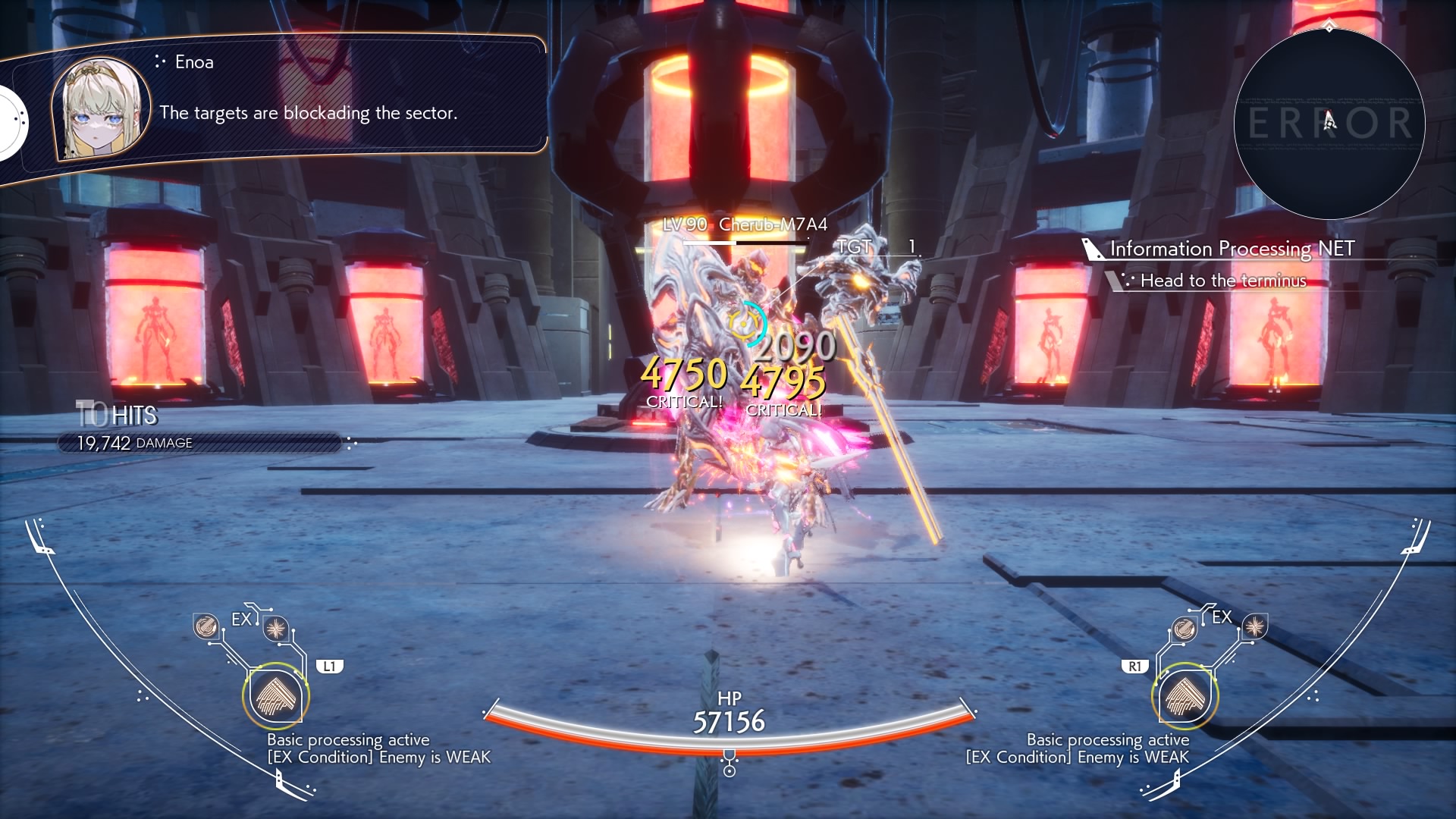

Those of you who've played Crystar, you'll probably be fairly familiar with the style of Crymachina, in both gameplay as well as aesthetics, albeit with some upgrades and variations. In typical JRPG fashion, characters will have both 3D models as well as 2D anime styled "live 2D" type character portraits while speaking. The design for the character portraits definitely have a rather unique style to them. Add to this the quality and tone of the soundtrack and you have an aesthetic match-up that really stands out. Seriously though, the soundtrack is really good, and the boss themes are super fitting for each major boss you fight.

Crymachina definitely has both good and bad points to it. While it has a rather unique art style and good music track, areas tend to get rather repetitive pretty fast. If you aren't a fan of action hack and slash games, that could also give you pause. While there are a lot of bonus mini areas to do, they are pretty much all similar to one another and get repetitive really fast if you want to go through all of them for all the personality data unlocks. I'll be honest, when I was trying to get all of the data this way, I had something on in the background to watch/listen to. If you stick to the main storyline though, this isn't quite as big an issue. If you swap which character you bring it can also feel a little fresher, as each character does behave differently, although the third character is particularly different from the first two, there are differences between all of them.


Fair warning by the way, difficulty is a weird concept in Crymachina. Certain enemy types are just plain brutal, and sometimes bonus stages skip from maybe level 50 suggested to level 90 suggested with no real indication what you're getting into. That being said, I was also routinely contesting enemies 30+ levels above me with, not too much of a challenge, depending on enemy type. Screw the lancers, and the light swordsmen have a really hard-hitting attack too. Also, some of the stats are really confusing. Like, I expect STR to be strength for damage, but Willpower is stated to be damage, yet the two stats don't necessarily correlate? It's weird, and you can manage, but still pretty confusing.

Overall, Crymachina is a title that I enjoyed both a lot more and a lot less than I should've in equal measure. If you're the type to go for the full hundred percent, Crymachina quickly becomes a repetitive slog. If you're ok to not have a bunch of shiny 100% ratings, then it won't feel quite as bad. The storyline is actually quite interesting, particularly on a deeper level, but takes a while to get into and may have a little too much "fluff" in between for some people. While Crymachina has an interesting combat system, it also feels at times a little rough around the edges and somewhat hard to get into. It certainly showed a lot of potential. While definitely a more niche title that may not appeal to everybody, I thoroughly enjoyed this 3D hack and slash adventure into a philosophical robot space world.

Score: 7.5 / 10


Share:

The Caligula Effect: Overdose Review

The Caligula Effect: Overdose by developer FuRyu and publisher NIS AmericaSony PlayStation 5 review written by Nick with a copy provided by the publisher.

Estimate reading time: 4 minutes

When Caligula Effect first came out, it was to a mixed reception. It had the pedigree and some of the vibe from the popular Persona games, but with far less polish. The Caligula Effect: Overdose takes that original Vita title and brought it to consoles a few years later, and now in its most advanced form on PlayStation 5. Does going back to the well here pay off? By and large it does, as The Caligula Effect: Overdose manages to improve upon the original in ways that don’t fundamentally change the experience, but make it a better one that allows for the game to show off some of its many ambitious ideas.

The Caligula Effect: Overdose is a JRPG that starts off with your protagonist giving a speech and realizing that something is wrong as faces around him begin to visually glitch in some strange, unexplained way. Naturally, this leads your character (who can be male or female, one of the updates Overdose brings to the table) to panic and run out of the building. At this point your character is faced with a hard-to-believe situation: they are trapped in a sort of alternate reality called Mobius and a strange virtual doll named μ. She apparently decided brainwash a bunch of peoples’ souls after abducting them.

Probably where the Persona DNA is strongest is in the social links you can form with a ton of other students within Mobius. This is a nine level system that works to help portray the backstories of the characters. This building of bonds happens through conversations and texting with them via your phone. This can lead to new quests and some pretty heartfelt stories that were among the highlights of the game for me. That being said – there is a lot, I mean a lot, of content here, as you can pursue this relationship-building with almost every student you encounter. Obviously some are more fleshed out and interesting than others. These can help play into the various endings, of which there are multiple – both good and bad. There’s even an option to play on ‘team bad guy’ for lack of a better way to put it, and it’s interesting because of the new stories it presents, but from a gameplay perspective doesn’t really change up the formula a whole lot, which feels somewhat like a missed opportunity.

Visually, the game looks pretty solid. The Vita version had some skipping and other hiccups that I didn’t notice at all on the PS5 version, which is a win. That being said, the visuals are not incredibly impressive. They’re not bad – the visual style itself is pretty solid in terms of being colorful and pleasant to look at. But this game was made for a handheld device over half a decade ago now, so it’s not exactly leveraging the full power of the latest gaming gear in either of its character models or it’s somewhat flat-looking environments. The music was a bit hit and miss for me as well, with several really catchy, memorable tunes and others that were more forgettable.

There is something about the pacing of The Caligula Effect: Overdose that seems just a bit slow at times, even for a JRPG. Maybe it’s the hundreds of students that can be interacted with, or the semi-grind of related quests and the exploring that goes with it. It starts to take on an almost chore-like quality after a time. However, the combat is a high point for me. Your characters can stack up to three actions per turn, and each one has a duration on the timeline they take to complete. This timeline gives you a ‘glimpse’ of the future (called Imaginary Chain), where you can better map your strategy against the enemies. It’s a fascinating way of presenting turn-based combat, especially since the predictions are not always one hundred percent correct, leaving some randomness in the mix.

That being said, this level of detail’s really not required for most of the more mundane battles, and you can use an auto-battle to advance things at a quicker pace. Just don’t go into a boss battle expecting to see you through these. There are some trickier non-boss battles too that require your thinking cap, or they will absolutely own you if you get sloppy and don’t leverage the Imaginary Chain to its fullest ability.

There’s enough quality of life improvements to be had in The Caligula Effect: Overdose, that even if you played the original and just felt like it was close but not quite what you were looking for? Well, Overdose might push you the rest of the way. For those such as myself who adore all things Persona, there’s enough interesting backstories here to scratch that itch, even if after a time there are probably too many of these relationships to pursue without going a bit numb to them. Combat’s probably the greatest strength to be had here, and it’s well-done. The Caligula Effect: Overdose is a solid if unspectacular JRPG that is a good way to burn a few dozen hours.

Score: 7 / 10

Share:

Monark - PS5 Review


Monark
by developers Lancarse, FuRyu and publisher NIS America Inc.Sony PlayStation 5 review written by Pierre-Yves with a copy provided by the publisher.

Estimated reading time: 12 minutes 


Note: Please note that we tried to keep the following review as spoiler free as possible in order to experience some of the twists that Monark has for yourselves. This being said, we would also like to warn any potential players of the various themes that Monark covers often with no warning (censure or trigger) to the players which could be hard to sit through such as abusive bullying, suicide, and murder to name the prominent ones in the first twenty or so hours.

Set within the boundaries of an academy with seemingly no way out, you wake up in a misty school hallway. Having no idea as to who you are or why you're there isn't exactly a great way to start your semester. Welcome to Shin Mikado Academy.

Developed by previous developers of Atlus' Shin Megami Tensei (SMT) series, Monark has some real talent behind it and for the most part it works well, almost brilliantly so. Combining an intriguing story with fun tactical combat and a musical composition that just keeps on giving you more as the title moves on, I am still wondering if the issues that I had were with me or with the game design.

Starting off after being saved from a creepy and misty hallway by the former student council president, the school doctor, and your little sister, you’re soon thrust into a position where you make a deal with the devil, so to speak, in order to achieve the power to protect those that just saved you. Known as Vanitas, they grant you power known as Authority under the banner of Vanity in order to fight against those of the seven deadly sins. Being an aberration to the other seven, that makes eight of you within academy grounds and you’ll soon find out if the others are potentially friends, or if they are all foes.

The seven deadly sins: love them, hate them, relate to one of them, have generally been done, so I was a bit worried on how Monark was going to portray them. Pride, Greed, Wrath, Envy, Lust, Gluttony and Sloth, we’ve seen them in movies like Seven, to animes like Fullmetal Alchemist and the Seven Deadly Sins. In this case, and perhaps scoring the first set of high marks, is that each of these “sins” makes up a person’s Ego, and through this Ego, how they see the world around them.

Continuously being asked questions throughout the adventure, either as pop-quizzes or psychology tests, there’s no “wrong” answer, but answering these questions will help to develop both your core Ego as well as your alter egos, which will have various effects on how you can proceed through the academy. Your core Ego to start off with can affect how you go about the first chapter of Monark and those you find to act as your companions. Super high in one stat would lock you into a straight path, while being more varied could allow you an actual choice in the matter, as far as I can tell at least based off of the restart (more on that below). Alter egos by comparison allow you to unlock bonuses throughout the academy, as long as your points are high enough to do so.

Continuing with the scoring of high marks of a grade A student, the visual presentation of Monark blends in that nostalgic PS2 era of JRPGs with elements that would make fans of Stephen King’s The Mist proud. Covering the hallways with a dense mist, there are plenty of things hiding within it just waiting for you to come across, such as the banging in the distance that just makes you want to run the other way. It's unsettling and I won't lie,  I jumped several times when my protagonist's cell phone started to ring, signaling that beings from the otherworld were out for my blood.

While very creepy in the beginning, sadly it soon levels off as you find out that “nothing” can actually happen to you within this mist. While exploring these areas, what can happen is that your sanity will begin to drop as your madness increases. If your madness hits 100%, then it’s game over. While seemingly harsh, as you can eventually run out of items while exploring, or just being unable to make it back to safety fast enough, I think using “Game Over” in Monark was just an excuse to jump onto the “You Died” train, as all it nets you is a trip to the infirmary while taking nothing away from you other than the need to run back to where you were.

Now, while “nothing” is in quotations, this will come down to individual choices and how much of a difficulty modifier you want to add while exploring the misty areas. While still atmospherically unsettling, once you walk into a new location your phone could start to ring. If you don’t answer it your madness will just continue to rise until it quite literally drives you insane, causing a game over. What adds to the atmosphere is that the students trapped in this mist will go berserk if they hear these phone calls and if you’re standing too close that’s the end of it for you as the sound is just too much to handle.

So because of all of this, while exploring the mist you’ll need to be careful of where and how you move around if you decide to not pick up the phone. Feeling brave enough to pick up? That is always a choice which leads into the next high scoring element on Monark’s report card. Picking up the phone when it rings in the mist will bring you into battle alongside anyone that you are currently partnered up with as you explore the various areas of the academy for a way out. Just as a side note… try not to pick up the phone in the mist as it basically guarantees a game over as these foes will be far beyond anything you can match for the first half of the adventure!

Monark does not do random encounters, which is something that I truly appreciated. Instead, you’ll have both story based fights that must be won in order to move forwards as well as a list of numbers in your phone to call in order to start an encounter. Calling these numbers, calling numbers found within notes spread around the academy, or simply putting in random numbers, each come with their own difficulties, but generally, each new misty area will give you a new number to call with tougher foes than the previous one. Winning this encounter the first time will prevent your phone from ringing in the mist, allowing you a bit more safety as you’ll only have to worry about your madness increasing naturally. Call the number again? That’s where the fun begins.

Combat in Monark plays out in 3D environments by using a your turn / their turn approach. On your turn, you can move any of your participating members from your actual human members over to the fiends of Legion assigned to you under both your Ego and alter Egos around the map as long as it's within their allocated movement radius. From there, most characters will have two types of attacks which both have to be thought through, as one set can only be used while sacrificing hit points, and the other by increasing your madness. Reaching zero hit points will cause your characters to die, reaching zero hit points with your protagonist will cause a game over in good old fashioned SMT goodness.

Reaching critical mass in madness, unlike while exploring the academy, will cause your characters to go berserk and attack anything that is close to them with no regards of being friend or foe. Depending on where they are placed this could work out to your advantage, but oftentimes keeping your hit points high and your madness low would be a suggested approach. Thankfully even if your protagonist goes mad in battle, this will not result in a game over, but you’ll want to get them help as soon as possible once the battle is over.

Adding an element to both the madness and the strategy of battle is the ability to defer a character’s actions. By deferring an action, a unit can still move but it can allow another to take up a second, third, or fourth turn at the price of their madness increasing. This lets characters with area of effect abilities to hit three or four enemies as much as possible in a small time frame to thin out the herd or allow a healer to ensure that your own units will survive the incoming onslaught. More strategically though, it allows your units to leapfrog forwards especially on larger stages that can take several turns to simply make it to your end goal, accumulating spirit and coming out victorious.

On top of not doing random encounters, leveling up is also very different from your usual affair, allowing you to easily keep your entire party up to the challenges ahead, even if you aren't actually using them. Accumulating spirit from your defeated foes, you’ll be learning new abilities and stat boosters which, once learnt, act as a level up. Each node, whether the first time or on an upgrade, levels up each character. While very “expensive” in the beginning, where the idea of 50 spirit on a node seems outlandish, it doesn’t take long before you start to drop anywhere from 1000 to 5000 spirit per node per character and think to yourself, huh, even 150 isn’t very much for this new party member, is it?

What I also rather enjoyed with this approach is that it didn’t change depending on whether it was a human party member befriended or frenemied on campus, or a member of Legion that has been assigned to you based off of your Ego. Instead, the principle is the same for everyone and human or legion alike, they all leveled in the same way with the only real difference being that you could rename and customize the appearance of your legion members, as well as equip them with head, chest and leg pieces to both raise their stats and change their looks, as well as provide skills attached to the equipment. This change of pace allows for a bit of freedom as the hours move forward, as you don’t need to mix grinding for experience alongside exploration of the academy and trying to figure out how to move forward.

This is the part that I had several issues with: figuring out how to move forward on the academy grounds. I often felt that the guidance to figure out the next move in how to get a door open, or how to get information to help sway someone into opening a door, is insanely ridiculous. Some, while looking back I can say to myself that I obviously fell for the red herring hook, line and sinker, but in other cases, how the hell did I even think of putting those together? First red herring actually cost me around four hours. Two hours to explore high and low in every single available space, and two hours because I restarted just in case there was a glitch or I missed something that wasn’t flagged properly.

Spending this amount of time, aside from the time spent making phone calls for combat and keeping up to level in order to move the story along, and spending time with the story itself that often has long cutscenes and huge amounts of dialogue, took me out of it. If it had been one puzzle that would be fine, but we are talking about multiple of these that just break the flow and as much as I loved the rest, this is where I feel like my romance kind of died as there are no hints at times in how to figure out some of these puzzles, especially when you have to type in your answer.

Otherwise, while it’s ok to fail at one subject and excel at the others, there is one more element that needs its own showcasing, and that is the musical composition of Monark. It was brilliant. Each “stage” of the experience had music designed for it from academy exploration to combat and boss fights. The academy music once the mist lifts is remixed a bit here and there so that each building sounds different. Combat, depending on which of the sins you’re going up against, is completely different and each boss fight has its own unique vocalized track. Combined with the combat and the story it was enough to make me keep going even if I ran into another puzzle that I was sure that I was going to groan at not figuring out, or feeling dumb over how long it took for me to solve it.

Bonus

Because I had the chance to restart because I thought I missed something, I did get to see a few extra features such as the above varying paths through the adventure depending on your starting Ego. Another big point is that each PSN trophy earned allows for you to further customize your Legion fiends with more hair styles, voices, and colors. The reason for the re-mention is that PSN trophies are only earned once so a new file, while perhaps not re-unlocking the trophy itself, if you can hit the parameters in question, you’ll re-unlock the customizations.

Summary

Overall, Monark scores above average on its report card. Non-traditional JRPG elements combined with a fun tactical based combat system and plenty of different musical tracks to groove to, it was hard to put down even when I couldn’t figure out what I was actually supposed to be doing. Maybe this was just me and the types of puzzles, or maybe it was a bit too vague, but it was often almost enough to make me quit and have to retake my semester all over again.

Score: 7 / 10


Share:

The Alliance Alive HD Remastered - PS4 Review


The Alliance Alive is a 3DS title that released early last year, and is now getting an HD remaster. A cute story of guts, determination, RNG, and frustrating ladders, The Alliance Alive is definitely one of the most fun RPGs I’ve played recently.

Back when Alliance Alive first released, I heard the name maybe once, read a few bad reviews, and promptly didn’t think too hard about it. I’d be kicking myself harder today if I hadn’t played the HD remaster. The story is a little hard to pin down without spoilers, but the gist of it is that the world has been split into sort of cordoned off sections, with an impassable wall called the dark current. The world is ruled over by daemons, powerful beings that decide to lorde of the humans of the world like an impersonable king to his peasants. However, one of these sectioned off lands has it pretty rough, with the local policing force of the daemons, the beast-folk, treating the humans as disposable tools for their own amusement. Well, eventually something is going to give, and a group of humans decide to overthrow their oppressors.

Gameplay in Alliance Alive is a wonderful throwback to a lot of traditional RPG elements. You have ye olde world map with monster symbols that you walk into to initiate combat in a turn-based fight, a world map that you traverse with different abilities when the unlock, guilds to visit and upgrade, and so many collectibles to find. Do some of you older gamers remember Final Fantasy II? Not the North American version, but the original II, or the remake released later? The one where your stats are determined by how much you use a stat? Remember how awful that was? Well Alliance Alive does that the way it was supposed to be done.


While stats such as they are aren’t affected, your HP and SP have a chance of increasing after battle. As someone who has struggled with RNG like nobodies business, I can assure you that Alliance Alive isn’t as mean as it could be. Although I do question why my healer has twice as much health as my tank, at least they won’t be dying anytime soon. Combat is both traditional turn-based RPG fare, where you select a move for all your units and then you and the enemy whack each other till someone dies, but it has it’s own twist to it. Characters can have two weapons equipped and spells available to them, giving a wide variety of customizable options to bring into battle, each with their own specific skills. The catch is you need to learn those skills through the power of dice rolls. Yup, they’re RNG as well.

However, the more you use a weapon, the more likely it seems you are to learn something new. These skills also have internal levels that you can increase. The analyze percentage increases as you continue to use a certain skill, and seems to carry between characters (although I haven’t extensively tested this), while learned skills per weapon and formation levels don’t. Formation levels also have a chance to increase as you use the skills in battle, and will be affected by what role in a formation that character currently fills.

Essentially you have a 5 by 3 grid, where five is the number of units you can bring to a fight, and 3 is the “location”. The further back you are, then less likely you are to be targeted by enemies. Additionally, you have roles such as attacker or defense that will give specific stat boosts related to the role to the character. Not going to lie, as you unlock more skills with your weapons the game can get kind of complicated in order to figure out what formations you want, when to use skills, what weapons to use etc., especially when you take into consideration that you need to use talent points in order to increase weapon proficiency, rate of unlocking new skills, and rate of increases to HP and SP.


Some of the talents will also decrease SP cost of skills, or increase SP recovery per turn, as stronger skills will require more SP to use. Another interesting battle trait is that if a character gets KO’d, they lose a portion of their max heath until you go sleep at an inn. This freaked me out at first when I thought it was permanent. With the full health recovery after every standard battle though, hopefully this won’t happen too often for you.

Admittedly the combat will get a little tedious after a while, particularly if you’re trying to have your front line units get more health than your rear-guards but their health just won’t go up. The grind is real. Thankfully you can speed the battles up to 4x speed, as well as turn on auto battle which will use the last skills used by each character, provided they have the SP to do so. Careful though, as self-targeting spells only get used on the caster in auto battle. It’s definitely a fun and interesting concept, and there’s a bunch of stuff that becomes available in new game plus to keep you coming back for more if it follows the original.

There’s library entries to fill out, a bestiary to complete, strong monsters that roam the countryside, and plenty of interesting characters to interact with. New game plus is also good for those who really want to see all the different combinations of things you can do, as there are five different guilds to help throughout the game that you may not get the chance to max out the level of during a playthrough. There are a number of guilds in the game, and once you reach a certain point you can start recruiting in order to increase the guild levels and get better bonuses from the guilds. While these bonuses are wide and varied between the different guilds, you can also get in-battle help from them occasionally, if you find yourself close enough to a guild tower.


As an HD remaster, and with little comparison to the original, I can’t outright state any gameplay changes they’ve made, but I can tell you that the game looks like it was made for the 3DS, but with a substantially increased graphical quality. The chibi characters are really cute, and the little walking 16-bit characters in the menu screen gave me so much nostalgia. While having voiced characters would have been nice to see, er, well hear, at least the music was good and catchy, so while it felt a little less immersive not hearing the characters voices, at least I could be entertained by the soundtrack. And not the ladders. Oh good lord, trying to go down the ladders in the lava area had me pulling my hair out. One particularly arse-ish ladder took me five minutes for the character to settle on. It would have been a lot better to have the player push a button to get on the ladders, although I do appreciate that you can just “push” doors and such open.

Overall there’s a lot I really enjoyed about The Alliance Alive: HD Remastered. The characters are pretty much all interesting and fun to watch, the soundtrack is good and catchy, the combat system is…trying at times, frustrating occasionally coupled with pleas to RNJesus, but definitely something that had me hooked. I appreciate the fact you can change formation mid-battle at no penalty at the beginning of your turn, particularly if you choose a wrong formation, no sweat, just choose another. One of the best things though is the handy guidebook. Easily accessible basically whenever, it stores all the info and tutorials you need, and I was definitely referring back to it often as I was playing.

As someone who has always loved a good RPG, I was not disappointed in The Alliance Alive at all. Yes some parts got a little frustrating at times, but that’s part of what makes the experience something you remember. While maybe not as portable as its 3DS brethren (at least for the PS4), the HD remaster is definitely a crisp and vibrant addition to the JRPG scene that I just couldn’t put down.

Game Information

Platform:
Sony PlayStation 4
Developer(s):
FurYu Corporation
Publisher(s):
NIS America
Genre(s):
RPG
Mode(s):
Single Player
Other Platform(s):
PC

Source:
Provided by Publisher


Article by Richard
Share:

The Legend of Legacy - 3DS Review

The Legend of Legacy is a game that has a lot of names to live up to from former Square and Level 5 employees. Follow the exploration of seven adventurers as they all come to an island untouched by civilization for ages all for different reasons. Why are they there? What do they expect to find? Take control of the adventurer of your choice and recruit the rest in order to delve further into the island and the savage lands it possess in order to find answers in this old school RPG brought over to us from Atlus.


Share:

The Legend of Legacy - 3DS Preview

Atlus have always been good to gamers. Now while they may not have had a hand in development, Atlus are publishing the Legend of Legacy for us in North America and to give us a bit of a treat they’ve recently released a demo for players to try out before its release. Containing the Prologue and the first two areas, this is a small taste of what to expect in this older school RPG designed by former Square and Level-5 employees!


Share:

Random posts

Our Streamers

Susan "Jagtress" N.


S.M. Carrière

Aldren


Affiliates

JenEricDesigns – Coffee that ships to the US and Canada

JenEricDesigns – Coffee that ships to the US and Canada
Light, Medium and Dark Roast Coffee available.

Blog Archive

Labels