with a copy provided by the publisher.
Estimated reading time: 9 minutes
Well now, it's time for something I considered a huge surprise when I heard the announcement for it: Rhapsody: Marl Kingdom Chronicles. For the first time coming to us in the West, we get a chance to experience the two sequels to Rhapsody: A Musical Adventure! Coupled in a pair, we now get to play Rhapsody II: Ballad of the Little Princess and Rhapsody III: Memories of Marl Kingdom.
If you didn't get a chance to play
Rhapsody: A Musical Adventure, you should probably give it a spin. While not strictly speaking required before playing Rhapsody II or III, they are direct sequels, which will both be massive spoilers as well as some maybe confusing sections, although Rhapsody II is fairly standalone-ish? Either way, I HIGHLY suggest playing the first Rhapsody before the sequels.
So, this review might be a little weirder than most, not in terms of strange content, but in terms of how it's laid out. See, Rhapsody II and III come here as a package deal in Marl Kingdom Chronicles, and they have many similarities and overlapping points, but are also quite different in other aspects. So what I'm gonna do here is lay out sections, and talk about Rhapsody II and then III in order for each section, then go over a comparison between the two so you know what you're getting into. Sound good? Well then, let's dive in.
Storyline
First thing I always ask myself when I look for a new game is "What's it about?". Now, as you may guess, there are almost assuredly going to be spoilers for the first Rhapsody title in this review, just by nature of these being direct sequels, so be aware of that.
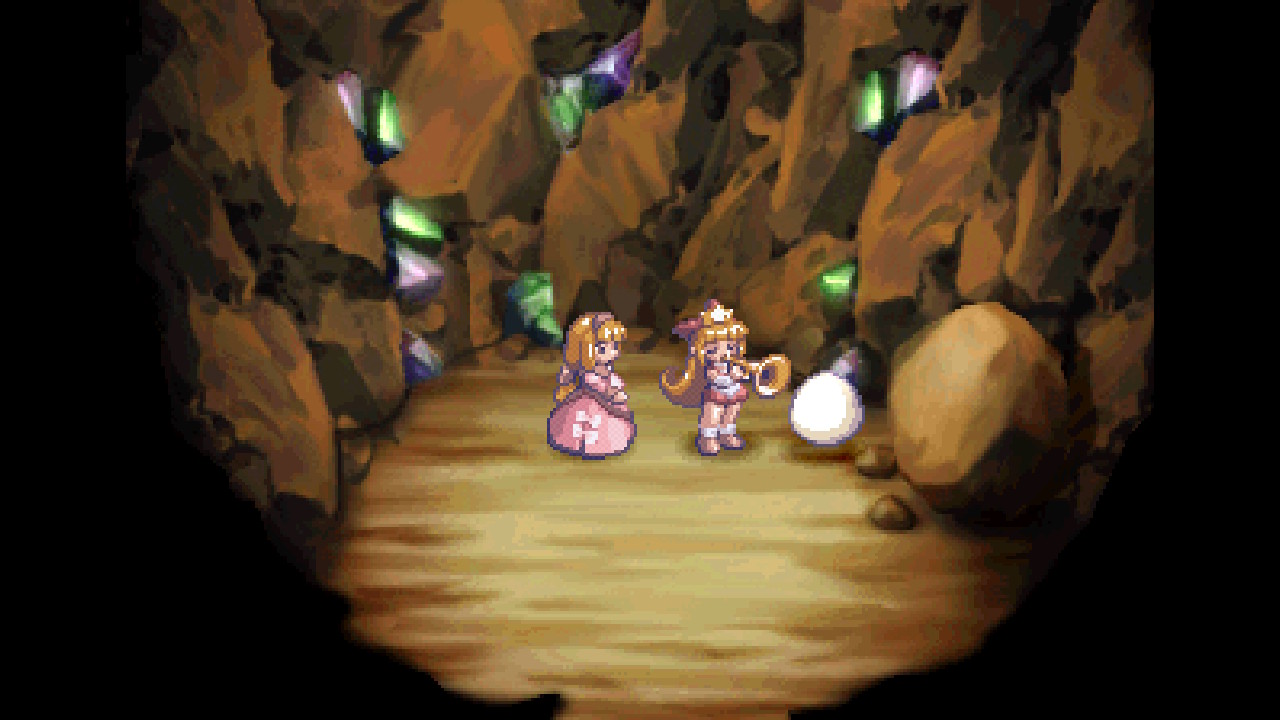
Rhapsody II: Ballad of the Little Princess takes place not too long after the end of Rhapsody, starring Kururu, the daughter of Cornet and Ferdinand. Kururu is...well, a handful, and kind of stupid, but her heart's in the right place. Longing to get out of the castle and explore the world, she and her childhood friend Crea escape the confines of the castle to explore the local area. Well, as these things go, stuff happens and she decides that in order to become a fitting ruler for the Marl Kingdom, she needs to see the world at large and experience what it has to offer. Along with her occasional party members, as well as Crea most of the time, Kururu sets forth on her own Grand adventure just like her mother before her.
Rhapsody III: Memories of Marl Kingdom is a collection of one-off style chapters that take place all throughout the timelines of the previous two games. For example, the first chapter takes place shortly after the beginning of the first Rhapsody game and details a short story of finding a young girl's mother. The second chapter takes place after the ending of Rhapsody II, and is full of spoilers. There's also a chapter about Cherie, Cornet's mother. While the chapters are somewhat eclectic, they are pretty interesting in order to get more insight into the Marl Kingdom. You can also summon certain partners over between chapters to help you out!
While both games are chapter based storylines, Rhapsody III takes a one-off style approach with different characters across chapters, and Rhapsody II is a full story centered on Kururu and her adventures. They both have their own charms, and it's probably best to play through Rhapsody III while both I and II are still fresh in your mind, while II doesn't require I to be as freshly remembered to enjoy.
Gameplay
So, here's where things take a bit of an interesting turn. Both Rhapsody II and III take a pace away from the grid style turn-based battle style that the first Rhapsody employed. Both are still turn-based, just now the grid is gone and you assign partners to your leading members. Both also have map exploration and random encounters, but where Rhapsody II has 2D backgrounds, Rhapsody III is a more 3D approach. You can get up to four leaders in combat, each of which can have three partners that can use skills and give you stat changes when partnered. Certain partners have different affinities for different leaders, and some may be restricted to certain characters. You can also recruit monsters to your team by beating them, where they then turn into dolls you can use in combat. As a general principal I've found that typically monsters are less useful than partners that start off as dolls. Your partners have three accessory slots that you can fill with what equipment you want in order to help your expeditions.
In Rhapsody II the gameplay is divided into sequential chapters, where each chapter sees you tackling a different task, sometimes one chapter will lead directly into the next. You collect any teammates you can, are forced to re-equip them every time they leave the party, which is frustrating, and then either gear and stock up on items or set forth. When out in the field you start your random encounters while exploring the environment. Pro tip by the way, you can still examine things even if there isn't a prompt, although not all the time. Once battle starts, you'll see a huge difference from the first Rhapsody title.

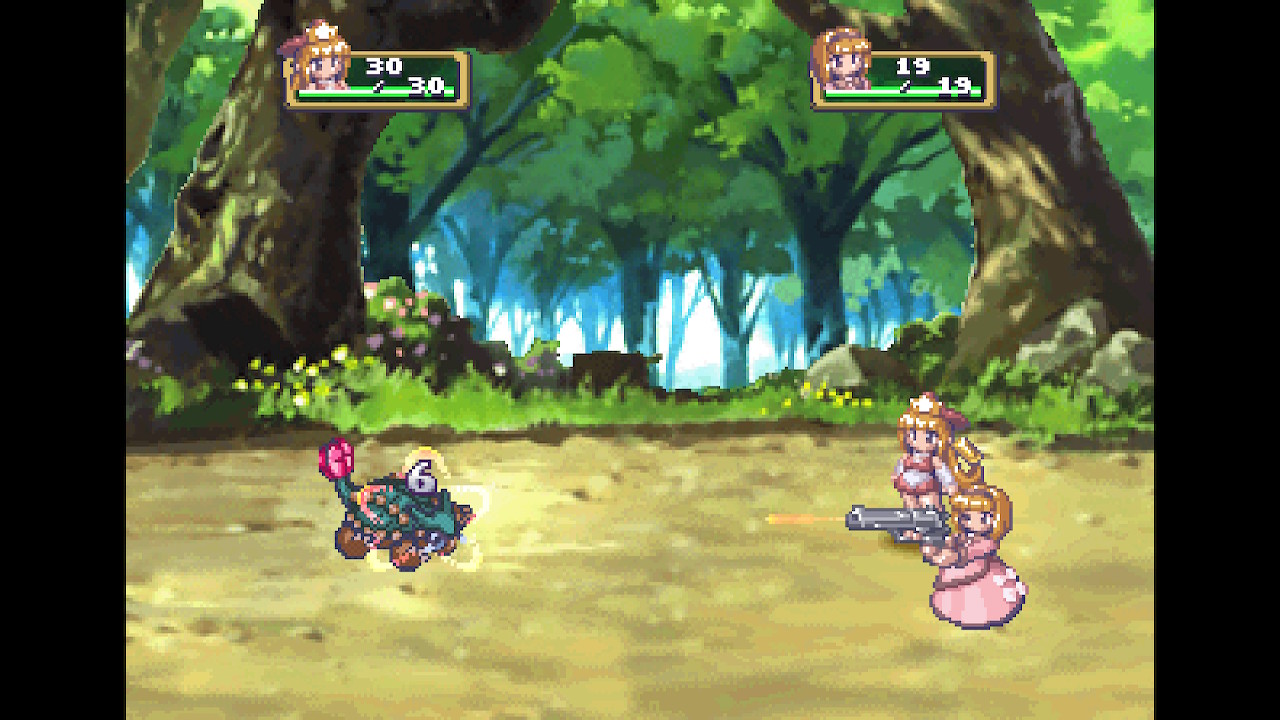
No more grids, you now have a more traditional turn-based system, where you select your actions and then you and your enemies act. While there are the standard options such as attack, flee, special, and defend, you also have a "puppet" command where you can summon your dolls or monsters to assist you. They do charge you a money fee though, which is interesting. Stronger skills require more money, and by using your partner's skills you will build up a musical bar. You can use rewards from the musical bar to either deal damage to your enemies or heal your allies. After battle, an enemy may join your ranks or you may get some items, but you will get money and exp. Money becomes fairly irrelevant to purchases fairly fast, but is still required for using your partner skills, so is always good to have. Exp is awarded to battle participants, so you need to make a choice sometimes between deciding on a lower level unit anticipating better end results or remaining with who you're currently using.
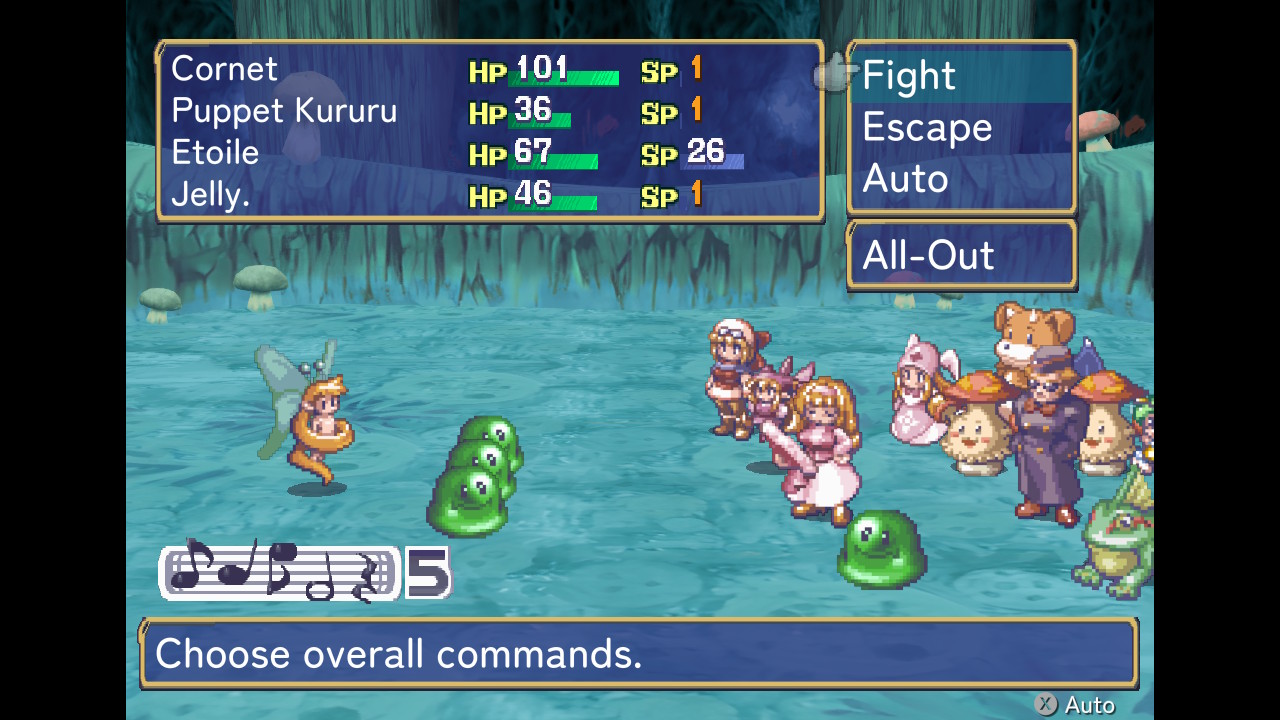
In Rhapsody III you tend to be quicker into the action, although there are some differences. While the map exploration and progression is similar, combat has taken...a turn. Similar to Rhapsody II you've got the turn based combat, but in Rhapsody III, you use your entire line of units. For example, you can assign any unit to a leader, and then line up three more units behind the leader. All four of these units participate in battle, and you have four leader slots, making a total of 16 units. In combat you control the leader, or a single one of the units as directed by the leader. The rest of the units will perform actions at their own discretion. Skills now require mana instead of money or health like in Rhapsody II as well, and they also have skill levels that will increase as you keep using the skills.
The logistics behind some of the stats and party management, like unique combos available only when certain units are in a group and at a certain level minimum can be a little disorienting. This is particularly evident once you consider there's also an elemental affinity type thing going on in the background. Fair warning by the way, battles are either trivial or really tough and there isn't much of an in-between. Unlike Rhapsody II you can also collect multiple copies of monsters to use in a grouping as well. At the friendly healing statues you can import units from other chapters, as well as release monsters back into the wild for bonuses. I'm not positive how rewards are determined, but they can be options like money, experience for the whole team, equipment, or filling the rewards gauge by a portion.

So, I do have to bring attention to a point of frustration in Rhapsody III. More units means more exp dispersal across those units, which means lower levels. So you've got to either spend the time grinding out levels for all the units, or having a smaller but higher powered group. Thankfully there is an auto battle command, but it can get a little tedious at times. Furthermore, there are chests that pop up mid battle when you defeat an enemy. This would be all well and good, but you need to smack them to open them, and if the last enemy dies before you open the chest? Or god forbid the chest drops from the final enemy? Well, you lose it, which really sucks.
Both titles also have the same sort of progression for chapters. You start of with some dialogue, followed by a decent chunk of fighting in whatever area you're exploring, collecting and buying new or better gear, and seeing if you can't recruit new teammates. As you explore you'll discover Ancient Statues which will heal you, and allow you to manage your partners in Rhapsody III. Chances are you'll probably be spending some time camping out around these statues at each new chapter while you bring your units up to par for what you want for the area you're exploring, especially during Rhapsody III.
Graphics
Rhapsody II and III have a lot of overlap in terms of graphic style. Character models are very much in that classic NIS design that you've probably come to know and love like I have. If not, they're all sort of like chibi bit-style characters. Map design and character portrait styles differ between Rhapsody II and III, with Rhapsody III having a more retro feeling character portrait and 3D style field areas as opposed to the more 2D art-style field maps from Rhapsody II. Otherwise, both titles are similar in graphical nature. Just keep in mind, these are older titles ported to a newer console, so they are still a bit dated. Ok, maybe a lot dated, but there's still that retro charm going on without compromising on the quality.
Soundtrack
With a game having a title of "Rhapsody", I'd expect it ot at least have a decent soundtrack. And good news, it does! In a world where characters will spontaneously break out into song, there are a lot of good tracks, and the general soundtrack is also pleasant to listen to. While all the musical numbers are in Japanese, they are subtitled for your convenience. Field tracks, battle tracks, as well as the musical insert numbers, in both Rhapsody II and III, are great benefits to the series and really do help to set both the tone as well as an interesting way to give character introductions or expositional pieces.
Final Impressions
Overall I'm extremely pleased to see these two Rhapsody titles finally making their way westward in Rhapsody: Marl Kingdom Chronicles. If you've played the first Rhapsody title and enjoyed it, this is a wonderful way to continue the adventure. It also ties in to La Pucelle which was part of the NIS classics collection with the first Rhapsody title in it. With a colourful cast of characters, a solid musical repertoire, and an engaging, if sometimes tedious, battle system, Marl Kingdom Chronicles is certainly a point of interest for any fans of the Rhapsody: A Musical Adventure game.
Score: 8 / 10