• Blue Reflection Quartet - PS5 Review

    The Blue Reflection series by Gust is a high school slice of life with apocalyptic level situations and magical girls. With the world on the brink of destruction, it'll be up to a select few to tackle those that wish to destroy it, all while managing the emotions of their friends, fellow students, and themselves…

  • Gobliiins Collection - Switch Review

    In the early 90s, Coktel Vision (which later became Sierra On-Line) released a quirky point and click adventure game titled Gobliiins which had players bouncing between three different Goblins to find a cure for good King Angoulafre.

  • Cat Mail Co. - PC Review

    What a meow-gnificent evening it is to send your paw-rcels out to those family and friends! Are mew looking to pick up an item or send something out? Well at Cat Mail Co. we can send and receive all your deliveries!

  • Volontes - Nintendo Switch Review

    Have you ever grown up feeling like you don't belong? For our Heroine, that's the feeling she lives with everyday in her small farming village. But it's not her only secret...

  • STARSEEKER: Astroneer Expeditions - PC Preview

    STARSEEKER: Astroneer Expeditions is just that! Massively co-operative and not an MMO! When you first run the game you are instantly into the tutorial...

  • Dread Delusion - Xbox Series X|S Review

    Today we’re looking at what has rapidly become an absolute favorite in the open-world RPG genre for me. An interesting story, memorable NPCs, stunning visuals, and a setting absolutely dripping with flavor, Dread Delusion sets its tone immediately and sticks with it.

  • House Flipper Remastered Collection - PC Review

    I enjoy simulation-type games, and I enjoyed the original release of House Flipper, but I never got around to getting the DLC. When the remastered version of the game was released, I figured it would be the best way to experience the DLC while checking out how the base game was upgraded.

  • GranBlue Fantasy: ReLink Endless Ragnarok - PS5 Review

    GranBlue Fantasy: ReLink released in 2024 bringing the GranBlue universe to an action adventure JRPG format. With a party of up to four members, this band of skyfarers set out for new skies, adventures, and dangers. Two years later, Endless Ragnarok...

  • 70s-Style Robot Anime Geppy-X - PS5 Review

    70s-Style Robot Anime Geppy-X is a mouthful of a title, but you know what? It’s quite the challenging game to describe as well. At its core, 70s-Style Robot Anime Geppy-X is a shooter...

  • Gunvolt Chronicles: Luminous Avenger iX 1+2 Dual Collection - PS5 Review

    Are you ready for the package deal for the Azure Striker spin-offs before the third title in the spinoff series drops? Do you love the Megaman X games but want something fresh and musical? Do you wanna feel totally inadequate when you get a crappy score rating after beating what you thought was a tough fight?

Showing posts with label Utawarerumono. Show all posts

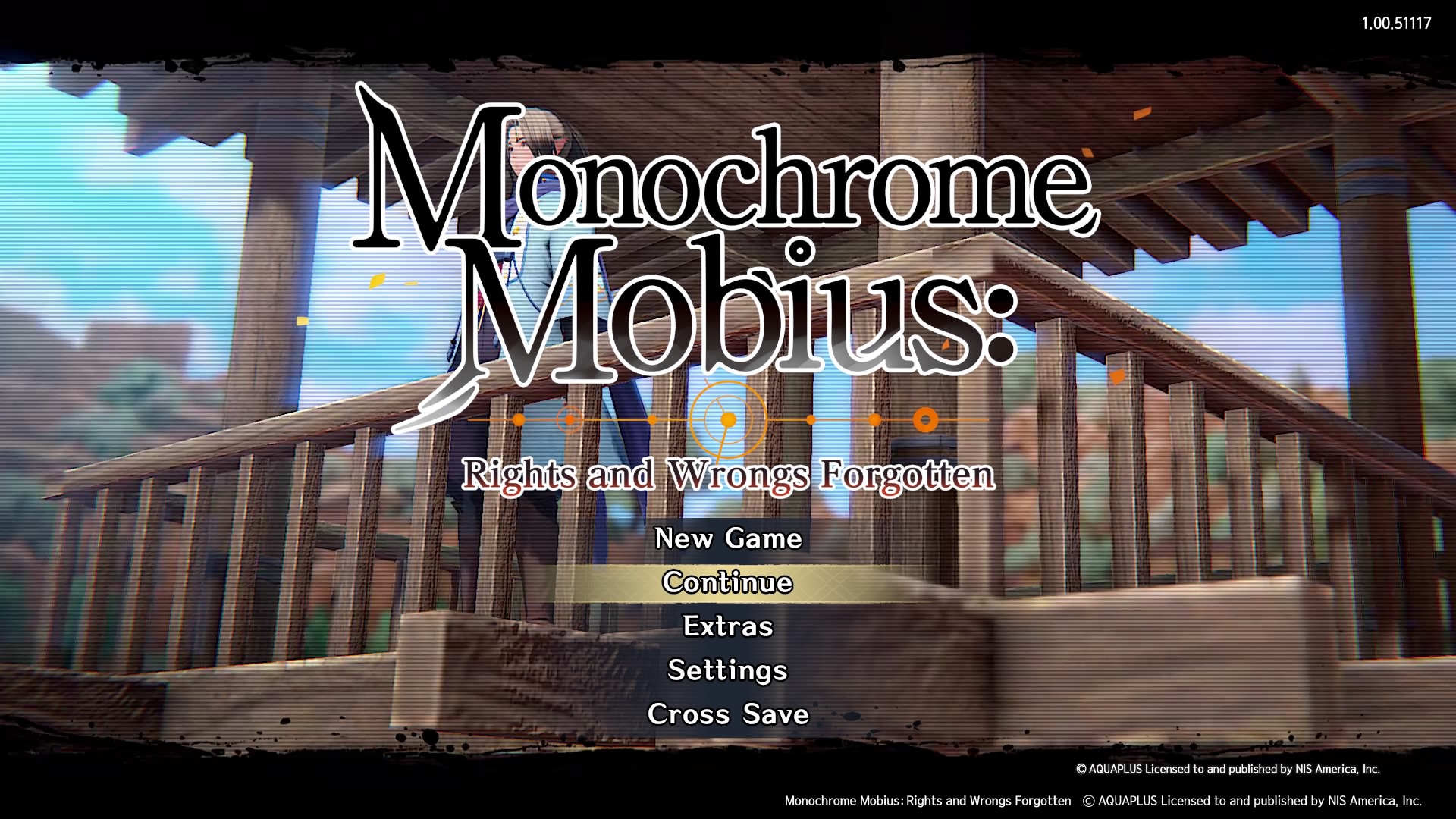
Monochrome Mobius: Rights and Wrongs Forgotten - PS4 Review


Monochrome Mobius: Rights and Wrongs Forgotten by developer Aquaplus and publisher NIS AmericaPS4 review written by Richard with a copy provided by the publisher.
 
Estimated reading time: 7 minutes
It's time again to look at the series I probably have the hardest time pronouncing. A part of the Utawarerumono franchise, we are looking at Monochrome: Rights and Wrongs Forgotten. Set as a prequel to the "Twin Masks" titles, Monochrome Mobius stars Oshtor and his rise to become a strong warrior for his country.

Those of you familiar with the Utawarerumono franchise may be familiar with Oshtar, but those who may be new to the series, allow me to lay out a bit of background into what you'll be getting into. In the land of Yamato, reminiscent of something close to Ye Olde Japan, people with beast-like traits inhabit the land. A young man named Oshtor is living in the village of Ennakamuy with his mother and little sister. One day he is tasked with the local lord to discover what has been happening with some issues with the townsfolk. In the process, Oshtor discovers a girl named Shunya. Shunya tells Oshtor that his father, who he had thought dead many years ago, was still alive. And so Oshtor decides to set out with Shunya in order to see for himself whether his father was still alive or not. Thus begins their adventure to Arva Shulan.


Monochrome Mobius takes a bit of a step away from what you may be expecting from an Utawarerumono title, replacing the "visual novel with turn-based strategy segments" with a "3D exploration and more traditional turn-based battle" style. Yep, that's right, we've got a standard turn-based battle system as well as full 3D map and field exploration this time. Exploring Yamato and Arva Shulan is done by running around a large map (very large actually) as any of the party members you acquire. You roam around, filling in the map as you go, picking up items from shiny locations, snagging chests, and getting into fights (maybe). You can run, although there is a stamina gauge that needs to recover, and jump around, and you can even interact with any friendly people you meet or areas of interest such as climbable vines.

When in town it is pretty similar, only you get a free full recovery, and you can buy stuff at the equipment and item stores, as well as check notice boards for any sidequests that may be available. Later on in the story you can spend some materials at the equipment shop to upgrade the quality of the gear they offer. Pay attention to this, as sometimes "lesser" equipment can end up better at higher "tiers". As an example, if a "steel sword" is better than a "bronze sword" to start out, a "bronze sword II" could end up better than a "steel sword II". Just something I noticed. Side quests can range from a variety of different requests, but can usually be summarized as "go here, defeat thing, report back". Side quests do have time limits, story wise not actual time wise, so be sure to get those done if you're interested!


As an additional note for the shop upgrades, after reaching a certain point in the story you unlock the ability to get, well, abilities by providing certain materials as well as meeting certain gameplay objectives, such as getting incapacitated by certain status effects. This can lead to useful abilities such as increasing the rate your dash stamina comes back, increasing rare material drop chances, or adding markers on the map for shiny items and chests.

Combat in Monochrome Mobius is a little...weird, I guess? Not because the combat mechanics are anything obscure or unintuitive, but more so because it just...might not happen if you play in a certain way? Obviously boss fights and event battles are mandatory, but the developers decided to add in what are probably some anti-frustration features that can be abused a little bit under certain circumstances. Essentially you can attack them on the field map to start the battle, but if you get a certain level stronger than the enemies, instead of starting the fight you just outright kill them on the field map, and you get all the exp and drops you would normally and no resource expenditure. I think some of you can see where this is going. 


Well, needless to say, my first task when introduced to the field map was to explore all the map, even the "tougher areas", as well as fight everything I saw. Cue a short while later and I can now field attack kill all of the enemies I can see that aren't either in the "you don't want to be here, I'm serious" area or a special monster. This does let off as you continue through the game though, so you will start getting into actual fights again later. Oh, also, you do end up getting a fast travel mechanic, so don't worry too much about that early game.

So, how is the battle system actually? It's pretty standard turn-based fare for the most part. Each character or enemy take their turns based on their speed stat, and have options such as attack, skill, item, defend, and flee. Pro tip, by hitting left or right on your turn, you can swap between the "attack, skill, 'spoiler command', item" options and "Defend, flee" options when your turn comes around. So, where is the unique twist you ask? Well, turn order is shown through an "action ring" that your character portraits speed around after taking action. However, there are three actions rings. You can ascend rings, which get smaller in size as you go up, greatly reducing the time between your turns. In order to ascend rings, you have two options. The first, and most likely, is by attacking an enemy a lot. They will get staggered, and the next hit will drop them a ring, or revert their ring position to the start if on the lowest ring, and raise you a ring. The other option is by building up the zeal gauge. When full you get a stat boost and have the special option under your skills to ascend a ring.


As an interesting added bonus for those unfamiliar with Utawarerumono, Bonus Points are a thing. These points are earned primarily on leveling up, and can be assigned to whatever stats you wish, either to improve a positive trait or balance out a lagging trait. For example, Shunya doesn't have a high natural physical attack, so you could bolster that, or you could increase her Int and MP stats so she can deal more spell damage and cast more spells.

I am pleased to let you know that the world is rather pretty in 3D animation, and you can swap between any of your current party members at will on the field map, each of which have their own unique attack animation for starting battle. Also, and this is something I was extremely pleased to see, the animated fights are REALLY well choreographed. Like, seriously, the cinematic battles are really great. Areas you traverse are pretty vast and are also pleasing to look at as well, and the character designs for important characters are good to look at.

Another piece of good news, or pieces, is that the soundtrack is also pretty good. I've always been pleased with the soundtracks from the Utawarerumono games, and Monochrome Mobius doesn't disappoint. Perhaps it doesn't have any really stand out tracks like some of the previous titles, but all the tracks are very thematic and very orchestral in nature. There's a lot of traditional Japanese instrument sounds, and it shows both in composition and tone.


Overall, my experience with Monochrome Mobius: Rights and Wrongs Forgotten was largely positive. I enjoyed the turn-based combat with it's own twist, the characters were interesting, and the graphics and music were well received. The fight scenes were really well choreographed, and finally being able to freely explore in an Utawarerumono title was pretty nice. While I did find the difficulty to be a little lacking on the normal setting, there is a harder difficulty available and self restrictions you can impose for a more challenging playthrough. The fact you can render combat almost non-existant can also hamper your enjoyment. Monochrome Mobius is a solid Utawarerumono title that needs little to no prior knowledge of the series, and is a pretty fun title on its own.

Score: 7.5 / 10


Share:

Utawarerumono: Prelude to the Fallen - PS4 Review

Utawarerumono: Prelude to the Fallen by developers Leaf, AQUAPLUS and publisher NIS America Inc.—Sony PlayStation 4 review written by Richard with a copy provided by the publisher.

Estimated Reading Time: 8 minutes.


Utawarerumono is a series that is hard to pronounce, harder to explain fully, and nigh impossible to spell without an eidetic memory. While it might be the most recent release, Prelude to the Fallen is actually a refurbished version of the first title now officially available in English.

Utawarerumono first released on PC back in 2002, and was only ever available to English speaking audiences via what I believe was a fanslation, or freeware English patch if you prefer. As a fan of grid based tactics games, a vaguely recall many years ago taking a stab at the original, although this was before the English Patch was available, so I lost interest rather quickly. Thankfully, we are now blessed with Prelude to the Fallen, an official English translation with updated specs.

For those of you unaware, Utawarerumono also has an anime, as well as two other "major" titles in the series: Mask of Deception and Mask of Truth, both of which occur after the events of Prelude to the fallen. But I digress, you aren't here to learn about the sequels, you're here to learn about the first/prequel, depending how you look at it. Prelude to the Fallen follows the daily life of a man who was found injured in the woods with amnesia. He awakens to find a girl with animal ears and a tail tending to his wounds, Eruruu. Now bedridden in the equivalent of a feudal era remote village, he is nursed back to health by Eruruu, her sister Aruruu, and their grandmother, Tuskur. The amnesiac man, who Tuskur names Hakuowlo (Hakouro?) after her deceased son, makes a place for himself in the village, as a man of knowledge, planning, and engineering knowledge, despite having a weird mask stuck to his face that he can't remove.

Unfortunately things won't stay peaceful forever, and Hakuoro and his myriad of companions are drawn into conflicts, armed rebellions, and a religious crusade. The story of Utawarerumono is actually really in-depth when you get into it, with a lot of background and interesting characters and their motivations. And let's be honest, Utawarerumono is basically a story with some combat tossed in to keep your attention. About ten hours in and I had only fought about 10 of roughly 30 or so battles, so be prepared for a largely story driven content, with the combat thrown in to break up the monotony. This actually works fairly well though, as you can replay battles and there's a training missions option once you get to that point in the game.

As I mentioned before, Utawarerumono as a series is basically a visual novel with some grid based combat thrown in here and there. That isn't to say the combat is done poorly, far from it, for the most part. The combat in Prelude to the Fallen can be roughly summarized as "complexly simple". All the basics are there, and you can largely ignore the aspects that are more unique to the franchise, but it also has the potential for some interesting strategy involved as well. The combat stages of Prelude to the Fallen are, technically speaking, objective based. More often than not, the conditions are generally "defeat this person" and "Don't let Hakuowlo die", but can also require you to reach a certain panel, or to survive a set number of turns. Combat can largely be described with:

Grid-based Basics: the standard fare across most of these types of titles. You have a grid based map, usually composed of squares, and you can sign units and move them around and attack or use skills or items on a turn by turn basis. Unit order is determined by speed, which is a hidden value but you should pick up pretty quickly, and all the units you acquire are unique characters, in personality if not in function. Units are not permanently lost if one dies, although certain characters may be required to remain standing throughout the stage. You have both a movement and action each turn your units get, and there's an elemental rock/paper/scissors game going on in the background for damage calculation. You may select any units available for deployment before battle, and you can earn items and equipment that you can give to you units for healing or stat increases.

Utawarerumono Basics: Experience is earned through smacking enemies upside the head, not through delivering the final blow, and the experience is based damage dealt, or health healed. This gets particularly amusing when you find a particularly burly rock that gives four to five times the exp than the enemy commander. Stages can be replayed to acquire missed items or for experience, and there are bonus missions, or training missions, that can also be undertaken. In addition to the standard exp for leveling your units, upon clearing a map you will also earn BP, or bonus points.

These points are individually awarded to battle participants, and may be used to increase one of the three stats a character has. Yes, you can replay stages to earn BP, and no, there is no "effective cap" on amount of BP you can earn, other than the characters stat cap. Yes, you can replay that first mission a billion times and then roflstomp your competition with just those units that can be used in that mission. No, I don't recommend doing that unless you're really struggling with the game.

Your three stats available are Attack (or healing for healers), Defense, and Magic Defense. That's it. Nice, neat, and concise, tell if you're a Mongol or a Turtle, because I know some of you reading this thought "I'm dumping all my points in one stat". Yes, that's an oddly viable strategy, but you'll find out rather fast that having high defense means very little if you have to kill any given enemy by hitting them 300 times, and high attack means little if the ranged units can pick you off before you melt the boss. Yes I'm speaking from experience. I regret nothing.

Free battles, the replayable version of the missions, are always available after they're unlocked, and you can even play them while preparing for another map, making it really easy to go back and farm some levels or BP if you start struggling in an area. Your units also have innate skills, so pay attention to those. As an example, units adjacent to Hakuowlo receive reduced damage. Very handy for the squishy units. Additionally, units are affected by direction, so attacking or getting attacked from behind results in more damage being dealt.

Now, the one thing I haven't really touched on is Zeal. Essentially, attacks in Prelude to the Fallen are "active", meaning there's a sort of timed button press for you to hit, and if you get it on time, you earn bonus Zeal. You also earn Zeal from being attacked or attacking. As you level, you also learn more chain moves, which will tack on after your current attack finishes, and failing too hard at the button timing stops the combo, although the timing for continuing the combo is pretty lenient itself. So what does Zeal do? Well, at full Zeal you get some interesting things. Some characters have passive skills based on Zeal, but mostly what you will be concerned with is the fact that consuming a full Zeal gauge gives you a bonus attack and finishing move, although you can toggle this on or off to preserve Zeal. I've got to say, the combat feels really well rounded, for how little of it I feel is actually in the game.

So, let's talk a little about the graphics and soundtrack. Both have gotten a nice upgrade from the original version. Seriously, go take a look at the old combat graphics. No longer 2D sprites on a 3Dish map, now you've got fully 3D units and environments, although the camera angle and map orientation can go take a long walk off a short plank. But ultimately that's mostly personal preference. The new combat graphics are a major improvement, and the well-drawn character art, illustrations, and backgrounds are really well done.

While the characters aren't "animated" like other companies do, such as Compile Heart, there are a wide range of expressive options available in the character portraits presented, and there is almost always something that can fit with the conversation or event that is happening. While I didn't really notice any grammatical or translation issues, although I have started to become numb to these, there was one point where a character references a definitely-not-western creature, and an actual description of what it was was added in brackets next to the name, which was quite convenient.

The soundtrack is also on point, with the option for both the traditional soundtrack and remastered version available. I have to say, the Utawarerumono franchise has never failed to impress me with their music selection and choices in the past, and they certainly aren't letting me down here either. You know it's a good soundtrack when it gets stuck in your head.

While Prelude to the Fallen may not appeal to those who have no interest in Visual Novels, the story and characters are quite unique and in-depth, and I tended to find myself truly invested in the characters. Each character has their own unique personality and are fairly easily discernible from the other characters. The storyline also takes a nice hard look at what it means to be someone who stands above others, and how the title of "hero" is subjective to those who are wearing it.

Overall, I'd say my time spent with Utawarerumono: Prelude to the Fallen was well spent. While the lengthy text may tend to drag on a bit, especially around the middle, the combat is interspersed well, and the breaks given allow to break up the monotony. The characters are interesting and unique, the scenes are well drawn, and the soundtrack selection is well done. Combat can be both smooth and infuriating at times, but is overall different enough to remain entertaining while not so overly complicated you need a guidebook every third turn. If you are a fan of Visual Novels and grid-based tactics, you'll probably get a fair amount of fun out of Utawarerumono: Prelude to the Fallen.

Score: 8 / 10


Share:

Utawarerumono Zan - PS4 Review


Utawarerumono is a series as steeped in story telling as it is hard to spell. Utawarerumon Zan is a bit of a weird addition to the series, forgoing a lot of the more intricate storytelling to get you into a more action styled game than those that came out in the past. While this type of game might be good for getting those less interested in Visual Novels onto the scene, it can also feel a bit lacking at times.

Uta-Zan (now my personal name for the game) is a retelling of the first game in the “False Faces” or “Two Masks” line, the first game I believe was “Mask of Deception”. Those familiar with the original game will notice that Uta-Zan follows the plot all the way through the game, skipping over a lot of the finer details. The basic premise is still there, a young girl named Kuon discovers a guy with amnesia who she names Haku, and they end up doing jobs for one of the local authority figures, which generally involves getting rid of bandits or monsters, or solving problems around the capital city.

Sound a little sparse? Well, that’s what Uta-Zan feels like a lot of the time as well. As someone who came from the original games in the series, I have a bit more knowledge than what is given in-game, as most scenes are maybe a minute or two long between combat, pretty much just covering the bare-bones in order to cover what is needed before shoving you into the action. Does this work? Technically yes, as I was rather content to spend most of the game not just reading text, but to people new to the series? This only brings up a lot of plot holes and questions that would’ve been solved with a little more exposition. At least all the key points were touched on, regardless of how well they were explained.


In terms of gameplay, Uta-Zan has opted for a more “muosou/warriors” style gameplay, forgoing the grid based tactics and focusing more on a beat’em up style of gameplay. You have a main mission to complete and up to two sub-missions depending on what type of mission you head out on, and you can bring a total of four characters with you into battle. As you battle you gain exp and bp, the first increases your level and the second can be used to increase base stats or character specific abilities. In battle you have pretty standard move-set combos, with a light and heavy attack that you can use in different combinations, as well as “holding” the button for a different move as well. You have special moves, two of which you can equip, that can be used if you have enough zeal, which is gained primarily by smacking the enemies, and involves an action prompt to match rings as they appear on-screen. There’s also a super move you can use once per fight if you build up enough zeal.

As an interesting tactical perspective, you also get an equippable “seal” that has a primary focus (i.e. attack or defense) and will buff your party. By performing certain actions you gain points, and at certain thresholds of points, the seal will give better stat boosts. You can also pick up “equipment” (read scrolls) that provide various effects, such as natural health regen or attack/defense increases, that are picked up in one of the most annoying methods I have ever seen: lottery. Yup, that’s right, lottery. You pay a wad of cash (presumably for the ten pack as you get one freebie), and hope they don’t turn out duds. Yeah, duds. And the better gear you aim for? The more likely you are to get a dud. Trying to get the last scroll I needed took me four attempts of ten packs, three of which were entirely duds. Thankfully duds have a chance of giving you a REALLY large chunk of cash, so the costs are somewhat offset. Have fun getting all the scrolls to level 10 this way, although at least you can get a great success which increases the level a few times instead of just once.

Despite not having a lot of plot, or even many story missions, there is a surprisingly large amount of content in Uta-Zan. In addition to the story missions, there are the battle recollections (normal and hard), free missions, the battle arena, and an online mode where you can join friends or strangers. All-in-all, there are a decent number of missions to keep you occupied for a while, and with a wide cast of characters, all of which who have different specialties, in can be fun to switch it up every once in a while with a different set of characters, especially since solo mode allows you to swap between the characters you bring with you.


And the AI controlled characters aren’t unconscionably dumb! If you get downed, they will come to get you back up, or if your health is low and they can heal, they will run up to you to do so. Unfortunately this doesn’t mean they’re smart, but hey, you take what you can get, and what you get is pretty decent. They’ve also thrown in “Battle Medals” for you to collect, which give you unlockable rewards upon completing certain milestones, usually costumes or soundtracks. For those of you trying to unlock some of the more annoying ones, fences are useful; at least at the time I was writing this.

The game plays really smoothly, and very rarely did I get any lag, even when using a flashy move in a horde of enemies, enemies don’t have a limit on how many can be rendered, so you aren’t going to be hit by invisible enemies, and the soundtrack is really great. No seriously, I’m downloading the soundtrack for this game, even the menu theme is amazing. While there are a few issues, such as the occasional spelling mistake or the online keyboard having the “space” and “confirm” button in Japanese, there is a lot to like in terms of fun gameplay.

Overall, Utawarerumono Zan is a bit of an awkward title to give a score to. On the one hand, as someone who has played the other games in the series and knows the plot, it’s really fun without needing to slog through a bunch of text. For new players however, the lack of fleshed out storytelling may leave a bitter taste and feel a bit underwhelming. The series was really made on the story telling, and would do well with more of it, even if it’s in something like a “sidestories” section, so you can have that faster gameplay for those who can’t sit through two hours of intricate characters before needing to shake someone down for loot and exp. Doesn’t stop me from wanting to pick up another title if they do the same thing with “Mask of Truth” though!

Game Information

Platform:
Sony PlayStation 4
Developer(s):
Aquaplus
Publisher(s):
NIS America
Genre(s):
Action, RPG, Hack & Slash
Mode(s):
Single Player, Multiplayer
Other Platform(s):
N/A

Source:
Provided by Publisher


Article by Richard
Share:

Utawarerumono: Mask of Truth - PS4 Review


Following where its predecessor Mask of Deception left of, Utawarerumono: Mask of Truth completes the story of Haku and his now not as merry band of friends from the first game. Mask of Truth follows from the first game, and improves a bunch of the major gripes I had with the previous instalment. Fair warning, there are spoilers ahead for the first game.

After the assassination of the Mikado, attempted brainwashing of Anju, and general misfortune that ended the first game, we pick up right where the last game left off. While Haku is dealing with the heavy responsibility of masquerading as Oshtor, and Nekone’s depression over having basically been the cause of her brothers death, a battle is brewing, and war waits for no persons emotional stability. Mask of Truth is markedly more dark, but that doesn’t mean it’s in any way worse than Mask of Deception.

All the story elements and characters that were great in Mask of Deception make their return, provided they’re still alive, and all the great story telling elements are still there. Mask of Truth is still a visual novel through and through, but as a sequel it definitely learns, feeling much easier to get through without feeling forced to sit down and just trudge through. While Mask of Deception often felt like I was halfway forcing myself to play through, Mask of Truth felt a lot more fluid, especially from a reviewing perspective, as normally visual novels have to be something I really want to sit down to, otherwise they feel like a chore. Thankfully, due to more interspersed battles and a more active narrative, Mask of Truth solves this issue.


If you’ve played Mask of Deception, then you already basically know how the game plays out. Essentially, you’ve got story, the occasional battle or two, some more story, some more battles etc, etc. The battles take place as a turn based system on a grid, a la Fire Emblem. Higher agility ratings mean that characters turns come faster and more frequent. As I mentioned in the other Utawarerumono review, I actually really enjoyed the battle system.

There’s nothing particularly complicated or convoluted, you have your basic attack combos or skill combos, and an overlimit gauge that’ll give you an immediate turn and stat boosts while filled. The combos unlock as you level up, and are “active”, similar to Legend of Dragoon, where you actually have to hit the X button at the right time to either score a critical hit or continue the combo. Longer combos and skills may use Zeal, which is your MP gauge and overlimit gauge, and will mostly fill up while attacking. You can choose how far through a combo you want to go through as well, in case it uses Zeal and you want to save the Zeal for something else.

The game is also really kind about notifying you what the expected outcome of an attack will be, which is useful for determining future strategies, or using limited usage per battle type skills. Always better to evade an attack that will kill you over one that does little damage if the evades are limited. It’s also useful for checking elemental weaknesses and resistances. Utawarerumono has the standard elemental circle, where one beats another, but the in-battle indications can be a little confusing at times, as it says adv for advantage and dis for disadvantage, but doesn’t specify for whom, so trying an attack on an enemy with an indicator and one without will let you know which is which if you check the expected results.


A lot of the time in these styles of Visual Novels, my biggest concern is proper leveling of characters, because battles are normally limited, so if you spec a character wrong or make a mistake it needs a restart in some cases. With both Utawarerumono’s, this problem is solved rather handily. Basically, units gets experience from performing actions, so if you attack an enemy, you’ll still get experience.

Also, unlike Mask of Deception, you actually earn exp from buff and healing moves this time, making leveling those “battle medics” on your team that much simpler. Additionally, battles can be re-fought basically whenever the game provides you the opportunity, which is incredibly often. This means you can either replay a stage you had fun on, or simply grind for more items and levels so that you can progress. Coupled with the bonus points you earn every time you complete a stage, which can be used to enhance character stats, you’re given all the tools to succeed as long as you make use of them, even if strategy type RPGs aren’t your thing. Also including a rollback function that’ll allow you to return to previous moves makes planning easier, as if you forgot about that enemy near your healer, you can rewind to the healer’s turn and move out of range either before or after an action.

Coupled with a really fitting and well-composed soundtrack, and wonderful hand drawn backgrounds and anime stylized character portraits, Mask of Truth also has its artistic aspect on show. While Mask of Truth fleshes out a lot of the problems with its predecessor, it suffers from a lot of the same problems that most visual novels do, which mainly consists of the fact that it has to be something you really want to sit down and play, and generally not something you’re told to.


Between the helpful synopsis and fact that it isn’t mandatory to play the first game, if you’d prefer to pick up with Mask of Truth and ignore Mask of Deception you could, although I feel as if you’d be significantly less invested in the characters. I can honestly say that the battle system was good and, above all else, the story is really engaging, so you’d be left out if you didn’t at least either read the other media available or watch the anime.

That being said, there are some fairly major changes between the game and anime, and the game is more canon. If you’ve played Mask of Deception, you want to play Mask of Truth. Not only is it the conclusion, it’s vastly improved. Even if you haven’t played Mask of Deception, Mask of Truth is a solid entry in the visual novel category for sure.

Game Information

Platform:
Sony PlayStation 4
Developer(s):
Aquaplus
Publisher(s):
Atlus
Genre(s):
RPG
Mode(s):
Single Player
Other Platform(s):
None

Source:
Purchased


Article by Richard
Share:

Utawarerumono: Mask of Deception - PS4 Review


Utawarerumono: Mask of Deception is a really interesting and very difficult to pronounce Visual Novel in the guise of an SRPG. While fuelled by an engaging story and interesting characters, Mask of Deception fails to really grab hold of its audience. Despite having a solid basis for the gameplay mechanics, the extremely sparse use of that basis can sometimes make going through the game feel heavy and forced.

Utawarerumono is a series of media that started with the first game released for PC, and has since spawned manga and anime adaptations. Mask of Deception is an indirect sequel to the original game, set in the same world and shortly after the events of the first game, but dealing with an entirely different set of characters, although there are characters from the original that make guest appearances.

Mask of Deception is the first in a two part set, followed by Mask of Truth, and is stand alone from that first PC Utawarerumono game. Mask of Deception is, broadly, a story of a man and his cat. While traveling through a snowy mountain Kuon, an insanely strong girl with cat(?) ears and a tail discovers a man freezing to death. Upon learning that the man has no memories of his past, Kuon names him Haku, and so their adventures in the land of Yamato begin.


Mask of Deception has a great storyline filled with entertaining characters, a lot of hilarious dialogue, and some really nice visual backdrops for the exposition, which you’ll see a lot of. Ultimately, Mask of Deception is a Visual Novel with some combat thrown in to keep you interested, but the main focus is clearly the story. Since Mask of Deception is the first part, don’t expect a solid conclusion at the end of the game, although it did finish on a rather solid footing.

While not everything will be explained in this first game, I felt there was enough to be comfortable with. If you are already aware of the plot, either from watching the anime or reading the manga, you may be pleasantly surprised with some of the differences between the game and its counterparts. Unfortunately, trying to sit through Mask of Deception while already knowing how things turn out is both interesting to see, and occasionally incredibly painful.

As a game that I played “to review”, trudging through this was a serious chore, as the battles are so far and few between that I started getting antsy. However, if I had thought “I want to read Utawarerumono in high definition”, I almost assuredly would have had a much more enjoyable time. Mask of Deception is truly a game you have to “want to sit down to” as apposed to either told to sit down to it or being made to sit down to it, although the overall experience was positive.


While very few, there are battles in Mask of Deception. Seventeen, to be exact, for a roughly thirty hour or so game, meaning you have, on average, about one battle every two hours. Except some fights are back to back, so it’s closer to one set of fights every three to four hours. Despite this, I found the battle system to work really well. Encounters are set up on a grid type field, and units will take turns moving and attacking, similar to: Disgaea, Fire Emblem, or X-Com. In this case, you only have three base stats: attack, defence, and speed, which should be rather self-explanatory, as well as health and zeal.

Attacking enemy units is really interesting, as you have chain combos, which will increase in length as you level up. Longer combos dish out more damage, and may also give more zeal points. Combos can be adjusted to exclude later hits in the combo after they’ve been unlocked, which is useful because some moves require zeal in order to be used, which you may want to stockpile for special moves.

Hitting 100 zeal will send you into overzeal, which gives you an extra turn and allows you to use a super powerful finishing move, if you have it unlocked. In addition to the standard rock-paper-scissors element effectiveness, Mask of Deception features a few things that I really liked seeing. The first of which is an “expected results” notification, which will tell you what the outcome of an action will be if you don’t successfully hit the action combos. These action combos are similar to Legend of Dragoon; you have to tap or hold and release a button at the right time to initiate a critical hit and continue the combo.


More often than not, I find this style of Visual Novel/Game to have on seriously glaring flaw: lack of good leveling. Yes, characters have levels and grow through either smacking enemies or earning the post battle bonus experience (surprisingly not for healing or buffing though), but a lot of the time I find that this style of game won’t make areas available for getting exp off of monsters very easy to come across, or the gains are really small, especially if enemies in a stage you need to beat are particularly smart or can smack you around (I’m distinctly remembering trying to new game Agarest War on hard).

Mask of Deception takes care of this in three ways that are great to see. First is the ability to replay any stage you’ve beaten as a “free battle” at any point in time, even right before starting another story mission. This is really great if you want to level some lesser used characters, or need a chunk of experience for a lot of units. Second we have the “retry battle” function, which lets you retry the battle from the beginning, but you keep all earned exp/levels, in case you just needed that little boost to get you through.

Finally, we have the ability to “rewind” actions taken, up to a large number of turns back. Fighting a boss, but put your mage a little too close? No problem, simply roll back the other 12 units’ turns and repositi
on and try again. It’s really helpful if you misjudge a units actions, or effective attack range. As an example, on the second last encounter, I didn’t notice an enemy with a spear, who snuck beside my back line units and proceeded to kill three of them in a single combo. I had to roll back to the beginning of the battle, but I managed to save them.


Mask of Deception is an incredibly easy game, although if you’re used to fire emblem and not wanting units to die, it may get a little trickier, but ultimately not that challenging. While the battle system and story is really nice with some great visuals, ultimately the game is held back by being more of an interactive novel than a game, which can be quite misleading. The battles are too far in between, and if you’re not prepared for the heavy text, it can seem like a pain or chore to make it through all the exposition or talking.

I feel really divided about Mask of Deception, since I really enjoyed it, but it really bothered me at the same time. Honestly, everything is there to make Mask of Deception a solid game, but it isn’t a game: it’s a novel, and that’s what you need to be prepared for.

Game Information

Platform:
Sony PlayStation 4
Developer(s):
Aquaplus
Publisher(s):
Atlus
Genre(s):
RPG
Mode(s):
Single Player
Other Platform(s):
None

Source:
Purchased


Article by Richard
Share:

Random posts

Our Streamers

Susan "Jagtress" N.


S.M. Carrière

Aldren


Affiliates

JenEricDesigns – Coffee that ships to the US and Canada

JenEricDesigns – Coffee that ships to the US and Canada
Light, Medium and Dark Roast Coffee available.

Blog Archive

Labels