• Gobliiins Collection - Switch Review

    In the early 90s, Coktel Vision (which later became Sierra On-Line) released a quirky point and click adventure game titled Gobliiins which had players bouncing between three different Goblins to find a cure for good King Angoulafre.

  • The Core - PC Preview

    Sometimes when you are browsing the internet for information on how to do something, you stumble upon ideas or projects or even games that people might be working on...

  • Cat Mail Co. - PC Review

    What a meow-gnificent evening it is to send your paw-rcels out to those family and friends! Are mew looking to pick up an item or send something out? Well at Cat Mail Co. we can send and receive all your deliveries!

  • Volontes - Nintendo Switch Review

    Have you ever grown up feeling like you don't belong? For our Heroine, that's the feeling she lives with everyday in her small farming village. But it's not her only secret...

  • STARSEEKER: Astroneer Expeditions - PC Preview

    STARSEEKER: Astroneer Expeditions is just that! Massively co-operative and not an MMO! When you first run the game you are instantly into the tutorial...

  • Dread Delusion - Xbox Series X|S Review

    Today we’re looking at what has rapidly become an absolute favorite in the open-world RPG genre for me. An interesting story, memorable NPCs, stunning visuals, and a setting absolutely dripping with flavor, Dread Delusion sets its tone immediately and sticks with it.

  • House Flipper Remastered Collection - PC Review

    I enjoy simulation-type games, and I enjoyed the original release of House Flipper, but I never got around to getting the DLC. When the remastered version of the game was released, I figured it would be the best way to experience the DLC while checking out how the base game was upgraded.

  • GranBlue Fantasy: ReLink Endless Ragnarok - PS5 Review

    GranBlue Fantasy: ReLink released in 2024 bringing the GranBlue universe to an action adventure JRPG format. With a party of up to four members, this band of skyfarers set out for new skies, adventures, and dangers. Two years later, Endless Ragnarok...

  • 70s-Style Robot Anime Geppy-X - PS5 Review

    70s-Style Robot Anime Geppy-X is a mouthful of a title, but you know what? It’s quite the challenging game to describe as well. At its core, 70s-Style Robot Anime Geppy-X is a shooter...

Showing posts with label Nippon Ichi Software. Show all posts

The Liar Princess and the Blind Prince is Coming to Steam


NIS America Reveals the First Screenshots of the Cozy Puzzle Game 


We are excited to share that the 2D side-scrolling platforming adventure The Liar Princess and The Blind Prince will be coming to Steam early this year.


The Liar Princess and the Blind Prince follows the tale of two lonely hearts brought together through a mutual misunderstanding. In it, you control the wolf, disguised as a princess who guides the blind prince through a perilous forest in search of the witch capable of restoring his sight. The forest is home to a number of hostile creatures intent on ending your journey prematurely, as well as hazardous traps that put the prince in danger.

Switch between wolf and princess form to dispatch your foes and guide the prince carefully as a princess to ensure his safety, in search of a fairytale ending.

The Liar Princess and the Blind Prince originally released worldwide on Nintendo Switch and PlayStation 4 on February 12, 2019.


About The Liar Princess and the Blind Prince


Deep in the forest, a solitary wolf sings. Charmed by this beautiful voice, a curious prince follows its song only to find and startle the wolf, who blinds him. Together, they embark on a journey to restore his sight. But every gift has a price in this storybook tale of love and loss.

Unleash Your Inner Monster: Transform at will from a princess into a wolf to guide the blind prince towards a cure. Weave through the dangerous forest, but be careful...the forest is no place for a blind prince.
     
Brute Strength Meets Sharp Wit: Various obstacles will require the wolf's strength, and others will require the princess's wit. With so many traps and perilous hurdles that await, can the two make it safely to their final destination?
     
Lost Pages from a Forgotten Tale: With each delicate petal comes a fragment of memories shared by the wolf and the prince. Collect them along your journey and paint a vivid story of tragedy, love, and loss.


Title: The Liar Princess and the Blind Prince
Release: Coming Early 2026
Platforms: PC (Steam), Nintendo Switch, PlayStation 4, PlayStation Vita
Genre: Adventure, Platformer
Players: 1
Text Language: English, Japanese, Traditional Chinese, Korean
Audio Language: Japanese
Rating: ESRB: Everyone 10+
Publisher: NIS America, Inc.
Developer/Licensor: Nippon Ichi Software, Inc.


Article by: Susan N.


Share:

Disgaea 7: Vows of the Virtueless - PS5 Review


Disgaea 7: Vows of the Virtueless by developer Nippon Ichi Software and publisher NIS America Inc.Sony PlayStation 5 review written by Pierre-Yves with a copy provided by the publisher. 

Estimated Reading Time: 8 minutes.


Welcome back to the Netherworld doods! A magical place where the demons are over the top in their particular quirks and the adorable plentiful Prinnies are just waiting to explode when thrown at your enemies. Unless they are your enemies, double bonus!

Spinning its own quirkiness, Disgaea 7: Vows of the Virtueless takes us to a realm dedicated to Bushido. Or it would have if it had not been almost eradicated by an organization that would give even the Corrupternment (Disgaea 4) a run for its money. Who says we can't have over the top and satirical takes on history?

Note: Please be aware that this review contains some spoilers either in the text or in the screenshots taken during gameplay.


I enjoyed Disgaea 6: Defiance of Destiny but there were some elements that made it harder to enjoy from a gameplay perspective because it became so hands off. The auto battling style system on top of the originally established Demonic AI system. The millions of damage and the super amounts of health which made doing math even in the starting chapters a nightmare. The story was fun, but why move everything around manually with those massive on screen numbers when the system can do it for you? 

So imagine my surprise when I launched the demo of Disgaea 7 to see the same well presented hilarious dark humor with the new great full in 3D character models supported by a more classic system. Disgaea 7 removed the auto battling but left the Demonic AI for only after a stage had been completed once. It removed the ability to deal millions of damage from the beginning and even into the low level 100s. It removed a fair amount of the gameplay features that made Disgaea 6 unique, but then threw in its own spin on the turn-based tactical RPG genre. 

Switching over from the demo into the core game, the enjoyment that I had just experienced continued. Disgaea 7 is the story of Fuji and Pirilika as they attempt to restore Hinomoto's Netherworld for their own reasons. Fuji? Needing cash, the rich Hinomoto Otaku Pirilika is just the ticket. Having learned everything about Hinomoto from romanticized dramas, Pirilika is first in line to wage war to restore this Netherworld to the romanticized version she believed it to be! She will have her sushy!! 

Note: The spelling of things in this game are hilarious.


As fans of the series know however, the starting over the top hilarity will soon show its darker depths as truths are learned. I wouldn't have this series any other way. It doesn't stop or drop the sarcasm or the hilarity, but it shows that there's always something deeper worth your time to fight for. To get there though, this journey will take players through a variety of gauntlets each with their own spin and there's no real right way to do it. Only your way! 

Do you bulk up a few Warriors and Martial Artists with hit point bulking items? Do you go more ranged with Archers and Gunners and mow down the crowd before they can even get to you? Or do you go for the ultimate glass cannons of witches and wizards with healers for support? You'll most likely find yourself making a combination of all of the above to be able to adapt to any situation alongside your main cast with their own unique quirks. 

And if that doesn't work? Cheat. This is the Netherworld doods, why the hell would you play by the rules!? Back again in order to help you do this is the Dark Assembly where you can pass bills or legislation such as the famous Cheat Shop. There are other bills to be passed like having your characters move, throw and counter attack past the default values, but the Cheat Shop allows you to decrease one aspect and increase the hell out of another one. Need cash? Reduce weapon experience. Want a lot of experience to level up faster? Bring everything else down. The enemies only get tougher so why would you stay at their level?


Even with that said, things will get tough and I swear I found myself originally going in circles before poking at the Dark Assembly to see if there was anything that could help. My characters kept dying, which meant I had to keep paying to bring them back but the cash flow wasn't there. Then? Found something around the lines of Netherworld Hospital Gacha. Gacha system? In my Disgaea? Qu'est-ce c'est? 

The Gacha system out of the Netherworld Hospital is the best damned addition to this series. Alright, maybe not best, but up there! The Gacha system replaces the original rewards system that was present for healing hit points, mana points and reviving downed characters. Now, instead of getting a reward for a certain amount of each, you now get points to be used in a randomized system. Do you get special items that can easily boost your battle prowess? Or do you get loads of experience and cash money dollars instead? Either way, it's all in your favor as you can keep getting these items, money and experience. None of them are one time deals like they used to be. 

And all of these elements help to boost the best part of Disgaea 7. The core strategic turn-based combat which is a great combination of new and old elements to the series. Going back to the good old days, back is a system that rewards the use of weapons types in combat instead of having to learn it all with Mana in a shop. This alone made me so, so happy. I've had issues with the mana system if only because certain characters could thrive while others became useless as mana is generally only accumulated on a kill. 


The return of the old school also took away one of my favorites however, tower attacks. You can still stack your characters ten high, but only the one carrying the stack can do or gain anything. This makes grinding new or reincarnated characters harder, but with some more powerful gear and throwing them into certain squad configurations, you can make it work. 

What I truly, and I mean truly enjoyed in the new, is the ability to undo your non committed moves. Moving and throwing can both now both be undone in sequence if they don't give the result that you were looking for. Once upon a time you had to simply deal with a bad throw. Not anymore!! Now? Now you can undo a whole set of whoops or a whole set of moving and throwing because you didn't actually need more than 4 or 5 characters to pull it off. 

If that wasn't enough though, there are other really neat tricks to keep up your sleeves… if you have them. Looking at you half the character models! For the main cast, starting with Fuji but then expanding a bit as they are acquired, characters with founding weapons can go into what is known as Hell Mode that provides a big boost for a few turns. If that wasn’t enough, while in Hell Mode, each character gets a unique and super powerful ability that can only be used once Hell Mode has been activated. The catch? If this move is used on the first turn, Hell Mode is terminated and your character goes back to normal.


But who wants to be normal dood? So on top of Hell Mode for those select few, which yes, will include your enemies from time to time, EVERYONE has access to Jumbification as long as the RAGE meter is full. Don’t ask me why that one is in all caps, it’s just how it’s written on screen. No seriously, just look up! Jokes aside, Jumbification can be a game changer, and that is true for both you and your enemies. 

When a character gets Jumbo sized, they take up an entire corner of a map. A bonus for being that size is that they get a stat boost and normal attacks can hit a fairly wide radius on the map. A special bonus is that if a character was close to death? Well they are healed, and this sucks when it’s the enemy, so it’s a good thing that once a character is jumbo sized that there’s a special option to hit another jumbo sized character. The upside and downside to all of this though is that once units get close enough to the edge, they can attack those in Jumbification. 

It’s a double edged system that has one last twist to it. All depending on the character, or unit type if it isn’t a story named character, will have an ability attached to being jumbo sized. Ninjas? They increase the dodge rate for everyone. Ceefore for example, yes, C4, and yes, she loves explosives, explosions and the smell of gunpowder, will bring down fire resistance for everyone, so be wary if there are any fire based wizards or witches around that aren’t yours!


And finally as something of an interesting twist, the ever famous Item World is in a twist of fate, not mandatory. This world has been mandatory in every single entry since the original Disgaea back on the PS2. This time however? You are free to visit when you want to, there’s no requirement to have to go through it for your very first level 10 item. I really enjoyed this as I was dreading that first entry. Funny enough though, I went into it anyway and then actually stuck around for much longer than I normally do that early in the game. There was some serious grinding done for exp!

Is any title perfect? No. Does Disgaea 7 feel damned near perfect for an SRPG? You’d better believe it dood! Everything about this entry, including some rather nerd rage-inducing boss fights, felt fun and well designed to test you while still making it a good time as you traverse the Hinomoto Netherworld.

 Score: 9 / 10 dood!

Share:

Rhapsody: Marl Kingdom Chronicles - Switch Review


Rhapsody: Marl Kingdom Chronicles by developer Nippon Ichi Software and publisher NIS AmericaNintendo Switch review written by Richard with a copy provided by the publisher.
 
Estimated reading time: 9 minutes
Well now, it's time for something I considered a huge surprise when I heard the announcement for it: Rhapsody: Marl Kingdom Chronicles. For the first time coming to us in the West, we get a chance to experience the two sequels to Rhapsody: A Musical Adventure! Coupled in a pair, we now get to play Rhapsody II: Ballad of the Little Princess and Rhapsody III: Memories of Marl Kingdom.

If you didn't get a chance to play Rhapsody: A Musical Adventure, you should probably give it a spin. While not strictly speaking required before playing Rhapsody II or III, they are direct sequels, which will both be massive spoilers as well as some maybe confusing sections, although Rhapsody II is fairly standalone-ish? Either way, I HIGHLY suggest playing the first Rhapsody before the sequels.

So, this review might be a little weirder than most, not in terms of strange content, but in terms of how it's laid out. See, Rhapsody II and III come here as a package deal in Marl Kingdom Chronicles, and they have many similarities and overlapping points, but are also quite different in other aspects. So what I'm gonna do here is lay out sections, and talk about Rhapsody II and then III in order for each section, then go over a comparison between the two so you know what you're getting into. Sound good? Well then, let's dive in.


Storyline

First thing I always ask myself when I look for a new game is "What's it about?". Now, as you may guess, there are almost assuredly going to be spoilers for the first Rhapsody title in this review, just by nature of these being direct sequels, so be aware of that.

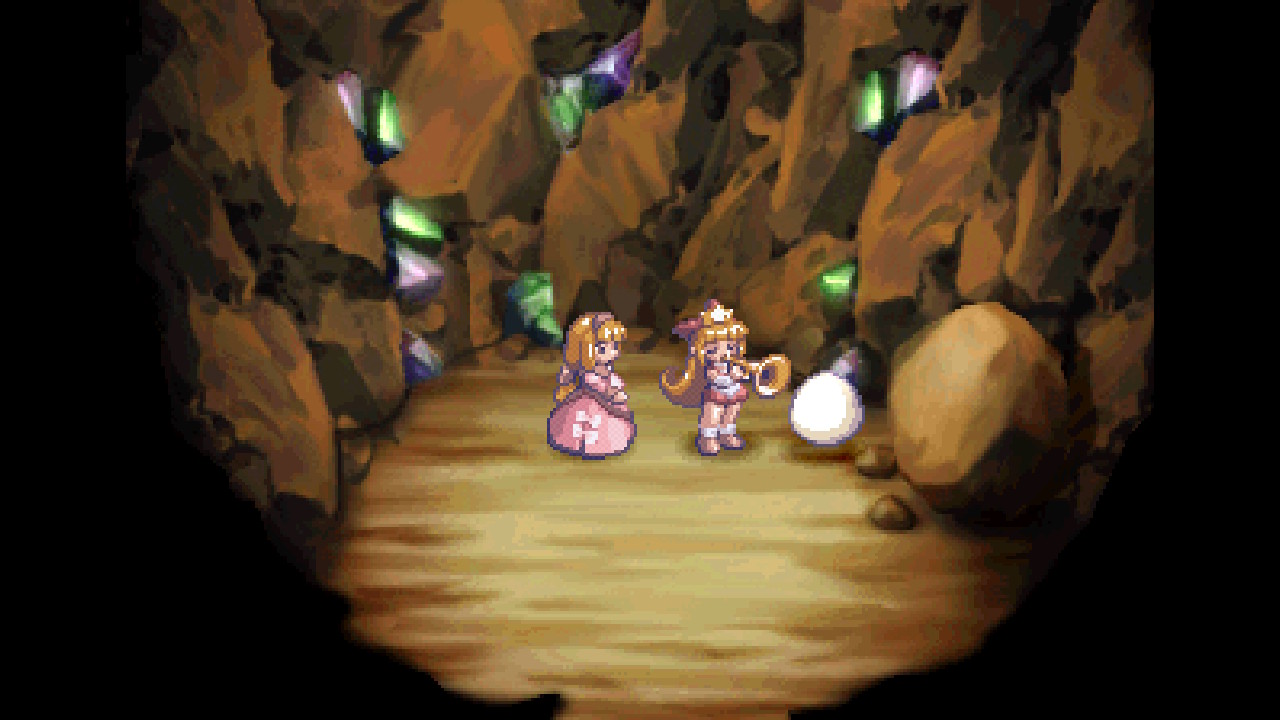
Rhapsody II: Ballad of the Little Princess takes place not too long after the end of Rhapsody, starring Kururu, the daughter of Cornet and Ferdinand. Kururu is...well, a handful, and kind of stupid, but her heart's in the right place. Longing to get out of the castle and explore the world, she and her childhood friend Crea escape the confines of the castle to explore the local area. Well, as these things go, stuff happens and she decides that in order to become a fitting ruler for the Marl Kingdom, she needs to see the world at large and experience what it has to offer. Along with her occasional party members, as well as Crea most of the time, Kururu sets forth on her own Grand adventure just like her mother before her.

Rhapsody III: Memories of Marl Kingdom is a collection of one-off style chapters that take place all throughout the timelines of the previous two games. For example, the first chapter takes place shortly after the beginning of the first Rhapsody game and details a short story of finding a young girl's mother. The second chapter takes place after the ending of Rhapsody II, and is full of spoilers. There's also a chapter about Cherie, Cornet's mother. While the chapters are somewhat eclectic, they are pretty interesting in order to get more insight into the Marl Kingdom. You can also summon certain partners over between chapters to help you out!

While both games are chapter based storylines, Rhapsody III takes a one-off style approach with different characters across chapters, and Rhapsody II is a full story centered on Kururu and her adventures. They both have their own charms, and it's probably best to play through Rhapsody III while both I and II are still fresh in your mind, while II doesn't require I to be as freshly remembered to enjoy.


Gameplay

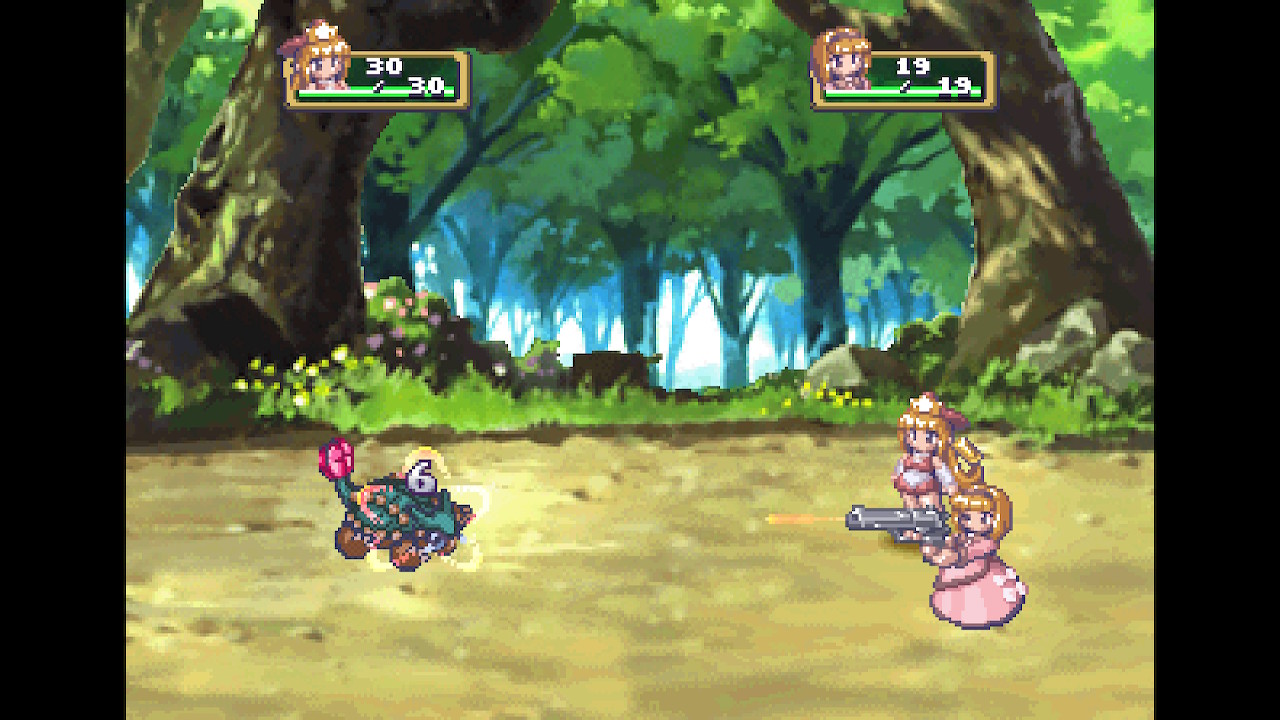
So, here's where things take a bit of an interesting turn. Both Rhapsody II and III take a pace away from the grid style turn-based battle style that the first Rhapsody employed. Both are still turn-based, just now the grid is gone and you assign partners to your leading members. Both also have map exploration and random encounters, but where Rhapsody II has 2D backgrounds, Rhapsody III is a more 3D approach. You can get up to four leaders in combat, each of which can have three partners that can use skills and give you stat changes when partnered. Certain partners have different affinities for different leaders, and some may be restricted to certain characters. You can also recruit monsters to your team by beating them, where they then turn into dolls you can use in combat. As a general principal I've found that typically monsters are less useful than partners that start off as dolls. Your partners have three accessory slots that you can fill with what equipment you want in order to help your expeditions.

In Rhapsody II the gameplay is divided into sequential chapters, where each chapter sees you tackling a different task, sometimes one chapter will lead directly into the next. You collect any teammates you can, are forced to re-equip them every time they leave the party, which is frustrating, and then either gear and stock up on items or set forth. When out in the field you start your random encounters while exploring the environment. Pro tip by the way, you can still examine things even if there isn't a prompt, although not all the time. Once battle starts, you'll see a huge difference from the first Rhapsody title. 


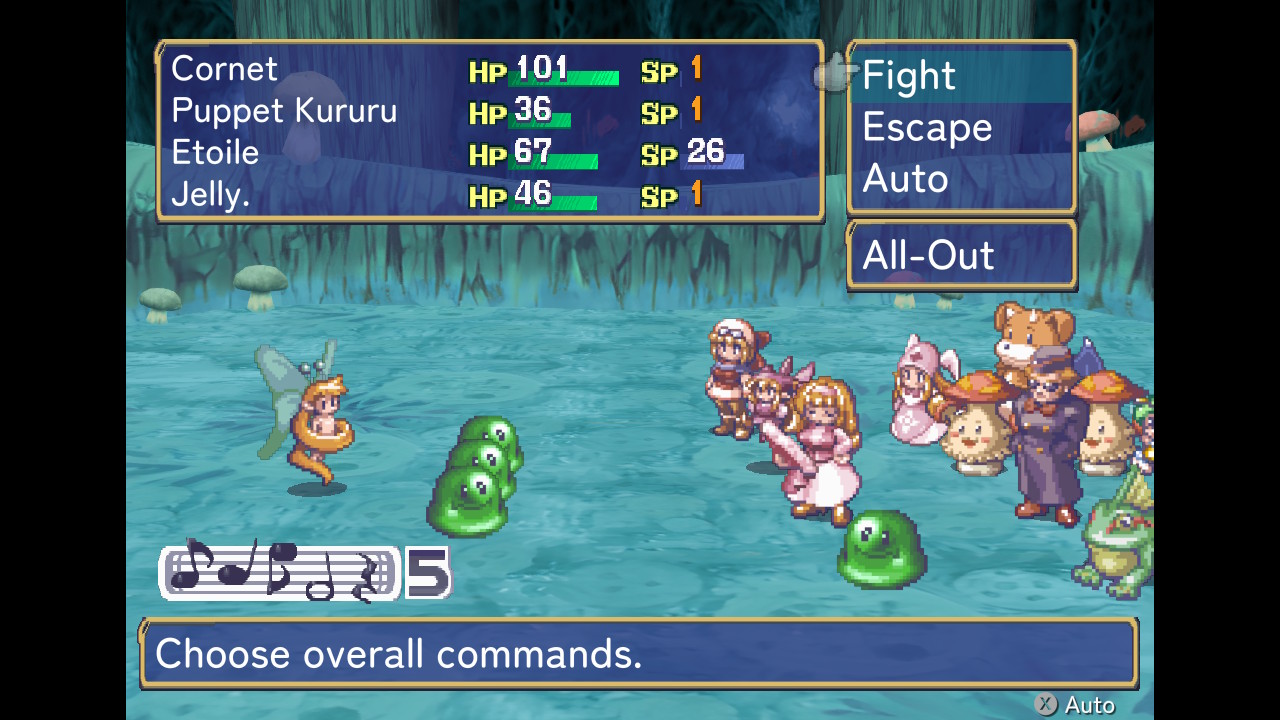
No more grids, you now have a more traditional turn-based system, where you select your actions and then you and your enemies act. While there are the standard options such as attack, flee, special, and defend, you also have a "puppet" command where you can summon your dolls or monsters to assist you. They do charge you a money fee though, which is interesting. Stronger skills require more money, and by using your partner's skills you will build up a musical bar. You can use rewards from the musical bar to either deal damage to your enemies or heal your allies. After battle, an enemy may join your ranks or you may get some items, but you will get money and exp. Money becomes fairly irrelevant to purchases fairly fast, but is still required for using your partner skills, so is always good to have. Exp is awarded to battle participants, so you need to make a choice sometimes between deciding on a lower level unit anticipating better end results or remaining with who you're currently using.

In Rhapsody III you tend to be quicker into the action, although there are some differences. While the map exploration and progression is similar, combat has taken...a turn. Similar to Rhapsody II you've got the turn based combat, but in Rhapsody III, you use your entire line of units. For example, you can assign any unit to a leader, and then line up three more units behind the leader. All four of these units participate in battle, and you have four leader slots, making a total of 16 units. In combat you control the leader, or a single one of the units as directed by the leader. The rest of the units will perform actions at their own discretion. Skills now require mana instead of money or health like in Rhapsody II as well, and they also have skill levels that will increase as you keep using the skills.

The logistics behind some of the stats and party management, like unique combos available only when certain units are in a group and at a certain level minimum can be a little disorienting. This is particularly evident once you consider there's also an elemental affinity type thing going on in the background. Fair warning by the way, battles are either trivial or really tough and there isn't much of an in-between. Unlike Rhapsody II you can also collect multiple copies of monsters to use in a grouping as well. At the friendly healing statues you can import units from other chapters, as well as release monsters back into the wild for bonuses. I'm not positive how rewards are determined, but they can be options like money, experience for the whole team, equipment, or filling the rewards gauge by a portion.


So, I do have to bring attention to a point of frustration in Rhapsody III. More units means more exp dispersal across those units, which means lower levels. So you've got to either spend the time grinding out levels for all the units, or having a smaller but higher powered group. Thankfully there is an auto battle command, but it can get a little tedious at times. Furthermore, there are chests that pop up mid battle when you defeat an enemy. This would be all well and good, but you need to smack them to open them, and if the last enemy dies before you open the chest? Or god forbid the chest drops from the final enemy? Well, you lose it, which really sucks.

Both titles also have the same sort of progression for chapters. You start of with some dialogue, followed by a decent chunk of fighting in whatever area you're exploring, collecting and buying new or better gear, and seeing if you can't recruit new teammates. As you explore you'll discover Ancient Statues which will heal you, and allow you to manage your partners in Rhapsody III. Chances are you'll probably be spending some time camping out around these statues at each new chapter while you bring your units up to par for what you want for the area you're exploring, especially during Rhapsody III.

Graphics

Rhapsody II and III have a lot of overlap in terms of graphic style. Character models are very much in that classic NIS design that you've probably come to know and love like I have. If not, they're all sort of like chibi bit-style characters. Map design and character portrait styles differ between Rhapsody II and III, with Rhapsody III having a more retro feeling character portrait and 3D style field areas as opposed to the more 2D art-style field maps from Rhapsody II. Otherwise, both titles are similar in graphical nature. Just keep in mind, these are older titles ported to a newer console, so they are still a bit dated. Ok, maybe a lot dated, but there's still that retro charm going on without compromising on the quality.

Soundtrack

With a game having a title of "Rhapsody", I'd expect it ot at least have a decent soundtrack. And good news, it does! In a world where characters will spontaneously break out into song, there are a lot of good tracks, and the general soundtrack is also pleasant to listen to. While all the musical numbers are in Japanese, they are subtitled for your convenience. Field tracks, battle tracks, as well as the musical insert numbers, in both Rhapsody II and III, are great benefits to the series and really do help to set both the tone as well as an interesting way to give character introductions or expositional pieces.

Final Impressions

Overall I'm extremely pleased to see these two Rhapsody titles finally making their way westward in Rhapsody: Marl Kingdom Chronicles. If you've played the first Rhapsody title and enjoyed it, this is a wonderful way to continue the adventure. It also ties in to La Pucelle which was part of the NIS classics collection with the first Rhapsody title in it. With a colourful cast of characters, a solid musical repertoire, and an engaging, if sometimes tedious, battle system, Marl Kingdom Chronicles is certainly a point of interest for any fans of the Rhapsody: A Musical Adventure game.


Score: 8 / 10

Share:

Monster Menu: The Scavenger's Cookbook - PS4 Review


Monster Menu: The Scavenger's Cookbook by developer Nippon Ichi Software and publisher NIS America—PS4 review written by Richard with a copy provided by the publisher.
 
Estimated reading time: 6 minute
Well folks, it's around the time a new roguelite comes out, which means my blood pressure is skyrocketing and my tears are flowing. This time we get to take a look at the NIS starvation roguelite Monster Menu: The Scavenger's Cookbook.

Monster Menu, like a large amount of roguelites, has a pretty basic premise. You're an adventurer who has gone on what was supposed to be a fairly standard adventure. Unfortunately, you get lost and run out of food and water. In a semi delirious haze, you resort to the only thing you can: eating the corpse of an unknown monster on an altar, always the best of ideas. Next thing you know, you find yourself in a sprawling labyrinth, with only a few items at your disposal. Good news though, you can't really die! You just wake up at a base camp whenever you should otherwise die. Too bad you still need to survive in order to find your way out of the labyrinth.


Like most roguelites, you are tasked with making your way through randomly generated floors to reach your goal. In monster menu, every new run sets you back down to level one, and depending on difficulty will also get rid of your materials. You do get to keep equipment though, which isn't really the most common. Monster Menu also has a few other little quirks that set itself apart from the crowd. So, let's take a look at some of the basics first.

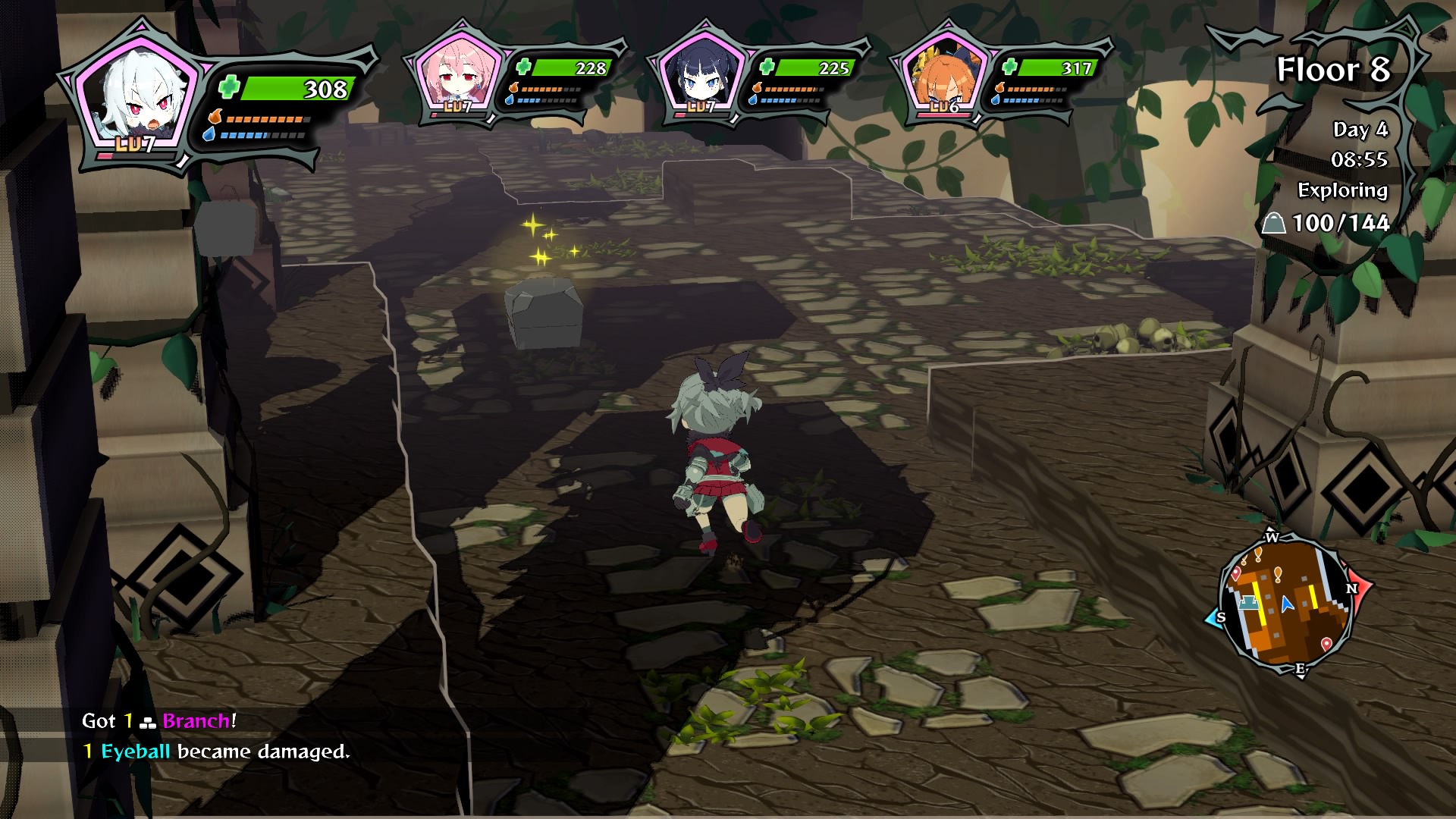
Exploration of each new floor is done in a 3D manner, where your main character, one of up to four, will be able to walk around, harvest items, pick fights with enemies, and investigate altars. Exploration is done in a real-time scenario, where the enemies and you can be constantly moving. When you make contact with an enemy, whether that be on your terms or theirs, the field map turns into a turn-based grid style map where your combat is performed in a turn order. In combat you can attack, use skills or items, defend, etc. After winning fights, you gain exp for your units, and can then scavenge the bodies for materials. When back on the field map, your goal is to find the stairs leading to the next floor, a task sometimes easier said than done.

Why is it so difficult? Well, a number of factors really, including: how the RNG treats you, the fact that time passes, your calorie and hydration values, where the stairs have decided to appear, and what sort of materials you're able to harvest. All of these aspects tie in to the major mechanic of Monster Menu: eating food. Your units all have an individual stat layout for health, calories, hydration, and happiness. It is your job to manage these values in order to keep your party in fighting shape. The only problem is, everything you do takes energy in the form of calories and hydration. Moving, attacking, harvesting, resting between floors, even just waiting around while time passes will cause your energy to slowly deplete.


In order to restore your calories and hydration, as well as give you some extra health, you will be cooking meals between floors as you investigate the labyrinth you find yourself trapped in. Point of note, materials will decay over time, reducing their freshness until they eventually become rotten. At your camp between floors, you can use ingredients to cook meals. Tastier meals made from more normal items will restore larger amounts of health, calories, hydration, and happiness. Disgusting meals, like a plate full of maggots, may give a good calorie value but your happiness takes a nosedive. When your units get too unhappy they may become prone to madness, so look out.

Meals can be prepared using a variety of different techniques, each possibly resulting in some sort of change to the dish, which will not only restore points, but will also give you food skills as well as increase stats. If you make a meal you can't take it with you into the labyrinth though, so you need to eat it at the camp. Trying to balance making meals that provide good recovery or stats while still remaining fresh can be a challenge, especially when you lose a lot of energy values every floor, and enemies and material harvesting points just don't cough up what you need. Additionally, at night time monsters get more active, and a lot tougher, so beware.

As you explore through the floors, you may run across some skeleton bones. These have a chance at netting you some crafting recipes, for both key items and repair kits, as well as cooking recipes. Good news, you also keep these on death, although you can actually cook freeform without a recipe, although it may be quite difficult to come up with a menu item if you have no clue what you can throw together, or what type of preparation is required.


Equipment can be gathered in chests found throughout the floors, and isn't necessarily of a level tied to the floor. *stares angrily at the starter cloak found in the 3rd strata*. Thankfully your gear carries over between runs but, uh, well, it has durability, so too many failed runs without any decent rolls on materials or equipment and your gear will be a lot less beneficial. It doesn't break thankfully, so you just need to make some repair kits, if you can.

So, I have to mention this, but game is tough. Like, seriously, depending on your luck and difficulty setting this game can be an absolute nightmare. It took me, like, more than a few hours just to get into the third area, and I never found any equipment better than what I had picked up in the first area. Like seriously, it was a rough go. On the other hand, I did manage to get rather good at goading enemies into locations I wanted them in, as well as hanging onto items I could feed to enemies to cause status debuffs or negative status effects.

Monster Menu is pretty fun, and the attention to the calorie and hydration aspects are an interesting focus, especially considering how you have to either make your own meals out of materials found in the labyrinth or through devouring the corpses of your enemies mid battle. It's certainly full of a lot of interesting parts that more veteran players may enjoy, and the cute chibi characters provide a nice contrast against the grim reality that you may be eating your own comrades in order to survive.


Overall, despite being hammered upside the face by poor equipment drops and RNG rolls, I am actually quite fond of Monster Menu: The Scavenger's Cookbook. The transition from freeform exploration to turn-based battles is smooth, the combat is pretty smooth, and it's interesting being able to shove your food materials into monster faces for your own benefit. If you're expecting pity though, you may be out of luck as a lot of your run depends on how lucky you are, which may be a little frustrating for some. Monster Menu definitely feels more like a title for those familiar with the roguelite genre as opposed to newcomers, but still provides the difficulty selection to allow for newcomers to play.


Score: 7.5 / 10
Share:

Check Out Rhapsody: Marl Kingdom Chronicles First Spotlight Trailer!

Rhapsody: Marl Kingdom ChroniclesRhapsody II Spotlight Trailer
ESRB Rating: TEEN
Rhapsody: Marl Kingdom Chronicles is coming to Nintendo Switch™,  PS5™ and PC* on August 29, 2023 in North America!September 1, 2023 in Europe and September 8, 2023 in Oceania.*PC sold separatelyExperience the harmonious combination of story and song inRhapsody: Marl Kingdom Chronicles, the continuation ofRhapsody: A Musical Adventure told through two captivating RPGs!Following in the footsteps of her mother Cornet, young Kururu sets out on a journey to find her own prince in Rhapsody II: Ballad of the Little Princess. Complete with more songs, a new turn-based battle system, and a story both new yet familiar, this title is ready to make your heart sing!
Visit the Game Website
Watch the Rhapsody II Spotlight Trailer
Visit the NISA Online Store
Preorder the Limited Edition

Title:  Rhapsody: Marl Kingdom ChroniclesDeveloper: Nippon Ichi SoftwareGenre: RPGAudio Language: English/JapaneseSongs in Japanese only.Text Language: EnglishNumber of Players1Release Date: August 29, 2023

Article by: Susan N.

Share:

Process of Elimination-PS4 Review


Process of Elimination by developer Nippon Ichi Software and publisher NIS AmericaPlayStation4 review written by Richard with a copy provided by the publisher.
 
Estimated reading time: 6 minut
Have you ever wanted to be a detective? How about moonlighting as an investigative manager? A contestant in a death game where you don't know who your allies are? Well, maybe Process of Elimination is the new NIS title for you!

Process of Elimination stars you as a young aspiring detective in a world rife with crime. Before the events of the game, a mysterious person called "The Quartering Duke" emerged to terrorize the populace. With the Duke's revelation, the crime rate started to spike, seeing an increase in detectives to help combat the rising crime spree. As the aspiring detective you are, you want to be able to number yourself amongst the 100 best detectives, brought together in the Detective Alliance. Luckily for you, you get a somewhat forceful nomination to the select group of individuals from the Detective Alliance being brought together to catch the Duke. So begins your investigation as you're now trapped on an island, with the possibility of the Duke himself being one of the members of the Detective Alliance.


Process of Elimination is a really interesting title. Many of you who are interested are probably thinking it'll be like Danganronpa, mainly on account of a rather similar premise. While there are a few parallels in the storytelling aspect, Process of Elimination is largely a Visual Novel, with a sort of "Clue"-esque investigation phase. The game follows a pretty standard format, where you have a large dialogue section where an incident takes place, then a sort of grid-based investigation, followed up by a resolution and exposing the culprit.

The dialogue segments are very Visual Novel style, with the occasional choice option, but largely will just be talking or explanation. The investigations, on the other hand, are a bit of a weird take, as they are both weirdly self playing at some times, and require a lot of interaction to really hammer down. During an investigation period, you are in charge of giving other detectives orders. You will have a grid-based view of the area you are investigating, and can select detectives and give them movement and action instructions. Some detectives won't trust you right away however, and will act on their own. Failing to give detectives directions when you can will also have them act on their own.

Detectives have different stats: Infer, Analysis, Investigation, Assistance, and Movement. Movement is pretty self explanatory, indicating how many tiles you can move. Infer is used on mystery points around the map in order to discover clues, while Investigation is a range that you can "examine" objects in. These objects or points of interest usually need to then be analyzed by someone with an equal or higher skill threshold in order to turn them into evidence. Assistance will allow you to help out another detective's action, adding their assistance value to the other detective's ability score.


You have a limited number of turns in which to discover all the evidence you need, but once you do, you can then move on to the other visual novel-esque portion where you put together statements by choosing correct answers to dialogue options, and then picking out the guilty party from the line-up of suspects. If you're finding the investigations a little too easy during the tutorial, you should know that there are additional dangers to be aware of. Occasionally there could be traps or enemies in the investigation zone, and the detectives will need to make an inference check to resolve the danger. Any detectives that end the turn in the range of the obstacle will result in a game over, meaning you need to restart the investigation. Additionally, there are bonus points on the maps that are either special scenes with the characters, or keywords you can pick up to get added to your in-game dictionary.

Now, I'm a little on the fence about how I feel about Process of Elimination, not because I have particular qualms about how it's put together, but rather the amount of each. The Visual Novel style segments are really long. Like, really long. It takes a very long time to get to the first non-tutorial investigation, and even then there's a massive amount of dialogue between investigations. I really wanted to see more investigations, as I actually really enjoyed them. They're like a weird combination of turn-based strategy and, I don't know, IRL board games? It's weird, but really fun. I mean, this isn't to say it was bad or I didn't like it. In fact, I actually really enjoyed the game, but I would've also appreciated a few more investigation segments, or even mini investigations just to spice things up a little more.

Now, a game like this is heavily dependent on the story telling, as it is mostly Visual Novel. Thankfully, Process of Elimination features a wide cast of characters that are both really interesting and quaintly unique. I honestly thought that all of the characters were good additions to the experience, and the story playing out was a real joy to see. Each character has their own unique aspects they bring to the table, and their own additions to the story that are all intertwined.


In terms of graphics and sound quality, the art style is well done, with a lot of emotion shown in the characters during the talking scenes, as well as well-drawn background images that will actually change based on what's happening, something I thought was really cool to see. The soundtrack is quite fitting for the title, and the tracks are well tuned to the situation at hand.

Seriously though, I can't stress enough just how entertaining each and every character is in Process of Elimination. From the serious to the funny interactions, it all felt really well done, and while I would have liked more investigations, the way the characters were laid out made the massive amount of text good enough to sit through. I also need to give special mention to the translation team for doing a really good job for any slang terms or special words or terms in the original Japanese that aren't easily translatable. As a bit of an example, one of the detectives has the moniker of "Rowdy" in English but is called "Yamato" in Japanese. This is an incredibly difficult nuance based on the character's personality, and while it may be a little off from a direct translation standpoint, it's a really good English equivalent that keeps enough of the original nuance while still getting the meaning across.


Overall, I have to say I absolutely loved Process of Elimination. As much as the storyline and translations are really well done, it is quite text heavy and some of the investigation instances can be a little frustrating when things you have no control over can screw you up. The balance between text and interactive portions is a little too skewed towards text, and it can be a little tough to get into at first, although it does ease out a little later. It's definitely an interesting title that I'd like to see more in the same vein of later in the future.

Score: 7.5 / 10


Share:

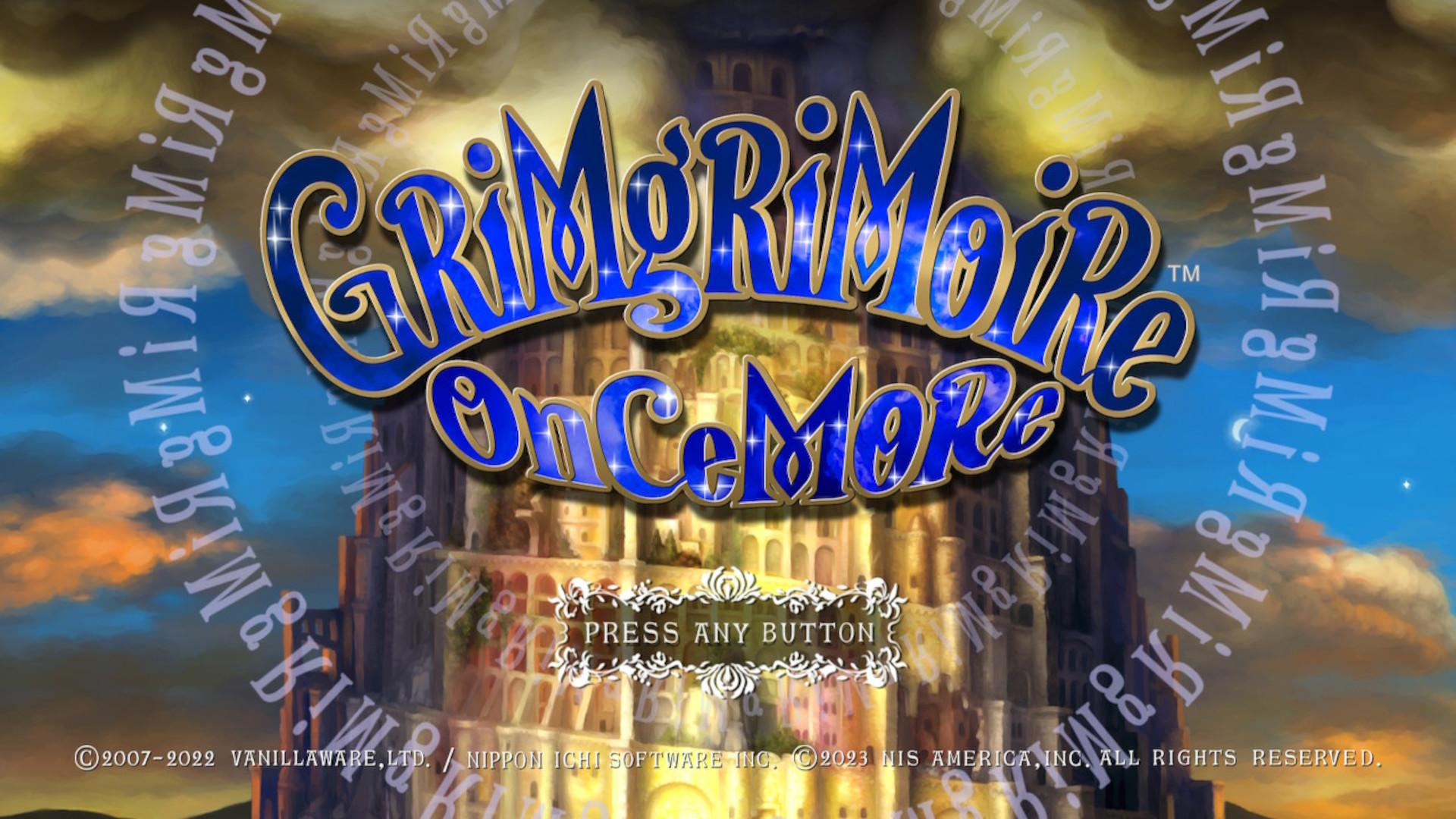
GrimGrimoire OnceMore - Switch Review


GrimGrimoire OnceMore by developer Vanillaware and publisher NIS AmericaNintendo Switch review written by Richard with a copy provided by the publisher.

Estimated reading time: 5 minutes


Those of you who remember the era of the PS2 may recall a somewhat niche title called GrimGrimoire. A title that I felt didn't receive as much attention as it should have, GrimGrimoire is now getting a remaster: GrimGrimoire OnceMore.

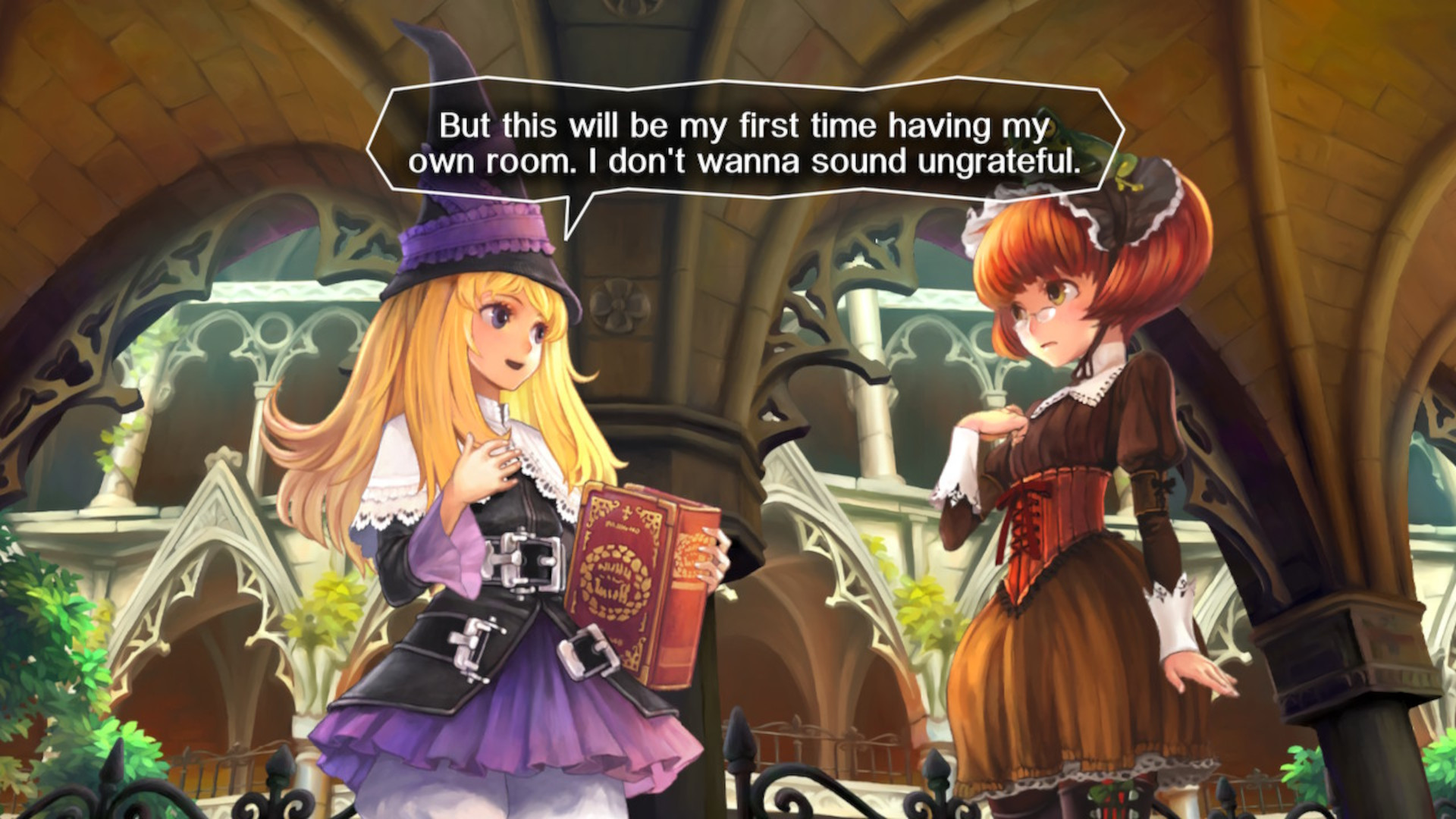
The story of GrimGrimoire follows a young girl, Lillet Blan, who has received an invitation to the acclaimed school for magic run by the famous wizard Gammel Dore. Housed in the tower formerly owned by the deceased Archmage, Calvaros, there are still many secrets hidden in the walls. Lillet excitedly takes to her studies, opening her first grimoires and delving into her magic studies. Unfortunately for her, only five days after starting, a horrible tragedy occurs and Lillet awakes five days ago on the eve of her induction into the school. So it begins, as Lillet strives to figure out what's happening in the tower, and to solve the mystery of her looping through time, hopefully while saving the others in the tower.


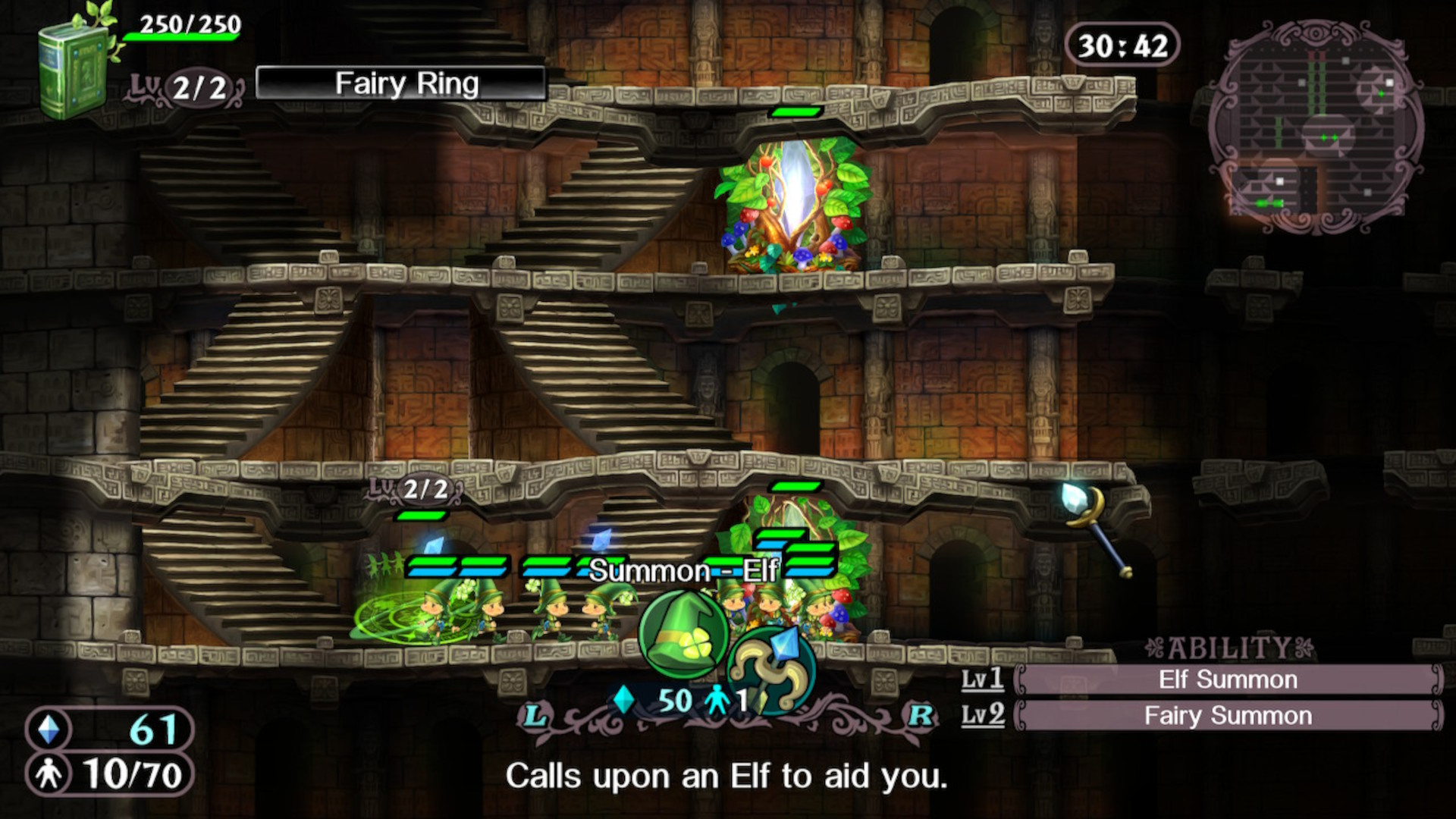
GrimGrimoire Oncemore is an interesting game, as it's sort of split between Visual Novel-esque storytelling, with battles between. Battles are what I can only describe as a sort of "side-view anime Starcraft", if I had to make a comparison. Essentially, battles are a sort of tower defense/reverse tower defense sort of deal. You'll generally start out each battle with at least one rune and a few gatherer units. You can send the gatherer units to crystals around the map in order to harvest mana. Mana can then be expended in order to summon more runes, upgrade runes, or summon units. Each fight usually has you either surviving a set amount of time, or destroying all of your opponents' runes.

Runes come in four types: Glamor, Necromancy, Sorcery, and Alchemy. Each rune type is effective against one type and weak to another. You can summon new runes for a mana cost, as well as upgrade them to allow you to summon more unit types or to improve the capabilities of your summonable units. Here we come to one of the improved aspects in the Remaster: the skill tree. In order to unlock new units and bonuses, you need to purchase upgrades to the associated runes, and then upgrade them in-fight in order to receive the benefits.
 
Something you will notice pretty quickly about GrimGrimoire is that there is a bit of repetitive nature to the fights. While you will get a bit of variety in the beginning as you are unlocking more runes, once most of them are unlocked, battles feel pretty similar to one another. The upgrade tree helps add some freshness that is sorely needed. As you complete stages you will earn coins to spend on upgrades. More coins can be earned by completing bonus objectives issued at the start of the fight, or by completing the trial stages.

Trial stages will generally restrict you in some way, or give you specific win/loss conditions. More trials become available as you progress through the story, and can both be a nice break from the story missions, as well as a good source of coins for the upgrades. Another cool addition is that whenever you clear a stage, trial or otherwise, you get a piece of artwork. For story stages, these are some really pretty full size images that were really nice to see after completing a battle. The trials have some interesting themes and layouts, so I highly suggest checking them out if you do pick up the game, although they aren't strictly necessary in order to complete the game.

GrimGrimoire isn't a particularly long game, with my playthrough coming in at just about 17 hours total play time, including the trials. That being said, the game offers three starting difficulties of easy, normal, and hard, with a hell mode unlockable for story missions upon clearing the game. What it does have is a great cast of voice acting, including one of my top 5 favourite evil laughs in gaming, cute animations for the monsters you can summon, as well as a nice background music soundtrack as well as fitting and well-drawn visuals. While Vanillaware isn't able to showcase the full extent of it's art in GrimGrimoire, you certainly do get the distinct taste of it.

Now, for those returning veterans who are familiar with the original, there are a few things new you should make note of. First up, the skill tree system I mentioned. The difficulty rating also seems to be largely revamped, including access to Grand Magic, which can be cast at default once per battle, and can serve one of four functions, such as reversing time, healing units, a large scale attack, or giving you a mana boost. Additionally, and a function that made me squeal in joy, is the ability to fast forward in-battle. Yeah, that's right, instead of waiting literally 2 minutes for mana gathering/unit movement, you can speed up time to zoom through those annoying waiting periods. The visuals have also gotten an upgrade so it no longer looks like a PS2 game.

Now, I would like to point out that despite the fact I mentioned the stages get a little repetitive, that doesn't mean they're all the same. Depending on your play style, each battle can be very different, as you may prefer one unit type to another, or make units based on enemy weaknesses. The stages are also constructed in different ways, as some units may be able to pass through floors and walls, but others cannot, meaning you have to set up bases and organize how you're utilizing your units. While it doesn't help much that the backgrounds are mostly the same, a lot of the time you'll most likely be too focused on the fights rather than what's behind the stairs.

Overall, I have to say that GrimGrimoire Oncemore is a great remaster to a wonderful title from the PS2 era. With a number of greatly appreciated improvements, such as the ability to speed up time in battle or the introduction of Grand Magic, it adds that extra oomph for those who have played the original, as well as reducing some of the more aggravating mechanical aspects for newcomers. With a great story complemented by equally great voice acting, GrimGrimoire Oncemore is a great RTS title for you to enjoy.

Score: 8.5 / 10
Share:

Void Terrarium 2

Void Terrarium 2 by developer Nippon Ichi Software Inc. and publisher NIS America Inc.PS4 review written by Richard with a copy provided by the publisher.

Estimated reading time: 5 minutes


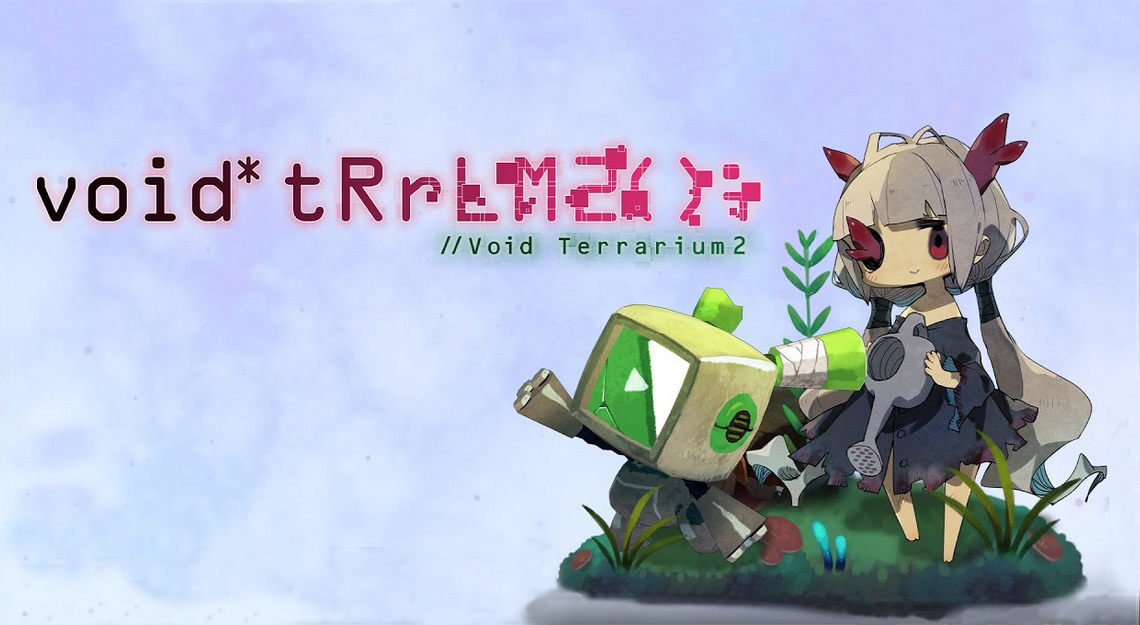
void* tRrLM2(); is certainly one heck of a title. You could also just call it "Void Terrarium 2". A cute but weirdly dark roguelite and Tamagotchi mash-up. What does this cutely drawn dread have in store for you? Well, let's find out.

So first off, I'd like to preface this by letting you know that if you've played the first Void Terrarium, you pretty much know everything you need to. Void Terrarium 2 doesn't differ a whole lot, and what is different isn't a make-or-break deal. Short version is, if you liked the first title, you'll like this one. For those unfamiliar with the first title, no worries! I've got you covered!


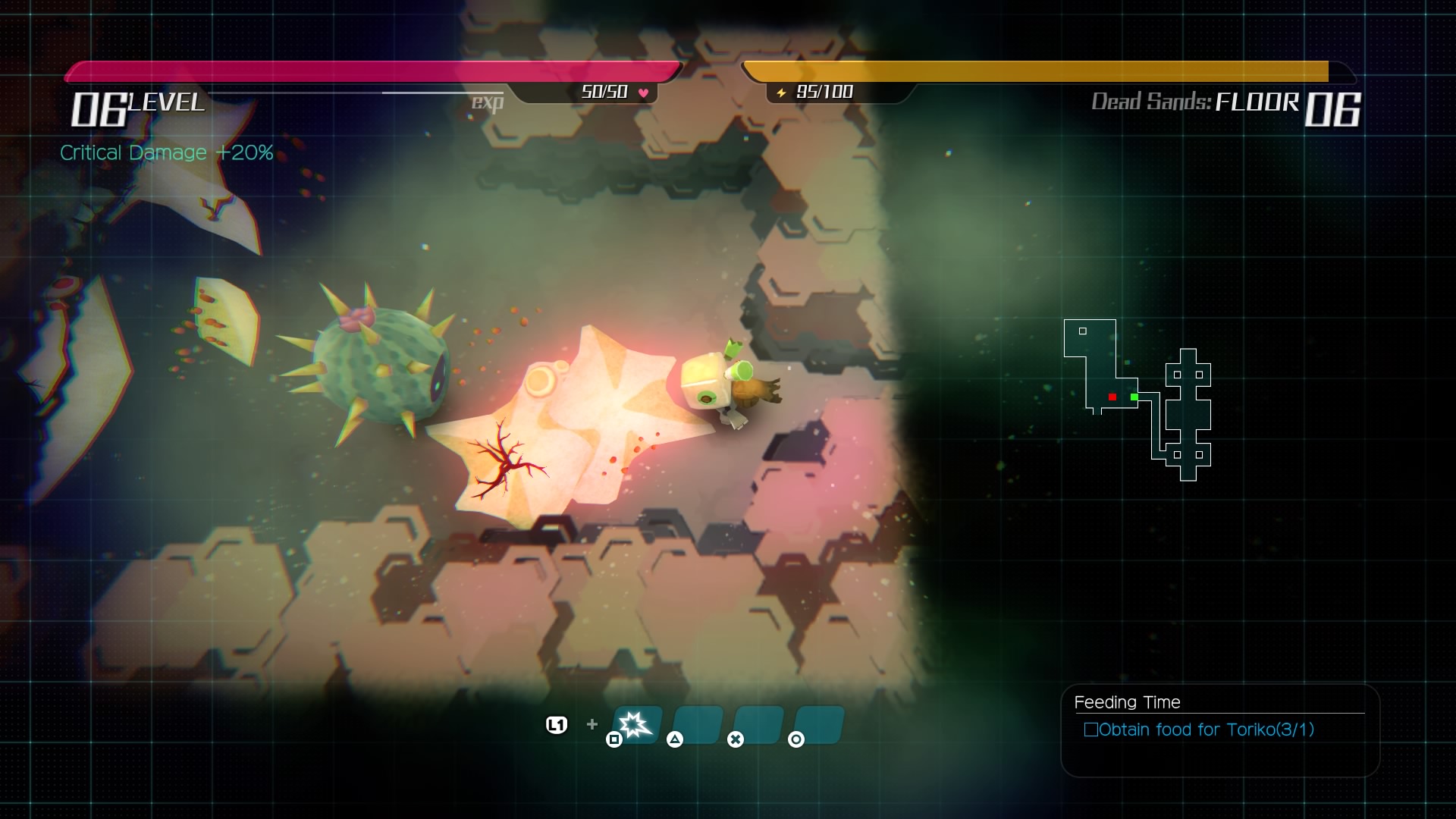
In Void Terrarium, and Void Terrarium 2, you take on the role of Robbie, a cute looking robot in a post apocalyptic world. Turns out humans have died out, but lucky you, you've discovered a young girl (in the first game), Toriko! Unfortunately, the atmosphere is chock full of these nasty contagious spores. As such your job, along with the helpful AI bot, is to build and manage a terrarium for Toriko in order to keep her clean, happy, and well fed. 

Obviously this isn't necessarily the easiest task, as food isn't readily available. Furthermore, the wastelands that now make up the vast majority of the world aren't exactly the friendliest of places. Filled with mutated and corrupted monsters, as well as rogue robots, you need to fight your way through the wastelands, discovering items, food, and blueprints to bring back to your home base for use in Toriko's terrarium.

So, how is this a Tamagotchi/roguelite mash-up? Well, when you're in your base, you need to clean Toriko's terrarium, feed her, pet her, get her medicine if she falls ill, and generally just take care of her. You can also craft items for the terrarium in order to decorate it. When you need to craft things though, you need to traverse the wasteland, which is where the roguelite aspect comes in.

Exploring the wasteland is no simple matter, but it is quite arduous. Luckily for you, Robbie is quite durable! Even if Robbie "dies", all his items get converted to resources, except food and blueprints, and he is sent back to the main base. Lucky for you, all your items except food and blueprints get turned into resources on a successful run anyways, and you still get to keep the food either way. Blueprints require you to actually return to base from a completed excursion however.


While out exploring, this is when the roguelite aspects take play. Each zone you explore consists of a number of floors, each with a series of connected rooms. You can find enemies, items, or traps in these rooms. Whenever you leave on an expedition, you will always start at level 1. Defeating enemies, or using a certain item you can find, will increase your level. Upon leveling, your stats go up and you get to pick from one of two randomly chosen upgrades. Take note however that these upgrades are selected randomly, so if you're hoping to see the rare and good upgrades, you may be disappointed.

As you progress through floors, enemies will also be getting stronger. Sometimes you can find weapons, shields, or throwable items such as grenades to help you on your way. Trust me when I say not getting a weapon for an entire run makes things really difficult. Even without any decent items to find, you still have to fight your way toward victory though. Each "room" in a floor is connected by tunnels, and floors are traversed by moving Robbie on a sort of square grid. You can see what's in your room, but not in other rooms. Once you enter a connecting tunnel, your vision gets restricted. Both you and enemies move in order, where enemies will move after you perform an action, whether that's attacking, moving, or using an item.

There are a few things to keep in mind while fighting with the local wildlife, mainly energy consumption and skills. Robbie only has a limited amount of energy, and running out causes his health to deplete. It's a good idea to keep energy restoring items around. Skills are generally attached to weapons, and for an energy cost will perform an action. For example, a lance may have the Kite skill, which attacks and does a backstep at the same time. There is a cooldown though, so be aware of that. As an added note, if you're standing on a tile with an item and can't pick it up because your inventory is full, you can still interact with it through your items menu.

Fighting isn't the only thing you''ll be doing in the wilderness though, because Toriko needs constant upkeep! At a certain point you get a sort of robotic nanny/monitor that you can give instructions to for an energy cost, thereby keeping Toriko clean and well fed. There are a few other mechanics that are pretty common staples to the roguelite genre, all of which can be reviewed either through the main menu or through some tutorial/practice stages set up in-game.


After returning, you can craft plot items to progress the story, or various decor to give Robbie some permanent status upgrades. That's right, even in death not all is lost, as you can come back stronger than ever if you keep making new decor items. You may only receive the bonus the first time you craft a new item, but they can really make the difference between a successful run or a failure.

Summary

Overall, I have to say I really enjoy playing Void Terrarium 2. The gameplay is enjoyable, and keeping Toriko healthy is an interesting mechanic to keep things fresh. The graphic design is cute but hides a darker nature, and the soundtrack is both fitting and engaging. Void Terrarium 2 is a (mostly) cute exploration into a destroyed world, and while it can be frustrating at times, I felt it was a thoroughly well fleshed-out title. While maybe not offering much more than its predecessor, there's no reason to fix what isn't broken either.

Score: 8.5 / 10

Share:

Random posts

Our Streamers

Susan "Jagtress" N.


S.M. Carrière

Aldren


Affiliates

JenEricDesigns – Coffee that ships to the US and Canada

JenEricDesigns – Coffee that ships to the US and Canada
Light, Medium and Dark Roast Coffee available.

Blog Archive

Labels