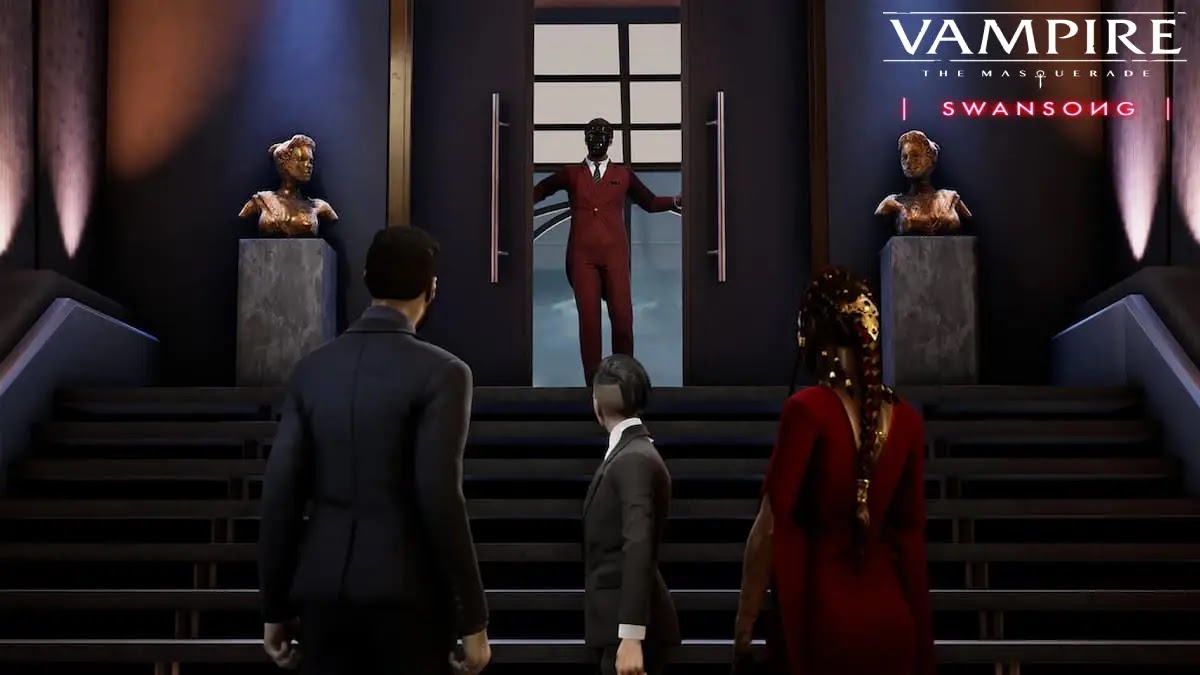
Vampire the Masquerade: Swansong by developer Big Bad
Wolf and publisher Nacon—PC (Epic Games Store) review written by Susan N.
with a copy provided by the publisher.
Estimated reading time: 8 minutes
Vampire the Masquerade: Swansong is a
roleplaying game based on the original tabletop RPG created by White Wolf
Publishing. Like the tabletop game, the video game focuses on
vampire political intrigue and investigation. Unlike many video games, Swansong
features three different protagonists that intermingle throughout the story. To
that end, the plot of the video game is interesting if not a little disjointed
for many.
Gameplay
One of the first points about Vampire the
Masquerade: Swansong is that the game is quite gruesome. Furthermore, the video
game drops players in the middle of a story which is confusing to new players
of the genre, and the hook I found to be somewhat strange.
As a player of the tabletop RPG and the
Live-Action version, it’s quite apparent to me that this game is designed
around players familiar with the World of Darkness. I know this because of the
dialogue choices, cutscenes, political structure, and available character
abilities. Characters mention clans like they themselves indicated specific
traits. However, if players aren’t familiar with clan traits and backgrounds,
Swansong provides a handy codex! To newer players, this is useful, but to experienced
players, information is sometimes shoe-horned through dialogue.
Swansong features skills and disciplines
familiar to World of Darkness fans. At the end of a scene, players gain
experience based on their success rate which is where players can boost their
abilities. In this way, Swansong feels very much like a tabletop game portrayed
in video game format. During a tabletop or live-action game, players begin
without knowing what they are walking into. It is only after certain events do
players receive their experience points.
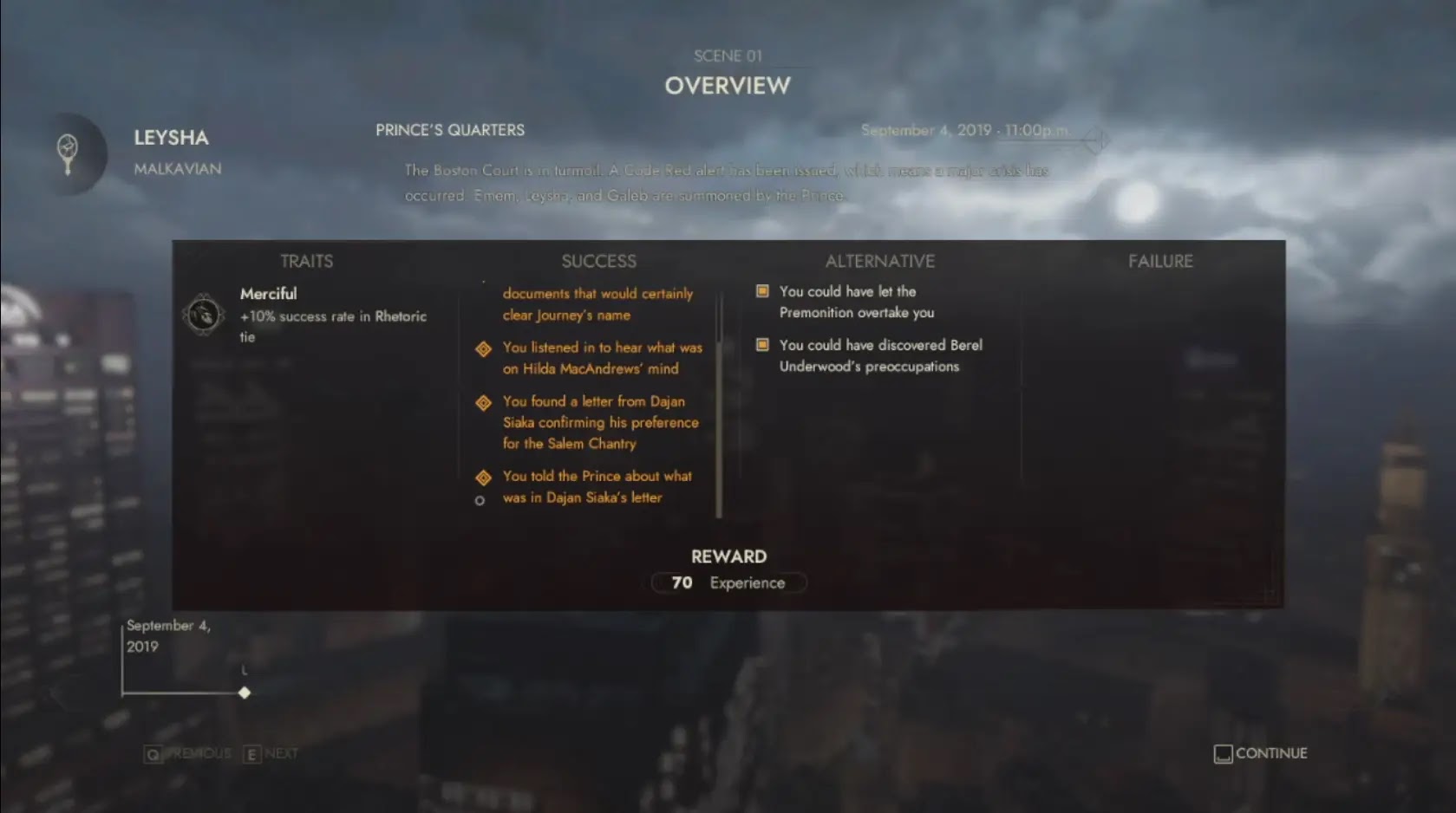
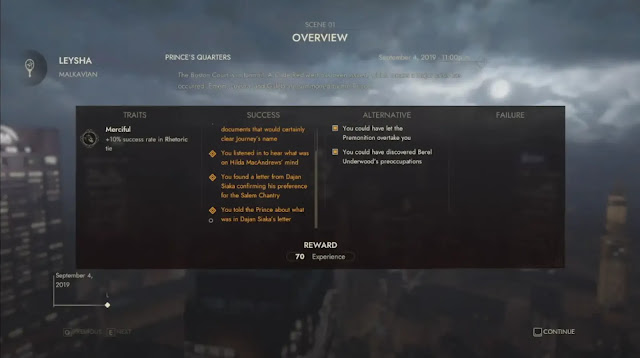 |
| Experience screen at the
end of a story section |
The Story
The storytelling in Swansong is done
moderately well. Protagonists interconnect through their individual stories,
which is fascinating. For the most part, while it seems to be disjointed at
times, the character connections blend well together. That said, the beginning
part of the story is what bothers me the most.
We answer the Prince's call because
Vampire society is in the middle of a ‘Code Red’. The Prince indicates to your
character Emem that you can be part of the Primogen Council. For me, this is
the first problem. Emem, Galeb, and Leysha are all 12th or 13th generation.
Thus, are all new vampires that have NO STANDING in vampire society. Beginning
at such a low level without having achieved anything significant doesn’t mean
players can be on the council. I expect that vampires between the 3rd and 7th
generation would be selected, not any of these three characters! It just
doesn't make any sense.
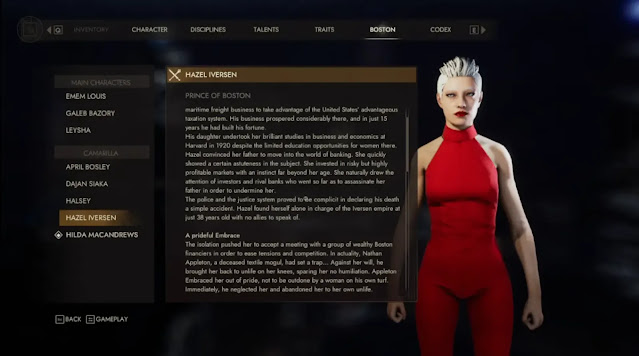 |
| The Codex, featuring the
Prince of Boston |
Incidentally, that isn’t the only aspect
of the introduction that irks me. Players begin in a large establishment that
requires a good deal of walking around. And thus, it is easy to run around in
circles. Also, there is no central database for collected information! Swansong
requires players to write down information or simply remember. Thankfully,
players can screenshot information - oh wait Epic… *ahem* Moving on...
Dialogue
The dialogue in this game often bothered
me for a couple of reasons. Firstly, the introduction has cringe-worthy
dialogue when clan names are inserted into a discussion like the names
themselves are significant. My problem is often the wording. I chalk it up to
the writers attempting to make significant points in a short time but they
spectacularly fail at it. This aspect needs work, in my opinion.
Secondly, the voice acting felt a bit
stilted due to the writing. I know that dialogue is challenging but sometimes
Swansong misses the mark. Also, the pronunciation of certain words grates on my
nerves. For example, I can't stand how characters pronounce Camarilla. It is
also not the only example of a different pronunciation either, just the most
obvious one.
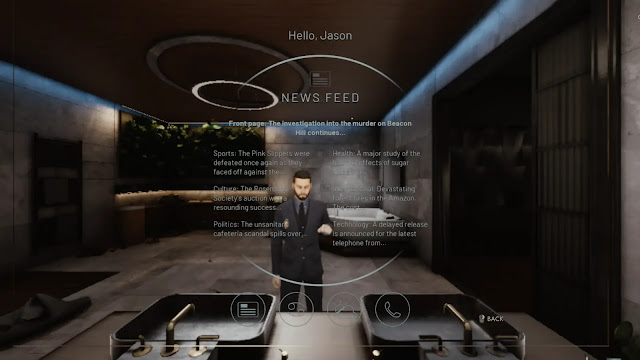 |
| Galeb looking at a neat
digital phone on the mirror |
Regardless of those points, dialogue not
only gives players key information but also gives them the option to use
character abilities. Players can use psychology, persuasion, intimidation, or
rhetoric to gain information. The more points players put into their abilities,
the easier the late game becomes. I enjoy this aspect of gameplay because
players are able to boost their success percentage when augmenting abilities
using their willpower.
Confrontations
During dialogue sections, players will
face a mechanic known as a confrontation. Confrontations occur frequently in
real life, so including this element in dialogue not only makes information
gathering interesting but makes dialogue much more dynamic. This is an element
that I enjoy in Swansong since players can miss out on critical information
should they fail. Even if players choose to focus on one of their abilities,
there is no guarantee that players will be successful during a confrontation.
As such, players must manage their willpower and blood usage at all times.
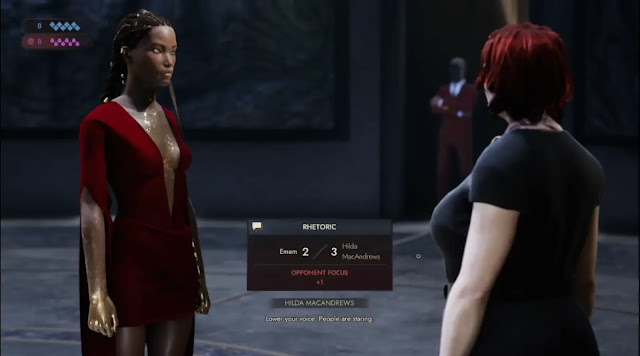 |
| Confrontation box when
the NPC uses their focus |
Investigation
Regular readers know that I love
investigation games. This one hooked its fangs into me rather quickly because I
wanted to know what was happening. Having said that, I find that some of the
clues to solving puzzles were too obfuscated for many gamers. Today, people
rely too heavily on hints to progress a story where Swansong doesn’t hold the
player's hand as other games do. Additionally, players can't save scum their
progress. Since this direction was taken, I had hoped that there would be an
in-game notebook or something to log gathered information because players are
expected to solve puzzles themselves. Personally, I think the inclusion of an
in-game logging system would be beneficial to Swansong. Or, you know, for Epic
Games to have a screenshot function...
Character Experience
Unlike the tabletop RPG, the experience
distribution is different. According to the 20th Anniversary Edition of Vampire
the Masquerade's rulebook (shown below), raising an ability is double the cost
of what it is going up to. If going from 1 point to 2 points, it will cost 4
points in the tabletop version. However, in Swansong, using the same example
would cost a total of 30 points. This may be higher because of the lack of
combat which allows for a much higher ability to spend skill points. While I
find that these values are quite a bit higher than they should be, it forces
players to carefully spend their experience. If players try to branch out too
much, gameplay will become virtually impossible later on. However, the game
always gives players one path to pursue, regardless of their skill
expenditures.
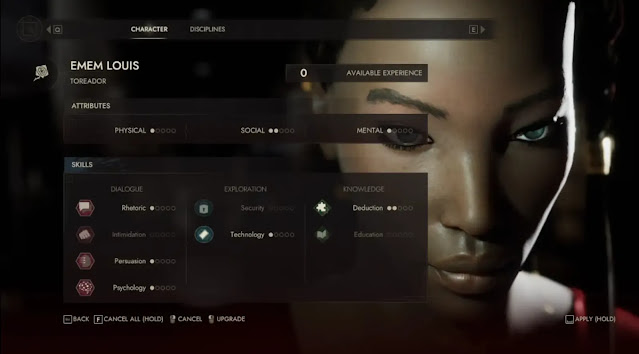 |
| The character sheet |
Graphics
Swansong has some amazing graphics which
span from elaborate prison cells to bloody crime scenes to large underground
garages. The detail in many of the locations is breathtaking. I love the
vacation area inside a building which feels like a player is in a whole other
location. As such, players might forget they are inside a large apartment
building. Also, the party location is quite immersive and rather gruesome
because it is incredibly bloody. The developers certainly know how to create a
dark atmosphere.
That said, of the main characters, Galeb
is the one that is visually the best. The artists did a fantastic job of
nailing a brooding and strong vampire with a piercing gaze. Emem has a
fantastic rebellious nature and her outfit kicks ass. Even her expressions look
great. Leysha, however, has a facial expression that just doesn’t sell the
character's emotion well. Thus, while I generally love the look of the game,
there are characters and graphical aspects that I wasn’t crazy about. Apart
from that, the only other glaring issue I had was the lighting. In several
locations, it was simply too bright, even after adjusting the settings. Having
some options to reduce the bloom or the glare would be a fantastic addition, in
my opinion.
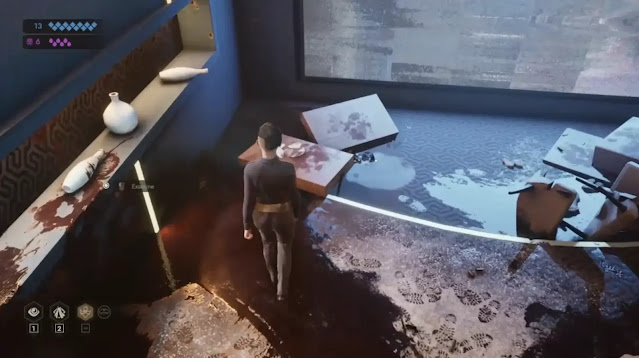 |
| Leysha investigating the
party scene |
Final Thoughts
Overall, Vampire the Masquerade: Swansong
is an intriguing RPG investigation game that just misses the mark. While I do
love the game, some aspects need a bit of improvement to get players to sink
their teeth into it.
Summary and Score
Big Bad Wolf did a great job
translating a tabletop RPG into a video game format by showcasing disciplines
and abilities in a way that works well in this medium. Having the ability to
see what Auspex visually looks like is fantastic. Plus, the overall aesthetic
of Vampire the Masquerade: Swansong is quite impressive if not different. I
feel as though the investigation aspects could be fleshed out more, but they
weren't too challenging for a puzzle aficionado to play without any assistance.
Swansong doesn’t scream game of the
year, but it is visually detailed and grim, set within a rich world. I love it
despite the minor flaws it has.
Score: 8 / 10
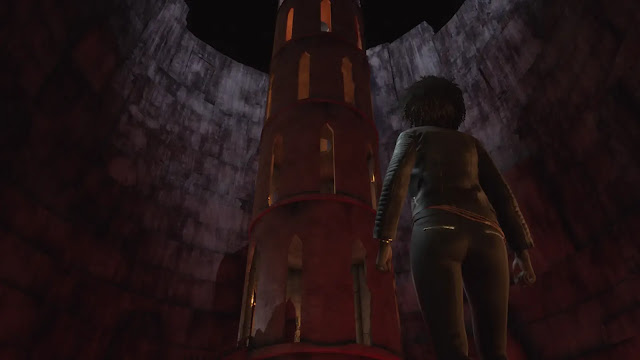 |
| Emem
in a strange place |


 WB
GAMES LOGO, WB SHIELD: ™ & © Warner Bros. Entertainment Inc.
WB
GAMES LOGO, WB SHIELD: ™ & © Warner Bros. Entertainment Inc.