• Gobliiins Collection - Switch Review

    In the early 90s, Coktel Vision (which later became Sierra On-Line) released a quirky point and click adventure game titled Gobliiins which had players bouncing between three different Goblins to find a cure for good King Angoulafre.

  • The Core - PC Preview

    Sometimes when you are browsing the internet for information on how to do something, you stumble upon ideas or projects or even games that people might be working on...

  • Cat Mail Co. - PC Review

    What a meow-gnificent evening it is to send your paw-rcels out to those family and friends! Are mew looking to pick up an item or send something out? Well at Cat Mail Co. we can send and receive all your deliveries!

  • Volontes - Nintendo Switch Review

    Have you ever grown up feeling like you don't belong? For our Heroine, that's the feeling she lives with everyday in her small farming village. But it's not her only secret...

  • STARSEEKER: Astroneer Expeditions - PC Preview

    STARSEEKER: Astroneer Expeditions is just that! Massively co-operative and not an MMO! When you first run the game you are instantly into the tutorial...

  • Dread Delusion - Xbox Series X|S Review

    Today we’re looking at what has rapidly become an absolute favorite in the open-world RPG genre for me. An interesting story, memorable NPCs, stunning visuals, and a setting absolutely dripping with flavor, Dread Delusion sets its tone immediately and sticks with it.

  • House Flipper Remastered Collection - PC Review

    I enjoy simulation-type games, and I enjoyed the original release of House Flipper, but I never got around to getting the DLC. When the remastered version of the game was released, I figured it would be the best way to experience the DLC while checking out how the base game was upgraded.

  • GranBlue Fantasy: ReLink Endless Ragnarok - PS5 Review

    GranBlue Fantasy: ReLink released in 2024 bringing the GranBlue universe to an action adventure JRPG format. With a party of up to four members, this band of skyfarers set out for new skies, adventures, and dangers. Two years later, Endless Ragnarok...

  • 70s-Style Robot Anime Geppy-X - PS5 Review

    70s-Style Robot Anime Geppy-X is a mouthful of a title, but you know what? It’s quite the challenging game to describe as well. At its core, 70s-Style Robot Anime Geppy-X is a shooter...

Showing posts with label Touhou. Show all posts

Touhou Mystia's Izakaya - Switch Review

Touhou Mystia's Izakaya by developer  二色幽紫蝶, and Re零同人社 and publisher Phoenixx—Nintendo Switch review written by Richard with a copy provided by the publisher.
 
Estimated reading time: 7.5 minutes
You ever have the urge to help a Japanese "Night Sparrow" run an Izakaya (late night pub type restaurant) in order to help pay off debts? Well, neither did I before now, but it's all I can think about at the moment.

Touhou Mystia's Izakaya is a cozy restaurant management type game based on the Touhou Project universe. In it you take on the role of Mystia Lorelei as you collect ingredients by day, and run the Izakaya by night, serving Gensokyo's residents. You will interact with the locals and procure ingredients by day, as well as completing requests for the locals, then at night you open up shop to try and rake in some cash so you can purchase new or different ingredients and to pay off your debts.


Mystia's Izakaya is a really laid-back 2D pixel art game that's really comfy and surprisingly relaxing to play. The gameplay loop is separated in two segments: the daytime and the nighttime. During the day you'll be checking out areas looking for cooking ingredients, buying things from the merchants (whether that's food, recipes, or additional cooking tools), completing requests for the locals, both unique and generic, and hanging out with your friends. Once night falls, you will be prepping your store by selecting what items to put on the menu, getting your tools in order, choosing where and what size storefront to use, and serving customers.

During the day you will have a set amount of time with which to gather what you need. Moving between areas, prepping food in advance, inviting a rare character to visit the restaurant, and harvesting items all take half an hour of time. Chatting with people, buying items, and interacting with characters, whether for sidequests or your assistant Kyouko for tips and tutorials doesn't take time. Once the time of day has advanced enough, you are then set to open your izakaya. Keep in mind you can choose to skip the daytime dealings if you want, and go straight to opening shop if you want. Also of note is that available harvest points change depending on time of day, and some rare gathering points are only available during limited periods. As an example, there is a rare gather that is only available early morning on the Yokai Trail (starting area).


As I mentioned, you can get requests from characters. Some of these are from the local newspaper clippings you keep, which also detail interesting tidbits as well as currently popular food types. Other requests you'll get as your bond with the rare customers goes up. It's a good idea to complete these, as they usually give not only a little bit of money, but also cooking ingredients and new recipes! New recipes can also sell for more money when you open shop, so it's probably a good idea to give those requests a shot.

Alright then, now that you've finished your gathering and request fulfilling, it's time to open the shop! First step is deciding where to open shop, provided you have more than one location available, how big you want the shop to be, and who you want as an assistant. Location determines who shows up, and different areas may have different levels of foot traffic. Size determines how many tables you have for guests. While guests will wait to be seated, usually more tables means more guests show up regardless. As a comparison, the amount I earned on the Yokai Trail between level 1 and level 2 size was 500 to 2000 yen in earnings. Yeah, it's a fairly sizable chunk for doubling seating. You can also hire an assistant to help out. You can also tell them what to help with, either handing out drinks to the customers, taking food from the storage area for them, or helping you out. 


Next up is selecting your menu. This includes dishes you will serve, drinks available, and what cooking tools you will set up. You only have a limited amount of space for these, so pay attention to what you're selecting and how many of each you have the ingredients to make. Don't want to run out mid dinner rush, now do we? Good news though, not having an item on the menu doesn't mean you can't make it, it just means that the common customers won't order it, and you have to make it manually if you want to give it to a rare customer.

But I'm getting ahead of myself here. After you've selected your menu and prep, you can open shop. Customers will come by, sit down, and then place an order. You then start cooking for them. For the common customers, they will order off your menu, so you walk up to the cooking implement needed, select the recipe, then start cooking. You can also play a little rhythm minigame when you start the cooking to have a chance of giving you a buff. My personal favourite is the ability to yeet the food you make (like a basketball player trying to beat the buzzer) at the customers, meaning you don't need to walk over to the tables. Food will cook on its own once started, so you can set up a bunch as needed. Once done, you can take the food to the table for them.

Now we get to talk about the exciting part here: the rare customers. Essentially these are the named unique characters that are part of the Touhou universe. These customers are...well, awful if you've ever worked food service, or even retail. These customers give you hints at what they want, such as "I like sweet food" or "I can't stand mild flavored food" and it's up to you to select a dish that suits their taste. As an added bonus, you can add extra ingredients to the dishes to add extra tags to it. Each dish has certain tags associated with it, and each ingredient has it's own tags as well. Some dishes aren't compatible with certain tags, which will cause your dish to fail.


Rare customers also have an extra aspect to them: spell cards. Basically, if your dish is too outside of what they want, or extremely in line with what they want, they will use a spellcard. If they're happy, it's a positive effect, such as attracting more customers or giving you ingredients. If they're unhappy, it'll be a negative effect, such as covering your work area in a dark cloud so you can't see what's going on.

Now, considering how many characters populate Gensokyo, remembering their likes and dislikes can be pretty demanding. Thankfully you always carry around a handy dandy notebook. This notebook automatically records everything you need, whether it's personal stats, recipes, current ingredients and items, character info, such as likes and dislikes, and what tasks you currently have, both for story purposes and requests. Seriously, the notebook is absolutely packed full of a ton of info. Anything you need can be found in there. More good news, while you're looking at the notebook, time is paused so your guests don't get tired of waiting and leave.

After a set amount of time passes, you'll now close up shop, count your earnings, and earn exp based on the number of guests served. Yeah, that's right, there's a bit of an RPG mechanic going on here. As Mystia levels up, her cooking speed, customer satisfaction rate, chance of activating a singing effect, tips earned, etc. will increase. You also unlock new recipes at certain level benchmarks, so you definitely want to do your best.


So, let's talk a bit about some miscellaneous items. First up, the music is really soothing, so Mystia's Izakaya really does end up being a pretty relaxing game for the most part. Well, unless you get a big rush of people, but even then it isn't too bad. Also, all the DLC is included in this Switch release, which adds a nice chunk of content. The only real negative aspects I can think of are that the game does get a little repetitive by nature, so make sure you're ok with this style of gameplay, although the daytime gathering/questing period helps alleviate this, and the selected highlight. What do I mean by the highlight? Well, the box surrounding whatever you have "selected" blends in too much, so it gets really hard to tell what you have selected. On a cool other note though, there's a jukebox type thing set up where you can play some rhythm games for fun.


Overall, Touhou Mystia's Izakaya is a really great and comfy restaurant manager sim. The food service is both rather simple, but with some complicated aspects thrown in to help spice it up, and the gathering makes a nice break to keep the nighttime food service fresh. The rare customers provide an interesting and unique challenge, the variety of recipes and additional ingredients is nice, and the rhythm minigames are a nice spice. I definitely recommend Touhou Mystia's Izakaya to anyone looking for a relaxing restaurant management type game to pass the time. Easy to pick up or put down, it's quite addicting.

Score: 9.75 / 10


Share:

The Touhou Empires - PC Preview


The Touhou Empires by developer Neetpia and publisher Phoenixx Inc.—PC(Steam) preview written by Richard with a copy provided by the publisher. 
 
Estimated reading time: 4 minutes
Attention all fairies! You have your marching orders, it's time to fight off our attackers! Get in there and beat them up! Demolish their barracks! Steal their snacks! Ok, maybe not that last one, but this is war, so war is what you're gonna get!

The Touhou Empires is another one of those cool Touhou fangames you've probably seen floating around. This time it's in the flavour of Age of Empires, if the title is anything to go by. Well, a pretty simplified version of it, at least at the moment. Perhaps a less complicated Starcraft may be a better comparison? Either way, a base management and army building and conquest style game.


As in pretty much all Touhou titles, whether spin-off, fan made, or official, our story starts out with an incident affecting the realm of Gensokyo. A bunch of weapons start falling from the sky, raining destruction upon Gensokyo. While the residents of Gensokyo are almost all superpowered spirits, demons, or supernatural creatures and don't really have an issue, their buildings don't fare much better. To add to matters, the local fairies that pick up the weapons suddenly get a ridiculous power boost, as well as innate knowledge on how to use the tools.

No, seriously, the fairies in the Touhou universe are, like, the butt end of almost every joke. They're weak, usually low intelligence, and are kind of like the "common mob" type enemies. Now though? Now they are cavalry units, lancers, archers, scouts, and guardians. They can contend with the other forces in Gensokyo with the help of the weapons, as well as building facilities super fast. Here we have how The Touhou Empires functions: a base building "conquer your opponent" real time strategy style game. 


Like in most games in this genre, you will need to harvest resources in order to create buildings, which allows you to create and upgrade troops. You will then march your troops off to war with your opponent, or opponents. Destroy their structures, defeat their generals, and win over your foes. Those of you who've played either the Starcraft or Age of Empires games will probably understand where this is going.

Touhou Empires, in it's current state, is a simplified version of some of the more popular real time strategy games currently out there. This isn't to say it won't end up growing a lot more, especially considering there are almost daily updates to the early build demo version, but it actually might work kind of nicely for getting new players into the genre. Touhou Empire has a playable tutorial section, a multiplayer, and a story mode, and yeah, the story also has a tutorial built in and is prettty good both in story content and in tutorial quality.


Now, let's talk a bit about your available units. You have your unique units, who have different skills that can be used, but the fairies acting as the bulk of your forces actually have a rock paper scissors aspect in the current build. Archers beat Lancers, Lancers beat Cavalry, Cavalry beats Archers. Lancers are also good against structures. You have three resources to manage: wine, faith, and wood. Wine also has a beer looking symbol, so if you play the demo, just be aware of that if it hasn't been changed. You need to build structures to upgrade your units, build units to fight for you, and upgrade your base level, and all of these require certain amounts of resources.

Now, I won't claim to be all that good at these types of games, but I do find them pretty fun. Touhou Empires, in it's current state, is pretty basic but has a nice feeling to it. The gameplay and progression feels pretty reasonable, the units aren't overly complicated to get to know and use, and everything is there for you, whether it is in the tutorials or control manual. Like a hot key to select all idle units. That's really handy.

Currently the graphics aren't really anything to write home about, but they certainly aren't bad. Apart from the wine/beer mug symbol mix-up, you can tell what everything is and what's going on. Character interactions are interesting and line up with how the characters normally act in the main series, and it's a neat little adventure away from either the normal fare for these kinds of Touhou spin-off titles. There are different maps currently, although team selection is rather minimal, but it seems like more will be implemented in the future. Also, the up to six player battle map is always nice to see, whether you play with other humans or against CPUs.


After a first look at The Touhou Empires I have to say I'm liking the direction it's taking. I really look forward to the direction this ends up taking, but it certainly has laid the groundwork for all the important aspects. Here's hoping they keep up their production, and we might be seeing a really nice RTS in the future!

Score: N/A
Share:

Touhou Luna Nights - PS4 Review

Touhou Luna Nights by developer Team Ladybug, WSS playground and publisher WSS Playground, PLAYISMPS4 review written by Richard with a copy provided by the publisher.
 
Estimated reading time: 6.5 minutes
Those of you who have been around here may know that I'm a fan of Touhou, both the official games and the fan games. Today I get to tell you about Touhou Luna Nights, a title that released on PC back in 2019, and now has a console port! A wonderful metroidvania with Touhou themes and gameplay elements! Without further ado, let's get started!
 
Now, those of you who have no knowledge of Touhou may not really get everything reference and plot-wise, but no worries if you aren't familiar, as most everything is self contained, to a certain degree. Everything else you need to know can generally be inferred as well. For those with no knowledge, I'll provide a bit more. Touhou Luna Nights starts out with Sakuya, a maid working for Remilia, the vampire owning the Scarlet Devil mansion, finding herself in a somewhat unfamiliar area. Turns out that Remilia is testing a new playground out, and has created a sort of game where Sakuya must fight her way through the fake world she is in to make it to the top of the mansion.


Unfortunately for Sakuya, her ability to fly and stop time is greatly restricted. Yes, those are things she can normally do, but where would the fun be if you could do that right from the get-go? So Sakuya must use what Remilia has provided within her game world as she does some metroidvania style exploration and combat.

Luna Nights at it's core is a metroidvania title, where the focus is exploring rooms, discovering abilities and enhancements, fighting bosses to proceed, and backtracking to acquire items you've missed, as well as any hidden rooms on the map you can find. While the basis is pretty typical of metroidvania titles, a 2D action platformer style where you have a primary attack, a secondary skill, and various movement/exploration based abilities to acquire, Luna Nights also implements some functions very typical of the Touhou genre.


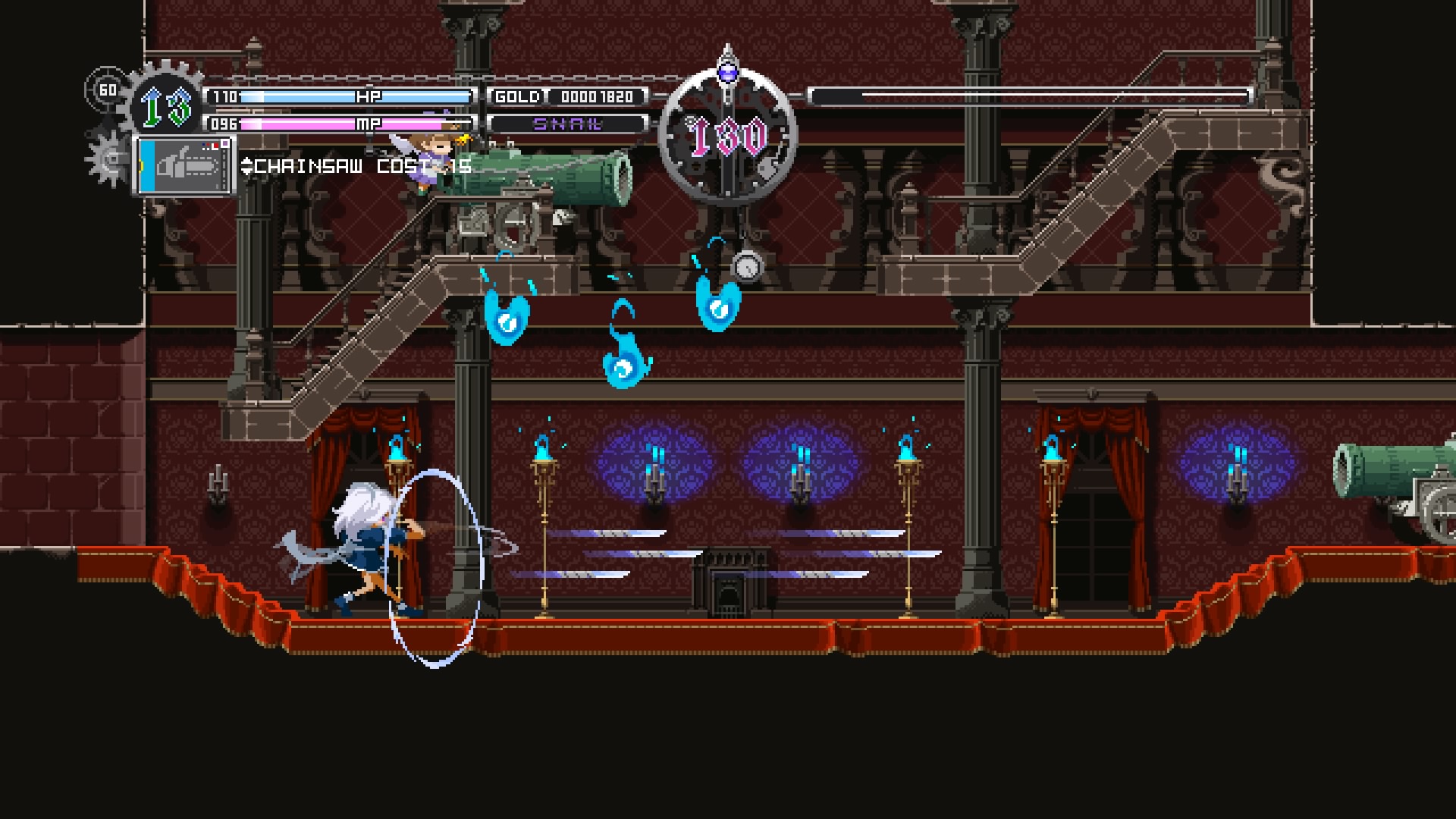
Let's go over some of the gameplay basics. Right off the bat you'll notice you have both a health gauge and an MP gauge. Almost every attack, both basic and skill, will consume MP which slowly fills back up.  Yup, even basic attacks are "limited". Using your basic attack to throw a set of knives does consume MP, although not that much. Cool fact, picking knives back up restores some MP. If you hold down the basic attack button you can build a move that slows down time around you, but not for you. This is really useful for getting lots of grazes, avoiding attacks, and environmental obstacles that are moving too fast.

Now, grazing is something that Touhou is really big on. The original Touhou games are bullet hell games, and grazing is just barely dodging an attack. While this was originally just for score, in Luna Nights grazing can be used to restore MP, health and time gauge. Since all basic attacks and skills take chunks out of your MP gauge, this is the best way of keeping both your attacks and health going strong. So what about that time gauge? Well, Sakuya has the ability to stop time. Here though, that ability has been largely diminished.


Shortly after starting the game, you'll find a friendly NPC to give you a pocket watch, which can be used to release the restriction on your time stopping ability, although not fully. This NPC also happens to run the item shop. You have a limited amount of time to use time stop for, and every action you take will reduce that time, whether it's moving, attacking, or using skills, your time gauge will deplete accordingly. This is kind of handy when you're out of MP, as you can substitute time for MP while time is stopped. If you end time stop or run out of time gauge, time resumes, all the knives or skills you've activated start moving again, and so can the enemies. Fair warning, if you run into attacks during stopped time you still take damage.

Luna Nights is an interesting game from a gameplay perspective because of a weird relationship between basic skill line and skill cap. See, as you kill enemies you get exp and can level up, increasing defense and attack damage, so you can theoretically outlevel bosses or use items bought in the store to push through when the game gets difficult. Or you could dodge enemy attacks by a few pixels, get really good at it, and be virtually unstoppable because you regenerate too much MP and health to die. It's certainly completable without being too good at the game, although it'll be a bit rough, but is incredibly rewarding to be able to demolish bosses by dodging attacks by paper thin margins and punishing them for it.


Add to this that the different skills you can get are pretty fun and interesting, as well as well-handled exploration and hidden power-up items, Luna Nights is a really fun title. Seriously, when I got the "chainsaw" skill I was like "...sorry, what?" but then I started hucking chainsaws at people and was like "ohhhh, I like this". There are other skills to collect, some more basic like homing knives or a paralyzing shot, and some like a blade that constantly homes in and attacks anything that can be damaged on-screen or a knife barrier.

Touhou Luna Nights also has a really fitting art style for a metroidvania title, with well done sprites and interesting enemies that differ each area you proceed through. A more retro like pixel graphic style is used and it fits really well. Add in some nice remixed Touhou theme tracks and you've got a very aesthetically pleasing title. As a cool little aside, those familiar with the Touhou universe, or at least the characters in and around the Scarlet Devil Mansion can probably guess at the next boss for an area based on either the area theme song or little hints added into the environment, which is a really cool consideration.

As you're exploring the world of Luna Nights, you'll be collecting gems that you can exchange with the vendor for cash. Why aren't you directly given the cash instead? Well, it turns out that each gem type has some sort of passive effect just from carrying them. Although selling them in order to buy upgrades is almost assuredly the way you should probably go, it is a cool little mechanic that was included.


Honestly, I loved the entire time I spent with Luna Nights. Unfortunately, that time wasn't nearly long enough. I loved Luna Nights, and I just wanted more when I was done. Even after earning every achievement, I still felt like I wanted more of the experience, and it didn't really take me too long. I'm not sure if this is because I've gotten too used to/good at metroidvania's where I can now tell which areas are most likely to have hidden walls or not, but I would've loved to see the game at least twice as long, in all honesty. Well, at least it doesn't have the opposite problem, where it overstays it's welcome. Also, in all fairness, the game is pretty linear, and the "metroidvania" aspect is pretty subdued, with the focus being on combat more so than large map exploration, although [the metroidvania aspects are] still there.
 
Overall, I gotta say that Touhou Luna Nights was an absolutely wonderful experience and I thoroughly enjoyed every minute of it. It was fun, engaging, had it's own unique twist with the grazing/timestop mechanics, and wrapped it all together with really smooth gameplay and a good artistic and musical package.  While certainly rather short, and maybe a little more confusing for those unfamiliar with Touhou in general, I think Touhou Luna Nights is a really great game for someone looking for some metroidvania fun.


Score: 9.5 / 10


Share:

Touhou Gensou Skydrift - PS4 Review


Touhou Gensou Skydrift
by developer illuCalab and publisher Phoenixx Inc.Sony PlayStation 4 review written by Richard with a copy provided by the publisher.

Estimated reading time: 8 minutes


The Touhou series has many spinoff titles: RPGs, shooters, other bullet hell, rhythm, fighting, and now we have a racing title. You ever wondered what happens when you cross Mario Kart Double Dash with F-Zero and slap a Touhou skin on it? Well, you're about to find out with Touhou Gensou Skydrift.

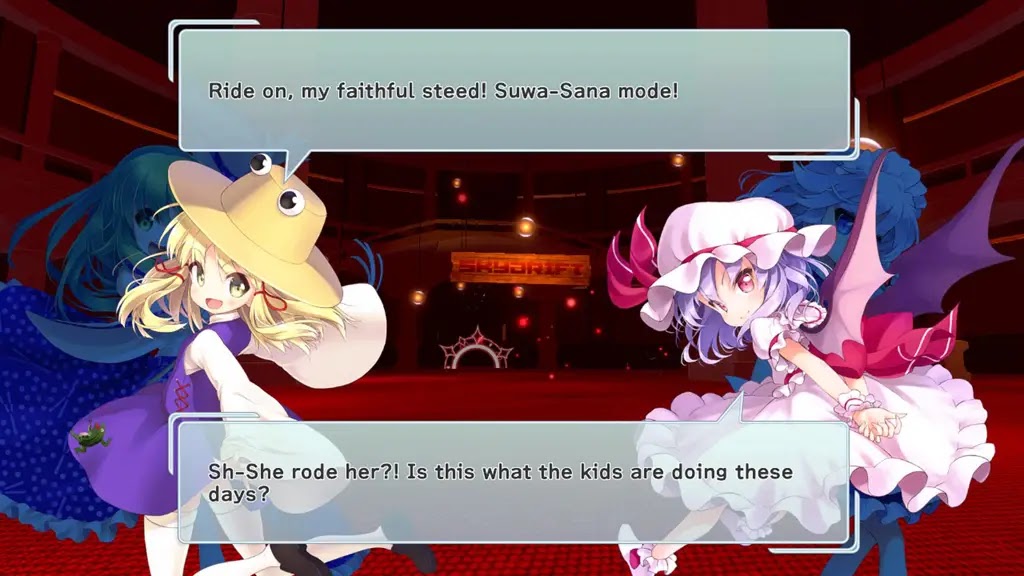
Now right off the bat, instead of going straight into the plot used purely for obligatory purposes, let me mention that the campaign mode actually has a second campaign after you clear the first. Now that's out of the way, what actually is the plot? Well, Marisa (an ordinary magician) is setting up a racetrack in front of a shop, much to the owners chagrin. The shrine maiden Reimu comes by, and lets Marisa know that, for some reason, they are unable to fly because their magical/spiritual power has been weakened, (flying is a common thing in the world of Gensokyou). They see a dark figure dash off, and intending to chase after them, Reimu decides to combine her power with Marisa's, in order to fly. By jumping on her back and riding her like a surfboard through the air.

So, gameplay wise, we get into what really makes Touhou Gensou Skydrift take off. Those from Mario Kart backgrounds will notice a lot of similarities, as well as maybe some differences that could be frustrating at first. Like any good racing game, the goal is to maneuver your way through the course, placing first amongst the participants in order to continue. While there is a free run mode, chances are you will spend most of your time racing others, whether that be human players or computer controlled AIs. You have your “forward” button, a brake/drift, a switch, and a “spell” command, as well as a button you can hold to look behind you.

Now, in Mario Kart when you drift, you don't really lose speed, and you can build up a drift boost. In Skydrift, drifting is braking, and unless you are going through one of the numerous rings dotting the course, you will start to slow down. So why drift then? Well, this is the main reason I said Skydrift is part F-Zero: the stages can be brutally unforgiving. The last stage in the main campaign, I fell off the sides so many times I legitimately stopped counting after 20. While earlier stages are more Mario Kart-esque, later stages feel like some of the harder F-Zero courses, where there is more bottomless pit than racetrack, and you will be driving more on the walls and ceiling than the ground. And the best part? There are some seriously tight turns that are basically mandatory you either slow down or drift around.

Switching and spells, on the other hand, are a little more unique to Skydrift. As you fly through the course, you will notice red and gold magic circles. Flying through these not only boost your speed for a short period, but also charges up a portion of your magic gauge. This magic gauge is then used for both switching and using spells. Upon hitting the spell button the first time, you are randomly(ish) given a spell, similar to how Mario Kart works. You then hit the spell button again to use it. These range from attacks, to boosts, to defensive spells. Your magic gauge also has “tiers”, so you can charge multiple levels. Gaining a magic skill depletes the entire gauge, but generally the usefulness of the item is tied to how full your gauge is. As another handy note, both characters in the tag-team can have a spell at the ready, so if one character has a skill you want to keep, you can switch to the other to effectively “store” the spell.

Switching characters also uses a small part of the magic gauge, but will also provide a small speed boost while doing so. While switching, you are unable to steer though, so switching while going around a corner is rather ill advised. That being the case, apart from the boost and separately stored spells, each character has their own stats, as well as a unique spell. The unique spells can be identified by a picture of the characters face, and are generally really powerful in some way or another. For reference, you can see what each characters stats and special spells are when selecting the character in freeplay mode. Most special spells involve nailing first place with an attack, and/or providing a speed boost for a long time. On the other hand there are spells like Flandre's, which summons Laevateinn for a long time and will let you swing it at other racers every time you hit the spell button.

So how are the different courses? Well, the first couple are pretty basic Mario Kart style courses, but as you progress through the list, they get tougher and tougher. The last course in the first campaign was absolutely brutal, and some of the bonus courses not in the campaign mode are pretty brutal as well. The saving grace is that the computer controlled racers will have just as much trouble as you will. No seriously, the easiest way to beat the hardest computer player is choosing a tough course you've gotten used to, and watch the other racers fall of edges. That being said, the AI is rather good. Normally, upon winning a race, I would only be in first place by less than a second for a majority of the simpler courses, if I even won at all. I recall one course I only won by 80 milliseconds. I'd also like to note that, despite some initial misgivings for some of the tracks, I actually liked the vast majority of them, and there weren't any I hated. Yeah, the final course in the first campaign is super tough, but once you get used to it? One of my favourites.

Now what would a Touhou game be without its music? Skydrift is full of many interesting locations, and many remixed theme songs to go along with it. With a wonderful collaboration work with Akiyama Uni, SOUND HOLIC, and StarDrops, there's a lot of gorgeous soundtrack pieces, all fitted to meet that Mario Kart style racing vibe. Coupled with some well drawn stage backgrounds, and foregrounds, as well as cutely modelled 3D characters, Skydrift is definitely pleasing to both the ears and the eyes. Well, most of the time. Occasionally there are some stages that are a bit “crowded”, and it can be difficult to tell where you're going, especially if you throw in the multicoloured lights from the different spells characters can use, not even counting Marisa's Master Spark laser of “I can't see a bloody thing”. Thankfully, if you can't see anything, your opponents can'r really see anything either.

There is a good number of characters to choose from, with plenty of different stat combinations and unique spells, making each race a little unique in terms of both the characters you use (if you so choose) as well as who your opponents have selected. And yes, there can be duplicates in the opponents. In one race there were about 6 Orin, which I wasn't really expecting, but hey, it was certainly entertaining. The only real complaint I have is that there aren't a whole lot of courses. There are 16 total, or 4 “cups” in Mario Kart terms. While this is a little reminiscent of the older games, the newer titles have many more courses. Other than that though, the online is a little...spotty, I suppose you could say. I couldn't find a single person to play with after trying for about half an hour, but that could just be me being unlucky, or choosing a bad timeslot.

Summary

Overall, Touhou Gensou Skydrift is an absolutely great racing game. While combining the feel of both a Mario Kart title with closer to F-Zero style gameplay, challenging yet fun courses, and an amazing soundtrack, Skydrift will definitely meet your racing needs. No prior Touhou world knowledge is needed either, and with a large cast of characters to choose from, it's really fun to figure out what tag-team combo you like the best. Although the number of courses may be on the smaller side, they're all really fun, especially once you've had some time to practice on them. If you're looking for a tide-over between Mario Kart titles, or just want something a little different from them? Touhou Gensou Skydrift is definitely for you.

Score: 9 / 10


Share:

Touhou: Azure Reflections - PC Review


Released as an enhanced version of a game originally published in 2012, Touhou Azure Reflections is now available on PC for all you fellow bullet hell aficionados out there. With some interesting gimmicks that will keep more veteran players entertained, or striving for score, and a story mode that can be easy enough for newcomers, Azure Reflections certainly paints a solid picture for the genre.

I believe I’ve used this phrase before, but the Touhou series, and generally other bullet hell styles as well, can usually be summed up as “the most colourful death you’ve ever experienced”, and Azure Reflections is no stranger to that. A sort of “retelling” of the events of “Embodyment of the Scarlet Devil”, local lazy and forever in poverty shrine maiden Reimu finds herself once again trapped in the mist of the Scarlet devil mansion. Is Remilia up to the same old tricks? Has the maid decided to host a revolt? Is Flandre going to beat you into next century? The first two maybe, the last definitely.

While the traditional Touhou titles are top down auto-scrolling shooters, Azure Reflections is a horizontal shooter, allowing you, and forcing you, to shoot both forwards and backwards in order to dispatch those annoying fairies (yes, Cirno too). While the standard fare is there, choosing a character (if unlocked) and shot type to help you get through the mansion to resolve the incident, there is a fancy little barrier system, where you can pull up a barrier to absorb bullets and then make a sort of bum rush at the enemy in order to return that absorbed damage. This is in addition to the spell cards that give you the bullet clearing/high damaging blast and your standard shot.


There are a few other changes to the standard formula, where you can actually take damage and recover your “hit point” as long as you don’t get hit within a time window after taking the first hit. This is a great system for newer players who need a little help learning the ropes (or those that aren’t as good at the games). Another interesting change for the newer or less proficient (like me) audience is that you can clear the storyline on easy. Yep, that’s right, you don’t get cut off for being a weenie this time, as long as you meet the other requirements (which they handily tell you if you fail to meet them). My biggest issue is trying to horde spell cards for no real reason. Probably because I want to earn the spell card bonuses. You can now also customize your appearance with accessories that you can purchase, which also happen to have effects attached to them, such as increasing the graze score bonuses. Are you all about the fashion, or all about the efficiency? Either way, there’s something there for you.

As can generally be found in the Touhou titles, the music is well done, with each character and stage having their own remix of the songs from the original Embodiment of the Scarlet Devil. The graphics are crisp and sharp in the standard anime style for the series, but come in multiple expressive variations. The neat little “cutscenes” during battles where the characters are duking it out are pretty cool too, and you can even unlock a model viewer and jukebox for music listening and character viewing.

While the title definitely feels easier compared to some, or most, of the other Touhou titles, that’s what the harder difficulties and self imposed challenges are for! Seriously though, any game that has a difficulty called “Lunatic” with the description “for crazy people” you know is gonna be like ramming your face at a brick wall. Although Azure Reflections is relatively easier, except the stupid bats, there was a lot I really enjoyed about it.


One of the aspects of the Touhou series as a whole that is also applied to Azure Reflections is how the characters interact with each other. Usually there’s a lot of rather un-serious banter, a couple of puns or gags, and occasionally a serious line or two. While most of this can get lost in translation, whether official or fan, I’m glad to say that the banter in Azure Reflections was well translated and doesn’t fall off the mark of what I’ve come to love and expect from the series.

As a whole, Touhou: Azure Reflections is a bit of a niche title. Most people I know aren’t super big fans of the bullet hell/danmaku style games, and those that will play them don’t necessarily recognize the Touhou franchise. That being said, what it offers is not only true to its roots, but also offers its own twist to keep things fresh and interesting. If you’ve got a hankering for colourful bullets, a masochistic tendency to watch yourself get shot down, a desire for an anime-esque scrolling shooter challenge, or a fancy soundtrack, you can’t go very wrong with Azure Reflections.

Game Information

Platform:
Sony PlayStation 4
Developer(s):
Unties Games
Publisher(s):
Souvenir Circ.
Genre(s):
Side-scrolling
Bullethell
Shoot 'Em Up
Mode(s):
Single Player
Other Platform(s):
NA

Source:
Provided by Publisher


Article by Richard
Share:

Touhou: Gensokyo Defenders - PC Review


Having fought against various foes in order to reign supreme in the lands of Gensokyo before Christmas, Richard took our first look at Gensokyo Defenders on the Switch. With the latest Touhou releasing on the PC for fans of bullet hells, shoot ‘em ups and tower defense, you’ll be following the Ice Fairy Cirno on her adventure of domination and personal growth though the new set of bullet hell battles once known as Danmaku.

Gensokyo Defenders hits a good balance of character interaction and trap placements. The action based tower defense style is a hard one to balance and while some are better than others, this one finds a home somewhere in the middle. Like most tower defense, enemies will be following a predetermined path to your base which contains a limited about of hit points. In order to prevent this from happening, you’ll be using a character to fight them off while also placing defenses in your enemies’ paths to help you out by either slowing them down or thinning them out.

Starting off with Cirno before other characters both new and old, or at least new and old for me, join up, you’ll be learning the ropes of defense which rely more on your character, your skills with the shoot ‘em up style, and your tactical use of magic spells with a limited mana pool. Moving around the map is easy and can be done either quickly to beat the enemy back to your base or more slowly that allows you to perform your range or magical attacks. Something a little interesting is that no two characters are really the same which makes trying them each out quite fun. You’ve got those that are balanced like Cirno, but then you have others that are giant wrecking balls like Utsuho who will destroy the enemy and your own trap placements if you’re not careful. She’s scary...


Placing your own traps is easy as long as you’re paying attention to what you’re doing. Some traps like spikes or bushes are designed to be put in an enemy’s way so that they walk over it and get hurt or slowed. Others, like the towers, are designed to be placed off to the side of the path in order to hit anything that is walking by. As you complete stages you’ll gain access both to new trap types and the possibility to level them up.

With a total of four towers that can be equipped at a time, and these are not locked by characters, it was nice that you could remove any upgrades and apply them to another. The same system applies to character boosts which can increase their hit points, mana points or speed amongst other abilities. The catch to all of the above? The amount of points that you can invest depends on how well you completed a stage.

Completing a stage is as easy as defeating the boss on the very last wave. Completing a stage well however depends on how many hit points your base has left at the end. One enemy getting through is one point gone. You dying on the field of battle is about five points gone. So in reality, and part of the better design, is that you can afford to let one or two through, but more than that, and you’re getting a two out of three star performance. Each star you get equals one upgrade point so you’ll really want to aim for those three stars if you want to keep up with the scaling difficulty.


If there were any issues with Gensokyo Defenders it would be that the PC port is not quite the smoothest that it could have been. Even while using a controller the mouse cursor is constantly in view on the last menu item that was selected making it a good idea to keep the mouse close by. Added to that, there’s a bit of screen tearing that can happen and with no Vsync option, the visuals can give a bit of a headache until they finally decide to smooth in. The only other issue that I had, and this was more of a me issue, is that the overall wave process felt slow and there was no way to speed it. This could get pretty long sometimes especially when you had almost an entire wave of slower mobs.

Overall, Touhou: Gensokyo Defenders may not be the best Action Tower Defense out there, but it’s a good one. With many different characters and loads of stages, it’s provides a fun time and the craziness that Touhou is renowned for.

Article Start

Game Information

Platform:
PC
Developer(s):
Neetpia
Publisher(s):
Unties
Genre(s):
Action
Tower Defense
Mode(s):
Single Player
Multiplayer
Other Platform(s):
Nintendo Switch

Source:
Provided by Publisher


Article by Pierre-Yves
Share:

Touhou: Gensokyo Defenders - Switch Review


Gensokyo Defenders is a neat take on the classic tower defense style, with a greater focus on your player character than on the traps you set. True to the Touhou style, there are lots of bullets and swathes of enemies to evade and fight off.

In the land of Gensokyo, the main method of dispute resolution or time killing is Danmaku, or what basically amounts to a bullet hell battle. Recently however, Yukari has come up with a new game to play, and taught it to the rather dense and easily influenced faries. So welcome the new method of battle/entertainment, defense battles!

The defense battles are, at their base, pretty standard fare: you have multiple waves of enemies attacking a “base point”, and you need to lay traps down to prevent the enemies from reaching your base. Each enemy that reaches your base will take a point of durability off of it, and if the durability runs out, you lose. Placing traps requires money that’s earned in-stage by defeating enemies, and you can lay or remove traps at any time. There’s also a short break between waves where you can set up/demolish traps before choosing to start the next wave.


Where Gensokyo Defenders gets a little more innovative is in the stage layouts and use of the player character. Stage layouts can be simple pathways, but they can also feature environmental hazards such as large thorns or rivers. Any enemy that isn’t a flying type can be thrown into the hazards in order to kill them. This also works on your player character, however. You don’t just place traps, your character can actually shoot and use special moves in order to attack the invading enemies. In fact, I generally found that the majority of the enemies I dispatched were from me actually shooting them, rather than the traps I had laid out. Occasionally there will be power ups that will increase you normal attacks and special moves that you can pick up. Additionally, after a certain point, you unlock the ability to upgrade your character or traps using the stars you earn in stages, which are awarded based on how much health your base has at the end of the mission.

While the graphics are pretty decent and the character art is pretty good, I did happen to notice that it seems that characters generally tend to be rather…bustier, than how they’re normally portrayed, which is maybe a little weird, but considering the massive amount of fan based interpretations of characters, not particularly unusual. The music consists of some rather nice remixes of Touhou tunes, some of my favourites in fact, and I didn’t notice any sort of lag that you normally see in these style games, especially when there are a boat load of enemies on screen and everyone is shooting, although it does become rather difficult to see where all the bullets are, and who is shooting what.


Ultimately, Gensokyo Defenders feels like something that would be more at home as a tablet or phone game, just with higher specs. If you plan on using your Switch more as a mobile style device, rather than a console, Gensokyo Defenders feels a lot more “right”. That being said, there isn’t any issue with it as a short and sweet time waster for a console. You can pick up a mission or two, and complete them in 10-15 minutes without too much hassle. Gensokyo Defenders would definitely appeal to those looking to make their Switch more of a mobile handheld, or those who enjoy a good tower defense style game.

Game Information

Platform:
Nintendo Switch
Developer(s):
Neetpia
Publisher(s):
Unties
Genre(s):
Action
Tower Defense
Mode(s):
Single Player
Multiplayer
Other Platform(s):
N/A

Source:
Provided by Publisher


Article by Richard
Share:

Touhou: Scarlet Curiosity - PC Review


Coming from Azure Reflections, we’ve got another Touhou fan spin-off! We’re getting a lot of Touhou spin-off games lately, but is this a bad thing? In my opinion, definitely not. While the main string of Touhou games is primarily bullet hell, the string of fan games have given us a wide range of genres, from turn-based RPGs, to fighting games, to Pokemon parodies. This time around we have a 3D sort of beat ‘em up in the same vein as the Ys series.

In Scarlet curiosity, you get to play as either Remilia Scarlet, the vampire lord of the Scarlet Devil Mansion, or Sakuya Izayoi, the head maid of said mansion. The general plotline is pretty much the same between the two: Remilia is bored and is looking for something to do, so Sakuya goes out to research about sightings of a mysterious monster that has been spotted nearby recently. At this point, either Remilia goes searching for the monster or Sakuya does, with the only real difference between the two being combat preference and what time of day you go exploring. As Sakuya, you explore during the day, and Remilia being a vampire explores at night.


Game progression is pretty basic, you waltz through a stage beating up offending wildlife and spirits, reach the end, and beat up something, or someone, a little more capable than the local fauna. While in a stage, you have a standard combo, a special meter, and a “spell card” meter, all of which are used for attacking. The standard combos are fairly self explanatory, Remilia uses claw swipes and Sakuya slashes with a knife, but the skills is where we get into some of the more interesting moves. You can equip two standard skills and one special skill, with the standard skills draining a constantly refilling skill gauge and the special skill using the “spell card” meter I mentioned earlier. As you beat up enemies and earn exp and levels, you’ll gain more skills, which you can sub out for your favorites.

Similarly, as you meander through the different stages, you’ll pick up three different types of equipment: weapon, armour, and accessory. These pieces of gear not only affect your attack and defense power, but will also affect item drop rate, skill gauge level, and critical rate and damage, and come in varying degrees of rarity.


Scarlet curiosity has some fun boss fights that still keep the bullet hell theme with some of the attacks, and is short enough to play it on and off without getting fed up with how repetitive it can get, yet at the same time, long enough that you don’t feel like the stages are simply sub-areas. With a well-remixed soundtrack of classic Touhou tunes, and sporting some nice 3D rendering, and 2D snapshots and CGs, the game definitely looks and sounds pretty.

To be perfectly honest, Scarlet Curiosity may not really appeal to you if you aren’t a big Touhou fan like I am, but on the plus side, it also isn’t the cost of a full game either, so if you get it on sale, you probably won’t feel too let down if you don’t end up enjoying it. Despite the occasional frame rate drop here and there, which I attribute to my old computer, Scarlet Curiosity actually ran smoother than I expected, and the control set-up felt really natural to play on a keyboard. As far as Touhou fan games go, Scarlet Curiosity is pretty looking and sounding, and while not as long or in-depth as a standard game, is also simple enough to pick up or ease back into, and low cost enough to at least give it a chance. So get ready to head into Gensokyō to help a vampire and her best meido out!

Game Information

Platform:
PC
Developer(s):
Ankake Spa
Publisher(s):
XSEED Games
Marvelous USA, Inc.
Genre(s):
Bullet Hell
RPG
Mode(s):
Single Player
Other Platform(s):
Sony PlayStation 4

Source:
Provided by Publisher


Article by Richard
Share:

Touhou Genso Wanderer: Reloaded - PS4 Review


Last year Richard got to experience the craziness that is Touhou in its dungeon crawling format while I doubled up and tried to focus on the platforming. Moving up to today, it's my turn to dive into the Roguelike dungeon Crawling that Touhou Genso Wanderer hides behind its many portals and locations.

Prior to Reloaded I've played the introduction to Genso Wanderer when I borrowed it from a local library for my brother. Because of this I had some idea of what I could be expecting in the lower, or higher, floors of the various dungeons that await Reimu and her party. Solo or with a partner, you'll be guiding her on various quests serious or otherwise as she explores the many mysteries that await. I say “serious” but let's be honest that evil was released by Rinnosuke not letting Reimu play with his golden ball which accidentally releases the seal when Reimu went for it anyways. Gearing up for yet another whoops adventure, there's no shortage of weapons, armor and experience to be gained. Only a shortage of food which can, and will, kill you.

Touhou Genso Wanderer: Reloaded is a both a roguelike in name an in nature. Dungeons are large masses that are both random and treacherous making every step you take your possible last. Using the classic formula, nothing moves until you do. Taking in a one to one step ratio, unless other factors are involved, everything and everyone will move one step or attack once you do. This can let you carefully plan out your actions or see your demise coming from a mile away unless you get really lucky and survive the oncoming attacks, otherwise it’s back to town!


Hit points fall to zero? Back to town. Hunger his zero, your health with drain with every step and thus when it hits zero? Back to town. There are some elements that are a little more friendly as if you fall in a dungeon you don’t lose everything which I actually found surprising. You actually get to keep the stuff you picked up off of the floor in which most would laugh gleefully at your misfortune or stupidity as you bravely declared that you could handle a situation instead of retreating.

Normally in these cases if you fell you lost everything or a good portion of your stock. Instead, being able to keep them, it allows you to prep that much better for your next outing without having to worry about losing your favorite spatula. What? It was an awesome two-handed weapon before it became a chisel… and now a giant deathscythe after merging it with Cloud’s sword.

The point that I want to make is that without that worry of loss, there’s a stress that is never enforced making you never really question your decision as to whether or not you should go back. While it increases the enjoyability, it also decreases the difficulty as you don’t need to worry about dying, you just need to worry about getting back to where you died with no strings attached. One way or the other, you’ll always start back at level one so maybe that’s the offset as often times there’s a way to boost yourself to be a “stronger” level 1 the next time.


Setting aside dying for a moment, the mechanics are extremely enjoyable. Moving around the dungeons is a pleasure and anything but a chore. The standard has you moving left, right, up and down. The advanced has you being able to move diagonally though often it's a bloody chore and not worth the effort because of some half-baked control schemes. Genso Wanderer is both responsive with your thumbstick or d-pad as well as having the option to hold down a shoulder button that will only allow you to move diagonally just to make sure you don’t mess something up. Adding in one more quality of life improvement is that by holding R1 you can zoom through the passageways between rooms regardless of the twists and turns. Holding “O” is already a godsend with you zooming but it’s only built for straight lines. Having the pathfinder option just makes it that much better.

Now while in these dungeons there are going to be plenty of floors with rooms for you to explore as you look for the gateway to the next floor. They are generally not that hard to find as your biggest worry is going to be a combination of traps, enemies to slay and level up off of and going hungry. As Richard would state, Pro Tip, and in my words, *spoilers* if you make early enough on a basic enough potion it has a property that can be merged into an item which reduces hunger. This means that instead of going through a truckload of Red Bean Cakes, you may only need one for several to a dozen floors worth of exploration allowing for you to go that much further. *end spoilers* This leads into one of the biggest features, fusing the hell out of anything and everything!

By use of what is called the Nito box, you can fuse just about anything with anything else through the use of accumulated points. Adding weapons together can increase the base strength but fusing them with other items can give that weapon new abilities such as life on hit or increased damage to flying enemies for example. Each fusion costs about one-hundred points so it’s not cheap per say but with the amount of junk that you’ll be picking up off of the ground, you can grind it all for points which also liberates some space in your inventory!


So while potions, scrolls and food (in which why would you want to get rid of!?) give about a point each, equipment yield many more with you looking at seven or more. So with the cost of fusion being one-hundred, it takes a fair amount of points to do anything but it’s worth it and besides? The great part of fusing all of these items together isn’t that you can get much better gear, it’s that you can do it anytime and anywhere with no restrictions. You don’t need your town, you don’t need the Yokai’s town, you just need to open up your inventory and go for it!

I quite enjoyed Touhou Genso Wanderer: Reloaded. It has many of those classic elements that make a Roguelike what they are alongside other factors that made it enjoyable as you aren’t always making hard choices as to whether or not to pick something up because you are out of space. Being able to grind it down for points and then use those points on something else makes for a fantastic feature as you aren’t stuck waiting for a blacksmith but you can do it yourself keeping the dungeon crawling rolling for a lot longer at a time.


Game Information

Platform:
Sony PlayStation 4
Developer(s):
Aqua Style
Publisher(s):
Nippon Ichi Software America
Genre(s):
Roguelike
Mode(s):
Single Player
Other Platform(s):
Nintendo Switch

Source:
Provided by Publisher


Article by Pierre-Yves
Share:

Azure Reflections - PS4 Review


The Touhou series of games can probably be summed up as the most colorful death you will ever experience in a game. Taking a bit of a change from the standard top-down danmaku/bullet hell/schmup, we get the side-scrolling fan game spin-off Touhou: Azure Reflections. Following the Touhou standard while still imparting it’s own charm, Azure Reflections is probably one of the best Touhou games for newer players to ease into, not to say it’s particularly easy on harder difficulties, but it certainly is more accessible.

The Touhou series of games, including their fan game spin-offs, have always been a bit of a personal favorite for me, not that I’m particularly great at them, but I certainly enjoyed them enough. Azure Reflections is a sort of retake on The Embodiment of the Scarlet Devil, an official Touhou title that was, incidentally, the first one I ever played. A red mist covers the land of Gensokyō, and it falls to the local shrine maiden and resident problem solver, Reimu, to solve the issue. And yes, that’s pretty much the description for both games. In Azure Reflections, both Marisa Kirisame (the ordinary average magician) and Cirno (the super last boss ice-fairy) can also participate in the resolution of this incident.

If you haven’t played a Touhou style game before, first let me say that they’re usually pretty difficult. Essentially, you will have an auto-scroller through a stage where you have to evade a seriously massive amount of bullets, and then you reach a boss, and have to dodge even more bullets. Thankfully, your hitbox is rather small, and you can change the settings to have it visible while playing, or just while slowly moving.


In traditional Touhou fashion, you have bombs that can clear bullets/enemies and damage bosses, and different shot types you can choose when starting a game. New for this particular instance, we have the side-scrolling mechanics of being able to shoot both forward and backwards. Additionally, you can now use a barrier-charge move, where you can activate a barrier to absorb bullets, and then use that absorbed power to do a dash attack at your foes.

Your barrier recharges naturally over time, although it will charge faster when performing grazes, which are basically getting close enough to the bullets that you can’t believe you didn’t get hit. While you can still power up your shot type with P items, they now hold a new purpose. By expending a portion of your P items, you can remove some of the bullets in the vicinity around you. Another change is that you aren’t instantly shot down upon getting hit. Instead, you get stunned for a bit, and another shot will bring you down if hit while stunned, essentially making you a two hit point wonder instead of one.

As is common in Touhou games, whether fan spin-off or not, the music is really great, as pretty much all of the soundtrack is remixed from the original Scarlet Devil soundtrack, and they were done really well. The graphics are nice and crisp compared to the old-school style, and the anime-style character portraits for the interactions were well drawn and had a lot more variation than I was expecting.


Speaking of the character interactions, I’m pleased to say that the often comedic banter that doesn’t really take much seriously is still an integral part of the game. Including accessories that you can purchase with in-game funds in order to adjust your character’s appearance or provide beneficial bonuses was a really interesting idea, meaning that you could purchase accessories that would increase your graze distance, reduce your stun time, or enhance or slow down movement speed. Or you could go the fashion route instead.

With a really stellar tutorial for introducing new players to the Touthou system, and veteran players to the new quirks, Azure Reflections is really easy to step into. While a lot of the game is unlockable through completing the story and capturing opponent spellcards (which is more or less a sort of  “challenge mode” during boss fights), neither are particularly difficult to do with a bit of practice, at least on normal difficulty, and there are always the harder difficulties with their own rewards for more seasoned players or those looking for a challenge.

Overall, Touhou Azure Reflections is a really great spin-off with its own fresh gimmicks and playstyles, with enough of a challenge for veteran players, while easy enough for new players to get into. With a solid soundtrack and interesting characters, a great beginner tutorial and some nice variation with accessories, Azure Reflections is a fine game if you’re looking for more Touhou in your gaming diet, or if you’ve been interested in getting into the bullet hell type games but have never known where to start.


Game Information

Platform:
Sony PlayStation 4
Developer(s):
Unties Games
Publisher(s):
Souvenir Circ.
Genre(s):
Side-scrolling
Bullethell
Shoot 'Em Up
Mode(s):
Single Player
Other Platform(s):
NA

Source:
Provided by Publisher


Article by Richard
Share:

Random posts

Our Streamers

Susan "Jagtress" N.


S.M. Carrière

Aldren


Affiliates

JenEricDesigns – Coffee that ships to the US and Canada

JenEricDesigns – Coffee that ships to the US and Canada
Light, Medium and Dark Roast Coffee available.

Blog Archive

Labels