Prinny
Presents NIS Classics Volume 3 by developer Nippon Ichi
Software and publisher NIS America Inc.—Nintendo Switch review written by Richard
with a copy provided by the publisher. Estimated reading time: 11 minutes
After releasing Vol. 1 and Vol. 2, we now
are getting Prinny Presents NIS Classics Vol. 3, and boy was I super excited
when I heard what was in this one. The titles we get in Vol. 3 are my two
favourite classic NIS titles outside the Disgaea series, so I'm excited to
share this with you. In Vol. 3 we get Rhapsody: A musical Adventure and La
Pucelle: Ragnarok.
Note:
Please be aware that this review contains some
spoilers either in the text or in the screenshots taken during gameplay.
For those of you who are familiar with
either title, the Rhapsody featured is the original PS1 version, and La Pucelle
is the extended / enhanced version of La Pucelle: Tactics. A review covering
the PC version written by P-Y for Rhapsody: A Musical Adventure and La Pucelle: Ragnarok can also be found on our
site if you're looking for a comparison between ports. If you're familiar with
the titles or have read the reviews for the PC port, feel free to skip to the
bottom paragraph and summary for my cliff notes on the Switch version.
For those who are unfamiliar, let's dive
into these two classic titles!
Rhapsody: A Musical
Adventure
First up, I want to talk about Rhapsody:
A Musical Adventure. Now, some of you may be asking "is this the DS
version?", to which I would say "definitely not". The DS version
had a simplified combat system, and removed the feature where you were able to
recruit monsters to your party. Thankfully NIS has opted to go for the original
PS1 version here, much to my delight.
Rhapsody stars a young girl named Cornet who
is living with her grandfather after the death of her parents. Cornet dreams of
marrying the prince of the Marl Kingdom, who the townspeople have nothing but
good things to say about. Unfortunately for her, every girl within a four day
trip is also interested in the prince.
Thankfully for Cornet she has something
that sets her apart from the crowd: a magic horn. This horn allows her to
command puppets, which she can use in battle or in general to help her out. She
can also speak with puppets, even if she isn't controlling them through her
horn, and is friends with a puppet named Kururu, who tends to give her
(somewhat) helpful advice. Needless to say, things don't always go how you
hope, and Cornet ends up setting off on an adventure in order to be with the
Prince, making both friends and enemies along the way.
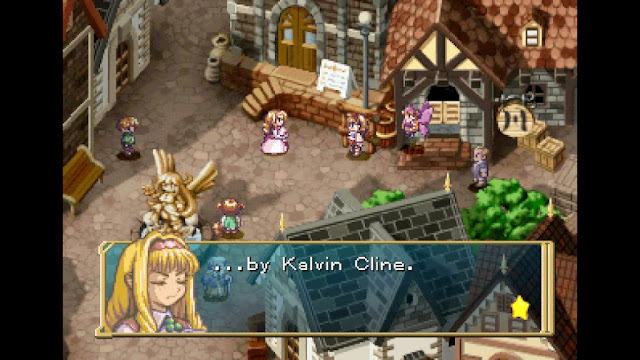
Rhapsody is a bit of a toned down version
of the NIS SRPG fare, with an interesting take on the adventure and combat. As
you explore the world, you will be roaming around maps, talking with townspeople,
beating up baddies, and helping puppets fulfill their dreams so that they may
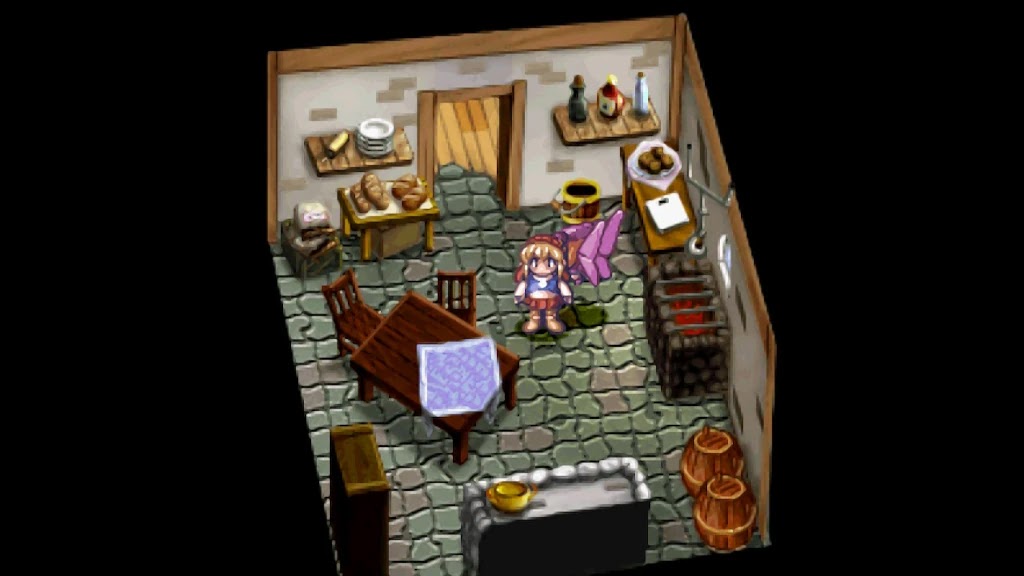
be reincarnated. Exploring locales is walking around a map, often consisting of
very similar looking passageways, in a 2D top-down-ish style. As you explore
you can find chests with items, puppets to recruit, as well as get into random
battles.
Combat in Rhapsody is well put together,
with enemies and allies being on a grid based map, with the units acting in
order of their speed value. These grids are significantly smaller than other
NIS titles, and don't feature any of the later title's convoluted panel and
stage effects. You can command your units to move and attack along the grids,
use special abilities or magic, or simply end the turn in order to guard.
Cornet also participates in combat, using
her treasured horn as a weapon. Since Cornet is essentially a puppet master,
not only does she participate in combat normally, but she can also use the horn
to increase the attack of any dolls fighting with the party as long as they are
within range. Doing so also builds up a musical score which can be used for
"rewards", which are attacks using desserts, or healing the party
members.
Cornet also plays another special role.
If Cornet defeats an enemy with her horn attack, there is a chance the enemy
monster will ask to join the party, provided they aren't unique or boss type
monsters. Monsters can either be used as party members or sold for cash if
you're running low. While dolls are usually the better party member options,
that doesn't mean the monsters aren't useful. Unfortunately, new units tend to
come in at the wonderful level of 1, so they will almost always require a bit
of effort to get them up to par.
Thankfully the game is rather basic in a
number of functions to help accommodate this. For starters, units you have only
wear accessories, no specific weapon types, and are therefore a lot easier to
outfit. Also, Rhapsody is pretty easy. No, really, it isn't that challenging,
even on the harder difficulty, especially if you use the combat system to its
fullest potential. However, in a rare turn of events for me, I actually don't
think there is anything wrong with Rhapsody being an easier title. With
Rhapsody, you're there for the story, the characters, the adventure, and the music.
Sure, combat may be a large part, but it's not where the focus lies.
There are many interesting companions to
recruit, and they all have desires which you can fulfill, making for
interesting companion quests. Additionally, the characters in Rhapsody have a
habit of breaking out into song whenever they have an opportune moment.
Sometimes it's a solo, sometimes a duet. Sometimes it's even the bad guy, but
hey, what do you expect from a game called "Rhapsody: a Musical
Adventure". In fact, I'm pretty sure a character makes a cameo in a later
game and questions why nobody breaks out into song.
Rhapsody is a game full of heart, and
song, and I'm really glad to see the PS1 version get an updated port.
La Pucelle: Ragnarok
Next up on the list we have La Pucelle:
Ragnarok, the enhanced / extended version of La Pucelle: Tactics, which is
sitting on my game shelf right next to me.
La Pucelle is around the time where NIS
started thinking "let's make this system absolutely ridiculous" and
decided to run away with it. La Pucelle is also, arguably, my favourite NIS
SRPG. Yes, I do mean including the Disgaea series in that statement. La Pucelle
is a story about Prier, a sister working for the church who aims to be the next
Maiden of Light, and a professional demon hunter. She's rude and crass, but her
heart is in the right place. Or at least it will be if you make the right
choices.
That's right, there are multiple endings
that are affected by your actions. In fact, one of the gag endings in the
original got extended for the Ragnarok version, which is pretty entertaining.
Just like with the rest of the game, there are still a bunch of quirky
character interactions to witness, mostly involving Prier getting mad at
someone. Chapters can have their own endings as well, so pay attention to what
people say, and if there is an extra panel of interest on the map, it may be a
good idea to check it out.
Much closer in style to Disgaea than
Rhapsody, La Pucelle features what has become what some may immediately think
of when a NIS or Disgaea title is mentioned: grid-based combat with many units
introduced through a base panel. While there are a lot of differences and
quirks, the basic premise of La Pucelle is to go shopping in the town and talk
to who you want, then head off into a series of stages in a large overarching
map.
Each stage is individual, and will
generally be cleared either by defeating all the monsters or by walking onto a
panel that leads to the next screen. What La Pucelle also has is Dark Portals.
Essentially these guys are like the geo panels in Disgaea, except they are
tiles you can walk on, and standing on them and facing a direction will send a
floor effect in a line. Certain characters can purify the portals, which causes
a chain reaction along the floor panels, possibly ending in a damaging or
healing miracle, if you fulfill the right conditions.
So, let's talk a bit about how La Pucelle
is different from the standard SRPG from NIS nowadays. You more or less have
four different base leveling systems at play. I know that sounds like a lot,
but hear me out a bit. Two are tied to your character specifically, and two are
tied to the gear you have equipped. For character specific, you have a raw
level, which increases as you kill enemies and participate in a group killing
enemies, and skill levels, which increase with use. The levels tied to your
items are item level and attribute levels. Items will gain exp as you purify
dark portals, enhancing stats upon leveling. Attribute levels increase as you
participate in killing enemies, and increases a characters attribute value. At
certain benchmarks, characters will learn new skills, such as minor increases
in critical rate or defense.
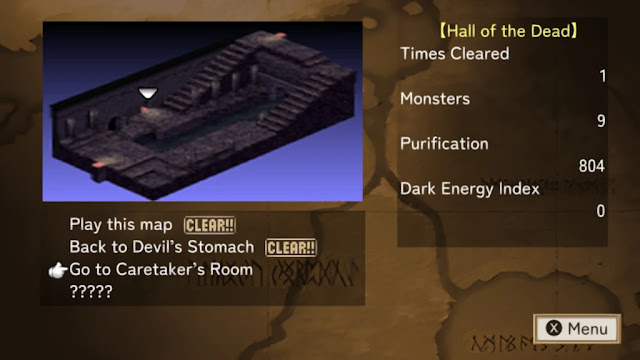
In addition to this, there is also an
item fusion option, where you can have a tamed monster hold at least two items
to have their effects added to the first item the monster is holding. Yes, you
read that correctly, you can tame monsters here as well. This is done in a
manner similar to the Dark Portals, where you purify a creature and then beat
it. The more you purify it, the more likely it will be to join you, although
more of a similar type of monster means a harder recruitment threshold.
La Pucelle is chock full of interesting
characters with some of the best names taken from French words as well. We have
Prier (prayer) the hot-headed and violent sister, Culotte (cheeky or knickers),
Alouette (Sparrow), Salade (Lettuce) etc. Heck, even the "Goddess
Poitreen" is similar to "poitrine". All of the characters have
their own personalities and place in the story and are interesting in their own
right. Characters are also only as useless as you let them become, so if you
feel a character isn't up to snuff, maybe you should reexamine your training
regimen for them and what they have equipped.
Now, despite having a little more
complicated battle and leveling system, I found the equipment economy to be a
lot more user friendly than in the Disgaea titles. Sure the way of leveling and
fusing is surprisingly in-depth, but at least you no longer need to run through
a 100 floors of annoying enemies, only to get soft-locked on floor 98 by geo
panels that give Immortality and No Moving. So dumb that was.
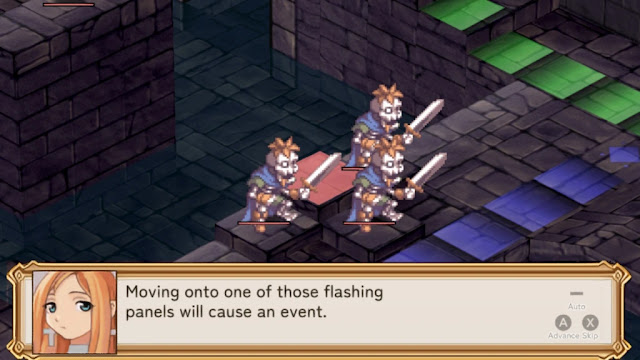
As a port, both Rhapsody and La Pucelle
have been done a real service. I can assure you, having broken out the original
La Pucelle Tactics a few weeks ago, that playing it on my PS2 looks ugly as all
hell on my current TV. The Switch port though? It looks great. Well, it
certainly looks and feels old, but it doesn't look bad, and that's the
important thing. Plugging the PS2 in it got all stretched and looked wonky, but
no more with the Switch release! Whether it is in handheld mode or TV mode,
both were appealing. Rhapsody does have a "smooth mode", which I've
shown an example of earlier, that I found to be a little ugly looking, but it's
an optional toggle! As an added bonus, the runtime was smooth and loading times
were fast. Heck, I feel like I got more lag on my PS2 than on the Switch.
Summary
Overall, Prinny Presents NIS Classics
Vol. 3 is my favourite of the bunch. Rhapsody: A Musical Adventure and La
Pucelle: Ragnarock have what I feel is the most heart of all the NIS classic
titles.
If you're a fan of the Disgaea series,
you can't go wrong with either title, and even those new to the genre have a
wonderful entry with Rhapsody. The updated graphic quality from the PS1 and PS2
era is greatly appreciated, and being able to bring these titles with me on the
go with the Switch is amazing.
Score:
8.25 / 10