RPG Maker MZ by developer KADOKAWA, Yoji Ojima and publisher Degica—PC review written by Pierre-Yves with copies provided by the publisher to both P.Y and Nick.
Estimated reading time: 11 minutes
Following on the back of RPG Maker MV from back in 2015, MZ is the latest in the line of engines to help make that potential indie hit for both fame and potentially cash influx. From the outset, it may not look like much as you are treated to a toolbar, a sidebar and a workspace but from here, the world is your oyster. Set out in front of you is a robust engine with just about everything you need to make your own custom RPG, OR, everything you need to make your own action or adventure RPG with help from various pretty active communities online.
At its core though, RPG Maker MZ is designed by default for turned based RPGs. For the first time without loads of extra coding and plugins, designers now have a couple choices to pick from before getting started. Making its return, there are the standard Hero Portraits at the bottom of the screen and the enemies above. New to the engine without having to go through a few extra hoops though is the option to have the character sprites on the right side of the screen like the old school Final Fantasy entries.

More than just that, there’s also now an option to select with a Wait style in which nothing else will happen until a player has input their selection, or, an Active style that will keep on going to make everything smoother and take less time. This may not sound like much, but for someone like me who’s not well versed into this style of coding and doesn’t want to rummage through the internet archives for a plugin style that could maybe give me what I want? It was fantastic.
Now like everything, you’ll have some hits and misses through the various iterations of softwares. I mean I get to see that all the time with the constant updates of the Adobe Creative Cloud and wonder… why? So taking away one of the previous why’s from MV, MZ has now re-enabled designers to select the layer that they want to place an object on manually while also still keeping the automatic option in place. Quick and dirty or slow and calculated, each is there but the level of control from the manual was a pleasure to have back.
Heavily updated, though a tad convoluted to save your work at first, is the revamped character sprite creation suite. While you could technically create characters in MV, you knew that the characters came from the software as they all had that static RPG Maker look. It’s not a bad thing especially if it’s your first time using the suite and you would rather get everything into place before spending the vast hours creating each character, but, this time around the amount of options are a lot more varied giving your stage actors a bit more depth.

Newly present within the looks department is the ability to change the shapes of faces which helps to give more variety and really showcase youth versus age as you design the cast of your title. Male, Female, and Kid, these three options have a fair amount of options for the avatar portrait as well as the character sprites. Whether moving around the map, in battle, or “damaged”, you can do a fair bit to edit both what a character is wearing such as adding a clock to adventuring gear or a cloak on top of robes making them truly wizardly. All of these options will help a developer on a budget or a developer without design skills though, as mentioned, it’s a bit convoluted to get right at first.
Unlike the rest of the RPG Maker, you can’t just “save” your work when it comes to sprites. Instead, you have to export. This wouldn’t be so bad, but you have to export your work separately. Facial Avatars, Generic Sprites and Damaged Sprites each have to be saved to an external file that the RPG Maker will then call in. If you want to add multiple characters to one sheet, you’ll have to select the slot that you want them to be in. There are a total of eight slots and in order to fill it out, you’ll have to systematically move across the spots as you save which worked fine when working on the project, but if you stop, close the software, and resume? It took a bit in order to get my new sprites into place without overwriting those already present. The system’s upgrades are great, I just wish they made saving your custom cast easier.
Otherwise, the rest of the returning features are exactly where returning designers would expect them to be though I did find myself looking for things as it’s been a decent while since I had loaded up either MV or VX Ace. Other than painting your canvas and its layers which can take a good deal of time to do, the rest of the workload is going to be behind the events that you create in order to essentially “make the game”. Transitions from one map to another, initializing combat sequences or setting up the random encounter percentiles, or adding and removing party members. All of these actions will be handled by an event which takes a fair amount of figuring out “what does what” and “what can be done with what”.

Those with coding knowledge will feel fairly at home with these as a lot of it comes down to variables and If / Then statements. Has the party done “X”? No? Then the gate won’t open. Has the party done “Y”? Yes? The allow NPC Wizard Unit #2 to say the following when talked with. These variables are all rather powerful and the system to generate them is easy enough though you’ll want to use a proper naming system as it’s fairly easy to get lost once you start creating loads of them to get your game on the way.
At this point though, the events options I wonder if they shouldn’t start revamping its look and feel as there’s no search option and everything is split into groups under three tabs and unless you know what you are looking for, you’ll have to reach each and everyone individually. Maybe it is because it had been a while, but I did find myself having a hard time to find what I was looking for at first and that’s before adding in that you need to make sure that if you are going to be putting in triggers and variables, that they work in the location that you want them to. Once you get going it’s not so bad, but I wonder if it’s as accessible to brand new users than it is for returning designers wanting to check out the latest version.
RPG Maker MZ is a powerful tool and one that is easy to recommend for anyone thinking of breaking into game design. This isn’t just because it’s a suite that comes with plenty of built in goodies, but it’s because it’s a powerful enough engine that can easily also run your custom scripts. A few examples of titles that didn’t feel like RPG Maker titles, but were, are Stegosoft Game’s Ara Fell which is now available on the Nintendo Switch and the PS4 which was designed with RPG Maker 2003. Following that is Dancing Dragons Games’ Echoes of Aetheria which used RPG Maker VX Ace. Finally, because this list could go on, the upcoming 8-bit Adventure 2 from Critical Games uses RPG Maker MV. When asked in an open AMA on Discord back in late June, the lead designer stated that while MV and MZ are similar, projects of this scope would require a blank slate so even if they are more powerful, already established devs would really have to make a conscious plunge compared to new ones.
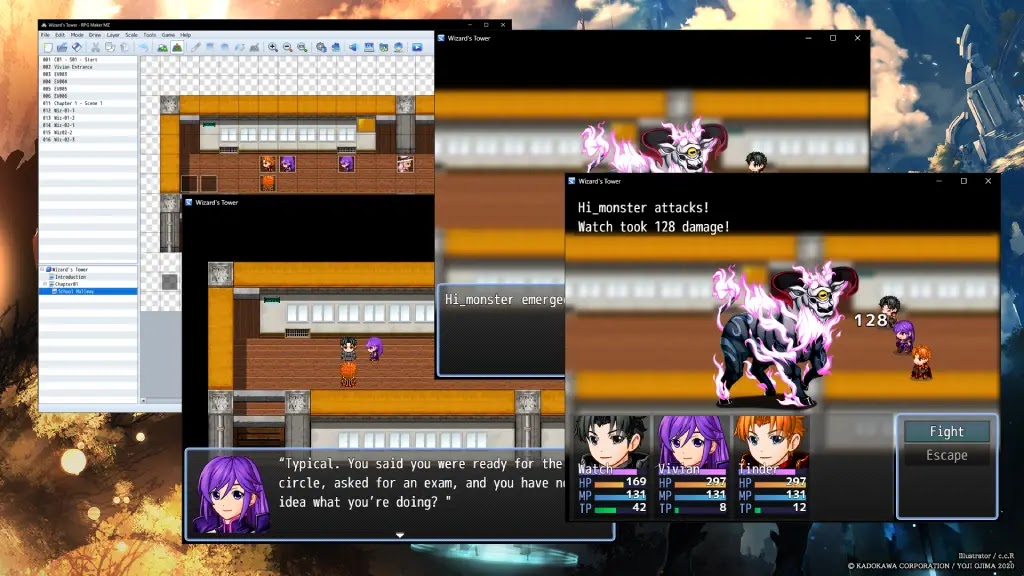
Finally, as a side note from me, I do want to add that the current tutorial system was a great asset as it helped me get back into the groove fairly quickly. Offering a vast amount of subjects to get someone started, or like me re-acquainted, the tutorial works off of a project that can be seen from start to finish turning that blank canvas into a decent enough demo to fairly understand what can be done with the basic engine before adding in any other plugins to turn this standard RPG into something else entirely.
Nick's Thoughts
PY's thoughts and review score are the final word on this article, but I wanted to take a few moments to touch on one of the series aspects that is often quite important to me: collaboration.
Very few of my projects over the years have been completed (though I've started oodles of them), and most of them have been solo efforts, but every now and then I get the opportunity to work with another person on a project and some versions of RPG Maker have handled project and asset sharing better than others.
I worked with Chris for this segment of the review, just to see how smoothly we could pass the overall project back and forth and also how easy it was to import a variety of assets. There was a bit of frustration on Chris' part that the tileset were again locked in at a size of 48. He likes to tinker with scale when messing with maps and sprites, and while he had not necessarily expected this part to change, he was a little disappointed all the same. That being said, many of the quality of life features PY talks about above really lend themselves to larger projects.
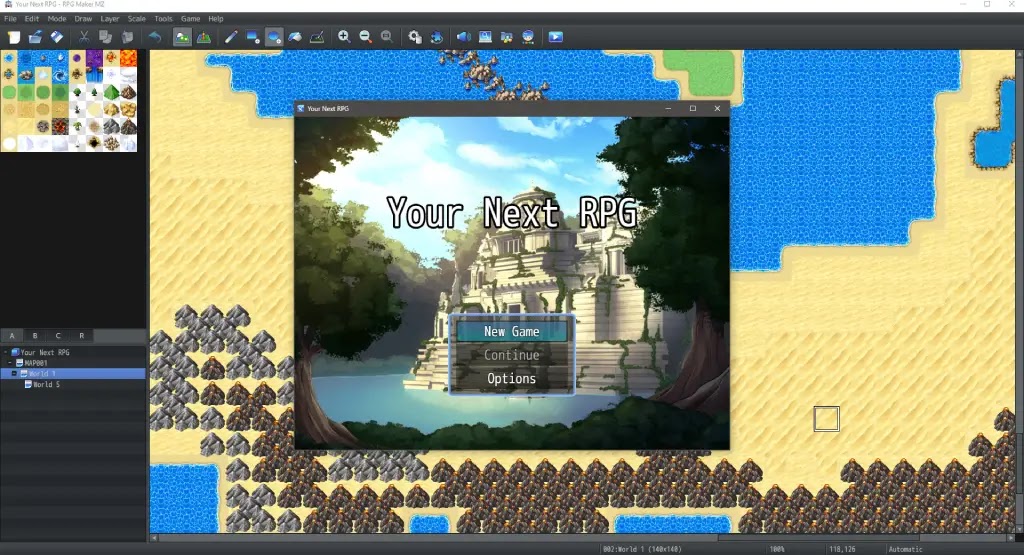
Importing assets works pretty similarly to MV, and that's a good thing. Chris did a handful of custom sprites, music files and backgrounds for us to play with and port back and forth and we never had any issues with those manual files. Using the Steam Workshop seemed to go smoothly as well as I pulled down a handful of files without any issue. One feature that might be happy in the future is a simple 'zip project' that pulls all of your assets into an easily shared project file (similar to how you deploy) to send to your fellow collaborator. It's not real hard to sync up if two people are sharing a single project, but it's not real intuitive either.
My impressions from working with RPG Maker MZ is that there are a lot of similarities to MV, but plentiful quality of life improvements for larger projects. Certainly, I have seen some of the features in MV as plug-ins, so the wheel is not getting reinvented here. That being said, collaborating with another user went rather smoothly from my perspective.
Summary
So overall, RPG Maker MZ is a great tool for those thinking of starting to break into game design. With plenty of newer elements to make life easier, you can just as easily import your own assets designed in Photoshop to create the game that you’ve been thinking of. With plenty of assets available through Steam, bundled or individual, and plenty of community resources, while it’s not as colossal as the Unreal or Unity Engines, you don’t need to know how to write code to get started here!
Score: 8 / 10