• Gobliiins Collection - Switch Review

    In the early 90s, Coktel Vision (which later became Sierra On-Line) released a quirky point and click adventure game titled Gobliiins which had players bouncing between three different Goblins to find a cure for good King Angoulafre.

  • The Core - PC Preview

    Sometimes when you are browsing the internet for information on how to do something, you stumble upon ideas or projects or even games that people might be working on...

  • Cat Mail Co. - PC Review

    What a meow-gnificent evening it is to send your paw-rcels out to those family and friends! Are mew looking to pick up an item or send something out? Well at Cat Mail Co. we can send and receive all your deliveries!

  • Volontes - Nintendo Switch Review

    Have you ever grown up feeling like you don't belong? For our Heroine, that's the feeling she lives with everyday in her small farming village. But it's not her only secret...

  • STARSEEKER: Astroneer Expeditions - PC Preview

    STARSEEKER: Astroneer Expeditions is just that! Massively co-operative and not an MMO! When you first run the game you are instantly into the tutorial...

  • Dread Delusion - Xbox Series X|S Review

    Today we’re looking at what has rapidly become an absolute favorite in the open-world RPG genre for me. An interesting story, memorable NPCs, stunning visuals, and a setting absolutely dripping with flavor, Dread Delusion sets its tone immediately and sticks with it.

  • House Flipper Remastered Collection - PC Review

    I enjoy simulation-type games, and I enjoyed the original release of House Flipper, but I never got around to getting the DLC. When the remastered version of the game was released, I figured it would be the best way to experience the DLC while checking out how the base game was upgraded.

  • GranBlue Fantasy: ReLink Endless Ragnarok - PS5 Review

    GranBlue Fantasy: ReLink released in 2024 bringing the GranBlue universe to an action adventure JRPG format. With a party of up to four members, this band of skyfarers set out for new skies, adventures, and dangers. Two years later, Endless Ragnarok...

  • 70s-Style Robot Anime Geppy-X - PS5 Review

    70s-Style Robot Anime Geppy-X is a mouthful of a title, but you know what? It’s quite the challenging game to describe as well. At its core, 70s-Style Robot Anime Geppy-X is a shooter...

Showing posts with label Dapper Penguin Studios. Show all posts

Recipe for Disaster Review

Recipe for Disaster by developer Dapper Penguin Studios and publishers Kasedo Games and Kalypso Media Digital Ltd.PC (Steam) review written by Susan N. with a copy provided by the publisher.

Estimated reading time: 5 minutes


In November 2021, we did an Early Access review of Recipe for Disaster which resulted in a 9 out of 10 score. Since then, Recipe for Disaster received a ton of updates, new features, and quality of life changes that appeased players. The full release contains an expanded campaign, new thematic decor, updated character models, new customer types, recipe tags, and more! We're going to tackle as much of it as possible without repeating our previous review points.

That said, Recipe for Disaster is most likely the type of restaurant simulator that you would expect from its title. I mean, disaster can strike at interesting times which makes your life problematic. Beyond managing the staff, character traits, customer desires, and recipe options, players have to complete objectives to advance to the next level. That can happen when the kitchen is emblazoned due to a stove fire... Yeah, that's right. This game is fun and hilarious in so many ways.

Gameplay

One of the first changes to notice about Recipe for Disaster is its updated tutorial. In the November Early Access build, the tutorial taught players some basics of the game but was quite short. The real fun comes from going through the campaign with the new features like the additional traits, recipe options, and customer needs. Success hinges upon your ability to manage all aspects of restaurant ownership from uniform design to staffing to recipe creation! In fact, players also get the option to expand their restaurant by purchasing additional plots of land!

Objectively, players need to complete the campaign tasks to progress to the next stage. However, each stage will pose greater challenges than the level before and they contain failure points if the restaurant's popularity drops below a certain amount. Or, if staff is poorly managed, they reach a breaking point rendering them useless for a time. This often causes a chain reaction of breaking points. (I was lucky because I closed the restaurant an hour early and gave everyone a raise to prevent people from quitting. Weirdly, this worked.) Another big point of failure is if appliances catch on fire. Not only does this cause panic, but if the restaurant only has one or two of any one appliance, it delays orders from completing. Disasters also come in the form of toilets clogging, which was the biggest issue I had in my game.

One of the best features that is integral to a player's success is the end-of-day report. Players are able to see what dishes were popular, what ones aren't selling, how much time staff spent working, and a list of your reviews. From this, players can adjust their strategy and menu accordingly.

Recipe for Disaster has a lot of replayability with the free play option. Players can begin a custom set of objectives or they can choose between easy, medium, and hard modes. Choosing a difficulty mode provides a specific gradual set of objectives to complete. As an example, one is having 15 positive reviews. If the custom setting is chosen, the player gets to create their own challenges. Really the sky is the limit here. Also, did I mention we get to have a bar in the restaurant now? No? Well, you know now!

Graphics and UI

Among the first noticeable features were the slight changes to the building menu. At first, it didn't seem like it was different, but after placing walls and customizing designs, I knew something changed. See, originally, I recall the building to be frustrating for reasons that I don't quite remember. However, the building mechanic operates similarly to the Sims games making it easy to manage. For me, it's a much smoother process than I remember, and while I can't put my finger on it, I love its simplicity.

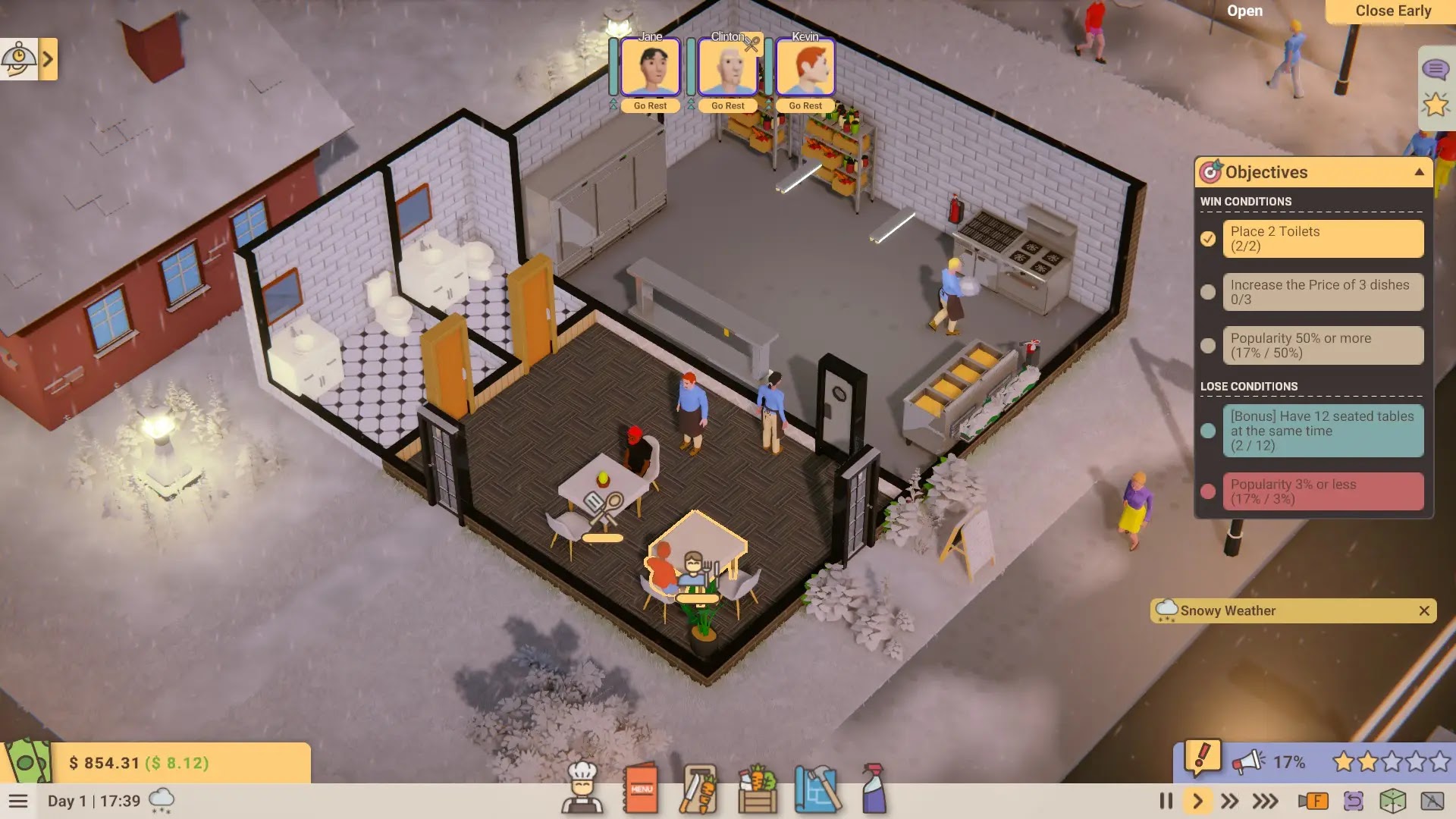
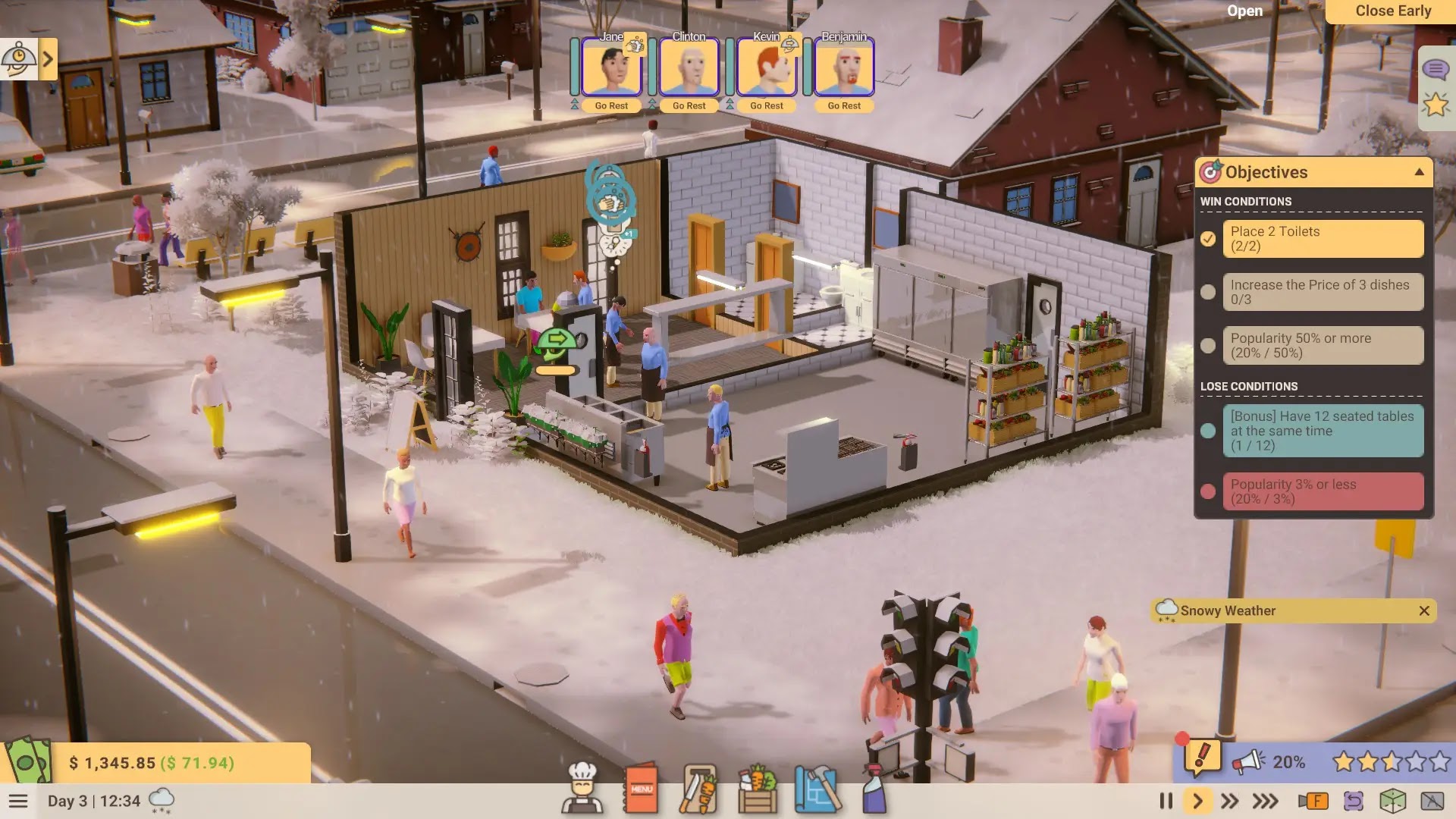
Another feature that wasn't in the game before, is the addition of weather effects! The first snowfall was stunning. And even though weather conditions pass quickly, they were beautiful. Beyond that, the game is graphically amazing even as a low-poly animated design. Nearby street lights and buildings are detailed bringing life to the game. All in all, Recipe for Disaster is visually stunning.


The UI, though unobtrusive, is designed intuitively. Players can easily designate cleaning areas, decorate their restaurants on a whim, or check out the overlay that shows restaurant attractiveness. In fact, there isn't a lot that I dislike about the game.

Final Thoughts

This restaurant sim has come a long way from the Early Access stage. The staff traits are fun to balance, the customization options are numerous, and the challenges keep players on their toes. I love that players can customize their restaurants and the menu on a whim, instead of waiting until the end of the day. Also, players can create their own restaurants without needing to go through the campaign in a free-play mode! In that mode, the sky is the limit. So, create your five-star restaurant from scratch and see how well you do. It'll be a great time. Trust me.

Summary

Tell your friends about Recipe for Disaster. It's either going to be interesting to see how they breeze through it, OR you will laugh at them while they HILARIOUSLY fail. Either way, with the new features and replayability, this game is an awesome time sink. After all, the game is called Recipe for Disaster.

So, LET CHAOS REIGN! Honestly, it's too entertaining not to. Are you up to the task?

Score: 9 / 10


Share:

Recipe for Disaster - PC Early Access Review


Recipe for Disaster
by developer Dapper Penguin Studios and publishers Kasedo Games and Kalypso Media Digital Ltd.PC Early Access review written by Susan N. with a copy provided by the publisher.

Estimated reading time: 7 minutes


Recipe for Disaster is a hilarious test of micromanagement skills. Players must run an entire restaurant like a true business owner by building and altering the establishment, hiring staff, creating the menu, and managing customer expectations. With all of that, players must complete objectives to advance to the next level.

Let's toss the fish in a barrel and light some kitchens on fire, shall we?

Gameplay

There's a reason that restaurants tend to fail within the first five years of opening. That is because it's one of the hardest professions to have due to the cost. Having worked within the fast-food environment, I'm no stranger to the basic principles of keeping a restaurant running. Unlike other businesses where people can simply return a product for a refund or a replacement, the restaurant business also has to make sure that customers aren't having allergic reactions to food, adhere to safety principles, and manage the high cost of waste. Never mind the fact that your equipment can fail in a variety of ways. It may not seem like that is much, but when you work in the foodservice industry, there tend to be a million aspects that staff have to consider.

Now that we've got that out of the way, Recipe for Disaster is exactly what you expect it to be. Players are tasked with completing various objectives while paying attention to the minutia of owning a restaurant. The game begins with an easy level where the objective is to serve a certain amount of customers. The restaurant doesn't have much going for it in terms of menu options or any of the complicated situations at this point in the game, but your staff are newbs. They set things on fire because they are bad cooks.

After playing the game for a decent amount of time I find myself strangely addicted to the early access game. It is well balanced in terms of the staff personality traits and tasks, your ability to change and add restaurant features with ease, and checking the user reviews immediately after they leave the establishment. These gameplay aspects help the player to create the best restaurant experience possible as they fight fires in the kitchen, decorate their dining area, and fight with staff to complete their tasks. Regardless, I had a ton of fun playing the game.

However, despite the amazing foundation that Recipe for Disaster has, there are some minor flaws and quality of life features that I would personally like to see fixed or added.

Heating Up the Grill (Minor Issues)

For one thing, I'd love to have a little more variety in the build menu. A cooking game that excels at this is the Cook, Serve, Delicious series which rewards players with decorations and upgrades. After every level, players earn money that they can use to purchase recipes or items. While I do really love that players can create their own masterpiece recipes, I felt underwhelmed with the decoration options. Unlike management games like the Sims, Recipe for Disaster only has one toilet option. What the developers have done is opted to allow players to put a stall door on a wall instead of a bathroom stall being its own item. When working with limited space, it would be amazing to have a little more variety in the build menu.

Another minor grievance about the build menu is how unintuitive it can be at times. As an example, I built a customer bathroom because there wasn't one available (a point I'll get into momentarily). It wasn't until much later that I discovered that I had placed the ceiling light outside of the wall! Not only did the customers not complain about it, but I felt that the lack of camera control was frustrating at times. Additionally, in many countries, sit-down restaurants MUST have public washrooms otherwise they aren't allowed to open. Just keep that in mind.

Finally, players can't designate a break area for staff that I know of. There is often a predesignated bench located outside that staff can take breaks at. The problem is that players cannot build additional benches for the staff. Nor can they place a table because the game treats those as customer-only usage. Essentially, I think what the game lacks, in this case, is simply a small menu to create a break room.

Incidentally, the build menu isn't the only minor grievance I have about the game. There were several points where staff idled in the middle of the dining area, without having a server stand or cash register. Furthermore, there were times where the staff would idle in the bathroom! Not only did that not go over well with the customers, but I found that the staff would sometimes return to the same location. Yes, we can move the staff but the customers would ignore the presence of others until after they left. Yikes.

Graphics and UI

Recipe for Disaster is graphically neat with its cartoonish style and relatively easy UI. The characters have different personalities as well as likes and dislikes. At any time, players can view the thoughts of their staff, look at the desires of their customers, and manage their restaurant accordingly. It has a decent variety of wallpaper colors and textures to choose from. Plus, when the kitchen catches fire, it is comedy gold for a short time.

What really makes Recipe for Disaster an amazing title is the UI design. Players are able to switch to build mode to modify features while in the middle of a level. They are also able to designate cleaning areas in and out of the restaurant giving the game a more realistic feel. In fact, there is an adjustable sliding bar that indicates how dirty a location has to be before a staff member will go over the area. But despite that, it was mildly annoying to have to click on individual tables to get staff to clean them.

Pros and Cons

For the pros of the game, I have a list of excellent aspects of Recipe for Disaster.

     Players control everything including the uniform look

     Excellent foundation for an Early Access title

     Graphically pleasing

     Well balanced gameplay that gives players tons of useful information

     Has a roadmap that will include features like a bar area and future Twitch integration (I have horrific visions of this already!)

     Staff level up over time. They get perks based on the most used job function, which is a great addition in my opinion

The cons in Recipe for Disaster are mostly minor issues that are not game-breaking in the least. Among them are:

     Cannot setup a break room

     Needs more item customization

     The physical building of the restaurant is a bit of a pain

     The UI size cannot be adjusted. This can be an accessibility issue

     There isn't yet a sandbox or free play mode however, this is being actively worked on according to this dev update post

Final Thoughts

Recipe for Disaster is a wonderful time sink that I thoroughly enjoyed. It has everything needed to create a fun and challenging gameplay experience. I had a fun time managing the tasks, customizing my restaurant, and puzzling out the needs of customers.

Of all the cooking based simulators out there, Recipe for Disaster is quite high on my list. It is both challenging and enjoyable to play. The UI is well laid out, the game has a great aesthetic, and it is quite entertaining. It is complex enough to keep players invested in their restaurants, and yet the game is rather relaxing to play. It is my opinion that despite the fact that Recipe for Disaster is in the Early Access stage, the game is spectacular. Management sim fans do yourself a favor and grab this game. You will love it!

Score: 9/10


Share:

Rise of Industry - PC Review


Introduction

Rise of Industry is a management game that is interesting in principle because it has a tech tree, a neat low-poly graphics style, and the potential for complex strategies to keep your industry from falling beneath the AI titans. I found that Rise of Industry's launch out of Early Access might have been jumping the gun, but in no way does this take away from my general enjoyment of it.

Gameplay

Like with most games, I tend to start with the tutorial, especially since this particular title has an emphasis on micromanaging your city to buy and sell goods to make a profit. Thusly, the tutorial seemed like a good idea at the time, but I found that going through it was actually somewhat frustrating. It's going to seem backward when I say that the tutorial felt too long. Maybe too long isn't what I mean here. Perhaps what irked me about the tutorial was that it didn't go into details about certain things and included other things that I didn't find necessary. What I mean is, the game doesn't explicitly tell players about the massive cost difference between trucks delivering goods versus trains or blimps. And when players are engaged in the campaign, there are a lot of things that players need to discover on their own, which is all well and good but I never progressed far enough to see some of these features. In fact, I went bankrupt several times, even though I was keeping up with sales to the various shops and not selling to the state.

Also with the tutorial, there were some explanations that were lacking. In a campaign, the assistant would guide players into upgrading, which was often too quick. At one point, I was made aware of the fact that the headquarters building could be upgraded, but to what end? What is also not really explained much is the concept that each upgrade is going to cost a ton of money and a ton of time. While this is not a surprising feature, it is frustrating to know that players have to spend a crap ton of waiting time to be able to save themselves from bankruptcy - even on an easy 35% map! Needless to say, I had a rough time playing Rise of Industry.

That said, let's talk about the game itself. Rise of Industry has a couple of features that I do really enjoy, even if they were also features that bothered me. First up is the tech tree. Now, some management style games have a tech tree style of progression, but their time frame is not infuriating like I find this one to be. Tier 1 requires only 60 days. Tier 2 takes 120 days. Tier 3 is 540 days to research new technology. Keep in mind that the number of days listed is per research item. Minus the first three choices which are freebies (hallelujah), if you want all of the produce unlocked at tier 1, it would take more than 400 days of time! Yikes! Now, don't get me wrong, time does need to pass for things to be researched, but the time it takes to complete a couple of research tiers gets to be so long that just thinking about it makes me feel like *I* will be bankrupt before progress can be made. Even with the ability to increase the game speed, the time length still seems bonkers. However, the idea behind unlocking certain features has its appeal. Especially considering that to win the game, players have to build one of the two major items (the computer or a car). This is the ultimate goal of the game.

Another feature that I enjoy is that players get the opportunity to sell products for profit. Players can view the different city's supply and demanded goods. As such, they can then tailor their industry to produce the most profitable items. This allows for playing freedom where players in one playthrough can specialize in toy creation, while in another, they can focus on making the coveted cars or computers. And, not only is there potential to make money in another industry than your competitors, it means that players can challenge themselves by producing different types of products. Though, it should also be said that I don't recommend selling to the state, because it buys products at wholesale cost - meaning that you don't make a profit. So, only sell to the state if you have taken on a mission to do so, otherwise, there is no point. And don't go producing an asstonne of product you can't sell well or can't use to make a higher value items. Though, all told, I do enjoy being able to change which products I will sell to the various stores.

I also like the fact that players can bid on auctions to get contracts. This feature allows players to feel like this world is realistic. In one playthrough, I was sending a neighboring town a large amount of food because they had a massive shortage. While the map didn't reflect any kind of flooding or infestation, the fact that this is included in the game made it feel a little more realistic. Make no mistake though, I did have a playthrough where some of my crops were plagued by bugs and I have no idea how I should have eliminated the problem. (This was also in the playthrough that I went bankrupt. I wasn't streaming at the time it happened but I did stream stream that particular city and it was well on its way to failing before the end of stream.)

This is what leads to my issues with the game. The fact that while I found the tutorial to be too long (because it went into detail about things I didn't need to know), it didn't cover the most relevant basic points like:

  1. How does one upgrade the HQ building and what purpose does that serve? It's not explained from what I can recall. Furthermore the assistant tells players that they should upgrade the HQ, but I never achieved that before failing (I should mention that I attempted not to become bankrupt multiple times. I've no idea what I'm doing wrong actually...) 
  2. Is it worth buying shares in a neighboring city? I mean, it is a neat feature and all, but you need a fair amount of coin to buy them out. Even then, they don't seem threatening at all - especially when you specialize in production of items they don't sell. 
  3. How much does each transport vehicle cost? It makes sense that transport trucks cost less than trains but it takes far longer to make a profit this way. 

After playing through the campaign on the easiest difficulty I could manage, I failed most of them because, even though I could track my profits and losses, some of the information isn't clear. The only other issue I had with the game was in the campaign, players can only seem to place their HQ in one region of the map. I don't know if this was an error on my part but, I did receive notifications that an HQ has to be placed in a region with four shops.

Furthermore, I was never able to get a permit to build in another region. Again this might have been my own failing but, there was never a point where I was able to harvest oil or anything in another region. Did I fail the RNGeesus lottery? I don't know, but being restricted in this way bugged the crap out of me.

The last major point I want to touch on with respect to my issues with Rise of Industry is the space it takes. Upon starting a new campaign map, when players are able to customize their difficulty level, there is an option to increase the map size. For a medium sized map, it tells you that it takes 15GB of RAM. Hawt damn! In all of the management games I have played, none of the maps have ever taken up that much space. I don't even want to fathom what a large map would take.

Now, I know I've done a bit of dumping on Rise of Industry, but it's because I care about the direction of this game. It has a great foundation with some strange irritations that aren't present in other management games. I've spent more than 40 hours in Rise of Industry trying to figure out how to make my industry sustainable. I've also looked at the charts and restarted the game several times just to improve and I'm still not able to keep my industry alive. In fact, I even stopped playing my 2130 playthrough because I felt like I didn't know enough about the game. And the reality is, I do really like the concept of Rise of Industry. Despite all the questions I have and my frustrations due to lack of progression, I can see this game doing extremely well. I wouldn't say it's quite there yet, but I have high hopes. 

2130 Maps

Before talking about the graphics and UI, I did receive a game code for both the base game and the newly launched DLC titled 2130. It is considerably harder given that 2130 has a completely different style than the base game. It is set in the future where pollution has overtaken the area. Humans have destroyed their planet from pollution. (A point that is highly relevant in today's society.) In 2130, players research different algae types and sell those in place of normal food types like vegetables or wheat. In order to harvest the algae, air purifiers have to be placed first. That said, not all buildings operate with no pollution. Some of them require there to be air pollution to filter out the necessary nutrients for other uses. Most notably, players will need some of these strains to create medication for the citizens.

In other words, while the principle of Rise of Industry remains the same, the concept of the 2130 maps is completely different in how your industry can survive. Instead of growing foods and raising cattle, 2130 has a potentially futuristic bend, using our knowledge of geneticly modified foods. Algae is used to make medicine in 2130 and to profit in this DLC, players have to harvest ruins and make other items.

Not only does this make Rise of Industry feel different, releasing the 2130 DLC puts a whole new spin on the game. And unlike other city management games, 2130 has put players in a futuristic new world that is less familiar to them. Honestly, I've spent a ton of time playing this game. Perhaps one day I will get gud.

Graphics and UI

At beginning of this review, I mentioned that Rise of Industry has a low poly style of graphics, and that isn't wrong. Looking at the trailer will showcase exactly what I mean. The game is as realistic to management games like minecraft is realistic to other open world builder games. All of the necessary components are there, like graphs, buying and selling goods, traffic management, etc... but the graphics are different from other games in its genre. Although, it still confuses me as to why larger maps require more computer resources than triple A titles. One would think that the graphics style would be less hampering to a computer than others, but I digress...

As for the UI, it takes some getting used to. Some of it is explained through the tutorial of the game, though there is a ton of information in menus which can be found by players easily enough. The top bar has buttons for the tech tree, useful overlays, graphs, and information about the competing companies. On the bottom of the screen are all the buildings that players can use to expand their industrial empire. Each of these are shown under appropriate categories like gatherers and farms.

In the bottom left is a bar that shows a bunch of monetary figures. At first, this bar was confusing. Once you click on it, then you see that on the left side it shows the previous months expenses. This shows the totals for transportation, upkeep of buildings, and profit generated. The right hand figure shows how you are doing for that month, which I found oddly deceptive. The total money you have is listed in the middle and occasionally that figure would drop. That is true even while I was generating profit according to the current monthly figures. I'm not sure why it is displayed this way because it just didn't quite work well for me (despite having dealt with basic accounting in real life).

My issue with the UI is something extremely insignificant. If players are using the assistant, there are times where you can open up a drop down and the assistant will always be in the way. Unlike other games which would shunt a screen over so that everything could be properly displayed, this game keeps the box where it is. I spent a lot of time moving the assistant around just so I could look at the information I wanted. Also, in the top right corner where players can look at how the other corporations are doing, if players are working on a contract, that bar will be covering part of the corporation box. Again, this isn't a big deal, but it bugged me enough to notice.

Final Thoughts

Overall, I do enjoy Rise of Industry, even with its flaws. I'm sure that some of my gripes boil down to things I haven't yet figured out. We could chalk it up to its unique style of management game but I am not sure if that is really the issue here. It has made leaps and bounds since its early access days and I'm thankful for the progress, but for some reason I still feel like the game could use more improvement. The concept is great and the foundation is there for Rise of Industry to be an excellent management game, but it still needs some time. At least for me. But don't worry, I'm still going to be playing this game well after writing this review!

In conclusion, I'm going to give Rise of Industry a 7 out of 10. It has kept my interest despite the number of failed attempts I've had.

Be sure to follow Rise of Industry on Twitter and join the Discord server for tips!

Game Information


Platform:
PC
Developer(s):
Dapper Penguin Studios
Publisher(s):
Kasedo Games,
Kalypso Media Digital
Genre(s):
Management
Mode(s):
Single Player
Other Platform(s):
Mac, Linux

Source:
Provided by Publisher


Article by Susan N.
Share:

Rise of Industry - PC Preview


I was initially really excited when I got Rise of Industry (ROI) because it looked like a game that was right up my ally! I followed the tutorial most of the way through then proceed to plop down my headquarters in a medium sized town. I then began placing crop and livestock farms complete with water access and selling my grass fed organic produce at the local farmers market like a good little hipster. Yay capitalism… except I was hemorrhaging money! Ok, what else does the town want? Wood? Ok I can do that. A deforesting we go! So I set up a bunch of lumberyards and began exporting wood… and still I was hemorrhaging money!? Fine! Being from Canada I know how this goes!

Exporting natural resources doesn't make you a lot of money, you need manufactured products to roll in the dough. I'm going to become the tycoon of beef stew! (don't judge I was hungry). So I set up a decent supply chain, trucks were whizzing down the highway like it was the month before Christmas until finally I began exporting my delicious meaty stew. I finally began to break even, sort of. Then I looked at the rest of the tech tree, realized I'd have to do the same for every single product on the there and thought why?  


ROI takes players back to the old tycoon age where you supply resources to growing towns using ever increasing complex supply chains. As you spread across the map you're forced to juggle warehouses and trucking depots and even trains to move your products wherever it needs to go. Once you outgrow your home town you'll need to buy the right to expand into new municipalities. But be careful, if you don't supply these cities with produce they will build their own factories and farms and you'll be forced to deal with the one thing business people the world over bemoan: competition. Don't worry, if your rivals get to be too annoying you can buy them out and resume your Coke like mega conglomeration status.

Honestly that's about all there is to ROI. It's minimalist in its design so you can focus on building your supply chains. And this is my main issue with ROI: it is very very minimalist. I have sunk hundreds of hours into repetitive games like Rimworld, Factorio, Banished and every tycoon and simulator game you can think of but for some reason ROI fails to keep my attention. I don't feel satisfied enough with the progress to keep rejigging the supply lines, buying new territory doesn't give me that little thrill that moving forward does in other games. I'm hoping this will change as the game adds more content which the developer does constantly! (One of the main reasons it took me so long to write this review, everytime I went back to confirm something there was a new patch!)


Normally I would look at a game like ROI with its bland, mobile like graphics and think it's just another early access game that will not amount to much more than it already is. Not this time, not with this developer. Through all the comments on Steam and the discussion/community pages Dapper Penguin Studios is one of the most engaged developers I have ever seen with an early access game. Ever. Not only do they engage with fans in meaningful discussion but they actually listen and, through YouTube videos explain why they made the changes they made. It's obvious there's pasion here and I think this little game will grow to be something complex and special.

I'll keep coming back to ROI and testing out the new content as the game progresses. I have a sinking feeling that, at some point the hook will be set and I'll disappear down the rabbit hole of supply chains and beef stew in the near future.

Game Information

Platform:
PC
Developer(s):
Dapper Penguin Studios
Publisher(s):
Kasedo Games
Genre(s):
Simulation
Mode(s):
Single Player
Other Platform(s):
N/A

Source:
Purchased or Provided by Publisher

Article by Breanna
Share:

Random posts

Our Streamers

Susan "Jagtress" N.


S.M. Carrière

Aldren


Affiliates

JenEricDesigns – Coffee that ships to the US and Canada

JenEricDesigns – Coffee that ships to the US and Canada
Light, Medium and Dark Roast Coffee available.

Blog Archive

Labels