• Culdcept the First - Xbox Review

    Culdcept the First (also attributed as Culdcept the First Saturn Tribute) is a very fun game, that does show its age. This is basically a re-issue of the 1997 Sega Saturn game that mashes together deckbuilding (think Magic: The Gathering) and boardgames (such as Monopoly).

  • NBA 2K27 - PlayStation 5 Review

    With these annual seasonal renewals of the sports season comes the related video games as well, and the question reviewers such as myself always face is this: Is this year’s game worth purchasing one year after the last one? My answer? Yes, absolutely. NBA fans are going to almost certainly enjoy NBA 2K27.

  • Midnight Moments - PC Steam Review

    Midnight Moments is a cozy cyberpunk diorama-building game that is stunning. Unlike games that require you to complete quests or take out assailants or even solve challenging puzzles, this one only requires one thing: imagination.

  • Isle of Reveries - PC Review

    Isle of Reveries is a top down 2D action adventure game that made my nostalgia for old school Zelda games flare up really hard. A good blending of puzzle, exploration, and combat, Isle of Reveries is a wonderful title to experience inside and out.

  • Outbound - PC Review

    Let me tell you about this cozy game my daughter and I are playing together called Outbound. Now, I've been following this game from the initial Kickstarter back in April 2025 to its full release in May 2026. The best Mother's Day gift for myself and my first ever collector's edition in a physical copy!

  • OVER REQUIEMZ - Nintendo Switch Review

    In OVER REQUIEMZ Yuhiru is thrown into the castle of Oz and is immediately accused of trying to assassinate the King and shoved into the dungeon. Not only is she treated like a criminal...

  • Dread Delusion - Xbox Series X|S Review

    Today we’re looking at what has rapidly become an absolute favorite in the open-world RPG genre for me. An interesting story, memorable NPCs, stunning visuals, and a setting absolutely dripping with flavor, Dread Delusion sets its tone immediately and sticks with it.

  • NHL 27 - PS5 Review

    ...and I have been playing NHL games since. It didn't matter whether it was EA or another game like 2K in the 2000s; I loved hockey games and still do, but is NHL 27 a step in the right direction?

  • Asdivine Knot - PS5 Review

    Asdivine Knot is the latest title in the Kemco JRPG library. Following protagonist Verselio, who's on the run from the church that they once served, he'll be accompanied by an odd selection of party members as they all find a reason to band together…

  • STEINS;GATE RE:BOOT - PC Review

    Our story begins in Akihabra, Tokyo Japan. The protagonist Okarin… Or rather Rintaro Okabe, (Voiced by Mamoru Minyano) is a recent high school graduate who rents an apartment with his best friend and resident computer hacker, Itaru ‘Daru’ Hashida (Voiced by Tomokazu Seki) during the summer of 2010.

Showing posts with label Solasta: Crown of the Magister. Show all posts

Solasta: Crown of the Magister – PC Review


Solasta: Crown of the Magister by developer and publisher Tactical AdventuresPC review written by Pierre-Yves with a copy provided by the publisher.

Estimated reading time: 8 minutes


It’s always a fun day when something that you have been looking forward to in Early Access hits that 1.0 version. It’s kind of like rolling a 20 on something that actually matters instead of rolling a 1 and hoping no one saw you faceplant while “trying” to do something cool. So on that subject, having sat down to Tactical Adventure’s Solasta: Crown of the Magister earlier this year when the cold winds of January were still upon us, I can say with certainty that I have not been disappointed with the recently released final version of this computerized table top experience.

Again, starting off like any good old fashioned Dungeons & Dragons player, I made a couple of my own characters instead of going with the system generated ones for those that want to simply dive into the action. Creating a half-elf Rogue, Dwarven Cleric, Human Fighter and Elven Wizard, I rolled the dice on all four instead of seeing what I could do with the point by system. Scoring some rather decent numbers for each (there was a LOT of rerolling and apparently steam achievement for such action) I was ready to take on the not so quite unknown as I re-entered the darkened caverns with at least three of my four members having low-light to darkvision. I swear that wasn’t on purpose…

Now for character creation, as a good deal of it is based on stats and what a character can or cannot do, there were a few aspects that I want to highlight in a good light. One of the first of these is that some abilities or languages are told upfront that they will be useless to you if you take them for the main campaign. Could they be useful later? Yes, but for right now, they aren’t so if there are other things that you want to take instead you probably should and then just make another character down the line to supplement what’s missing at that point in time. The other, while perhaps seemingly minor to some but will be huge to others, is the ability to choose not only your binary gender of Male or Female which affects the default appearances, but also your pronoun. He, She, They. I was pleasantly surprised to see this added in as Solasta is the emulation of a table top experience and if someone wants to play outside the “norm” then they should be able to. That’s the entire point of Dungeons & Dragons!

Once your party of four is in order, you’ll once again dive through the tutorial in order to get a handle on things. Split between your four characters, you’ll quickly get an idea of how each character type works from the rogues and stealthy actions like lockpicking and sneak attacks to warriors dropping boulders on wolves. Once that’s over and you’re into the first city to gear up, there are a few things to check out but one thing that I greatly want to highlight and that I didn’t pay enough attention to the first time around is the following. DO NOT LOOT EVERYTHING. Well… loot everything, just don’t pick it all up, it’s not at least in the beginning worth it as there’s a crew designed to come up behind you and do it for you for a percentage. So why slow down your characters in battle when the most it’s going to cost is a few GP for super convenience? The only tradeoff to be aware of is if you do end up doing this, it could be a few in-game days until you get paid if you really need the cash? Carry the stash.

In the field, things will work just as they would with papers spread out on a table alongside pizza boxes, beer and pop on a friday or Saturday night with friends. Character sheets, check. Dice, check. Lines of sight and fields of vision depending on ambient lighting? Check. Each of these comes together in order to bring about a single player tabletop campaign that makes you feel like you’re at a table with others which is huge especially since we haven’t been able to actually do that over the past year and a half. That’s really what drew me to Solasta as it wasn’t just another computerized D&D adventure. Like Pillars of Eternity 2, like Divinity: Original Sin 2, like the upcoming Pathfinder: Wrath of the Righteous, these are crafted experiences to bring you into the adventure and not simply have you sit on the sidelines for yet another dungeon crawl that you hit the spacebar to pause and decide who to magic missile next. There’s nothing wrong with this as it's a solid genre of gaming, but sometimes, you need something more and the twist in direction of Solasta is a good start.

Mixing exploration, dialog and combat though, scenarios will have you moving through environments as you see fit. Do you want to go all out from the beginning? Do you want to be rude to someone who may be able to help you out? Do you want to try a secret code that the rogue says that they know that could trigger something from the person standing behind the door if you’re lucky enough. How you go through is up to you but like any good table top, only the dice will be able to tell you if you’ve succeeded, failed, or failed miserably by rolling a 1 and fumbling hard.

This leads me to perhaps one of the more interesting elements, the showcasing of your rolls. The best example and I HATE (and love) how they do it, is take a combat scenario for example. You get your wizard to prep a firebolt as a cantrip, they cast it, you see it fly out across the distance to the enemy and while it’s flying out you see the dice hit the table and you notice that it’s a low number. You’ve missed, the firebolt moves past the target and hits the wall, you groan, the enemy chuckles to themselves, the battle continues. The interactiveness and seeing how your dicerolls affect certain of your actions but not until the action is in play is rather neat as you inch that much closer to your screen and wonder, did I do it?

Otherwise, everything really plays out like a D&D on a table top surface. You can move “X” distance based on your physique and how much you’re carrying. Stealth checks are constantly made against those you are trying to hide against making their own Perception checks. You can try to hit enemies off in the distance if you can make them out but sometimes you’ll want a cleric or a wizard to make some light or ignite sconces to provide additional light to see. You’ll need to take short and long breaks which consume supplies to get back into tip top shape. And sometimes you’ll have to think on your feet and realize that the environment can both help and kill you all at the same time by being able to push enemies off and be pushed off yourself.

Now is Solasta perfect? No as there are a few details here and there that could have easily been approved upon but what is there is pretty awesome. If there are small things that I would have liked to see more of it would have been in the cosmetics of your character because I found that the options for both facial hair and head hair to be a bit lacking. Another category that I think could use a little bit of work is to have more voice options for your characters is three per binary gender is definitely not enough to fully differentiate your characters.

The other perhaps small detail is that the dialog while all voiced and having options is rather limited. A lot of it felt like all options would lead to the same thing, the only difference though between the options would be as to how sarcastic or gentle you would be if you decided to say something. I hadn’t really noticed it the first time, but the second time around it was a bit more noticeable and in some ways it’s not a bad thing as this campaign is on rails and you’ll go where the “Dungeon Master” wants you to go. Like I said, it’s not the end of the world, but sometimes I would have preferred a few more options.

Summary

So overall, Solasta: Crown of the Magister does an excellent job at bringing a tabletop experience over to the digital realm. While it may not be perfect, that’s more of a detail as it’s still being worked on with new features to come down the line such as the Dungeon Maker and a Sorcerer class to add to the already existing six available. Will more come? That’s to see down the line but for now? Solasta offers hours of brilliant tabletop goodness all from the comfort of your chair.

Score: 8.5 / 10


Share:

Solasta: Crown of the Magister - PC Preview

Solasta: Crown of the Magister by developer and publisher Tactical AdventuresPC Preview written by Pierre-Yves with a copy provided by the publisher.

Estimated reading time: 7 minutes

Having released this past October, I had the pleasure of taking Tactical Adventures’ Solasta: Crown of the Magister for a solid playthrough over our holiday break. Based in Dungeons & Dragons' Fifth Edition rule set, and currently in Early Access, you'll have your choice of Humans, Elves, Dwarves and Halflings in order to explore this new world that suffered it's own cataclysm forever changing the landscape like Faerûn.

So starting off like any good old fashioned D&D player, I made a couple of characters of my own for my party while also trying out some of the premade ones. Human Rogue, Dwarven Paladin, and then picked the premade Elven Wizard and Human Cleric to more or less cover my bases for the party of four that I found myself with. The character creation feels just like it should though I fully expect to see more options for both races and subraces down the line as Human, Elf, Half-Elf, Dwarf and Halflings may not cater to everyone. They work to be sure as they are often at the core of the most adventures and populace makeups but there's something about having an Orc Paladin or an Orc Rogue that just breaks the mold a bit. 

After choosing your race and backgrounds, you get to either roll 6d20 for your stats or use a point-by system. There's no penalty for using one over the other so it was nice to have both to see how lucky you could actually be with dice rolls, or, just more mathematically go at it with a preset number of points. I totally rolled my stats and finally scored gold with my Paladin landing , 18-13-18(16+2)-12-10(9+1)-17 which after Dwarven racial boosts worked out to no negatives. 

So once you've gotten your party of four set up, custom or premade, it's time to hit start on the first campaign that's currently available. Like any good old fashioned tale, it starts off in a pub with cheap ale tasting of, and I quote, donkey piss. Apologizing for being late, my premade Cleric Tanya goes into what held her up which launches into the first of Solasta's tutorials.

Being captured at crossbow point, Tanya was stripped of her gear and thrown into a cell to rot. Being an adventurer and not willing to wait around, she busted down a broken part of a wall and got to finding the exit. This wall and subsequent path forward had finally made things like "Athletics" viable character skill to worry about when creating your character. When playing on a table top, something like Athletics comes in handy when needing to make a long run and jump, climb a high wall or not drown while swimming but inside of a computerized version? Often overlooked, until now.

Being a Strength based attribute, the higher your Strength, the more additional points you'll receive when making a roll in order to perform an action. Starting with a base of 10, you'll get nothing extra when making a roll. Adding a +1 for every two points and 18 strength will net a +4 on your rolls. Thankfully this didn't take my Wizard into account as it could have been a bit more disastrous, this is Dungeons & Dragons and tutorials will kill you just as easy with bad rolls, and my Cleric made her jumps and her climb checks all the way to the exit and breaking down a wall onto the heads of her had been captors.

Not to be outdone, my Paladin Jackson said that he instead faced his challenges head on which introduced combat. I grew up playing Baldur's Gate, IceWind Dale, Planescape Torment, Temple of Elemental Evil, etc. but there's one thing that they all had in common. Things were real time with a pause button even even if dice rolls were being made. Pillars of Eternity follows this path while Divinity Original Sin and Original Sin 2 went more the action point based approach that the original Fallouts used. Solasta, meets them somewhere in the middle bringing that tabletop approach of rolling dice and being able to move and attack on your character specific turns to life.

Introduction to combat, stealth, lockpicking and sleight of hands, each of these showcase that anxious feeling one can get when rolling the dice and just hoping that they don’t mess up. Is the dice roll high enough? Did you ace through your challenge or fumble at a trap even with a set of thieves' tools and lose half of your health for that failure? It’s all there and done in a fast enough time that feels natural to the adventure and not like an added extra level of flair like one would expect when seeing dice rolls and score additions being added on screen. Once these four introductions have been made, the journey starts off in earnest. 

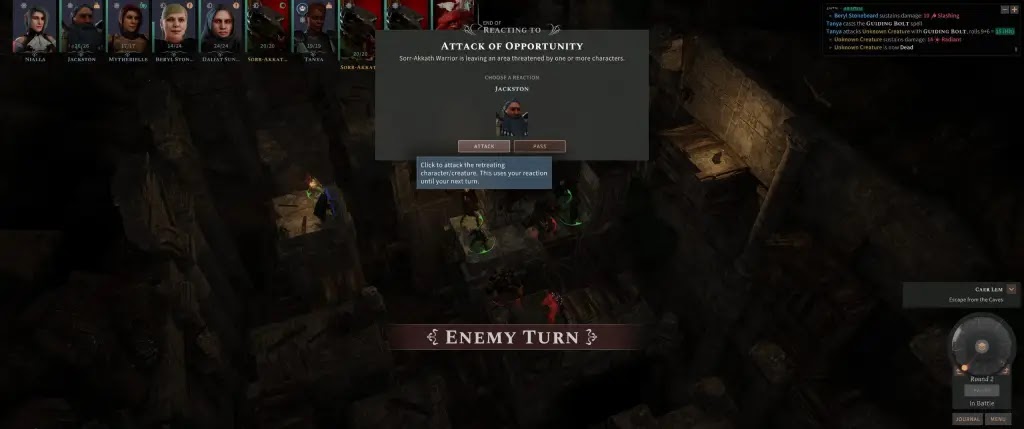
Keeping a bit inline with the tabletop aspect, while you can move your party across the map in any which way either crawling through holes, jumping over ledges or climbing up windows, once you’re engaged in battle, the square based grid comes up showing you how far you can move, and what you can do within it. Attacks of opportunity are clearly a thing and if you wish to move out of the range of your current opponent you’ll have to disengage first. Move too far, and you won’t be able to attack. Unlike a standard tabletop experience, you can move each character the total amount of squares that they are allowed on their turn, it’s not just “I move two squares of my six” and that’s it. You can move those two squares and then move again.

More than that though, it was the most refreshing of experiences in that you had to not only consider where you had your party and potential temporary allies standing, but where they were standing in the environment. Solasta doesn’t take place on a 2D plane once battle gets started. There are ledges that can be fallen off of is either you or an enemy tries to push you off. Fall from high enough and you’ll do damage. Hide from high enough and they may just never know where those arrows and magic missiles are originating from.

This changes the playing field drastically as one of your main enemy encounters in what’s currently available can climb up or down walls easily moving in and out of an actual melee range. Frustrating when they move away, but amazing to see as the world is finally “alive” in a sense and you have to worry about everywhere when exploring areas that have ceilings. Speaking of moving in and out of range, while Attacks of Opportunity have always been there, now you can also prepare an action whether melee, ranged or cantrips for the spellcasters. It really brings that tabletop feeling alive.

Prepared actions were neat as you could line up the ledge and fight enemies before they even get up there so potentially toss you off. Along with the prepared actions though, there’s one more thing that pleasantly surprised me, your reactions such as Attacks of Opportunity. You don’t actually have to attack if you don’t want to. I’m not quite sure why you wouldn’t, but you can pass on it if you want. Other types of these reactions were my Paladin stepping in to block an attack or my Wizard being able to cast Feather Fall as my Paladin failed his saving throw and was shoved off a very high ledge. So instead of crashing down and getting fairly hurt, he was able to float softly down and then use up both movement actions to get back up and into the fight.

Even without the more tabletop elements being brought to life, Solasta would have been an interesting game with how some of it’s mechanics are bringing 5e D&D to the screen. Adding in those elements? Even in Early Access and probably loads of development left to do, this is already sitting at a 9/10 for me and it’ll be to see if the full version holds up to that statement once released.

While some people don’t like taking chances on Early Access / in development titles, and it’s hard to blame them, fans of Dungeons & Dragons should definitely check out Solasta: Crown of the Magister even if it’s only to get your feet wet while waiting for the rest of the experience to be finalized.

Score: N/A

Share:

Random posts

Our Streamers

Susan "Jagtress" N.


S.M. Carrière

Aldren


Affiliates

JenEricDesigns – Coffee that ships to the US and Canada

JenEricDesigns – Coffee that ships to the US and Canada
Light, Medium and Dark Roast Coffee available.

Blog Archive

Labels