• Blue Reflection Quartet - PS5 Review

    The Blue Reflection series by Gust is a high school slice of life with apocalyptic level situations and magical girls. With the world on the brink of destruction, it'll be up to a select few to tackle those that wish to destroy it, all while managing the emotions of their friends, fellow students, and themselves…

  • Gobliiins Collection - Switch Review

    In the early 90s, Coktel Vision (which later became Sierra On-Line) released a quirky point and click adventure game titled Gobliiins which had players bouncing between three different Goblins to find a cure for good King Angoulafre.

  • Cat Mail Co. - PC Review

    What a meow-gnificent evening it is to send your paw-rcels out to those family and friends! Are mew looking to pick up an item or send something out? Well at Cat Mail Co. we can send and receive all your deliveries!

  • Volontes - Nintendo Switch Review

    Have you ever grown up feeling like you don't belong? For our Heroine, that's the feeling she lives with everyday in her small farming village. But it's not her only secret...

  • STARSEEKER: Astroneer Expeditions - PC Preview

    STARSEEKER: Astroneer Expeditions is just that! Massively co-operative and not an MMO! When you first run the game you are instantly into the tutorial...

  • Dread Delusion - Xbox Series X|S Review

    Today we’re looking at what has rapidly become an absolute favorite in the open-world RPG genre for me. An interesting story, memorable NPCs, stunning visuals, and a setting absolutely dripping with flavor, Dread Delusion sets its tone immediately and sticks with it.

  • House Flipper Remastered Collection - PC Review

    I enjoy simulation-type games, and I enjoyed the original release of House Flipper, but I never got around to getting the DLC. When the remastered version of the game was released, I figured it would be the best way to experience the DLC while checking out how the base game was upgraded.

  • GranBlue Fantasy: ReLink Endless Ragnarok - PS5 Review

    GranBlue Fantasy: ReLink released in 2024 bringing the GranBlue universe to an action adventure JRPG format. With a party of up to four members, this band of skyfarers set out for new skies, adventures, and dangers. Two years later, Endless Ragnarok...

  • 70s-Style Robot Anime Geppy-X - PS5 Review

    70s-Style Robot Anime Geppy-X is a mouthful of a title, but you know what? It’s quite the challenging game to describe as well. At its core, 70s-Style Robot Anime Geppy-X is a shooter...

  • Gunvolt Chronicles: Luminous Avenger iX 1+2 Dual Collection - PS5 Review

    Are you ready for the package deal for the Azure Striker spin-offs before the third title in the spinoff series drops? Do you love the Megaman X games but want something fresh and musical? Do you wanna feel totally inadequate when you get a crappy score rating after beating what you thought was a tough fight?

Showing posts with label Aquaplus. Show all posts

Monochrome Mobius: Rights and Wrongs Forgotten - PS4 Review


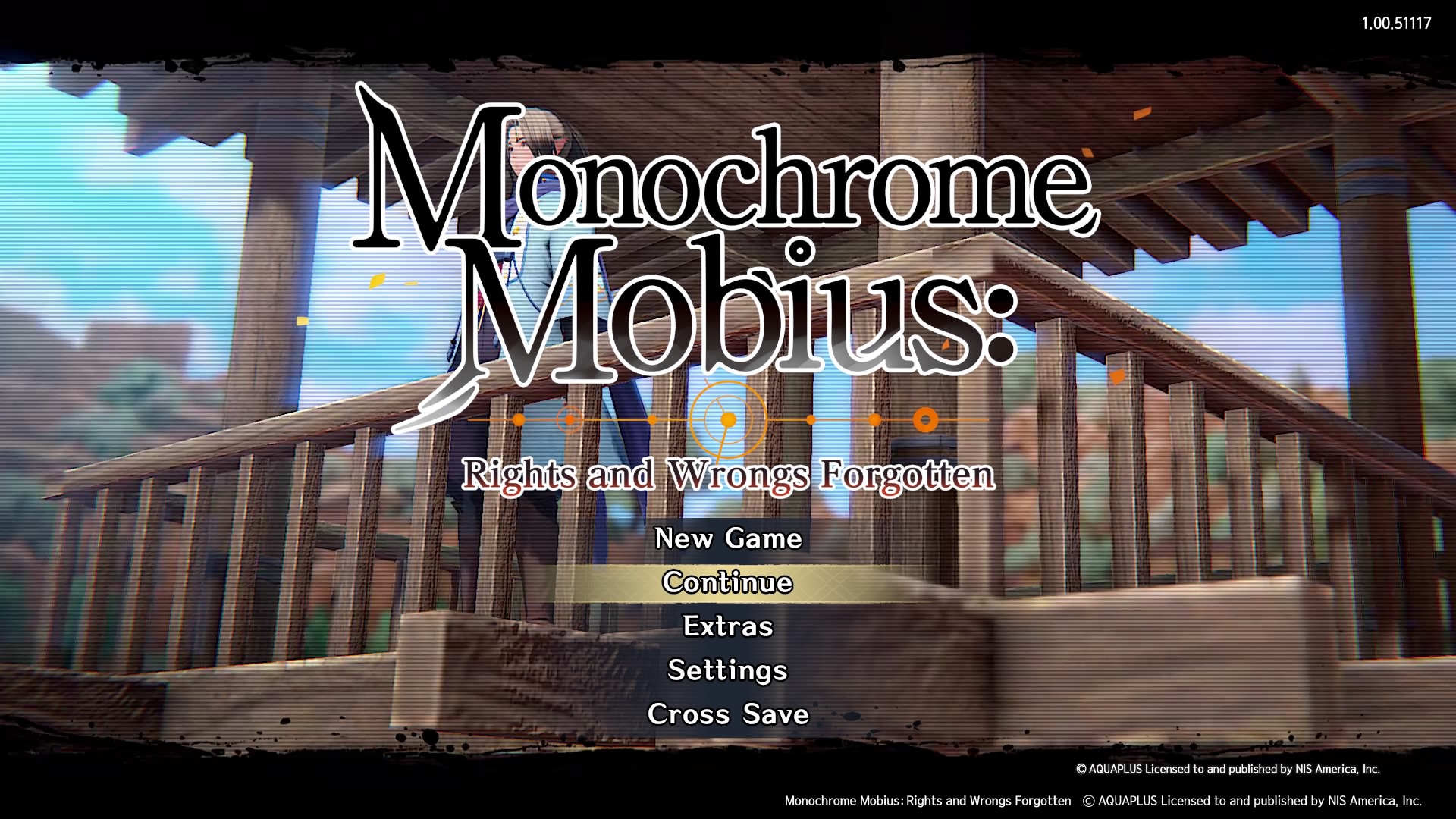
Monochrome Mobius: Rights and Wrongs Forgotten by developer Aquaplus and publisher NIS AmericaPS4 review written by Richard with a copy provided by the publisher.
 
Estimated reading time: 7 minutes
It's time again to look at the series I probably have the hardest time pronouncing. A part of the Utawarerumono franchise, we are looking at Monochrome: Rights and Wrongs Forgotten. Set as a prequel to the "Twin Masks" titles, Monochrome Mobius stars Oshtor and his rise to become a strong warrior for his country.

Those of you familiar with the Utawarerumono franchise may be familiar with Oshtar, but those who may be new to the series, allow me to lay out a bit of background into what you'll be getting into. In the land of Yamato, reminiscent of something close to Ye Olde Japan, people with beast-like traits inhabit the land. A young man named Oshtor is living in the village of Ennakamuy with his mother and little sister. One day he is tasked with the local lord to discover what has been happening with some issues with the townsfolk. In the process, Oshtor discovers a girl named Shunya. Shunya tells Oshtor that his father, who he had thought dead many years ago, was still alive. And so Oshtor decides to set out with Shunya in order to see for himself whether his father was still alive or not. Thus begins their adventure to Arva Shulan.


Monochrome Mobius takes a bit of a step away from what you may be expecting from an Utawarerumono title, replacing the "visual novel with turn-based strategy segments" with a "3D exploration and more traditional turn-based battle" style. Yep, that's right, we've got a standard turn-based battle system as well as full 3D map and field exploration this time. Exploring Yamato and Arva Shulan is done by running around a large map (very large actually) as any of the party members you acquire. You roam around, filling in the map as you go, picking up items from shiny locations, snagging chests, and getting into fights (maybe). You can run, although there is a stamina gauge that needs to recover, and jump around, and you can even interact with any friendly people you meet or areas of interest such as climbable vines.

When in town it is pretty similar, only you get a free full recovery, and you can buy stuff at the equipment and item stores, as well as check notice boards for any sidequests that may be available. Later on in the story you can spend some materials at the equipment shop to upgrade the quality of the gear they offer. Pay attention to this, as sometimes "lesser" equipment can end up better at higher "tiers". As an example, if a "steel sword" is better than a "bronze sword" to start out, a "bronze sword II" could end up better than a "steel sword II". Just something I noticed. Side quests can range from a variety of different requests, but can usually be summarized as "go here, defeat thing, report back". Side quests do have time limits, story wise not actual time wise, so be sure to get those done if you're interested!


As an additional note for the shop upgrades, after reaching a certain point in the story you unlock the ability to get, well, abilities by providing certain materials as well as meeting certain gameplay objectives, such as getting incapacitated by certain status effects. This can lead to useful abilities such as increasing the rate your dash stamina comes back, increasing rare material drop chances, or adding markers on the map for shiny items and chests.

Combat in Monochrome Mobius is a little...weird, I guess? Not because the combat mechanics are anything obscure or unintuitive, but more so because it just...might not happen if you play in a certain way? Obviously boss fights and event battles are mandatory, but the developers decided to add in what are probably some anti-frustration features that can be abused a little bit under certain circumstances. Essentially you can attack them on the field map to start the battle, but if you get a certain level stronger than the enemies, instead of starting the fight you just outright kill them on the field map, and you get all the exp and drops you would normally and no resource expenditure. I think some of you can see where this is going. 


Well, needless to say, my first task when introduced to the field map was to explore all the map, even the "tougher areas", as well as fight everything I saw. Cue a short while later and I can now field attack kill all of the enemies I can see that aren't either in the "you don't want to be here, I'm serious" area or a special monster. This does let off as you continue through the game though, so you will start getting into actual fights again later. Oh, also, you do end up getting a fast travel mechanic, so don't worry too much about that early game.

So, how is the battle system actually? It's pretty standard turn-based fare for the most part. Each character or enemy take their turns based on their speed stat, and have options such as attack, skill, item, defend, and flee. Pro tip, by hitting left or right on your turn, you can swap between the "attack, skill, 'spoiler command', item" options and "Defend, flee" options when your turn comes around. So, where is the unique twist you ask? Well, turn order is shown through an "action ring" that your character portraits speed around after taking action. However, there are three actions rings. You can ascend rings, which get smaller in size as you go up, greatly reducing the time between your turns. In order to ascend rings, you have two options. The first, and most likely, is by attacking an enemy a lot. They will get staggered, and the next hit will drop them a ring, or revert their ring position to the start if on the lowest ring, and raise you a ring. The other option is by building up the zeal gauge. When full you get a stat boost and have the special option under your skills to ascend a ring.


As an interesting added bonus for those unfamiliar with Utawarerumono, Bonus Points are a thing. These points are earned primarily on leveling up, and can be assigned to whatever stats you wish, either to improve a positive trait or balance out a lagging trait. For example, Shunya doesn't have a high natural physical attack, so you could bolster that, or you could increase her Int and MP stats so she can deal more spell damage and cast more spells.

I am pleased to let you know that the world is rather pretty in 3D animation, and you can swap between any of your current party members at will on the field map, each of which have their own unique attack animation for starting battle. Also, and this is something I was extremely pleased to see, the animated fights are REALLY well choreographed. Like, seriously, the cinematic battles are really great. Areas you traverse are pretty vast and are also pleasing to look at as well, and the character designs for important characters are good to look at.

Another piece of good news, or pieces, is that the soundtrack is also pretty good. I've always been pleased with the soundtracks from the Utawarerumono games, and Monochrome Mobius doesn't disappoint. Perhaps it doesn't have any really stand out tracks like some of the previous titles, but all the tracks are very thematic and very orchestral in nature. There's a lot of traditional Japanese instrument sounds, and it shows both in composition and tone.


Overall, my experience with Monochrome Mobius: Rights and Wrongs Forgotten was largely positive. I enjoyed the turn-based combat with it's own twist, the characters were interesting, and the graphics and music were well received. The fight scenes were really well choreographed, and finally being able to freely explore in an Utawarerumono title was pretty nice. While I did find the difficulty to be a little lacking on the normal setting, there is a harder difficulty available and self restrictions you can impose for a more challenging playthrough. The fact you can render combat almost non-existant can also hamper your enjoyment. Monochrome Mobius is a solid Utawarerumono title that needs little to no prior knowledge of the series, and is a pretty fun title on its own.

Score: 7.5 / 10


Share:

Utawarerumono Zan - PS4 Review


Utawarerumono is a series as steeped in story telling as it is hard to spell. Utawarerumon Zan is a bit of a weird addition to the series, forgoing a lot of the more intricate storytelling to get you into a more action styled game than those that came out in the past. While this type of game might be good for getting those less interested in Visual Novels onto the scene, it can also feel a bit lacking at times.

Uta-Zan (now my personal name for the game) is a retelling of the first game in the “False Faces” or “Two Masks” line, the first game I believe was “Mask of Deception”. Those familiar with the original game will notice that Uta-Zan follows the plot all the way through the game, skipping over a lot of the finer details. The basic premise is still there, a young girl named Kuon discovers a guy with amnesia who she names Haku, and they end up doing jobs for one of the local authority figures, which generally involves getting rid of bandits or monsters, or solving problems around the capital city.

Sound a little sparse? Well, that’s what Uta-Zan feels like a lot of the time as well. As someone who came from the original games in the series, I have a bit more knowledge than what is given in-game, as most scenes are maybe a minute or two long between combat, pretty much just covering the bare-bones in order to cover what is needed before shoving you into the action. Does this work? Technically yes, as I was rather content to spend most of the game not just reading text, but to people new to the series? This only brings up a lot of plot holes and questions that would’ve been solved with a little more exposition. At least all the key points were touched on, regardless of how well they were explained.


In terms of gameplay, Uta-Zan has opted for a more “muosou/warriors” style gameplay, forgoing the grid based tactics and focusing more on a beat’em up style of gameplay. You have a main mission to complete and up to two sub-missions depending on what type of mission you head out on, and you can bring a total of four characters with you into battle. As you battle you gain exp and bp, the first increases your level and the second can be used to increase base stats or character specific abilities. In battle you have pretty standard move-set combos, with a light and heavy attack that you can use in different combinations, as well as “holding” the button for a different move as well. You have special moves, two of which you can equip, that can be used if you have enough zeal, which is gained primarily by smacking the enemies, and involves an action prompt to match rings as they appear on-screen. There’s also a super move you can use once per fight if you build up enough zeal.

As an interesting tactical perspective, you also get an equippable “seal” that has a primary focus (i.e. attack or defense) and will buff your party. By performing certain actions you gain points, and at certain thresholds of points, the seal will give better stat boosts. You can also pick up “equipment” (read scrolls) that provide various effects, such as natural health regen or attack/defense increases, that are picked up in one of the most annoying methods I have ever seen: lottery. Yup, that’s right, lottery. You pay a wad of cash (presumably for the ten pack as you get one freebie), and hope they don’t turn out duds. Yeah, duds. And the better gear you aim for? The more likely you are to get a dud. Trying to get the last scroll I needed took me four attempts of ten packs, three of which were entirely duds. Thankfully duds have a chance of giving you a REALLY large chunk of cash, so the costs are somewhat offset. Have fun getting all the scrolls to level 10 this way, although at least you can get a great success which increases the level a few times instead of just once.

Despite not having a lot of plot, or even many story missions, there is a surprisingly large amount of content in Uta-Zan. In addition to the story missions, there are the battle recollections (normal and hard), free missions, the battle arena, and an online mode where you can join friends or strangers. All-in-all, there are a decent number of missions to keep you occupied for a while, and with a wide cast of characters, all of which who have different specialties, in can be fun to switch it up every once in a while with a different set of characters, especially since solo mode allows you to swap between the characters you bring with you.


And the AI controlled characters aren’t unconscionably dumb! If you get downed, they will come to get you back up, or if your health is low and they can heal, they will run up to you to do so. Unfortunately this doesn’t mean they’re smart, but hey, you take what you can get, and what you get is pretty decent. They’ve also thrown in “Battle Medals” for you to collect, which give you unlockable rewards upon completing certain milestones, usually costumes or soundtracks. For those of you trying to unlock some of the more annoying ones, fences are useful; at least at the time I was writing this.

The game plays really smoothly, and very rarely did I get any lag, even when using a flashy move in a horde of enemies, enemies don’t have a limit on how many can be rendered, so you aren’t going to be hit by invisible enemies, and the soundtrack is really great. No seriously, I’m downloading the soundtrack for this game, even the menu theme is amazing. While there are a few issues, such as the occasional spelling mistake or the online keyboard having the “space” and “confirm” button in Japanese, there is a lot to like in terms of fun gameplay.

Overall, Utawarerumono Zan is a bit of an awkward title to give a score to. On the one hand, as someone who has played the other games in the series and knows the plot, it’s really fun without needing to slog through a bunch of text. For new players however, the lack of fleshed out storytelling may leave a bitter taste and feel a bit underwhelming. The series was really made on the story telling, and would do well with more of it, even if it’s in something like a “sidestories” section, so you can have that faster gameplay for those who can’t sit through two hours of intricate characters before needing to shake someone down for loot and exp. Doesn’t stop me from wanting to pick up another title if they do the same thing with “Mask of Truth” though!

Game Information

Platform:
Sony PlayStation 4
Developer(s):
Aquaplus
Publisher(s):
NIS America
Genre(s):
Action, RPG, Hack & Slash
Mode(s):
Single Player, Multiplayer
Other Platform(s):
N/A

Source:
Provided by Publisher


Article by Richard
Share:

Random posts

Our Streamers

Susan "Jagtress" N.


S.M. Carrière

Aldren


Affiliates

JenEricDesigns – Coffee that ships to the US and Canada

JenEricDesigns – Coffee that ships to the US and Canada
Light, Medium and Dark Roast Coffee available.

Blog Archive

Labels