News Editors' Note: This press release was posted the day Steam Next Fest concluded. Keep an eye out for the title by wishlisting it on Steam here!
Showing posts with label Shoot 'Em Up. Show all posts
Showing posts with label Shoot 'Em Up. Show all posts
Bullet Hell "NeverAwake" Haunts Xbox Series X|S in the Second Quarter!

TOKYO – Mar. 21, 2023 – NeverAwake, the twin-stick shoot’em up set in the world of a young girl’s horrifying dreams from developer Neotro Inc and publisher Phoenixx, continues the nightmare on Xbox consoles in Q2 2023.
Capturing the hearts of critics and fans alike, NeverAwake earned numerous awards including an entry to the Famitsu Golden Hall of Fame in January 2023, the Tokyo Game Show 2022 First Selection designation, best game of BitSummit 2022, and a Metacritic score of 84 overall, securing a spot in the top 40 best reviewed PC games of 2022.
Enter the subconscious realm of unlucky school girl Rem, whose deepest fears become her reality. Unable to awaken from her slumber, face off against the manifestations of her childhood phobias. Fight against monstrous dentists, ghoulish vegetables, evil chihuahuas and other adolescent troubles in a never-ending nightmare.
Shoot and glide through the eerie machinations of her mind in fluid twin-stick SHMUP fashion. Combat Rem’s hallucinations with a surreal arsenal of weaponry. Equip armaments and upgrades to create epic attack patterns, then blast bad dreams while bobbing and weaving through enemy fire including dozens of terrifying bosses.
Navigate through more than 80 levels across a whimsical hand-drawn bullet hell, and unravel a deeply emotional narrative with multiple endings. The release of NeverAwake on Xbox will include the latest 1.1 content update featuring the secret HIMITSU CHALLENGE after clearing world 8, plus six new reality-bending accessories alongside gameplay optimizations and balance adjustments.
Venture into the dark recesses of Rem’s imagination with the official NeverAwake “Nightmare World Art” digital artbook and soundtrack featuring the tranquil melody “AWAKE” by DJ, singer-songwriter, and producer YonYon, streaming on Spotify and Apple Music.
“We knew that NeverAwake was a special title the moment we saw it. It was a dream of ours to release NeverAwake on all consoles, and we are proud to be step closer to achieving that goal by coming to Xbox,” said Azusa Kawamura, Producer at Phoenixx. “The touching narrative and smooth gameplay has received praise from players and reviewers alike, and Xbox users will get to enjoy the latest, most polished version of the game.”
NeverAwake is available now on PC via Steam for $19.99 and on Nintendo Switch, PlayStation 4, and PlayStation 5 for $24.99 with support for English, Japanese, Traditional Chinese, and Simplified Chinese language text. The emotional “Nightmare World Art” digital artbook is also for sale on Steam for $7.99, as well as the NeverAwake soundtrack also for $7.99. A bundle with the game, artbook, and soundtrack is available for a 15% discount.
To learn more, visit the Phoenixx official website, Phoenixx Facebook page, and follow @Phoenixx_inc on Twitter.
About Neotro Inc.
Neotro Inc. is a Japanese independent game development company based in Yokohama with a particular affection for arcade games and has previously released the 2D fantasy side-scrolling shooters VRITRA Complete Edition and VRITRA HEXA for exA-Arcadia. By bringing two words “Neo” and “Retro” together, Neotro Inc. chose their name to follow the saying “OnkoShuin”(温故知新, which translates to “learning from the past” and “carrying old wisdom to create new.”
About Phoenixx
Established in 2019 by industry veterans, Phoenixx aims to support innovative and creative developers from Japan and around the world. Its mission is to inspire and nurture the human spirit – one creator, one game, and one community at a time.
Article by: Susan N.
Toaplan Arcade Shoot ‘Em Up Collection Vol. 1 Review
Toaplan Arcade Shoot ‘Em Up Collection Vol. 1 by developers Bitwave Games and Toaplan and publisher Bitwave Games—PC (Steam) review written by Jim with a copy provided by the publisher.
Estimated Reading Time: 4 minutes

Toaplan Arcade Shoot ‘Em Up Collection Vol. 1 is a collection of four classic arcade shoot ‘Em Ups consisting of Out Zone, Truxton, Twin Cobra, and Zero Wing. The four games were originally released in the late 80s to early 90s and some have been ported to other systems other than just arcade cabinets while others like Out Zone don't seem to be until now. I can't be positive about this but I do think Video game preservation is important so it is nice to see these old arcade classics re-released and with some added touches.
Out zone, Truxton, and Twin Cobra are vertical shooters while Zero Wing is the only horizontal shooter in the pack. These being arcade games mean they didn't have any story but once beaten every one of the games takes you back to the first stage to replay the game. This is my guess that in an arcade once you paid to play you would want to keep going and not have to stop just because you beat the game. All four games are solid shmups and I am glad they are getting re-released so more people can play them.

With that said the games did have some cool improvements. These games are really hard but you can slow down time, rewind, and fast forward time in the game so if you find one too easy or hard you can use these to help. You can also quickly save a game and quickly load. You can turn on assists like auto fire mode where you don't have to keep pressing the shoot button. You can change the difficulty setting and there is even a new very easy mode. You can rotate the screen 90 degrees to switch it any way you like. There, of course, is Steam achievements and lastly, there is a practice mode. These all add up to nice little touches that can help new players or someone who wants to beat the games.
Gameplay in each game is about the same in Out Zone, Truxton, and Twin Cobra. You shoot at everything and can get power-ups and upgraded gun pick-ups, and in each game, I had a favorite weapon. You also can pick up bombs in all four games where you can use these to blast enemies and or to save yourself from their bullets. You can collect these and save them for a boss as I did or just use them to save your neck. The only game that differs slightly is Zero Wing. The bombs in Zero Wing are not collected and kept until you use them. You can only get one at a time and you can use it but it also helps if you get shot it will explode then and there taking the hit instead of you and saving you a life. Each level ends with a boss fight and Zero Wing has a few mini-bosses along the way. Each game can be beaten in about an hour or so. They are not time-consuming games and can be fun to play when you don't have much time to play.

While playing I ran into no problems and there was no input lag as it was a perfect emulation of these classic arcade games. From the music to the sound effects they all seemed to match up with the original arcade games. I hope Bitwave Games brings more classics to PC and hopefully to consoles.
Now the only thing some people may have a problem with is the price. Each game is $7.99 each or $20 for all four games. These seem a bit much for games from the late 80s early 90s but with such care being put into making these games playable and work good on modern PCs, the $20 for all four isn't a bad price.
Summary
Overall Bitwave games did an excellent job with these classics and I cannot wait to see what they do next with what will hopefully be a second collection. Shoot ‘Em Up fans shouldn't miss out on these four blasts from the past. Without games like these there would be no Shoot ‘Em Up genre. I enjoyed this collection of games.
Score: 8 out of 10
Yurukill: The Calumniation Games Review
Yurukill: The Calumniation Games by developer IzanagiGames and publisher NIS America Inc.—Sony PlayStation 4 review written by Richard with a copy provided by the publisher.
Estimated Reading Time: 10 minutes.

Yurukill: The Calumniation Games is an interesting title that combines room escape with shoot'em up, while adding in pop quiz segments for fun. A tale of prisoners trying to prove the claims against them false while vying for their lives, by…playing room escape and virtual shooting games…? Seem a little eclectic and confusing? Well, let's take a look into Yurukill, to see how it all comes together.
Waking up in a holding cell aboard a ship, convicted prisoner Sengoku Shunju discovers that he, and a handful of other prisoners, are all being transported to Yurukill Island, a sort of deranged theme park where the prisoners must bet their lives as they visit the park attractions. Notified by a strange girl in a fox mask, calling herself Binko, that the successful prisoner will be given the evidence necessary to prove that they were falsely accused of their crimes. In addition, an Executor will follow each prisoner around, thereby creating a team. The executors will have a wish granted if they win, and are also in charge of the prisoners' lives, as a collar has been attached to their necks that can inject a lethal poison if the Executors so desire.
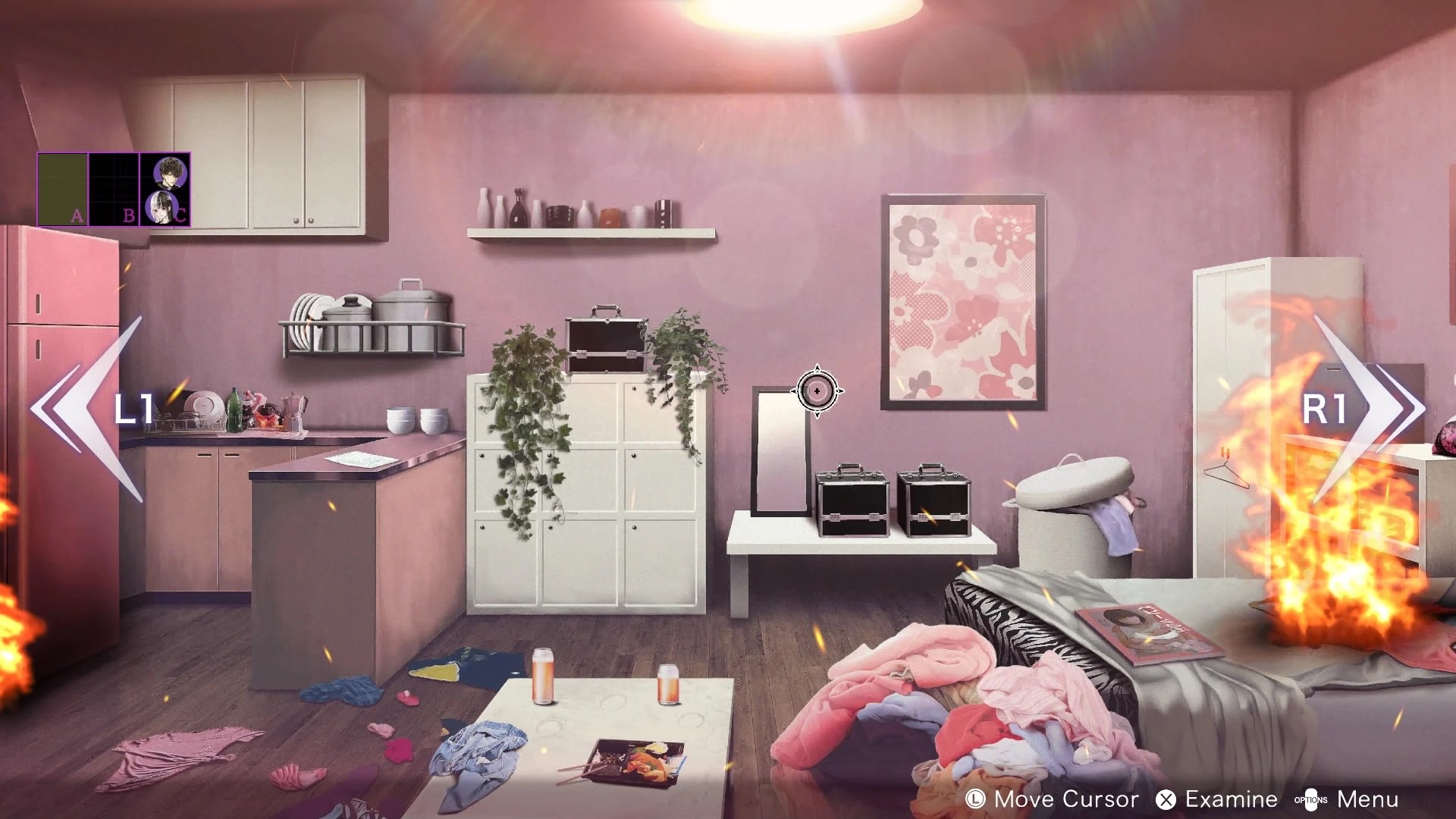
So just to let you know ahead of time, half this review will probably be a rant about the room escape half of the game. For this reason, I'll be more or less dividing Yurukill into two, with a tag about the "pop quiz" type gimmick. I personally believe Yurukill feels like a shoot em up that someone decided to tack room escape elements on to for plot or to appeal to a wider audience without really giving it enough thought, which I'll try and be really spoiler free about explaining.
The room escape sequences are pretty standard, you can examine rooms, move a magnifying glass around and examine objects, find puzzles and hints, solve the puzzles, and make your way through. There aren't really all that many segments, and some are closer to puzzle rooms than escape rooms per se. Each attraction in the park starts off with a different set of characters exploring a room escape attraction associated with the crime the prisoner was convicted of. The attractions are, for the most part, three areas with each area having one central room and two side rooms, or just one large room. You must solve puzzles to open the door to the next area, leaving the previous area behind.
This is all pretty standard fare for room escape titles. So, why do I dislike the room escape segments so much? Well, the truth is I actually love room escape games. That is, provided the puzzles are reasonable. The puzzles in Yurukill are, except for maybe one puzzle, either extremely simple or frustratingly underexplained or poorly translated. Well, maybe it isn't that they are "poorly translated" rather than there is a lot lost in translation. Keep in mind that the game is Japanese, with anime stylized characters, and the voice acting is also in Japanese. This means that anything that either uses English as a hint, or Japanese wordplay, won't come across well, if at all, if translated literally. Normally I'm not a huge fan of localizers taking "artistic license" with translations unless necessary, and this is one of those times it's absolutely necessary.
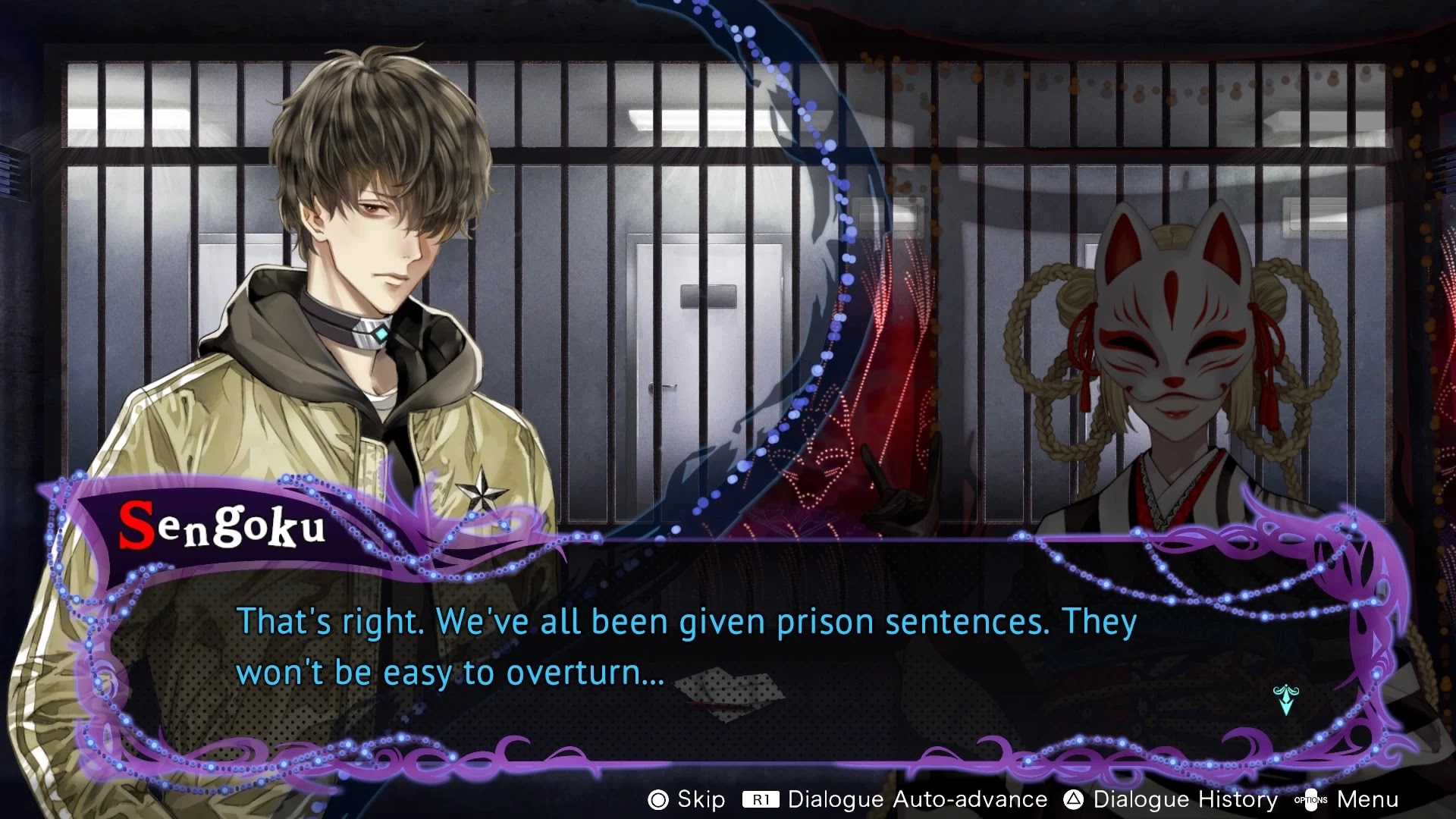
Thankfully, you're given up to three hints for each puzzle, and while most can be solved fairly easily with a hint or two, there were exactly two puzzles that made me want to throw something. The first is in the first attraction, and it involves choosing one of two bottles. The second is in the second attraction, and if I recall correctly was the very first puzzle. Good lord, I want to beat whoever thought the solution to that puzzle was a good idea. Even after having the hints literally give me the answer, it still took about 15 minutes for me to get the correct answer. Sometimes it's easier to hit the reset button and start with nothing than try and put in an answer.
Just so you know, I did clear the full game, so I did manage to solve everything, one way or another, but it really was either extremely frustrating or disappointingly easy. Fortunately, after clearing the escape room, you get to my favourite part of the game: the shoot em up segment. Explained in-game as some sort of neural interface into the brain, the characters will get in these pods and then pilot ships in a bullet hell type shooter segment. The actual in-game explanation may be a little forced, but I found the way the shoot em up segment was handled was very well done.
The general outline of the shooting segments is that they come in three stages. This is a theme throughout the game it seems, where each stage will have a boss to defeat before moving on to the next. During the stage leading up to the boss, you will be assaulted by a number of enemies. These enemies can be shot down with either bomb energy or normal shots in one of two configurations. Normal shots are performed in two different ways, depending on what the button you use is. One normal shot is pretty basic, having your ship fire ahead, and any sub ships also firing as normal. The other firing mode has your ship reduce in movement speed, but usually allows you to manage your sub ships in a way.
For example, one character ship can get a number of sub ships to follow them around. Normal firing will have all the ships fire as they follow the exact same flight pattern you take. The secondary firing mode locks them in their place while firing. Power ups to your shot and subships are acquired by defeating certain types of enemies.

As you defeat enemies, hit things with your normal shot, or collect score items, you have a bomb gauge that will increase. The bomb gauge can be used as either a one-off shot or as an actual bomb. The shot will take a set amount of energy, while the bomb consumes it all. Both bombs and shots using the bomb energy gauge can destroy bullets, and can be immensely helpful, as one hit and you die. Another use is that there will be fox masks, one per stage, which are invisible until hit. If hit with bomb energy, they can be collected for a large chunk of score as well as an extra life.
So, now we come to the gimmick of the game: the pop quizzes. These will happen during four points in the game: once per initial escape room segment, at the start of a shoot em up segment, mid boss fight in the shoot em ups, and at the end of the shoot em ups. During the escape room sequence, it is called "maji kill time" and you have to choose the answers that will keep the executioner from killing you. You have four options, and honestly, sometimes the options are as dumb as: Yes, No, Maybe, and That shouldn't be right. Yup, and getting that wrong means you're dead. You need to get four right to continue. At the beginning of the shoot em up segment, correctly answering questions will give you a corresponding number of lives for the segment. Mid boss fight you get asked to provide evidence that you aren't the real culprit of the crime you've been accused of. The final pop quiz is basically like "confirming the events of the crime". While the Maji kill time and the evidence presentation aren't timed, the other two are.
Now I have to draw attention to this, but the music is actually really good, especially the boss themes for the shoot em up segments. MMM. The characters were all really unique and pretty much everyone was quirky in some way or another, making all the character interactions entertaining. The art style was also well drawn for the characters and shoot em up segments, and while it was a little bland in the escape room backgrounds and art, it wasn't bad by any means.

So now comes the tough part where I need to score this. I honestly really loved the shoot em up segments. They were fun, unique layouts and enemy types and spawn patterns, the areas you go through are well varied, and all of the bosses are really neat. Did I mention that enemy shots take priority, meaning they're easier to see over anything else? Yeah, definite praise for that. On the other hand, the escape room segments seem kinda rushed, or shoddily put together. While a lot of my issue stems from how the English language localization made a few gaffes here and there, it was still largely underwhelming, and seemed like it was only there to prevent you from getting bored of the plot or to pad out the game length. The puzzles were almost all way too easy, except the localization ones which were almost relegated to guesswork.
If this were entirely based on the escape room portions, I would be forced to probably give it a 4 out of 10 for boring puzzles and being frustratingly obtuse at times. A pure shmup, I would rate it rather high at a 9 out of 10. Now, while usually I would just average these values out, I do need to give credit where it's due for have one of the weirdest mash-ups of genres. Despite the rather poor in-game justification for it, I found the genre mix actually worked really well. After completing an escape room, I sure as hell didn't want to go back to another one, so the shmup stage was a nice break. After having a rather good length shmup stage, I was ready to go back to the room escape as a break from a repetitive shooter. With the weird pop quiz elements thrown in to break up some of the tedium, it meshed extremely well together, despite my initial hesitation.
Summary
Overall Yurukill: The Calumniation Games is about as weird as its title suggest. A wacky mash up of escape room and shmup with Phoenix Wright/pop quiz elements thrown in that was weirdly endearing. While Yurukill certainly fell flat in some areas, it certainly had a good showing with the cast of characters, interesting storylines, and decently integrated genre changes.
I'll be honest, it can be frustrating at times, but I still found myself wanting to continue so I could figure out the truth, and to see if I could guess at what happened before the reveal in each chapter. I laughed, I cried, I raged, but in the end, I had a lot of fun.
Score: 7 / 10Dariusburst: Another Chronicle EX+ - PS4 Review

Dariusburst: Another Chronicle EX+ by developer and publisher Taito Corporation—Sony PlayStation 4 review written by Nick with a copy provided by the publisher.
Estimated reading time: 4 minutes
While the Dariusburst titles have never been among the best-known shoot-‘em-up games out there, the series has been a consistently excellent one throughout the years. Dariusburst: Another Chronicle EX+ continues that trend and fans of the genre should absolutely take the time to check this release out.
For those unfamiliar with this title, it is actually a port of an arcade game just over a decade old. The genre hasn’t seen a ton of innovation during that time, but you can still make sure that the gameplay is balanced and exciting, and Dariusburst: Another Chronicle EX+ delivers on that front.
The first thing that stands out when you play this game is the super widescreen presentation. You have some cropping at the top and bottom, giving this title a very unique perspective. But given the vibrancy of the colors and fluidity of the animations, these elements all come together to create an appealing visual style. The sound effects are standard shmup stuff – gunfire, explosions and so on. Nothing all that memorable, but the soundtrack pulses and thumps with a life of its own that compliments the constant pressure of gameplay.

As for the core gameplay, you have a core horizontal shot that can be charged up to deal a bigger, stronger shot and the ability to tweak the mechanics with angle adjustments and additional power-ups as you battle waves of enemies while navigating the environments. The F-Burst is probably the most interesting mechanic, as it allows you to set up a secondary turret that will fire along with you. You can use this to double up your firepower or deal with enemies in one spot while your ship directly handles them in another. It’s a fun, strategic little element. Boss fights are large, challenging and visually impressive. Stage design is often clever, frequently giving you a couple of different options or so to navigate through the environments, especially in some of the later, more complicated stages.
Dariusburst: Another Chronicle EX+ is not often a long game. You have infinite lives and you can complete a basic session if you have the patience, but there is plenty of replay value to be had here as well. Original Mode gives you a trio of different paths with branching stages that can increase the difficulty and keeping the flow of the game fresh by letting you mix up your preferred path. Original EX is basically the same thing, but with more variety, shuffled up bosses and basically a higher degree of difficulty. There is an Event Mode which feels like a remixed version of the above modes and a couple of limited time events / stages. These are all solid and provide a reason to come back and play things again, but hands-down my favorite of the options is Chronical Mode. It sees you zipping around the universe on a bunch of remixed missions and boss rushes that provides the most content overall.
So that is a lot of content mentioned above – it’s just not necessarily a ton of variety. There is, after a half dozen or so hours, a sort of ‘sameyness’ to the gameplay once you’ve fought the various bosses and flown the different stages, even if the order they get thrown at you gets shuffled up. Also, the bosses can be something of a mixed bag in how they are handled. I mentioned the things I liked about them – variety and visuals – but they can feel like massive damage sponges. Oftentimes your shots just sort of strike the surface and don’t give you any real feedback as to whether or not you’re hitting them in the right spot (unlike many shmups where the boss gives off a distinctive sound, flashes, etc to indicate that you’re hitting them where it hurts). It’s a minor quibble, but with runs generally not lasting for every long (the focus is on many runs, not long runs), and an uneven amount of that time feels like it’s spent just plinking away at the bosses.

Summary
Dariusburst: Another Chronicle EX+ looks and sounds pretty great, with lots of content – even if perhaps the variety of that content could have been better. It is still an enjoyable overall shoot-‘em-up that series and genre fans will want to give a go. This may be a port of a game from over a decade ago, but it agreed rather well.
Score: 7 / 10
Devolver Digital Announces My Friend Pedro: Ripe for Revenge!

AUSTIN (July 5, 2021) - Terminally
relaxed developer Deadtoast and their imaginary friends Devolver Digital today
announce My Friend Pedro: Ripe for Revenge, a brand new, mobile adventure of
blood, bullets and bananas coming to Android and iOS devices on August 5th.
Brutal bananas can pre-register for the free-to-slay carnage at revenge.myfriendpedro.com.
They kidnapped his wife and kids and left him for dead. But it's going to take more than that to split this banana's family. Help your friend Pedro serve some ice cold revenge, with a sprinkle of bullets on top!
Flip and fire your way through dozens of action packed levels on foot, on a motorcycle, and even on a skateboard. Plan your high caliber choreography for the best scores and, if your skin is tough enough, test your skills in Blood Rush mode.
This banana is Ripe for Revenge. Are you?
Article by: Susan N.
Curved Space - XB1 Review

Curved Space by developer Only By Midnight Ltd. and publisher Maximum Games—Microsoft Xbox One review written by Nick with a copy provided by the publisher.
Estimated reading time: 5 minutes
Curved Space is a fun shoot-‘em-up that took me just a bit of time to warm up to, but once I did I could appreciate its novel approach to the genre, bringing something new to the table. Curved Space is a twin-stick shooter at heart, but actually makes the environment something you coast over as opposed to simply dodging it at the tops and bottoms of the screen. The formula works more often than not.
To start with, Curved Space is visually very cool to look at, simply because you have a slightly different perspective than most shooters. It was like someone took the concept of twin-stick shooters like Super Stardust HD and brought the camera down closer to the ship and added texture to the landscape. In shooters like the aforementioned Super Stardust HD, you generally zip around a large orb-like body, using one stick to steer and the other to shoot at enemies.

The same holds true here, but instead of the ten mile overview of the action, the camera is brought down closer to and behind your ship as you zip around these surfaces, which have bumps and nuance given the terrain a bit more to do here than in your standard side scroller where you are simply avoiding contact with terrain because it will kill you. It took a bit for me to wrap (pun intended) my head around the concept, but once it clicked - Curved Space is a lot of fun.
Beyond this novel bit of gameplay and presentation, Curved Space is pretty much standard fair for the shooter genre. There is actually a pretty cool story (something of a novelty in these arcade style titles) that can take a few unexpected twists and turns while encouraging some replay with different endings. There is also a nice variety of weapons that beg for experimentation, from lasers to flamethrowers and more. Additionally, there are two unique extra attacks provided.

One is a hyper mode that allows you unlimited ammo of your chosen weapon for a brief time, allowing you to roll out a lot of carnage for a bit. The other is a sort of tethering system that allows you to bind enemies to anchor points in the stage (and to one another in a chain) that drains them and fuels the previously discussed overdrive ability. It also keeps them in place, making them easier to shoot down later.
The soundtrack and overall audio effects range from decent to great depending on the stage. While I didn’t necessarily get any of the songs lodged in my head once I turned Curved Space off, they were generally the sort of fast-paced tracks the complemented the frenetic pacing of the gameplay. The narrative with its various endings and twists are supported by some solid voice acting – again, not normally a hallmark for this genre but welcome all the same. This combined with the visual style make Curved Space pleasant to play, even if it’s not a technical marvel on the presentation front.

There are small things that hold Curved Space back a bit though as well. Shoot-‘em-ups often rely on visibility. You see the obstacles and the enemies and perhaps most importantly, the bullets, coming at you from all sides. The forced perspective from where the camera is at does sometimes make it so I don’t quite have as good a view of my periphery as I would have liked, leading to some annoying deaths that I literally didn’t see coming once in a while.
Also some of the stages can be a bit tedious by the end of the level as you are trying to hunt down the remaining enemies and don’t quite have a great feel for where they are at on the field in relation to you. These are both fairly minor quibbles, but one that did drain some of the excitement out of the gameplay for me here and there.
Summary
Curved Space deserves credit for doing something interesting with its camera angle and use of landscape in a genre that doesn’t see a ton of innovation these days. The decent collection of enemies and solid number of weapons help to add some variety to what was otherwise somewhat slightly repetitive gameplay a few hours in. All of this is ably assisted though by a solid narrative told by some good voice acting that provides some replay value through its multiple endings. Curved Space is unlikely to bring new fans to the genre, but those who enjoy a good shooter should enjoy this offering.
Score: 7 / 10
Mighty Goose - PS4 Review

Mighty Goose by developers Blastmode Games, MP2 Games and publisher Playism—Sony Playstation 4 review written by Richard with a copy provided by the publisher.
Estimated reading time: 5 minutes
Do you know what the mightiest of birds are? Is it the pidgeon? The crow? Here in Canada, we know what the mightiest of birds is: the goose. They're tough, they're gruff, and they won't hesitate to beat you up. Obviously the developers of Mighty Goose are aware of this, with the eponymous bounty hunter and feathered friend Mighty Goose.
Mighty Goose is a fine feathered bounty hunter chasing after evil across the galaxy. The dreaded void king is taking over, and Mighty Goose is contracted to get rid of the problem. With his trusty mechanical gun arm and pig(?) assistant, the great Mighty Goose is off to rescue planets across the galaxy from the dominion of the VOID. Mighty Goose is very reminiscient of Metal Slug, or maybe some of the older megaman games for those of you who don't recognize Metal Slug, in both art style and gameplay.

You play as the eponymous Mighty Goose, fighting your way through 2D side-scrolling stages, shooting up enemies, collecting different weapon types, occasionally hopping in vehicles, and beating up the bad guys. The Mighty Goose has a normal shot that is the default, but can also pick up limited ammo weapons while going through a stage, or get them called in via air drop for a cash price. As you run, gun, and dodge-roll through stages, you may also come across "war machines", such as a bike, a tank, or a…mecha goose suit. Hop on in and rain bullets down upon your enemies. In addition to the gunning, the Mighty Goose also has a secondary skill that can be used. The secondary skills can be swapped out between stages, and may be damaging skills like bombs, support skills like filling the "mighty meter", or honking.
If you fill up the mighty meter, you can enter a super mode where you don't take damage from enemies (environment is still fair game) and your weapons are enhanced. The gauge will deplete, even when not using the mighty mode, so make sure to keep it filled for when you need it. After completing a stage you can visit the armoury to choose what secondary skills to equip, as well as passive skills which will unlock as you play through the game. Passive skills may be as small as "increased walking speed", but can help you out a lot. You have a limited amount of energy to assign skills, so make sure you know what you want. You can also pick an ally to join you. That's right, you can bring an assistant into battle, that can also be controlled by a friend in a sort of co-op mode. Although the partner isn't to the same level as Mighty Goose, they can definitely still assist you.

Mighty Goose has a great retro feel with both the soundtrack as well as graphic style, and I felt like the developers really nailed a lot of what made the old school games so enjoyable. Unfortunately there are a few very noticeable setbacks. First and foremost: you have a melee attack. If enemies get too close, you slash them instead of shooting. Which is pretty awful considering all of the guns other than the default definitely do more damage than the slash attack. Second, there's a sub weapon that are rockets, and they are unequivocably awful to handle. They are auto seeking, but hover around a bit before doing anything, and I would routinely go out of my way to avoid picking them up.
The game is also very short. I completed the normal game, "new game +", and had most of the stages S ranked within three hours. I'd also like to point out that the S rank requirements are… weird, I suppose you could say. It seems like there are certain benchmarks you need to hit for kills, deaths, combo, and speed, but points aren't total cumulative? There is also this really annoying slo-mo and cut-in with a honking goose occasionally, which is really infuriating. As much as I gripe though, I truly do hope to see more from the Blastmode and MP2 developers in the future. I had a lot of fun with Mighty Goose, and can't wait to see what they come out with next.
Summary
Overall, Mighty Goose is a pretty fun game with a lot good points to it. The combat basis is pretty well done, the skills and upgrades are a neat touch, and the weapon system was enjoyable. Unfortunately, there just isn't a whole lot there to really dig into. Mighty Goose is well too short, and coupled with some of the more aggravating issues, such as the periodic slow-mo, the easy difficulty, and how the "post game" is just the main game but a little harder, Mighty Goose probably won't keep you occupied for too long. That being said, if you enjoy Metal Slug, this is definitely going to be put on your watch list, it will probably just be one of those titles you'll pick up on sale.
Score: 7.5 / 10
SturmFront - The Mutant War: Übel Edition - PS4 Review
SturmFront by developer Andrade Games and publisher RED ART GAMES—Sony PlayStation 4 review written by Pierre-Yves with a copy provided by the publisher.
Estimated reading time: 4 minutes
Do you like shooting at things and not having to accurately aim? What about loads of enemies that don't let up? Combined with both the elements of a Shoot 'Em Up and a Bullet Hell and SturmFront - The Mutant War: Übel Edition is for you!
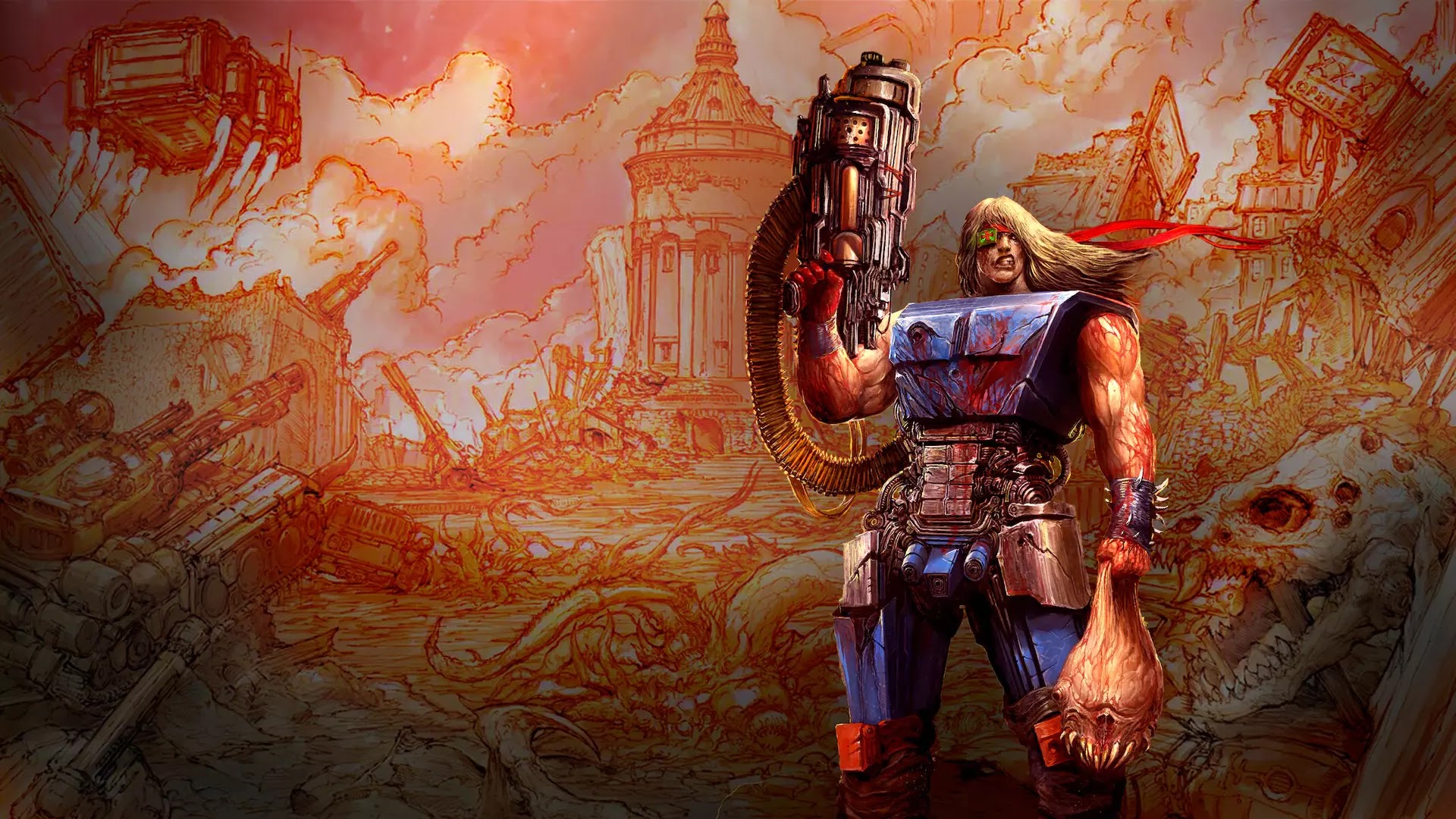
What I really like about titles such as SturmFront is that they provide some good old fashioned arcade challenges in short bursts but with modern day refinements. Taking control of the semi-organic battle unit Siegfried von Hammerstein, your only job is to take this 80s action hero inspired combat machine on a no holds bar rampage through hordes of alien forces until there’s nothing left.
Unlike other arcade based Bullet Hells or Shoot ‘Em Ups, SturmFront moves at your pace instead of having to worry about a horizontal or vertical autoscroll. It takes a bit to get used to as enemies can come from any direction and even if you’ve moved on by, it is possible to have enemies come from behind you and ruin your day as by that point you quite literally have nowhere to go!

So for your combat prowess, you’ll be by default equipped with a gun that as you power it up will shoot both more bullets and streams of bullets either in a full 360 arc with the joystick or top, down, left, right with the four buttons on the controller. One method offers you a lot more flexibility while the other lets you specifically shoot in exactly the right direction which can help you out when moving in tighter quarters and you want to use the walls to your advantage.
Adding in a bit of its own flair, by default, Siegfried will also have a flamethrower that can be refueled with gasoline in order to both burn enemy nests as well as to act as a defensive barrier against enemy fire. It’s not uncommon to have a method of defense inside of bullet hells and shoot ‘em ups however having the ability to simply burn away enemy fire was pretty cool as it’s an ability that you get to use repeatedly without having to worry about a numbered limited usage. Yes, you can run out, but more often than not, if you play your cards right and use it only when really needed? You’ll be fine.
So for your rampaging pleasure there are several stages split between a main stage and then the path to the boss that can be tackled on either easy or normal before being able to move onto hard mode. For achievement hunters and sadists, there are also challenges such as making it from the beginning to the end without dying once. In either case, there’s plenty of old school arcade fun to be found for players of all types as while there is still a pretty crazy amount of bullets flying around in easy mode, there are more health packs making the journey a little less perilous than in normal mode.

Summary
Overall, SturmFront - The Mutant War: Übel Edition is a quick and fun arcade title that you can challenge friends to beat your score like in the good old days. The only difference here is that you won’t need to worry about mortgaging your house in order to sink a colossal amount of quarters into the machine for one more playthrough as this train doesn’t even game you over! It simply throws you right back in for another go from your latest checkpoint.
Score: 7.5 / 10
Natsuki Chronicles - PS4 Review
Natsuki
Chronicles by developer Qute
and publisher Rising
Star Games—Sony
PlayStation 4 review written by Nick
with a copy provided by the publisher.

Natsuki Chronicles is a fantastic horizontal shoot-‘em-up game that fans of the genre will absolutely want to add their collection. It has an enjoyable blend of old-fashioned gameplay mixed with some modern design that gives the title a great balance that makes it a whole lot of fun to play.
Beyond that quibble however, the presentation is pretty slick. Visuals are bright with clean graphics and the soundtrack is appropriately catchy and fits the pacing of the game. There are plenty of options that help you to customize the experience as well, such as bullet tracking and more. As is the norm for these genre, there is an awful lot happening on the screen at any one time, with the screen perpetually moving, new enemies entering from all directions and bullet spray covering the screen. Each stage culminates in a boss battle, and they – like the stages – become more intricate as you progress through the campaign.
Lastly, there is a ‘special’ weapon that has a few different flavors but is primarily a shielding mechanism. You can unlock different types of patterns from the default ‘block your front’ to protecting top and bottom or having orbiting protections and more. These run on a recharging shield mechanism that causes damage to opponents and blocks their fired attacks, helping to compensate for otherwise very tight spaces that might be impossible to escape cleanly. It helps that this is not a one-hit-and-you’re-dead kind of game. You have shields, and they regenerate slowly as long as you’re not getting hit.
For those looking for a more traditional, skills-based arcade experience with less of the other stuff, there is an arcade mode as well as the story one, with ranked leaderboards for those who really want to show off their skills.
Estimated reading time: 5 minutes

Natsuki Chronicles is a fantastic horizontal shoot-‘em-up game that fans of the genre will absolutely want to add their collection. It has an enjoyable blend of old-fashioned gameplay mixed with some modern design that gives the title a great balance that makes it a whole lot of fun to play.
Set in the same universe as last year’s Ginga Force (another shooter from the same team, but vertically oriented instead of horizontally), Natsuki Chronicles is a more polished, deeper spinoff. That being said, Natsuki Chronicles can stand alone just fine, with plenty of exposition baked into this game as well. The devs deserve some credit for trying to tell a story, even if that’s not really something the shooter genre is particularly well known for.
One of the areas where Natsuki Chronicles is lacking for me personally is the constant dialog that tries to explain what is happening – because there is no English voice acting option. Granted, that’s not unusual in a game like this when it comes over to North America, but it’s pretty hard to try and read the text in the upper right corner when everything on the screen is trying to shoot you dead at the same time.

Beyond that quibble however, the presentation is pretty slick. Visuals are bright with clean graphics and the soundtrack is appropriately catchy and fits the pacing of the game. There are plenty of options that help you to customize the experience as well, such as bullet tracking and more. As is the norm for these genre, there is an awful lot happening on the screen at any one time, with the screen perpetually moving, new enemies entering from all directions and bullet spray covering the screen. Each stage culminates in a boss battle, and they – like the stages – become more intricate as you progress through the campaign.
Early boss battles amount to little more than dodging their bullets and shooting them as you get openings. Later though, they come at you in a variety of different ways. Some of them use different types of attacks, others jump behind your ship while others certainly give a ‘throw the kitchen sink’ feeling. Stages become more intricate as well. Earlier stages pretty much just scroll left to right, but later stages add obstacles at ground level to be avoided, or narrow passages to fly through as doors open and close to the screen moving up and down for short bursts as well as horizontally. This really impacts the pacing and difficulty in positive ways.
This ties into the fantastic weapons systems in Natsuki Chronicles as well. There are three types of weapons your ship is equipped with. One is your primary weapon – think what you fire forward. Highly concentrated laser, homing missiles, angled attacks, large wave shots and more get unlocked and purchased with credits you earn by playing through the stages. There is also a secondary attack which functions very similarly and tends to be focused more on shooting behind you or at angles. The early stages can pretty much be aced with a focus on forward firing, but from about stage six and on? You need to be able to deal with threats that come up behind you, because your ship can’t be turned around or pointed in any direction except to the right.

Lastly, there is a ‘special’ weapon that has a few different flavors but is primarily a shielding mechanism. You can unlock different types of patterns from the default ‘block your front’ to protecting top and bottom or having orbiting protections and more. These run on a recharging shield mechanism that causes damage to opponents and blocks their fired attacks, helping to compensate for otherwise very tight spaces that might be impossible to escape cleanly. It helps that this is not a one-hit-and-you’re-dead kind of game. You have shields, and they regenerate slowly as long as you’re not getting hit.
The variety and purchasable nature of the weapons is one of the more modern, RPG-like aspects of the game, but Natsuki Chronicles’s actual gameplay is very much like an old-school arcade shooter. Just tough as nails, constant pressure coming from all directions. However, Natsuki Chronicles tries to make itself as accessible as possible. As you unlock stages, you can revisit prior ones to earn more credits and experience. Each stage has multiple levels of difficulty you can choose from as well. Higher difficulty has greater experience modifiers. And as I just mentioned… experience. So that’s an RPG-lite element to Natsuki Chronicles that I thoroughly appreciated. There are actually two different experience systems at play here.
There is the player level, which unlocks new weapons for purchase as you gain them. There is also stage experience, which is one of those areas that marries classic punishing difficulty the genre is known for, with a more modernized progression. When you play a level over and over again, you start to learn the patterns and you simply get better at the game. That’s how the genre has always helped the player improve. However, stage experience gives you some additional shields at the start of the level. You can earn up to fifteen of them on any given level, and those extra hits along with your improved knowledge of the stage’s enemies made me feel like with enough patience, I could always push through the stage no matter how much was thrown at me.

For those looking for a more traditional, skills-based arcade experience with less of the other stuff, there is an arcade mode as well as the story one, with ranked leaderboards for those who really want to show off their skills.
Natsuki Chronicles is a smooth, polished shooter that has some great, modern RPG-lite features that make it accessible despite the shoot-‘em-up genre being one traditionally known for being brutally challenging. A bit more effort in localizing the audio would have gone a ways for making the in-stage narrative easier to soak in, but that is a pretty minor complaint about an otherwise very entertaining game.
Score: 8.5 / 10
Psikyo Shooting Stars - Bravo - Switch Review

Psikyo Shooting Stars - Bravo by developer City Connection and publisher NIS America Inc.—Nintendo Switch review written by Pierre-Yves with a copy provided by the publisher.
Estimated reading time: 5 minutes
Following right on the back of Psikyo Shooting Stars - Alpha, the Bravo package is bringing another six Shoot ‘Em ups into the hands of fans. Following a more traditional Japanese artistic style, there are still tons of bullets, lasers and mech bosses to make the world go round! So where to start with these six titles? Let’s start off with the more traditional ones.
Starting off once again with a main interface that allows you to pick up one of six titles developed by Psikyo, this time around you have Gunbird, Gunbird 2 and Samurai Aces as your vertical shooters. Going horizontal are Tengai (If I’m right this is Samurai Aces II because of the characters) and Samurai Aces III. Finally throwing me into a confused state as I wrapped my mind around it, GunBarich is a Block Breaker style of “Shump” where you have a time limit to break blocks while also being shot at by your enemies.

For the most part in following their iconic style, each of the first three vertical shooters follow the short and sweet style with plenty of enemies to shoot at and multi partitioned mech like bosses. What makes these titles different from the Strikers series though is that they’ve put in a little bit of story. Your bad guys have personalities, those operating the mechs often either have a bone to pick with you, or they will, once you’ve trashed them. It doesn’t really add anything, but it’s enough to make them feel different and wonder where Gunbird 1 / 2 and Samurai Aces will take you.
Keeping with most of the basic arcade like controls, you can shoot, you can auto shoot, and you can drop a bomb or a special attack for massive amounts of damage to everything on screen. While this is the basis of Shumps Gunbird 2 made some little modifications that were awesome. These modifications were that on top of your normal three options, you now had one more addition in the form of a special attack but that was completely different depending on the character. Some felt overpowered against large groups while others felt completely useless unless you were facing off against the giant mech boss 1v1. It was neat and I was happy to have it.

Going in a different direction unlike the first, Tengai and Samurai Aces III both of these decided to scroll horizontally unlike the first. What felt different, but again, not in a bad way, was that in Samurai Aces III instead of going from one quick stage to another and battling multi staged mech bosses, the stages were actually longer and you didn’t just face off against multi partitioned mech bosses. Instead, after dealing with multiple enemies you went up against “hero” like bosses that possess several health bars worth of hit points that you need to deplete before moving onto the next set of enemies and the new “hero” like boss. After loads of quick and to the point stages, it was odd to have this kind of length but it was a newly welcomed challenge.
Finally, we have the odd ball out that was perhaps one of my favorites. Part skill and a whole lot of luck, GunBarich was basically block breaker on steroids. Sitting at the bottom of the stage below the ball that you’ll keep bouncing upwards, there’s more than just waiting for the ball to come back down to you as it breaks the blocks above. While you’re down at the bottom you’ll be dodging enemy shots and even returning them with pinball like paddles that when closed form up a solid bar. Want to bounce the ball gently? Let it hit the bar. Want to launch it up? Smack it like you would a pinball and watch it fly! The same doesn’t apply to enemy shots so those you’ll actually have to hit all the while trying to not lose track of the ball and letting it fall past you which will cost you a life. Also costing you a life is if the sixty seconds expire so there’s plenty of things to worry about but I’ll be damned if it wasn’t fun.

Overall I have to say that while I preferred Psikyo Shooting Stars -
Bravo over Alpha, they are both amazing packages especially for fans
of the style. Coming with different experiences in Bravo, there’s
plenty to enjoy right here with some titles that both stick to the
norm and others that add in just that little bit more. That is until
you get to the last title that just breaks the mold all together and
I couldn’t have been happier to have it in the package.
Score: 8 / 10
Space Pioneer - Switch Review

Do you enjoy exploring space? Fighting giant bugs and robots? GETTING LOOT? Well then, you may be interested in Space Pioneer. The Switch has ended up with a lot of little App style games, some bad, some good, and Space Pioneer definitely falls into the latter category.
In Space Pioneer you act as somewhat of a blend between bounty hunter and janitor, visiting planets and getting rid of the hostile indigenous creatures, which occasionally include robots. While the plot is rather lacking in substance, it does make the game easy to jump into, play for a bit, and then put down.
I might be dating myself a bit with this reference, but if you ever played a game for the N64 called Robotron 64, you know the basic premise of how the game will work. Essentially you have a small map you can walk around, completing various objectives, such as “hold a point” from waves of enemies, or picking up items and carrying them to certain locations. You have a couple of tools at your disposal to help you out with the local wildlife.

You start out with an assault rifle, and as you get rid of the creatures infesting the worlds you visit, you gain coins and exp. When you level you gain access to new weapons and gear, with three possible classes and a variety of weapons, such as a shotgun and laser gun. You run and gun, complete objectives, collect coins, and occasionally fight a boss or two on your way. Unlike the pain that was Robotron 64 after 90 levels of the same enemies over and over, Space Pioneer keeps things fresh with the variable missions, gear loadout customization, and handy robot companion that I personally started calling “The Memebot” after it started spouting lines such as “never gonna give you up”. It doesn’t start out super handy in a fight, but it does draw fire and respawn after a time if it dies, so it’s nice if you use your gun too much and it overheats, forcing you to wait out the cooldown period.
The game isn’t complicated, but that’s good because it makes it easy to pick up and roll with. I really loved picking Space Pioneer up for a couple of 5 to 10 minute rounds in between doing other things, or clearing a few planets before bed. With three planet missions to complete, and five challenges to work on that will reward you with coins and weapon and skill upgrade cards, which can be used to enhance your skills and gear, there’s a surprising amount of customization for your character and weapon loadouts. There are a bunch of different planet locales, such as lava or volcano areas and ice fields, with different enemy sets on each planet type you visit. The bosses appear fairly often, making for a sort of refreshing change in pace from the short one-off style objective based stages that make up most of the game.

There isn’t really a lot to Space Pioneer. You run, you shoot, you upgrade, rinse and repeat. Despite not being either in-depth or complicated, I had a lot of fun with Space Pioneer. With an option to play on your own or with your friends, Space Pioneer is a nice little time waster when you’re looking for something to do for about half an hour to an hour at a time. With over 60 stages in the main game, and an unlockable endless mode, there is enough to keep you entertained for a while, even if it isn’t the style of game you’d sit down for a few hours to play.
Game Information

Nintendo Switch
Developer(s):
QubicGames
Publisher(s):
Vivid Games
Genre(s):
Action, Shoot 'Em Up
Mode(s):
Single Player, Multiplayer
Other Platform(s):
Mobile iOs and Android
Source:
Provided by Publisher

Article by Richard