• NHL 27 - PS5 Review

    ...and I have been playing NHL games since. It didn't matter whether it was EA or another game like 2K in the 2000s; I loved hockey games and still do, but is NHL 27 a step in the right direction?

  • NBA 2K27 - PlayStation 5 Review

    With these annual seasonal renewals of the sports season comes the related video games as well, and the question reviewers such as myself always face is this: Is this year’s game worth purchasing one year after the last one? My answer? Yes, absolutely. NBA fans are going to almost certainly enjoy NBA 2K27.

  • Midnight Moments - PC Steam Review

    Midnight Moments is a cozy cyberpunk diorama-building game that is stunning. Unlike games that require you to complete quests or take out assailants or even solve challenging puzzles, this one only requires one thing: imagination.

  • Isle of Reveries - PC Review

    Isle of Reveries is a top down 2D action adventure game that made my nostalgia for old school Zelda games flare up really hard. A good blending of puzzle, exploration, and combat, Isle of Reveries is a wonderful title to experience inside and out.

  • Outbound - PC Review

    Let me tell you about this cozy game my daughter and I are playing together called Outbound. Now, I've been following this game from the initial Kickstarter back in April 2025 to its full release in May 2026. The best Mother's Day gift for myself and my first ever collector's edition in a physical copy!

  • OVER REQUIEMZ - Nintendo Switch Review

    In OVER REQUIEMZ Yuhiru is thrown into the castle of Oz and is immediately accused of trying to assassinate the King and shoved into the dungeon. Not only is she treated like a criminal...

  • Dread Delusion - Xbox Series X|S Review

    Today we’re looking at what has rapidly become an absolute favorite in the open-world RPG genre for me. An interesting story, memorable NPCs, stunning visuals, and a setting absolutely dripping with flavor, Dread Delusion sets its tone immediately and sticks with it.

  • HOT WHEELS Infinite Rush - PS5 Review

    ...Now Milestone, the original developer of the two Hot Wheels Unleashed games, is back, and I was hoping it would be as fun as the last two Hot Wheels games they made...

  • Asdivine Knot - PS5 Review

    Asdivine Knot is the latest title in the Kemco JRPG library. Following protagonist Verselio, who's on the run from the church that they once served, he'll be accompanied by an odd selection of party members as they all find a reason to band together…

  • STEINS;GATE RE:BOOT - PC Review

    Our story begins in Akihabra, Tokyo Japan. The protagonist Okarin… Or rather Rintaro Okabe, (Voiced by Mamoru Minyano) is a recent high school graduate who rents an apartment with his best friend and resident computer hacker, Itaru ‘Daru’ Hashida (Voiced by Tomokazu Seki) during the summer of 2010.

Showing posts with label CCG. Show all posts

Black Book - XB1 Review


Black Book
by developer Morteshka and publisher HypeTrain DigitalMicrosoft Xbox One review written by Nick with a copy provided by the publisher.

Estimated reading time: 5 minutes


Black Book is a fascinating mashup of genres steeped in Slavic lore. There is a bit of a learning curve to be had here, both with the game’s mechanics and heavily steeped mythologies, but it is absolutely worth the effort. There is an engrossing story to be had here and experience absolutely worth exploring.

Our protagonist Vasilisa, is an engaging one from the start. We are introduced to a nineteenth century Russian countryside that oozes a creepy, dark style that follows the orphaned Vasilisa on her path to becoming a witch after tragedy strikes. Her quest sets Vasilisa on an adventure to break a series of seals so she can have a wish granted.

All of this can take a bit of time to wrap ones head around. There’s terminology in here that I was in no way familiar with. After a time, I began to make the proper associations between words or phrases, and from an aesthetic standpoint I’m glad the in translating the tale to English the heart of the content remained true to its roots. It’s just that it took a bit of time to build up familiar word associations during the early hours of gameplay.
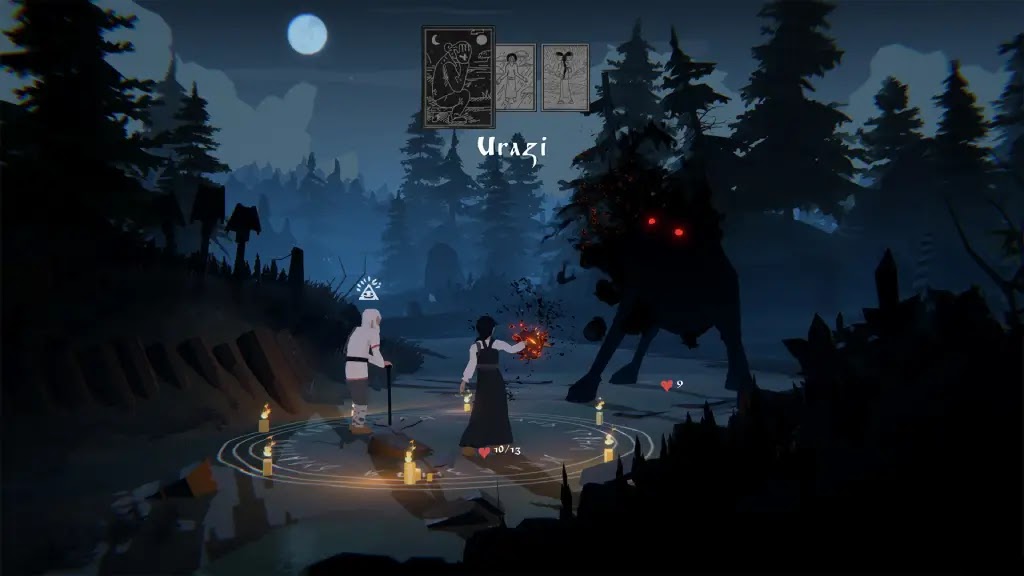
There is a combination of deck building and morality-based decision making that sit at the heart of Black Book’s gameplay. She collects ‘Sins’ as she furthers her adventures. Her quest starts out as a labor of love, but she has to quickly determine how much of the weight she wants to carry herself… or whether or not to let the demons she controls commit crimes out of a restless need to – well, to be demons really. It’s a slowly degrading scale. This is not Mass Effect’s good vs bad paragon system. This is more a matter of: how bad do you want Vasilisa to be? Because she suffers penalties when not sending demons out, and using them collect money or give Vasilisa other benefits – at a cost to her soul.

Combat itself is a card game, that is fairly simple during its early stages. This makes it easy enough to learn the basics, but as you get deeper into your Black Book, you gain far more spells and modifiers that complicate the gameplay. The learning curve (outside of a handful of rather nasty boss fights) was gentle enough in its difficulty curve that I seldom got frustrated. That is surprising given the somewhat random nature of card games of this nature, which attests to the overall balance of the combat. You have offensive and defensive cards and winning matches means getting more cards. Early on the pickings are a bit on the slim side, but as you continue to expand upon your library of cards, you start to see some fun and unique synergies. I just with the boss battles were a bit more balanced. I’m okay with having to come at them from a slightly different angle, but there were a couple that just made me toss out everything I thought that I knew about how I was designing my decks and became something of a frustrating puzzle in and of themselves.

Outside of combat, you are advancing the story to find clues and try to solve the riddles that make up the seals. Each of these seals creates a sort of chapter that is a separate entity from the others. There’s an overarching storyline here, but your focus is on getting through conversations and tasks that allow you to eventually best the seal. I was pleased that the Sins counter had a tangible impact on things like conversational choices and even the game’s endings. This certainly provides some replay value for those interested in seeing the more extreme levels of the counter (which is something that had me playing games like Dragon Age and Mass Effect multiple times in the past).

The overall presentation is pretty impressive. The deck building component of the game looks really sharp. Card art is impressive, and they inject life into the combat component. The visual style is not super detailed and technical, but the use of colors and inky blacks really give the game a creepy atmosphere. The music score is often subtle but complimentary to the graphics as well, really setting the stage for a bleak story that I wanted to see through until the end.

Summary

Black Book doesn’t fit neatly into any one genre with its combination of adventuring, deck building, card combat and morality – which makes it a unique game that might not have a built-in audience but is definitely worth a look from those who like a creepy gaming experience that engages their minds. The pacing and a few of the boss battles can be a little uneven, but the overall experience was one I enjoyed far more often than not.

Score: 7.5 / 10


Share:

Faeria - XB1 Review

Faeria by developer Abrakam Entertainment S.A. and publisher Versus EvilMicrosoft Xbox One review written by Nick with a copy provided by the publisher.

Estimated reading time: 8 minutes

Faeria is an interesting hybrid of tactics and collectible card game that bucks many of the trends we’ve seen out of other, similar titles. Having released a few years ago on PC to very positive reviews on Steam, Faeria brings its unique blend of gameplay mechanics to consoles with very positive results

I got into collectible card gaming a couple of decades and change ago with Magic: The Gathering, but also branched out into numerous other ones such as Legend of the Five Rings, Marvel Overpower and several others. I had a lot of fun and made some good friends through doing so – but anyone who has played these types of games heavily also knows it is a potentially expensive hobby. Somewhere along the way, several video game developers took note of the consumer spending habits and began to offer up the digital equivalents.

There were benefits to this of course – readily available virtual packs and plenty of online competition. I have enjoyed but also found it difficult to stay invested in most of these games though. There is just something off to the money-grubbing nature of digital cards versus real ones, and many of these online collectible card games start off being very accessible and enjoyable, but often hit a point too early in where you need to either start spending quite a bit of money or grinding obnoxiously long hours to get continued, satisfying progress as the single-player content dried up and forced players to commit their time and money to competitive online multiplayer.

So, when I saw Faeria claiming that you don’t need to buy card packs, and offering a robust community but also hundreds of hours of solo content? I was more than a little intrigued. Even better? I would say that based on my time so far, the statement appears to be true. Certainly you have to spend time playing – and sinking dozens of hours into a game like this is not unheard of. However, after dozens of hours (and not the often hundreds required by many other games to field a complete or competitive deck), I was still enjoying my experience without the usual pay-creep that tends to work its way into the genre.

Much of this is likely due to the numerous opportunities to acquire crystals (used mainly for cosmetics such as avatars or card backings) or chests (which give you five random cards) abound. There are daily quests, solo missions, objectives (such as casting ten blue cards or completing a set number of puzzles) that were entertaining and relatively easily attainable. The first day I played, I must have unlocked over a dozen chests, and in a good afternoon or evening of play? That is not uncommon. There are other mechanics as well, such as forging cards, that allow you to round out collections and build new decks.

If there is a potential concern, it is one of how robust the community will be. One of the primary advantages of the free-to-play / pay-to-improve model is it invites more players into the fold. By having this be a purchased game, that might make it slower to gain community adoption. Perhaps the ones that are here will be more invested because they have already paid and don’t need to worry about the pay-to-win disparity that can occur.

In terms of the mode offerings, there are plenty of solo objectives in the forms of missions and puzzles that reward experience and new cards. There are also player vs player options (ranked and unranked) All of this offers a nice sense of progression and variety – but none of this would matter if the core game was lacking. Thankfully Faeria delivers on that front as well.

Neither of the two primary aspects of gameplay are all that revolutionary, but how they are woven together helps to make Faeria such a unique experience. You draw cards into your hand, and you have magic points that you gain each turn that are used to pay for these cards. This resource / play card mechanic is the foundation for just about every card game out there, and it provides the core gameplay here as well. The variation comes from the hex-styled board that should immediately look familiar to fans of tactics games. The general layout is a honeycomb looking pattern with two opponents facing off at the northerner and southern ends. These gods start with twenty life and summon the cards in their hands to deal direct damage to one another, or summon creatures to the battlefield. There are also four wells in the corners of the board, and having one of your units next to a well allows you to draw an extra point of magic to use in casting your cards.

Simply casting the cards and having the creatures combat one another (with the typical attack / life points assigned to them to help dictate how the combat resolves) is interesting and strategic enough, but Faeria adds an element of board creation / manipulation as well. You can put down up to two ‘regular’ tiles as long as that spot is a) open and b) next to your god / one of your creatures.

However, there is one last element to the cards that needs consideration, and that is ‘type’. There are four colors – red, yellow, blue and green. These cards tend to be slightly more powerful than the ‘colorless’ types that can summoned simply by having enough magic points. If the cost is 3, and you have 3 magic, you can summon those. But these colored cards require tiles of a specific color to be on the board. So the cost to a blue card may be 3 magic points – but also ownership over 2 blue / water land tiles. Unlike the regular / uncolored ones you can dole out two at a time, these colored ones can only be placed one at a time. This sets up an interesting power balance, as having more tiles makes it far easier to move your creatures around the board (you can walk on an opponent’s created tile – but you can only summon a create to one of your created tiles).

This creates a sort of internal debate: do you lay down tiles directly towards your opponent’s base and try to get as many of your creatures over there as possible? Just put down two of the uncolored ones and try to beeline over there? You can likely get some quick, cheap cards out and make that sort of push, but you won’t have the terrain tiles like forests that stronger, green creatures need in order to be summoned. Also, if you go straight for your opponent, you won’t be branching out towards those magic wells in the corners, which means you have less magic per turn, which could keep you from casting more powerful cards or multiple cards at a time later in the game.

All of these elements come together to put more of an emphasis on strategy than the typical collectible card game, which tends to rely very heavily on the luck of the draw. Of course careful deck construction is still key and you quite literally have to play your cards right, but when playing Faeria I felt as though I had more control over the outcome and very seldom looked at my opening hand and thought: well, I’ve lost already.

I never played Faeria on PC, but I suspect the interface was tuned for the clink and point of mouse controls over using an actual game controller. There are times I found moving around unit-to-unit or selecting cards to be a bit clunky. Additionally, I would like a way to limit the lands available to be put down. Yellow cards have a tendency to look just reddish enough to me that there were times I clicked the red land tile instead of the yellow. If my deck contains no blue or green or yellow cards – why are there land options for those types? Maybe some sort of smart filtering could be applied where it looks at your deck and sees if you have cards eligible for the land types. It’s a minor quibble, and it’s fully user error on my part – but all the same, I have had matches where I accidentally clicked down the wrong land type and just surrounded to start over because it is a pretty major strategy misstep when it occurs.

Summary

Faeria offers excellent value to people who enjoy collectible card games but dislike the feeling that the devs have their hands in your pocket almost from the beginning. It will be interesting to see how the community fleshes out, but I found the combination of tactics and deck management to be a rewarding experience.

Score: 8.25 / 10


Share:

Jaggy's Corner - Saturday August 4


Valve's new card game Artifact is launching later this year. It is a Collectible Card Game (CCG) that will be published on November 28th and will be available for PC, Mac, and Linux. The game will retail for $20 and in 2019, it will be ported to mobile devices. As it stands, the game will be available to try at PAX West at the end of August.

A Little of Garfields' Magical History

Creator Richard Garfield is the legendary man behind the longest running CCG in existence, Magic the Gathering. Garfield is also responsible for releasing the game Netrunner which was an equivalent of a Cyberpunk/Shadowrun CCG. Both of these games launched in the 90's during the CCG uprising. At the time there were Star Trek CCGs, Battlestar Galactica, Babylon 5, and even Neon Genesis Evangelion! Other CCGs that released in the 90s can be found on this list.

In the 90s, everyone played Magic the Gathering (heck, I ran a local gaming group for it! Editor's Note: Not this guy! Never found the appeal until the spinoffs like .Hack came into my life. My Brother though, oh boy, he was a monster) and over the years it has developed into a card game that has stood the test of time. It is a game that has evolved because of expansion packs and different concepts. In the last few years, Magic launched a new 'mode' of gameplay. In this game variation, players have a Commander which gives them different unique abilities. Since, MTG has captivated its varied audience, a new prospect CCG created by Garfield is exciting.

Information about Artifact

I found some in depth articles about Artifact and decided to simplify some of it for our readers. As we know, the game is largely inspired by DOTA – a game that originally began as a WarCraft 3 mod. Based on what can be found online through articles and YouTube videos, here is a short list of some features in Artifact:

  • There are four different colors that are used in a deck. They are red: the tanks, black: the assassins, green: the supporters, and blue: the spellcasters.
  • There are five heroes which each player uses. They represent a five-man team like in the computer version of DOTA.
  • Artifact consists of three boards that are representative of the top, middle, and bottom lanes in the MOBA.
  • Each hero card has three slots: a passive item, a weapon, and an armor.
  • Heroes re-spawn from death after only one turn.
  • Players can have as many or as little cards as they like in the game though there are considerations in doing either.
  • Each deck is made up of a combination of two of the colors.
  • The objective is to take out the ancient after a tower is taken out, much like in DOTA.

The game promises to be highly complex, more than MTG is, in its current state. And because of this, I speculate that players will enjoy its level of complexity in contrast to a CCG like Hearthstone.

For an indepth explanation of Artifact and its gameplay, take a look at the article posted on PCGamesN. Included in the article is a YouTube video that describes Artifact's gameplay.

But that's not all Artifact has in store! Valve also intends to launch its own tournament right out of the gate. In the first quarter of 2019, Artifact will have a $1 million dollar tournament, hoping to start off strong. So, players will have a few months to prepare for the tournament and enter the ring in 2019. The problem is, at this juncture there is no information about where the tournament would be held, who will be hosting, ticket costs, casters, etc...


Final Thoughts

I somehow missed this games introduction throughout the year and I'm pleased to see information about it now. As a person that used to play a few CCGs, I'm really looking forward to giving this game a shot when it launches.

As I said above, the game is slated for launch on November 28th on PC, Mac, and Linux. The mobile ports will become available in early 2019. It will cost $20 USD and players will be able to buy and sell cards in Valves' marketplace. Outside of the base deck, players will be able to purchase more cards at $2 a pop.

In the meantime, keep an eye on Twitter and the website for updates on this title as we approach release date.

Do you think Artifact will be interesting? Let us know your thoughts in the comments below!


Article by Susan N.
Share:

Golem Gates - PC Review

"If I had to sum up Golem Gates in one statement, it would be stop reading this right now and go get it."
The above statement still stands. Golem Gates, by Laser Guided Games, is one of the best Real Time Strategies that I've played in a long time. Taking on the role of the Harbinger in order to restore your planet to what it used to be, you'll be facing off against others of equal power as you summon units from a deck built from collectible cards. There are no buildings to worry about, there are no drones to collect your resources. There is only you and your mana pool as you send your forces across the maps in order to decimate those that stand in your way.

Not having to worry about building up a base and drones brings a whole new element to the table when it comes to an RTS. Golem Gates while being all about the destruction of your foes, is destruction of your foes based off of two major elements. The first of these is still resource management as you have a mana pool that requires to be augmented if you're going to summon bigger and badder units faster. The second of these is luck as the other half of its core is that of a Collectible Card Game and your deck gets shuffled. Often.

Requiring a minimum of thirty cards, you'll be making adjustments to your deck as time goes on. In that deck, you can have whatever you want though it's fair to say that having units, and lots of them at that, is a good idea. With everything available though there is a balance that is going to need to be struct, unless you're really good at what you do. The reason for this as the more powerful the unit, the spell or the defensive structure, the more it costs to summon. As your mana pool near the beginning is not the biggest or even remotely fast, you'll want to start summoning a few smaller units to get the ball rolling and march them towards the first augmentation point before your foes take it over.


Because there are no based, everything about Golem Gates becomes much more mobile and fluid as you take over and capture points across the map. Some of these are to unlock doors while others are to speed up the generation of the mana that you'll need to summon out your units. These points will need to be defended so making sure that units are never really far is one way, but another is to leave a turret or two and if "shit really hits the fan" summon in several units to lay a smackdown or throw some potent spells your enemy's way.

This was perhaps one of the greatest features. Your Harbinger can summon units to anywhere that you can see on the map. Your forces are having a hard time? Drop in a large defensive type to take the brunt of the damage? Need to add that extra little push? Add in some minor attack troops or unleash hell with a unique special unit that can only exist as on instance on the field. The choice is yours but you have to see the location in order to summon to it.

That last statement was probably the biggest adjustment to it all. The fog of war in Golem Gates is very heavy and you never really see far requiring units like scout hounds almost necessary to see your enemy coming as you won't until they are on top of you. It's part of the strategy. I'll be honest at first that I thought it may have been part of the Early Access and development but after even just an hour or so it becomes clear that with the other systems in place it makes sense otherwise summoning units or using spells simply becomes broken if you can see that much at any time.


Now that Golem Gates has been fully release there are three chapters each with a series of missions to complete alongside a survival mode and a multiplayer. So really if one of these styles isn't your thing than one of the others surely will be.

Golem Gates is fantastic. Real Time Strategy mixed together with a Collectible Card Game makes for not only a flexible experience, but a personalized one. Instead of having to choose a race and being stuck with units you like or despise because you wanted the rest of them, you instead have exactly what you want. The catch? You need the mana to summon them! So dust off your capes and get your Harbingers out there!

Game Information

Platform:
PC
Developer(s):
Laser Guided Games LLC
Publisher(s):
Laser Guided Games LLC
Genre(s):
Real Time Strategy
Collectible Card Game
Mode(s):
Single Player
Multiplayer
Other Platform(s):
NA

Source:
Provided by Publisher


Article by Pierre-Yves
Share:

Golem Gates - PC Preview


If I had to sum up Golem Gates in one statement, it would be stop reading this right now and go get it. I honestly had to remind myself that it’s a currently an in Early Access title because I was going on my merry way to score it. Brilliantly meshing the real time strategy style and that of a collectable card game, the dark yet shiny metallic colours are amazing to watch as they traverse an ever present fog of war.

Other than maybe some balancing issues and adding in the rest of the campaign chapters, Golem Gates felt complete and very solid. Put into the role of the Harbinger, you are tasked with eliminating all threats that currently lie in the way of healing your world. Armed with the ability to summon offensive and defensive units as well as the ability to apply augmentations and impairments, your goal is clear. Eliminate everything that is not under your control.

Golem Gates has streamlined some RTS elements in order to make things not easier, but more manageable when combined with the CCG elements. Instead of using drones in order to collect resources, you instead have an ever filling energy pool that is used to summon Glyphs onto the field. Glyphs are essentially your cards that are present in your deck. The more powerful the Glyph, the more energy that it costs. Starting off you’ll be wanting to hold back on summoning the big things not because of the amount of energy required, but because of the recharge rate of your energy meter.


Starting off slowly you’ll need to play a few Glyphs on the field either for defensive purposes or to get more Glyphs in your hands. Summoning a few units will also do the trick as the more you play the faster your energy will fill up. This only works until a certain point in time however and after that point you’ll need to venture forth in order to start capturing either unoccupied or enemy generators to speed up your progress.

Because everything is “card” based you don’t have any structures to worry about which also speeds things up. Instead all of your worry and your attention can be dedicated to your units. The variety of these can make for interesting strategies as you have both basic and advanced melee, ranged and arcane that fall alongside more stationary structures like turrets and flame pillars. This lets you easily decide whether you want to keep units around a generator or to send them off to hit the enemy or one of their own placements. The choice is entirely yours just don’t want too long as the enemy will simply keep stocking up like you and the results will not be pretty.

Moving your units around is easy. Simply click and order them out. Where things get a bit tricky however is that there is a constant fog of war. The most you can see is where your troops or where your turrets are currently placed. Outside of that you’ll often have to rely on scouts to make sure that you aren’t walking straight into an enemy force when you could have held back and used your currently in place defensive turrets to your aid.


Because of the fog of war and only being able to see your units, you are allowed to play Glyphs as long as you can see the ground. This means that if you need more troops in a particular location, play the Glyph if you have enough energy and turn the tide of the skirmish. The same can be done with turrets and fireballs. Simply play them if you can which is much better than having to wait for them to run all the way over just to be marsacred because the battle was already over.

Adding to the single player campaign there are also trials, survival scenarios and a versus option to go up against other players or an AI. Honestly as I mentioned earlier Golem Gates feels rather complete so other than the extra campaign segments it’ll be interesting to see what is really added between now and full release.

Game Information

Platform:
PC
Developer(s):
Laser Guided Games LLC
Publisher(s):
Laser Guided Games LLC
Genre(s):
Real Time Strategy
Collectible Card Game
Mode(s):
Single Player
Multiplayer
Other Platform(s):
NA

Source:
Provided by Publisher

Article by Pierre-Yves
Share:

Elemental Monster: Online Card Game - PSN Review

Alright then - I am back from Florida. Which, for the record, was a whole lot nicer than Michigan. It is roughly five degrees out this morning. Guh! Ah well, I decided to toss out a quick review to help get the ball rolling this week. I will have another brief guest post tomorrow morning as well.

I think by now I have safely established my love of collectible card games. While none really top my history with Magic: The Gathering, there are a lot of different ones out there. They have been showing up all over mobile devices like the iPad, and there are some good PC ones too - but outside of Magic: The Gathering, there have not been too many console CCG's to date.


Share:

Star Wars: Force Collection - iOS Review

Two things most people who know me are aware I enjoy a great deal: Star Wars and CCG's (collectible card games). So when I heard that there would be an iOS game mixing those two elements together, I was more than a little excited. Still, when the recipe for success seems so certain, that usually means you are in for some degree of letdown.


Share:

Tridek: Creaturs of Galena - Preview

I am a big fan of CCG/TCGs (Collectible Card Games/Trading Card Games) as evidenced by a lot of my reviews over the last few years. A lot of them come specifically to mobile devices because they are always available and the touch screen interfaces lend the games a sort of tactile quality when dealing with the cards.


Share:

Tekken Card Tournament - iPhone Review

I am a big fan of Collectible Card Games - both the physical and digital variety. They are extremely competitive by nature, and 'cracking packs' has always been rather addictive to me (which also explains the very large sports card collection I used to have).


Share:

Marvel: War of Heroes - iPad/iPhone Review

I think by now it is safe to say I am a fan of collectible card games.  Of course, this spills out into Magic: The Gathering, but also a lot of the video game based ones like Guardian Cross and Rage of Bahamut.  I had heard some time ago on IGN that Mobage was going to be releasing a Transformers game this fall that would be very similar to Rage of Bahamut.  I have not seen or heard anything else about that (it might even be out for all I know?  Searches did not turn anything up yesterday, however).

I did however get a pleasant surprise when I found out that Marvel: War of Heroes had been released last week for mobile devices.  I had completely forgotten about this title, only having heard it briefly mentioned months ago before I even had an iPhone, and therefore any particular interest in it.

Share:

Guardian Cross - iPad/iPhone Review

I have been noticing a lot of collectible card games for the iOS lately, and it makes sense really. Matches are usually quick, there is a competitive online element and they tend to be more strategic than action-based. I first heard about Guardian Cross by Square Enix some time ago, and it finally got its release and I have been playing it daily since.

Share:

Magic: The Gathering, Pure Chess, Mass Effect 3... yup, it was the weekend

Good morning - I sure hope you all had a really nice weekend.  Mine was fairly uneventful - which is not a bad thing at all.  My wife and daughters were out of town since Thursday, leaving my son and I to sit around and kill time how we saw fit.  Generally speaking, that was video games.

One game he and I have both been playing a bit is Pure Chess.


Share:

Nightfall for the iOS

I haven't heard much about Playdek's Nightfall game until just recently, but the idea appeals to me as a big fan off collectible card games.  I got my start with real ones like Magic: The Gathering, Legend of the Five Rings and Marvel: Overpower but have enjoyed many of the video game iterations as well. 

Share:

Random posts

Our Streamers

Susan "Jagtress" N.


S.M. Carrière

Aldren


Affiliates

JenEricDesigns – Coffee that ships to the US and Canada

JenEricDesigns – Coffee that ships to the US and Canada
Light, Medium and Dark Roast Coffee available.

Blog Archive

Labels