Fatal Frame II: Crimson Butterfly REMAKE by developer Team Ninja and publisher Koei Tecmo America—Microsoft Xbox Series X review written by Nick with a copy provided by the publisher.
#FatalFrame2 #FatalFrame2Remake
Estimated reading time: 6 minutes


Fatal Frame II: Crimson Butterfly REMAKE by developer Team Ninja and publisher Koei Tecmo America—Microsoft Xbox Series X review written by Nick with a copy provided by the publisher.
#FatalFrame2 #FatalFrame2Remake
Estimated reading time: 6 minutes

Nioh 3 by developer Team Ninja and publisher Koei Tecmo America—Sony PlayStation 5 review written by Pierre-Yves with copy provided by the publisher.
#Nioh3 Nioh 3
Estimated Reading Time: 17 minutes.
Related reading:
● Nioh - PS4 Review
● Nioh 2 - PC Review
● Wo Long: Fallen Dynasty - PS5 Review
● Nioh 3 - Alpha and Pre-release demo Preview
The year is off to a great start.

For those that may not have heard of Nioh before, it is Team Ninja and Koei Tecmo’s Soulslike series. Taking a different direction from the often darker gothic inspired designs that the genre gravitates towards, Nioh instead chose to visit Japan in the 15~1600s. Using historical events as a backdrop allowed for an interesting fantasy adventure of what could have happened if otherworldly power was involved.
This series has also never been afraid to try new things while still keeping its formula intact. Starting with Nioh in 2017, our British protagonist William sets sail for Japan in the very late 1500s. Instead of the more Metroidvania approach that most Soulslikes have adopted with plenty of locked doors, ladders to kick down and other shortcuts to unlock in a single large environment, Nioh instead went in a stage like format. Stages could vary in length but they all finished with an epic boss fight.

Released in 2020, Nioh 2 enhanced the gameplay design of its predecessor. While being named, Hidechiyo, you this time around had the chance to design your own character that would become “half” of Hideyoshi, one of Oda Nobunaga’s retainers. Where you were different from William is that you yourself were half demon. You could harness the powers of the spirit guardians in a different way and instead of seriously imbuing your weapons with power, you yourself changed shape and surged in power. You could also now acquire demon cores for an even greater advantage in battle.
Just released, Nioh 3 takes all of the above, including lessons learned from Wo Long: Fallen Dynasty in 2023, and has dropped the best entry yet. Combining stage-like designs with open world hubs, our latest protagonist and future Shogun Tokugawa Takechiyo is fighting for Japan across the ages starting in the early 1600s, visiting the late 1500s, the late 200s, and mid 1800s for some interesting blends of challenges.
Where the Nioh series has stood apart from the rest of the Soulslikes is in its stage design. While using some of the Metroidvania formula with locked doors, hidden passages and plenty of shortcuts, these were all “bite” sized pieces of the world. This has allowed for a very catered experience that presented a very specific gauntlet to be conquered.
Nioh 3 is the first in this series to move away from the strict stage-like design. Combining the stage-like formula that it's known for with “open world” hubs, the scope is now much grander in what can be done. While the specific stages segments will continue to throw a very catered gauntlet your way, the open nature of the hubs will often allow you to poke and prod at various parts of Japan throughout the years.
There are still plenty of elements to block your path such as locked gates that need a specific key, doors that “don’t open from this side”, and shortcuts to uncover but it works well together. If you can’t move forward right away, that’s often because you don’t yet have the right tools to do so. You can also explore another area if the current area is too hard.
While I personally in general am not a fan of open worlds as I often find them empty and just an excuse to pad the core gameplay design, the open nature of the hubs work for the most part. Rarely did I feel like I was going through yet another empty space as there is enough to do while you’re in each of these areas. Lastly, I appreciated that some of these areas will see multiple uses from the main and secondary quests.

Love them or hate them, Nioh 3 has A LOT of collectibles or actions to be taken on a map for "completion. Back once again are our adorable Kodama that reside in the shrines that act as our safety points. Scattered throughout the world, they need to be guided back and can provide us with bonuses for doing so.
Also returning are treasure chests big and small. Who doesn’t like a good loot box? Available to locate are Chijiko which are flying ferrets that love to be used for target practice. Once shot down they can be pet and will drop you much needed items for character development. Finally, and also returning are the Scampusses which are super adorably round but unlike before, need to be chased down to obtain a reward.
While these may sound like “ugh”, why do I have to do this for a simple item or three, they combine into a grander feature. Each hub is designed in regions that all have a various amounts of items or actions that must be taken. As these lists are completed, you’ll obtain permanent bonuses such as attack, defense or luck increases which can go a very long way as the adventure progresses.
The best part? Once you get to the higher thresholds of completion, you’ll be able to see all the currently missing ones on the map. This makes searching much easier with no need for guides in order to get 100%.

Making a return are the various player's graves that can be interacted with. This is one feature that I’ve enjoyed going back to the original alpha for Nioh. While Demons and Dark Souls introduced a feature to see the last moments of a player’s life before “something” ended it, Nioh instead allows you to fight these revenants.
While controlled by the game’s AI (which goes back decades now with IF / Then statements), revenants can easily differ from one to another as they are a reflection of the player that died. Do they go in for super fast attacks? Use items? Dodge a lot? Try to stay in long range combat? All of these can be easily calculated by the system to give other players a challenge.
Why do this though? Like in the original, you can do it for Glory (more below), or you can do it for cold hard steel. Taking out a revenant gives you the chance to acquire a copy of one or more pieces of gear that they are holding. Sometimes this can be better than what you have, other times it’s useful for materials to help you upgrade.
Introduced in Nioh 2 and making a return is the ability for players to place benevolent grave sites. Like the malevolent graves, they will summon a copy of a player but instead of facing off against them, they’ll stay with you for a period of time giving you a bit of breathing room especially against foes of immense powers like the new Bloodedge Demons.

These will haunt me for a long time.
As tough as I considered some of the boss fights, I would rather do them with increasing difficulty than facing off against one of these four horsemen of the apocalypse. Horseman War here is the accumulation of the hatred of all of the players that died.
If I’m not mistaken on this aspect, the more players that die, the stronger this demon is? They do however level with you, so regardless of if they level up another way, they will always be an insane fight as they are already stronger than they have the right to be. In my almost 70 hours, I’ve honestly only defeated three in total and that is not from a lack of trying. Two in the Beta Demo and one in the main game.
So why go out of your way for this? The loot they dropped changed the entire course of my game. The armor was nice, by the Tonfa they dropped with a VERY high paralyze infusion? I literally used them until the very end of the game through the returning soul level matching available at the blacksmith.
So worth it, but you’re going to have to really work for those victories.

While each Soulslike has its own quirk, the Nioh series continues to push the boundaries of its own from one entry to the next.
Originally combining the martial Samurai arts with both Ninjitsu and Onmyo as support abilities, you could shape William and Hidechiyo into the type of warrior that you wanted.
Unlike our former protagonists, Takechiyo can literally on a moment's notice switch from being a Samurai to a Ninja. Weapon change, armor change, and even appearance change if you want, all of these changes allow for two completely different playstyles without the need to restart your entire character development.
I loved this as it allowed for a much more flexible approach to the various challenges. Being nimble won’t always help you win the day, some days you need to tank the hits. Other times, you need to be fast otherwise you’ll never catch up or be able to avoid certain enemies. The shifting mechanic has removed the compromise in your character setup. Now you can really play as you want to play regardless of the situation.

Playing as a Samurai is everything that we’ve come to know over the course of the series. With multiple different weapons available, we can hold them in a low, medium or high stance which will affect the speed and power. As new weapon abilities are learned, we can modify some of these moves to be stronger and slower, or, add in some elemental damage for good measure.
It still feels just as solid as it has been. Where some players may feel “slighted”, is that not all of the weapons are available for a Samurai loadout, nor a Ninja loadout. Heavier and harder hitting weapons have been reserved keeping this mode feeling powerful. That’s not to say that there aren’t faster hitting weapons like your standard sword, but for Tonfa lovers, me, those are in the Ninja category.
Playing as a Ninja is where things get interesting. Unlike playing as a Samurai that can adjust how they hold their weapon, a Ninja only has one style. To compensate for this, playing as a Ninja allows you to equip several “usable” items that can be recharged for unlimited use. Elemental range attacks, surikens, caltrops, bombs, you name it. The stronger the item, the less uses it will have, but the more efficient it will be.
I abso-freaking-lutely loved this new style of gameplay. You can say that it’s technically already been there, but for people like me who have always preferred a character that can take more than one hit? I’ve avoided it as I just know that I’ll be dodging into an attack instead of out at the worst possible timing. Now being able to have a tank mode and a dodging mode for any occasion? I made very good use of the Ninja’s unlimited items.
To prepare for all of these situations, you’ll be spending a decent amount of time in the equipment menu. Both Samurai and Ninja modes have their own melee weapons, range weapon, armor sets and accessories. Looking through both active and passive abilities will take some time, however it’s worth the investment.

Only adding to what you can do are your spirit guardians. These wonderful beings are back again and even better than before. Each spirit comes with an attack and defense value to increase your character’s baseline. From there, each spirit also has two special attacks that can be used for some pretty epic gameplay.
More than that, however, is that Burst moves from Nioh 2’s demon core abilities have moved into both the switching of the styles mentioned above and the spirit guardian abilities. Those giant red flashing attacks are no longer as scary as they have been as there are multiple ways to now counter them without fear of being taken out in one hit.
I have still been on many occasions taken out in one hit. But it’s a Soulslike, you learn, you adapt, and you run back to your spirit guardian to hopefully not lose all of the amrita that has been accumulated to level up!

Soul cores have also made a return but function “differently” than before. In Nioh 2, these cores were used for Burst attacks to counter the dreaded red attacks from enemies. Having been replaced by the spirit guardians, soul cores now have a Yin and Yang function.
If a core is set into the Yang position, that demon can be summoned however many times is listed to perform an attack against your enemies. The stronger the demon, the less times it can be summoned, but, the stronger the attack. Cores set into the Yang position will also provide an attack and defense boost similar to the Spirit Guardians.
If a core is set into the Yin position, Onmyo talismans can be created for use that are restored every time that you rest at a Kodama Shrine. These abilities range from added elements to your weapons, boosting your attack, your defense, regenerating your health or surrounding yourself in floating elemental orbs for extra damage. Why should the enemies get all of the fun?
I really enjoyed this adjustment to the soul cores from Nioh 2 as it allowed for so much flexibility while keeping the same pieces in play.

So what does everything above have in common? The more you do, the more that you’ll be rewarded for it. Fighting enemies, tackling strong bosses, fighting mid-bosses, chasing down scampusses and guiding Kodama home all reward you in one of two ways.
Guiding our little adorable yokai home has also been beneficial to us. In a stage-like format, these rewards used to be localized to either a stage or set of stages, but now? These bonuses carry through across the ages!
For every Kodama that you guide home, you’ll receive points that can be used to increase healing Elixir drop rates, its efficiency, and if it could boost your attack and defense at the same time. Comparatively, stopping to pray at Jizo statues will net you Jizo Merit that can be used to increase melee damage done in Crucibles, as well as Crucible Elixir drop rate, Life Corrosion and Guardian Spirit Skill recovery in Crucibles.
In both of these cases, these small increases can go a long way to help you out.
For everything else you do, you’ll earn a reputation in a variety of categories that will all allow you to increase the percentage of certain aspects. Increasing the amount of Amrita acquired will allow you to level up faster. You can increase your stealth to sneak around more easily. You can also increase the damage to another Ki which will allow you to perform grapple attacks even faster.
The great thing about all of these decisions are that none of them are permanent, allowing you to easily mix, match and try a variety of different upgrades to see what works best for you.

Clan battles continue to be interesting. This is where all of your glory can be used for a faction of your choice to try to come out on top of others. Glory can be accumulated by defeating revenants summoned through malevolent graves or by having your character summoned through benevolent graves.
What’s it all used for? Primarily, it’s used in a store that allows you to spend glory to buy items, character looks or gestures. What it is also used for is to raise your rank in the clan to increase the passive bonuses that it bestows for your loyalty. If you don’t end up liking these bonuses, you can always move, but this can only be done once every eight hours.
Either that, or move before you’re tired of being on the losing team. There’s no judgement here. I myself while having constantly been on the losing team haven’t moved because the bonuses provided to me made breaking an opponents Ki that much easier.

I think that we can all admit that the above was a lot to go through. Unlike a lot of others in the genre, Nioh continues to have layers to its gameplay that all come together for a very refined experience. Does it always work? “Yes”, but like a lot of others in the genre there are areas that can be a bit rougher than others.
Soulslikes have a high entry point and Nioh 3 is no different. In a way, Nioh 3 may have an even higher entry point as the first boss is damn right savage with most of the game’s features becoming available after that point. That said, I did keep expecting a super high difficulty spike that soulslikes and JRPGs are both known for, and it didn’t happen. Were some areas tougher? Sure, but not so much so that I would die in one hit. I mean… I did, but that’s because I realized that I shouldn’t have been there but conquered the day anyways. I was there and not leaving until I won.
What I think may have offset that difficulty spike are the adjustments to the series core features and the inclusion of being able to shift between a Samurai and Ninja loadout to be the one dictating the fight and not being dictated to.
Where I have a “tiny” bit of disappointment with Nioh 3 compared to its predecessors is with the normal enemies. The variety of yokai seems to be reduced and certain enemies were simply adjusted to meet a new environment. There was also a heavy recycling of previous bosses from Nioh and Nioh 2 for mid-bosses. I would have liked to see more new bosses across each area with the reduction of the stage-like format.
But otherwise, I really enjoyed the move to the new hub like format as I wasn’t sure how the “open world” would work. I’m happy that it wasn’t an actual open world but more of larger catered areas that use most of what’s been placed there.

Team Ninja and Koei Tecmo’s Nioh 3 continues to push the envelope of what this series offers. Moving away from a pure stage-like format and introducing area hubs works really well to divide the adventure’s chapters. Combined with multiple enhancements to the already fast-paced gameplay, and the new ability to instantly switch between Samurai and Ninja like combat, I was hooked solid from start to finish.
Score: 9/10

Nioh 3 by developer Team Ninja and publisher Koei Tecmo America—Sony PlayStation 5 preview written by Pierre-Yves with limited time demos provided on the PSN.
Estimated Reading Time: 8 minutes.

Dynasty Warriors: Origins - Visions of Four Heroes by developer Omega Force and publisher Koei Tecmo America—Sony PlayStation 5 review written by Nick with a copy provided by the publisher. #DynastyWarriorsOrigins #VisionsofFourHeroes
Estimated reading time: 5 minutes

WARRIORS: Abyss by developer Omega Force and publisher Koei Tecmo America—Sony PlayStation 5 feature written by Pierre-Yves with a copy originally provided by the publisher.
Estimated Reading Time: 4 minutes

Dynasty Warriors: Origins by developer Omega Force and publisher Koei Tecmo America—Nintendo Switch 2 review written by Pierre-Yves with a copy provided by the publisher. #DynastyWarriors
Estimated Reading Time: 5 minutes.

Atelier Yumia: The Alchemist of Memories & the Envisioned Land by developer Gust and publisher Koei Tecmo America—Sony PlayStation 5 review or preview written by Pierre-Yves with a copy provided by the publisher.
Estimated Reading Time: 8 minutes.

WARRIORS: Abyss by developer Omega Force and publisher Koei Tecmo America—Sony PlayStation 5 review written by Pierre-Yves with a copy provided by the publisher.
Estimated Reading Time: 5 minutes

Unlike
the rest of the warriors titles with grand overarching story lines, Abyss is
rather simple in scope. You have to fight through four layers of hell, each
with eight phases. The final phase of each layer is a boss. Fail at any point,
and that's game over. Start again.

The
gameplay is familiar but at the same time it is not. Set in a top down
isometric view, you'll be moving and dodging your character along while
performing those square, square, triangle, triangle, triangle combos. What's
super neat about these is that it's not just pulling off a combo, but pulling
off a combo AND summoning in some help from your available support characters
to get the job done.
For
those that have played both Dynasty and Samurai series, characters from both
play as they would in their respective entries. Dynasty Warriors for example
use the Square button as the main focus of their attacks and the Triangle to
prompt something special. Samurai Warriors on the other hand use both and can
sail through the crowd of enemies if the Triangle button is used first. This
potentially small detail allows for fans of either series, or both, to find
familiar footing in an unfamiliar setting.
How far you make it through the layers of hell will depend on a few things. Skill certainly helps, but luck will be a huge factor and determine whether you have a great run through hell, or a horrible one. It all comes down to the paths you choose through the Abyss will make or break you. Are you trying to simply gather as much karma as possible? Or are you trying to make it all the way through to the final boss and win?

While that is a choice you'll need to make, it also won't be your only choice. As mentioned above, each phase will yield a reward, but so will completing each layer. Completing layers will grant you a choice of relics. Relics can be epic, but also double edge swords making you have to really evaluate your choices. And if that wasn't enough on its own? You'll also have to worry about the memories of the dead.
This last twist is perhaps the most interesting. Often these choices come with chances of good, bad, or nothing happening. Seventy percent chance of getting a stat boost or a thirty percent chance of losing maximum health. Maximum. Health. Not something you really want to risk but sometimes even that is the least of your worries. Other choices could be something as awesome as a permanent boost, but, for that one phase you'll lose 1% of maximum health for every dodge you perform. And believe me, if you want to stay alive you NEED to dodge.
This new, what I hope becomes its own series, isn't without its flaws. I would never begrudge the introduction stages as you learn the ropes, that's what they are for. What I do begrudge is that every powerful enemy, unit leader, mid boss types or main boss types, have barriers that are often simply obnoxious. Some characters simply, even with great upgrades, don't have enough power to both knock out the barrier and do great amounts of damage while the barrier is down.

This one factor haunted me for a while until I found certain characters that could shatter these barriers. Some could do more than that, they could shatter these barriers AND destroy the boss in one go. I won't lie, I laughed maniacally. But these characters were far between with the size of the roster. So there is a need to find a balance as these barriers were a bit ridiculous and one thing I would like to see softened, or modified, in the future.
All in all? WARRIORS: Abyss was loads of fun and had me playing for hours at a time and thinking it had only been a couple minutes with how quickly the phases go by. There is a solid gameplay loop and I really hope to see more of this style!
Score: 8 / 10




Estimated Reading Time: 8~10 minutes

The
end of the trilogy is upon us. From the Ever Darkness & the Secret Hideout
to the Lost Legends & the Secret Fairy, join back up with Ryza, Tao, Lent,
Bos and Klaudia as they welcome the Alchemist of the End & the Secret Key.
Trilogies, like sequels, always have a raised bar to
meet. Is the story as good as the previous entry? How directly do the prior
events affect the latest and do they make sense? Are you following the same
characters and cast? Or are they cameos? How do the gameplay systems relate?
How do the visuals present themselves? Lots of questions and I'm happy to say
that other than one quirk in the camera work, Atelier Ryza 3 is a great way to
end this trilogy.
Starting back up on the island that they call home, Atelier Ryza 3 sees a return to where it all started while offering so much more. After the events of Atelier Ryza 2, Ryza, our titular protagonist, has returned home to her rustic farmlike island of Kurken Island off the coast to the mainland. Starting off with an attack by monsters, it doesn’t take long to get back into the swing of things as other islands have mysteriously appeared close by and no one knows why. Adding to the sense of urgency in the matter is that these islands are causing earthquakes to Kurken Island and like always, it’s possible that only alchemy will save the day.

Jumping right back into the thick of things I thought
was a great way to start off this adventure as for returning fans, you already
know the cast, you already know the location, and what you want to really know
is what’s going on. Gameplay is as smooth as it’s ever been with you being able
to move Ryza around each location by walking, running, jumping, climbing,
crawling or swimming through the various obstacles as they present themselves.
As you move around these environments, you can gather resources with your
hands, staff, hammer, scythe, axe or fishing rod if you’ve already learnt the
recipes to make them and have the materials on hand.
As with the other entries into both this trilogy and
the series as a whole, alchemy plays both minor and major roles. Minor and
major? Wouldn’t one immediately cancel out the other? Not particularly as
sometimes you can get away with doing the absolute bare minimum. Simply need an
item or a new piece of equipment to progress? You make it if you have the
ingredients on hand and then simply continue on your journey. For anyone that’s
played any of the Atelier series though, you already know what this means. You
aren’t going to be making it very far as that trademark difficulty curve will
inevitably show up and make you cry whether you’re ready for it or not. I wish
I could say I was kidding…

This is perhaps one of the things that I really
enjoyed compared to some of the other entries in the series. Atelier Ryza 3
allows you to explore the world fairly early on even to the point of giving you
just about the entire set of locations from the original before going into the
newer areas. Do you have to? No. But having these spaces allows for a fairly
decent collection of materials early on as well as a way to level up your party
before they head onto new lands and tougher foes.
If this approach were to have one issue, it would be
the same as any of the more open world experiences. Anything “pressing”, like
the fate of Kurken Island, doesn’t feel as important as it should be while
you’re out and about picking flowers, breaking rocks and collecting bugs. If
you can get past that point though? Atelier Ryza 3 paces itself rather well and
I would even say encourages this side exploration as plenty of side quests can
be found as well as plenty of party based cutscenes that expand the character’s
relationships with each other.
As you’re exploring, you’ll also come across “random”
quests given to you either by NPCs or from your own party members. While less
important towards the overall adventure and each character’s journey, the
rewards can be the difference between having to grind out some money and
experience or getting it the quick and easy way. By completing random quests!
These quests can range from defeating a pack of monsters that have appeared to
handing in various materials of different grades for rewards. What’s really
cool about these though, is that the random quests given by your own party can
raise that party member’s actual stats outside of leveling and acquiring new
gear. So very much worth doing.

Like its predecessors however, the title plays a role
in the adventure and the Alchemist of the End & the Secret Key is no
exception! Ranging from modifications in alchemy and equipping characters for
better stats to exploring the vast reaches available, keys can now be made.
Following into one of the various elemental categories, story based locked
doors or color coded exploration barriers can be unlocked by using alchemic
keys. It took a while for this feature to really kick into high gear, but once
it did, it made me have to rethink a variety of ways that I was approaching…
well everything.
Keys can be made in one of two ways. The first, is
that the party must find a vein of power on the map that is happily and
conveniently placed by quick travel points. From there, you can make up to a
certain amount of keys before having to return to your Atelier to “rest”, don’t
actually have to use the rest function but you do have to head back. The second
way to make keys can be done in battle against enemies once the tactics gauge
is high enough, more on its return shortly. Once that’s done however, how you
use them is up to you but I do wish that it had been mentioned that you can
store other keys off to the side in order to more appropriately fill up your
active “key chain”.
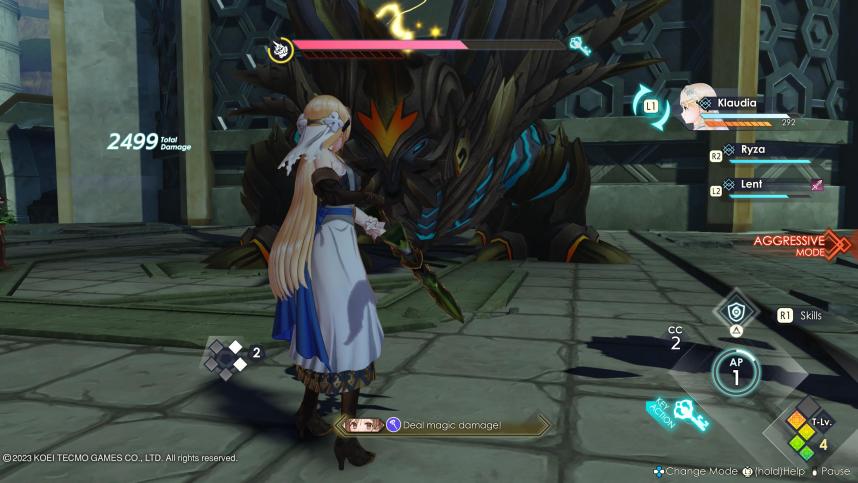
What’s neat about this is that whoever you are not in
control of will be acting independently between one of two states, passive or
aggressive. Passive will help you to accumulate AP to do more special attacks
yourself and to answer your allies call to perform physical or magical attacks
for some rather neat follow ups. Aggressive will have your allies use that AP
themselves to perform those abilities which can often leave you without any to
do special moves yourself, however, this is where things got to be a lot of fun.
With all of the alchemy being done, odds are that
you’re going to make a few interesting items. Curatives, bombs, ice bombs,
lightning bombs, explosives in general that can either target one or more
enemies in battle. Where Atelier Ryza 3 truly shines in this respect is that
item usage is now a “free for all” in which ALL characters can independently
accumulate craft points (CP) to use whenever you want them to. So while I
originally have a decent spread of healing and damage items on Ryza, I eventually
went full attack power while giving Klaudia the healing gear and Lent a mix of
the two.
While these three eventually formed my main party, I
was also careful to ensure that both Tao and Bos were just as well equipped as
it’s super easy to swap characters in and out of a party of five. You will have
more characters than that available over time, new to the series and returning
alike, but those have to be set up before battle. This makes things a lot of
fun as everyone in your party levels up, and if you need to catch some of your
other characters up? They can be swapped into those reserve spaces allowing you
to still rock the battlefield without having to worry about your characters
themselves getting rocked. You are being rocked though its back to the Atelier
with a penalty of losing a portion of your accumulated items while out
exploring.

Interestingly enough as a near final note, unlike the
rest of the trilogy, you can make new Ateliers in the different locations which
can end up serving different purposes. The main purpose is obviously to perform
alchemy, rest up and save your game, but the other factors are really neat. In
addition to the core functions, you can choose whether your Ateliers boost
effects for exploration, the quality and trait modifiers of items you gather,
or the amount of SP gained while also increasing the likelihood of merchants
visiting your Ateliers. And once you’ve potentially outlived the usefulness of
certain exploration effects like seeing items on the map, you can redesign them
into another type!
If I had one actual issue with Atelier Ryza 3, it
would be in some of the camera work. I think the best way to describe it at
times would be a hybrid between the Blair Witch Project and Cloverfield. The
camera isn’t steady, it moves all over the place and a few times even gave me
motion sickness in the heavier storied portions of the adventure. I also found
the camera to be too close in battle, often not letting me know that there was
more than the enemy that I was focusing on as you also often cannot see your
two partners because they are just out of sight depending on their own
movements. This would be the only reason to not be sitting between 8.5 and 9 /
10.
All of this said though, the storytelling continues to
provide a fun adventure and I’m really happy to have finally had a full trilogy
where you get to travel with the same principle cast. Seeing the characters
grow over the course of time, 3 years between Atelier Ryza and Atelier Ryza 2,
and then 1 year between Atelier Ryza 2 and Atelier Ryza 3, was fun as it allows
you to better enjoy the banter especially when they are talking about the past
and how much or how little has changed over the years.
Overall, this final chapter in the trilogy was worth
the wait and I look forward to seeing what comes next. Between the various
gameplay elements and the fun to tag along the story, Atelier Ryza 3: Alchemist
of the End & the Secret Key has once again set a new bar on the series.