• Blue Reflection Quartet - PS5 Review

    The Blue Reflection series by Gust is a high school slice of life with apocalyptic level situations and magical girls. With the world on the brink of destruction, it'll be up to a select few to tackle those that wish to destroy it, all while managing the emotions of their friends, fellow students, and themselves…

  • Gobliiins Collection - Switch Review

    In the early 90s, Coktel Vision (which later became Sierra On-Line) released a quirky point and click adventure game titled Gobliiins which had players bouncing between three different Goblins to find a cure for good King Angoulafre.

  • Cat Mail Co. - PC Review

    What a meow-gnificent evening it is to send your paw-rcels out to those family and friends! Are mew looking to pick up an item or send something out? Well at Cat Mail Co. we can send and receive all your deliveries!

  • Volontes - Nintendo Switch Review

    Have you ever grown up feeling like you don't belong? For our Heroine, that's the feeling she lives with everyday in her small farming village. But it's not her only secret...

  • STARSEEKER: Astroneer Expeditions - PC Preview

    STARSEEKER: Astroneer Expeditions is just that! Massively co-operative and not an MMO! When you first run the game you are instantly into the tutorial...

  • Dread Delusion - Xbox Series X|S Review

    Today we’re looking at what has rapidly become an absolute favorite in the open-world RPG genre for me. An interesting story, memorable NPCs, stunning visuals, and a setting absolutely dripping with flavor, Dread Delusion sets its tone immediately and sticks with it.

  • House Flipper Remastered Collection - PC Review

    I enjoy simulation-type games, and I enjoyed the original release of House Flipper, but I never got around to getting the DLC. When the remastered version of the game was released, I figured it would be the best way to experience the DLC while checking out how the base game was upgraded.

  • GranBlue Fantasy: ReLink Endless Ragnarok - PS5 Review

    GranBlue Fantasy: ReLink released in 2024 bringing the GranBlue universe to an action adventure JRPG format. With a party of up to four members, this band of skyfarers set out for new skies, adventures, and dangers. Two years later, Endless Ragnarok...

  • 70s-Style Robot Anime Geppy-X - PS5 Review

    70s-Style Robot Anime Geppy-X is a mouthful of a title, but you know what? It’s quite the challenging game to describe as well. At its core, 70s-Style Robot Anime Geppy-X is a shooter...

  • Gunvolt Chronicles: Luminous Avenger iX 1+2 Dual Collection - PS5 Review

    Are you ready for the package deal for the Azure Striker spin-offs before the third title in the spinoff series drops? Do you love the Megaman X games but want something fresh and musical? Do you wanna feel totally inadequate when you get a crappy score rating after beating what you thought was a tough fight?

Showing posts with label Turned Based RPG. Show all posts

Tactical RPG 'Dark Deity' Gets New Balance Changes and Language Updates!


Dark Deity, the turn-based tactical RPG inspired by the genre’s classics from developer Sword and Axe and publisher Freedom Games, upgrades Steam with a host of ability and gear rebalancing as well as language updates today.

Experiment with over 50 newly rebalanced, highly customizable classes within the Warrior, Ranger, Rogue, Cleric, Mage, and Adept trees. Utilize revamped combinations of spells, weapons, and skills to discover the secrets each character holds in team compositions.

Experience the captivating story through the eyes of 30 playable characters voiced by English talent like Kira Buckland (Nier Automata, Persona 5 Strikers, Demon Slayer.) now with Chinese, Japanese, Korean, French, Italian, Spanish, and German language support, bringing the magic to a wider audience.

Dark Deity along with its free update is available now at 30% off for $17.49 on PC via Steam with a Nintendo Switch version taking charge in 2022.

For more information on Dark Deity, please visit the official website and follow it on Facebook, Twitter, and Instagram and search for #DarkDeity on social media.

About Freedom Games

Freedom Games is a publisher dedicated to offering best-in-class services to partners and providing players around the world with unique and memorable experiences. With over 50 years of combined industry experience at the executive level, Freedom Games seeks to leverage its expertise to facilitate great games and even better publishing experiences.

For more information, visit the official Freedom Games website.

Article by: Susan N.


Share:

Disciples: Liberation - PC Preview


Disciples: Liberation
by developer Frima Studio and publisher Kalypso MediaPC preview written by Pierre-Yves with a copy provided by the publisher.

Estimated reading time: 9 minutes


The Disciples series, originally designed by Strategy First, is back again with its fourth entry currently within Early Access by developer Frima Studios and returning publisher Kalypso Media. Taking a turn towards something new in this turned based building strategy compared to its predecessors, I've easily sunk over a dozen hours and can honestly say that I'm sure I've barely begun to scrape the top.

Now unlike the much more known Heroes of Might & Magic series started by 3DO and then picked up by Ubisoft for HoMM V and on, Disciples fell into a more niche category that unless you knew someone who played it or took a chance at picking up the box on a shelf? You could have easily missed it. What made this series different is that instead of gathering resources for giant armies, you raised the strength of individual units to fight for you. This brought more of a "personal" touch to the experience as you really didn't want to lose anyone unless it really was a tough battle and then perhaps cried a bit even in victory.

Not having played the series in quite some time, I re-loaded Disciples II: Gallean's Return (Dark Prophecy / Guardians of the Light / Servants of the Dark), Disciples II: Rise of the Elves and Disciples III: Renaissance. Having gone back through where the series has come from allowed for quite a comparison of how far the series has come. No longer the series that I used to spend entire weekends playing the campaign or going head to head with a few friends, gone are most of the turn-based elements of the world of exploration in favor of a real-time faster paced experience.

This move was perhaps one of the biggest changes to get used to. A lot of this series and those like it have relied for so long on the fact that units could only move so far per turn allowing you to deviously calculate your next move or frantically scramble to defend your main base. These elements are both actually now gone as our protagonist Avyanna moves around the world in real time conquering ore mines, wood mills and other resource sources as needed. Or at least, as what’s possible within her current army strength and your own strategic mind.

Along with this turn to a more real-time experience, Disciples: Liberation has also moved into a more RPG like direction with choices and consequences. Now instead of having a campaign based on scenarios, the campaign is based in chapters with your choices forming your path forward as well as your relationships with your allies. Are you friendly? Cruel? Power hungry? That’s up to you but just be sure to prepare for the consequences as some people will really not have the tolerance for your wit even if you yourself found what you said quite funny.

This was perhaps my favorite part of the shift in direction for the series. Falling more in line with the likes of BlackIsles, Interplay, Bioware, Obsidian Entertainment, Bethesda and more, the adventure that you find yourself within is a lot more hands on than simply moving an army or a force to be reckoned with across the map and then winning battles against crazy odds. Where do you want to start? What do you want to do while you’re there? How much do you actually want to do while you’re there? These choices are all yours as this adventure is all about how Avyanna is building up a force of her own with elements from returning factions such as Legion of the Damned, the Undead Hordes, the Elven Alliance and the Empire (basically humans).

Continuing on the twists of the series, Avyanna does have a home base in order to build new buildings and research new spells, but it doesn’t exist in any of the areas that you are exploring. Instead, your base of operations exists somewhere that can at all times be teleported to as long as you're in the outside world and not diving underground or inside into a dungeon-like area. This base of operations lets you build structures in order to hire new units that can be leveled up and upgraded over time to be more useful to you.

Now there are three elements that I really enjoyed with this feature. The first, is that because Avyanna leads her own faction, you get to pick which buildings are put into place. Want a hybrid set of undead, demons and elves? Go for it! There’s nothing stopping you from doing this. The second element is that as there is limited space, you aren’t bound by early game decisions. Once you run out of place and want to switch things up, all you need to do is phase out what you don’t want and either phase something in or build it from scratch. It keeps with the level of customization and it doesn’t punish you for trying new things out down the line.

The third element that I really enjoyed is that unlike the previous entries into the series, if you lose your minions you don’t need to cry (as much) as long as you’re not deep deep within a dungeon. The reason is that because of the more open ended approach to the adventure, there are elements in place that allow you to hire new units and then train them up to Avyanna’s level as needed. This not only avoids having to try to keep new units alive while at low levels, but it also lets you catch up units that you may be keeping in reserve in case something does happen.

Combining the hirable units with Avyanna herself, and there’s one more element to take into account before heading into battle. Alongside the hirable units, any companion of Avyanna’s can join her in battle. Each of these units are much more powerful, contain incredible abilities and unlike hirable units, if they are downed in combat, they’ll come right back once the curtain has fallen on the corpses of your enemies.

With the real-time shift of the rest of the adventure, this latest in the series takes the hex based combat put into place by Disciples: Renaissance and refines it. This switch from the your forces on one side and the enemy on the other offered up a much higher stakes tactical game as you now had to worry about where all your forces were at all times such as with others in this vein like Black Guards (2) and Gloomhaven. Now instead of worrying about Avyanna’s level, her companions levels and her hired units levels, you also have to worry about where everyone is standing on the field so to both maximize your force’s capabilities and minimize your casualties.

Set up in an initiative order, battle takes place in rounds that give every unit the ability to act at least once per round short of counter-attacks and attacks of opportunity. Unlike your traditional experience though, characters, companions and hirable units all have two mana modules of differing or matching colours. What these mana modules do is allow any and all characters to move and to act. What the change in colours do however is allow for certain units to attack twice if they have the same colour of mana as long as they don’t move. It’s an extra layer in the strategy as it applies as much to your forces as it does to your enemies.

The rest of combat is “pretty easy”. Set up on a hexagonal board, each unit can move a certain amount of spaces per their turn and then either attack an enemy or perform a supportive action such as healing or increasing their attack or defense. From there, as it’s a hex based grid, you’ll have to be careful on how you line your units up as some spaces will not allow you to attack at a range as you will no longer be line of sight, while other positions can land you into the perfect flanking positions or the worst ones.

What I loved / hated about flanking is that you can technically flank a unit three times because of how the hex grid is designed. This allows for some rather neat “ambushes'' if you hold your initiative for just a little while or if you play your cards just right and get lucky that the enemy moved right where you wanted them to. There’s a learning curve to get it right depending on your unit setup and which faction you decided to go and see first as it’s an open choice and I have no regrets having seen the Elven Alliance first. The hate would be sometimes you think something is going to be great only to find yourself double flanked and potentially rather dead.

If there’s one thing that I would have a complaint about it would be the speed of combat. Just about the rest works rather well from moving around the main map, teleporting to and from the main base, checking out your unit formations and equipment loadouts, but combat takes a long time especially against archer units that keep running away all of the time. I would like the ability to speed it up either to 2x or to 4x the normal speed as the increase in speed would not detract from the thrill of winning or losing. It would simply make things a bit smoother especially when there are almost twenty people on the field and each and every one gets at least one action.

Finally, a quick note for multiplayer, as it currently stands the option was disabled to try so we’ll try to take a closer look at that on full release as I’m quite curious how this new style will affect the player versus player approach that is listed.

     Will Disciples: Liberation include multiplayer? Yes. You can battle with a friend in two-player online skirmishes

Summary

So overall, even with the shift of the Disciples series with Disciples: Liberation to a more real-time and turn-based tactics RPG than the older entries of “player versus player” styles, it’s in good shape. The shift isn’t a bad one but as mentioned above, a few small tweaks could definitely help to polish this off even further regardless of if you decide to drop into this dark and intriguing world on the PC or on the consoles at the beginning of next month.

Score: N/A


Share:

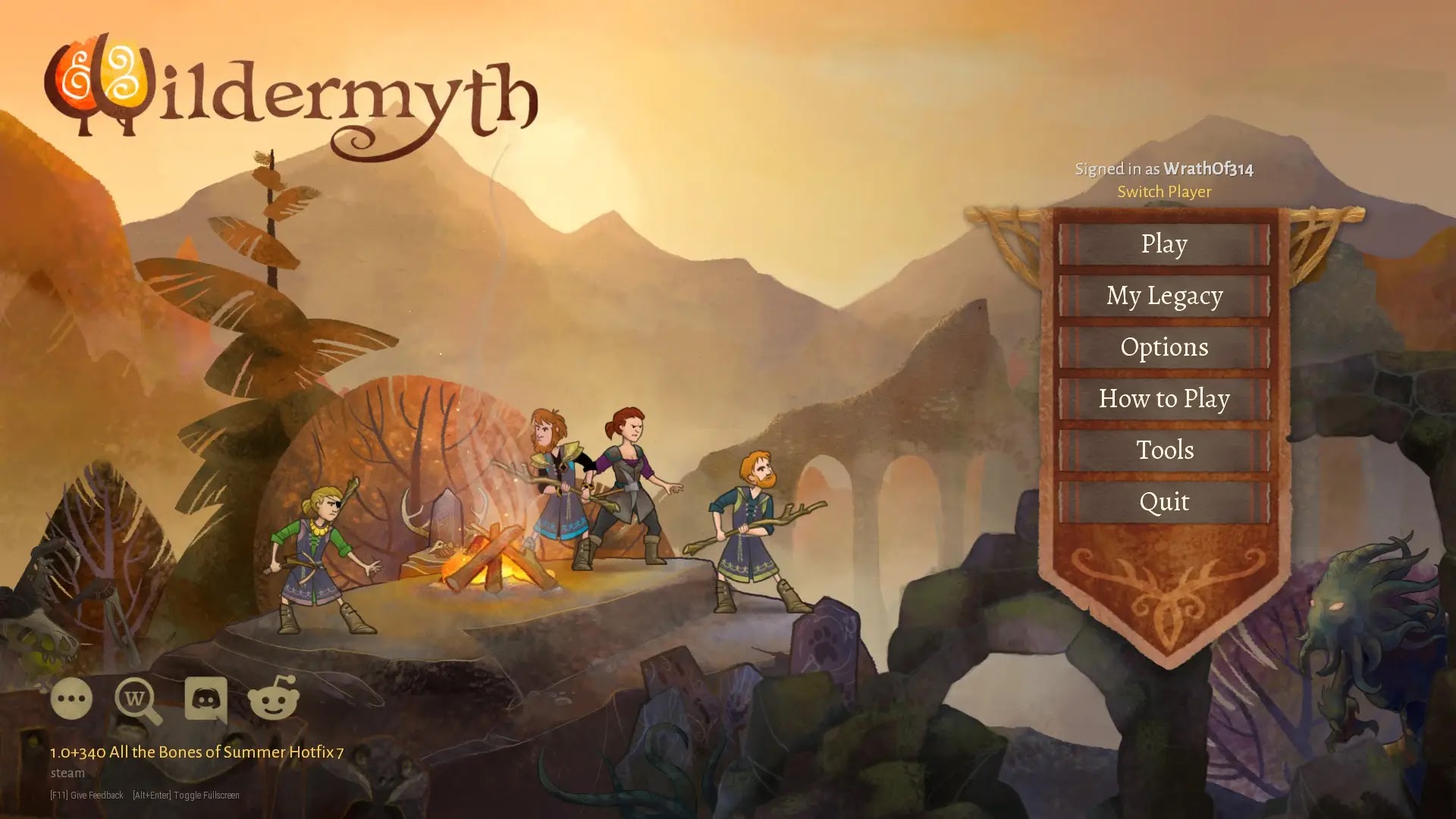
Wildermyth - PC Review


Wildermyth
by developers Worldwalker Games LLC and publishers Worldwalker Games and WhisperGamesPC review written by Pierre-Yves with a copy provided by the publisher.

Estimated reading time: 9 minutes


There are some formulas that just go together like peanut butter and jam or pineapples on pizza. They just work. Wildermyth by Worldwalker Games is one such title that just works so well as it blends turn-based tactics and procedural storytelling in a vibrant visual 2D pop up style presentation.

Starting things off like any good roleplaying adventure, you get to create a character. Choosing what they look like, what they sound like and what you want then to be addressed as (he / his, her / hers, they / them), you then move onto the next one. Starting off with three, you'll very soon get to see how they relate to one another and from even this early on, control of how they relate to one another is entirely up to you. The stage is set, you just need to act.

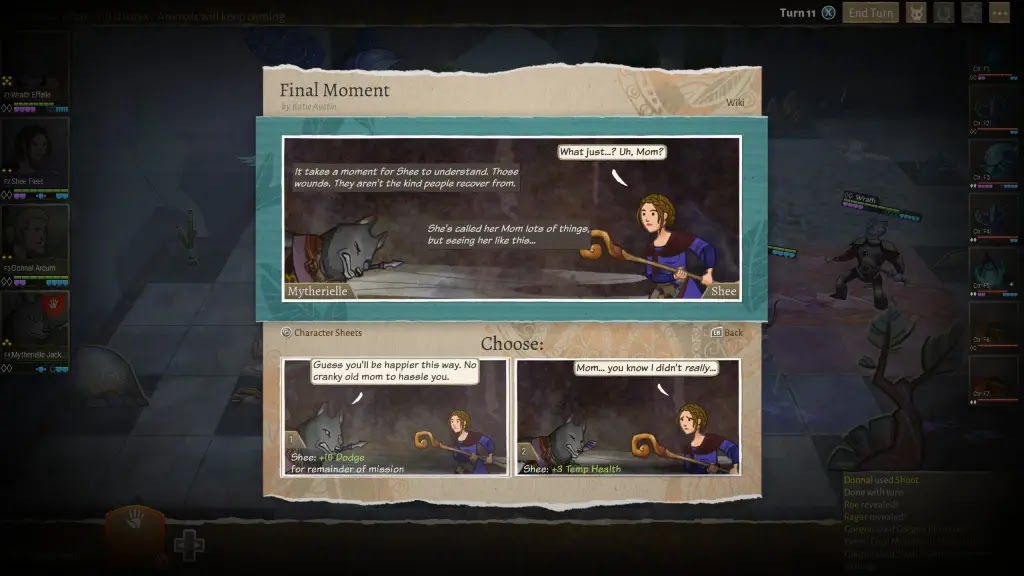
This is perhaps Wildermyth's biggest draw, its storytelling. Starting off at the beginning before things start to go to hell and mysterious monsters or otherworldly beings start to rain on your parades, your would-be adventurers have a lot to learn if they are going to survive. Do they get along? Do they fall in love? Do they sacrifice limbs to restore robots or turn into werewolves? Do they perform the ultimate sacrifice so that their friends can live another day to protect the people that they swore to? Or finally, do they fall before the adventure even begins as all three have to escape a cave with an unseeingly ending number of monsters that stand between them and the exit.

Each one of these choices helps to shape your overall adventures or end it before it even begins. While luck has a little bit to do with it, Wildermyth is just as much about skills and planning out what you're going to hopefully do as turn-based tactics never go according to plan. Doubly so when you can't see half the map at times because of lines of sights and fogs of war. This is the other major draw of the adventure, the thrill of testing your might with the would be mortal heroes against the hordes of enemies that would wipe them from history.

Starting off at a beginning, each adventure will have its own way to transition you into the story whether or not there is a main antagonist to go up against. Taking the the very first campaign titled the Age of Ulstryx which is designed to teach you the ropes, most of the following is based off of that experience even if I had plenty of fun trying out the others.

Spread out in a series of territories, the overall "world map" sets the main stage which can be moved around through yet another fog of war that has to be scouted out in order to know what's there. Once that's done you can choose to either clear out any enemies that reside there, build a resource outpost, build a bridge to more quickly travel to another territory or fortify it with defenses and trained militia. None of these are bad choices and if there's one thing that I was taught over the course of my first failed adventure falling in the very last battle as I failed to deal the final blow as my last remaining adventure's arrow clinked off the big bad's armor, it's that sacrifices are going to have to be made at all levels. Wildermyth plays for keeps and doesn't allow for many mistakes to be made. Heroes can fall once per chapter which is known as being maimed and once that's happened, any subsequent fall will be fatal. This isn't anything new per say, *glares at The Stranger of Sword City*, but it does come with some interesting elements to spice up the mix. 

Any lost or modified limbs which can happen over the course of your adventures are replaced so that adventures will always have two arms and two legs, but it could affect how they use weapons. My main archer for example, after she became a werewolf, at first it was just the head and the fur, the rest was still human. Over time your character can morph those parts if you want which will affect your stats and when I refused the leg because it would reduce their evasion, I said yes to the arm. That upgrade removed their ability to use bows, but at least there are crossbows and I have her a pretty nifty power story based spear to make up for it. Other adventurers could lose an arm and get a hook in its place adding yet another potential attack, but also removes the ability for two-handed weapons.

To get to these points however, you're going to have to plan for battle. Are you attacking a point to free it from those that currently roam around it? Or are you running to the aid of the territory that is currently under attack? In either case, you'll have a choice to make before the battle even starts as your group approaches the situation. Charge right in, wait until the last minute, try something crazy like going in with only two or three troops or wait until nightfall. Succeed and your group of adventures will receive bonuses or the enemies will lose theirs. Fail? And you'll be fighting off at a disadvantage.

Once you're in battle everything becomes up to what your team of up to five can do versus the hordes that you'll often be fighting against. Based on a Dungeons & Dragons like rule set, every character as a base has two actions. You can move and attack, you can move twice, attack twice if you're not moving, you can use free actions, or you can wait and do nothing depending on the situation. Obviously with leveling up and gaining perks these can be modified as standard actions can become free and you can definitely learn to really make use of attacks of opportunity and level those up, but you’ll still want to be careful as who you have is generally all you have.

Otherwise though, combat is really fun as you move your adventurers through similar enough maps depending on the terrain with plenty of environmental “props” to help you out. Giant rocks can be hidden behind, mystics (the wizards) can use the terrain to sling spells around such as sucking fire from a source and putting it in as an obstacle, and if things are in your way? Simply destroy them to more easily get to your enemy that can do the same things that you can. As a final note, if your character falls in battle, the first or the second time, there are options depending on what the situation is. Do they use the last of their strength to stick it to the enemy? Or do they take the time in order to temporarily or permanently buff one of their allies, family, friends or lovers, before they die?

All of these have to be decided on the fly and to raise the stakes one more time, for every enemy that you fight, they’ll get a permanent upgrade for the rest of the campaign. So the stronger your adventurers get, the stronger the enemy gets. Adding to that stress, there are two other timers to worry about. The first is when the next rampage will kick off making you either need to get defenses in place or move to where they are rampaging as soon as possible. The second is more of an evolution counter. Once this counter hits zero, there are four “cards” that are drawn either making your enemies stronger or adding in new enemies to the mix. This can be countered with Legacy Points (LP) that can be acquired through various means, but sometimes it’s better to allow a few of these so that you can use your LP when it counts.

If there was one potential complaint, it would be that your characters can die easily enough even if they’ve been upgraded due to the unnatural amount of enemies thrown at you at times. Like the first of my final fights mentioned above, every turn there were more and more enemies and I couldn't even properly get to the boss that could slither away easily enough and then pound my adventures from a distance. You learn to live and learn but always having to start back at basically “zero” makes it tough especially when you're a good way through the story as without a full team? You’re generally not going to make it with how much the numbers are stacked against you.

But it works.

It works very well and the dialog between all of these characters, family, friends, rivals, people that just live to annoy you, all of them bring something to the table making you want more. It makes you want to keep these people alive until they are old enough to retire and die in their beds instead of sacrificing it all on one last gamble far from home making them wonder if you raise a monument to them there, or if you bring them home and hurry them with their family.


Summary

Overall though Wildermyth was amazing. The visual presentations mixed in with a procedural storytelling that adapts to your characters choices as well as your newer characters that join up was just brilliant. Add in a very well done combat system and there’s more than enough here to keep anyone occupied for a good long time as no two playthroughs should be the same.

Score: 9 / 10


Share:

Black Legend - PS4 Review


Black Legend
by developer and publisher WarcaveSony PlayStation 4 review written by Nick with a copy provided by the publisher.

Estimated reading time: 6 minutes


Black Legend is a perfectly serviceable strategy game with an interesting theme and aesthetic, but presentation issues and pacing concerns hold this tactics game from truly standing out in the genre.

On the surface, the setting for Black Legend is really unique with its gothic / medieval setting in the city of Grant. A strange fog has rolled it as, creating a sense of mystery and dread. An alchemist named Mephisto has taken control of the city, enforcing his control with a zealot-like cult of guards at his disposal. Black Legend’s overall aesthetic is very reminiscent of Bloodborne, which is a good thing. That was arguably one of my two favorite Souls games, and that was due in large part to the environments.

That being said, the studio doesn’t have the same kind of resources at their disposal and once you get past the initial gothic setting, the visuals and audio come across a little glitchy at times and certainly lack polish. I am fine with a grim, sort of grimy vibe from the visuals, but over time that impression gave way to me feeling like there is a dated ‘sameness’ to everything. Perhaps this is reinforced by the combat, which grows somewhat repetitive over time. It starts off challenging, especially since early on when healing options are somewhat limited (they are expensive, you can’t heal unless you’re in combat, and even just finding healing items can be pretty scarce), but over time the enemy variety is somewhat limited and tactics don’t change a whole lot.

Moving around Grant is intriguing to start. I was excited to learn more about the city itself. Grant is broken up into a variety of districts, though they don’t really feel dramatically different from one another. There is no map, which I think will rub some gamers the wrong way, given the similar aesthetic throughout the game. There are street signs you can read to serve as directional guides, but as smooene who has a somewhat terrible sense of direction in both real-life and video games, I did find myself doing a lot of needless backtracking. There is a light element of stealth / line-of-sight to exploration as you can engage in combat by approaching enemy parties that are patrolling the streets. Once combat begins, there is a familiar grid-based combat that takes place.

These elements are all relatively standard in the genre, with initiative impacting who goes in what order. Characters move around the grid and then use ability points on special or standard attacks. Ranged, flanking, backstabbing and more all play into the damage being dealt. This is all delivered through a turn-based structure boils down to positioning and the best use of action points. You want to deal maximum damage while minimizing incoming damage to your own units.

Where things get more interesting is in the way you can progress your actual characters. Different classes can develop in unique ways. Classes can be swapped out between combat, and some abilities persist across classes and others do not. Growing my character abilities and synergizing the different perks of the classes within a character and across my party of characters was where I found most of my max/min statistical enjoyment.

New weapons unlock new classes, and when you start the game you have a trio of options, but later you will have access to over a dozen options. There is also the Humor system (think of these as stacks that can be applied to attacks – and they can yield oodles of damage if you save them for the right moments). This system relies on alchemy and has a somewhat heavy elemental aspect to it that adds some depth to the otherwise somewhat shallow combat. I would say that saving humors for the bigger battles and positioning are what most of the combat hinges on.

Now, one callout I want to make is the boss battles. These are actually quite engaging – very challenging. They certainly are not the same battles as those you have wandering the city streets where you deal with somewhat generic soldiers and dogs. This element added a somewhat Souls-like flavor to the proceedings, as I often lost those fights on the first go-round or two, but then learned how the developers wanted me to engage with those bosses and felt a solid sense of accomplishment upon beating them. Sure, there was some frustrating mixed in there as well, but they were a nice change of pace from the rest of the game’s content.

While the gothic-themed city was interesting to explore, the actual characters lack… well, character really. They are respectably voice acted, but the writing in Black Legend is nothing special. It’s not bad, but the story was less intriguing than the actual sense of exploration, and all four of my party members felt rather generic throughout. Conversations with NPCs were fine, but there was a lack of banter or growth in the characters themselves that left me feeling rather ambivalent towards them outside of their class skills and development.


The technical side also had some rough patches. Playing on my PS4, the game crashed once and froze once. I save pretty frequently, so it didn’t set me back much, but felt worth calling out. The audio could use a little tweaking as there was quite a bit of inconsistency between sound effects, music and voiced dialog, and just a lot of minor visual hiccups along the way as well as some pretty lengthy load times. I also had moments where I felt as though I was fighting the camera as much as my enemies, with some weird pathing popping up as my soldiers moved about the map. There is room for some technical optimization here.

Summary

Black Legend’s combat is solid if unspectacular, and the setting is unique and atmospheric. The character progression is more interesting than the characters themselves, and the story fails to match the intrigue created by the overall visual style due to average writing. Across the board, Black Legend is a decent game with some good ideas but technical issues hold it back.

Score: 6 / 10


Share:

Baldur's Gate: Enhanced Edition - Retro Reflection

Baldur's Gate: Enhanced Edition by developer Beamdog, Overhaul Games, BioWare Corporation and publisher Atari, Inc.Android OS retro reflection written by David.

Estimated reading time: 9 minutes

I’ve always been a bit of a full on geek, but one moment really sticks in my mind as the beginning of it all. Taking me from a passing interest in gaming to diving deep into reading, writing, fantasy as a genre and the way stories are told in general, Baldur’s Gate set the foundation for much of my future. I’d be lying if I said I hadn’t been giddy when I saw that Beamdog had picked it up and ported it to mobile of all places. Unfortunately, I had a habit of keeping overly out-of-date phones and couldn’t even play it until the full suite of classic Dungeons and Dragons games from my formative years made the trip: Baldur’s Gate: Enhanced Edition, Baldur’s Gate 2: Enhanced Edition, Planescape: Torment, Icewind Dale, and their own original creation, taking place between Baldur’s Gate 1 and 2, Siege of Dragonspear.

The games are made for a tablet, recommending a 7-inch screen, though the games work well on my Samsung Galaxy S10+ regardless, and the would-be difficulties of navigating dialogue options are negated by numbered buttons ready for a thumb tap. The only real problem I had with this version of the game had nothing at all with the game itself; I can’t seem to pay that much attention to a mobile device for long enough to really get deep into the game. Conveniently for me, the game was also recently ported to Xbox One, and not only includes Baldur’s Gate 2, but also Beamdog’s own Siege of Dragonspear. Three for the price of… Five actually, but $9.99 USD is pretty steep as-is for a mobile game, even one like this, while $49.99 USD is pretty much expected where console markets come in.

Big upside to the console version, aside from screen size and my mobile-distraction being a separate device entirely, is the movement. Before the iconic opener, I howled with glee. I could move my party with my thumbstick! After marvelling at this for a few short seconds (the game was originally point-and-click), checking out the I-skipped-the-tutorial controls and finding them fairly familiar for console CRPGs like Obsidian’s Pillars of Eternity, I entered the tavern outside of Candlekeep Hall and approached the innkeep to buy my starting gear.

“My hotel’s clean as an Elven arse!”

The jolly man exclaims aloud as you pick up what you need. I started as a Dragon Disciple Sorcerer, so I actually didn’t need anything, and couldn’t yet use most of it. There are some ranged options even for a nearly-no-proficiencies sorcerer, but I thought I’d hang onto my coins, despite my Burning Hands being limited to twice per day. My quarterstaff should do it, right? As it turned out, it would absolutely do the trick, after missing a dozen swings at the lowly thug that attacked me, I finally cracked him a couple good ones.

When I was attacked shortly after, I opted instead to use Burning Hands, instantly downing him and making me feel all the first-level-sorcerer might. I had to nap before I finished exploring though, returning to the Inn and passing eight hours in a room to regain my spent spell slot so I would be prepared for the road. While the tutorial is handy and goes a bit deeper into some of the mechanics, there are actually “Tutor” characters sprinkled around Candlekeep Hall to teach you how the game works, and explain the UI, as you explore this initial area. Granted, I’m playing this while familiar with games in general, but returning to this game for the first time in easily fifteen years, I’d say both the official tutorial and the less-direct Tutors tied into this starting zone were pretty effective at their jobs.

Soon thereafter, I met with my father/mentor character and we were off! Only for him to die in the very next scene, lending a much greater sense of danger to the two very-direct attacks from earlier, and a relief as I gained my first party member, Imoen, a rogue I met just before departing Candlekeep Hall. The only instructions we were given before Gorian and I were ambushed on the road were that we were meeting with allies at the Friendly Arm Inn, and Imoen and I set off at once. After some minor baddies, and a mysterious totally-not-a-wizard with an interest in my doings, we made it to the Friendly Arm, and on our way into this fortress of a tavern, we’re attacked again by someone looking for me specifically.


This time though, there’s a guard nearby who jumps to my aid. Dispatching the villain with haste, before I could call my dragon-blooded wrath down. Once inside, we met the friends of Gorian were looking for, and it began to feel like a real party. Sorcerer, Rogue, Fighter, Druid. Not a bad group to start an adventure with. In fact, we mopped the floor with some hobgoblins together! After the first couple of encounters as a party, I forgot how absolutely unforgiving 2nd Edition Advanced Dungeons and Dragons really was though, and my pyromanic urges ended up wiping my whole party, because Burning Hands has just enough of an Area of Effect to catch them all, and one of the three hobgoblins we were fighting. Whoops.

The game progresses in much a similar manner, with as much cheese as late nineties fantasy writers could muster, this is Dungeons and Dragons and BioWare (Editor's Note (PY): BlackIsles at the time) after all, and some entertaining characters on the road. One in particular stood out toward the beginning. Lord Foreshadow is a very subtle easter egg that references both the coming sequel, Shadows of Amn, and Neverwinter Nights, another BioWare not-related-except-the-setting D&D game that itself signified major steps toward digital D&D play that we see so frequently now.

Everybody likes the classic Five Man Band, but Baldur’s Gate opts for a total of six characters in your party, should you choose. Your own player character, and a whole range of new friends of varying alignment, skill, and personality to choose from. From vocally disapproving of your actions to actively attacking you if you do something too far out of their line, the characters’ varied morality and motivation lend an excellent extra layer to the game, and an awareness of who you’re taking where is a good survival strategy.


I signed on with a dwarf looking to hire some mercenary work, and had to choose between him and my bard (since I’d just acquired the bard and had no attachment), and the bard simply stayed put in the Dwarf’s shop. Turned out the man was evil, as pointed out in a background-interaction between him and my Neutral-Good Fighter, Khalid. It also turned out, he was really good at eating hobgoblin axe, and in a fight with six of the beasts, fell almost as soon as combat started. Nobody else, including two very squishy casters, took any damage in the fight, so we sold the loot and picked up our Bard friend once more, with some fresh gear for him. Turns out some problems sort themselves out! Besides, he had a nice helmet.

The game isn’t a walking simulator by any means, but it involves quite a great deal of quiet exploration as you follow what amounts to vague directions most of the time as you explore moderately sized square zones. This is a game that blends the interactivity of gaming with the pacing and storytelling of a novel, or even a series of them. You go from little more than a child who’d grown up in an academic institution fiercely guarded against the outside to a god-who-walks-the-earth being of interplanar power, but it takes much longer than more readily accessible modern games. This is due to what is, in my opinion, both the brightest point and the most glaring flaw in the game.


Baldur’s Gate was originally created to literally be a digital single player game of Advanced Dungeons and Dragons. There are certain aspects of the game that just don’t translate without that interaction, but at the same time, there are stories that just couldn’t be told as well neither from a more direct game nor from a non-interactive medium. While this odd mashed up medium of storytelling does wonders for the world and story itself, it’s also a big part of why the game is hard to get into. THAC0, To Hit Armor Class 0, was possibly the worst part of Advanced Dungeons and Dragons, and its removal was no small part of how massive Third Edition D&D became in comparison. I’m not going to go into an explanation of this too far, but it was based around lowering your armor class and raising your THAC0, and was calculated in ways that were so not clear that player groups would just use different combat rules.

If you want a single player AD&D experience, it’s fantastic. If you want an entertaining and consistent gaming experience, it’s kinda horrifying. Beamdog got around this with a more modern list of difficulty settings, ranging from Storyteller mode where you’re essentially guaranteed success to Throne of Baal which is essentially for people who are both masochists and really into THAC0 and AD&D.

All in all, this was both a great nostalgia trip and a fun gaming experience for me, though I'm a big D&D fan in general. Maybe I’ve got some rose colouring to my glasses, but getting to see the original content refreshed and expanded upon felt great, and the genuine love for the original that Beamdog has, that made these possible, has me excited to check out Siege of Dragonspear as a connector between Baldur’s Gate and Shadows of Amn.


Share:

Fairy Tail - PS4 Review

Fairy Tail by developer Gust and publisher Koei Tecmo GamesSony PlayStation 4 review written by Nick with a copy provided by the publisher.

Estimated reading time: 6 minutes

The source material for Fairy Tail is perfect for a JRPG, and while most of what is found in this game has been done before in other roleplaying titles, the experience comes together in a very enjoyable way. Fairy Tail is easy to pick up and learn, but I found myself gladly playing for busts of several hours at a time, making it surprisingly difficult for me to put down.

Gust has a knack for anime-styled roleplaying games, with the Atelier series springing to mind (though they’ve logged plenty of good work with titles like Blue Reflection, Nights of Azure and Ar Nosurge as well), and that trend continues here. The developers seemed completely comfortable taking the Fairy Tail world and breaking it into gameplay components that work well together, though they are familiar. Fetch quests, quests to kill certain types of monsters, working together to raise the bonds between team members, upgrading facilities and more are all pretty common aspects to JRPGs these days, but I found myself enjoying these gameplay elements all the same.

It helps that some smart design choices were made. For example, travel is generally snappy (fast travel between points in the city the world map is made up of key points you can quickly bounce to and from), which makes exploration fun and seldom feels like needless padding. There are sometimes opportunities to find hidden items or create shortcuts in the larger, more winding maps by ‘breaking’ barriers in the environment (doing over a specified amount of damage during a nearby fight) that adds an interesting challenge while walking about. Quest items or people to talk to are clearly located on the map and mini-map, again letting you focus on your objectives without wasting a bunch of time. Too many RPGs don’t feel like they respect your time, often by making you double back repeatedly over the same areas on foot or grinding just so you can get past the next boss, but I never really got that feeling out of my time spent with Fairy Tail.

Combat is handled well also. There are options to streamline things by cutting out the animations or having an auto-battle turned on. However, the core mechanics are surprisingly tactical, with enemies occupying a gridded space and your own attacks having variance in which and how many of those grid squares get hit. There are additional status elements, elemental weaknesses / vulnerabilities and some overpower types of states and chain attacks that can be used as well. The members of your team certainly feel powerful most of the time, and chaining together a bunch of attacks and wiping out a mass of enemies is satisfying. That being said, the sense of satisfaction does dim a bit by the game’s end. It is a difficult balance to strike between giving the protagonists growing power and how to scale the enemies along the way and most JRPGs struggle with this – Fairy Tail included. Usually there are either massive difficulty spikes that lead to grinding and / or frustration, or the enemies cease to become serious threats outside of a handful of specific encounters by the end of the game, and Fairy Tail falls into the latter category.

The overall presentation is solid, looking every part of the anime. The music is often catchy too – especially during some of the more pivotal plot points. That being said, the voice cast is strictly Japanese, leaving those interested in English using the subtitles. Not a big deal to me, but something that will inevitably bother some people. There were However, while I am familiar with Fairy Tail, and have read some of the manga and watched some of the anime, I would not consider myself an expert in the series. I am familiar with most of the major plot points and many of the character histories, but one area I thought Fairy Tail took a bit of a misstep was right at the beginning.

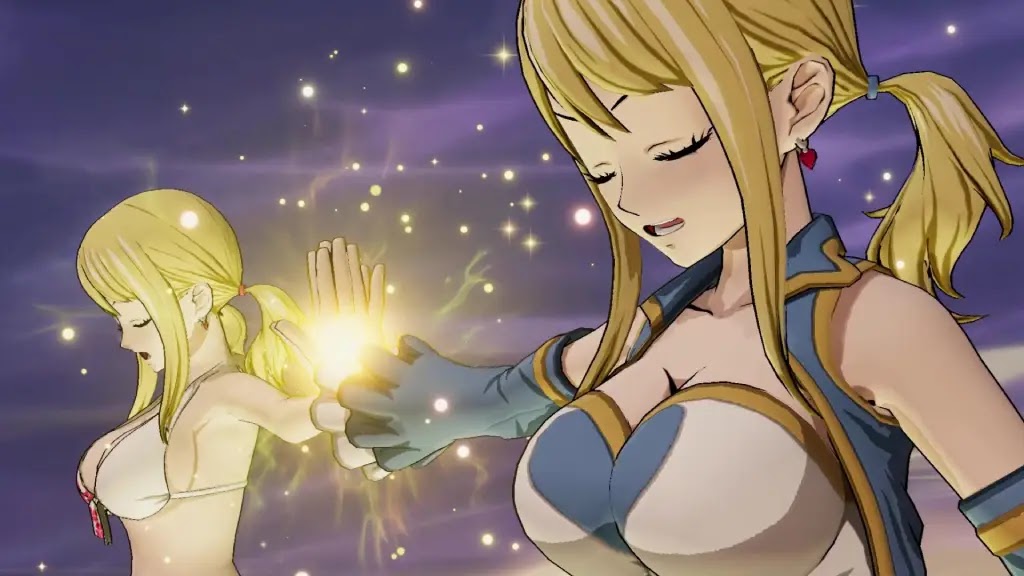
There is a long timeline to draw from, and for whatever reason the developers decided to drop this game into the events around the seven year jump (for those familiar with the timeline), instead of a more natural starting point to getting to know the characters a bit better (like perhaps when Lucy and Natsu first met). As a result, the game rushes you through a quick tutorial as the party faces off with Hades, and there was a bit of virtual whiplash on my part that I can only imagine was far worse for those completely unfamiliar with the series when they first play.

Despite this breakneck start, the developers do find time to help establish the relationship better during the rest of the game. There are small dialog options that come up here and there as characters tackle missions together or raise their bonds post-quest that are best described as comfortable and even heart-warming at times, that really allow the Fairy Tail characters to shine. Unfortunately it takes a while for this part of the narrative to hit its stride, with many of the earlier events feeling almost unearned because there is little to no context around prior events and relations between characters.

Fairy Tail recovers nicely enough the longer you play as the story itself is easy enough to follow along with even without a working history of the source material However, given that this game may well be the first exposure many people are getting to the series, a few of these narrative choices struck me as potential head-scratchers. I will say however, that given the large cast of characters involved with kicking things off at this point in the timeline, the game does a nice job of giving most of the characters ample time for the spotlight. None of the main cast felt neglected to me, and while Fairy Tail has numerous anime tropes baked in, the overall cast of characters and their guild-as-family approach to life is undeniably charming.

Summary

While the breakneck opening might make it somewhat difficult for newcomers to the series to find their footing, it is clear that Gust was quite focused on delivering a love letter to existing fans of Fairy Tail. To that end, the developers succeeded. Fairy Tail is not a terribly challenging JRPG, but it never felt overly grindy or tiresome either, and with any luck we’ll see more of the series in game form in the future.

Score: 8 / 10


Share:

Random posts

Our Streamers

Susan "Jagtress" N.


S.M. Carrière

Aldren


Affiliates

JenEricDesigns – Coffee that ships to the US and Canada

JenEricDesigns – Coffee that ships to the US and Canada
Light, Medium and Dark Roast Coffee available.

Blog Archive

Labels