• Gobliiins Collection - Switch Review

    In the early 90s, Coktel Vision (which later became Sierra On-Line) released a quirky point and click adventure game titled Gobliiins which had players bouncing between three different Goblins to find a cure for good King Angoulafre.

  • The Core - PC Preview

    Sometimes when you are browsing the internet for information on how to do something, you stumble upon ideas or projects or even games that people might be working on...

  • Cat Mail Co. - PC Review

    What a meow-gnificent evening it is to send your paw-rcels out to those family and friends! Are mew looking to pick up an item or send something out? Well at Cat Mail Co. we can send and receive all your deliveries!

  • Volontes - Nintendo Switch Review

    Have you ever grown up feeling like you don't belong? For our Heroine, that's the feeling she lives with everyday in her small farming village. But it's not her only secret...

  • STARSEEKER: Astroneer Expeditions - PC Preview

    STARSEEKER: Astroneer Expeditions is just that! Massively co-operative and not an MMO! When you first run the game you are instantly into the tutorial...

  • Dread Delusion - Xbox Series X|S Review

    Today we’re looking at what has rapidly become an absolute favorite in the open-world RPG genre for me. An interesting story, memorable NPCs, stunning visuals, and a setting absolutely dripping with flavor, Dread Delusion sets its tone immediately and sticks with it.

  • House Flipper Remastered Collection - PC Review

    I enjoy simulation-type games, and I enjoyed the original release of House Flipper, but I never got around to getting the DLC. When the remastered version of the game was released, I figured it would be the best way to experience the DLC while checking out how the base game was upgraded.

  • GranBlue Fantasy: ReLink Endless Ragnarok - PS5 Review

    GranBlue Fantasy: ReLink released in 2024 bringing the GranBlue universe to an action adventure JRPG format. With a party of up to four members, this band of skyfarers set out for new skies, adventures, and dangers. Two years later, Endless Ragnarok...

  • 70s-Style Robot Anime Geppy-X - PS5 Review

    70s-Style Robot Anime Geppy-X is a mouthful of a title, but you know what? It’s quite the challenging game to describe as well. At its core, 70s-Style Robot Anime Geppy-X is a shooter...

Showing posts with label Sony PlayStation 4. Show all posts

Metro Quester - PS4 Review

Metro Quester by developer Thousand Games and publisher KemcoPS4 review written by Richard with a copy provided by the publisher.
 
Estimated reading time: 5.5 minutes

An apocalyptic future where humanity needs to fight against mutated monsters for resources and food. A dungeon crawl to get to what you want. Will you brave the dangers in an attempt to thrive? Or will you be consumed by the monsters infesting the world?

Metro Quester is an old-school dungeon crawler that looks like it'd be right at home on the MS-DOS. No, this isn't a bad thing at all. Taking inspiration from what I'd guess is the original Rogue title, yet without the randomization, we get what Metro Quester feels like, at least to me.


You play as a band of would-be explorers and artifact hunters. Powerful monsters hold the secret of relics, which you are now hunting. Your team of five have the goal of defeating these monsters in order to find the relics. But it won't be easy as you need to find food to survive, and you only have a certain amount of purification power that allows you to explore. Returning to camp replenishes your purification as well as health and revives any knocked out teammates.
 
Metro Quester is a pretty simple game when you break it down. You explore a map that gets filled in as you explore, and remains every time you set out to explore, and have a limited time to explore before you need to return to camp. There are monster icons that you can touch to start combat, resource collection points, false walls and mud to clear away, safes to open for gear, and more for you to find out.

The field map you traverse functions in traditional rogue style rules. Your character moves, enemy characters move, repeat until you run out of purification power. If you make contact with an enemy unit, you will enter into a turn-based combat. There are also resource points that you can interact with in the hope of getting either food or resource points. These will return the next time you set out from your base, which is measured as a day value.


You are tasked with maintaining your food stores during set periods, with the value required increasing as your number of party members increase. Failing to find enough food will result in penalties to your exploration team, so make sure you fulfill your food quota! Food can be obtained both through resource points on the map as well as from defeating certain enemy types.

Now let's talk a bit about the combat. Combat is a turn-based system where you have 5 party members going against enemies of varying sizes. Each character has a number of moves they can choose from, each costing a different amount of action points. Moves are based on both equipment and what your character has as a class, so swapping weapons could mean you no longer have access to the moves you want to use.

Each character can choose up to three actions per turn maximum, as long as they have the action points to support it, and each move can only be selected once. If you have multiple of the same move, such as if you have two of the same weapon equipped, you can use the move twice, one move per weapon. All moves have both a hate value and speed value associated, and dictate the likelihood you get attacked by enemies and the turn order in which you use your moves. Some moves will also have extra resource costs associated with them, such as "medicine", for example. These extra resources are shown during battle, and purification energy can be converted into resources if you have the appropriate move to do so, usually afforded through equipment.


After combat ends, you will be fully healed and cleansed of status effects, at the cost of purification power, if required. While this depletes the amount of time you can spend out exploring, it does help keep you up and going. Couple this with the fact you can run from battles means you can salvage what could be a party wipe at the cost of some purification power.

After running out of purification power, or choosing to return to base, you can level up your characters (yes this isn't automatic) up to whatever their current level cap is. While leveling is "free" at lower levels, it will start costing resources. Unused members won't get experience gain unless you have a specific accessory that grants experience sharing, so pay attention to that as well. Another use for resources is for improving your weapons. If you have multiple copies of weapons in your storehouse, you can fuse them with a resource cost in order to improve them.

As you've been exploring the map, you will come across camping locations. You can move your base to any of these camping locations at the cost of 30 food. No, that isn't a lot, and it helps when you're exploring a new area to reduce the purification power required to explore, as you'll now be closer to where you want to check out. There are also tough enemies and boss monsters that may be nearby camping points, letting you avoid unnecessary resource drain before engagement. You do want to fight these monsters, as not only do they normally hide loot behind them, but beating one also increases your maximum level cap, making other fights easier.


Metro Quester is...weirdly endearing? It looks right at home on an MS-DOS, and I'm pretty sure at least half of the people reading this don't even know what that is. Graphics are really basic, the game looks incredibly bare bones and retro, and the start menu interface feels more like a command prompt menu than a video game start screen. I love it. Admittedly at first I was a little hesitant, but don't let the appearance fool you, Metro Quester is surprisingly in-depth and really fun. I had a great time exploring the map trying to discover secrets, uncovering and filling in the map, and collecting materials to help the exploration. Once I got used to the combat and started getting a better understanding of it (please read the in-game manual and tips, trust me it's worth it), I had soon found a few hours had flown by.

Metro Quester is a very unassuming title holding a lot of fun. An extremely retro feeling with a surprisingly fleshed out combat system as well as resource management and exploration planning make metro quester a neat little dungeon crawler that is really enjoyable. Don't let this gem pass you by based on how it looks at first glance, a game doesn't always need to be fancy to be fun, and it's definitely worth the price it's currently going for.

Score: 9 / 10
Share:

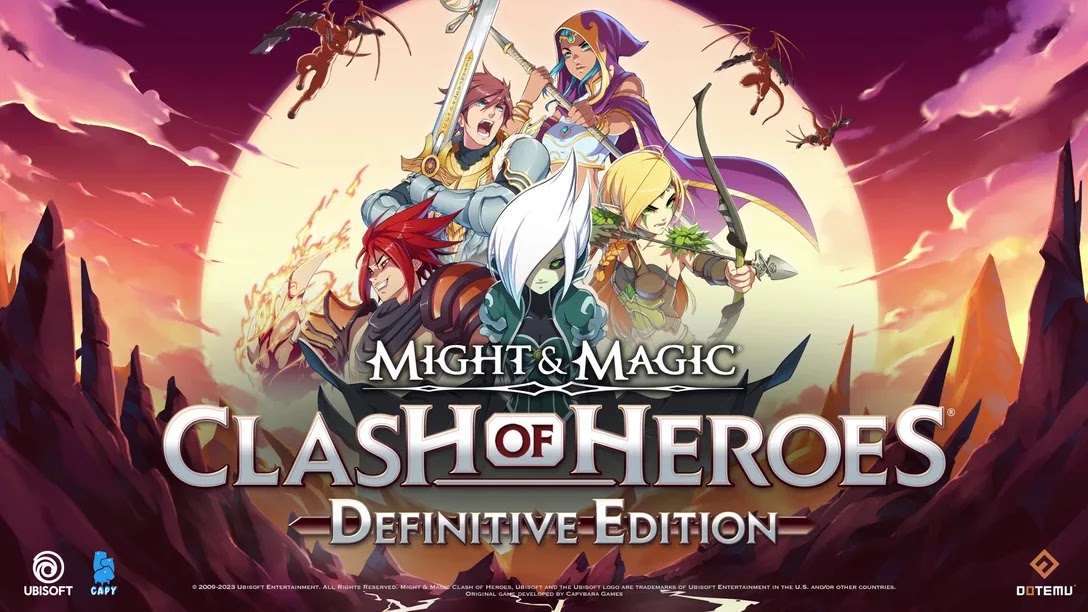
Might & Magic: Clash of Heroes - Definitive Edition Review

Might & Magic: Clash of Heroes - Definitive Edition by developers Dotemu and Capybara Games and publishers Dotemu and Gamera GamesSony PlayStation 4 review written by Nick with a copy provided by the publisher.

Estimated reading time: 5 minutes


Might & Magic: Clash of Heroes - Definitive Edition a rerelease of a surprisingly deep match-three style puzzle game that released over a decade ago. This hybrid RPG / puzzle title is every bit as engrossing now as it was then, even if this release doesn’t really do a whole lot to improve upon the original.

I actually reviewed this title back in 2012 when I played it on PlayStation 3, and honestly my opinion of the game was quite high then, and it remains the same today. Now, I haven’t actually touched this game in over a decade. I played it all of the way through, getting all of the trophies back when it first released. I was hooked. However, having taken a decade off from it, I found there were things I still remembered, like how stacking three in a row vertically causes an attack, the basic storyline and types of heroes that make up the game. There were absolutely things I had forgotten too, like how the special units worked and the best way to build defenses (three horizontally).

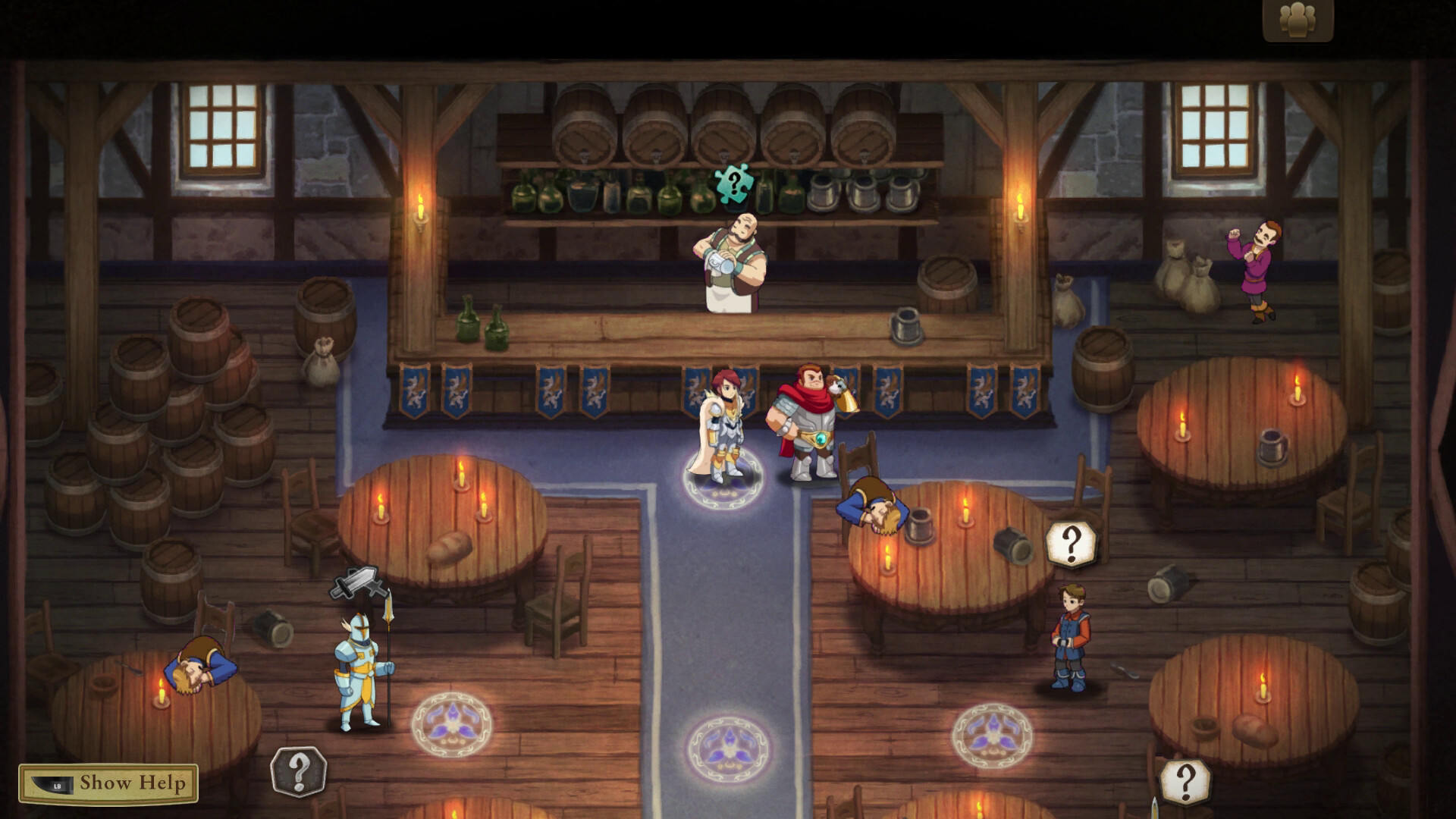
Now, I love the match / puzzle genre and adding RPG elements just makes it that much more addicting for me - I am still playing Marvel Puzzle Quest nearly a decade after I started, and enjoyed Puzzle Quest both when I first played it on PSP and later on the Switch. For those reasons, Might & Magic: Clash of Heroes - Definitive Edition is really my jam, despite the somewhat generic archetypes and storyline. The game starts simply enough, talking about an artefact of great power and some notable families coming together when an ambush strikes and splits them up, forcing the younger bucks in the families to step up and try to stop the villainy at play. None of it is particularly new, but it sets the table and is all framed up nicely enough with pleasant graphics and music – if somewhat redundant sound effects. The visuals have a nice hand-drawn style to them, though I know it’s a somewhat debated topic in the community as some people feel the original game’s art direction was better. I like both and don’t see it as dramatically different (but better than what was on DS before, which was more pixelated).

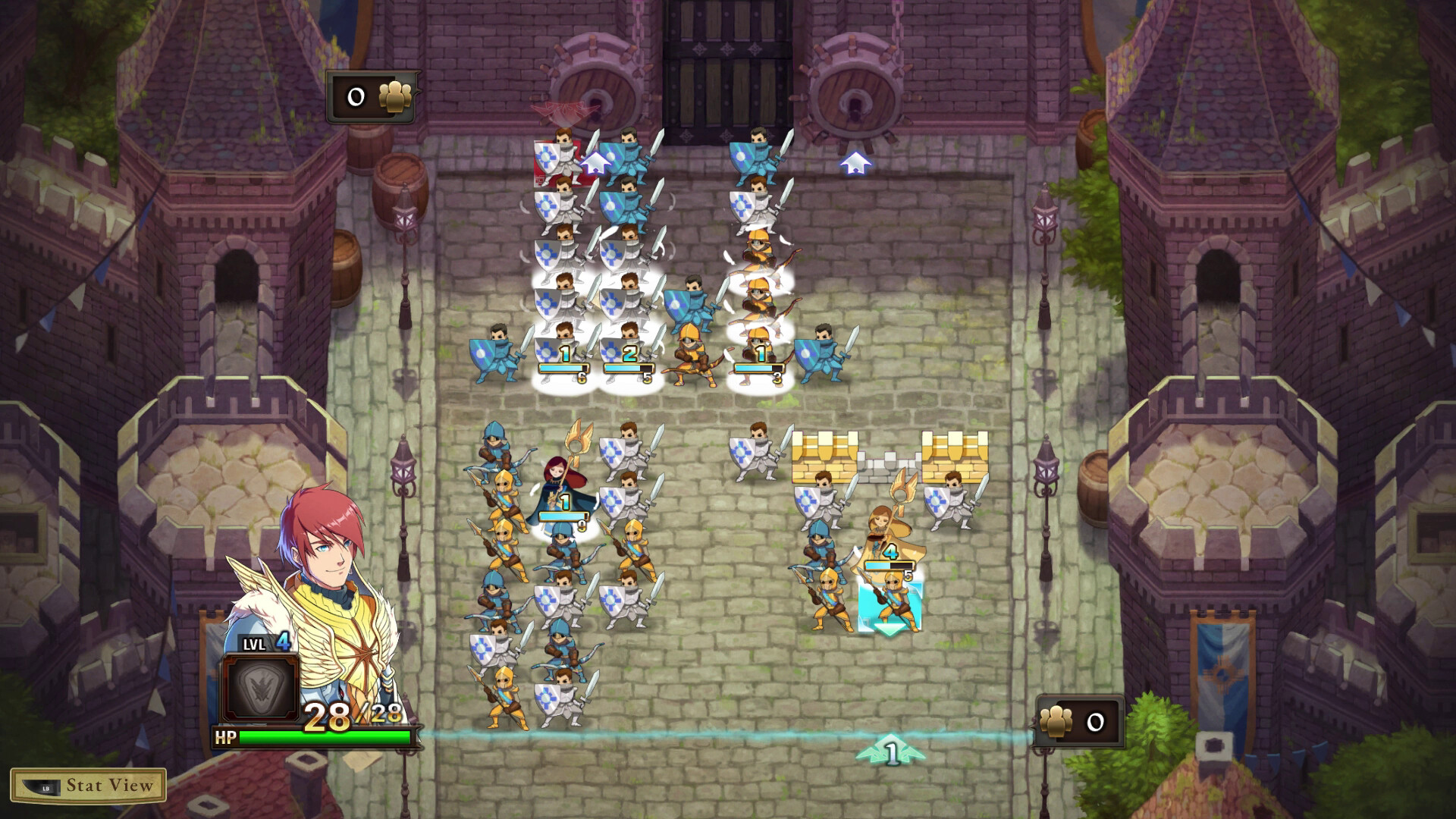
The meat and potatoes here is in the actual gameplay. Match-three doesn’t sound like much initially, but there’s a significant amount of depth in how the game itself plays. Your forces occupy one half of the screen, your opponent is on the other. There are regular units that can be matched three in a row horizontally, which creates a wall at the front of your army. Vertical columns of three creates an attack that launches towards your opponent’s side of the screen. Attacks might hit walls and fizzle out, or strike less resilient units who haven’t formed walls / attacks yet – or they might pass all of the way through and strike the opposing general, chipping away at their hit points.

This as the core foundation of gameplay receives a lot of wrinkles that make it even more engrossing. There are special units like dragons and spellcasters that can do massive amounts of damage, but are expensive to purchase and often require more matches and longer waits before their attacks fire. You can drop four green archers behind a green dragon and unleash a very powerful two column attack… but doing this could take five or six rounds to complete. In that time, your opponent might go with a weaker but faster couple of units who kill your dragon if it’s not properly protected. On top of that there are spells, equipment items and levels that can be acquired that raise character stats and attempt to tilt the balance in your favor.

There is a lot of creativity (and challenge) baked into other aspects of the game. What I described is the typical fight. But there’s often stages where you win by completing a specific objective, such as hitting the two soldiers moving back and forth with a massive saw as they attempt to cut a tree down. You need to hit them to win, not the empty space behind them to weaken a general. Boss fights are challenging – sometimes even frustrating. They have massive attacks and often move around on the screen, forcing you to change your presumptions and often forcing you to pivot from your usual tactics.

This single player campaign is pretty meaty to begin with, but there are several cool multiplayer options available for those who want to try their hand at taking on another sentient player with an even playing field. This is nice as the original game’s online modes have been disabled for some time now. Admittedly, some of these are more fun than others in my mind (I am not a fan of the 2 vs 2 mode). Another nicety (as the ‘Definitive Edition’ denotes), all of the earlier DLC is included here as well.

The RPG elements in Might & Magic: Clash of Heroes - Definitive Edition are not incredibly deep, but there are enough progression elements to keep things interesting, even if the story itself doesn’t do a whole lot of the heavy lifting on that front. The deep, strategic puzzle gameplay is the real star of the show, and despite some rough moments where the difficulty spiked suddenly, I greatly enjoyed experiencing this title all over again.

Score: 8 / 10

Share:

Our Favorite Games Through the Years - Part 7 - Gaming Thoughts

Estimated Reading Time: 13 minutes

We started this series with some games dating back to the 80’s and are finally nearing the latest generation of consoles and games. Those of us contributing to this series of articles tend to lean heavily into the RPG genre, but it was fascinating for us to see how our favorites did shift over the years into different genres of games as well.

Pierre-Yves:

PC 2010s: Divinity Original Sin 2

Where to start?

Taking the concept of Dungeons & Dragons and making it their own, the concept of a protagonist to make your own was twofold. Did you

A) Make your own character from scratch and go on an epic adventure with your cohorts. Or

B) Did you choose a premade character with their own unique quirks and dialog options based on their personal history that could surprise you in unexpected ways?

Fight your way though, talk your way through, or use the environments to knock your foes out, strategy on the battlefield or your own words was the name of the game of this epic RPG that is simply super easy to keep returning to either solo or with a friend.

Wii U: The Legend of Zelda: Hyrule Warriors

And yes, here is the confirmation of both there being a theme, The Legend of Zelda, and, that the timelines do in fact exist, and Hyrule Warriors played upon this brilliantly. Taking the Dynasty Warriors format, Hyrule Warriors was a completely original story that sees the Kingdom of Hyrule come under attack and its people band together in different ways. Meshing in Twilight Princess, Skyward Sword and unique new characters to the series, it was brilliant. Best part? Hyrule Warriors could be broken into three parts. The Heroes, The Villains, The Conclusion. You get to play as the bad guys in the heroes’ darkest hour. It was awesome.

PlayStation 4: Dragon Quest XI: Echoes of an Elusive Age

I was late to Dragon Quest. Enix titles weren’t exactly common around here and those that were released were NICHE like Valkyrie Profile. That is however until Dragon Quest VIII: Journey of the Cursed King which had a demo disk to try out Final Fantasy XII. So I rented it, yes, we still had Blockbusters and the equivalents back then, and I figured since I had it for the weekend anyways, I would play it.

Mind. Blown.

WHERE HAD THIS JRPG SERIES BEEN ALL MY LIFE. And then I remembered seeing Dragon Quest VII on a shelf but couldn’t afford it but that was probably for the best as I really… REALLY… do not like that game. I’ve since played 1-9 and 11 since 10 is an MMO that was never localized for us.

Moving to Dragon Quest XI itself however, wow. It has that Dragon Quest magic, it has amazing music, stellar visuals, great combat and that’s even before the revamp, AND, it’s two games. Not that there’s the PS4 version and the 3DS version that we would get access to in the “S” version, but there’s the core game, 40+ hours, and then there’s the post-game which is a what if “X” happened instead at a certain point in time. Wow… just wow.

PlayStation Vita: Persona 4: Golden

Atlus not only made a masterpiece with Shin Megami Tensei: Persona 4, they made it even better with Persona 4: Golden. Persona 3 and Persona 3: FES on the PS2 would stay niche enough even after Persona 3 Portable on the PSP until about “now” where it’s been released on the PSN, Xbox Marketplace / Game Pass and Steam, but Persona 4? Sold like hot cakes in North America. It brought this series the attention that it had never had and only continued the upwards trend with Persona 5 which ditches the Shin Megami Tensei label.

Murder mystery. Mysterious other realm known as the midnight channel that you have to dive through a TV to get to. Hardcore JRPG system that if you’re not careful you can easily game over and lose a lot of progress. And a stellar voice cast to go with the writing, as much as I loved Persona 5: Royal, the Persona 5 revamp, Persona 4 is still my favorite in the series.

Xbox One: Gears of War 4

At this point I’m kind of running out of ideas and it’s not just because this is my second last entry, but it’s because I had an Xbox to play very specific Xbox games. Otherwise? I had a PC or my PlayStation. That said, Gears of War 4 managed to move the series forward in a new direction without it being forced and Gears of War 5 kept up that momentum making me wonder just when we are going to get Gears of War 6.

The cover shooter that really started the style modernized some aspects and made the whole thing much more approachable. They let new fans dive right in without really having to know what happened prior if they didn’t want to have to go through it all. I would suggest that they do, but they don’t have to in order to enjoy the ride.

Richard:

Wii U: Hyrule Warriors

This spot goes to another title because I loved playing it with my friend. Same friend from the N64 section and one who'll appear again in this list. The winner for the Wii U section of my favorite game is: Hyrule Warriors. Yup, the Zelda themed Dynasty Warriors. I've always like Dynasty Warriors and Zelda, and so has my buddy. Combine the two with the expansive bonus maps you can play, and it was really fun. Yeah, the game isn't exactly for everyone, and the story is a little cobbled together, but we aren't here for quality, remember? Hyrule Warriors was a great coop opportunity, and because I had so much fun playing with my friends, that's why this is my top Wii U pick.

PlayStation 4: Iconoclasts

This one gave me a lot of issue for a while. In all honesty, there were a lot of games on the PS4 I enjoyed, but none really felt right to say they were my favorite for the PS4. For a while I was waffling between either The Witness or Gravity Rush Remastered, both amazing and unique games. Then I remembered Iconoclasts. Oh boy, how could I forget Iconoclasts. For a while I was feeling a little let down by the Metroidvania titles at the time, as none of them really scratched that itch I wanted scratched. Then I discovered Iconoclasts. This rekindled my spirit and hope for Metroidvanias. The gameplay and soundtrack were great, and I loved every second of it. While Ender Lillies, which is a Soulsborne and Metroidvania sort of hybrid was also really great, I just feel like Iconoclasts I enjoyed the MOST personally.

Nintendo 3DS: Stella Glow

This was a rough tossup between the turn-based strategy of Stella Glow and the turn-based battles of 7th Dragon III: Code VFD. Both titles are really good, with a solid battle system, a super amazing soundtrack that just blew me away, as well as very enjoyable and entertaining. Barely eking in a win here though is Stella Glow. While Code VFD was also good, I just felt a little more invested in Stella Glow. They aren't very comparable, since they're different genres, so I advise you to play them both, but for those who lean towards the turn-based strategy/tactics style on a grid-based battlefield? Stella Glow was definitely a really big hit for me.

PlayStation Vita: Criminal Girls

Here we go to wrap it up, it's actually a title that fellow reviewer P.Y. made as a joke. Yeah, if you're reading this, first of all: how dare you. Second: ...you're right. My favorite title on the Vita? Well, there were a few really good options, but in the end I was left with one very specific choice: Criminal Girls. Now, before you go googling that in public, please don't. It's not the...worst title I could've put on here, but it's certainly up there. Playing like a more traditional RPG in a sense, you are tasked with taking a group of prisoners, all teenage girls because why not, through Hell as a form of "pre penance" before they end up living a life that could be considered a testament to one of the capital vices. I say this instead of the seven deadly sins as they go the more archaic route when there were more than seven of them. Criminal Girls has an interesting battle and skill system that's rather unique. In battle, you get four primary characters each give an option for you to pick from. That's right, you aren't really in charge of what your units want to do, just picking an option from what you're given. Their skill callouts are also sometimes rather vague, such as "everybody go brr". For learning new skills, you need to learn new skills by "training" the prisoners. Yeah, don't do that in public. Seriously though, I really did enjoy the game.

And that's my list of favorite games! Sure, some of them maybe be pretty poorly designed or implemented, but I love them regardless. Everyone has some of those, right?

Susan N:

PC 2010-2015: Antichamber

From 2010 to present, I had such a large list of memorable and favorite game titles that I struggled to find one or two without debating another ten titles that are also eligible. Sims Medieval (which very few people know about), Guild Wars 2, The Secret World (or Secret World Legends), Transistor, and Her Story are all games that I absolutely love for various reasons. However, out of those, a puzzle game comes out on top to be my favorite between 2010 and 2015. That game is none other than Antichamber. What makes it stand out above many puzzle games is the fact that it was successful in breaking my brain. I STILL have no idea what that timer is for. I’m not sure that I remember how to solve some of the puzzles, but for a game to completely flip the script when it came to the puzzle genre, was something that hadn’t been done in several years. It was mind melting in such a good way because it broke all conventions. Most puzzle games had clues that could be found in other places. One could logically figure out what pieces fit together, making certain games predictable. It takes a lot to create a puzzle game that challenges puzzle aficianados like myself. Among notable puzzles were ones where you couldn’t look at the ground because the floor would LITERALLY disappear if you peaked. If you had certain colored tools, you could duplicate blocks to make a stairway to previously unreached locations. It made sense eventually but not after you could feel brain matter falling from your ears (metaphorically). No other game has equated to Antichamber in that way, and I’m not sure that any game ever will.

Runner Up: Tomb Raider (2013)

In 2013, a game was famously rebooted and released. The moment I knew it released, I HAD to have it. At the time, I didn’t have the money to get it until someone graciously gifted me the 2013 Tomb Raider. Up until this point, I had played through several of the Tomb Raider games and loved them. It was a perfect blend of combat, mystery, and story in one. The game was familiar to me and I loved the movies that had released in the late 90s. I loved this game because of the nostalgia factor, the graphics, and the lore pieces you could gather. I adored the storytelling and the relationships between the characters. It was also one of the first times where a game scared me enough that my reactionary screech surprised the heck out of my roommates. I clearly recall heading to the kitchen to make some tea while muttering, “I didn’t see the second wolf” as I passed my roommates. I thought I had everything planned out, but when all you see when you turn around is a set of wolf teeth in your face, you’d likely scream in terror too. Just saying… Anyways, as a person that was solidly embedded in the TTRPG space and in the adventure and puzzle gaming space, Tomb Raider had everything I was looking for in a video game. Hence why it is a contender.

Nick:

PC – 2010s: King’s Bounty: Dark Side - After that machine, it would be several years again until I could afford another decent gaming computer. I spent most of my time playing consoles during that time – but my wife bought me a gaming rig for Christmas early that decade and I got to experience the wide world of Steam. The idea of that many games all available digitally was mind-blowing really. I could almost just plug Wow in here again – honestly I played it more than anything else in the 2010’s. But the King’s Bounty titles take the cake here. I was late to the party with The Legend (2008) and Armored Princess (2009), but Crossworlds was still a fairly recent release when I got my new machine (2010) and later Warriors of the North (2012). The music was amazing in these games (I still use them as background music when I’m in the mood to write), the tactical gameplay and progression elements were highly addicting and just in general the series had me hooked over and over again. If I had to give a nod to one, it would be Dark Side that released in 2014. Putting me in charge of the more evil minions from the get-go was a blast.

Nintendo DS / 3DS: Kid Icarus Uprising – I didn’t have a DS right out of the gates, preferring my at-home consoles on big screens most of the time. Still, my kids had them, and the more I saw them playing truly excellent games on them, the more interested I became. Especially since there were so many excellent RPG and strategy games – some of my favorite genres, that felt right at home on the handheld system. Still, when the 3DS came out, I went and bought one, and Kid Icarus Uprising was one of the first things I got for it. The 3D was absolutely mind-blowing, and the music is arguably among the best handheld ever. It was so good that my son and I continued to trade it back and forth, working through our play files until we beat it within a day of one another. There were probably other games (like Fire Emblem) that I spent more time with on the platform, but Kid Icarus made me look at what handheld gaming could do differently.

Sony PlayStation Vita: Persona 4 Golden – Like the Dreamcast, I always felt like the Vita was a fantastic piece of hardware that never quite got the love I felt it should have. There were plenty of games that I enjoyed on it, but none more so that Persona 4 Golden. I had a bit of a weird gap with the Persona series. I played the original when it released on PlayStation and loved it, then missed the entries until playing 4 on the Vita. After thoroughly enjoying it here, I rectified that mistake and played the other entries I missed – but Persona 4 Golden was still my favorite out of all of them.

Nintendo Wii U: Super Mario Maker – Okay, one could argue this isn’t a game in the traditional sense. But man – our family had a ton of fun with this. We used our small army of Amiibos to unlock lots of things, and we spent dozens (if not hundreds) of hours collectively making stages and challenging one another to beat them. The Wii U had an odd controller that never really helped with its adoption, but it worked really, really well for this title in particular.

Sony PlayStation 4: Spider-Man – So. Many. Options. However, Spider-Man was one of those games I was a bit late getting to, but once I started to play it? I couldn’t put it down, on my way to a platinum as well as fully completing all of the DLC as well. The story tickled my comic book-loving side, and the sensation of movement throughout the city with Spidey resonated with me in a way few open-world games do. There were some flaws to be had here, some missions that I didn’t care for, but in the end? I absolutely loved my time as the web-slinger.

Sony PlayStation VR: Star Wars Pinball VR – Does the PSVR count as a different gaming platform? Eh, that’s for me to decide when I sort these articles out. But let me just say that my time spent with Zen Studios’ Star Wars Pinball VR is one of my favorite reasons to pull out the bulky headset and lose myself in the immersive sights and sounds of the game.

Microsoft Xbox One: Halo: Master Chief Collection – It feels a bit like cheating to list this here, as it’s really a compilation of lots of different games. That being said, I was never the biggest Halo player back in the day, and this offered me a great way to catch some of the titles I had originally missed or not given enough time to. Now, this game got off to a notoriously rocky start with its online problems, but the state it wound up in? Absolutely fantastic.

Article by RobertPierre-YvesRichard, Susan N., and Nick

Share:

Labyrinth of Galleria: The Moon Society

Labyrinth of Galleria: The Moon Society by developer Nippon Ichi Software and publisher NIS America Inc.PlayStation 4 review written by Richard with a copy provided by the publisher.

Estimated reading time: 10  minutes


Well folks, it's time to take a look at another dungeon crawler! A genre that usually tends to be either really good or really underwhelming. Today we have Labyrinth of Galleria: The Moon Society. A spiritual sequel to Labyrinth of Refrain: Coven of Dusk, let's see how well this title stacks up.

Labyrinth of Galleria tells the tale of a sprawling labyrinth hiding beneath Galleria manor. Within its walls are hidden precious Curios: items that are cursed and have mysterious powers. As a young girl Eureka comes to take up a hired help position at the manor. She is entered into the service of a witch hired by the baron who owns the manor. Eureka's task is to act as a medium to a soul planted within a magical lantern. You, who technically take on the role of the soul, are tasked with taking puppet soldiers into the labyrinth in order to combat the fierce creatures within and to recover the relics.

Now, if you've played Labyrinth of Refrain, then you've already got a good idea of what's in store for you. If not, have no fear, we'll be going over things. Briefly though, as there's actually quite a lot involved in these titles. Good news for you dungeon crawler aficionados! Encounters in the labyrinth are not random! Enemy icons appear on the map and you walk into them in order to start a fight. Walking into them from the side or back will generally result in a battle start in your favour. First up, let's take a look at how you go about exploring the labyrinth.


Your basic exploration is pretty standard fare. You have an empty map that fills itself in as you explore, each tile you walk over adds the info of that tile to the map. Sometimes these tiles may be hazards, such as damaging tiles, pitfalls that drop you floors, or perhaps cursed mud that damages you while you're inside it. Your goal here is, ultimately, to discover the 7 major Curios d'Arte hidden within the labyrinth. These are placed in very special looking chests that you can discover. There are also a myriad of other curios as well. Let's not forget the normal chests and items that you can discover while roaming the labyrinth. 

Now obviously, if all the labyrinth had to offer was just pathways, it wouldn't be all that interesting. Well, as you progress through the game, you can unlock more and more movement techniques. This will let you get into other areas, or past hazards that you weren't able to get by previously. Pro tip, if you see some spikes/lances, you do get a move to get past them later, so make a note of where those are. Apart from movement, you also can break down dungeon walls. Yup, that's right, you can break the dungeon. While most walls get repaired upon returning to the labyrinth, certain walls don't, allowing for quicker access to areas. You can also unlock other abilities, like a fog wall that prevents enemy icons from spotting you, although you still can get into combat, or the ability to stockpile exp.

Most active abilities will require you to use reinforcement points. These points start at a default of 100, and will reduce each time you use an active ability. Reinforcement points can be recovered by earning mana in the labyrinth. Either touching a glowing green orb or wall will give you mana, as well as replenish reinforcement points at a certain rate. Be careful though, as each floor of the labyrinth has a mana limit. Exceed this, and some of the enemies get...well, scary. If any of you are coming from Refrain, I'm sure you have minor PTSD from the reapers. Or blowing up your first wall and getting demolished by the enemy behind it. Yeah, 25 hours later and they're some of the stronger enemies you can come across. Either way, collecting mana, as well as pretty much any item you see, is still really useful. When you return to base, you also get bonus exp. Once you unlock it, I do suggest playing with stockpiling exp, as it can be very useful.


So, how are you going to deal with the baddies infesting the labyrinth? Well, that's where the handy puppet soldiers come into play! You can create units with a combination of a soul and some puppet parts. You get to choose a class, nature, stance, lucky number, name, starting skill, as well as growth type. Fun fact: everything I listed actually affects something about your unit. Well, at least in Refrain it did, and it's implied it does so in Galleria as well. Yup, even the name. I won't go into the specifics, otherwise this will turn into a four hour lecture on just the basics, but feel free to play around with what you want from your puppets. If you really want, you can always check out a beginner's guide to unit creation for Refrain, provided one isn't available for Galleria when you're reading this. It'll go more in depth.

So, let's say you've created your unit and decided upon what you want of them. It's now time to put them in a coven! How Galleria works is that all your units get placed in covens, of which you can have five covens in your squad. Each coven has different passive effects and exp acquisition rates, so pay attention when assigning, or reassigning, your units. For example, there is a coven type that has one frontline position and multiple support positions, with a 120% exp rate for the front liners, but it can only be used by theatrical star units. These types of covens are pretty plentiful, especially once you get later into the game, so you will want to take a look at new covens you acquire. 

This brings us to another facet of the coven: Donum. This is basically just palette swapped mana/spells, but essentially any spells you can use are predominantly tied to the coven, rather than the units themselves. Some Donum require certain slots in the coven to be filled, while others may just be in-battle usage restrictions. Important to note however, is that coven actually may require reinforcement points to use. Covens earn exp and will level up based on number of battles mostly, and their cost will reduce as they level, as well as possibly opening up more Donum slots, which you can learn through manuals you can collect. 


Alrighty, now that you have your squad ready to go, it's time to take on the labyrinth! What better way to get used to this than to fight an enemy! Or group of enemies, maybe. Walk into an enemy icon, or interact with certain event markers, and you get into a fight. So, there's a lot going on, and I swear it gets easier the more time goes on, so bear with me for a bit. So to start with, you've got a turn based battle system, with higher AGI characters moving sooner. At the start of every "round", you will give directions to your units, adjust whether they are in the vanguard or rearguard, as well as spend reinforcement points as needed. Commands for the units are fairly straightforward, as you can attack, fortify (guard), use Donum, or attempt to flee. Adjusting whether your units are in the front or back is important because every weapon has a certain range value that needs to be met to use efficiently. If you're outside the range, your damage output decreases. Also, certain combinations of vanguard and rearguard coven positions will activate formation bonuses, so make sure to shuffle your covens to get the maximum effectiveness out of them!

While it's still on your turn, you can use reinforcement points for different bonuses. These are unlocked through witch petitions mostly, which I'll talk about a bit later, but are explained to you when you acquire them in-game as well. As an example, you can spend 1 reinforcement point to increase attack of a unit in a coven for the turn, up to three times. Using items is also considered a "special move" and needs reinforcement points to function. Once you've set out all your commands, it's time to begin battle. Now, how enemies and your units react to battle situations are rather similar, so I'll be lumping them together. All units have varying degrees of resistance and damage types. Some attacks might be more effective against certain enemies. As you attack enemies, you also build up a "secret art" gauge. When full you can unleash it. This is based on coven, so if you don't like it, consider changing covens. Different status effects can be applied to both your allies and enemies, of which there is an in-game tutorial on how they work.

One of the more unique aspects of Refrain and Galleria, and the bane of my existence in Refrain, is "Critical Gore". Basically, as puppets, your units aren't as attached to their limbs as you'd think. Enemies, and allies, have a chance at hitting a critical gore, meaning the character or unit hit loses that body part. This comes with a massive amount of damage, an decrease in stats and max health, and the inability to use any equipment associated with that limb. For your own units, you must then repair the puppet either with a specific item, or by returning from the labyrinth and repairing them at the workbench. Be warned though, as losing the head means your unit is just plain out of commission until repaired. The last thing I think I should mention here is that all units have a stun gauge. Attacks will drain this, and once emptied, the character will be stunned for that turn, but recover at the start of the next round.


Alright, that covers most of the primary gameplay aspects, so let's talk about a few things you can do outside of exploration. First up, and I can't stress this enough, CHECK THE TUTORIALS SECTION. This will be periodically updated with sometimes very important info with little to no indication. Seriously, just check it every so often. Additionally, there are messages written on the walls of the labyrinth. Most of the time, these are helpful tutorials or hints, so you may want to read them. When you return from your expeditions, there are a number of facilities at your disposal. You can take on requests by delivering loot items for rewards, check out the alchemy cauldron to enhance gear or release sealed equipment. Additionally, you can spend some of that mana you've brought back in order to petition the resident witch to unlock something new for you.

Now, if any of you have been paying attention to the release info, or the pictures in this review, it may come as no surprise when I say this is a NIS title. What this means is that you can expect a pretty engaging story, anime stylized visuals for character portraits and cut-scenes, as well as a lengthy grind and occasionally bull*#$t enemies. Also some really dark themes tossed around like they're popcorn and a really bangin sound track.

My only real complaints about Galleria are: sometimes navigating menus can be really annoying to find what you're looking for, and the fact that you can be brutally punished for having poor luck, both in-game and as a player. The amount of times I've been doing well then been screwed over by a few really unfortunate gore attacks... blegh. That being said, despite how much Galleria, and Refrain by extension, frustrated me to no end, I absolutely love them. If you're a dungeon crawler fan, you'll definitely enjoy Labyrinth of Galleria. 


Summary

Overall, Labyrinth of Galleria: The Moon Society, is a great addition to any dungeon crawler lover's library. With a surprisingly in-depth system for those looking for it, an interesting view on labyrinth exploration, and engaging characters and story, it's a gripping tale all through. While it may be a little much for newcomers to the genre, it's still a lot of fun. No need to know the previous title also means you can jump right on in.


Score: 8 / 10


Share:

Neptunia: Sisters VS Sisters - PS4 Review

Neptunia: Sisters VS Sisters by developer Idea Factory and Compile Heart and publisher Idea Factory InternationalPS4 review written by Richard with a copy provided by the publisher.

Estimated reading time: 9 minutes


It's that time again where we explore the next title from our friends at Compile Heart and Idea Factory, the next Neptunia game! This time getting a starring role is Nepgear in Neptunia: Sisters VS Sisters.

In Neptunia: Sisters VS Sisters we get to see Nepgear make a return as the protagonist! For those new to the series in general, think of the in-universe world as a sort of personification of the video game, and tech industry. Set in the land of Gamindustri, the world is ruled by four goddesses, each of which are the representatives of a specific company. As the goddesses leave to go investigate issues occurring on the PC continent, the Godesses' little sisters, the Goddess Candidates, are left to take care of things in their absence. No sooner are they left in charge, they get a notification that monsters have appeared nearby Nepgear's home country of Planeptune. So off she and the other candidates go to investigate and get rid of the monsters. Needless to say, everything isn't exactly going to go the ideal route.

Neptunia: Sisters VS Sisters takes a good balance between old and new mechanics for this latest installment in the franchise. Those who have played other titles in the main series line will probably be fairly familiar with how things work, but let's see if we can't break things down a little for the newcomers. The Neptunia titles, including Sisters VS Sisters, function pretty similar. You have a general world map with locations of interest you can select. Some of these may be dungeons, some may be events. When selecting an event, or running into one in a dungeon, you get a Live2D cutscene with the anime stylized characters. When not on the world map or in a cutscene, you get a 3D roaming adventure through a number of locales, where you can smack boxes for items, interact with glowing cubes for treasure, jump around obstacles, or get into fights with enemies.


Combat has taken a bit of an interesting route this time around. Instead of the turn-based system that used to exist before, we now have a...well, mostly active system. Battles are fought with up to three characters in combat at once. While in combat, you have a circular area that you can walk around in. You have a set amount of AP, Action Points, and using different moves in your combo string costs a different amount of AP. Combos can be set up beforehand, and running out of AP means you either need to swap to another character, or wait until the AP regenerates passively. It's highly suggested you swap though, as swapping after you've used a few moves starts a "Chain" which increases your damage. In addition to your combo moves, you also have a Tec gauge which builds up over time while in battle. Once it is full you can use a skill or item. Tec gauges and AP are individual per character, so when you run out you can swap to another character to either continue the combo or use items or skills as needed.

Now, what game with action-style battle mechanics wouldn't be complete without a guard or dodge? Both of these are available for you, and are done in a similar state. Guarding will reduce the damage you take, but your guard can break if it sustains too much damage. Dodging will let you get out of the way, but there's a brief delay before you can dodge again, so make sure you aren't just opening yourself up. Something important to note is that all of your attacks require a lot of commitment. You use an 8 hit slow attack? You're stuck in it. Often times some of the tougher fights, or bosses, become a balance of when to attack, when to block wider hitting moves, and when to dash away, or towards, the enemy. To be honest, when I first started playing, combat felt really...thick, I suppose you could say. After I stopped trying to play an Ys or DMC title through a Neptunia game, I warmed up to it a lot more.

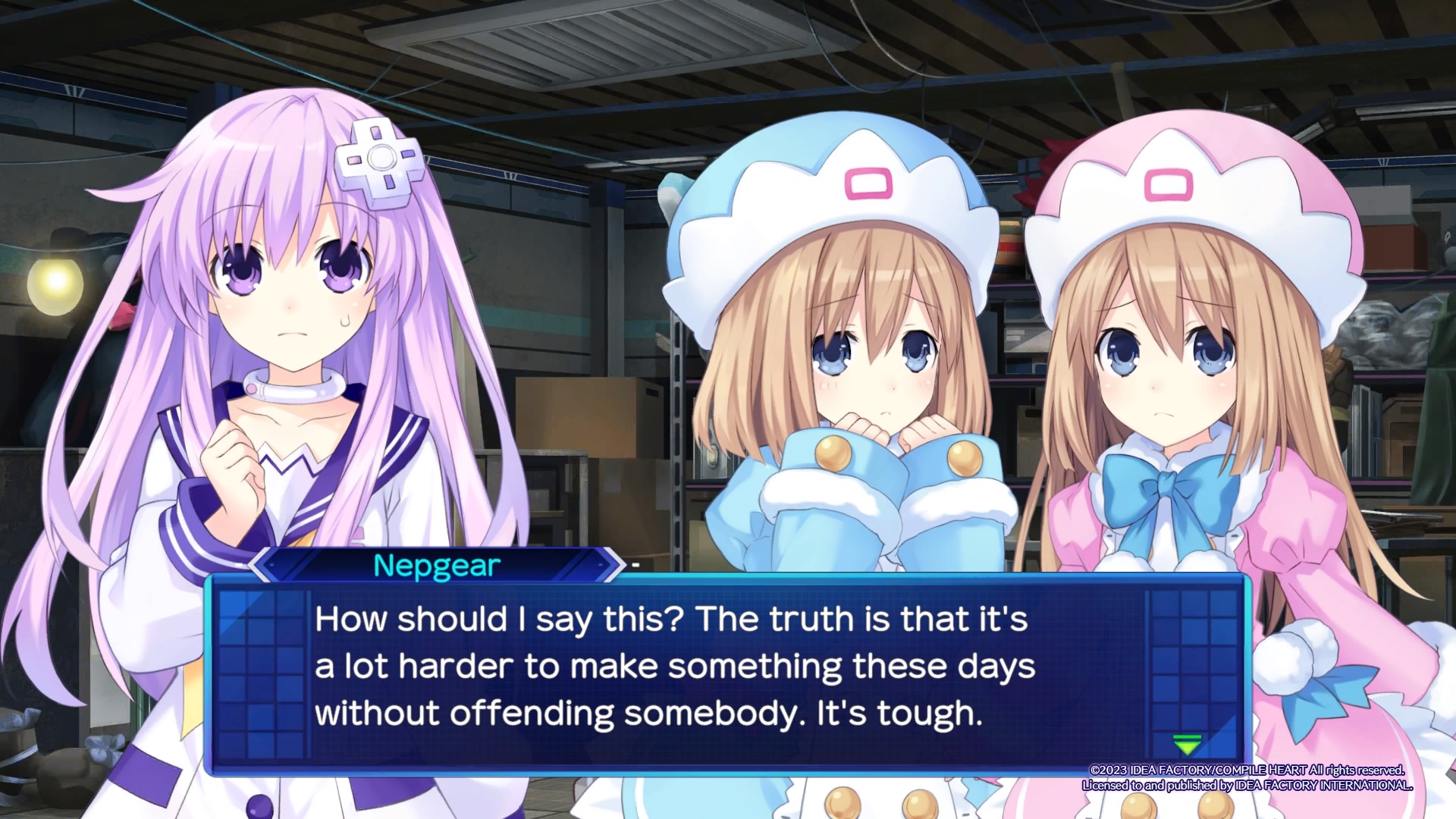
By and large, Sisters VS Sisters is predominantly a title for those already familiar with how things work and the characters involved. A lot of dialogue relies on the player being at least somewhat aware of who the characters are and some of the events from past games, although usually nothing so in-depth that you feel completely out of it. The Neptunia series, regardless of whether the title is a spin-off or not, has always had its writing grounded in a place that's a sort of running commentary on the current video game market and how companies are doing and what is going on at the time. Needless to say, the last few years have been...well, not particularly stellar, so there's a lot to work with. 


From outbreaks, to the rise of mobile and phone gaming, gacha games, lack of available parts for certain systems, as well as the release of mini-consoles that are essentially a nostalgia pitch, Sisters VS Sisters has some commentary for pretty much all of it. That being said, while Sisters VS Sisters is a little more "grim reality" compared to other titles, it doesn't really play itself too seriously the whole time. You can still expect the gags you've come to know and love from the series, just perhaps in a different form.

Another point to take note of is that there are a lot of reused assets from other titles. This isn't really a bad thing, as many of the models and Live2D models seem to be updated, but those familiar with the series will quickly notice textures, dungeon themes, enemies, and music from previous titles. Good news, it looks good and is well implemented. Reusing assets also allows the devs to focus more on other areas, such as the writing and gameplay design. There are a lot of interesting interactions and gameplay does feel pretty smooth, although there are some lapses in certain areas. For example, when exploring an area, you can now usually interact with ladders to create short-cuts to different areas. Climbing said ladders is pretty slow, but setting them up felt pretty novel for the series. Additionally, there are many doors you need to find switches for, which is a bit of a divergence from how the dungeons standardly used to work.

This being said, there are definitely issues with the title. There's a little lag here and there, and often you may have a long portion of dialogue events with no action, although they are fairly far between and the dialogue doesn't usually get too lengthy. The devs have made the choice to split large chunks of dialogue into smaller events, so you can go do some dungeoneering to complete requests in-between to keep a good pace. Also to note is that anytime fog or mist type effects happen during dialogue, there tends to be some lag. Otherwise, I found the title to run quite smoothly. The other major issue you may run into is how..same-y the dungeons can be. For the most part they tend to be varied enough, but fair warning, if you decide to run through the bonus dungeon, expect to be pretty much just done with the dungeon crawling aspect.


Some of the more positive aspects revolve around the little things. For instance, event points are clearly indicated on the mini-map, with lines clearly showing when the event will activate as soon as you touch the indicated yellow area. As a long time gamer, I love seeing this, because it means I can know exactly what I can get away with. Also, I'm pleased to announce that you now get Quest indicators over any dungeons where you can meet the requirements for completing a request. These requests can be picked up from Chirper periodically, which is "totally not blue bird related". Back once again is the ability to customize your characters' appearances with accessories. There's an awful lot, and you can dress up your characters basically however you want with the items you can collect.

There's a few more game mechanics that I feel should be included as well. Let's start with the longer running mechanic: Combo Maker. Essentially, as you level up you get new moves. These moves are different types, such as power (hard hitting), rush (faster and more hitting), or break (more stagger gauge damage). The skills can be assigned how you wish and you can put multiple in a line. You can build up a combo of up to 4 specialized skills, and depending on where in the order the move is, it may receive a power up from being after the skill before it. 

The other mechanic is Disc creation. From battle you get DC, or Disc Coins. These can be spent in order to create equipable discs, which are usually a sort of reference to an existing game of sorts. When creating a Disc, you can select a genre, a developer if you want, and an item if you want in order to create a Disc. These Discs will have different effects, such as increased exp or item drop rate. It's an interesting mechanic where you can put up to four in development at once, and then they take a certain amount of in-game time to complete. You can equip up to four Discs, so it is worth your time.


Summary

Overall, I have to say I really enjoyed Neptunia: Sisters VS Sisters. It feels like a good return to the main series while still trying to change things up enough that it doesn't feel like the older titles, while still keeping what made the previous titles fun. While the dungeon crawling can get a little repetitive, and it is fairly easy to exploit certain mechanics at times, Sisters VS Sisters tends to limit dungeon length, or segment it, in such a way that it usually doesn't become too much. The battle system took me a while to get used to, but once I did I thoroughly enjoyed. If you're new to the series, it may be a little tough to get into, but is still fun. If you're a fan of the series though, I'm certain you'll have a Neptastic time!

Score: 8 / 10
Share:

Adventure Academia: The Fractured Continent

Adventure Academia: The Fractured Continent by developer Acquire and publisher PQube—Sony PlayStation 4 review written by Richard with a copy provided by the publisher.


Adventure Academia: The Fractured Continent is an interesting active strategy RPG set in the world from Class of Heroes. Taking cues from both traditional turn based strategy games while implementing them in a more real-time fashion. Will this be enough for you to unite the continent of Pedra, or will the system be as fractured as the continent? It's time to find out.

Adventure Academia follows the story of Alex, a young boy who is the son of the principal of the local school, who's dad has disappeared on an adventure. One day he inherits the Ruler Orb, a sort of staff that allows him to command units as if he were playing a board game. Unfortunately, the previous owner was his father, which means something bad has happened to him! Hence Alex sets off with his childhood friend Citrin and the shut-in researcher who is supposed to be his advisor Lazuli in order to figure out what happened to his father. Unfortunately for everyone involved, strange things are happening on the continent, and it's up to you to solve the mysteries.

Adventure Academia has a pretty unique system in place, one that I found rather enjoyable for the most part. Or at least fresh enough to keep me entertained. The game story is told in pre and post battle snippets and interactions that will happen everytime you choose a stage. Beating a stage unlocks the next subsequent one. A pretty simple setup, with only a few side missions here and there. Note however that the story will play every time you do a stage, not just the first time. Either way, once you begin a stage, you will usually be given the task of "Destroy the target", which is generally a crystal or specific unit, but there are a few bosses.

In combat you have a square grid-based map, with the only default unit being Alex. If you've played any grid-based tactics games, then you will probably realize rather fast that Alex acts as a sort of mobile base camp. Alex can summon units from his party roster of 6 companions to drop onto the field, although not all at once to start.

See, Alex can only drop two units to start, but can be "ranked up" in order to drop more. Alex will generate MP, which is a bit of a global resource for Adventure Academia, where you can use MP to increase your rank when you build up enough, or to cast spells or special actions with. When you rank up a unit, they will get an increase in stats. For Alex, this will increase his maximum MP value, MP generation rate, and number of units that can be set. At Rank 5 you will max out. Other units Rank up similarly, and will gain access to their special skill at Rank 1, which is 5 MP as the baseline.

Something interesting to note is that Alex himself cannot attack. He can move around, be attacked, and use a special buff/healing skill, but otherwise doesn't offer much. What he can do is move and command units. While on a battle map, any time you set a location for Alex to travel to, or pick up/set down a unit, the game will "pause" while you are making a decision. Once the units are down and your location determined, your units will follow Alex along towards his goal, attacking any enemies that come within range on their own. If you have enough MP, you can also get your units to use their specialty skills. Be careful though, as if you take too long or if Alex dies, you lose the stage.

Thankfully, death is not the end. Well, not really. For Alex, it means restarting the stage. For any other unit however, they will simply be unavailable for a period of time and probably lose one Rank, but then you can throw them right back into the action again. In my experience, the time factor isn't much of a concern on story stages, and is only remotely worrying on some of the side quest stages, even if you spend the first few minutes just ranking up Alex and your units. Thankfully the developer included a "speed up time" button, which speeds up the clock, but also hastens all units. You can toggle this on or off at will. This is really handy if you're looking for treasure chests in stages as well, as it lets you zoom around the stage without it being too much of a slog.

As you move around the map, you can grab units from anywhere on the field, but can only place them within a set range from Alex by pinching them and moving them around. This allows for some interesting strategy, as you can wander into an area after setting your units on a group of enemies, then have them moved over to you, or you can box in an enemy with some of your units. Definitely a neat idea. Well, as long as the AI is functioning. See, you don't actually give your units any instructions. You just plop them down and expect them to do what they need to.

While generally this works fine, I did have a few issues with some of my units. For whatever reason, one of my front line units always headed straight behind Alex, away from the action. Not exactly useful in his role, unless I literally dropped him almost right next to the enemies. Another back line unit never engaged unless I forced them too. On the opposite end of the spectrum, my Diabolos unit, a mage-like type, always ran headfirst into the combat. While that...worked sort of, they are a little less healthy than the frontline units, so that could be a little annoying.
So, let's talk about the units you can summon. Each unit has a species, gender, and character traits, as well as unique classes to that species. All units start out as freshman, but will eventually be able to change classes to higher rated options. For example, a human can go through Freshman > Swordsman > Samurai > Sovereign in order of unlocking. Each class has a different unique ability, as well as unit abilities that apply to that unit regardless of current class once unlocked. Unit abilities, and the first time changing to a new class, requires SP which you can earn from clearing stages. You will also earn exp for your units other than Alex, money, and equipment from clearing stages.

Equipment is rather interesting in Adventure Academia. You basically have four stats on your battle units: health, power, action speed, and movement speed. Equipment can either be bought at the store, or found in stages either by clearing them or by opening chests. Equipment earned in a stage has a chance to have an added ability to it, such as a Power boost, that has multiple possible tiers to it. Good luck getting any specifics though, as the "info" about the skill can be very vague.

For instance, the GRD. Power+ skill says "Tier1 GRD PWR boost". Super useful that. If you didn't know what GRD (guard, I think) is, well too bad I guess? The abilities attached to equipment is interesting though, as it means you may favor a lower ranking piece over a higher ranking piece if the skill is good enough. Keep in mind that the units also have levels, and leveling up will also increase your stats.

If you think you've got a nice reserve of cash floating around, you can also head on over to the Lab, where you can enhance equipment up to +9 by shelling out some cash. This only upgrades whatever the basic equipment stat is though, so if you're upgrading a weapon you get Power, not Health for example, regardless of attached skill. By the way, you better remember this stuff either now, or if you play the game when it tells you, because there isn't anywhere you can check the instructions out again. Seriously.

So, let's mention two more gameplay elements before we move into the visual/audio aspects. First up, stages may have hidden switches. These hidden switches become noticeable either by looking at different coloured tiles on the map, or when Alex comes within one panel range of them. The game says you activate them by stepping on them, but what it means is by dropping a unit on them. It's actually a pretty interesting mechanic for exploring and expanding maps.

The second thing I need to mention is the difficulty curve. Or more like, difficulty EKG. You'll notice that each stage has a level suggestion, where bosses and "academy fight" stages have a big jump, and then the difficulty goes back down again. Even when the level suggestion starts going up after these fights, the normal stages still feel a lot easier. When some of the bosses can 2-hit Alex and constantly target him? It's an absolute pain.

On the plus side, the artstyle is rather cute. While the story mode is done in a standard "storyboard JRPG anime cutout" style, in battle you have a more board game like style to the art, where all the units are symbolized with little cardboard drawings on little plastic stands. It really does make it feel really boardgame like. The soundtrack is pretty decent as well, although none of the tracks really make me want to take the game seriously. Coupled with the rather corny and not overly interesting storyline though, this actually makes it seem a lot better, so a positive there.


As a bit of a wrap-up, I would like to mention how incredibly short the game is. Seriously though, there aren't a lot of main stages, and there are few bonus stages. Each stage will take probably somewhere between 3 to 10 minutes to beat, so you aren't looking at anything too lengthy, even if you take time out to over level your units. On the positive side, this means the game doesn't really overstay its welcome. Yeah, it does give some frustration that it really shouldn't.

Summary


Overall, Adventure Academia: The Fractured Continent is a bit of a fractured game itself. With a storyline that isn't particularly gripping, a lack of main content, some frustrating game design choices, and vague instructions and descriptions of how things work at some points, I doubt this title is making any headlines.

That being said, I did actually rather enjoy my time with it. Yes, it definitely could've been a lot better, but it also isn't the worst thing I've ever seen. If you want a fresh take on the turn based tactics, maybe you'll also get some enjoyment here.

Score: 6.5 / 10


Share:

Phantom Breaker: Omnia Spicy Edition is Now Available on All Platforms


Los Angeles, Calif. – July 28, 2022 – Publisher Rocket Panda Games has turned up the heat this summer with the release of Phantom Breaker: Omnia Spicy Edition! This FREE update is available on all platforms, features two levels of spicy play-by-play by THE ANNOUNCER (as featured in Phantom Breaker: Omnia’s Release Date Trailer), quality of life improvements, along with some gameplay adjustments.

Key Features

  • THE ANNOUNCER – He’s back, and his voice is just as buttery smooth as before.
  • Choose From 2 Levels: Spicy and EXTRA SPICY! – In addition to the original announcer, there are now two special commentary tracks available—original commentary by THE ANNOUNCER and fiery hot commentary by THE ANNOUNCER.
  • Twenty-five Thousand 100% More Spoken Words! – This is a lie, but it sounds great, so we’re leaving it in.
  • It’s Free! – THIS INCREDIBLE UPDATE TO PHANTOM BREAKER: OMNIA WILL BE AVAILABLE ON ALL PLATFORMS AND IS SO FREE THAT WE’RE CAPPING EVERYTHING.

Full release notes here: https://bit.ly/PBOSpicyEdition_ReleaseNotes

About Phantom Breaker: Omnia

THE FIRE IN YOUR HEART IS BURNING!

Phantom Breaker: Omnia is a fast-paced 2D anime fighting game that features 20 unique characters pitted against one another to make their greatest wishes come true. The ability to choose between 3 fighting styles will appeal to seasoned gamers while making the game accessible to newcomers. The game features 2 guest characters, Kurisu Makise from Steins;Gate and Rimi Sakihata from Chaos;Head, as well as two brand new characters created specifically for Phantom Breaker: Omnia.

About Rocket Panda Games

Yeah, we’re new, but our team has been around the game industry block. We’re gamers and we’re fans, and we want the same things you do: cool games, more options, and a better gaming experience. We’re in the business of fun!

Follow us on Facebook, Twitter, YouTube, Discord or on our official website.

About THE ANNOUNCER

Jamison Boaz is a singer and voice actor known for voicing Death Metal Retsuko from Aggretsuko and Devil May Cry 5’s Cavaliere Angelo, as well as for his music in Epsilon Zero and Rezodrone, featured in Cyberpunk 2077.

You can check out more of his work on YouTube, Spotify, and Bandcamp.


Article by: Susan N.


Share:

2K Announces the Limited NBA 2K23 Championship Edition with Michael Jordan!


A player who needs no introduction - Michael Jordan - returns to grace the cover of the NBA 2K23 Michael Jordan Edition and the limited NBA 2K23 Championship Edition

2K today announced that 14-time NBA All-Star, five-time Kia NBA Most Valuable Player, six-time NBA World Champion, and Naismith Memorial Basketball Hall of Famer, Michael Jordan, will appear on both covers of the NBA® 2K23 Michael Jordan Edition and the ultra-premium NBA®2K23 Championship Edition.

Jordan’s career transformed the NBA into a global phenomenon, making him a household name and leaving an undeniable impact on the basketball world. For the 24th year of NBA 2K, Jordan is the perfect embodiment of this year’s campaign theme: Answer the Call. As an athlete who always rose to the occasion, Jordan returns to star on two NBA 2K23 covers, giving an opportunity for old and new fans alike to celebrate a talent who left the world in awe throughout his career.

“After making 23 the most recognizable number in sports, it was only fitting that for NBA 2K23 we introduce the Michael Jordan Edition," said Alfie Brody, Vice President of Global Marketing Strategy for NBA 2K. “Additionally, we’re thrilled to introduce a brand new premium edition of the game with the NBA 2K23 Championship Edition, as no other player embodies the word ‘champion’ like Jordan. This limited-edition version will also offer players the opportunity to catch on-court action throughout the season with a 12-month subscription to NBA League Pass* included. We look forward to celebrating this game with the community when it’s released on September 9.”

Along with Michael Jordan returning to grace the covers of NBA 2K23 this year, the game will also reintroduce The Jordan Challenge, which encourages players to recreate 15 iconic moments from Jordan’s illustrious career. All ten of the original Challenges from NBA 2K11 have been completely rebuilt from the ground up and will make their return this year - alongside five new iconic Jordan moments - for an entire new generation of players to experience. These Challenges take advantage of more than a decade of technological leaps to provide a completely new way to play through Jordan’s accomplishments - all housed within its own game mode.


The Jordan Challenge also elevates an array of spellbinding performances across Jordan’s college, NBA, and Team USA Basketball careers that players can experience across all 15 Challenges and includes unique video vignettes that come with special commentary from an array of NBA luminaries: Jordan’s teammates, opponents, and other sports personalities, who saw him do it live and can bring to life his legacy to a younger generation of NBA fans. More details on The Jordan Challenge in NBA 2K23 will be released later this summer.

Michael Jordan is one of the most decorated athletes in the NBA and NBA 2K history, and the NBA 2K23 Michael Jordan Edition and NBA 2K23 Championship Edition collectively mark his fourth time headlining an NBA 2K cover. He was previously on the cover for NBA 2K11, NBA 2K12, and the NBA 2K16 Special Edition. Stay tuned for more cover athlete reveals in the next two days and pricing when pre-orders go live on July 7.


Follow NBA 2K on TikTok, Instagram, Twitter, YouTube, and Facebook for the latest NBA 2K23 news.

Visual Concepts is a 2K studio. 2K is a wholly owned publishing label of Take-Two Interactive Software, Inc. (NASDAQ: TTWO).

*Offer only available with purchases of the NBA 2K23 Championship Edition. Championship Edition (Digital) only available for pre-order. The Championship Edition (Physical) will be available in select regions and select retailers while stocks last. Pre-order to guarantee a copy. Not available on Nintendo Switch. NBA League Pass code will be delivered to the email address associated with the NBA 2K Account with which the Championship Edition Bonus Content was redeemed within 5 days of redemption (but no earlier than September 27, 2022) and must be redeemed by December 31, 2022. NBA League Pass is valid for 12 months from redemption and auto-renews monthly unless canceled prior to renewal date at the then-current published MSRP for NBA League Pass in your territory Availability restrictions apply. See nba.2k.com/2K23/league-pass for full terms, availability, redemption, and cancellation instructions.


Article by: Susan N.


Share:

Random posts

Our Streamers

Susan "Jagtress" N.


S.M. Carrière

Aldren


Affiliates

JenEricDesigns – Coffee that ships to the US and Canada

JenEricDesigns – Coffee that ships to the US and Canada
Light, Medium and Dark Roast Coffee available.

Blog Archive

Labels