• Gobliiins Collection - Switch Review

    In the early 90s, Coktel Vision (which later became Sierra On-Line) released a quirky point and click adventure game titled Gobliiins which had players bouncing between three different Goblins to find a cure for good King Angoulafre.

  • The Core - PC Preview

    Sometimes when you are browsing the internet for information on how to do something, you stumble upon ideas or projects or even games that people might be working on...

  • Cat Mail Co. - PC Review

    What a meow-gnificent evening it is to send your paw-rcels out to those family and friends! Are mew looking to pick up an item or send something out? Well at Cat Mail Co. we can send and receive all your deliveries!

  • Volontes - Nintendo Switch Review

    Have you ever grown up feeling like you don't belong? For our Heroine, that's the feeling she lives with everyday in her small farming village. But it's not her only secret...

  • STARSEEKER: Astroneer Expeditions - PC Preview

    STARSEEKER: Astroneer Expeditions is just that! Massively co-operative and not an MMO! When you first run the game you are instantly into the tutorial...

  • Dread Delusion - Xbox Series X|S Review

    Today we’re looking at what has rapidly become an absolute favorite in the open-world RPG genre for me. An interesting story, memorable NPCs, stunning visuals, and a setting absolutely dripping with flavor, Dread Delusion sets its tone immediately and sticks with it.

  • House Flipper Remastered Collection - PC Review

    I enjoy simulation-type games, and I enjoyed the original release of House Flipper, but I never got around to getting the DLC. When the remastered version of the game was released, I figured it would be the best way to experience the DLC while checking out how the base game was upgraded.

  • GranBlue Fantasy: ReLink Endless Ragnarok - PS5 Review

    GranBlue Fantasy: ReLink released in 2024 bringing the GranBlue universe to an action adventure JRPG format. With a party of up to four members, this band of skyfarers set out for new skies, adventures, and dangers. Two years later, Endless Ragnarok...

  • 70s-Style Robot Anime Geppy-X - PS5 Review

    70s-Style Robot Anime Geppy-X is a mouthful of a title, but you know what? It’s quite the challenging game to describe as well. At its core, 70s-Style Robot Anime Geppy-X is a shooter...

Showing posts with label Side-Scrolling. Show all posts

JRPG-Inspired Metroidvania ‘Fallen Tear: The Ascension’ Debuts New Trailer, New Demo Available Now


MANILA, Philippines 
– Fallen Tear: The Ascension, the JRPG-inspired, hand-animated sidescrolling Metroidvania from developer Winter Crew and publisher CMD Studios, emerges from the shadows in a new demo launching today alongside the Fated Bonds trailer ahead of launching on PC via Steam and consoles in Q1 2026.

Check out the new Fated Bonds trailer here!

Experience the prologue to Fallen Tear: The Ascension in this brand-new demo, offering an immersive introduction to the world of Raoah. Awaken as Hira, a young boy with a mysterious past, awakening new powers on a quest to regain his memories. Discover new areas, take on challenging bosses, and forge Fated Bonds to recruit destined allies.

Meet some of the many friendly faces Hira befriends throughout his journey. Relationships manifest in the form of Fated Bonds, an innovative JRPG-inspired party system where special characters provide useful Talents to help Hira. These accrued abilities give Hira the power needed to reach new heights and tackle new enemies.

Tap into the wider world of Raoah by delving into the Castle for a taste of Fallen Tear’s vast open world and explore “the Elden Ring of Metroidvania in terms of map size.” Unlock new paths and challenges using Ascension Abilities, a power deeply connected to Hira’s unknown origins. Wield them to blaze paths to new biomes in Raoah’s living map, transforming in response to Hira’s actions. 


What are these dreams of a powerful Overgrowth form, comparable even to Raoah’s wild gods? What relation does it have with Hira’s forgotten past? As he hunts rampaging threats and learns more about the land’s inhabitants, more of Raoah’s mysteries come to light – and perhaps even more questions arise.

Check out the new demo here!

“The ‘Fated Bonds’ system is a keystone to our vision for Fallen Tear,” said CMD Studios founder Stephen Manalastas. “For both the innovation in combat and exploration, and making a deeper and richer narrative. The prologue demo represents a 95% complete slice of Fallen Tear. More polishing, full voice acting, cinematics, and further area development will be seen in the full game!”

Fallen Tear: The Ascension is set for release on PC via Steam and consoles in Q1 2026. The June 2025 demo offers 1-2 hours of gameplay and exploration. Visit the website for more information, keep up to date with the game on FacebookTwitter/XInstagram, and Reddit, follow its conversations on Discord, and wishlist the game on Steam.


About The CMD Studios

Founded in Manila, Philippines, The CMD Studios sets out to recreate the great memories and experiences of gaming’s past. The studio’s name is its ethos, highlighting the Creative Minds and Designs as the foundations upon which truly memorable experiences are built, to build with greatness, work with kindness, and inspire with purpose.


Article by: Susan N.


Share:

Look for a Miracle Cure in Ahro Available on the Nintendo Switch

Warsaw / Detroit - September 10th, 2024 - Well-established publisher of exclusively meaningful and arthouse games Nakana.io releases its 11th and latest Nintendo Switch title on September 27th. Ahro is a side-scrolling adventure and explorative journey created in Detroit by Oeh Interactive (Joel Vile). 


A MEANINGFUL AND LORE-RICH STORY ADVENTURE

The story begins when Ahro starts experiencing frequent and distressing breakdowns. After finding only mild relief from herbal medicine, he sets out in search of a legendary miracle cure. As events unfold, the mysteries will both deepen and come into focus.

This transcendent and atmospheric side-scrolling adventure takes place in a fictional world full of history and deep lore. Themes addressed aim to be contemporary, relatable, and provide space for reflection and interpretation.

A JOURNEY OF SEARCH & DISCOVERY / WALKING & FLYING / BODY & SPIRIT

As they explore his intriguing world, players will need to release Ahro’s spirit to travel into the sky and uncover new items, places, and secrets. 

The players will be challenged to figure out how to access out-of-reach areas and make their way forward, while being rewarded for their curiosity as they traverse the landscapes.

BASED ON THE DEVELOPER’S EXPERIENCE WITH ANXIETY 

"Ahro is an experience about anxiety, working through your past, and coming to terms with it all. The game was born out of my personal struggle with panic disorder. I wanted to place the focus on an ordinary character dealing with his own issues and then place the wars and world changing events in the background (like it is for most of us). Ahro is not a warrior or a superhero, he’s not saving the world. He’s an average person who’s experienced personal trauma and loss. Ahro is me and you." - Joel Vile, founder of Oeh Interactive

STYLISH AND NEARLY WORDLESS PRESENTATION

With a stylish visual and audio atmosphere, no violence and just a few words, Ahro tells its story in a unique yet  universal way.


Zelda-inspired video with the release date announcement: https://www.youtube.com/watch?v=PyImBTrGpX8

Ahro is the 11th and latest Switch title published by the niche label of meaningful/arthouse titles: Nakana.io

Article by: Susan N.
Share:

Vengeful Guardian: Moonrider Review

Vengeful Guardian: Moonrider by developer JoyMasher and publisher The Arcade CrewSony PlayStation 5 review written by Pierre-Yves with a copy provided by the publisher.

Estimated Reading Time: 6 minutes

Vengeful Guardian: Moonrider by JoyMasher and The Arcade Crew is a side-scrolling action platformer channeling the golden age of classic 16-bit action games in a refined full-throttle quest for revenge. With crisp and clean controls, this short and fast paced adventure won’t leave you with much downtime as you race through multiple stages as a cybernetic ninja death machine.

What originally drew me to Vengeful Guardian: Moonrider was the Ninja Gaiden-esque feel to it. Having enjoyed the originals as tough as they were when I was younger, and still to this day not being able to get through even the revamp of Ninja Gaiden Sigma… it’s embarrassing I know… I thought that this would be my chance to redeem myself a bit. What I didn’t know was that while channeling that awesome nostalgic 16-bit era of gameplay, this adventure would have a lot in common with Capcom’s Mega Man X series.

Split between a tutorial and the main adventure, the tutorial will teach you everything that you need to know. Walking and running, jumping and wall jumping, and finally attacking enemies with your sword or secondary abilities. What’s neat about the sword attacks that worried me a bit with so many ranged enemies is that Moonrider can slash through a lot of these projectiles. Some still need to be dodged while others can actually be parried back to the source which is great for those enemies out of reach. Finally an adventure that doesn’t penalize you for being melee based!


Where the parallels get drawn with Capcom’s Mega Man X series, is that you are given a little bit of story, and then you are given several stages to select with more story sprinkled throughout. These stages can be selected in any order after the initial stage, and for every stage completed, you get an ability from the boss you defeated. While the concept itself is obviously nothing new as the original Mega Man himself dates back to the late 80s, it’s easy to make it their own and JoyMasher have definitely done that here.

The stage designs themselves are neat and feel independent from one another in their challenges. In most cases, the stages are direct A to B paths from the beginning of the stage to the boss, but some have some slight options as to whether you want to go one way or the other. On that note, you’ll definitely want to check out both routes which can most often be done in the same gameplay session as hiding high and low are upgrade chips to improve Moonrider’s fighting capabilities.

The use of upgrade chips was neat. Only being able to equip two at a time, these chips offer the ability to:
-    Increase your hit points over time,
-    Add in extra armor but at the cost of only being able to get a “B-rank” on your stage evaluation,
-    Increase your attack power for each enemy defeated
-    Double jump <- My favorite as it made a lot of areas so much easier!
-    And plenty more


And the best part is that you can install them on pickup. You don’t need to worry about going back to the stage selection screen to do so. If you want to modify your loadouts then yes, you’ll have to either finish the stage or call it quits, but otherwise it was nice to have.  

Finally, there’s one feature that I want to praise but it leads into something that I had an issue with. As mentioned, all roads will lead to the bosses, but first you’ll have to make your way through the mid-bosses which are numerous through each stage. Most of these mid bosses can be downright terrifying at times and in any other game? Could almost be bosses in their own right. Their challenge rating is appropriate and there’s a sense of “yeah, I did it” for most of them which is why it’s a bit disappointing that most of these are harder than the actual stage bosses.

Stage bosses are supposed to be badass and the hardest part of any stage. Sadly when it comes to Vengeful Guardian: Moonrider, just about all of the bosses short of the final one will take no more than a few seconds to dispatch. The main reason as you can often get one or two full sets of combo hits before even counting on some of your special abilities. Add in either your default overpowered ability or that of a specific boss which launches a giant otherworldly tentacle making me think of H.P. Lovecraft, and that’s it. You win and you get to move on.


On a final note, while Vengeful Guardian: Moonrider may only take two to three hours depending on your skill level, there is a bit of replayability. The upgrade chips mentioned above also act as collectibles and it’s entirely possible that you missed a few. So going back and exploring to find them is always an option as some may have even been out of reach without being able to double jump at that point in time. The other element of replayability is the stage grading which comes in a letter format and I’m not proud to say that I got several C’s and D’s before finally getting into the proper flow for A’s and B’s while working on the S’s.

Summary

Overall though, JoyMasher and The Arcade Crew’s Vengeful Guardian: Moonrider was both challenging and fun. Channeling that golden age of classic 16-bit action games really shines through alongside some modern elements to keep up the pace as you run, hack & slash your way through this world.

Score: 8 / 10

Share:

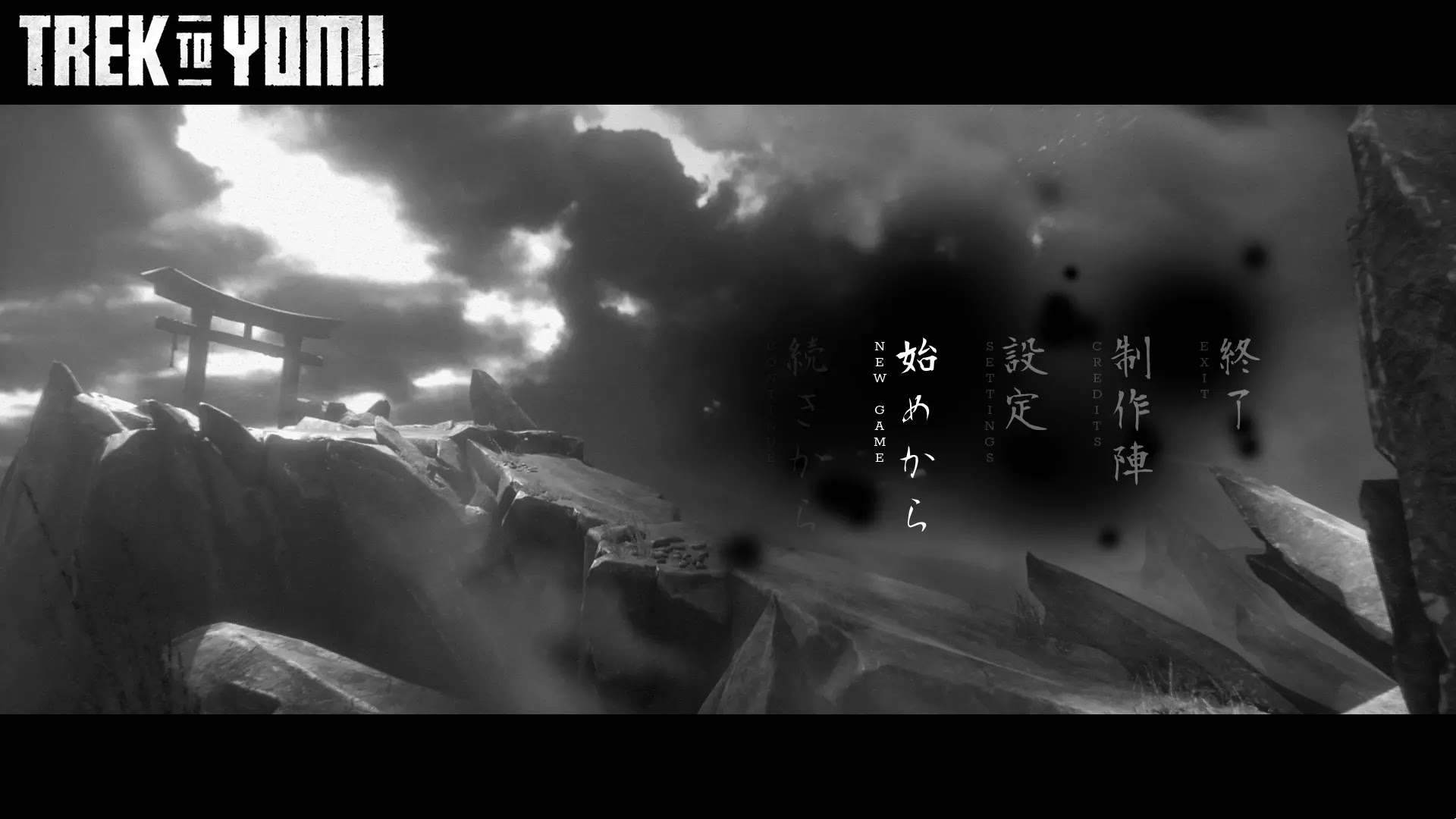
Trek to Yomi Review


Trek to Yomi
by developers Leonard Menchiari, Flying Wild Hog and publisher Devolver DigitalPC (Steam) review written by Robert with a copy provided by the publisher.

Estimated reading time: 4 minutes 


Trek to Yomi by Flying Wild Hog and Leonard Menchiari is an artistically beautiful side-scrolling action-adventure game set during a turbulent time in a fictionalized Japan. Every new screen you visit is an artistic masterpiece that warrants smashing that screenshot button with jarring regularity. The beauty of Trek to Yomi is perfectly framed by the game's composer, Cody Matthew Johnson taking a more haunting approach with its music. Tie that to the black and white aesthetic and it absolutely screams "classic samurai film," a sentiment that I wholeheartedly stand behind but where Trek to Yomi stumbles though, is in the poor execution of combat.

Trek to Yomi is a bit of an interesting beast- visually stunning in its classic use of black and white cinematography and is aurally enchanting in that haunting-kind-of-way. The combination of the eerily beautiful audio and the fixed camera angle ensures we only see and hear exactly what the developers and artists want us to see. That can be a powerful mix and it's that very mix that is evident throughout Trek to Yomi; every shot is essentially perfectly curated with a complimentary soundtrack.

While creative artistry and overly-designed (in a good way) visuals are important to a good title, especially one that will inevitably draw some comparisons in setting, style, and overarching themes to Sucker Punch Productions' near-perfect, classic samurai media-influenced, and jaw-droppingly-gorgeous, Ghost of Tsushima; these two titles are wildly different from one another.

Ghost of Tsushima, a 90+ hour epic set in a massive, thriving world with a brilliantly designed main story, and exceptionally well-written side stories (I refuse to call them "missions" or "quests" because they are just so much more) that have set the bar so incredibly high that few games will match it. Trek to Yomi on the other hand is a relatively short (beatable in a about 4-5 hours if you struggle with the combat* the way I did) side-scrolling, action game that takes place in a relatively small but stunning environment that is only enhanced by the black-and-white color palette that Flying Wild Hogs went with.

Now, many of you may be scratching your head about drawing that comparison- I admit, at first glance, it seems rather silly to compare the two. However, as you peel away the difference in combat and world design (linear vs. open-world), both titles are clear love letters to samurai films of yesteryear like Kurosawa Akira's spin on Shakespeare's King Lear with 1985's epic, Ran or through their clear focus on setting a scene and letting it quietly carry the gravitas that oozes out of both titles' very makeup.

Toss in there the main story being about a man on the search for vengeance and... these titles could almost be twins; now, would I claim that Trek to Yomi is better? If you like side-scrollers it is, but it's silly to grade those two games against one another, it's just that throughout the relatively short campaign, I could not help but feel the same weight and heavy atmosphere that both games exhibit.

Though its combat at the time of this writing is frustrating, Flying Wild Hog have come out and publicly stated that they are hoping to push out a patch in short order that addresses many of the issues with combat (as well as a number of other issues, some console-related, some not). At the time of this writing, though, combat was still in a sorry state and that really puts a sour taste in my mouth. With luck, their upcoming patch will address these concerns, though a part of me does wish these struggles were caught (and addressed) in their QA process. Let's be real, though- it's relatively rare to see a title drop without some sort of chonky bugs to deal with.

Summary

Trek to Yomi is an enjoyable, heavy, and atmospheric side-scroller whose presentation along can place it with the greats by way of Flying Wild Hog titles that's hampered by poor combat. The engrossing story, immersive and highly cinematic presentation, and an excellent score are all indicators of greatness and Trek to Yomi seems to be on its way to being one of 2022's best Indie titles; only time will tell.

Score: 7 / 10


Share:

Streets of Rage 4: Mr. X Nightmare - XB1 Review


Streets of Rage 4: Mr. X Nightmare
by developer Lizardcube and publisher DotEmu—Microsoft Xbox One review by Nick with a copy provided by the publisher.

Estimated reading time: 7 minutes


When Streets of Rage 4 first came out, I spent the following handful of days playing through it repeatedly. It was a fantastic continuation of a legendary franchise. Now we get some fresh DLC, and if you were a fan of the base game? You need to give Streets of Rage 4: Mr. X Nightmare a go, because it adds to the already great base game.

When you are getting DLC, the developers are banking on you enjoying the base game so much that you’ll happily toss a few bucks or so down on some additional content of the same vein. Sometimes that works, sometimes it doesn’t – often times because the DLC is releasing well after the base game initially has. Thankfully, Streets of Rage 4 was an easy title to pick up, so if like me you had a bit of a long layoff since playing the core title? The DLC is a great reason to pick things back up again.

Here, Mr. X Nightmare brings the goods, and is anything but a nightmare. The highlight of course, is that you get three more playable characters. My favorite is Shiva, the one-time boss enemy from earlier titles. I’ve just always enjoyed his character design, and getting to use him and his incredibly fast style of play is satisfying. We get a nice middle-ground kind of character in Estele (a one-time boss from Streets of Rage 4) – who has always felt like she was waiting to be added to the roster given her character had just a bit more depth than most of the other bosses in the base Streets of Rage 4 title. She isn’t the bulkiest of the characters on the roster (you can unlock other characters through playing the base game. That progression system is one of my favorite aspects of Streets of Rage 4), but the third combatant – Max- will no doubt make maulers happy. I’ve never really gravitated towards the bigger, slower characters in brawlers like this, but the style has its fans and Max should make them quite happy.

Streets of Rage 4: Mr. X Nightmare also comes with a new mode: Survival. The idea of course is nothing new. One or two players get dropped into stages and have to hold off waves of enemies that become increasingly more difficult over time. Still, while this had the possibility of being a thin, quickly stale mode, I have to give the devs credit for mixing things up a bit here. The variety of stages is appreciated, there’s leaderboards and weekly challenges to keep the goals a bit fresh, and there is a neat lightweight progression system where you get to pick between one of two perks every stage. It also provides yet another way of unlocking some new goodies permanently too, including further customizing your fighters that can be carried over into the story mode as well. I really appreciated this feature. I really did not expect much from this mode, but I came away pleasantly surprised.

Achievement hunters get a few new objectives here as well, taking some more possible points onto the base game’s 1,000 possible as well. Not all DLC provides new achievements, but I like to chase trophies / achievements, so it’s appreciated when this is added.

Summary

Streets of Rage 4: Mr. X Nightmare is a fairly priced bit of DLC that is the perfect reason for people who played this title a year ago to pick the game back up again. All three new characters play differently from one another, providing a satisfying variety as you pound your way through hapless bad guys once again. The Survival mode also exceeded my expectations and has that addictive ‘one more time’ feel to it.

Score: 8 / 10


Share:

Fallen Knight - XBSX Review


Fallen Knight
by developer FairPlay Studios Co. Ltd and publisher PQube Limited—Xbox Series X review written by Pierre-Yves with a copy provided by the publisher.

Estimated reading time: 4 minutes


In an age where remakes and remasters are basically king, especially with the launch of a new console generation, there are some older styles that while we wish we were still getting but unfortunately are not. Coming from FairPlay Studios and being ported over from the Apple Arcade, the gap in the lack of Mega Man titles has been filled a bit more with an interesting play on the Knights of the Round Table as you get to play as either Lancelot or Galahad in this side-scrolling action platformer.

Unlike the 20XX and 30XX series (which are awesome) that are direct homages to Mega Man / Mega Man X (see Mega Man 11 review at DDnet) and Mega Man Z (review at DDnet), Fallen Knight takes the idea behind the concept of getting more powerful by defeating foes and getting their powers while changing it up a bit. Instead of having a gun, cannon, or mega particle cannon, you instead have a real sword that you’ll be swinging around in normal mode as Lancelot. While one could argue that you are just playing as Zero, where things change is that while you are running around with a sword, the sword is just the beginning of your repertoire.

Fallen Knight surprised me in its accessibility and versatility when it came to the 2D platforming style. Instead of having to wall jump your way up, which you can do, you can also simply run up the wall and then jump once you need to. Either that or an air dash. While fighting enemies, you can swing your sword at them but when it comes to certain more powerful ones, or ones with shields, sometimes just waiting for the right moment is a better idea as you can disarm and then take them out in one hit. Much more efficient and offers a different gameplay element than simply swinging at them until they are dispatched.

Whether you are attacking enemies head on or waiting for the perfect moment to strike, either or these methods will help against the final score of the stage which gives you currency in order to buy upgrades. Double jumping, air dashing, stronger attacks, more health, etc, each of these can be bought and equipped to make you more powerful and make the stages easier to go through as being able to double jump or air dash open up a fair amount of shortcuts especially if you’re planning on just blitzing to the end of the stage to face off against the dreaded boss that awaits you there.

These five monsters, six including the boss of the game, will test you on everything that you’ve learnt up until this point and make you wonder if perhaps you shouldn’t go back and do the first stage a few times in order to load up on some upgrades. What I loved about this though is that their movements are unique from one another making you really have to learn patterns and not simply swing with wild abandon like I’ve done in a few of the Mega Man titles over the years. Special moves, moves to be blocked, moves to be dodged, you’ll have to figure each of these out if you’re going to win and it’s not easy.

This is perhaps my only real issue with Fallen Knight. The stages are easy enough but the boss fights are almost stupid hard making you wonder how many times you will be willing to die before walking away. In my case, it’s something to overcome, but that’s because I’m tenacious enough and that’s about how I’ve finished Demon’s Souls, Dark Souls, Bloodborne, and more over the years. So I have to wonder if perhaps the bar wasn’t set too high, however, for those loving a challenge, you’ll get plenty of that with Lancelot before moving over to Galahad which is essentially hard mode.

Summary

All in all though, Fallen Knight even if it has a higher entry point due to the learning curve for boss battles is one worth looking into. It’s not very long but it does have separate paths for our two Knights of the Round Table as they fight to protect the city and its people from those currently attacking it.

Score: 7.5 / 10


Share:

Super Meat Boy Forever - PS4 Review


Super Meat Boy Forever by developer and publisher Team MeatSony PlayStation 4 review written by Richard with a copy provided by the publisher.

Estimated reading time: 9 minutes


Oh boy, here we go again. Back for more, Team Meat is here to deliver a flying lariat to the throat that is Super Meat Boy Forever. After the sadistic success of Super Meat Boy, SMBF changes up the playstyle to deliver to you a completely new experience, but still jam packed with the table-flipping difficulty you've probable come to expect.

In Super Meat Boy Forever, the nefarious Dr. Fetus kidnaps the adorable Nugget, who I presume is the kid of Meat Boy and Bandage Girl. Needless to say, it's up to you to help guide them through the dangers they will experience on their quest to save Nugget from the grip of Dr. Fetus.

Now, those who have experience with Super Meat Boy may want to know that there have been some major overhauls to the gameplay in SMBF. While basic progression is similar to the previous title, meaning you make your way through individual stages of a world, fight a boss, then move onto the next world, all while dodging instant death traps like saws and spikes, SMBF changes the brutal platforming gameplay. Gone is the day of full control over Meat Boy, instead it is now a side-scrolling “auto-runner”, where you are always constantly running forward. Jumping off a wall or landing on a little direction pad will make you reverse direction, but Meat Boy can, and will, keep running in the direction he's facing, provided there isn't anything blocking or killing him.
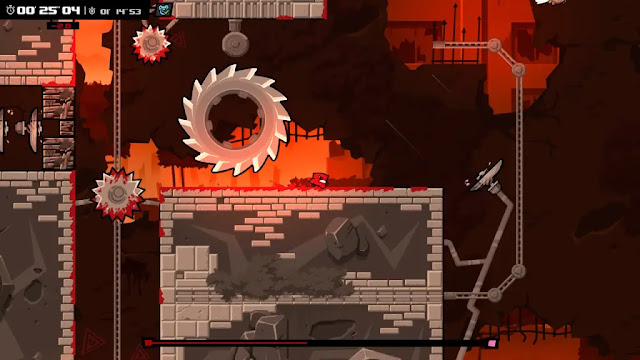
Unlike in the previous title, where there were few gimmicks and everything relied on your own understanding of stage composition, a lot of gimmick type aspects are added in SMBF. You can now punch and slide tackle, for instance. This will let you hit enemies, and bosses, as well as destructible environment objects. An airborne punch also propels you straight forward for a short distance. You can also drop down fast while in the air and slide on the ground, allowing you to avoid midair threats, or to duck under saw blades.

In addition to the new action moves, there are many new environment effects. Without wanting to ruin too much of the surprise, you have stuff like acid/glass, that you can only spend a set amount of time in before you need to leave, blocks that can turn intangible blacks tangible, and hooks to grab onto that will move you up or down. While the focus of both games is primarily your own skill, where the previous title focused on your ability to navigate terrain, this title focuses more on your ability to correctly interact with stage environments and objects. There are a lot more “puzzle” type segments this time around as well.

Another new aspect is that the game is seeded. That's right, the stages are generated from a code that can be randomized or manually input when you're starting up a new game. This is interesting for a number of reasons, as it means that item locations can change depending on your game seed. Furthermore, each stage in each world is comprised of smaller segments. These segments will differ between the game seeds, meaning you could, theoretically, have the toughest time at the beginning of the game only to have a really easy late game. Yes, this actually happened to me. I had significantly more collective deaths on the first world than the last world. Back to harass you as well are the collectibles, only this time they come as pacifiers instead of bandages. Collecting these, as well as fulfilling certain achievements, will allow you to unlock new characters to play as. There is also a new game plus feature, which retains unlockables, but allows you to restart the game with new collectibles. Seeing as there is an unlockable character that requires 90, and there definitely aren't that many in the game from what I can tell, this would probably be required to unlock that character.
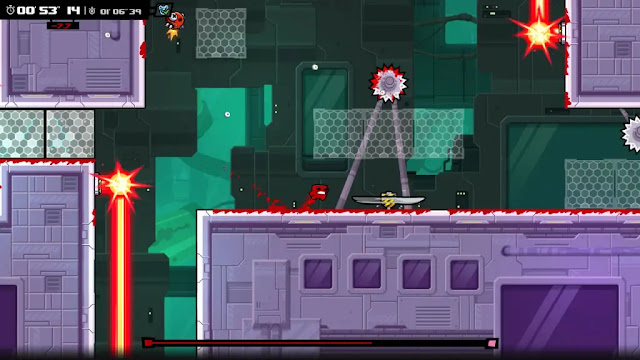
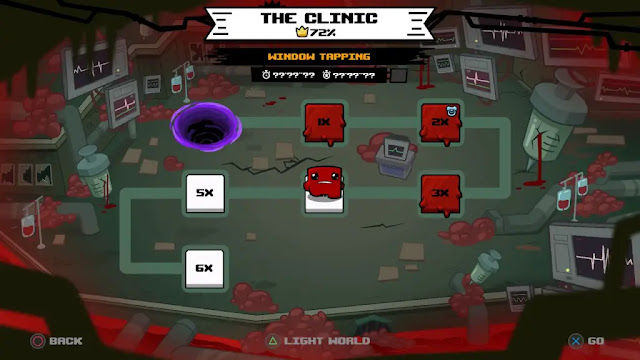
A couple of interesting things that have resulted from levels being in segments are the locations of items and the in-game timer. Items are also randomized according to the seed, which also includes warp zones. This means your warp zone may be in a dark world stage instead of the light world, most likely meaning it is significantly harder to unlock. As reference, my first two warp zones were in the light world, and my rest weren't. So how do you unlock the dark world? Well, you have to clear the associated light world stage within the time limit set by the developpers. These time limits can range from “meh” to “HOW THE BLOODY HELL AM I SUPPOSED TO SHAVE 12 SECONDS OFF THAT TRASH?!?!?”.

Words were had, controllers were thrown.

Thankfully, the in game timer keeps track of your overall time in a stage, and will update after each segment indicating whether you are currently under or over based on how much time is allotted per segment. For instance, clearing a segment fast might mean you have a green “-1.2” next to your timer, indicating you are currently 1.2 seconds under the the time to beat. Doing poorly in the next segment could mean you now see “+12.7” meaning you are now 12.7 seconds over the segment total you should be around to reach the goal within the time limit. Lucky enough, dying will just return you to the beginning of the segment you are on, and will revert your timer to what you started the segment at. This is really useful for scoping out fast paths through segments.

Let's talk a little bit about what I personally liked and disliked about Super Meat Boy Forever. I like how the bosses were actual bosses you fought, and weren't just races/dodging endurance contests. I liked the segment timer. I liked how some of the collectibles were timed, and you needed to get to them fast. I liked the massive number of really cool gimmicks and environmental effects. I did not enjoy the constant running function, which made the game feel more like it was going to be a mobile/iOS style game instead of a console/PC title. I didn't like how harsh some of the time requirements were for unlocking the dark worlds. While this is predominantly seed dependent, it was still quite frustrating. I am rather on the fence about the seeded games. On the one hand, this means there are a myriad number of different combinations, all with varying difficulties that can be formed, which is really cool. On the other hand, having a string of some of the most arse precision movements that felt like they only had a few frames as a window was wretched. The first world's dark world? Good lord man, I legitimately thought I was going to cry.
While the above were simply likes and dislikes, that doesn't mean there weren't any issues with the gameplay itself. Hitboxes are...weird and mostly awful. It feels like Meat Boy has a bubble around him larger than his character sprite that will take collision damage. While this isn't too bad normally, it results in some extremely frustrating moments when trying to thread a thin gap, or when you're supposed to make contact with a gimmick, only to die as you grab a hook or enter a warp portal as soon as you touch it, because those spikes nearby are just a little too close to the portal. Another issue that kept cropping up was with the punching mechanic. Punching can be done by hitting any button that will cause you to jump while midair. Since you have more than one button for this, what happens if both buttons are pressed, or one is held as a jump and the other pushed as attack? You get a quarter second punch with hardly any of the momentum you need.

Super frustrating.

Also, special mention goes to the last boss. There is a gimmick to block attacks, but half the time I found the attacks would just completely bypass by “block” and still hit me for no good reason. Some of the jumps are super tight, and some gimmick activations were super sketchy. As a reference, I had a total of, I think about 54 deaths in the last world leading up to the boss, including using multiple deaths on a timed pacifier I wanted to collect. The boss itself? Somewhere around 168 deaths. I mean, I did it, but it was a super iffy fight all around, despite the other boss fights being more or less decent.

Summary

All in all, I have to say that Super Meat Boy Forever felt like a step back from its predecessor. It felt clunkier, there were some collision detection issues, and it felt a lot less refined. That being said, it's by no means bad, although it is a drastic difference from the original style. While I wasn't fond of the gameplay changeup, that is entirely personal preference and should be taken with a grain of salt. While you should come in to Super Meat Boy Forever expecting a vaguely similar feeling to the previous title, it is still by and far a different experience. A few collision detection patches and maybe some time requirement adjustments for those a little too casual to make the cutoff for the dark world stages, but who are better with the platforming, could really go a long way.

Score: 7.5 / 10


Share:

Touhou: Azure Reflections - PC Review


Released as an enhanced version of a game originally published in 2012, Touhou Azure Reflections is now available on PC for all you fellow bullet hell aficionados out there. With some interesting gimmicks that will keep more veteran players entertained, or striving for score, and a story mode that can be easy enough for newcomers, Azure Reflections certainly paints a solid picture for the genre.

I believe I’ve used this phrase before, but the Touhou series, and generally other bullet hell styles as well, can usually be summed up as “the most colourful death you’ve ever experienced”, and Azure Reflections is no stranger to that. A sort of “retelling” of the events of “Embodyment of the Scarlet Devil”, local lazy and forever in poverty shrine maiden Reimu finds herself once again trapped in the mist of the Scarlet devil mansion. Is Remilia up to the same old tricks? Has the maid decided to host a revolt? Is Flandre going to beat you into next century? The first two maybe, the last definitely.

While the traditional Touhou titles are top down auto-scrolling shooters, Azure Reflections is a horizontal shooter, allowing you, and forcing you, to shoot both forwards and backwards in order to dispatch those annoying fairies (yes, Cirno too). While the standard fare is there, choosing a character (if unlocked) and shot type to help you get through the mansion to resolve the incident, there is a fancy little barrier system, where you can pull up a barrier to absorb bullets and then make a sort of bum rush at the enemy in order to return that absorbed damage. This is in addition to the spell cards that give you the bullet clearing/high damaging blast and your standard shot.


There are a few other changes to the standard formula, where you can actually take damage and recover your “hit point” as long as you don’t get hit within a time window after taking the first hit. This is a great system for newer players who need a little help learning the ropes (or those that aren’t as good at the games). Another interesting change for the newer or less proficient (like me) audience is that you can clear the storyline on easy. Yep, that’s right, you don’t get cut off for being a weenie this time, as long as you meet the other requirements (which they handily tell you if you fail to meet them). My biggest issue is trying to horde spell cards for no real reason. Probably because I want to earn the spell card bonuses. You can now also customize your appearance with accessories that you can purchase, which also happen to have effects attached to them, such as increasing the graze score bonuses. Are you all about the fashion, or all about the efficiency? Either way, there’s something there for you.

As can generally be found in the Touhou titles, the music is well done, with each character and stage having their own remix of the songs from the original Embodiment of the Scarlet Devil. The graphics are crisp and sharp in the standard anime style for the series, but come in multiple expressive variations. The neat little “cutscenes” during battles where the characters are duking it out are pretty cool too, and you can even unlock a model viewer and jukebox for music listening and character viewing.

While the title definitely feels easier compared to some, or most, of the other Touhou titles, that’s what the harder difficulties and self imposed challenges are for! Seriously though, any game that has a difficulty called “Lunatic” with the description “for crazy people” you know is gonna be like ramming your face at a brick wall. Although Azure Reflections is relatively easier, except the stupid bats, there was a lot I really enjoyed about it.


One of the aspects of the Touhou series as a whole that is also applied to Azure Reflections is how the characters interact with each other. Usually there’s a lot of rather un-serious banter, a couple of puns or gags, and occasionally a serious line or two. While most of this can get lost in translation, whether official or fan, I’m glad to say that the banter in Azure Reflections was well translated and doesn’t fall off the mark of what I’ve come to love and expect from the series.

As a whole, Touhou: Azure Reflections is a bit of a niche title. Most people I know aren’t super big fans of the bullet hell/danmaku style games, and those that will play them don’t necessarily recognize the Touhou franchise. That being said, what it offers is not only true to its roots, but also offers its own twist to keep things fresh and interesting. If you’ve got a hankering for colourful bullets, a masochistic tendency to watch yourself get shot down, a desire for an anime-esque scrolling shooter challenge, or a fancy soundtrack, you can’t go very wrong with Azure Reflections.

Game Information

Platform:
Sony PlayStation 4
Developer(s):
Unties Games
Publisher(s):
Souvenir Circ.
Genre(s):
Side-scrolling
Bullethell
Shoot 'Em Up
Mode(s):
Single Player
Other Platform(s):
NA

Source:
Provided by Publisher


Article by Richard
Share:

Warlocks 2: God Slayers Spellbinds Switch, Steam October 2018 - News


Two or more players side-scrolling coop action? I was already in for the single player but you can be sure there'll be a few of us playing this from my couch come October!


Co-Op Action RPG Warlocks 2: God Slayers Enchants Nintendo Switch, Steam October 2018

PlayStation 4, Xbox One Versions Q1 2019

WARSAW, Poland – July 24 , 2018 – Warlocks 2: God Slayers, the 2D co-operative ARPG combining a retro aesthetic with fresh hack 'n' slash mechanics, will come to Nintendo Switch and Steam when Fat Dog Games and Frozen District release their collaboration in October 2018. PlayStation 4 and Xbox One versions will follow in Q1 2019.

Choose from five playable warlocks including a crazed goat riding a dwarf-centaur or a tech-savvy e-witch who casts spells from her smartphone. Join forces with up to three friends via local and online co-op then take on vile gods hellbent on reigning chaos throughout the multiverse.

Devastate more than 40 enemies in fast-paced battles using more than 45 abilities such as shooting selfies, turning enemies into frogs and summoning hordes of skeletons, ghosts and demons. Unlock more than 100 upgrades and take on even greater challenges.

Packed to the pixel with more than 120 equippable items, Warlocks 2: God Slayers delivers tight gameplay, gut-busting pop culture references and hundreds of procedurally generated sidequests spread across three worlds depicted in hand-animated, retro-styled art.

"Warlocks 2 presents an exhilarating spread of multidimensional travel, side-scrolling adventure and hack 'n' slash combat," said Krzysztof Krej, chairman of the board, Frozen District. "It's the perfect blend of humor and action to share with friends."

The sequel to Warlocks vs. Shadows, Warlocks 2: God Slayers will be available on Nintendo Switch, PlayStation 4, Xbox One and Steam for PC, Mac and Linux for $19.99. The game will support English and other languages to be announced later.

For more information on Warlocks 2: God Slayers, visit the official website, check out the game's Steam page, follow Fat Dog Games on Twitter or follow Frozen District on Facebook.

Article by Pierre-Yves
Share:

Dragon's Crown Pro - PS4 Review


Following Vanillaware’s port of the spiritual sequel to Odin Sphere subtitled Leifthrasir from PS3-4, Dragon’s Crown has received the same treatment and is also being released on Sony’s newest platform under the Pro subtitle. With many small upgrades under the hood, we are invited to rejoin the visually satirical mighty and magicked cast as they adventure for the titular treasure known as the Dragon’s Crown.

The revamp, titled Dragon’s Crown Pro is interesting because, unlike Odin Sphere, nothing has changed. There are still the six characters available which personify their classes with wonderfully exaggerated physical proportions and each still have their own skills and their equipment restrictions. There are no new modes. There is no new content. But it does one thing that many other re-releases do not: Dragon’s Crown Pro is not only revamped on the newest system and performing absolutely smoothly compared to the PS3, but both the PS3 and the Vita versions will be forwards compatible!

For those poor souls who do not already own this fantastic title here’s what you can expect.

Starting off inside a pub, as all good adventures do, you can choose from one of the six available classes. There are two full melee classes, two that concentrate on skill rather than might though they are just as strong (in nerd speak glass cannons) and finally there are the spellcasters. Each is labeled for their respective difficulty level to use with the Knight being the easiest and the Sorceress, aka the Necromancer as she raises the dead, as the toughest to use. Once you’ve chosen your class, name, colour palette and a message seen by players who can resurrect your dead, magnificent corpse in their own worlds to use, it’s time to grab your thief and head out.


Visually Dragon’s Crown is just as pretty to look at as a re-release now as it was when it first came out in 2013. What really aids the visual presentation however is the power under the hood of a PS4, and in my case, a PS4 Pro. Because of the added system power you no longer experience the slowdowns caused by having too many enemies or effects on screen other than the occasional boss dying animation trying to catch up because you killed it too fast (cough).

All of this power also contributes to the splendor of one of the most enjoyable facets of this title which is the stellar art that is used for the graphics. Dragon’s Crown isn’t made of some quickly thrown together sprites but instead serves your eyeballs a much more refined, hand-drawn style. Character models as well as the variety of enemies and locations are all amazing to look at whether it’s the first, second or hundredth time that you pass through a location. Regardless of their eclectic gameplay styles over the years, Vanillaware truly know how to craft a unique visual landscape. However, don’t let the shiny look fool you, this game isn’t some functionless piece of modern art.

Just because it’s amazing to look at, doesn’t mean that Dragon’s Crown isn’t a hell of a lot of fun to play. While each class has their own specialties, they all share certain game elements in common such as their movements, the dodge mechanics and the item utilization. At its core, Dragon’s Crown is a brawler that uses RPG elements in the character leveling and skill point mechanisms that allow for a variety of customizations. Characters can be completely different in the beginning but through skill points they all unlock the same options by the end. If you get bored of cleaving mobs with a sword like Braveheart you can whip out your sneaky, stabby daggers for the final boss! You’ll have more than enough skill points for both the character specific and the common trees so you’re not stuck to the style of play you started with.


Where things really get interesting in combat is in the showdown between might versus magic. Each melee class has a powerful ability in their arsenal that can be used by throwing their weapons at enemies or into the ground. These hail mary blows or shockwaves can turn the tide in even the worst case scenario, especially if you are under leveled. The only issue with using these abilities obviously is that you just threw your weapon. It’s a good thing that you have a set of fists and feet because you are going to need em!

Once you’ve thrown your weapon or have had it unceremoniously knocked out of your hands, you’ll see a cooldown for where your steel hit the ground. While that timer runs down you’ll have to brawl the good old fashioned way which is almost as effective as if you had a weapon. While you do less damage it does not mean that you are useless (at least not this time), just that you have to be a bit more strategic while waiting to get your weapon back.

Spellcasters on the other hand, will never lose their wands or their staves because they seem to be smart enough not to use them as projectiles. Because of this though, their skills in close ranged combat are not as effective and they rely more on the charging of spells and on the power of limited usage tomes for incredible feats of magic. These tomes can either be bought from the local wizard or learnt by using skill points in order to obtain and power up the spells that you want to use (stay in school kids). The difference between these methods of acquisition is that anything bought from a vendor will have limited uses per dungeon and a set number of times they can be restocked while the spells bought with skill points will recharge after and be ready to go for the next time you enter a dungeon. This removes some of your reliance on the local wizard and his fickle inventory. Melee characters also have this ability though their skills are typically used less since they rely more on simply clocking people in the face.


Where these skill point spells and abilities truly come in handy is in the setup of your various bags for adventuring. In the beginning of the game you will make frequent trips to the town where you can repair your weapons and sell your loot. As you progress, new areas are available in the combat zones opening up the world and prolonging your time in the field. Like a longer trip to the mall this forces you to carry more bags to hold your replacement gear and all the pretty stuff you pick up. Different routes contain different bosses and enemies to fight as you make your way to them so bringing weapon options and following the boy scout rule becomes essential.

At the end of each of these routes you will find a boss, a big bad, the mack daddies of evil. Not all the bosses are created equal though. The Monty Python Hare, while devastating in his own right, is nothing compared to the pissed off Red Dragon that you just woke up after punting it in the face with the challenge of “come at me bro”. The ability to choose your route and the eventual boss you must face is one of the shining points of Dragon’s Crown giving it a “pick your own adventure” feel. There are eighteen bosses to conquer before facing off against the final boss. They get tougher and tougher with every difficulty scale because where would the fun be otherwise?

This replayability factor is not just found in boss selection, it also surfaces in the sheer amount of quests that can be taken on that not only grant skill points for every character present, but also provides artwork that makes for incredible wallpapers either on your PS4 or your PC… or both. Quests can be anything from kill xth amount of a mob in a certain location to unearthing plans that happen to be hidden behind a wall that you have to blow up with a bomb. Don’t have a bomb because you don’t have a Dwarf with that skill? Then you better hope that you made the goblins drop one as you were raiding their fort.


There are a few other elements that make Dragon’s Crown stick out in its class. For one, when it was released it featured a couch coop experience in a time where the idea of people playing the same title in the same location was viewed as taboo or so 1990s. It was online or nothing. Slight exaggeration but you get the idea. Players could actually get together in the same room and play together as long as there were enough controllers for the four of you, they could *gasp* socialize! Additionally, just because one person took a character / class, it didn’t mean someone else couldn’t. If you all wanted to be four Amazons, go for it. Three Elves and a Dwarf? Why not? It was entirely up to the players which significantly decreased the rate of ruined friendships as everyone got to play what they wanted and the loot is character specific.

Dragon’s Crown Pro is a prime example of what a couch co-oped remake should be like. The amazingly designed system is just as good now as it back back in 2013 and because of the newer hardware it runs even smoother. If you already have it? It’s really up to you but fans of the title will want to see this masterpiece in its new glory. For everyone else, Dragon’s Crown Pro is exactly what a Brawler should aspire to be with plenty of customizations and amazing artwork to go with it.


Game Information

Platform:
Sony PlayStation 4
Developer(s):
Vanillaware
Publisher(s):
Atlus
Genre(s):
RPG
Side-Scrolling
Dungeon Crawler
Mode(s):
Single Player
Multiplayer
Other Platform(s):
Sony PlayStation 3
Sony PlayStation Vita

Source:
Provided by Publisher


Article by Pierre-Yves
Share:

Random posts

Our Streamers

Susan "Jagtress" N.


S.M. Carrière

Aldren


Affiliates

JenEricDesigns – Coffee that ships to the US and Canada

JenEricDesigns – Coffee that ships to the US and Canada
Light, Medium and Dark Roast Coffee available.

Blog Archive

Labels