• Kingdom's Return: Time-Eating Fruit and the Ancient Monster - PS5 Review

    Kingdom's Return: Time-Eating Fruit and the Ancient Monster is Inti Creates latest project. Blending 2D side-scrolling and town building simulation, you'll be venturing through a small interesting world as you try to restore a kingdom whose time has been stolen from it.

  • Minos - PC (Steam) Review

    The tower defense genre is one that doesn't tend to innovate much with static maps, various traps, and its simple to grasp gameplay loops. At least, that is until Minos with a mighty laugh to prove you wrong.

  • Decollate Decoration - PS5 Review

    Hello everyone and welcome to a new KEMCO title! But wait a moment, this one is different to the retro JRPGs that you’re probably expecting when you hear KEMCO from me by this point. Instead what we have is a sort of point-and-click style visual novel! Something a little new and fresh coming out here!

  • Volontes - Nintendo Switch Review

    Have you ever grown up feeling like you don't belong? For our Heroine, that's the feeling she lives with everyday in her small farming village. But it's not her only secret...

  • John Carpenter's Toxic Commando - PC Review

    Toxic Commando harkens back to video games years ago when they were fun and innovative while giving the player freedom to explore among the waves of enemies in a 4 player chaotic onslaught of combat and driving mechanics.

  • Dread Delusion - Xbox Series X|S Review

    Today we’re looking at what has rapidly become an absolute favorite in the open-world RPG genre for me. An interesting story, memorable NPCs, stunning visuals, and a setting absolutely dripping with flavor, Dread Delusion sets its tone immediately and sticks with it.

  • People of Note - PS5 Review

    ...I love music in general. After playing the People of Note demo, I knew I had to play the full game.

  • Valor of Man - PC (Steam) Review

    Valor of Man, by Legacy Forge and Numskull Games, is a turn-based roguelite RPG where you guide a party of four through ever increasing difficult situations. Achieving victory is never assured and the randomness of the roguelite nature will either be your best friend or your worst enemy.

  • Starship Troopers: Ultimate Bug War - XBXS Review

    Are you ready to do your part for the United Federation and join in the most realistic depiction of war ever created? Today we join General Johnny Rico and Major Samantha Dietz as they present the first ever game created under supervision by FedDev for the enjoyment of those on the path to citizenship. Ultimate Bug War follows the path of Dietz during the First Bug War 25 years ago.

  • Soulmask - PC Review

    Soulmask enters the increasingly crowded world of multiplayer-capable survival crafting games with a launch that has bundled its first DLC pack as a free download for anyone buying it within the first month. Featuring some striking Egyptian-style graphics...

Showing posts with label Kadokawa Games. Show all posts

Metal Max Xeno: Reborn Review

Metal Max Xeno Reborn by developer Kadokawa Games and publisher PQubeSony PlayStation 4 review written by Richard with a copy provided by the publisher.

Estimated Reading Time: 12 minutes.
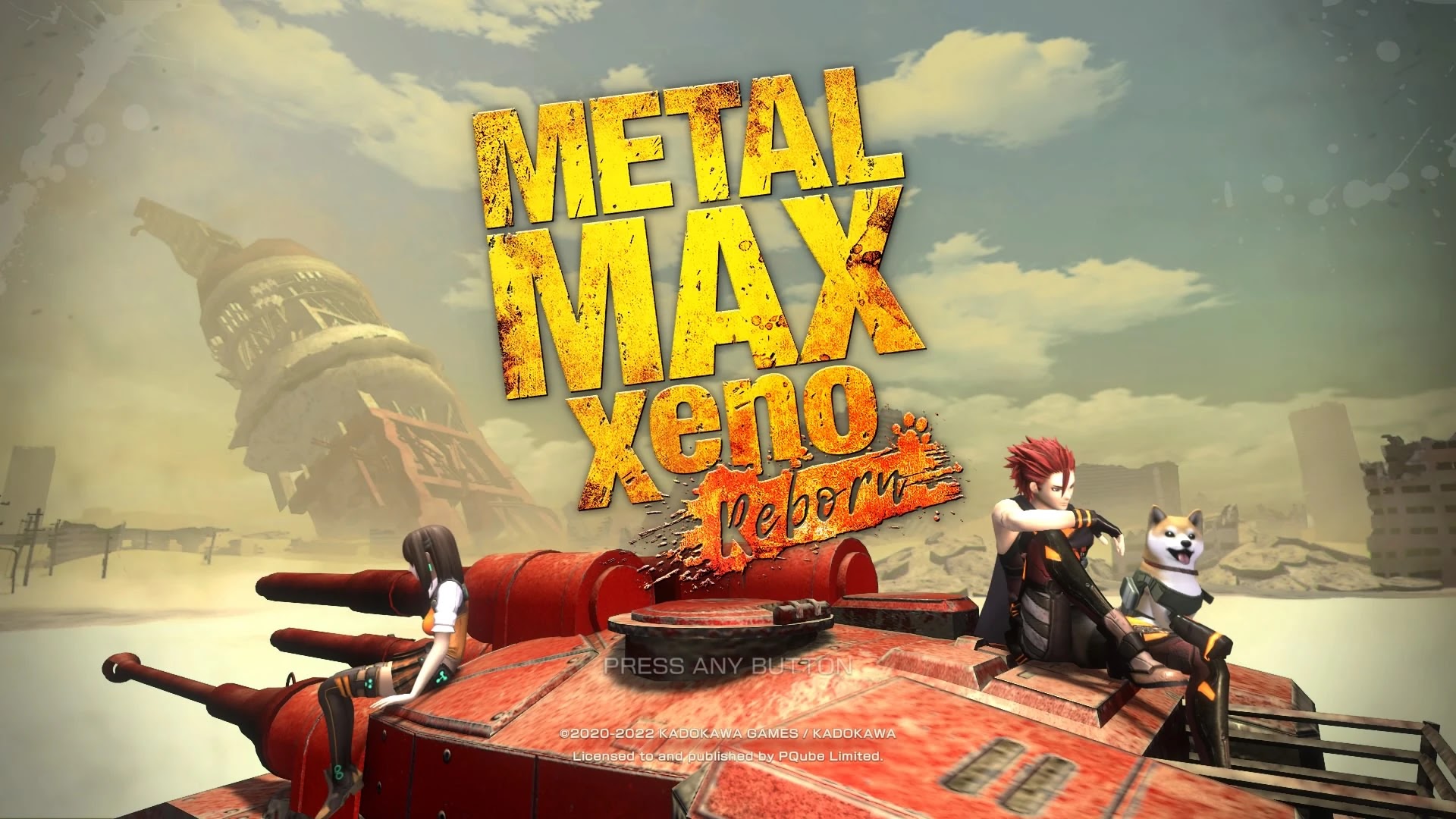


Metal Max Xeno Reborn is a remake of Metal Max Xeno, a title released in 2018. Now with a revamped combat system, and a whole lot less dialogue, Metal Max Xeno Reborn is here to provide an interesting twist on the classic JRPG format.

While I admit I haven't personally played the original Metal Max Xeno, I have done some research into it, so hopefully I can include some of the differences between the two versions throughout this review. Without further ado, let's talk a little about the background plot. Metal Max Xeno Reborn is part of the Metal Max series, which I can only liken to a Mad Max if you replace the bandits with robots.

Specifically for Metal Max Xeno Reborn, the basic idea is that many years ago, humanity built a supercomputer to make life better, which was named Noah. Turns out, the supercomputer deemed humanity the biggest problem, so elected to expunge them from the planet. After much warring, a hero managed to shut down Noah. The machines and biologically engineered creatures it spawned, however, are still out on a rampage.

You take on the role of Talis, a young man who calls himself a "monster hunter" who has made it his goal to destroy as many monsters, robotic or otherwise, as he possibly can. After being let in to the local garrison "Iron Base", he will begin recruiting allies to help fight back against the giant robot called Catastropas. This giant mech is responsible for much of the destruction of "Distokio", and presents a serious threat. As you play through the game, you can collect background info from the characters you meet, and from the residents at the Iron Base.

So, at this point I'd like to let you know that in Metal Max Xeno Reborn (MMXR from now on) the developers have, for the most part, absolutely scrubbed away most of the plot other than a few missions you don't technically have to complete, and the main goal of defeating Catastropas. What this means is that the game is almost fully active play time, but you miss out on a lot of the in-depth story. Some characters will also talk about things that might not make sense as it is related to plot that has been removed. While minimalist plot presentation isn't always a bad thing, like older Monster Hunter titles or the Souls series, in a JRPG like this it is a little disappointing. You don't get to learn more about the characters, other than the occasional dialogue line while in the base.

So, let's talk about what a weird but fun gameplay approach has been taken here. First of all, we need to separate a few things: exploration, combat, and things to do at the base. We'll start off with exploration. Now, in most traditional JRPGs you start off walking around the world map, then you normally get a land vehicle, then an air vehicle. In MMXR you get tanks. Now don't get me wrong, you can walk everywhere if you really want, but tanks are where it's at. In the tutorial dungeon you will acquire your first tank, and along with it, a brief intro into combat, which we will talk about later. Now obviously, you can't take a tank everywhere you go, so sometimes you will need to go out and explore on foot. MMXR is divided up into areas with the occasional sub area you can get into, normally on foot. As you roam around the map, you will be able to pick up crates with items, or salvage materials from scrap piles.

As you earn some more cash, or progress further in the game, you have the opportunity to dig up buried items, which can be anywhere from cash to weapons and items. While chests and buried items will not respawn, the salvage piles will after a while. But everything isn't all simply a trip to the dilapidated desert that used to be Tokyo, no no. There are fearsome creatures, both mechanical and semi-organic, prowling around. If they spot you, an "alert" meter will pop up. While this is filling up, you can run and hide from enemies, or initiate a first strike. When either the gauge fills up or you attack the enemy, turn-based combat will commence, which I will get into a little bit later.

Now, in addition to the common dreg monsters, there are WANTED monsters, which are REALLY strong creatures that have been giving people trouble possibly for years. These things are incredibly dangerous, and chances are you'll be running away from them for a while until you get your tanks outfitted better. These monsters however will not only drop some unique items, they also provide you with a large cash payout, and potentially a new tank! Whenever you enter a new area, the helpful gynoid from the Iron Base will give you info on all the WANTED enemies in the area. When you approach one, she will also give a few dialogue lines, often indicating how well she thinks you'll fare. Chances are "very poorly" in the first two map areas.

Now, if you look at the map you may think "oh, this game isn't that big", but you'd be surprised at how large the areas really are. Add into this that there are always enemies wandering around, treasure to collect, and things to explore, and the areas aren't as small as they seem. I mean, there's a reason there's often a decent number of different fast travel locations in each area. Fast travel locations are something you'll use a lot of as well, as most monsters other than the common scrub types won't actually respawn for a decent length of time. Couple this with the fact that your tanks take a lot of damage and you heal at the base on normal mode, you'll probably be traveling back and forth an awful lot. The side areas are similar, usually being areas you need to explore on foot, but may contain interesting mechanics, such as turning on the sprinkler system to reduce the stats of some exploding enemies you find in the area.

Alrighty then, let's talk a bit about combat. Combat for on-foot battles and tank battles are largely similar, so we're going to roll general combat under one umbrella, and then I'll talk about the tank mechanics specifically after. Combat will start for you as soon as you, the player, see an enemy on-screen. This is because all enemies can be attacked outside of combat as long as the weapon you're attacking with has the necessary range. This means you can also sneak up on an enemy from behind and hit them with a strong attack to start the battle. Before you ask, yes, you can kill enemies on your first move, without technically "entering combat". Once you see an enemy, you can enter the action menu, select attack, and then either choose an enemy close enough on foot or actually aim your sights while in a tank.

Once actual combat starts, it functions largely like traditional turn-based JRPG combat. You have a little circle that fills up, and then you can perform an action, such as attack, guard, use a skill, or use an item. While the character you're controlling is not performing an action, you can also walk around the battlefield. This allows you to move to set up attacks with weapons that have different areas of effect, such as cone shaped spread. While range becomes irrelevant for single targets once you enter combat, that doesn't mean you can't catch other enemies in the range if you position properly. Since you can equip multiple weapons, you can also decide what to attack with, as some enemies may be resistant or weak to certain types of damage. While the game gives you an effectiveness gauge when selecting an enemy to attack, I'm pretty sure there's also a hidden attack modifier for physical/elemental damage types, at least just based on personal observation.

Tank battles are a little different fare. While tank fights function with a similar basis, because you can set up to five weapons, as well as support chips which will give certain bonuses on the tanks, things get a little more interesting. As an example, you could equip up to five heavy cannons on a tank, and then grab a support chip that allows you to fire all five cannons at once. Unfortunately, cannons are heavy, and tanks have a maximum load rating. As an interesting note, which took me a while to figure out, your tank health is proportional to the difference between max load capacity and current equip load. In order to increase equip load, you need to either improve your current engine, or acquire a new one. You can equip three different weapon types: cannons, machine guns, and special effect weapons. Each weapon type serves a different use, and has their own effects, as well as ammo count. While the machine guns have infinite ammo, they also tend to do less damage and have a worse hit rate.
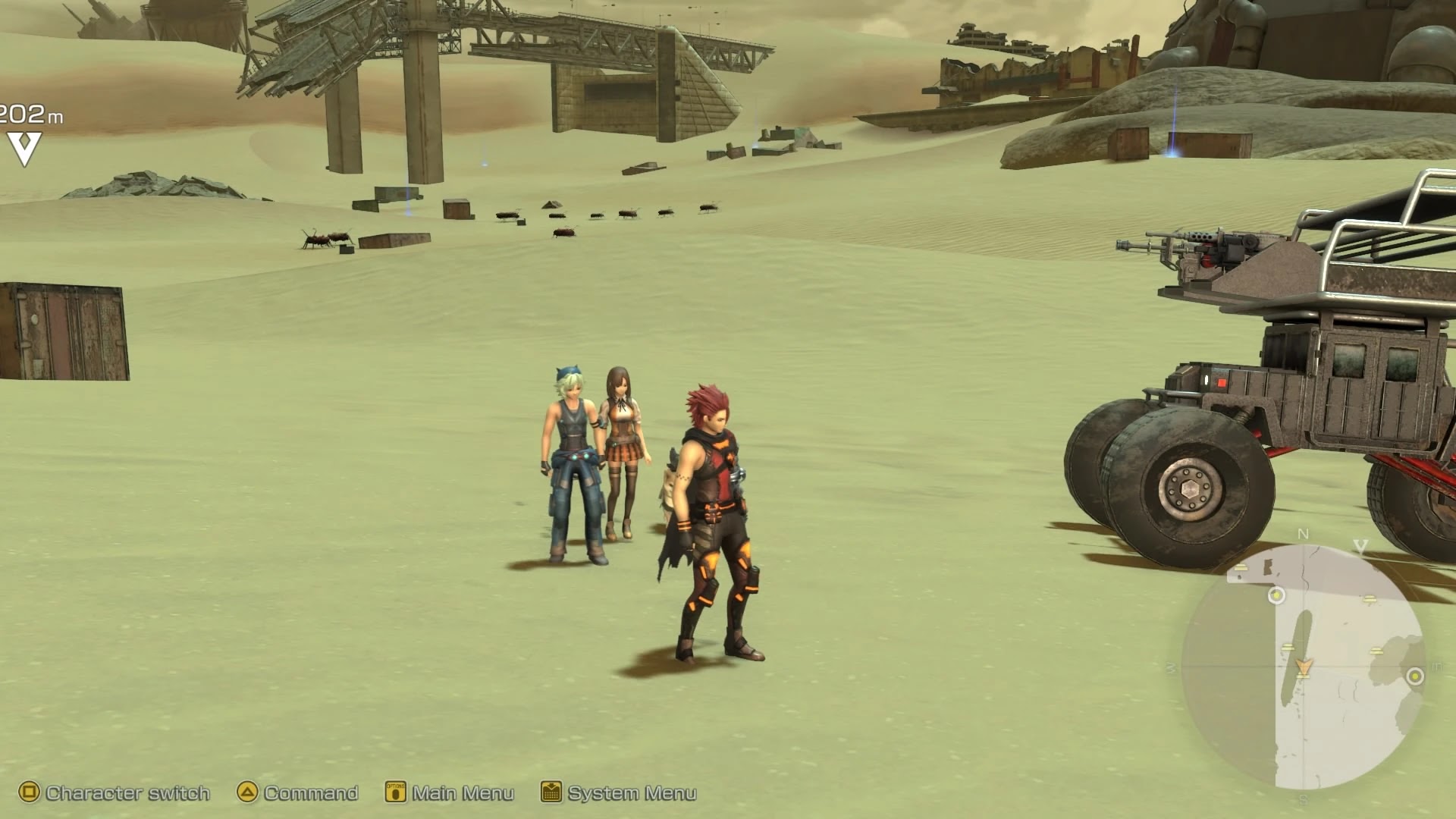
Now, you might be thinking "well, isn't that basically the same as while on foot?". So here's the thing: tanks don't "die" when they lose their HP. Essentially, a tanks HP is just a protective armour. Once that's gone, any further attacks will start damaging your equipment. Guns severely damaged? Can't fire them. Engine broke? Can't move. This is kinda cool in the sense that you can still keep on fighting after you run out of health, provided your gear isn't fully broken, in which case you'll be ejected to a foot battle. Keep in mind you could still run away, which stops your attacking, and instead lets you literally drive your tank, or walk, away from the fight and hope the enemy stops following you.

Even once you've cleared the game, there is still more available. As you clear a difficulty, you unlock the next difficulty, which restock chests and buried treasure, new and better gear becomes available, new WANTED targets become available, and enemies give more exp and money. You can either start up a new game, or continue on your saved file with all your progress still intact. After beating Catastropas at least once, you'll also unlock Survival mode, which doesn't heal you when you return to base, making it necessary to stock up on healing items to help get you through.

So as you've noticed I've mentioned earning levels. While these don't directly affect the tank fights, they do affect your three characters and dog that you can take with you into battle. Yes, a dog. The dog is also an absolute beast, tanking hits better than some of your tanks. As your party members level, or your dog gets fed doggy chow, they earn skill points. These can be assigned in the main menu under characters, then again under skills. Skills can be anything from stat increases, to new skills to use in combat, to passive upgrades or unique skills.

Alrighty then, let's talk a bit about the art direction, both musical and graphical. We'll start graphical. There are two graphic modes, which confused me when I first swapped them, because it changes all the character portraits and I was NOT prepared for that. Essentially, one art style is more "gruff" and a little rougher around the edges, fitting for a desert dystopia. The other art style is smoother, and is more "traditional JRPG"-like. Both styles are pretty good and serve their own purpose. Personally, some characters, like Talis, the main character, I liked better with the rough texture. Others look better with the smoother art style. The music however? Just all-around really great. The area themes were really well done and I found portrayed the tone of the zone you were in really well. All of the battle themes also really slap, most of which are some nice heavy metal tracks with electric guitar at the forefront. The WANTED theme especially is really good.

Metal Max Xeno, despite all the love I have for it, is still certainly flawed in some aspects. First off, it's really tough if you can't figure out what you're doing. Figuring out where to go is fine, but until I found a tank setup that worked for me, any battles that lasted more than a few turns didn't end well for me. Additionally, there are a few really underexplained aspects, such as how upgrading engines give massive HP payouts on tanks.

Also, getting in and out of the tanks can get a little annoying, as sometimes you park too close to what you want the on-foot units to get in, then you have to get back in and move the tanks around. There are also a few points where you're slogging through an absolute wash of enemies you don't want to deal with, hoping you can just get through and be done with it. You can also get your tank stuck, sort of. While you can spin on an axis, you will still collide with obstacles, meaning if you catch a corner while trying to run from a WANTED bounty, you may be screwed. At least a full party wipe just sends you back to the base. It's also really good money to game mileage, which always helps.

Summary

Overall, I have to say I really like Metal Max Xeno Reborn. While the gutted storyline and a few design choices are a little questionable, I found the combat system to be immensely enjoyable. Nothing quite like spotting an enemy over a hill and massacring them with a 100 ton cannon dropped by the last boss.

Score: 8.5 / 10

Share:

Root Film - PS4 Review


Root Film
by developer Kadokawa Games and publisher PQube Ltd.Sony PlayStation 4 review written by Richard with a copy provided by the publisher.

Estimated reading time: 6 minutes


Murder mysteries have always been a genre that's rather polarized many people. Is there enough information to solve the mystery yourself? Has the story been provided in a way that makes the deductions reasonable? Is the culprit someone you know, or is only introduced at the end? All of these can have a huge impact on the telling of a story. Root Film is a title that brings you a set of murder mysteries that are both well grounded yet may keep you on your toes all the same.

Root Film, the sequel to Root Letter (a title I sadly haven't played), you get a dual protagonist feature, starring Rintaro Yagumo, an aspiring director, and Riho, an aspiring actress. They are both supposed to be working on a new movie, but a series of mysterious deaths are constantly happening. Is the movie really cursed like everyone says, or is there a more human evil lurking in the shadows? Rintaro has a ragtag crew of a former delinquent assistant, a cameraman that says little and you never see his face, and a really quirky actress who came along for location scouting. Riho has her manager and highschool friend to help her out.

The thing about Rintaro and Riho though is that they both have a form of synesthesia. If you were curious, synesthesia is the neurological condition where you perceive a stimulus using a different sense than the sense you would expect to, a good example being the ability to see music as colours. In this instance, both Rintaro and Riho perceive important words or phrases as floating letters in front of them. They can then memorize these phrases later when they need to use them. I have to say, while most games do something like this, I'm very happy to see someone finally justify WHY it happens. These keywords and phases can be gathered by talking with people or examining scenes. You will be building up these phrases by visiting locations on a map and interacting with the people or objects in each location you visit. Sometimes it may require talking to the same person multiple times to learn something new.

The key phrases will then be used in “Max Mode”, which is a sort of Cross examination where you have to select a phrase to prove your point. Both the main characters and their opponents have bars, and the more correct answers you get, the more the bar fills. Fill it up all the way and you “win” the interrogation. Answer too many wrong, however, and you fail the interrogation, resulting in you not revealing the truth of the situation. The bars will flip back and forth depending on who had the initiative last, but progress in the bar is not reset.

The storyline is split up into chapters, with each chapter split into parts. The parts of a chapter will follow the progression of the case you're working on, giving you a prologue, some sections for finding clues and figuring out aspects of the case, a solution where you confront a target, and then an epilogue. Now, it should be noted that the solutions to the mysteries that you reveal during the Max Mode interrogation, are fairly well thought out. Occasionally you will have the odd fact or evidence piece that you either didn't know or wasn't revealed, but the selection for the Max Mode key phrase is framed in such a way that it isn't too difficult to figure out what the phrase you require for the interrogation is. For example, the tutorial style Max Mode had a concept of filming technique that I was wholly unaware of, but it was still easy enough to figure out what phrase to use when the other options didn't make sense.

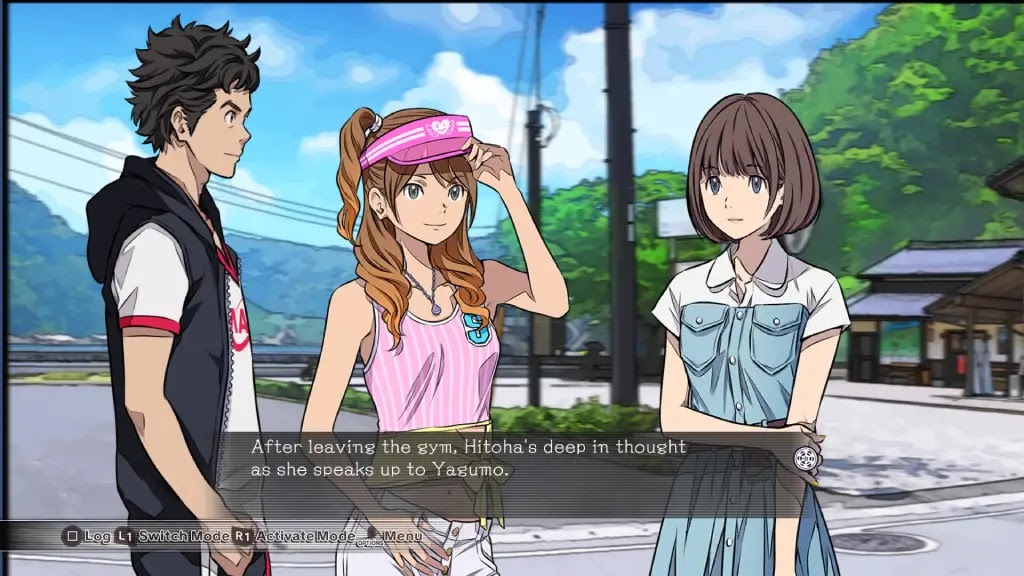
I am glad to say that the location and character graphics are well drawn. Being a Japanese style Visual Novel type murder mystery, the characters are all drawn in an anime style with a sort of old school comic type focus. The backgrounds are also pretty to look at, and are full of cultural and historical points of interest, which is really neat to see. I definitely learned some things about both science and Japanese culture while playing through Root Film. The sound track for Root Film also amply enhances the mood and tone of the locations and situations the characters find themselves, providing for a more enjoyable experience.

If there is one glaring issue, it's that the localization is a little...off, shall we say. There were plenty of occurrences where there were spelling mistakes, or a character would refer to another character in a way that was contradicted later on, or by a different character. This coupled with some of the more obtuse reasoning for some of the mysteries do put a bit of a damper on things, but is easily overlooked in lieu of the engaging story and characters, and fun Max Mode interrogations. The chapters themselves aren't overly long either, meaning you won't have to take a few days each one, and then forget where you left off. You can also save at almost any time, and there is an autosave feature whenever you leave a location, meaning if you fail an interrogation and get a game over, it's easy enough to try again.

Summary

Overall, Root Film is a great mystery style Visual Novel with some Phoenix Wright style interrogations, just with only words instead of evidence. The characters are all quirky and entertaining, the mysteries are usually quite reasonable to figure out, and if not the interrogation is a little easier on subjects that may be unknown. There are some localization issues, but those can be fairly easily overlooked for the story. Could Root Film have been better? Yes, there's room for improvement, perhaps making the animations a little more dynamic, or adding a little more player interaction to keep the viewer entertained, but Root Film certainly does provide a mystery tale worth exploring.

Score: 8 / 10


Share:

RPG Maker MZ - Software Review

RPG Maker MZ by developer KADOKAWA, Yoji Ojima and publisher DegicaPC review written by Pierre-Yves with copies provided by the publisher to both P.Y and Nick.

Estimated reading time: 11 minutes

We all love to play games and explore the far reaches of fantastic worlds offering us that break from modern life. With all of the choice out there, there's probably been a point in all of our lives where we think, I can do that. So we scribble a few things on paper here, type up a few notes there, and then when we think “let's do this” we realize how little we have, and with the little we have, that we don't know the first thing of coding (generalized statement). Thankfully there are systems out there to help with that issue, and on that subject, the latest of the RPG Makers is finally available!

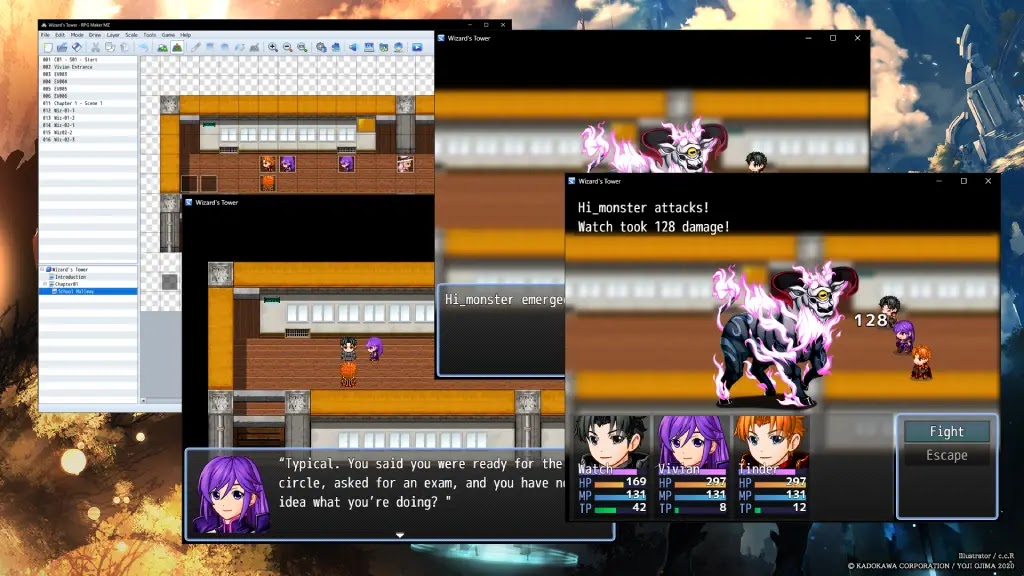
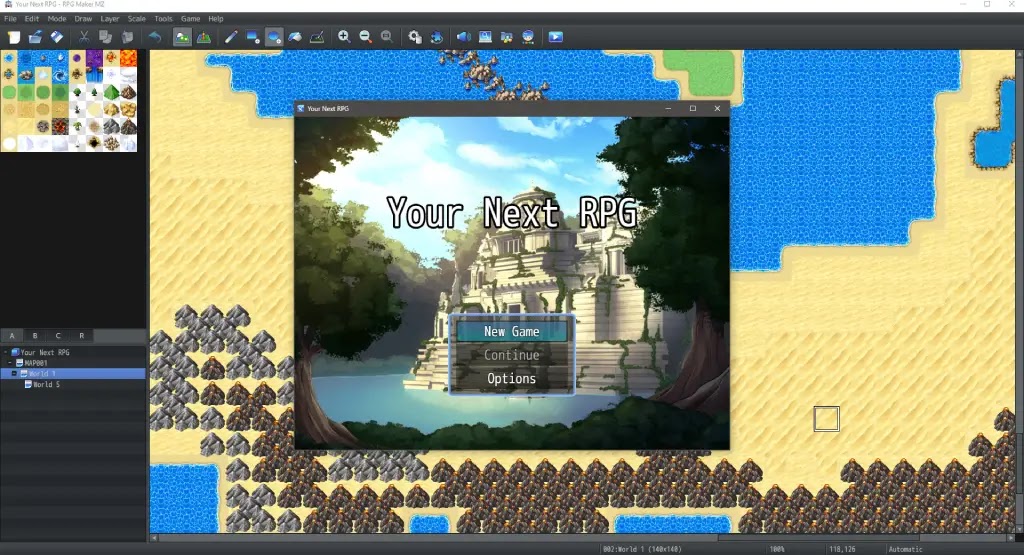
Following on the back of RPG Maker MV from back in 2015, MZ is the latest in the line of engines to help make that potential indie hit for both fame and potentially cash influx. From the outset, it may not look like much as you are treated to a toolbar, a sidebar and a workspace but from here, the world is your oyster. Set out in front of you is a robust engine with just about everything you need to make your own custom RPG, OR, everything you need to make your own action or adventure RPG with help from various pretty active communities online.

At its core though, RPG Maker MZ is designed by default for turned based RPGs. For the first time without loads of extra coding and plugins, designers now have a couple choices to pick from before getting started. Making its return, there are the standard Hero Portraits at the bottom of the screen and the enemies above. New to the engine without having to go through a few extra hoops though is the option to have the character sprites on the right side of the screen like the old school Final Fantasy entries.

More than just that, there’s also now an option to select with a Wait style in which nothing else will happen until a player has input their selection, or, an Active style that will keep on going to make everything smoother and take less time. This may not sound like much, but for someone like me who’s not well versed into this style of coding and doesn’t want to rummage through the internet archives for a plugin style that could maybe give me what I want? It was fantastic.

Now like everything, you’ll have some hits and misses through the various iterations of softwares. I mean I get to see that all the time with the constant updates of the Adobe Creative Cloud and wonder… why? So taking away one of the previous why’s from MV, MZ has now re-enabled designers to select the layer that they want to place an object on manually while also still keeping the automatic option in place. Quick and dirty or slow and calculated, each is there but the level of control from the manual was a pleasure to have back.

Heavily updated, though a tad convoluted to save your work at first, is the revamped character sprite creation suite. While you could technically create characters in MV, you knew that the characters came from the software as they all had that static RPG Maker look. It’s not a bad thing especially if it’s your first time using the suite and you would rather get everything into place before spending the vast hours creating each character, but, this time around the amount of options are a lot more varied giving your stage actors a bit more depth.

Newly present within the looks department is the ability to change the shapes of faces which helps to give more variety and really showcase youth versus age as you design the cast of your title. Male, Female, and Kid, these three options have a fair amount of options for the avatar portrait as well as the character sprites. Whether moving around the map, in battle, or “damaged”, you can do a fair bit to edit both what a character is wearing such as adding a clock to adventuring gear or a cloak on top of robes making them truly wizardly. All of these options will help a developer on a budget or a developer without design skills though, as mentioned, it’s a bit convoluted to get right at first.

Unlike the rest of the RPG Maker, you can’t just “save” your work when it comes to sprites. Instead, you have to export. This wouldn’t be so bad, but you have to export your work separately. Facial Avatars, Generic Sprites and Damaged Sprites each have to be saved to an external file that the RPG Maker will then call in. If you want to add multiple characters to one sheet, you’ll have to select the slot that you want them to be in. There are a total of eight slots and in order to fill it out, you’ll have to systematically move across the spots as you save which worked fine when working on the project, but if you stop, close the software, and resume? It took a bit in order to get my new sprites into place without overwriting those already present. The system’s upgrades are great, I just wish they made saving your custom cast easier.

Otherwise, the rest of the returning features are exactly where returning designers would expect them to be though I did find myself looking for things as it’s been a decent while since I had loaded up either MV or VX Ace. Other than painting your canvas and its layers which can take a good deal of time to do, the rest of the workload is going to be behind the events that you create in order to essentially “make the game”. Transitions from one map to another, initializing combat sequences or setting up the random encounter percentiles, or adding and removing party members. All of these actions will be handled by an event which takes a fair amount of figuring out “what does what” and “what can be done with what”.

Those with coding knowledge will feel fairly at home with these as a lot of it comes down to variables and If / Then statements. Has the party done “X”? No? Then the gate won’t open. Has the party done “Y”? Yes? The allow NPC Wizard Unit #2 to say the following when talked with. These variables are all rather powerful and the system to generate them is easy enough though you’ll want to use a proper naming system as it’s fairly easy to get lost once you start creating loads of them to get your game on the way.

At this point though, the events options I wonder if they shouldn’t start revamping its look and feel as there’s no search option and everything is split into groups under three tabs and unless you know what you are looking for, you’ll have to reach each and everyone individually. Maybe it is because it had been a while, but I did find myself having a hard time to find what I was looking for at first and that’s before adding in that you need to make sure that if you are going to be putting in triggers and variables, that they work in the location that you want them to. Once you get going it’s not so bad, but I wonder if it’s as accessible to brand new users than it is for returning designers wanting to check out the latest version.

RPG Maker MZ is a powerful tool and one that is easy to recommend for anyone thinking of breaking into game design. This isn’t just because it’s a suite that comes with plenty of built in goodies, but it’s because it’s a powerful enough engine that can easily also run your custom scripts. A few examples of titles that didn’t feel like RPG Maker titles, but were, are Stegosoft Game’s Ara Fell which is now available on the Nintendo Switch and the PS4 which was designed with RPG Maker 2003. Following that is Dancing Dragons Games’ Echoes of Aetheria which used RPG Maker VX Ace. Finally, because this list could go on, the upcoming 8-bit Adventure 2 from Critical Games uses RPG Maker MV. When asked in an open AMA on Discord back in late June, the lead designer stated that while MV and MZ are similar, projects of this scope would require a blank slate so even if they are more powerful, already established devs would really have to make a conscious plunge compared to new ones.

Finally, as a side note from me, I do want to add that the current tutorial system was a great asset as it helped me get back into the groove fairly quickly. Offering a vast amount of subjects to get someone started, or like me re-acquainted, the tutorial works off of a project that can be seen from start to finish turning that blank canvas into a decent enough demo to fairly understand what can be done with the basic engine before adding in any other plugins to turn this standard RPG into something else entirely.


Nick's Thoughts

PY's thoughts and review score are the final word on this article, but I wanted to take a few moments to touch on one of the series aspects that is often quite important to me: collaboration.

Very few of my projects over the years have been completed (though I've started oodles of them), and most of them have been solo efforts, but every now and then I get the opportunity to work with another person on a project and some versions of RPG Maker have handled project and asset sharing better than others.

I worked with Chris for this segment of the review, just to see how smoothly we could pass the overall project back and forth and also how easy it was to import a variety of assets. There was a bit of frustration on Chris' part that the tileset were again locked in at a size of 48. He likes to tinker with scale when messing with maps and sprites, and while he had not necessarily expected this part to change, he was a little disappointed all the same. That being said, many of the quality of life features PY talks about above really lend themselves to larger projects.

Importing assets works pretty similarly to MV, and that's a good thing. Chris did a handful of custom sprites, music files and backgrounds for us to play with and port back and forth and we never had any issues with those manual files. Using the Steam Workshop seemed to go smoothly as well as I pulled down a handful of files without any issue. One feature that might be happy in the future is a simple 'zip project' that pulls all of your assets into an easily shared project file (similar to how you deploy) to send to your fellow collaborator. It's not real hard to sync up if two people are sharing a single project, but it's not real intuitive either.

My impressions from working with RPG Maker MZ is that there are a lot of similarities to MV, but plentiful quality of life improvements for larger projects. Certainly, I have seen some of the features in MV as plug-ins, so the wheel is not getting reinvented here. That being said, collaborating with another user went rather smoothly from my perspective.

Summary

So overall, RPG Maker MZ is a great tool for those thinking of starting to break into game design. With plenty of newer elements to make life easier, you can just as easily import your own assets designed in Photoshop to create the game that you’ve been thinking of. With plenty of assets available through Steam, bundled or individual, and plenty of community resources, while it’s not as colossal as the Unreal or Unity Engines, you don’t need to know how to write code to get started here!

Score: 8 / 10


Share:

Week in Review - July 17th to the 21st


Welcome back to our Week in Review!
Richard started the week off with his thoughts on the latest Xanadu game Tokyo Xanadu. While those with a PS4 may want to wait until the revamp's release later this year, hardcore fans not wanting to wait or willing to do it again should really pick it up!

"While Tokyo Xanadu may not appeal to everyone, with it's lack of English voice-overs and at times clunky mechanics, but is certain to at least provide some good entertainment while waiting for your next anticipated title."
- Richard

Next up we had Nick's take on the latest RPG Maker FES that was surprisingly for the 3DS. With multiple members of the team being fans of the software it'll be interesting to see how well it takes off with the handheld.

"Like any 'Maker' game, you get out of the software what you put into it. RPG Maker Fes will provide owners with hours of game creation, assuming you can see past the non-existent early guidance and a couple of annoying aspects of an otherwise splendid UI."
- Nick

The middle of the week saw an interesting entry through a PC version of Pathfinder titled Pathfinder Adventures. Robert loved it and while I myself have mostly moved on to 5th Edition, there's no real substitute for a good Pathfinder one-shot.

"Pathfinder Adventures PC game is a wonderful port from the traditional living card game model that many are familiar with. With the excellent combat mechanics and gorgeous art, Pathfinder Adventures is a game for any fan of the franchise, and even moreso for fans of card games in general."
- Robert

Almost finishing the week on a high note Robert takes a look at Elite Dangerous' PS4 port.

"Though Elite: Dangerous on the PlayStation 4 is a straight port, it is an incredibly excellent release."
- Robert

Finishing the week on a not so high note is my review of After the End: The Harvest. Not bad by any means, this indie RPG needs polishing in order to run smoother.

"If you can get past the issues and get past the lag there's definitely a gem underneath and the developer is still working on it and providing updates."
- Pierre-Yves

Article by Pierre-Yves
Share:

RPG Maker Fes - 3DS Review


Game making software is already one of the toughest categories to try and review, and RPG Maker Fes might be one of the most difficult yet. Those who are familiar with the PC RPG Maker programs are bound to find this title somewhat limited in features, and those new to the genre may find the lack of guidance frustrating. Yet beneath those concerns and limitations is a surprisingly robust tool that can make perfectly fun games for your 3DS and those of others - which is actually pretty cool when you think about it.

Share:

God Wars: Future Past - PS4 Review


There have been a handful of excellent RPG/strategy games that have released so far in 2017, and God Wars: Future Past hangs in there with a nice mix of old school sensibilities with some modern touches that make it an enjoyable adventure until the end.

Share:

RPG Maker MV - PC Review

The latest RPG Maker MV has both a familiar focus and a new feel. Rather than trying to reinvent the wheel, it is more akin to improved accessibility and streamlining processes. While a less dramatic change than moving from RPG Maker XP to Ace, there are enough changes here to merit an upgrade for those who enjoy spending their time creating RPGs. As with any new release in the series, there are multiple things that users are excited about.


Share:

Natural Doctrine - PS4 Review

At a glance, Natural Doctrine should be a title that I immediately fall in love with. I love the RPG and strategy genres, and when they are blended together, I spend hours upon hours considering how to best level up my characters and approach the tactical situation. This dates back to older titles such as Shining Force and Warsong, but also newer games such as King's Bounty and Fire Emblem. Natural Doctrine does some interesting things but somehow manages to make a challenging title that misses the mark in enough places to hold it back. It is a shame, because I was coming into this hoping and even expecting to love Natural Doctrine, but in the end I only found myself liking it - and I suspect I am the target audience, so others may not be so forgiving.


Share:

NAtURAL DOCtRINE to land in N America and Europe in September!

One of my most anticipated games for the PlayStation 4 this year is Natural Doctrine - the type of strategy game I have a tendency to sink hundreds of hours into. My wait is nearly at an end.


Share:

Trailer and images for Natural Doctrine

Natural Doctrine is one of those titles for the PlayStation 4 we have been excited about since first being told of its impending release. The screenshots and trailer below have done nothing to dampen that excitement.


Share:

Demon Gaze - PS Vita Review

NIS America's trend of bringing strong if niche titles to the US continues with Demon Gaze. For fans of the Wizardry or Etrian series, you should feel right at home here crawling through dungeons, grinding out levels and finding new loot to either put to use or sell. The experience could prove more daunting however, if you are not familiar with first-person RPG titles.


Share:

Random posts

Our Streamers

Susan "Jagtress" N.


S.M. Carrière

Aldren


Affiliates

JenEricDesigns – Coffee that ships to the US and Canada

JenEricDesigns – Coffee that ships to the US and Canada
Light, Medium and Dark Roast Coffee available.

Blog Archive

Labels