• Kingdom's Return: Time-Eating Fruit and the Ancient Monster - PS5 Review

    Kingdom's Return: Time-Eating Fruit and the Ancient Monster is Inti Creates latest project. Blending 2D side-scrolling and town building simulation, you'll be venturing through a small interesting world as you try to restore a kingdom whose time has been stolen from it.

  • Minos - PC (Steam) Review

    The tower defense genre is one that doesn't tend to innovate much with static maps, various traps, and its simple to grasp gameplay loops. At least, that is until Minos with a mighty laugh to prove you wrong.

  • Decollate Decoration - PS5 Review

    Hello everyone and welcome to a new KEMCO title! But wait a moment, this one is different to the retro JRPGs that you’re probably expecting when you hear KEMCO from me by this point. Instead what we have is a sort of point-and-click style visual novel! Something a little new and fresh coming out here!

  • Volontes - Nintendo Switch Review

    Have you ever grown up feeling like you don't belong? For our Heroine, that's the feeling she lives with everyday in her small farming village. But it's not her only secret...

  • John Carpenter's Toxic Commando - PC Review

    Toxic Commando harkens back to video games years ago when they were fun and innovative while giving the player freedom to explore among the waves of enemies in a 4 player chaotic onslaught of combat and driving mechanics.

  • Dread Delusion - Xbox Series X|S Review

    Today we’re looking at what has rapidly become an absolute favorite in the open-world RPG genre for me. An interesting story, memorable NPCs, stunning visuals, and a setting absolutely dripping with flavor, Dread Delusion sets its tone immediately and sticks with it.

  • People of Note - PS5 Review

    ...I love music in general. After playing the People of Note demo, I knew I had to play the full game.

  • Valor of Man - PC (Steam) Review

    Valor of Man, by Legacy Forge and Numskull Games, is a turn-based roguelite RPG where you guide a party of four through ever increasing difficult situations. Achieving victory is never assured and the randomness of the roguelite nature will either be your best friend or your worst enemy.

  • Starship Troopers: Ultimate Bug War - XBXS Review

    Are you ready to do your part for the United Federation and join in the most realistic depiction of war ever created? Today we join General Johnny Rico and Major Samantha Dietz as they present the first ever game created under supervision by FedDev for the enjoyment of those on the path to citizenship. Ultimate Bug War follows the path of Dietz during the First Bug War 25 years ago.

  • Soulmask - PC Review

    Soulmask enters the increasingly crowded world of multiplayer-capable survival crafting games with a launch that has bundled its first DLC pack as a free download for anyone buying it within the first month. Featuring some striking Egyptian-style graphics...

Showing posts with label Colony Builder. Show all posts

Autarkis Full Release is Available Now on Steam with Launch Discount!

Zurich, Switzerland - September 1st, 2025 | Metaroot and rockingprojects are pleased to announce that AUTARKIS, the puzzle colony builder in which you play against time, is now fully released on Steam, with a 10% launch discount.


Build colonies and portals. Protect your settlers from catastrophes. Find the lost components. Mine resources. Escape with a rocket. Save us all!

Check out the game page on Steam here: https://store.steampowered.com/app/2378160/AUTARKIS/

About rockingprojects:

rockingprojects is a project by passionate indie developers, based in eastern Germany near Berlin. Our goal is to embrace the technical and visual challenges of modern game development and bring our ideas to life professionally.

About Metaroot:

Metaroot is a small publisher and marketing agency based in Zurich, Switzerland. Metaroot has published the programming game "The Farmer Was Replaced", the Tetris like city puzzler "River Towns" and the nature simulation game "Of Life and Land".


Article by: Susan N.
Share:

Evolugame Invites You to Build an Evolving City in Food Industry Soon!

Paris, France – August 12, 2025 | The studio Evolugame announces the early access release of Food Industry, a strategic and evolving city builder, scheduled to be released on Steam (PC) in Q4 2025.


Blending modern innovations with classic management mechanics, Food Industry offers a fresh experience set in a world disrupted by the excesses of industrialization.

A strategic, immersive, and eco-friendly city builder

You take on the role of the leader of a new colony. Your mission is to build a modern city where food production is at the heart of survival and prosperity. Construction, resource management, citizen satisfaction, and adaptation to climate events form the pillars of your strategy.

Environmental challenges such as climate change and pollution pose major threats, requiring careful attention to avoid collateral damage and public unrest.


Rebuilding a sustainable society 

Years of massive industrialization and overexploitation have deeply disrupted the climate, making it unstable and triggering violent storms and major ecological shifts. 

In the face of this situation, you have been forced to start over on new lands. Your task is to rebuild a sustainable society while avoiding the mistakes of the past, in a changing world where food has become a currency.


Game Features

  • Agriculture: Plant, grow, and raise animals to feed your citizens
  • Construction: Expand your city and manage priorities
  • Economy: Adapt the supply of goods to meet the needs of the population
  • Modular Industry: Customizable and upgradable production lines
  • Micro-management: Plant and harvest crops, organize market stalls, sell goods, assemble machines
  • Energy Resources: Produce oil, water, and electricity
  • Weather & Pollution: Extreme climate events with real impact
  • Population Morale: Handle citizen anger, protests, riots, and strikes
  • Task Automation: Hire staff and transition from micro-management to full automation
  • Research & Development: Technology and progression tree
  • Design Office: Discover and optimize blueprints for automated factories
  • Immersive World: Detailed, colorful graphics and a rich soundscape

ABOUT EVOLUGAME

Founded in 2019, Evolugame is an independent video game studio based in France. Developed solo, Food Industry is a passion project built with Unity, crafted with care by a dedicated and committed indie developer.
Article by: Susan N.
Share:

Microtopia - PC Review

Microtopia by developer Cordyceps Collective and publisher Goblinz Publishing and Gamera Games—PC (Steam) review written by Susan N. with a copy provided by the publisher.
 
Estimated reading time: 8.5 minutes

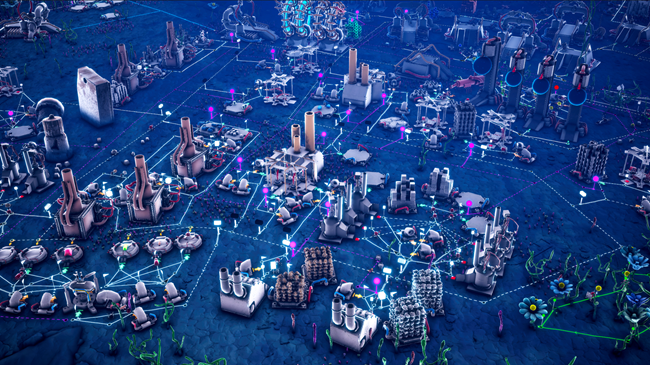
Microtopia is a neat game where players grow a new kind of colony, the kind that is run by robotic ants. Now if an automation game where you get to control robotic ants isn't an interesting one, you've been living under a rock. Your job is to automate the building, gathering, or smelting of materials to create an epic supply chain and rule this ant world. There's just one draw back, you have to do all this knowing that your ants have a short lifespan. 

I shall talk a bit about this interesting game with my thoughts on both the good and the bad points to paint a picture of this particular civilization.


Gameplay


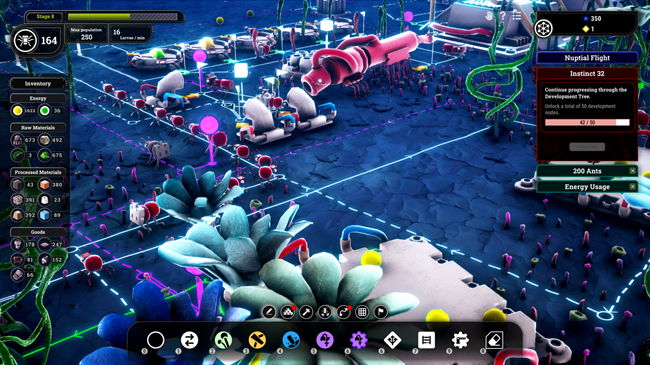
The first action you take is to place your robot queen ant. She will spawn larvii that turn into cute little small ants that hold the weight of the colony on their shoulders. Right off the bat, you have four worker ants that don't die (at least, from my experience that is true). These ants have to collect some resources before you can do anything significant. Naturally, that means you will have to gather enough resources to build a warehouse and an incubator. The warehouse will hold the shiny supplies you collect while the incubator zaps the larvii into small worker ants. Those worker ants will comprise the bulk of your colony as they are the ones responsible for collecting and crafting the materials needed to expand.

Each unit type has a limited life span (with exception of the original four worker ants), meaning that you must continually feed the queen in order to produce more larvii. If the ants don't feed the queen, she can no longer produce larvii to keep the colony thriving. Another thing to note about the queen is during the beginning stages of gameplay, you can only have one. She cannot move on her own either, although you can manually move the ants and the buildings whenever you like. 

As you progress through the game, you will be able to research new technology and expand onto new islands. With respect to the new technology, it has to be researched in the tree by using points collected by an inventor ant. The inventor ant is made in the combiner which merges them into a larger ant. It is unique in that you have to feed it until their bubble is full enough to burst. Literally. Once you manually click on this large blue bubble, you will receive research points and the inventor ant dies. 


Once you unlock enough technology in the tree, the game becomes more complex. It is not uncommon to redo your entire base because of new pathways or buildings that may be larger than the area you have. It also makes the game a bit frustrating as you may find yourself shuffling your whole production line repeatedly. When you combine that with the unique way of gathering research points as well as the life span of your ants, the game can get messy. 

Tech Tree

Let's talk about the tech tree for a few moments. I saw that the tech tree is quite vast, and it has it's downsides. When you begin the game, there are limited paths you can draw for your ants to travel. As you continue through the tutorial, you will gain access to cutting paths and gathering paths, both of which you have to be mindful of their usage and placement. After that, you will gain access to logic gates to how many ants can go to another line so that you don't lose production or collection in another area. You will even get to unlock splitter lines and 'null' lines. Naturally, the splitter lines are self-explanatory, and the null lines are used for allowing ants to take that path if they don't have resources in their hands.

The tech tree allows you to unlock fabric, iron plate tiles, the ability to unlock copper, and even the skill to morph an ant into a flying variant! On the surface, the tech tree is decent enough to progress through the game while still providing a challenge. Although, I do have some gripes about the tech tree which I will get into later in the review. 


Graphics and UI

Microtopia is quite cute for a colony builder. It has a unique visual aesthetic that drew me to the game in the first place - that and my love of ants. Believe it or not. Anyways, I couldn't help but chuckle when I began my ant colony because they literally have IC's (Integrated Circuit) for heads! What an interesting idea! Anyways, the game has a vibrant color palette that certainly fits well with the various machines and objects used by the ants. 

When you start discovering new islands to explore, you will find that they have different color palettes because they are different biomes with different materials. How these biomes are found is none other than the radio tower you have to build which establishes a connection with other ant colonies. On the one closest to my starting island, I have access to copper among other materials. So visually, Microtopia is rather pleasing because it has unique plant life and a different take on a colony builder. 

The UI is alright, but it has some shortfalls. While it is clean and doesn't bog players down with too many windows or information about the colony, I have some gripes. For one thing, manually clicking on an ant to move it to another place requires you to click a path all the way to the required destination (if it isn't on a path). Many games allow you to click on a unit and then click an end point to get it to the desired location. This is not the case in Microtopia. You have to click individual points around the obstacles to get them to its intended destination. Now, the problem with this is if you are looking to move multiple ants, you might not be able to because there is a building blocking the path. In the early game stages, this isn't as much of an issue as it can be in the later part of the game.


Another aspect of the UI that I dislike is the lack of ability to see where ants are - or more importantly if an ant ended up somewhere without a path to follow so it is sitting idly. To add onto the shortcomings here is the fact that depending on the object, you cannot manually move it. Most materials that are used in the construction of items can be picked up by ants. What I discovered that can't be picked up are rogue larvii that end up on the ground instead of in the incubator. What's more annoying is the inability to kill it or have it die over time. And on the subject of dying ants, I would love to have the ability to remove them off the field instead of waiting for a dead ant to despawn.

That said, we are given enough information about how many ants are on the map as well as what type they are. Also, there is another tab that displays your total inventory levels, which is particularly useful as you need parts to build machines. Another positive point about the UI is the ability to track tech tree objectives and you are able to minimize each progression step as needed. In summary, the UI is decent, although imperfect, for the player to see their colony at a glance.    

The Good and the Bad

Microtopia is a game that has an interesting take on the standard colony builder. Often the genre is filled with titles that have similar aspects even if they take place in different time periods. The basic food production is similar, building shelter for your citizens is paramount, and recruiting new people to your expansion efforts is often the lynchpin. However, Microtopia tosses a few things out the window in favor of a different method to colony building. There is no food production, there are only fruit bearing plants that certain ants consume. Although, most of your ants don't need to eat! Heck, they don't even need oiling from what I can tell... *heh*

As you have robotic ants as your citizens, you will discover that these ants also do not require shelter from the elements. The only purpose for building your colony is collection and expansion. Who cares about all the other stuff, right? And recruiting more ants is as easy as feeding the queen so that she can produce larvii. 


When you account for the fact that the graphics are vibrant and cute, Microtopia starts off on the right foot. It allows you to start your colony on the island in whatever location you wish. The game also gives you a sizeable tech tree to work your way through and even if you cannot reach some of the technology, you can see what a node will unlock because it is listed!

Though, no game is perfect, and this one is no exception. Among the negative points about the game are needing to rearrange your workers and buildings frequently. This could be because of a lack of understanding about the different paths or simply not having access to the right types of paths until much later in the game. I found it to be prohibitive that I could not simply create an inventor path, as an example. Also, the scrap piles may seem like they have a lot of materials in them, but you will have to move your paths to hit new piles a bit more frequently than I like.

Another big thing that frustrated me was the tech tree. For one thing, while you can see what you are working towards, you cannot see the prerequisite lines to the next bit of technology. At least, you cannot see those lines easily because they fade in and out quickly, and they are rather soft in color. What's even more frustrating is having to wait on a seemingly invisible milestone to unlock the tech you want. I spent a good amount of time waiting to see how much something would cost but that never became visible to me. 


While we are talking about the time restrictions, the biggest detriment to the game right now is the early game is mostly a waiting game. While you could make an argument that you have to constantly watch for when resources run low, it's just not enough to stay invested. Although, Microtopia tries to mitigate this fact by forcing you to micromanage your colony as you deplete resources. Generally speaking, colony builders share a few elements, but the biggest one of them all is the ability to speed up time. A feature which this game does not have. For a game that relies on automation and logic gates, it lacks clarity and features for me to play it consistently. 

Final Thoughts

As much as I enjoy the concept of this unique departure from the average colony builder, Microtopia doesn't quite do enough to keep me interested. It has robot ants that have relatively short lifespans, interesting concepts, and a sprawling tech tree. It just became tiresome too quickly for me to add it to my regular games list. Although, I will say that the game isn't bad per se, it simply lacks needed features and some reason to replay it beyond a couple of sessions. For one thing, the game doesn't have a tutorial skip or sandbox mode which might entice people to play it more frequently. It also isn't clear on the time passage or the milestone requirements to advance in the tech tree. And the help feature does not add to the information it already tells you from the first time you are introduced to a new material or building or pathway.

With all of that said, I really wanted to love playing with these fascinating ants, but there are enough small issues and lacking elements that made me lose interest rather quickly. But, even with my lack of interest in the title over time, the game is decent enough and it has a good number of positive reviews on Steam. Take that for what you will. I hope that a time skip and a tutorial skip can be implemented later on, and that there is a bit more work done with respect to progression.

Score: 8 out of 10

Share:

Goblinz Publishing and Cordyceps Collective Launch Automation Game with Ants Today!

January 29th, 2025 – Cordyceps Collective and Goblinz Publishing are thrilled to announce that Microtopia, a fresh automation game with a quirky futuristic aesthetic and a unique twist, is coming to PC via Steam and GOG on February 18 for a base price of 19,99 USD, with a 10% launch discount for the first two weeks.


In Microtopia, you’ll manage a colony of robot ants, design a network of transport trails, explore unique environments, and expand your settlement.

Your goal? To reproduce! Create young queens that will fly out during the nuptial flight to spread to distant lands, starting the cycle anew.


KEY FEATURES

  • Establish Your Colony: Deploy your queen to build a thriving ant colony in a world of electronic waste. Command Your Ants: Use trails and buildings to guide your ants as they collect materials, produce goods, and feed the queen.
  • Optimize & Innovate: Utilize logic gates to sort ants on different parameters to create efficient workflows.
  • Evolve Your Workforce: Upgrade ants into specialized castes like drones, diggers, and inventors.
  • Unlock New Tech: Progress through a tech tree to access powerful upgrades and abilities.
  • Explore & Expand: Fly to nearby islands, uncover colorful biomes, discover new plant species, and harvest their resources.
  • Reproduce: As with all life; your goal is to reproduce! Gather up enough resources to build young queens to let them fly out and start new colonies!


About Cordyceps Collective

Cordyceps Collective is a collaborative endeavor formed by Game Director Tijmen Meijer, Programmer Maarten Brouwer, and Art Director Floris Kaayk, all based in The Netherlands. This team previously developed the indie game Next Space Rebels, released in 2021 across multiple PC and console platforms and published by Humble Games.

The soundtrack for Microtopia is crafted by renowned Dutch composer and sound artist Rutger Zuydervelt, celebrated for his work on the soundtrack of the indie hit game Astroneer.

About Goblinz Publishing

Goblinz is an indie game developer and publisher based in France specializing in strategy and management games. The studio’s first title Dungeon Rushers debuted in 2016. Following the game’s successful launch, the studio followed up with Robothorium, released in 2018 and has since worked on numerous other titles such as Legend of Keepers, Terraformers, Hero’s Hour, and more.
You can find out more about us on our website, our Steam publisher page, our YouTube channel, our Discord server, and our X account.


    Article by: Susan N.


    Share:

    Surviving The Abyss Preview

    Surviving The Abyss by developer Rocket Flair Studios and publisher Paradox ArcPC (Steam) preview written by Hayden with a copy provided by the publisher.

    Estimated Ready Time: 7 minutes

    It’s time to blast off once again and make a new colony in the harsh vacuum of the alien world known as… *checks notes* …Earth? Yes, that’s right, Surviving The Abyss takes the familiar-looking tropes of domed facilities connected by sealed tunnels and drops it right in our own backyard. Set in an alternate version of the 1960’s, early experiments with cloning humans were (sort of) successful, producing living, breathing humans that had just one tiny little flaw - they died in a matter of weeks. While an outraged public forced a shutdown of cloning research, you’ve been brought in by the military to keep the research going in secret. Their chosen locale? Kilometers beneath the waves, in the crushing depths of the ocean, far from the prying eyes and obnoxious morality of Joe Q. Public!

    The game starts you off with the typical colony-builder basics of a central hub and a few machines used to harvest resources and construct buildings. The aesthetics here definitely support the quasi-60’s setting, with the subs using what look like giant mechanical claws to manipulate things rather than something high-tech-looking like a laser beam. Construction, though, is a bit of a break from that look, with the buildings rendered in a wireframe when you place it that slowly fills in during construction. For a 60’s setting, that struck me as very 1980’s Tron-like, and was hard to square with the rest of the setting. Personally I would have expected some kind of dropping girders and frames on the building with those giant submarine claws, but as I’m neither the developer or anything approaching a competent digital artist my opinion holds about as much water as the shipwrecks that are scattered on the seafloor here and there.

    Soon enough, your efforts to get established will run into a shortage of resources, especially crew. At this point it’s time to remember your stated mission here and break out the cloning vats and research labs! Scattered across the seafloor are various habitats for undersea life, and these habitats are what your scientists need to try to stabilize the genomes of your clones. The better your samples, the longer your clones will live - initially, you’ll be lucky to have them for a month of useful work before they die of old age. Of course, once humans get involved, habitats quickly get over-harvested, and Surviving The Abyss acknowledges that. Unless you specifically devote extra resources (crew, along with the power, oxygen and food needed to support them) to maintaining these habitats, you’re quickly going to run out of your fresh fish and chips in the mess hall - oh, and in your cloning lab too. Since you need crew to replenish the things that you harvest to make your clones to replenish and expand your crew, well, you can see how this quickly becomes a cycle in which you are trying to extract more genome material out than it takes to keep replacing the fast-aging clone crews that are doing the extraction in the first place!

    If I have a beef with the game, that last paragraph really shows where it is. The early game can feel like a Red Queen’s Race where you’re madly rushing forward just to avoid losing ground. From limited resource deposits to early clones that die fairly quickly, to building efficiency being hugely dependent on where your resources spawned on the map in relation to each other, the early stages of Surviving The Abyss are going to be most appealing and rewarding for players who love to micromanage. For those that like a bit more of a relaxed build-up, Surviving The Abyss is going to have some early gameplay that is hard to move past.

    As I touched on before, Surviving The Abyss is visually gorgeous, and overall holds to the 1960’s retrofuturism aesthetic fairly well. The environment has just enough shimmer or distortion at the edges of your view to remind you that you’re underwater. The seafloor is done in the slightly wavy sand patterns that any beach-goer will recognize. The way your base’s lighting goes to emergency reds when fuel runs low, and even the way the mysterious leviathans attacking your base loom imposingly out of the darkness, full of shadowed, jellyfish-like tentacles really adds to the atmosphere. Oh, you thought you were alone down here? Silly human, you’re not the apex predator in this environment…. 

    Speaking of light and darkness, Surviving The Abyss makes good use of lighting as a substitute for a fog of war effect. Being deep beneath the ocean, no light from the surface reaches you to illuminate the area, so you need to light up the areas that you are going to work and build in. Like everything else, that comes with a power cost, and the 1960’s technology you start with means you’re not using fancy eco-friendly green power sources but rather coal-burning power plants at the outset. If you’re thinking “ew, coal?? Underwater??” you’re absolutely right - not only are you scouring the seafloor for small exposed deposits of coal to keep your base running, but the exhaust from the plants reduces the air quality in your base since it is a closed system. Now you’re trying to research basic air purification systems while keeping your people (I’m assuming 1-month clones still count as ‘people’ here) healthy enough to work through the indoor smog.

    In writing about Surviving The Abyss, I keep trying to touch on different topics, and always end back up on the costs that the game imposes. It is both a blessing and a curse, since a colony builder is inherently concerned with resource management, and the harsher the environment it is set in the more of a concern those survival items need to be. On the other hand, it makes me realize as I try to deconstruct the game for this preview just how harsh and punishing those game loops can feel at this early-access stage. At the same time, I struggle with thinking which of these mechanics the game could do to lose or markedly change the balance on, without seriously affecting the overall feel of being in a harsh, isolated environment.

    Summary

    Overall, Surviving The Abyss is a visually beautiful colony builder that is going to appeal to players who enjoy micromanagement in their games. This isn’t a set-it-and-let-it-run type of game where you can go grab dinner while you wait for resources to accumulate, and that’s great if you know that going in. I’m also optimistic at the pace that patches and updates have been flowing out since the Early Access release, as it shows that the developers are focused on keeping the game in a playable state while they go through the EA process. This is a good one to pick up if you like your colony builders challenging, and one to avoid if you like games that just require you to tweak some variables and watch the outcome.

    Score: N/A
    Share:

    Land of the Vikings Preview


    Land of the Vikings by developer Laps Games and publisher Iceberg Interactive—PC (Steam) preview written by Susan N. with a copy provided by the publisher.

    Estimated reading time: 9 minutes


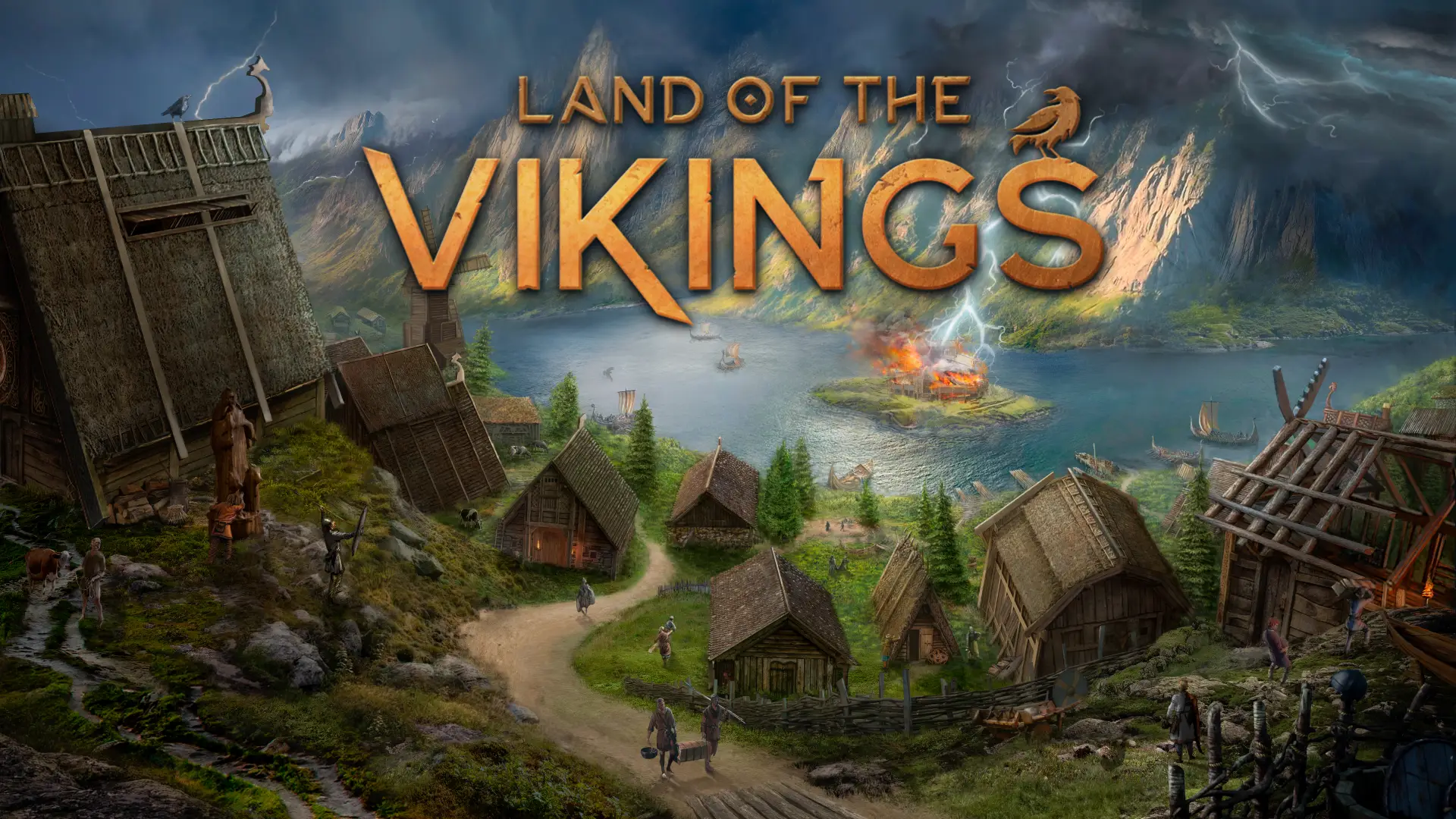
    Laps Games delivers a beautiful game in Land of the Vikings, a new relaxing colony builder. You begin the game with a nice fertile plot of land where you can grow crops, set up warehouses, and erect lodging for the people. Unlike most colony-building games that rely on the simple expansion of people, Vikings adds an element of conquest on top of that. While it is not without its flaws, the title has a lot of promise as it progresses through the early access phase of its development.

    Gameplay

    Like most colony builders, you can expect that it has expansion elements capabilities, resource management, and financial management. However, what makes Vikings unique revolves around two key features: the ability to create an army in search of conquest and surviving the harsh environment while choosing the outcome of conflicts between your people - which will be covered in the next section.

    Aside from that, you can explore the surrounding area for the perfect location to settle with different mountains that are rich with resources to plunder. The area will have fertile ground perfect for hunting and foraging. Plus, expanding onto the sea will yield plentiful resources and allow for trade agreements that can boost your civilization.

    That said, outside of keeping an eye on storage space, adequate lodging, and total coin on hand, there are other aspects of the game that are interesting. For one thing, you're able to decorate the colony with statues and shrines which actually provide a benefit beyond happiness augments. When adding beautification for your Vikings, placing crates will increase storage space by a small amount while other decorations boost Viking productivity or morale!


    Harsh Environments and Viking Conflicts

    Without touching on these two elements in great detail, Land of the Vikings has plenty of challenges for you to deal with. The first is the harsh environment colonists endure. People often die from starvation, lack of heat, or homelessness. Specifically, Vikings have to deal with fierce thunderstorms which can burn down buildings at random. You have the option to either rebuild (at the full cost of the original construction) or demolish the building.

    This, in itself, is particularly challenging to the gameplay loop as those are expected issues. The part that makes Vikings interesting is the conflict popups between colonists. Often you receive three choices which include kicking a person from the colony, having them compensate the others, or forgiving them. In other cases, you might need to choose between sacrificing animals, donating money, asking villagers to help, or abstaining from a resolution of any kind.

    Between the thunderstorms that can halt expansion efforts and the conflicts produced by a growing populace, Land of the Vikings can hold its own among other games in its genre.


    UI and Graphics

    One of the main gripes I have about Land of the Vikings is UI details that are critical for gameplay. For example, once players build the training facility they need to assign people to train. The issue with the UI is that the building itself doesn't need the resources physically present, nor does it need citizens to transport anything to the building for storage. While the Land of the Vikings removes the micromanaging requirement that is expected, it fails to display how many of your resources are on hand without opening the resource tab. It may be minor to most, but I actually thought this was going to be a fatal flaw.

    Another small issue with the Land of the Vikings is the constant need to assign trees to demolish. Unlike other simulation games that allow you to assign specific areas for planting and demolishing trees, this game requires constant micromanagement. Perhaps the only saving grace is that trees regrow quickly and on their own. Having to assign the demolishing of individual trees is painful. Removing one irritating management aspect to replace it with another was not a great decision, in my opinion.

    Aside from those problematic UI elements, the graphics and UI design are wonderful. The UI doesn't overly clutter the screen and each popup box can be opened and closed at will. Zooming in on individual buildings will show a great deal of detail on the structures and the people. What is neat about the Land of the Vikings is that most of the colonists don't look too similar to each other! Each character model is unique enough without feeling like they're carbon copies.


    Grow Your Viking Colony in the Skill Tree!


    As this is the Land of the Vikings, it's no surprise that the skill tree would be shaped like a tree. Each large branch has skills that are divided into the following sections: Trade, Military, and Colony. Any perks gained from the core part of the tree help fortify the colony itself by increasing production, speed boosts, or happiness levels. It will give access to certain buildings required to advance through objectives. One of the branches will boost or unlock the ability to trade with other colonies. The other side covers military building unlocks and upgrades.

    Pros

    The Land of the Vikings has a fantastic foundation to solidify its place in the colony builder genre. It has a number of handy elements that ensure the colony's survival like clean UI windows, random conflicts to challenge you, and army management. While the addition of conflicts increases the complexity of the game, it is further engaging by obfuscating the skill tree behind a fog of war. You will have to plan accordingly in order to fulfill objectives, which adds to the fun.


    Additionally, the Land of the Vikings is a visually stunning game. The weather effects are realistic as they aren't instantaneous. For example, the snow gradually sticks to the ground as the season changes.


    Cons

    While no game is truly flawless, Land of the Vikings has a few small problems that may need addressing. Other than the items listed previously, another minor issue is the need to micromanage harvesting crops. While I understand that there are certain micromanagement aspects of colony builders that people dislike, requiring players to manually harvest basic crops is a pain in the ass. Why bother assigning people to the building if they can't perform a basic task? Why is it that the training facility no longer requires micromanagement of its supplies where the farming ones need attention? Please make it make sense!

    The final issue with Land of the Vikings is the inability to upgrade one house to a better house. In order to get a better house, you must first demolish one building and then erect the better one!

    Final Thoughts

    Land of Vikings is a great colony builder, despite my minor grievances. It has a solid foundation as a colony builder because it has everything including military conquest. The game is incredibly well-polished and it is a great game to play, even in its early access state!


    Anyone interested in the colony builder genre would not be disappointed with this one!


    Score: N/A


    Share:

    The Wandering Village Preview

    The Wandering Village by developer Stray Fawn Studio and publisher WhisperGamesPC (Steam) preview written by Hayden with a copy provided by the publisher.

    Estimated reading time: 5 minutes 


    The Wandering Village by developer Stray Fawn Studio and publisher WhisperGames is a beautiful new entry into the colony sim genre. Taking control of a small group of nomads who are fleeing the slow corruption of their land by toxic spores, you climb aboard a giant creature known as Onbu to make your home as it slowly plods across the land. As you build your home, you must be mindful of the limited resources within reach as you travel. You will need to balance not just the familiar needs of your village, but those of Onbu as well. You will need to watch for poisoned air affecting your people, toxic plants taking root near your village, and even ailments affecting the Onbu on which you live.


    Climb aboard Onbu, make your village and see the world. Just hold on tight when it flops down to sleep for the night!

    The Basics

    Like most colony sims, The Wandering Village has the player balancing the resources available to the settlement. Food production, housing, happiness and various construction materials are familiar territory for players. As has become more frequently seen in titles lately, there is also a focus in the game on scarcity and interaction with your environment. In this case, the Onbu that carries your village around is the personification of that (more on that later). The resources available to the player on Onbu’s back are inherently limited to what can be found within that limited area. Only so many trees and rocks are on Onbu’s back, and the creature’s size creates a limit to how far your village can sprawl.


    For being on the back of a giant Onbu, this happy, thriving village looks like it would fit into any number of colony sims.

    The Twist

    As the player is traveling on the back of Onbu, there are opportunities to investigate and scavenge the environments as you pass through. Certain buildings will allow the player to send out teams to investigate points of interest nearby: forests, quarries, mines, ruined settlements, and the list continues. Depending on how far away from Onbu the teams have to travel, their total job time will vary. Investigating something just ahead of Onbu’s line of travel is quick, while investigating things far off to the sides or already behind Onbu take considerably more time. Your investigation options are also limited to a specific area around Onbu that you can see - once you’ve moved past a location, it is hidden and inaccessible to you.


    What you see is what your scavenging teams can reach. Once you've passed it by, it's gone....forever?

    The other part of The Wandering Village is your relationship with the creature Onbu itself. Onbu needs to eat and sleep, has its own health and sickness (poison) pools, and needs to decide where and when to wander. The player has access to various buildings that can interact with Onbu directly, from trebuchets to feed Onbu to doctors and dung collectors (hey, its massive amounts of free fertilizer!). The darker side of this is that the player can also choose to do things that hurt Onbu - extracting blood and minerals to fuel the village, feeding it medicated foods to alter its metabolism and so forth. Onbu will react to this by altering its trust in the player, making it less likely to heed the player’s suggestions on when and where to move. Lose enough trust, and you might find Onbu wandering into a desert full of storms that will wreck your buildings!


    Onbu's health and condition is a constant presence in your village stats in the top right corner. And Onbu itself is hard to miss too!

    Excellent Extras

    The Wandering Village includes a few nice touches that help it stand out. For example, players will find on the main settings menu that Twitch integration is built in. In The Wandering Village, this allows the game to pick up the names of people in stream chat and use those as the names of the villagers. Don’t like the jokes that PookyPie423 is making in chat? Maybe a stint manning the dung collector is in order!

    The way that The Wandering Village uses variations in biomes is a great touch as well - moving from forest to plains to desert to frozen tundra forces the player to adapt. Different crops, different methods of obtaining water, and even different job priorities can be appropriate depending on the local climate. This variety really gives The Wandering Village a nice leg up on other colony sims that try to use weather and seasons to influence play, by breaking the predictable cycle of seasons that players are used to.

    Moving to Full Release

    The Wandering Village just launched into Early Access on September 14, 2022 and developer Stray Fawn Studio has been very open with their plans on how to move through Early Access. The developer speaks to this directly on the Steam store page, and gives about as much certainty as could be reasonably expected at this stage:

    How is the full version planned to differ from the Early Access version?

    The full version will have a bigger set of features and more content. We plan to add new building types, new biomes, new events/missions and expand the background story of the game. It will also be more polished, having gone through lots of testing and QA. We are also planning to add controller support to the game alongside other Steam features such as trading cards and achievements. And finally, we're sure players will have lots of interesting ideas during Early Access which we will consider implementing as well.”

    Summary

    The Wandering Village is a solid, well-balanced colony sim with a broad enough feature set at the point it has entered Early Access to keep many players happy for quite a chunk of play time.

    Consistent, high-quality graphics and animations make both the village and the giant creature Onbu come alive, and a relaxing sound score manages to not become repetitive or intrusive even after hours of play. Variations in biomes as you travel and build keep play fresh and challenging, avoiding the stagnation of a single “ideal” build style that other games sometimes create. This is a great entry for colony sim and management sim players, and definitely worth wish-listing if you can’t buy it right away.

    Score: N/A


    Share:

    Autonauts Launch is Successful According to a New Infographic


    London, UK - Thursday, 31st October: Today Curve Digital and Denki have released a new infographic to mark Autonauts’ impressive launch on PC earlier this month.

    In Autonauts players are responsible for colonising planets by harvesting natural resources using the power of robot-powered automations which they code on the fly.

    It’s clear this unique ‘Playful Programming’ premise has struck a chord with many management game fans around the world with over 57,000 tutorials completed and 88,000 achievements (commonly known as badges) in-game unlocked. The infographic accompanying this press release has more delightfully colourful insights.

    This impressive scale is also reflected in Autonauts’ sales since launch according to its publisher, Curve Digital, who have stated that the game has become one of its best sellers.

    "Everyone at Curve was totally enraptured with Autonauts the moment we first set eyes on it – so to see it received so well globally has been a genuine thrill,” said Simon Byron, publishing director at Curve Digital. “To become Curve’s fourth highest-grossing Steam game within 7 days of launch is a real endorsement of the game Denki have created. With some significant free updates in the works, this is just the start of our adorable Bots’ adventures."

    Priced at £17.99, $19.99 and €19.99 respectively, Autonauts is currently sitting at 79 on metacritic and has over 477 reviews on Steam, 83% of which are positive.

    Curve Digital and Denki are also happy to announce an aggressive post-release strategy for Autonauts which will see the game receive meaningful new features and content for at least the next six months and importantly, all of this new content will be added to the game for no extra cost.

    "The response to Autonauts has been just phenomenal. We want to thank everyone for supporting the game, not only since its launch on Steam but also back in the old pre-pre-pre-Alpha days on itch.io," said Denki's Creative Director Gary Penn.
    My dev bud Aaron and I are amazed by what players are doing with Autonauts: some cunning script ideas, some lovely-looking worlds and some surprising bugs, which we're fixing - and acting on suggestions, too. We're also working on lots of fab new ideas for free future updates, like more technology, machines, structures, vehicles, resources and a whole new Age for the game. We'll share more about all that Autonaut-y goodness real, real soon. Cheers!

    To learn more about Autonauts and to stay up-to-date with the game’s continued evolution, please visit the official Steam product page: https://store.steampowered.com/app/979120/Autonauts/


    About Curve Digital

    Curve Digital is one of the leading publishers of games on PC and consoles. Since 2013, the company has been working with some of the world’s best game developers to help bring their games to the broadest possible global audience; from indie hits like Dear Esther to the likes of the multi-million-selling Human: Fall Flat. In 2017 Curve Digital was recognised by the celebrated Develop Industry Excellence Awards as ‘Publishing Hero’ and crowned ‘Indie Games Publisher of the Year’ at the 2018 and 2019 MCV Awards. Curve Digital was also a 2019 finalist for MCV’s ‘Community Management of the Year’.

    About Denki

    Denki is a video game developer based in Dundee, Scotland which was founded in 2000 by 4 developers from the now-defunct, DMA Design. Denki has worked extensively in the digital interactive television (DiTV) market, as well as other gaming platforms, and has produced bespoke licensed gaming products with the biggest entertainment brands on the planet. Autonauts is an original IP from the studio and their next big release.


    Article by Susan N.

    Share:

    Surviving the Aftermath is Available on Epic and Xbox Game Preview


    BERLIN & STOCKHOLM -- Oct 19, 2019 -- Paradox Interactive today announced Surviving the Aftermath, the next chapter in the publisher’s Surviving brand, is now available in Early Access on the Epic Games Store and Xbox Game Preview. Developed by Iceflake Studios, the post-apocalyptic colony builder is being co-developed alongside the community with regular updates incorporating player feedback. Players who want to get in on the ground level and participate in the game’s Early Access period can purchase Surviving the Aftermath at an early-bird discount of $19.99 / £15.49 / €19.99. Surviving the Aftermath will leave Early Access and launch on Epic Games Store, Steam, Xbox One, and PlayStation® 4 in late 2020.

    Check out the Early Access launch trailer to see Surviving the Aftermath in action.
    In Surviving the Aftermath, players will build and manage a colony of survivors in the shadow of a world-ending event. Resources are scarce following the apocalypse, and survival requires mastery of complex systems to optimize production and colony management to ensure nothing is wasted. Players will construct buildings, manage colonists, adapt to natural disasters and more in an effort to restore civilization.


    Surviving the Aftermath is more than a colony builder and enables players to go beyond the shelter to explore a dangerous world filled with unique biomes, hazards, bandits, and more. Recruit and send out teams of Specialists to gather resources and intelligence about the world around the colony. Players can see what their teams have discovered by utilizing a vast overworld map that adds layers of strategic gameplay not typically included in a colony builder.

    “Throughout Surviving Mars’ development we learned the importance of listening to our community and their feedback helped elevate that game to new heights,” said Nikhat Ali, Lead Producer on Surviving the Aftermath at Paradox Interactive. “With Surviving the Aftermath we want to get our players involved as early as possible so we can make sure we’re making the game they want to play. We have an ambitious content schedule ahead of us that includes monthly updates where we will incorporate feedback from our players and we’re confident the team at Iceflake is the right team for the job.”

    “Surviving the Aftermath is the game we’ve always wanted to make,” Lasse Liljedahl, CEO and Lead Designer at Iceflake Studios, said. “When we pitched our plan to Paradox, they recognized our passion and commitment to making this game the best survival colony builder it can be. We’re beyond thrilled to finally share our dream project with the world and to have the support of one of the industry’s leading publishers.”

    Surviving the Aftermath Features:
    • No Place Like Home: Build and manage a colony of survivors after a world-ending event. Construct more than 50 unique buildings to handle everything from resource collection and farming to exploration and security. Don’t forget to construct the Gate to venture into the savage world beyond your colony.
    • Surviving Earth: Explore a vast procedurally generated world featuring six different biomes filled with exploitable resources, bandits, and more. Each environment has different conditions that will affect your colony’s survival. Stay vigilant: Natural disasters will put your survivors to the test.
    • Survival is my Specialty: Recruit over 46 unique Specialists, each with their own skills and motivations, to manage your colony’s resources and production. Send them beyond the Gate on scientific missions, scavenger runs, and to fight bandits.
    • Expect the Unexpected: Life in the aftermath requires you to make moral choices. You may not be able to control everything in your colony, but how you respond to situations and emergent events will shape the character of your new civilization.
    • Mods: Surviving the Aftermath players can bring their own visions to life using Paradox Mods.

    Future updates to Surviving the Aftermath include diplomacy and combat options between colonies, expanded tech trees, endgame content and much more. To learn more about Surviving the Aftermath, and to check out the content roadmap, head over to http://survivingtheaftermath.com

    About Paradox Interactive

    Paradox Interactive is a leading global publisher of strategy games for PC and console. The company has developed and published a world-renowned catalog stretching back to 1999, with players hailing from all around the world.

    The publisher’s steadily-growing portfolio includes firmly established franchises such as the critically acclaimed Europa Universalis, Crusader Kings, Hearts of Iron, and Stellaris series created by Paradox Development Studio, the Age of Wonders series created by Triumph Studios, as well as award-winning titles such as Cities: Skylines, Pillars of Eternity, and more from a network of partner studios. Paradox is the owner of the World of Darkness IPs and is publishing Vampire: The Masquerade - Bloodlines 2.

    Paradox’s head offices are located in Stockholm, Sweden. Our development studios are located in Stockholm, Malmö and Umeå, Sweden, in Delft, The Netherlands, in Seattle, Washington, and in Berkeley, California. We share a passion for gaming and gamers, and our goal is to provide deep and challenging games with hours of gameplay and endless variety to our ever-growing community.

    For more information, please visit our forums and follow us on Facebook, Twitter, and Instagram.

    Comet sighted!

    About Iceflake Studios

    Iceflake Studios is an independent game development company founded in 2007 and based in Tampere, Finland. Although, their roots go as far back as 2003 when they started making game modifications. They are a team of experienced game developers and have made games for  PC, console, and all current VR and mobile platforms. The studio’s biggest successes include the multi-million download hits Premium Pool and the popular ice fishing game Ice Lakes.


    Article by Susan N.
    Share:

    Random posts

    Our Streamers

    Susan "Jagtress" N.


    S.M. Carrière

    Aldren


    Affiliates

    JenEricDesigns – Coffee that ships to the US and Canada

    JenEricDesigns – Coffee that ships to the US and Canada
    Light, Medium and Dark Roast Coffee available.

    Blog Archive

    Labels