• Gobliiins Collection - Switch Review

    In the early 90s, Coktel Vision (which later became Sierra On-Line) released a quirky point and click adventure game titled Gobliiins which had players bouncing between three different Goblins to find a cure for good King Angoulafre.

  • The Core - PC Preview

    Sometimes when you are browsing the internet for information on how to do something, you stumble upon ideas or projects or even games that people might be working on...

  • Cat Mail Co. - PC Review

    What a meow-gnificent evening it is to send your paw-rcels out to those family and friends! Are mew looking to pick up an item or send something out? Well at Cat Mail Co. we can send and receive all your deliveries!

  • Volontes - Nintendo Switch Review

    Have you ever grown up feeling like you don't belong? For our Heroine, that's the feeling she lives with everyday in her small farming village. But it's not her only secret...

  • STARSEEKER: Astroneer Expeditions - PC Preview

    STARSEEKER: Astroneer Expeditions is just that! Massively co-operative and not an MMO! When you first run the game you are instantly into the tutorial...

  • Dread Delusion - Xbox Series X|S Review

    Today we’re looking at what has rapidly become an absolute favorite in the open-world RPG genre for me. An interesting story, memorable NPCs, stunning visuals, and a setting absolutely dripping with flavor, Dread Delusion sets its tone immediately and sticks with it.

  • House Flipper Remastered Collection - PC Review

    I enjoy simulation-type games, and I enjoyed the original release of House Flipper, but I never got around to getting the DLC. When the remastered version of the game was released, I figured it would be the best way to experience the DLC while checking out how the base game was upgraded.

  • GranBlue Fantasy: ReLink Endless Ragnarok - PS5 Review

    GranBlue Fantasy: ReLink released in 2024 bringing the GranBlue universe to an action adventure JRPG format. With a party of up to four members, this band of skyfarers set out for new skies, adventures, and dangers. Two years later, Endless Ragnarok...

  • 70s-Style Robot Anime Geppy-X - PS5 Review

    70s-Style Robot Anime Geppy-X is a mouthful of a title, but you know what? It’s quite the challenging game to describe as well. At its core, 70s-Style Robot Anime Geppy-X is a shooter...

Showing posts with label Throwback Thursday. Show all posts

Andre Agassi Tennis - Retro Reflections - TBT

Andre Agassi Tennis by developer TecMagik and publisher Lance Investments—SEGA Game Gear Throwback Thursday retro reflection written by Hamza. 1992.
Estimated reading time: 4 minutes.


Why are tennis video games sharply divided into very good and very bad? Why is there no in-between? Why can’t one pick a game, play it and say “hmm, this game was good, but adequate.” I guess this is true for all sports games, and maybe this is why I don’t enjoy them as much. Sure, once in a while they impress me, like the excellent Mario Tennis on the GBC and Tennis on the 2600; but at other times they infuriate me to no end, like Andre Agassi Tennis did on the Game Gear.

A video game featuring a recognizable sportsman’s name in the title has been done to death, and while most become everyday household names, like Tony Hawk, the unfortunate others never cross from real life to digital that successfully, and are thus known for real-life achievements only. Considered as one of the greatest tennis players alive, Agassi before his retirement was known for his charisma and energy. This game is the complete opposite of that.

I was introduced to this game by YouTube’s only worthy video-game reviewer, Stan Burdman, the funniest Jew since Mel Brooks. He is known for his dead-on, accurate reviews and constant swearing and shouting, which has kinda softened down a bit in his latest reviews. Watching him play this game made me think this guy is being harsh and unfair. It was only when I played a few minutes of the GG port, which is similar to the Genesis one that was reviewed by Stan, that I now stand fully by him in calling Andre Agassi Tennis as simply one of the worst sports games ever made. It’s too awful that it’s unreal.

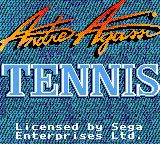
The picture of the famed player on the menu is the first sign of doom, and probably the game’s most worrying feature. Is it just me or does he resemble Jazz Jackrabbit? The intrepreting from real life to pixels was a job very badly done. Since the Game Gear is a handheld and naturally has a smaller screen than the TV that the Genesis is hooked into, the screen is not static. It moves in accordance to the ball. To put it this way, the camera moves more than the players and the ball combined. Mario Tennis on the GBC adopted the same feature but Camelot – the developers – executed it exceptionally brilliant and thus resulted in an exciting and rewarding gameplay, despite its non-realistic approach. Come on, a baby going one-on-one with an ape? Anyway I digress -Agassi Tennis should have at-least gotten the camera right, maybe top-down view or something, because the camera moves in a blocky fashion that bogs down the already unexciting gameplay.
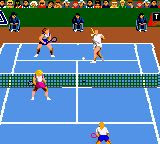

Fluidity is something this game has a fear of, because everything, from the clapping to the player movements to the serve, is robotic and horrendous. Let’s say I want to move left. Now I’d expect my player to take one step to the left, right? Well, with that expectation in mind, imagine the horror when the player took nearly three steps to the left in the most robotic fashion ever possible. It’s as if he’s suffering from rheumatism. The stiff movements, ugly camerawork, uninspired gameplay and total lack of genuine excitement all make up for one really bad sports game that doesn’t fulfill its basic requirements correctly.

The music, in heavy contrast, is actually hearable. Honestly, I think its more suitable in any Atari 2600 title than a Game Gear one. It has in it a loose-funky atmosphere with faint touches of goth-music and RPG-scores. Very unusual, considering the genre of the game.

Anyway, in conclusion, Andre Agassi Tennis is easily one of the worst sports games I’ve played due to its failure to meet the basic requirements and expectations like, you know, real authentic gameplay. This game sucks! and don’t be telling me otherwise...


Note: Screenshots from all platforms that were available at the time can be found here at Moby Games.


Score: 2 / 10


Share:

Silver Surfer - Retro Reflections - TBT

Silver Surfer by developer Software Creations and publisher Arcadia Systems—NES Throwback Thursday review written by Hamza. 1990.

Estimated reading time: 6 minutes


Silver Surfer on the NES has the cosmic-power (see what I did thar?) to both attract and offend. Badly.Its intense difficulty was intimidating and spiked several times during the gameplay. At times it would spike so badly that Sonic would have a hard time jumping over it; and at other times it would spike so badly that MegaMan would have a hard time jumping over it. See? Silver Surfer is easily one of the most challenging games I’ve played and certainly the least rewarding of all, because all it shows for your pin-point precision timing and tremendous effort is a half-baked image of the Surfer in a victory position as if he just won the marathon. Who does he think he is? Usain Bolt of the Cosmic Universe? The fastest man in all of space? Embarrassing!

Why has GamesRadar called it one of the worst video games is, frankly, quite beyond me. If its low rating and the bestowed title comes from the fact that this game is the most anti-superhero game ever made; or that the titular character has to fight through seemingly anachronistic enemies with zero boss battles... then yes, Silver Surfer can be called lacklustre, uninspiring and tame, but not the worst. In fact, I dare say this game is one of the enjoyable on the NES. With the graphics style and a majority of the gameplay very reminiscent of NES’s own Section Z and Gradius, Silver Surfer is a shooter that alternates between top-down and side-scrolling – a similar move that was adopted by Axelayto more critical acclaim 2 years later on the SNES.


With the strong difficulty in check, Silver Surfer is pretty much standard fare that only shows glimpses of ideas or something different... but these expectations are always betrayed by the game’s ugly habit of rehashing itself, to the point where it almost becomes a horizontal escalatar, coming back to square one after a few intense minutes. Further, like most pain-in-the-butt games, Silver Surfer adopts the “contact upon death” mentality that I still to this day cannot understand or does good to whom. Sure, the developers may have been having a nerdy, half-suppressed laugh about this, but this is beyond frustrating and the complete opposite of all that is fun. It’s as if games with this feature are begging to be a nuisance. I’ve seen Dennis the Menace behave better.

Now, the story of Silver Surfer goes like this; a terror “from the beyond” is threatening the universe, and presumably Earth, since sci-fi and comic book writers cannot contain themselves from terrorizing and annihilating their own home. Humans and their weirdness! Galactus summons the titular character and tells him to collect the scattered pieces of the Cosmic Devicefor reasons I have forgotten. There are five worlds and one can play them in any order as they wish. I suggest leaving the top right world for the last, for the boss of that stage, Firelord, seemingly keeps flipping the bird at you. Intentional or not, that effect is best saved for last.


When I say boss, I mean it in the most casual sense of it. The boss is nothing more than a big collection of pixels that requires five more hits than the common enemies. That’s it. No epic Metroid-style battles or such. The, er, battle, as it supposedly calls itself, is nothing more than staying in one position, shooting enough cosmic power, then quickly descending or ascending to avoid the boss’s projectiles. Repeat until boss is dead.

When you finish the five stages, Galactus then tells you to go to the Magik Domain to finally put an end to the aforementioned “terror from beyond” menace by laying dirt to the main enemy who I believe was created specifically for the game. I’m no comic-book junkie but I haven’t seen that character before. The Magik Domain turns out to be nothing more than a series a minty green top-hat projectiles and of the same color squashed top-hats – if you think I’m joking, check it out for yourself. Also, small skeletons with large heads also make an appearance that made me question both the boss’s nature and the supposed ‘humor’ of the developers. The skeletons resembled that of babies, and that had me worried. Unlike in the previous chapters, the boss battle here is long and surprisingly extra-challenging. The purple and green villain keeps going back and forth across the screen, while shooting yellow bolts in both a straight and angular fashion. The straight ones can be easily avoided but it’s the angular ones you should watch out for. After when that’s done, Silver Surfer takes the finished Cosmic Device from Galactus and keeps it on a very high kitchen shelf... out of the reach of human and non-human hands alike!


Silver Surfer on paper and in reviews may sound as a badly realized game, but when you play other titles on the NES and then this, you will realize Silver Surfer was just being an obedient student of the requirements of the NES and nothing more. It's just its uninspired gameplay, as well as its difficulty, and reluctance to give its superhero titular character something heroic and dashing to do, Silver Surfer failed to blow me away and didn’t provide enough incentive to warrant replays from me.

Despite the negativity the world bestows upon it, almost everyone, including I, come to this universal conclusion that its music is arguably one of the coolest on the NES, and the single redeeming factor from the game. The music... is AWESOME! There is no other word to describe it. Its energetic tone and fast rhythm almost makes it an epic on a smaller scale. *sigh* if only the game were like that; because frankly, Silver Surfer had the potential of being one of the greatest scrolling-shooters on the market. The other feature I enjoyed was the movements of the Surfer himself. When you pressed down, he would slightly bend down and the upper deck of his board would be revealed; likewise, in opposite, when you press up. When you press back, he would tilt the board in his direction. These little effects were satisfying, and anytime you feel the game is giving you a temper, just press any of the directional buttons and calm yourself a bit.


In conclusion, Silver Surfer on the NES is not a bad game at all, no sir. Though I played it only once, I found the game enjoyable and provided adequate fun for 1 hour. But that’s how it’s gonna remain; Once! Once! Once! Once! No twice!

Score: 5.5 / 10


Share:

Where in the World is Carmen Sandiego - Retro Reflections - TBT

Where in the World is Carmen Sandiego by developer and publisher Broderbund—MS-DOS Throwback Thursday retro reflection written by Hamza. 1985.

Estimated reading time: 4 minutes


It’s that puzzle-adventure edutainment time of the month again, and this time Carmen Sandiego has gone missing! The first in the long-running Where in... series, the series sees the titular thief committing crimes that are oftentimes comical in nature.

The game starts with an ancient typewriter asking you for your name - or status, as it so bluntly puts it. Here is where the game’s subtle attention to detail first impresses you. If you type in Carmen Sandiego or any of her henchmen/women’ name, the company, Interpol, will reject you on the grounds of your criminal past. It’s a small but neat touch. You take on the role of a rookie tasked to apprehend the criminal mastermind. If you aren’t too well-versed in your geography, you won’t be making much progress - so it’s rather vital you hit the local library first before booting up the game.


Preceding each level is a news-flash that tells you about the new felony by V.I.L.E - Ms. Sandiego’s villainous organisation. After being notified of the stolen item, you are then transported to the city where the V.I.L.E lightning struck. On the left side of the screen is an image of a famous landmark of the city you’re currently in; on the right is where the various activities take place. On the bottom you will find four icons. The first will display the cities you can visit; the second will take you to the map; the third will open a sub-window in which you can enter three different places and interrogate people; and lastly in the fourth, if you pay attention to what the civilians are saying, you can enter the information and issue an arrest warrant, but only if it successfully matches with the description of the villain you’re chasing. If it doesn’t, it will keep rejecting it until you’ve got it right or if the villain escapes. Then it’s game over!

When you’re sent to capture them, you’re usually given till 5pm on Sunday to do it. In game time it means a week. This brings me to a question; if the dossiers of the villains are true in detailing that they’re experts in their field, then how is it that a rookie (meaning you) is able to nab them in a week? But who am I to question game logic?


As I mentioned before, you need to be smarter than a fifth grader, because the civilians only talk in enigmatic-tongues: often dropping useful hints which you can enter in the data icon below. For example, the oft-repeated clue will go something like this: “I saw him leave in a car and it had a blue flag with a white cross on it”. Of course, he is clearly describing the flag of Norway – your next destination. Resorting to Google only gives you this crushing acknowledgement about your pitiful know-how about the world you inhabit. Tut! Tut!

When you travel city to city, and when you land on the right one, a short animation of a sneaky yet harmless robber in the classic get-up will pop-up in the ‘action’ screen. This indicates you’re indeed on the right track. Whenever a civilian says “they’re in town nearby”, this means you have reached the end of your detective hunt and that you can finally apprehend them - provided you correctly entered the data and received a warrant for arrest. A short, smooth animation will start; showing the villain being chased by a trio of policemen. An off-screen scuffle ensues, and if there was no warrant for arrest, then a lone policeman will shuffle back to his police-station, alone, defeated. This brings me to another question; is he sad because he failed to capture the villain, or because two of his friends were killed in the scuffle... that’s something I want to know!

In conclusion, Where in the World is Carmen Sandiego is one of MS-DOS’s best games. Very entertaining, humoristic and surprisingly brain-challenging. For those who want an enjoyable game to pass time by or to recommend to their children, then Where in the World is Carmen Sandiego is the perfect choice.

Note: Screenshots from all platforms that were available at the time can be found here at Moby Games.
 

Score: 9 / 10


Share:

H.E.R.O - Retro Reflections - TBT

H.E.R.O. by developer and publisher Activision—Atari 2600 Throwback Thursday retro reflection written by Hamza. 1984.

Estimated reading time: 3 minutes


Being an acronym for Helicopter Emergency Rescue Operation, this title is easily one of Atari 2600’s best, if not the best. Unlike most others while trial-and-error works wonders, and where points are all that matter, H.E.R.O calls for something more. It calls for primitive strategy, pin-point precision and good fun where you get to be an 8-bit Alex Ryder or James Bond – or any action hero of your choice. But this assuming is rather unnecessary because the hero has a name, Roderick Hero, or R. Hero... a pun on “our hero”. Geddit?

Designed by John van Ryzinfor the 2600, and released in 1984, H.E.R.O was and is a pretty advanced and detailed game on the console. Every now and then I play a very impressive 2600 game, and I’m talking Enduro, Pitfall! & Demon Attack, but this game really tested my expectations. I thought it would be like Elevator Action set underground; or something like Commando or Ikari Warriors; but H.E.R.O. is in its own class and more entertaining than the aforementioned.


With almost no graphical or interactivity achievements to boast and to compliment, its color scheme, the movements of the protagonist and the creatures are enough to make H.E.R.O. a satisfactory and working game that’s indeed playable for long moments. Coming back to the color schemes, they’re warm, rich colors that keep with the theme of underground mines and it was a relief they weren’t as glaringly eye-sore-like as I witnessed in Duke Nukum. Pink and yellow? Get the hell out...

Taking control of “our hero”, the player has to rescue trapped miners – one per level. I made it to level 7 before losing all my lives, so if there are multiple miners to rescue in level, then I’m unaware of it. Equipped with an backpack-mounted helicopter unit, a lazer-shooting helmet and limited number of dynamites, the player must strategically blast away the cave-ins, shoot creatures, – both known and unknown –, be careful not to accidentally destroy lamps and rescue the hapless miner.
 

Though the premise is simple and one that has been mercilessly revamped to the top difficulty level in succeeding games, even the most experienced gamer will find H.E.R.O. to be an engagingly challenging experience, and the end result to be a polished, satisfactory title for the legendary console. Although I concur that there are far better games than this one, like Tapper, Adventure and Activision’s Tennis... but H.E.R.O. doesn’t disappoint and should be reason enough to back you up when you’re trying to convince someone that Atari 2600 games do not suck!

In conclusion, H.E.R.O. is a fun, challenging game that should make the 2600 lovers love the console all over again; and newcomers a reason to stick around a bit more and give the console and its games a further try. Besides this, I highly recommend the above titles as your starting point!


Note: Screenshots from all platforms that were available at the time can be found here at Moby Games.

Score: 8 / 10


Share:

Pac-Mania - Retro Reflections


I would like to introduce our first Throwback Thursday review of PacMania. An arcade game all the way back from 1987.

Estimated reading time: 3 minutes


Article by: Hamza 

Pac-Man... but with differences. The first and foremost is that it’s in isometric view that boasts pseudo 3D-graphics. With this one particular camera view that I love in video games, it was only natural that Pac-Mania was not restricted to one screen. The maps may be limited in number but are twice the size of the maps in Pac-Man and take nearly about twice the amount of time to finish them, too. The second noticable feature is that there are more ghosts here than probably in any other Pac-Man game – bar Pac-Land. Though Pac-Mania retains the basic formula of the original games and plays exactly like them albeit from a different perspective, the cool new feature is that the titular yellow dot can also jump. Unfortunately, so can the ghosts!

But first, I’m pretty sure many of you are thinking, “why improve, modify or re-create a bonafide classic?” I thought the same, too, until I played Ms. Pac-Man, Pac-Land and Pac-Man 2: The New Adventures – all ofwhich surfed on the giant waves the original had caused. Since I loved all of them and was confident that any yellow dot related game or spin-off would not be a disappointment, I tried out this game and left with a smile on my face. Once again a Pac-Man-related experience that has left me rightly satisfied.


The gameplay is simple and familiar to those who have played the original. With now the ability to jump, the yellow dot must collect/eat/chomp/chew all similarly colored pellets. But of course a gamer’s main aim is to gain the highest score possible and not lose all three lives in the process. When one map is completed, the player proceeds to the next one. The big pellets temporarily turn the ghosts into edible phantomswhich the protagonist can then gobble them up for further points. The phantoms then become floating eyes and float all the way back to the pen, where they immediately become ghosts again. In this version, the protagonist seems to give them a small nibble, and there’s a considerable distance between him and the ghost. This faulty programming, in reverse, often results in unfair deaths. You can clearly see there’s a good distance between the two inhabitants, yet Pacmanloses a life.

This version is not as big as the others and really not at all polished or graphically defined. The outlines are quite-fuzzy and give off a chromatic aberration effect. But the movements – jumping and all – are very smooth and responsive. Never once did the controls suddenly decide to become stubborn and refuse to obey me. They worked perfectly and all the deaths witnessed were partly my fault. I say partly because apparantly cats and toddlers find it irresistible to start randomly typing away on my keyboard as if they will become the next Hemingway by doing so.


Coming back, Pac-Mania is a simple little game good enough incentive to come back for more. The level designs themselves are worth the replay. The first is simply made up of Lego blocks; the following one has neon walls and crazy corners. Though not wildly inventive or catchy, they are fun to wander in for long periods. But despite anything and everything, I just cannot see Pac-Mania fall under the ‘great games’ banner. It lacks that certain unspeakable charm, an intangible quality. It’s worth the time, yes totally, but not worth the adulation in a praising compilation or category.


Score: 8.5 / 10


Share:

Random posts

Our Streamers

Susan "Jagtress" N.


S.M. Carrière

Aldren


Affiliates

JenEricDesigns – Coffee that ships to the US and Canada

JenEricDesigns – Coffee that ships to the US and Canada
Light, Medium and Dark Roast Coffee available.

Blog Archive

Labels