• Culdcept the First - Xbox Review

    Culdcept the First (also attributed as Culdcept the First Saturn Tribute) is a very fun game, that does show its age. This is basically a re-issue of the 1997 Sega Saturn game that mashes together deckbuilding (think Magic: The Gathering) and boardgames (such as Monopoly).

  • NBA 2K27 - PlayStation 5 Review

    With these annual seasonal renewals of the sports season comes the related video games as well, and the question reviewers such as myself always face is this: Is this year’s game worth purchasing one year after the last one? My answer? Yes, absolutely. NBA fans are going to almost certainly enjoy NBA 2K27.

  • Midnight Moments - PC Steam Review

    Midnight Moments is a cozy cyberpunk diorama-building game that is stunning. Unlike games that require you to complete quests or take out assailants or even solve challenging puzzles, this one only requires one thing: imagination.

  • Isle of Reveries - PC Review

    Isle of Reveries is a top down 2D action adventure game that made my nostalgia for old school Zelda games flare up really hard. A good blending of puzzle, exploration, and combat, Isle of Reveries is a wonderful title to experience inside and out.

  • Outbound - PC Review

    Let me tell you about this cozy game my daughter and I are playing together called Outbound. Now, I've been following this game from the initial Kickstarter back in April 2025 to its full release in May 2026. The best Mother's Day gift for myself and my first ever collector's edition in a physical copy!

  • OVER REQUIEMZ - Nintendo Switch Review

    In OVER REQUIEMZ Yuhiru is thrown into the castle of Oz and is immediately accused of trying to assassinate the King and shoved into the dungeon. Not only is she treated like a criminal...

  • Dread Delusion - Xbox Series X|S Review

    Today we’re looking at what has rapidly become an absolute favorite in the open-world RPG genre for me. An interesting story, memorable NPCs, stunning visuals, and a setting absolutely dripping with flavor, Dread Delusion sets its tone immediately and sticks with it.

  • NHL 27 - PS5 Review

    ...and I have been playing NHL games since. It didn't matter whether it was EA or another game like 2K in the 2000s; I loved hockey games and still do, but is NHL 27 a step in the right direction?

  • Asdivine Knot - PS5 Review

    Asdivine Knot is the latest title in the Kemco JRPG library. Following protagonist Verselio, who's on the run from the church that they once served, he'll be accompanied by an odd selection of party members as they all find a reason to band together…

  • STEINS;GATE RE:BOOT - PC Review

    Our story begins in Akihabra, Tokyo Japan. The protagonist Okarin… Or rather Rintaro Okabe, (Voiced by Mamoru Minyano) is a recent high school graduate who rents an apartment with his best friend and resident computer hacker, Itaru ‘Daru’ Hashida (Voiced by Tomokazu Seki) during the summer of 2010.

Showing posts with label turn-based JRPG. Show all posts

Dragon Spira - PS5 Review


Dragon Spira by developer Exe Create Inc and publisher KEMCOPS5 review written by Richard with a copy provided by the publisher.
 
Estimated reading time: 7 minutes 

Well hello there, and welcome to another review of a KEMCO title! We’ve been through a few of these in the past, each with their own charm, and now it’s time to take a look at a new title: Dragon Spira.

The world of Dragon Spira is an interesting place, where The Divine created six spirit beasts to rule over the world, along with different races for most of them. However that didn’t go over so well when the spirit beasts rebelled, and were sealed into eggs. The Divine created humans to replace them, and left them with some relics and wisdom before disappearing. One thousand years later and humanity is doing pretty well for itself, all things considered. Unfortunately, danger lurks, and a hero is needed to stand against the coming evil! (that’s you by the way).

So you end up with a traditional JRPG party of four plus a mascot creature (who is also helpful in battle at least) to venture forth. Now, most of you who are familiar with KEMCO titles should know that they generally come in two flavours: old-school Final Fantasy like or old-school Dragon Quest like. This time we’re going with the Final Fantasy like style.

For those of you new to KEMCO titles, Dragon Spira is a very retro stylized JRPG, but in a good way. You have a party of heroes that ventures out into the world to right wrongs and uncover hidden secrets along the way. Getting into random turn-based battles is a mandatory experience here, all done in a pixel-graphic and MIDI sounding adventure.

Between bouts of random encounters and facing off against powerful bosses, you will be exploring dungeons, towns, taking sidequests from characters or the guild, and maybe challenging optional areas if you’re feeling confident? You may need to rethink that last one though. When the game says “powerful enemies here”, it means you’re getting one-shot.

Dragon Spira runs the traditional set-up: visit a town, find out there’s something important to do in a dungeon nearby, find and enter dungeon on world map, clear dungeon, report in to town, rinse and repeat with the next town. It’s a tried and true formula of JRPGs through the ages. Thankfully KEMCO tends to do away with a lot of the frustration of some of the older games when going for their retro feel. Such quality of life options include: being able to teleport to any town or dungeon you have previously set foot in, indicators for where quests are available, the option to warp back to quest giver when complete from the quest menu, and many other small but handy bits.

Exploration of dungeons is pretty straightforward, where you walk around aiming for the depths and the boss that’s sure to meet you there, getting into random battles along the way, and maybe seeing a cutscene or two. At set intervals there are teleportation circles that you can use to warp between different zones, as well as braziers that can summon enemies as a set of three individual battles so you can get exp, money, stones, and RP more efficiently, more on those last two later.

Combat in these types of KEMCO games is a little interesting, as player units are in a vertical line with front and rear options, while enemy units are placed in a 3x3 grid so that they fit. Some enemies will take up multiple squares.  Combat is taken in turns based on speed of units with faster units taking earlier and more frequent turns, as indicated by a handy turn order bar at the top of the combat screen. When in combat you have a number of tactical options available to you: attack, job, unique, item, defense, summon, and if you have the mascot character unlocked summon.

Unique and Job refer to skills, which cost MP but hold special effects, deal extra damage, or multiple enemy tiles. Each move has it’s own range, so pay attention when deciding what skill to use. Unique are character specific and are solely learned by that character, but Job skills are learned as long as you have the required job equipped and at the right level. Summon just calls your mascot to stand in front of the unit that summoned it, which is also the only time you can use the mascot character’s Wonder Skill ability to help you in battle.

Yup, you read that right, we get jobs. Now, I feel no shame in telling you I’m an absolute sucker for a decent job system, and I feel like Dragon Spira delivers a decent system. You start out with a set of jobs, and a bunch of locked jobs you can’t access yet. Basic jobs can level from JP earned primarily through combat, and default jobs will level to 25. Once you hit 25, if you have a specific item, you can use it to unlock an advanced version of that class allowing you to level it to 50. Some of the locked jobs require hitting that level 50 with more than one job class. There are both active and passive skills awarded to you as you level your jobs, and your jobs can be swapped at any time outside of combat or a cutscene, so feel free to play around with them. It is important to note that jobs can only equip certain types of items, so if you make it through a good chunk of the game without getting a decent dagger and equip a thief job, don’t expect that to go super well. While job levels are not shared across party, you don’t lose anything from switching jobs, so you can always swap back if you don’t like the job you’ve changed to.

So, let’s take a poke at a really weird but interesting feature: the sugoroku board. If you don’t have any idea what that is, don’t worry, neither did I. Basically you can think of it kinda like a mario party board, or maybe a Jumanji board if that’s more familiar. As you pass over or land on certain tiles, you gain the item or stat associated with that tile. On certain tiles or at the end of the board, you may distribute all the stats you’ve earned through tiles. Yes, you can replay boards, so you can do this pretty much indefinitely. Do note that the higher the player party level the more costly it is to move tiles on the board.

So how do you move tiles? Well, you earn RP from battles, or the board, and you spend a set number of points based on board and party level to spin a roulette wheel that has 1 to 6 on it. What you land on is how far you go. At intersections where you have a choice of direction, you also spin to determine where you go. You can find items to choose a desired roll, so don’t worry too hard about missing a tile. You can always come back and try again.

So you KEMCO veterans are probably wondering at this point: does this one have the store? The answer is yes, it does. For those of you confused, these types of KEMCO titles tend to have a sort of store where you can exchange kaishin stones earned through combat or as certain rewards for either permanent cross-save game modifiers like increased exp earned, or exchange for items or an equipment gacha roll where you might end up with some ridiculously overpowered gear.

Overall I have to say I’m quite a fan of Dragon Spira. The combat is pretty fluid and has a lot of options for you, the job system is a decent mesh of easy to use and tactical options with a fair number of jobs available, and the sugoroku boards are an incredibly interesting addition to the game. The story is pretty engaging, the characters are unique in their portrayal, and each job class has their own outfit sprite in addition to the general character sprite. I would definitely recommend Dragon Spira if you’re looking for a really fun retro style RPG.


Score: 8 / 10
Share:

Alphadia III - Playstation 5 Review


Alphadia III by developer Exe Create Inc. and publisher KEMCOPS5 review written by Richard with a copy provided by the publisher.
 
Estimated reading time: 6 minutes 

Alphadia III is the third instalment in the Alphadia series. Set as a prequel to Alphadia I, Alphadia III tells a story about war and how an energi clone named Alfonso looks for a future that isn’t as a weapon to be wielded.

If you haven’t played any other Alphadia titles no worries, you’ll be told everything you need to understand what’s going on as you play. You gather a caste of eclectic characters, headed by Alfonso, an energi clone, who has started wanting a life not as a tool for war but as his own person. So he sets out with the local anti-war movement to try and find a place in the world. You will end up journeying with others, a clash of unique personalities, and a lot of adventure awaits.

As for the gameplay system, it’s kind of like the midway point between Spirit Valor and Astrune Academy. If you haven’t played either or read my reviews for those, no worries I’ll outline it here. Alphadia III is a retro-style RPG similar to old-school Final Fantasy at its core. You will have pixel characters exploring a world map, dungeons, and towns, with random encounters in the first two. While exploring dungeons you can find chests, puzzles, and a handy enemy encounter adjustment device and a warp point to take you to other warp points you’ve activated in that dungeon. In towns you can buy equipment, accept and complete requests for citizens, and maybe even take part in some arena bouts.

The world isn't just a safe place to explore as enemies and monsters abound. You will either get into a fight randomly, as a scripted event, or by summoning enemies via the device I previously mentioned. Combat is turn-based with a turn-order indicated at the top of your screen where a characters agility will determine how often they attack. When one of your turns come around, you have your traditional commands such as: attack, defend, and item. You can also use Energi Skills, which is the in-universe equivalent of what mana is in most other games. Your SP skills, which are powerful moves that build a charge gauge as you take action, as well as formation and array commands.

While most of this is pretty standard for many turn-based RPGs, whether in parts or in whole, Alphadia III adds a little bit of a personal spin to it. Not only do you have the Energi skills and SP attacks instead of just one or the other, but Alphadia III actually has you playing with a six member party, something not often done. If you adjust your formation to meet certain pre-set layouts, you can activate an array which will give an effect to the party. For instance, one array may increase both damage output and damage taken, or one may increase agility at the cost of reduced energi attack damage. It’s a cool feature that may help you out if you use it properly.

Another interesting route the developers decided to go is how your energi and SP skills level. While your main characters level through exp from defeating enemies, to a ridiculously high 999, your energi element is what determines your energi skill and the number of times you use SP skills determines your SP skill level. Basically, more fights and your characters’ innate element levels up, more SP skill usage and your overall SP skill level goes up. As for the energi skills, your character is restricted to their natural element, one for each six of the party members. But have no fear, you can equip rings that allow you to use other element types, although those must also be leveled when a ring is equipped. Unequip the ring and you lose access to those skills.

The main way to get rings is by trading energi fragments with characters in the item shop for rings. Energi fragments are mostly obtained through chucking unwanted items in the Energi Crock. Every one-hundred points worth of items nets you a fragment.

Now for those of you somewhat familiar with Kemco games, yes the “sort of cheat shop” is in Alphadia III. For those unaware, as you win battles, occasionally you will get ten of a “premium currency”. You can go to the shop tab in the main menu use that “premium currency” to purchase random items (that get removed from the item pool when pulled), exchange for specific items (like a key to a storage house), or you can purchase game modifiers like exp increases or increased drop rate. Unlike Astrune Academy which pretty much shovelled these in your face, Alphadia III is much more withholding of the premium currency. Sure, if you really wanted you could grind out low level enemies for them, but it really depends on how you want to play the game.

You do have different tiered missions as well, a sort of in-game bonus for meeting certain requirements such as obtaining a certain number of fragments from the energi crock or using a certain number of SP skills. These missions can reward that premium currency or other items like consumables or upgrade materials. I’m not sure it’s particularly spelled out for you all that well, but there is a tab in your item menu called “upgrade” where permanent stat boosting items can be found. These are dropped occasionally after a fight and will usually raise your stats by a minor amount.

Alphadia III, much like some of the other Kemco titles out there, gives you a lot of ways to make your team somewhat overpowered. Whether it’s from getting a bunch of the “store” currency and buying exp/damage increase upgrades or pulling a gacha for equipment. Unlike some of its contemporaries however, Alphadia III doesn’t just shove the store currency in your face. I think it strikes a good balance between “available if you want to turn this into a casual experience” and “I want a challenge” where you can choose how easy to make the game but don’t feel almost pushed into it if you’re given a lot of store currency.

The graphics and soundtrack are good for what they are, but probably won’t hold much space in your memory. While the spritework is good, including different weapon styles, the still portraits seen during talking scenes sometimes don’t mesh properly with the background. Although it is rather faint, a minor issue, all things considered. What is distinctly more annoying, however, is that there are a few menus where hitting “back” means you need to completely exit out of the submenu, instead of reverting to a choice. An example of this is the scenario menu. Normally you can go here to read up on what has happened and where you should go, but you also go here to turn in sidequests. Unfortunately if you have a few to turn in, you need to turn in one, leave the scenario menu, then go back into it to turn in another. Also a minor issue but pretty annoying.

With a cast of interesting characters, some neat combat mechanics, and the wonderful ability to fast travel anywhere you’ve been before, Alphadia III is definitely a pleasing retro RPG style title. There are a few kinks here and there, but it’s a rather smooth experience that was enjoyable to witness. While it may not stand up to some other major games out there, it’s definitely a delightful experience.


Score: 8 / 10
Share:

Spirit Valor - PS5 Review


Spirit Valor by developer Exe Create Inc. and publisher KEMCOPS5 review written by Richard with a copy provided by the publisher.
 
Estimated reading time: 6 minutes

Spirit Valor is an interesting title from KEMCO and Exe Create Inc., the same people that brought us Astrune Academy if you saw my review for that. Another turn-based RPG with some twist elements thrown in, Spirit Valor is a pretty entertaining journey through a fantasy world, so let’s take a look at what it has to offer!

In Spirit Valor we take on the role of a spirit summoned by a mighty warrior to help in the defeat of an Overlord, one who controls the rise of demons in the world. Unfortunately, there is a magic outburst from the warrior, and so the spirit is stuck in the warrior’s body. Unable to return home to the spirit world, and feeling a sense of obligation to fulfill the warrior’s goal of defeating the new Overlord, the spirit inside the warrior’s body gathers three other companions to set out and save both the human and spirit world from the overlord.

So set out the warrior “Richard” (totally not a spirit, shhh), Alice, a young warrior in training, Finn, the flirty knight, and Vallerie, a spirit researcher. Those of you who remember old school Final Fantasy titles, like the first game, or who’ve played Astrune Academy will have a pretty good idea how things will play out, but for those of you who haven’t, we’ll take a look at what makes Spirit Valor enticing.

Spirit Valor has a pretty standard JRPG game loop. You go visit someone of importance and have a cutscene, you get told where to go, you explore a dungeon, you repeat. This is pretty basic fare for many JRPGs. You’ll explore a world map, getting into random fights until you either enter a town or dungeon. Feel free to explore the various local settlements at your leisure, buying and equipping new equipment, talking with the townsfolk, and picking up any chests you may see hidden around, as is pretty common in these types of games.

Once you enter a dungeon, there are a few things you’ll probably notice right off the bat. First of all, you’ll probably see a little panel on the floor and a weird floating rock tower somewhere nearby. The panel is a warp point, which will bring you to any other panel in the dungeon you’ve stepped on. If you step on it, the floating rock tower is a sort of enemy adjustment device. Basically, battles in the dungeons are random encounters, but the towers near the warp points allow you to adjust encounter rate, as well as summon a set of three battles to use for gaining levels, money, or items. While the first time you interact with a tower you can either increase or decrease the encounter rate slightly, after reaching the last tower you can either stop random encounters or greatly increase the encounter rate. This is pretty handy when you return to an area for a sidequest and don’t want to bother with way too weak enemies while looking for the sidequest objective.

So, what about when you actually get into a battle? Well, this is where Spirit Valor brings out some interesting ideas. Basic combat is turn based, with a sliding bar where both enemy and ally icons will move along indicating each turn order. Faster characters mean faster moving icons. Once it comes to your turn, you can perform your actions. While Spirit Valor has the basics, like attack, defend, and item use, it also has a pretty unique spirit summoning system going for it.

In battle, you can opt to spend a percent portion of your max mana pool to summon a spirit, at varying strength depending on your mana used. The spirits you summon however are actually somewhat random, determined by the area you’re fighting in, and will change each time a spirit gets summoned. Being a spirit himself, the main character doesn’t have that option, but the rest of your party members still do. So let’s say one of your party members summons a spirit. Well, there’s a chance the spirit will stick around and ask to make a contract with you. If you agree. That spirit will lend you it’s power. You can have up to ten spirit contracts per character, but can only “equip” four at a time. You can swap these out outside of battle.

Now, forming a contract with a spirit doesn’t mean you can summon them whenever, it actually means you can use their abilities as skills. Spirits also have levels, and as you bring them into battle with you they will level up, gain new skills, and maybe even evolve! You can swap them out and level other spirits to see if they gain skills you want. Some spirits can provide healing or buffs, and some have large single target damage.

In addition to the spirits and their skills, you also have these things called mana stones. Basically they’re sort of like discount pokeballs. You can throw one at an enemy, and if they have a skill that can be used, there’s a chance you can “capture” the monster’s skills at a certain chance. These mana stones that have a skill can be used three times before they either break or lose the skill. If the mana stone loses the skill, you get the mana stone back and can use it on another enemy. If it breaks, a spirit is released and a character can contract it, or the warrior can learn a skill from it. If you either summon a spirit or break a mana stone and receive a spirit you already have a contract with, that character’s spirit will get a power increase.

Those of you who have played Astrune Academy may remember the store system, where you can exchange gems you’ve gained for items, or permanent buffs applied to your game. Unlike in Astrune Academy however, the items don’t include primary equipment, just accessories, so it’s much tougher to “break” the game, although you can still purchase experience and money increases. These can also be toggled, so you can adjust the game to your preference.

Spirit Valor is a pretty nice retro style JRPG that still manages to put some interesting twists on things. The graphics are definitely a little more old-school looking, but fit really well with the style. As a nice added bonus, while the storyline is somewhat generic, there are still some twists, and tropes that are commonly used that are either subverted or altered in a pretty interesting way. Probably one of the more interesting storyline decisions comes in the post-game, where there is a split in how the story goes based on what you choose. I thought the choice to go this route was pretty interesting, and while I liked the split in direction it went for, being unable to carry over from one plotline to the other is a little annoying. What I mean is that completing one of the branches doesn’t allow you to keep playing with all the stuff you’ve gained in that route. You have to reload from before the branch, although it isn’t too bad, and you can earn the equivalent back on the other branch.

Overall, I actually had a lot of fun with Spirit Valor. It’s a nice JRPG with a pretty unique twist and a solid storyline. The characters all have unique personalities, the graphic style is very fitting for the game type, and there are a number of quality of life options for players. If you’re looking for a smaller JRPG to fill your time, Spirit Valor may be something for you!


Score: 8 / 10
Share:

Rhapsody: Marl Kingdom Chronicles - Switch Review


Rhapsody: Marl Kingdom Chronicles by developer Nippon Ichi Software and publisher NIS AmericaNintendo Switch review written by Richard with a copy provided by the publisher.
 
Estimated reading time: 9 minutes
Well now, it's time for something I considered a huge surprise when I heard the announcement for it: Rhapsody: Marl Kingdom Chronicles. For the first time coming to us in the West, we get a chance to experience the two sequels to Rhapsody: A Musical Adventure! Coupled in a pair, we now get to play Rhapsody II: Ballad of the Little Princess and Rhapsody III: Memories of Marl Kingdom.

If you didn't get a chance to play Rhapsody: A Musical Adventure, you should probably give it a spin. While not strictly speaking required before playing Rhapsody II or III, they are direct sequels, which will both be massive spoilers as well as some maybe confusing sections, although Rhapsody II is fairly standalone-ish? Either way, I HIGHLY suggest playing the first Rhapsody before the sequels.

So, this review might be a little weirder than most, not in terms of strange content, but in terms of how it's laid out. See, Rhapsody II and III come here as a package deal in Marl Kingdom Chronicles, and they have many similarities and overlapping points, but are also quite different in other aspects. So what I'm gonna do here is lay out sections, and talk about Rhapsody II and then III in order for each section, then go over a comparison between the two so you know what you're getting into. Sound good? Well then, let's dive in.


Storyline

First thing I always ask myself when I look for a new game is "What's it about?". Now, as you may guess, there are almost assuredly going to be spoilers for the first Rhapsody title in this review, just by nature of these being direct sequels, so be aware of that.

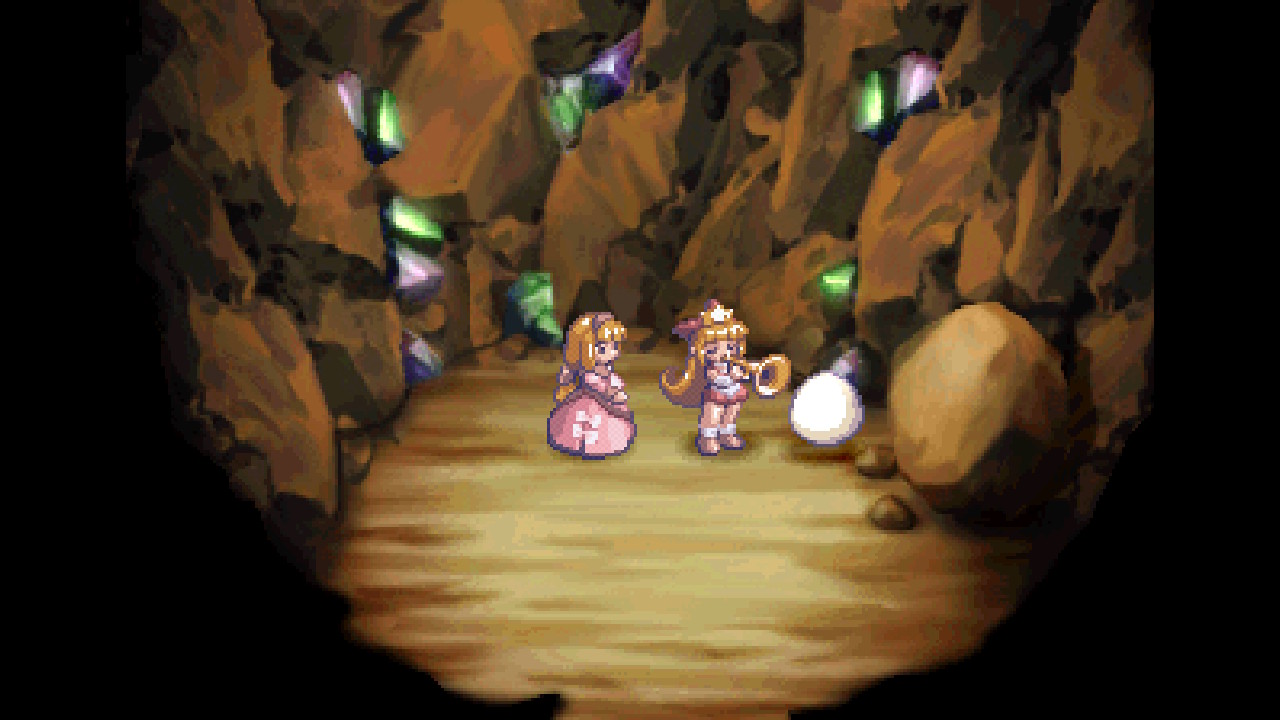
Rhapsody II: Ballad of the Little Princess takes place not too long after the end of Rhapsody, starring Kururu, the daughter of Cornet and Ferdinand. Kururu is...well, a handful, and kind of stupid, but her heart's in the right place. Longing to get out of the castle and explore the world, she and her childhood friend Crea escape the confines of the castle to explore the local area. Well, as these things go, stuff happens and she decides that in order to become a fitting ruler for the Marl Kingdom, she needs to see the world at large and experience what it has to offer. Along with her occasional party members, as well as Crea most of the time, Kururu sets forth on her own Grand adventure just like her mother before her.

Rhapsody III: Memories of Marl Kingdom is a collection of one-off style chapters that take place all throughout the timelines of the previous two games. For example, the first chapter takes place shortly after the beginning of the first Rhapsody game and details a short story of finding a young girl's mother. The second chapter takes place after the ending of Rhapsody II, and is full of spoilers. There's also a chapter about Cherie, Cornet's mother. While the chapters are somewhat eclectic, they are pretty interesting in order to get more insight into the Marl Kingdom. You can also summon certain partners over between chapters to help you out!

While both games are chapter based storylines, Rhapsody III takes a one-off style approach with different characters across chapters, and Rhapsody II is a full story centered on Kururu and her adventures. They both have their own charms, and it's probably best to play through Rhapsody III while both I and II are still fresh in your mind, while II doesn't require I to be as freshly remembered to enjoy.


Gameplay

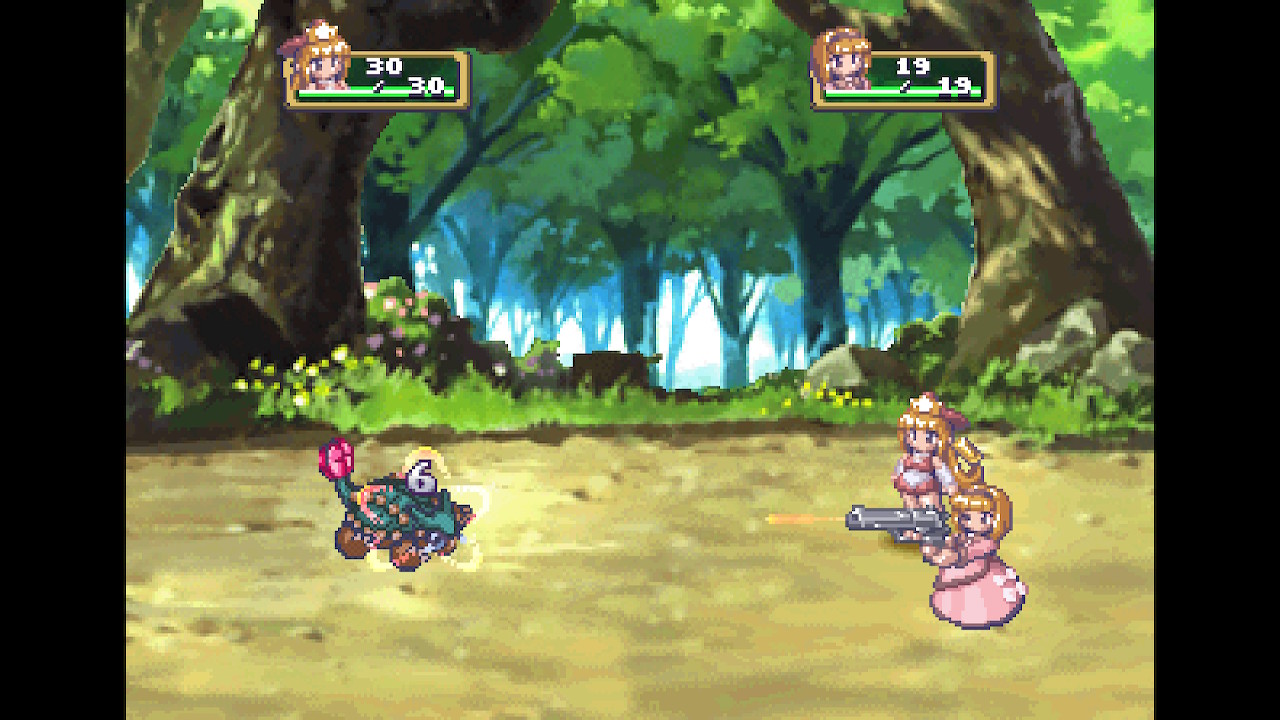
So, here's where things take a bit of an interesting turn. Both Rhapsody II and III take a pace away from the grid style turn-based battle style that the first Rhapsody employed. Both are still turn-based, just now the grid is gone and you assign partners to your leading members. Both also have map exploration and random encounters, but where Rhapsody II has 2D backgrounds, Rhapsody III is a more 3D approach. You can get up to four leaders in combat, each of which can have three partners that can use skills and give you stat changes when partnered. Certain partners have different affinities for different leaders, and some may be restricted to certain characters. You can also recruit monsters to your team by beating them, where they then turn into dolls you can use in combat. As a general principal I've found that typically monsters are less useful than partners that start off as dolls. Your partners have three accessory slots that you can fill with what equipment you want in order to help your expeditions.

In Rhapsody II the gameplay is divided into sequential chapters, where each chapter sees you tackling a different task, sometimes one chapter will lead directly into the next. You collect any teammates you can, are forced to re-equip them every time they leave the party, which is frustrating, and then either gear and stock up on items or set forth. When out in the field you start your random encounters while exploring the environment. Pro tip by the way, you can still examine things even if there isn't a prompt, although not all the time. Once battle starts, you'll see a huge difference from the first Rhapsody title. 


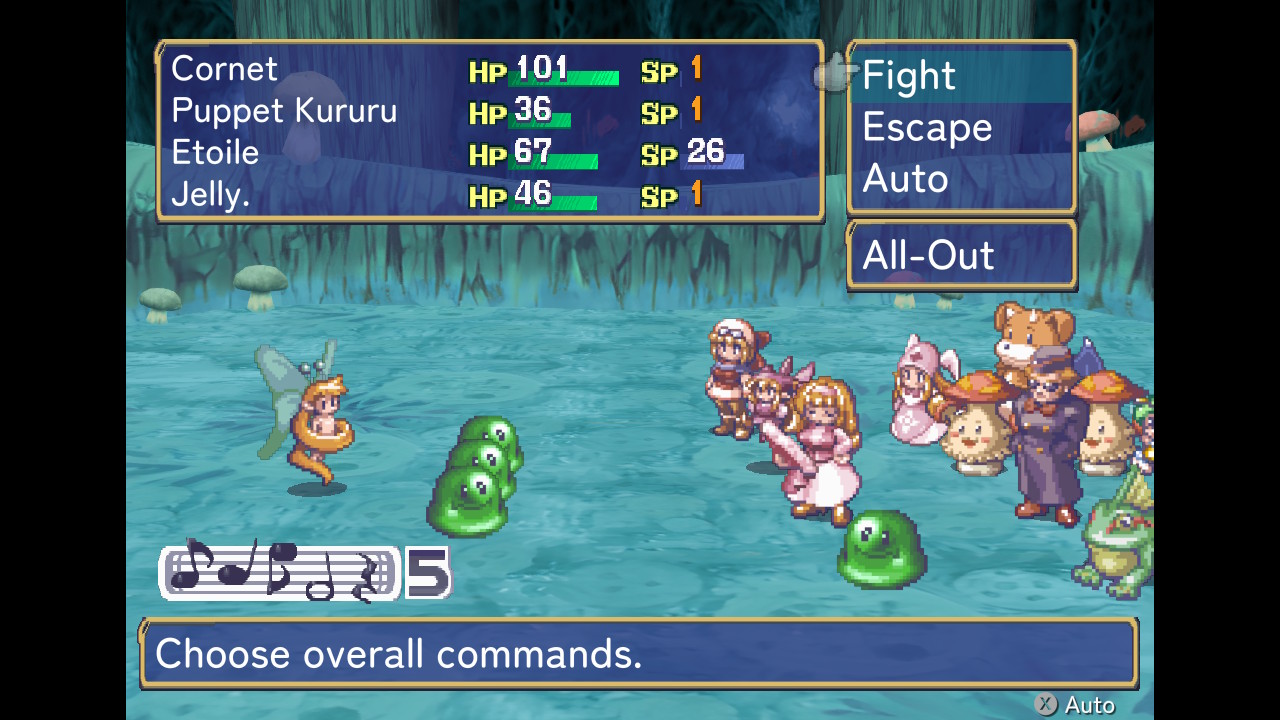
No more grids, you now have a more traditional turn-based system, where you select your actions and then you and your enemies act. While there are the standard options such as attack, flee, special, and defend, you also have a "puppet" command where you can summon your dolls or monsters to assist you. They do charge you a money fee though, which is interesting. Stronger skills require more money, and by using your partner's skills you will build up a musical bar. You can use rewards from the musical bar to either deal damage to your enemies or heal your allies. After battle, an enemy may join your ranks or you may get some items, but you will get money and exp. Money becomes fairly irrelevant to purchases fairly fast, but is still required for using your partner skills, so is always good to have. Exp is awarded to battle participants, so you need to make a choice sometimes between deciding on a lower level unit anticipating better end results or remaining with who you're currently using.

In Rhapsody III you tend to be quicker into the action, although there are some differences. While the map exploration and progression is similar, combat has taken...a turn. Similar to Rhapsody II you've got the turn based combat, but in Rhapsody III, you use your entire line of units. For example, you can assign any unit to a leader, and then line up three more units behind the leader. All four of these units participate in battle, and you have four leader slots, making a total of 16 units. In combat you control the leader, or a single one of the units as directed by the leader. The rest of the units will perform actions at their own discretion. Skills now require mana instead of money or health like in Rhapsody II as well, and they also have skill levels that will increase as you keep using the skills.

The logistics behind some of the stats and party management, like unique combos available only when certain units are in a group and at a certain level minimum can be a little disorienting. This is particularly evident once you consider there's also an elemental affinity type thing going on in the background. Fair warning by the way, battles are either trivial or really tough and there isn't much of an in-between. Unlike Rhapsody II you can also collect multiple copies of monsters to use in a grouping as well. At the friendly healing statues you can import units from other chapters, as well as release monsters back into the wild for bonuses. I'm not positive how rewards are determined, but they can be options like money, experience for the whole team, equipment, or filling the rewards gauge by a portion.


So, I do have to bring attention to a point of frustration in Rhapsody III. More units means more exp dispersal across those units, which means lower levels. So you've got to either spend the time grinding out levels for all the units, or having a smaller but higher powered group. Thankfully there is an auto battle command, but it can get a little tedious at times. Furthermore, there are chests that pop up mid battle when you defeat an enemy. This would be all well and good, but you need to smack them to open them, and if the last enemy dies before you open the chest? Or god forbid the chest drops from the final enemy? Well, you lose it, which really sucks.

Both titles also have the same sort of progression for chapters. You start of with some dialogue, followed by a decent chunk of fighting in whatever area you're exploring, collecting and buying new or better gear, and seeing if you can't recruit new teammates. As you explore you'll discover Ancient Statues which will heal you, and allow you to manage your partners in Rhapsody III. Chances are you'll probably be spending some time camping out around these statues at each new chapter while you bring your units up to par for what you want for the area you're exploring, especially during Rhapsody III.

Graphics

Rhapsody II and III have a lot of overlap in terms of graphic style. Character models are very much in that classic NIS design that you've probably come to know and love like I have. If not, they're all sort of like chibi bit-style characters. Map design and character portrait styles differ between Rhapsody II and III, with Rhapsody III having a more retro feeling character portrait and 3D style field areas as opposed to the more 2D art-style field maps from Rhapsody II. Otherwise, both titles are similar in graphical nature. Just keep in mind, these are older titles ported to a newer console, so they are still a bit dated. Ok, maybe a lot dated, but there's still that retro charm going on without compromising on the quality.

Soundtrack

With a game having a title of "Rhapsody", I'd expect it ot at least have a decent soundtrack. And good news, it does! In a world where characters will spontaneously break out into song, there are a lot of good tracks, and the general soundtrack is also pleasant to listen to. While all the musical numbers are in Japanese, they are subtitled for your convenience. Field tracks, battle tracks, as well as the musical insert numbers, in both Rhapsody II and III, are great benefits to the series and really do help to set both the tone as well as an interesting way to give character introductions or expositional pieces.

Final Impressions

Overall I'm extremely pleased to see these two Rhapsody titles finally making their way westward in Rhapsody: Marl Kingdom Chronicles. If you've played the first Rhapsody title and enjoyed it, this is a wonderful way to continue the adventure. It also ties in to La Pucelle which was part of the NIS classics collection with the first Rhapsody title in it. With a colourful cast of characters, a solid musical repertoire, and an engaging, if sometimes tedious, battle system, Marl Kingdom Chronicles is certainly a point of interest for any fans of the Rhapsody: A Musical Adventure game.


Score: 8 / 10

Share:

Loop8: Summer of Gods - PS4 Review


Loop8: Summer of Gods by developer Marvelous and publisher XSEED GamesPS4 review written by Richard with a copy provided by the publisher.
 
Estimated reading time: 9 minut
Have you ever been doing something and thought "hey, haven't I done this before"? Have you had this feeling of Deja Vu for an entire month? Have you also felt like you've been fighting evil spirits that want to destroy the world? Well, Loop8: Summer of Gods will give you that feeling, for better and for worse.

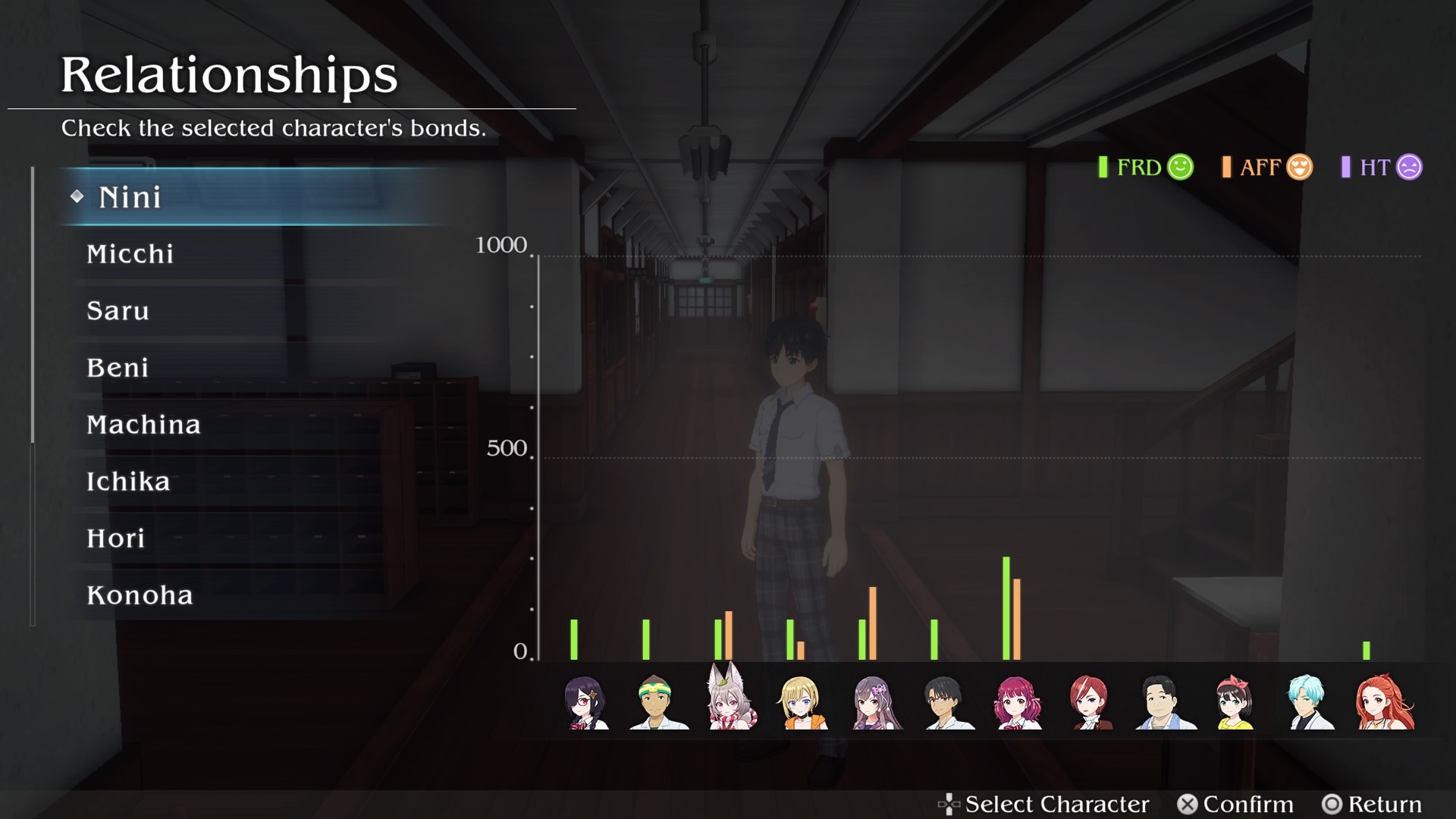
In Loop8 you control the character "Nini", a boy who has come down to the Japanese town of Ashihara in the 1980s. In this alternate version of the world, creatures called Kegai have been running rampant across the world. Thankfully, the town of Ashihara has seen a distinct lack of Kegai activity. Well, it's lucky that Nini's been forced to show up, as the Kegai are beginning to stir in Ashihara.


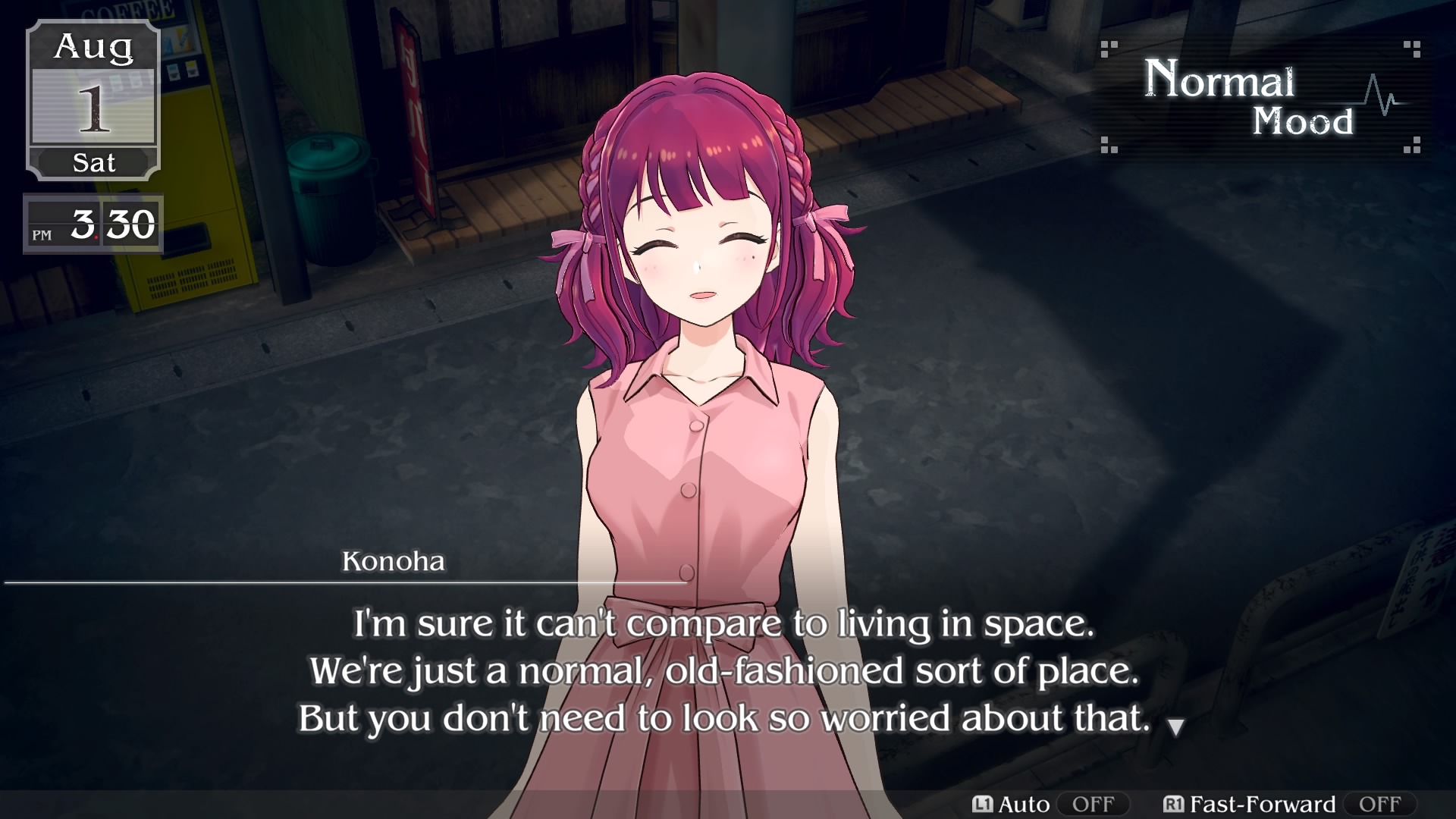
Loop8 takes a very interesting stance on gameplay, having a sort of persona-esque vibe, just more of a focus on the social networking, less on the turn-based fighting. Well, let's start at the top and you'll see how things go. After you're new roommate and distant relative gets you situated and registered at the local highschool, you'll start having free time after the tutorial has run its course. During your free time you can explore the town, interact with other characters, and increase your stats. Normally I like to start broader and then get into some of the specifics, but today we're doing the opposite!

First let's talk about interactions with other characters. All the characters you can interact with have three different social values: Friendship, Affection, and Hate. Whenever you interact with someone, there are a number of options to choose from depending on their social stats. For instance, if you build enough friendship or affection with someone, you can ask them to hang out. In addition, every character will have their own mood and feeling, which will affect the success rate of your interactions. The general area you're in will also have a general mood depending on who is there at the time and their moods.

As you can probably guess, failing at an interaction usually increases hate and reduces friendship or affection. What I haven't mentioned yet is that interacting with other characters require health and stamina from Nini. As you move about the town and interact with people, your health and stamina will decrease. If it runs too low, or it gets too late in the day, you'll need to return to your room and sleep, starting the new day. Yup, that's right, it's one of those timed things. On the plus side, you can get a lot done in a day, as well as increase your health and stamina through your character stats (not the social ones).


Your character stats include such examples as Strength, Agility, and Divine Power. These determine battle effectiveness as well as increases in health and stamina. Your character stats can be improved either by interacting with specific locations around town and spending an hour and a half of in-game time or certain interactions with characters will increase both of your stats. An important note here is that even characters that won't necessarily fight alongside you still have status values. Pro tip, if you invite a character to walk around with you, they enter your party and you can check if they have any battle skills, which is a good way to check if you can have them fight with you in the combat segments.

So then, here's a question before we get into the combat type elements. Why is the game called Loop8? Well, anytime you either lose or make a request to a certain character, you will repeat the game from the beginning of August, continuing to loop until you reach an ending. Each time you do though, your stats and relationships will get reset, with two caveats. The first is blessings. As you meet certain criteria, you and your friends will earn blessings from the Gods. These blessings will permanently increase your stats between loops, giving you a higher starting value. The second is that your stats will increase at twice the rate until they reach their previous value, making future loops progressively easier as you increase your stats faster.

Alright, so now that we talked about what the bulk of the game involves, let's talk a bit about the combat portions. Basically, the world will end because an evil spirit possesses someone in town after a day or two. You have a 5 day countdown after beating a boss where that new evil spirit possesses someone. In order to start the foray into the world of the dead where the kegai reside, you actually need to figure out who is possessed and probably talk to them a few times. A portal then appears at the shrine, and you and up to two other members can venture forth to defeat the Kegai. This is where your affinity with other characters comes in, as you need a certain level of friendship and affection in order to ask others to fight with you.


Exploring the realm of the kegai is a little different than exploring the town. There are barriers around the mirror town you find yourself in, requiring magatama to unlock. You can interact with orbs in the mirror world and there are status checks to see if you get a magatama. Get enough for the barrier you want to unlock,, and you can challenge the boss. Alternatively you can talk to the shadow beings walking around to get some info on why the person who's being possessed is possessed to begin with. Or you could get into a fight.

Combat is...an interesting affair. Your party members will take action on their own initiative, while you can actually select what type of move you make yourself. You can attack with any of your social stats: Friendship, Affection, or Hate, which will have different impacts on the enemies, and bosses. If you attack with too much hate, or let it build too much from the boss, the bosses can increase in strength. Attacking with affection will lower this, but hate tends to be a stronger value, so use that wisely. In battle any moves you make will generally require stamina, except the option to restore stamina. If you get too low you will need to recover it. So you also have a health gauge, but you need to be careful. If Nini loses all his health, it's game over, and if your teammates lose all their health? They die. Like, OG Fire Emblem, they're gone for good.

Now, here is where I have to make the obligatory statement that I have no idea behind the exact mechanics of what determines the difficulty of a boss. They're also kind of randomized. For example, the first boss I fought during my first non-tutorial loop was the last one, before the final boss, during my first successful completion of the game. Now, for whatever reason, the second boss on my first loop, and the third last on my first success, were the hardest. Disgustingly so. That's where I learned your party members can permanently die. But I soloed the last three bosses no problem? Even the last boss was a bit of a pushover compared to that one specific one? It's probably related to your social stats, but I still don't fully understand just how the mechanics work. Maybe that's some science I can do later though.

Loop8 has a pretty wide variety of characters, all with  their own personalities and quirks, and it's really neat to see them all interacting with each other. That being said, you'll see that a lot, as each subsequent loop means you need to watch the same scenes over and over again while building up characters Friendship and Affection. To add to this, time passes really fast. Like, one in-game minute is one second in real time. While you'll generally be given a lot of time to deal with all the characters and increase your stats accordingly, the speed at which time moves, even in the mirror world, can seem quite pressuring.


Another bit of complaint I have is that there is a lot that is...rather under explained. While a bunch you can get from hints dropped by the divine flying squirrel that gives you your blessings, there's a certain amount of info that would've been really helpful to know a lot earlier than when I figured it out on my own. There's no real "check in here for different tips" deal either, so you have to basically just hope any non-blessing squirrel will give you actually helpful tips instead of random trivia.

Overall, I had a really good time with Loop8, despite some of the absolutely frustrating moments it gave me. I like the breadth of characters each with their own unique events, the backstories are generally either really relatable or make you feel for the characters. Well, at least some of them, yeah? The slow walking speed, the recurring scenes you have to go through every loop, and the necessity to build up relationships and stats again can feel quite off-putting at first, but it was nice to find out it just becomes easier the more loops you do.

Loop8: Summer of Gods is a rather rough game. It has some issues with pacing due to the looping nature of the game. Combat feels a bit like a slog to get through half the time, and frustrations can arise if you screw something up and find out you need to start a new loop because you aren't happy with the outcome. That being said, Loop8 is one of the most uniquely endearing games I've played in quite a while. Honestly, what you get out of Loop8 is roughly what you put into it. If you're shallow on your relationships, the game feels shallow, whereas if you ignore personal improvements, combat can become difficult. It's a very interesting JRPG take on balancing a personal and social life, more or less.

Score: 7.5 / 10


Share:

The Legend of Heroes: Trails From Zero Review

The Legend of Heroes: Trails From Zero by developer Nihon Falcom and publisher NIS America Inc.Sony PlayStation 4 review written by Pierre-Yves with a copy provided by the publisher.

Estimated reading time: 10 minutes 


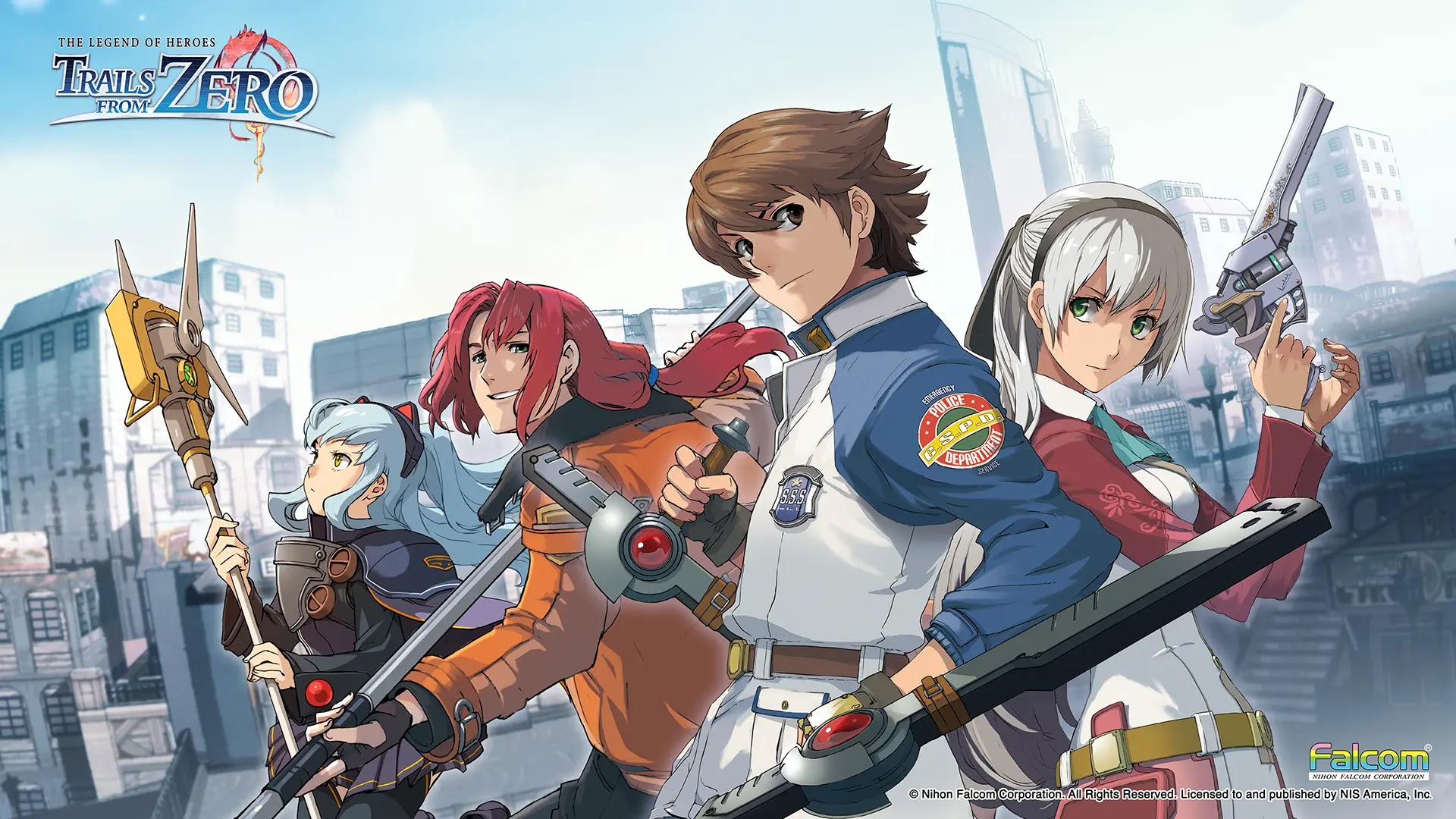
Having taken a long time to come into the hands of fans of the series, Falcom's The Legend of Heroes: Trails From Zero is finally here with the help of NIS America Inc.'s localization efforts. Starting off on their first day on the job, Lloyd Bannings, Elie MacDowell, Tio Plato and Randy Orlando find themselves in a unique position. Having joined the Crossbell's Police Department's newly formed Special Support Section, our protagonists must navigate both the day to day routine that is anything but as well as Crossbell's has a unique structure as it belongs to both the Erebonian Empire and the Republic of Calvard.

Note: Please be aware that this review contains some spoilers either in the text or in the screenshots taken during gameplay.

Not just the main cast, but the players too will find themselves in a unique situation. Placed after the events of the Trails in the Sky series, Trails From Zero starts before and then runs parallel to the beginning of Trails of Cold Steel. The reason this is important is we in North America have already had the chance to explore Trails in the Sky's First Chapter, Second Chapter (Digitally Downloaded) and Third Chapter as well as Trails of Cold Steel, Cold Steel II, Cold Steel III and Cold Steel IV where the Special Support Section appear in both Cold Steel III and IV. So because of this, we already know "how this ends" with the upcoming localization of Trails to Azure in 2023, but how does it all begin? This was a 40+ hour JRPG adventure that I wouldn't have traded a minute of as the credits rolled just shy of the 51 hour mark.

Moving onto Trails From Zero itself, having originally released back on the PSP over a decade ago it uses the same engine and artstyle as Trails to the Sky's First / Second / Third Chapters. What’s impressive with this style, as well as Falcom’s Ys Series that had releases in the same time period, are that the system and the artstyle don’t hold any part of the presentation back. Character models are unique and detailed and in true Falcom fashion, they weren’t afraid to take their time and tell a story. Whether the releases of yesterday that we are now getting to see today or the releases that we’ve recently had a chance to experience, there is a LOT of text, dialog, and storytelling. The only downside to this? It’s a time investment and to truly understand what’s going on? You’ll either need to play every entry or consult several wikias. Otherwise, what are you waiting for!?

So to tell this story, the events of Trails From Zero will happen within the various districts and surrounding areas of the city of Crossbell. From the city center to the upper lavish residential quarters down to the downtown slums, each of these spaces holds its own charm, people and establishments to go with it. What I really appreciated with this design is that while new and exciting at first, it never gets tiring as the hours go by. While always at your fingertips, and while it will obviously contain a lot of back and forth, the city has been designed for this alongside the stories being presented. This in a form of retrospect really helped set the stage for the Trails of Cold Steel series’ move over into the Empire’s Thors Military academy which somewhat emulated this approach but on a much larger scale.

Starting off on the very first day of work, Lloyd, Elie, Tio and Randy will have their work cut out for them. While the unit that they’ve been assigned to has a fancy name, the Special Support Section, it may not be as glorious as it sounds once you get to know what’s required. Basically being the Police Department’s attempt to gain better favor with the townsfolk, this new unit is, at least in the beginning, looked down upon from the core Police Department Divisions as well as the Bracer’s Guild that already does what the Special Support Section is supposed to do, help the people out first, and worry about the rest second.

Divided into chapters, each chapter will have “days” that play out in which you’ll be taking on requests from finding lost people, looking for vendor stall thieves and taking on dangerous monsters. Basically, everything that a Bracer (a member of a guild that exists to help people and should not be confused with mercenaries) would normally do to keep the people safe and happy! What’s great about this style, and the series itself as it’s almost the core function to move everything along, is that the “side quests” or “side content” don’t feel like they are simply there for padding. In a more modern take as they came out after, think of Bioware’s Dragon Age 2 which takes place in a single city merged with CD Projekt Red’s The Witcher 3’s quests. They are both entertaining and fulfilling and next thing you know? It’s ten hours later and you’re only now moving onto the main story event.

The flip side of this is that you don’t actually have to do these side quests. It will reflect poorly on you of course, you’ll be out a fair amount of reward money and items and finally? It would be a disservice to Trails From Zero itself as it’s also through these side events that you’ll both get to better understand Lloyd, Elie, Tio and Randy as well as the city of Crossbell. Taking it a step further is that, while I did finish just under 51 hours, there is a lot that I probably missed. Not all of these side events are given to you at the beginning of each day, or in some cases half days. Some of them require you to do what you’re supposed to do. Explore the town, talk with people and find out if they need anything. Through those conversations it’s possible to get new quests to follow further expanding the experience.

Not all sunshine and lollipops for our Special Support Section, it’s a good thing that each is trained in a form of combat because they are going to need it. Street thugs, various mafia, military training exercises, ghosts, monsters and just general crazy pants cultists, you name it, they’ve faced it. Having to remember that Trails From Zero was in fact released before Trails of Cold Steel, while combat still has some enhancements from the Tails in the Sky series (which I REALLY need to play the Third Chapter that was more of a stand alone), there were some items that I had to remember didn’t exist. Or that they didn’t exist in the same manner.

Combat for the Trails series is a unique take on turned based JRPG systems. Having a set turn order, this turn order can be flipped on its head in a manner of seconds depending on character actions. Split into normal attacks, arts and crafts (that never gets old), every battle participant can choose an action on each of their turns. Normal attacks are just that, normal attacks where Lloyd will use his tonfas, Elie her long ranged orbal gun, Tio her orbal staff that emulates arts (magic) and Randy with his modified halberd. Each having their own uses, these will keep with the normal flow of battle.

For those stepping in now, arts and crafts and where things get nuts. Arts are basically magic which can be split into the core elements of Fire, Water, Earth, Wind, and then the higher elements of Time, Space and Mirage. Once a quartz of these types has been equipped, these not only allow for stats buffs and new abilities such as seeing enemy stats without an analysis or all chests on the field, but they allow for casting magic. The more powerful the ability, the more energy points (EP) that are going to be required to cast it alongside time. This will shift the order or battle around as characters are no longer in the normal flow because of it.

Crafts, unlike arts, are character specific abilities that can be used in battle. Having their own pool of points, craft points (CP), unlike HP and EP, these are set in number from start to finish. Totaling up to 200, CP can be used for normal abilities costing 10-20-30-40 points, or, when using 100 can be used for a seriously powerful solo or partnered character ability. Unlike the partnered abilities that cost 100 CP each, if a character can accumulate up to 200 they can unleash an even more powerful version. Where crafts are a bit different is that they can also be used to stop an art in its tracks, preventing it from ever being cast and wrecking havoc against you. Just remember, whatever you can do? So can the enemy!

So it’s a little bit of rock, paper, scissors to keep things in check however battle doesn’t stop there. That timeline of who is going when and doing what? It has a side element such as being able to restore HP, EP, CP, cause critical hits, gain more sepith (currency and can be used to turn into quartz) as well as two functions that will see a revamp in the Trails of Cold Steel Series. Rush attacks and all out attacks while needing points in future entries, are here within part of the timeline. Rush will allow a character to go twice and all out attack will allow every party member to attack at the same time. Because it can’t just stop there! Once the higher elements are involved you’ll also have to deal with hits being able to vanish a character from battle for a limited amount of time, flat out block attacks and deathblows that you do NOT want to be on the receiving end of.

It sounds like a lot, and at times depending on the boss fights it can be, however it all works so well together. This is actually a big point that I want to make as unlike the other entries that I’ve played, I barely touched arts until about the 40ish hour mark. The reason? I didn’t need to as each character's crafts were so well designed that it just wasn’t needed unless I needed a mass healing from someone other than Elie or Tio. In those cases I would use breath or holy breath under the wind quartz from Lloyd, Randy or one of the other supporting characters at that point in time such as the Bracers Estelle or Joshua from Trails in the Sky who tag along now and then.

So with all of the above put together? Trails From Zero was fantastic from start to finish. Well paced and well written, what really brings everything together is how everything is intertwined. Seemingly unrelated, everything has a way of coming together making you realize just how deep some storylines went and how important other self-contained stories really were in the larger picture. Finally? As good as it all is, I don’t think it would have carried the same weight without the musical talent of the Falcom Sound Team which are always a pleasure to listen to either while playing Falcom’s work or otherwise. I often have their albums playing while working on something or another.

Nihon Falcom’s The Legend of Heroes: Trails From Zero was worth the wait and I’m happy that NIS America Inc. have localized both it, and the upcoming Trails to Azure in 2023 for us. Well paced and well written storytelling is only ever elevated by the characters that you’ll get to adventure with as they establish what the Special Support Section is all about as they trek through and around the city of Crossbell solving problems big and small.

Score: 9 / 10


Share:

Random posts

Our Streamers

Susan "Jagtress" N.


S.M. Carrière

Aldren


Affiliates

JenEricDesigns – Coffee that ships to the US and Canada

JenEricDesigns – Coffee that ships to the US and Canada
Light, Medium and Dark Roast Coffee available.

Blog Archive

Labels