• Gobliiins Collection - Switch Review

    In the early 90s, Coktel Vision (which later became Sierra On-Line) released a quirky point and click adventure game titled Gobliiins which had players bouncing between three different Goblins to find a cure for good King Angoulafre.

  • The Core - PC Preview

    Sometimes when you are browsing the internet for information on how to do something, you stumble upon ideas or projects or even games that people might be working on...

  • Cat Mail Co. - PC Review

    What a meow-gnificent evening it is to send your paw-rcels out to those family and friends! Are mew looking to pick up an item or send something out? Well at Cat Mail Co. we can send and receive all your deliveries!

  • Volontes - Nintendo Switch Review

    Have you ever grown up feeling like you don't belong? For our Heroine, that's the feeling she lives with everyday in her small farming village. But it's not her only secret...

  • STARSEEKER: Astroneer Expeditions - PC Preview

    STARSEEKER: Astroneer Expeditions is just that! Massively co-operative and not an MMO! When you first run the game you are instantly into the tutorial...

  • Dread Delusion - Xbox Series X|S Review

    Today we’re looking at what has rapidly become an absolute favorite in the open-world RPG genre for me. An interesting story, memorable NPCs, stunning visuals, and a setting absolutely dripping with flavor, Dread Delusion sets its tone immediately and sticks with it.

  • House Flipper Remastered Collection - PC Review

    I enjoy simulation-type games, and I enjoyed the original release of House Flipper, but I never got around to getting the DLC. When the remastered version of the game was released, I figured it would be the best way to experience the DLC while checking out how the base game was upgraded.

  • GranBlue Fantasy: ReLink Endless Ragnarok - PS5 Review

    GranBlue Fantasy: ReLink released in 2024 bringing the GranBlue universe to an action adventure JRPG format. With a party of up to four members, this band of skyfarers set out for new skies, adventures, and dangers. Two years later, Endless Ragnarok...

  • 70s-Style Robot Anime Geppy-X - PS5 Review

    70s-Style Robot Anime Geppy-X is a mouthful of a title, but you know what? It’s quite the challenging game to describe as well. At its core, 70s-Style Robot Anime Geppy-X is a shooter...

Showing posts with label NISA. Show all posts

Annoucing Phantom Brave: The Lost Hero Coming to Consoles and Steam in 2025!

We are proud to announce that Phantom Brave: The Lost Hero will be launching on Nintendo Switch, PlayStation 4, and PlayStation 5 on January 30, 2025 (Steam version to follow in Spring 2025)!


Preorders for the Phantom Brave: The Lost Hero Limited Edition, exclusive to the NIS Online Store, are now available for Nintendo Switch, PlayStation 4, and PlayStation 5. The contents of the Limited Edition include a Deluxe Edition copy of the game, an Art Book, a soundtrack, an acrylic diorama stand, and a coaster.

Phantom Brave: The Hermuda Triangle Remastered Coming to PlayStation 5

In addition to today’s release date announcement, Phantom Brave: The Hermuda Triangle Remastered is coming to PlayStation 5! Embark on the heartfelt first adventure of Marona and her Phantom friend Ash in Phantom Brave: The Hermuda Triangle Remastered on November 7, 2024. 


About Phantom Brave: The Lost Hero


In Phantom Brave: The Lost Hero, the story follows Marona – a gifted young girl with the power to speak to Phantoms – as she traverses the ocean world of Ivoire, providing aid to those in need. When a fleet of ghost ships attack, it’s up to Marona and her new friend Apricot to assemble the legendary crew that once defeated these spectral foes.

Recruit Phantoms, bind them to objects, combine them with Gadgets, and even merge them with Marona herself to unleash show-stopping abilities and sink the Shipwreck Fleet!

Article by: Susan N.
Share:

Check Out Super Mario Party Jamboree for Nintendo Switch Releasing Oct 17th!

Are you ready to join the biggest Mario Party yet? Nintendo has an early look at the new Super Mario Party Jamboree game for the Nintendo Switch family of systems, releasing October 17.

Jam-packed with fun, Super Mario Party Jamboree features over 110 minigames, 22 playable characters (including newcomers to the series, Pauline and Ninji) and more ways to play than ever before.

Here are just some of the many festivities that await in Super Mario Party Jamboree:

  • Mario Party Mode – Travel to a tropical party paradise and play your way across a total of 7 distinct boards with friends, including the brand-new Goomba Lagoon and Rainbow Galleria boards! Plus, Super Mario Party Jamboree includes two returning favorites: Mario’s Rainbow Castle from Mario Party and Western Land from Mario Party 2. Hit the Dice Block and you may come across a Jamboree Buddy along the way – characters who unlock game-changing abilities, from copying opponents’ items to launching you across the board.
  • Minigame Bay – Explore an assortment of minigames in this mode, like daily challenges and 2 vs. 2 matches.
  • New Motion Control Modes* – Grab your Joy-Con controllers and fly through the air in Paratroopa Flight School, move your way through Toad’s Item Factory and cook to the beat with Rhythm Kitchen.
  • New Multiplayer Online Modes** – Join the 20-player race to finish first in Koopathlon, where you’ll collect coins during minigames to advance through a giant racecourse. Or take on Imposter Bowser in Bowser Kaboom Squad, a cooperative battle for up to 8 players.

Plus, a 3-month Nintendo Switch Online Individual Membership is also included! Anyone who pre-orders or purchases the game prior to March 31, 2025 at 11:59 p.m. PT will receive a Nintendo eShop code for a 3-month Nintendo Switch Online Individual Membership (not valid with Nintendo Switch Online Family or Nintendo Switch Online + Expansion Pack memberships)! The code never expires and will come either in a packed-in pamphlet (while supplies last) with physical versions of the game, or by email if the game is purchased digitally.

And as you can expect from a Super Mario Party game, there are still even more surprises in store! The party kicks off with the release of the game next month. Pre-orders for Super Mario Party Jamboree are available right now!


-- Your friends at Nintendo


* Joy-Con controller required for motion-control minigames. Motion-control minigames not compatible with online mode or Nintendo Switch Lite.


** Any Nintendo Switch Online membership (sold separately) and Nintendo Account required for online features. Membership auto-renews after initial term at the then-current price unless canceled. Not available in all countries. Internet access required for online features. Terms apply. nintendo.com/switch/online
    Article by: Susan N.


    Share:

    Monster Menu: The Scavenger's Cookbook - PS4 Review


    Monster Menu: The Scavenger's Cookbook by developer Nippon Ichi Software and publisher NIS America—PS4 review written by Richard with a copy provided by the publisher.
     
    Estimated reading time: 6 minute
    Well folks, it's around the time a new roguelite comes out, which means my blood pressure is skyrocketing and my tears are flowing. This time we get to take a look at the NIS starvation roguelite Monster Menu: The Scavenger's Cookbook.

    Monster Menu, like a large amount of roguelites, has a pretty basic premise. You're an adventurer who has gone on what was supposed to be a fairly standard adventure. Unfortunately, you get lost and run out of food and water. In a semi delirious haze, you resort to the only thing you can: eating the corpse of an unknown monster on an altar, always the best of ideas. Next thing you know, you find yourself in a sprawling labyrinth, with only a few items at your disposal. Good news though, you can't really die! You just wake up at a base camp whenever you should otherwise die. Too bad you still need to survive in order to find your way out of the labyrinth.


    Like most roguelites, you are tasked with making your way through randomly generated floors to reach your goal. In monster menu, every new run sets you back down to level one, and depending on difficulty will also get rid of your materials. You do get to keep equipment though, which isn't really the most common. Monster Menu also has a few other little quirks that set itself apart from the crowd. So, let's take a look at some of the basics first.

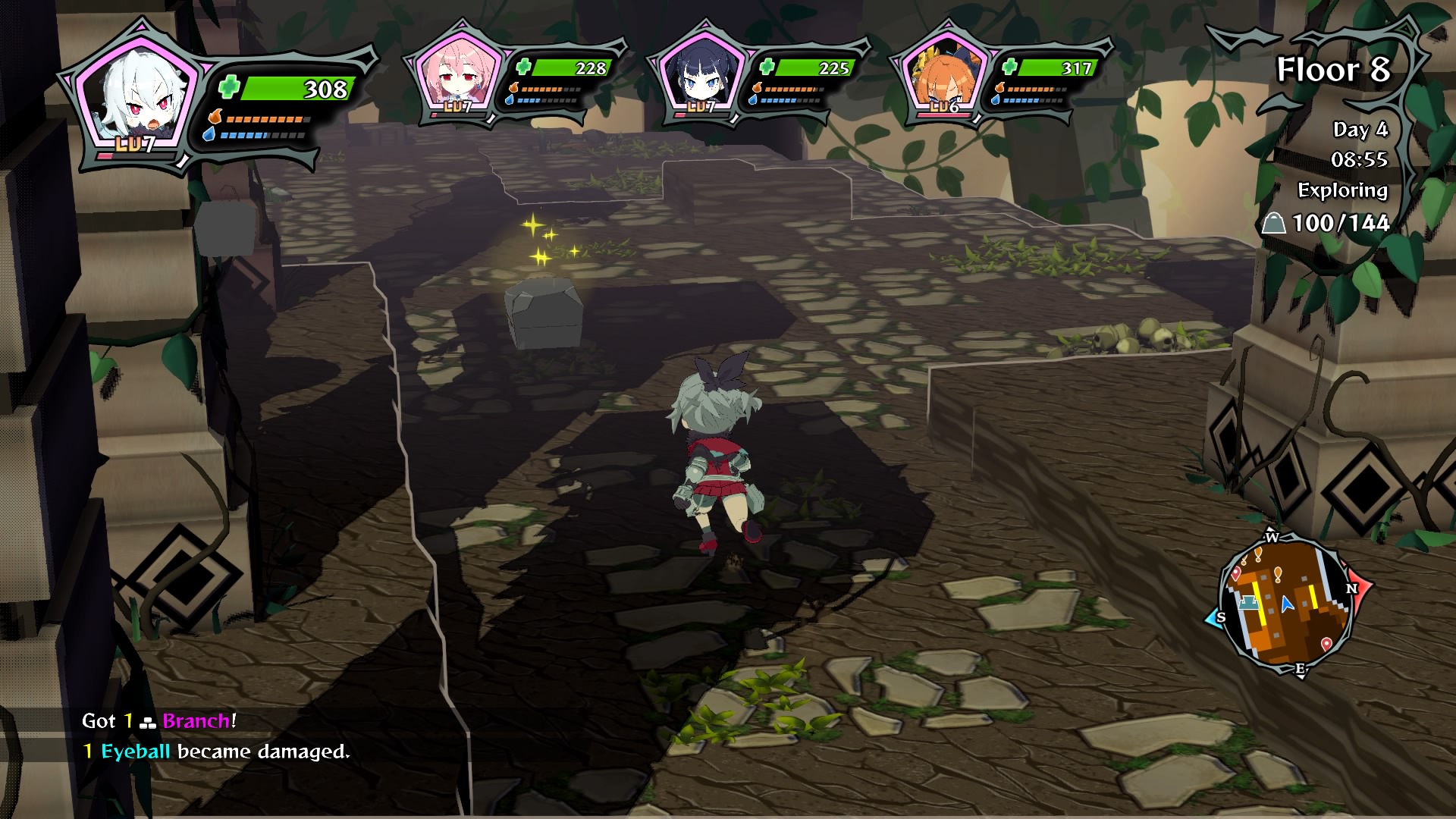
    Exploration of each new floor is done in a 3D manner, where your main character, one of up to four, will be able to walk around, harvest items, pick fights with enemies, and investigate altars. Exploration is done in a real-time scenario, where the enemies and you can be constantly moving. When you make contact with an enemy, whether that be on your terms or theirs, the field map turns into a turn-based grid style map where your combat is performed in a turn order. In combat you can attack, use skills or items, defend, etc. After winning fights, you gain exp for your units, and can then scavenge the bodies for materials. When back on the field map, your goal is to find the stairs leading to the next floor, a task sometimes easier said than done.

    Why is it so difficult? Well, a number of factors really, including: how the RNG treats you, the fact that time passes, your calorie and hydration values, where the stairs have decided to appear, and what sort of materials you're able to harvest. All of these aspects tie in to the major mechanic of Monster Menu: eating food. Your units all have an individual stat layout for health, calories, hydration, and happiness. It is your job to manage these values in order to keep your party in fighting shape. The only problem is, everything you do takes energy in the form of calories and hydration. Moving, attacking, harvesting, resting between floors, even just waiting around while time passes will cause your energy to slowly deplete.


    In order to restore your calories and hydration, as well as give you some extra health, you will be cooking meals between floors as you investigate the labyrinth you find yourself trapped in. Point of note, materials will decay over time, reducing their freshness until they eventually become rotten. At your camp between floors, you can use ingredients to cook meals. Tastier meals made from more normal items will restore larger amounts of health, calories, hydration, and happiness. Disgusting meals, like a plate full of maggots, may give a good calorie value but your happiness takes a nosedive. When your units get too unhappy they may become prone to madness, so look out.

    Meals can be prepared using a variety of different techniques, each possibly resulting in some sort of change to the dish, which will not only restore points, but will also give you food skills as well as increase stats. If you make a meal you can't take it with you into the labyrinth though, so you need to eat it at the camp. Trying to balance making meals that provide good recovery or stats while still remaining fresh can be a challenge, especially when you lose a lot of energy values every floor, and enemies and material harvesting points just don't cough up what you need. Additionally, at night time monsters get more active, and a lot tougher, so beware.

    As you explore through the floors, you may run across some skeleton bones. These have a chance at netting you some crafting recipes, for both key items and repair kits, as well as cooking recipes. Good news, you also keep these on death, although you can actually cook freeform without a recipe, although it may be quite difficult to come up with a menu item if you have no clue what you can throw together, or what type of preparation is required.


    Equipment can be gathered in chests found throughout the floors, and isn't necessarily of a level tied to the floor. *stares angrily at the starter cloak found in the 3rd strata*. Thankfully your gear carries over between runs but, uh, well, it has durability, so too many failed runs without any decent rolls on materials or equipment and your gear will be a lot less beneficial. It doesn't break thankfully, so you just need to make some repair kits, if you can.

    So, I have to mention this, but game is tough. Like, seriously, depending on your luck and difficulty setting this game can be an absolute nightmare. It took me, like, more than a few hours just to get into the third area, and I never found any equipment better than what I had picked up in the first area. Like seriously, it was a rough go. On the other hand, I did manage to get rather good at goading enemies into locations I wanted them in, as well as hanging onto items I could feed to enemies to cause status debuffs or negative status effects.

    Monster Menu is pretty fun, and the attention to the calorie and hydration aspects are an interesting focus, especially considering how you have to either make your own meals out of materials found in the labyrinth or through devouring the corpses of your enemies mid battle. It's certainly full of a lot of interesting parts that more veteran players may enjoy, and the cute chibi characters provide a nice contrast against the grim reality that you may be eating your own comrades in order to survive.


    Overall, despite being hammered upside the face by poor equipment drops and RNG rolls, I am actually quite fond of Monster Menu: The Scavenger's Cookbook. The transition from freeform exploration to turn-based battles is smooth, the combat is pretty smooth, and it's interesting being able to shove your food materials into monster faces for your own benefit. If you're expecting pity though, you may be out of luck as a lot of your run depends on how lucky you are, which may be a little frustrating for some. Monster Menu definitely feels more like a title for those familiar with the roguelite genre as opposed to newcomers, but still provides the difficulty selection to allow for newcomers to play.


    Score: 7.5 / 10
    Share:

    Void Terrarium 2

    Void Terrarium 2 by developer Nippon Ichi Software Inc. and publisher NIS America Inc.PS4 review written by Richard with a copy provided by the publisher.

    Estimated reading time: 5 minutes


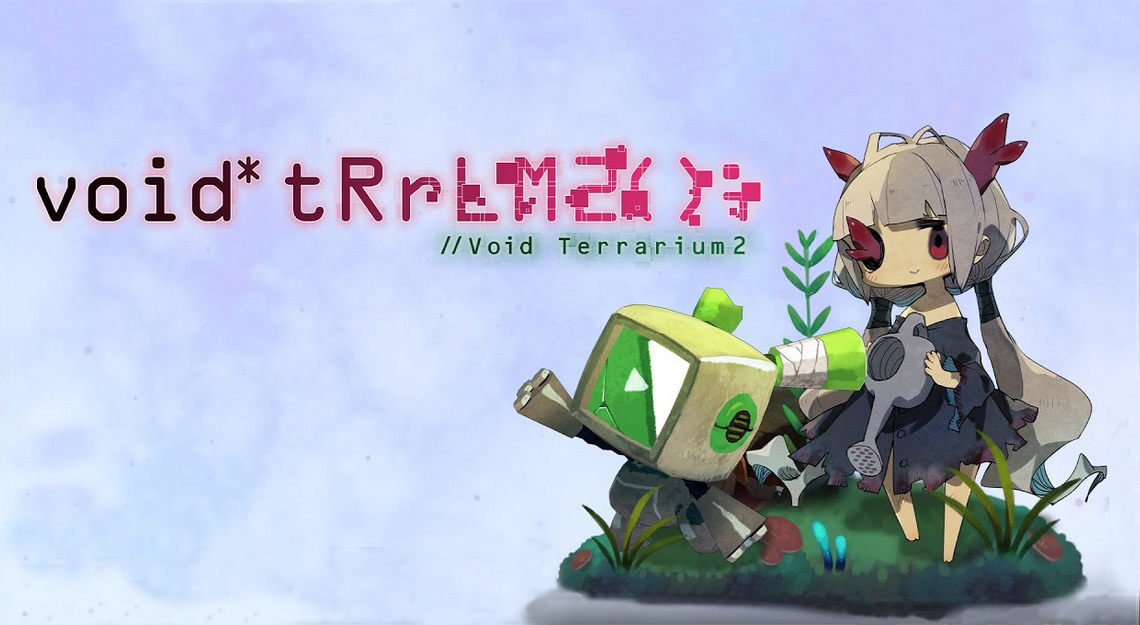
    void* tRrLM2(); is certainly one heck of a title. You could also just call it "Void Terrarium 2". A cute but weirdly dark roguelite and Tamagotchi mash-up. What does this cutely drawn dread have in store for you? Well, let's find out.

    So first off, I'd like to preface this by letting you know that if you've played the first Void Terrarium, you pretty much know everything you need to. Void Terrarium 2 doesn't differ a whole lot, and what is different isn't a make-or-break deal. Short version is, if you liked the first title, you'll like this one. For those unfamiliar with the first title, no worries! I've got you covered!


    In Void Terrarium, and Void Terrarium 2, you take on the role of Robbie, a cute looking robot in a post apocalyptic world. Turns out humans have died out, but lucky you, you've discovered a young girl (in the first game), Toriko! Unfortunately, the atmosphere is chock full of these nasty contagious spores. As such your job, along with the helpful AI bot, is to build and manage a terrarium for Toriko in order to keep her clean, happy, and well fed. 

    Obviously this isn't necessarily the easiest task, as food isn't readily available. Furthermore, the wastelands that now make up the vast majority of the world aren't exactly the friendliest of places. Filled with mutated and corrupted monsters, as well as rogue robots, you need to fight your way through the wastelands, discovering items, food, and blueprints to bring back to your home base for use in Toriko's terrarium.

    So, how is this a Tamagotchi/roguelite mash-up? Well, when you're in your base, you need to clean Toriko's terrarium, feed her, pet her, get her medicine if she falls ill, and generally just take care of her. You can also craft items for the terrarium in order to decorate it. When you need to craft things though, you need to traverse the wasteland, which is where the roguelite aspect comes in.

    Exploring the wasteland is no simple matter, but it is quite arduous. Luckily for you, Robbie is quite durable! Even if Robbie "dies", all his items get converted to resources, except food and blueprints, and he is sent back to the main base. Lucky for you, all your items except food and blueprints get turned into resources on a successful run anyways, and you still get to keep the food either way. Blueprints require you to actually return to base from a completed excursion however.


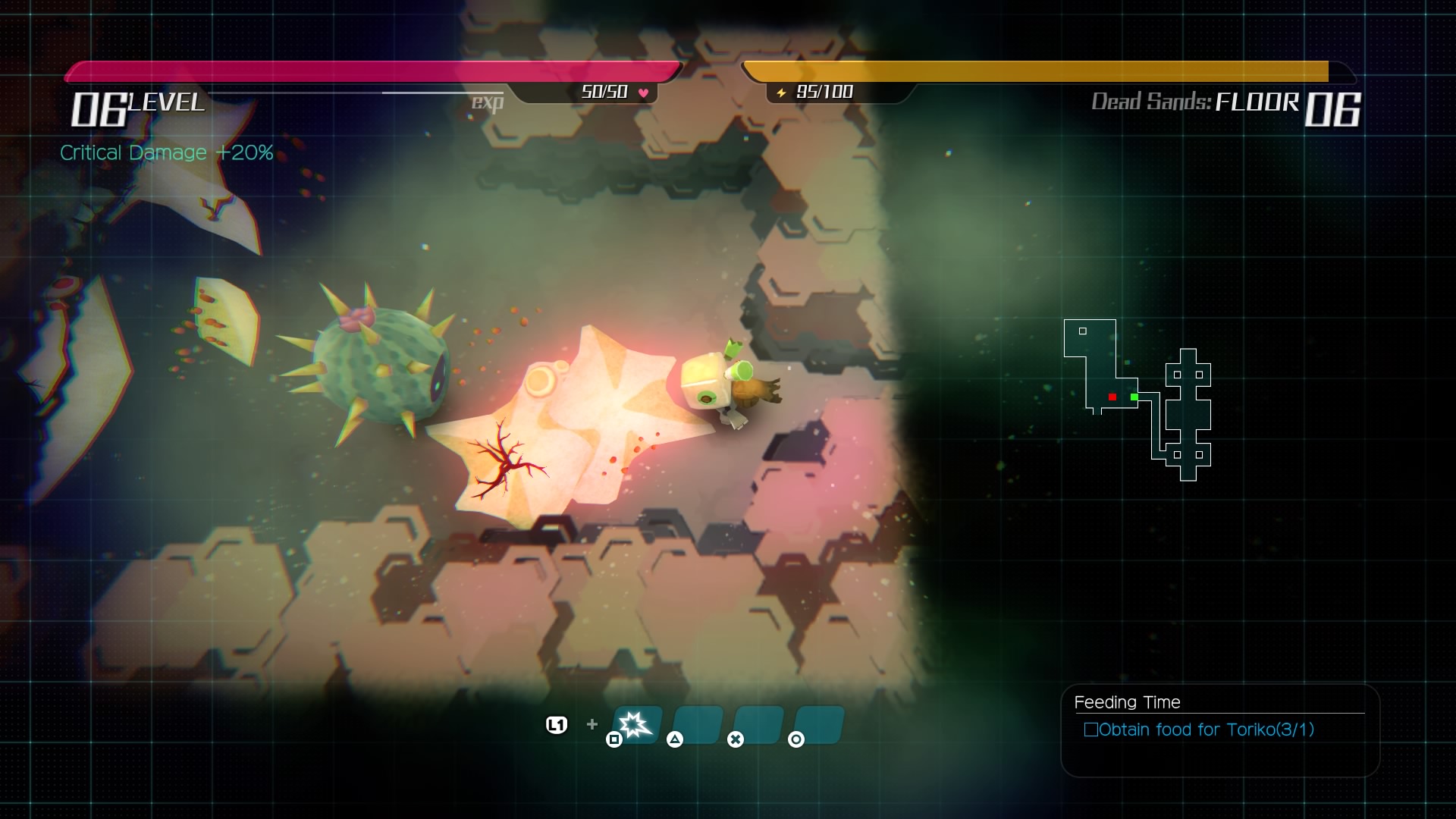
    While out exploring, this is when the roguelite aspects take play. Each zone you explore consists of a number of floors, each with a series of connected rooms. You can find enemies, items, or traps in these rooms. Whenever you leave on an expedition, you will always start at level 1. Defeating enemies, or using a certain item you can find, will increase your level. Upon leveling, your stats go up and you get to pick from one of two randomly chosen upgrades. Take note however that these upgrades are selected randomly, so if you're hoping to see the rare and good upgrades, you may be disappointed.

    As you progress through floors, enemies will also be getting stronger. Sometimes you can find weapons, shields, or throwable items such as grenades to help you on your way. Trust me when I say not getting a weapon for an entire run makes things really difficult. Even without any decent items to find, you still have to fight your way toward victory though. Each "room" in a floor is connected by tunnels, and floors are traversed by moving Robbie on a sort of square grid. You can see what's in your room, but not in other rooms. Once you enter a connecting tunnel, your vision gets restricted. Both you and enemies move in order, where enemies will move after you perform an action, whether that's attacking, moving, or using an item.

    There are a few things to keep in mind while fighting with the local wildlife, mainly energy consumption and skills. Robbie only has a limited amount of energy, and running out causes his health to deplete. It's a good idea to keep energy restoring items around. Skills are generally attached to weapons, and for an energy cost will perform an action. For example, a lance may have the Kite skill, which attacks and does a backstep at the same time. There is a cooldown though, so be aware of that. As an added note, if you're standing on a tile with an item and can't pick it up because your inventory is full, you can still interact with it through your items menu.

    Fighting isn't the only thing you''ll be doing in the wilderness though, because Toriko needs constant upkeep! At a certain point you get a sort of robotic nanny/monitor that you can give instructions to for an energy cost, thereby keeping Toriko clean and well fed. There are a few other mechanics that are pretty common staples to the roguelite genre, all of which can be reviewed either through the main menu or through some tutorial/practice stages set up in-game.


    After returning, you can craft plot items to progress the story, or various decor to give Robbie some permanent status upgrades. That's right, even in death not all is lost, as you can come back stronger than ever if you keep making new decor items. You may only receive the bonus the first time you craft a new item, but they can really make the difference between a successful run or a failure.

    Summary

    Overall, I have to say I really enjoy playing Void Terrarium 2. The gameplay is enjoyable, and keeping Toriko healthy is an interesting mechanic to keep things fresh. The graphic design is cute but hides a darker nature, and the soundtrack is both fitting and engaging. Void Terrarium 2 is a (mostly) cute exploration into a destroyed world, and while it can be frustrating at times, I felt it was a thoroughly well fleshed-out title. While maybe not offering much more than its predecessor, there's no reason to fix what isn't broken either.

    Score: 8.5 / 10

    Share:

    Labyrinth of Galleria: The Moon Society

    Labyrinth of Galleria: The Moon Society by developer Nippon Ichi Software and publisher NIS America Inc.PlayStation 4 review written by Richard with a copy provided by the publisher.

    Estimated reading time: 10  minutes


    Well folks, it's time to take a look at another dungeon crawler! A genre that usually tends to be either really good or really underwhelming. Today we have Labyrinth of Galleria: The Moon Society. A spiritual sequel to Labyrinth of Refrain: Coven of Dusk, let's see how well this title stacks up.

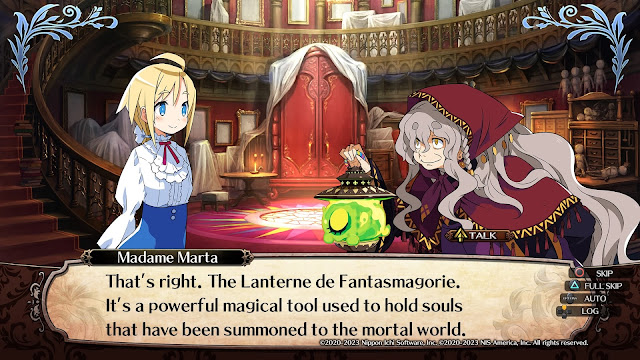
    Labyrinth of Galleria tells the tale of a sprawling labyrinth hiding beneath Galleria manor. Within its walls are hidden precious Curios: items that are cursed and have mysterious powers. As a young girl Eureka comes to take up a hired help position at the manor. She is entered into the service of a witch hired by the baron who owns the manor. Eureka's task is to act as a medium to a soul planted within a magical lantern. You, who technically take on the role of the soul, are tasked with taking puppet soldiers into the labyrinth in order to combat the fierce creatures within and to recover the relics.

    Now, if you've played Labyrinth of Refrain, then you've already got a good idea of what's in store for you. If not, have no fear, we'll be going over things. Briefly though, as there's actually quite a lot involved in these titles. Good news for you dungeon crawler aficionados! Encounters in the labyrinth are not random! Enemy icons appear on the map and you walk into them in order to start a fight. Walking into them from the side or back will generally result in a battle start in your favour. First up, let's take a look at how you go about exploring the labyrinth.

    Your basic exploration is pretty standard fare. You have an empty map that fills itself in as you explore, each tile you walk over adds the info of that tile to the map. Sometimes these tiles may be hazards, such as damaging tiles, pitfalls that drop you floors, or perhaps cursed mud that damages you while you're inside it. Your goal here is, ultimately, to discover the 7 major Curios d'Arte hidden within the labyrinth. These are placed in very special looking chests that you can discover. There are also a myriad of other curios as well. Let's not forget the normal chests and items that you can discover while roaming the labyrinth. 

    Now obviously, if all the labyrinth had to offer was just pathways, it wouldn't be all that interesting. Well, as you progress through the game, you can unlock more and more movement techniques. This will let you get into other areas, or past hazards that you weren't able to get by previously. Pro tip, if you see some spikes/lances, you do get a move to get past them later, so make a note of where those are. Apart from movement, you also can break down dungeon walls. Yup, that's right, you can break the dungeon. While most walls get repaired upon returning to the labyrinth, certain walls don't, allowing for quicker access to areas. You can also unlock other abilities, like a fog wall that prevents enemy icons from spotting you, although you still can get into combat, or the ability to stockpile exp.

    Most active abilities will require you to use reinforcement points. These points start at a default of 100, and will reduce each time you use an active ability. Reinforcement points can be recovered by earning mana in the labyrinth. Either touching a glowing green orb or wall will give you mana, as well as replenish reinforcement points at a certain rate. Be careful though, as each floor of the labyrinth has a mana limit. Exceed this, and some of the enemies get...well, scary. If any of you are coming from Refrain, I'm sure you have minor PTSD from the reapers. Or blowing up your first wall and getting demolished by the enemy behind it. Yeah, 25 hours later and they're some of the stronger enemies you can come across. Either way, collecting mana, as well as pretty much any item you see, is still really useful. When you return to base, you also get bonus exp. Once you unlock it, I do suggest playing with stockpiling exp, as it can be very useful.
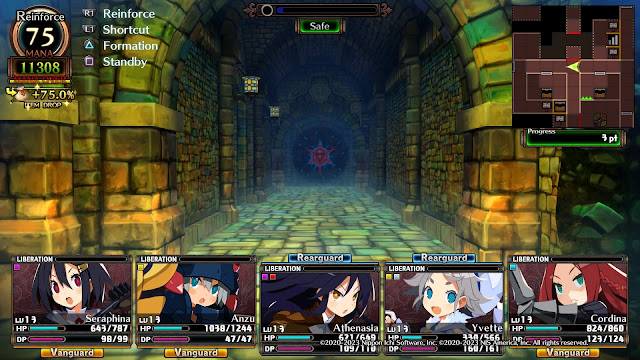

    So, how are you going to deal with the baddies infesting the labyrinth? Well, that's where the handy puppet soldiers come into play! You can create units with a combination of a soul and some puppet parts. You get to choose a class, nature, stance, lucky number, name, starting skill, as well as growth type. Fun fact: everything I listed actually affects something about your unit. Well, at least in Refrain it did, and it's implied it does so in Galleria as well. Yup, even the name. I won't go into the specifics, otherwise this will turn into a four hour lecture on just the basics, but feel free to play around with what you want from your puppets. If you really want, you can always check out a beginner's guide to unit creation for Refrain, provided one isn't available for Galleria when you're reading this. It'll go more in depth.

    So, let's say you've created your unit and decided upon what you want of them. It's now time to put them in a coven! How Galleria works is that all your units get placed in covens, of which you can have five covens in your squad. Each coven has different passive effects and exp acquisition rates, so pay attention when assigning, or reassigning, your units. For example, there is a coven type that has one frontline position and multiple support positions, with a 120% exp rate for the front liners, but it can only be used by theatrical star units. These types of covens are pretty plentiful, especially once you get later into the game, so you will want to take a look at new covens you acquire. 

    This brings us to another facet of the coven: Donum. This is basically just palette swapped mana/spells, but essentially any spells you can use are predominantly tied to the coven, rather than the units themselves. Some Donum require certain slots in the coven to be filled, while others may just be in-battle usage restrictions. Important to note however, is that coven actually may require reinforcement points to use. Covens earn exp and will level up based on number of battles mostly, and their cost will reduce as they level, as well as possibly opening up more Donum slots, which you can learn through manuals you can collect. 
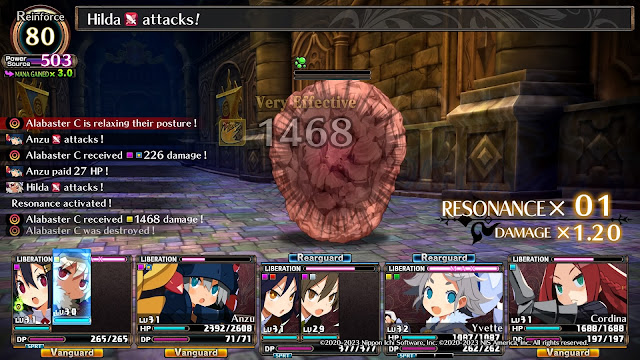

    Alrighty, now that you have your squad ready to go, it's time to take on the labyrinth! What better way to get used to this than to fight an enemy! Or group of enemies, maybe. Walk into an enemy icon, or interact with certain event markers, and you get into a fight. So, there's a lot going on, and I swear it gets easier the more time goes on, so bear with me for a bit. So to start with, you've got a turn based battle system, with higher AGI characters moving sooner. At the start of every "round", you will give directions to your units, adjust whether they are in the vanguard or rearguard, as well as spend reinforcement points as needed. Commands for the units are fairly straightforward, as you can attack, fortify (guard), use Donum, or attempt to flee. Adjusting whether your units are in the front or back is important because every weapon has a certain range value that needs to be met to use efficiently. If you're outside the range, your damage output decreases. Also, certain combinations of vanguard and rearguard coven positions will activate formation bonuses, so make sure to shuffle your covens to get the maximum effectiveness out of them!

    While it's still on your turn, you can use reinforcement points for different bonuses. These are unlocked through witch petitions mostly, which I'll talk about a bit later, but are explained to you when you acquire them in-game as well. As an example, you can spend 1 reinforcement point to increase attack of a unit in a coven for the turn, up to three times. Using items is also considered a "special move" and needs reinforcement points to function. Once you've set out all your commands, it's time to begin battle. Now, how enemies and your units react to battle situations are rather similar, so I'll be lumping them together. All units have varying degrees of resistance and damage types. Some attacks might be more effective against certain enemies. As you attack enemies, you also build up a "secret art" gauge. When full you can unleash it. This is based on coven, so if you don't like it, consider changing covens. Different status effects can be applied to both your allies and enemies, of which there is an in-game tutorial on how they work.

    One of the more unique aspects of Refrain and Galleria, and the bane of my existence in Refrain, is "Critical Gore". Basically, as puppets, your units aren't as attached to their limbs as you'd think. Enemies, and allies, have a chance at hitting a critical gore, meaning the character or unit hit loses that body part. This comes with a massive amount of damage, an decrease in stats and max health, and the inability to use any equipment associated with that limb. For your own units, you must then repair the puppet either with a specific item, or by returning from the labyrinth and repairing them at the workbench. Be warned though, as losing the head means your unit is just plain out of commission until repaired. The last thing I think I should mention here is that all units have a stun gauge. Attacks will drain this, and once emptied, the character will be stunned for that turn, but recover at the start of the next round.
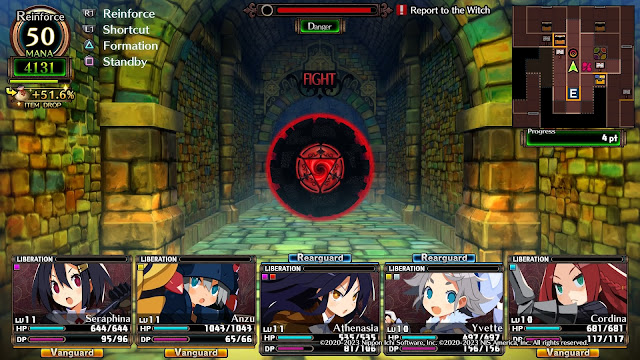

    Alright, that covers most of the primary gameplay aspects, so let's talk about a few things you can do outside of exploration. First up, and I can't stress this enough, CHECK THE TUTORIALS SECTION. This will be periodically updated with sometimes very important info with little to no indication. Seriously, just check it every so often. Additionally, there are messages written on the walls of the labyrinth. Most of the time, these are helpful tutorials or hints, so you may want to read them. When you return from your expeditions, there are a number of facilities at your disposal. You can take on requests by delivering loot items for rewards, check out the alchemy cauldron to enhance gear or release sealed equipment. Additionally, you can spend some of that mana you've brought back in order to petition the resident witch to unlock something new for you.

    Now, if any of you have been paying attention to the release info, or the pictures in this review, it may come as no surprise when I say this is a NIS title. What this means is that you can expect a pretty engaging story, anime stylized visuals for character portraits and cut-scenes, as well as a lengthy grind and occasionally bull*#$t enemies. Also some really dark themes tossed around like they're popcorn and a really bangin sound track.

    My only real complaints about Galleria are: sometimes navigating menus can be really annoying to find what you're looking for, and the fact that you can be brutally punished for having poor luck, both in-game and as a player. The amount of times I've been doing well then been screwed over by a few really unfortunate gore attacks... blegh. That being said, despite how much Galleria, and Refrain by extension, frustrated me to no end, I absolutely love them. If you're a dungeon crawler fan, you'll definitely enjoy Labyrinth of Galleria. 


    Summary

    Overall, Labyrinth of Galleria: The Moon Society, is a great addition to any dungeon crawler lover's library. With a surprisingly in-depth system for those looking for it, an interesting view on labyrinth exploration, and engaging characters and story, it's a gripping tale all through. While it may be a little much for newcomers to the genre, it's still a lot of fun. No need to know the previous title also means you can jump right on in.


    Score: 8 / 10


    Share:

    Prinny Presents NIS Classics Volume 3: Rhapsody: A Musical Adventure Review

    Prinny Presents NIS Classics Vol 3: Rhapsody: A Musical Adventure by developer Nippon Ichi Software and publisher NIS America Inc.PC (Steam) review written by Pierre-Yves with a copy provided by the publisher.

    Estimated reading time: 6 minutes 


    Following up on Nippon Ichi Software and NIS America Inc.'s Prinny Presents NIS Classics Vol 1 and Vol 2, Vol 3 is finally upon us! Taking two much older titles than the ones we’ve seen so far, Rhapsody: A Musical Adventure and La Pucelle: Ragnarok (PSP revamp of Tactics from the PS2), these two SRPGs were both a delight to revisit in a modern day environment.

    Note: Please be aware that this review contains some spoilers either in the text or in the screenshots taken during gameplay.

    Starting off with the PS1 classic Rhapsody: A Musical Adventure, while it did see a Nintendo DS port a decade later after its initial release, more than a decade after that Rhapsody is making another entrance from stage right but in its original 4:3 format. Starring a small town girl known as Cornet, this adventure is the story of love. Love for the prince that she dreams of one day being with, love of friends and frenemies, and finally? Love of family.

    While the story of Rhapsody: A Musical Adventure is never very deep, each of these forms of love is what makes Rhapsody a heartwarming story. It's cute and it's entertaining which is a good thing as there are some of the gameplay mechanics that did not age as well over the decades. Having originally found an almost sweet spot in its playstyle, Rhapsody is an SRPG but with JRPG elements when it comes to exploring the world and finding out clues of where to go next. Town interfaces are small but have people to talk to and depending on actions completed they can potentially offer you new leads on what to do next.

    This part works great and it allows for a more natural flow and reason to revisit locations as you progress through the adventure. One of the parts of Rhapsody that hasn't aged as well however are the dungeons that you'll be exploring in order to process through this adventure. Forgetting just how complicated it could be at times unless you have a stellar memory, I quickly found myself with a pad and paper to start drawing my way through as without it? It could take you some time to figure it out. It could also easily break your gameplay experience by your party being severely over-leveled as you try to figure your way through these dungeons.

    The dungeons themselves are built in bland small cube-like rooms with passages potentially opening up to the north, east, south or west sides. There's no mini map. There's no map in your menu. There's nothing but remembering what passageways you've taken and which floor you are currently exploring. Because of this, and the at times crazy amount of random encounters, it's really easy to lose your sense of direction as you could forget which way you were going. I highly recommend making sure you have a pad of paper, a pen and / or pencil nearby because for some of these dungeons? You'll be venturing in a few times over the course of the adventure and no one wants to get lost a second or third time.

    So it's a good thing that the story is cute enough to want to know the end of and that the dialog is fairly entertaining especially in the banter with Cornet's enemies and frenemies. Another good point for older gamers is that some of the one liners from the original localization are totally from the 90s making for a double nostalgia trip! If that's not enough for you however then there's also a decent combat system to keep you going which meshes in a turned based JRPG with the grid like combat of an SRPG.

    The combat overall is fun. Using unit speeds as a basis for turn order, battle will play out in turns with the fastest characters going first and the slowest going last. Each character on the field can either move, move and attack, attack and move (which is something new titles could remember to implement) or simply attack. Standard attacks tend to only target one square in front of the character but special attacks such as magical blasts can cover a wider range. They do less damage than their single target variants, but two of those, especially if you’ve overleveled, should be enough to clear the field and get your experience points for more levels! Again, overleveling could break the more strategic nature that you’re supposed to experience.

    Aside from the normal and magical attacks, there’s another neat combat feature to Rhapsody: A Musical Adventure which ties into the musical adventure. Cornet uses a musical horn as her combat weapon but it’s also with this horn that she can command puppets to help her in battle. So it only makes sense that while going into battle with her puppets that she’s able to also use it to inspire them to do more damage which is always a welcome bonus. Not stopping there however, using Cornet’s horn will also fill up a musical gauge to perform large scale attacks such as dropping massive flans or pancakes on the enemies which can easily remove a boss’ minions!

    Outside of battle the musical theme often continues with actual songs making you think you were playing a Disney Movie. Cornet sings, sometimes even in a duet and as une pièce de resistance, even Marjoly (main antagonist) gets their own musical number! These are all overall fun to watch and to listen to as they each have a good production value and fit the overall themes of love, friendship, and in the case of Marjoly? Lack of all the above as some people simply get no respect! It’s tough being the boss some days…

    Otherwise, while it can feel a bit dated in a few areas, I’m really happy that Nippon Ichi Software and NISA brought Rhapsody: A Musical Adventure back. I was also happy that NIS and NISA decided to bring the PS1 version of the experience to the Prinny Presents NIS Classics Vol 3 as the DS version did away with the SRPG elements for a more traditional JRPG combat experience. Also? Trying to find a PS1 copy is damn near impossible unless you REALLY want to spend a small fortune and the Nintendo DS version just didn’t have the same magic to it. 

    Summary

    So overall, Prinny Presents NIS Classics Vol 3: Rhapsody: A Musical Adventure, while perhaps a little dated from today’s standards, is worth picking up. If you’ve never had the chance to play it, with a charming story, decent combat system and some fun musical numbers, the adventure should net you a solid twelve to sixteen hours and should leave you with a smile on your face as the credits come to a close.

    Score: 7.5 / 10


    Share:

    Prinny Presents NIS Classics Volume 2: Makai Kingdom: Reclaimed and Rebound Review


    Prinny Presents NIS Classics Volume 2: Makai Kingdom: Reclaimed and Rebound
    by developer Nippon Ichi Software and publisher NIS America Inc.Nintendo Switch review written by Pierre-Yves with a copy provided by the publisher.

    Estimated reading time: 10 minutes


    Prinny Presents NIS Classics Volume 2: Makai Kingdom: Reclaimed and Rebound / ZHP: Unlosing Ranger vs. Darkdeath Evilman is the second of the two volumes to bring back PS2 and PSP era titles to the Nintendo Switch. Starting off with Makai Kingdom, welcome back to one of the craziest titles to come out of the Netherworld.

    The first half of this collection, Makai Kingdom: Reclaimed and Rebound, contains previously unreleased Japanese-only content from the 2011 PSP port that followed six years after the initial release of the PS2 edition in 2005. Containing both the original version where we follow along Lord Zetta, the biggest and baddest overlord that you'll ever piss off, the alternate mode similar to the Etna (Disgaea 1), Axel (Disgaea 2), and Beryl (Disgaea 3) modes contains the Petta Mode titled "Papa is the Strongest Overlord in the Universe" starring Zetta's daughter Petta who apparently comes from the future.

    Starting with the core mode, Makai Kingdom: Chronicles of the Sacred Tome, Zetta starts the ball rolling for what could only be the biggest mistake that he could have ever made. Torching the Sacred Tome after it called him stupid, Zetta would bind his soul to the tome in order to try to prevent both his and his Netherworld's destruction complete destruction. While binding his soul to the Sacred Tome worked, the rest of the plan didn’t and his netherworld was wiped from existence. Queue the ensuing shenanigans!

    Both body and netherworld-less, Zetta is found floating in space by the Oracle Pram who doesn't take long to start making literary jokes. Telling Zetta that she would help him out however, Pram sends out a call for aid to some of the other overlords who are basically frenemies to write in a wish to the Sacred Tome along with their own power to create new lands filled with enemies to defeat in order to restore Zetta to his former glory.

    From this point forward, while Zetta creates the first member of his new army to be his arms and legs as he no longer has any, the rest is up to you. Given a new castle to rule in the form of a dog house, this small, yet robust, "facility" will serve as part of your base of operations in the field alongside a shop and a hospital. Once your first few minions have been created, Makai Kingdom plays out like a lot of other Nippon Ichi titles. Broken down between chapters and stages, each stage will have enemies that you need to tactically defeat in order to move on. What's different with Makai Kingdom however is how you move onto the next stage.

    Unlike the core Disgaea Series, or other of Nippon Ichi’s SRPG entries, Makai Kingdom followed up on another unique spin to the turned-based Strategy RPG style. Staying in a more 3D environment like its predecessor Phantom Brave, instead of binding phantoms to objects on a map, here, you could either summon a unit or a facility that you've assigned them to in order to deploy them for combat. Bonus? If your enemies are close enough to Zetta's starting location you could summon the facility right on top of them mwahahahaha.


    From this point the rest plays out in a "your turn their turn" approach. Always starting off on your turn, you'll sometimes have the chance to eliminate the enemy from the board. This all depends however on the size of the maps that you'll be fighting on which is another feature unique to Makai Kingdom. Instead of set maps that you could essentially build strategies around, here they are procedurally generated so you're never quite sure what you're in for.

    Another aspect that makes Makak Kingdom unpredictable is that in order to complete a stage you either need to decimate absolutely everyone, or, reach a score of 1,000. Sometimes hitting the 1k mark is super easy as enemy units could be worth a few hundred each, other times though, there'll be a horde of enemies and they are worth next to nothing as they wipe your forces from the map. You basically always have to be ready for anything.

    The rest though is pretty standard for the netherworld craziness where you can level up your characters to obscene levels all while accumulating Mana that can be used for wishes (new facilities, dungeons, Prinnies) and re-incarnation. Another twist on this is that unlike Disgaea where you simply go for re-incarnation, in Makai Kingdom a character has to be sacrificed first by spending their mana on something and only then could their soul be re-bound into a worldly object to bring them back. The better the item, the better the stat bonus! You just have to hope that you do find something good to bring back while out on the field of battle.

    Now that’s the core mode and while these aspects all apply to the Petta Mode titled "Papa is the Strongest Overlord in the Universe", the story like the Axel, Etna and Beryl Modes is a whole new adventure in which if you’ve never played, like me, you’re in for a brand new experience. Starting at the same point as the core game, things take a whole different turn as Zetta bites his tongue and fails to properly bind himself to the tome costing him a thousand years to recover. As a lot can change in a thousand years, the playing field has changed and Zetta is going to have to really step up his game if he’s going to return to the title as the strongest freakin overlord.

    This new content should also, unless you’re really, really, REALLY good at what you do, should not be attempted until after you’ve finished the core game at least once as the starting levels of the enemies is just under where the end levels of the main story leave off. Just be warned that once a story is started, it has to be finished and the clear data saved in order to switch back.

    If there are some elements to Makai Kingdom that I wish were a bit better it would be in some of the smaller details. The pathfinding at times can be pretty bad making you wonder just what the hell the AI is thinking as it’s generally easier to move your characters on your own and then perform a move than hope that it’ll be taken care of on its own. The other element is a toss up.

    Like Phantom Brave, weapons are items that can be carried by your units and thrown around if need be. If the item is tossed off the map though it’s gone and you won’t be getting it back. Early game this is BAD, late game is manageable but oftentimes a map won’t have any items to throw off in order to expand to where you need to go so the only thing left are your shiny awesome gear… unless you throw your own units overboard.

    The very last thing applies to both Makai Kingdom and ZHP, but the issue I had with how out of place the sprites felt in Phantom Brave wasn’t as much of an issue here. They blended together a lot better and felt like they belonged instead of having rich textured backgrounds and then very pixelated sprites. It helped the adventures along!

    Summary

    Overall though, I was very pleased with Prinny Presents NIS Classics Volume 2: Makai Kingdom: Reclaimed and Rebound. Like with Vol 1, these titles have been ported forward and run very well on the Switch. While I do still wish there had been some work done to touch up the quality of the sprites, the gameplay speaks for itself and Makai Kingdom is still as much fun as it used to be.

    Score: 8 / 10


    Share:

    Soul Nomad & the World Eaters - PC Review


    Soul Nomad & the World Eaters
    developed by Nippon Ichi Software, codeglue and published by  NIS America Inc.PC review by Richard with a copy provided by the publisher.

     Estimated reading time: 11 minutes


    Soul Nomad and the World Eaters is a classic NIS title that really hits home to my nostalgia. One of the NIS titles that shows a bit of a darker foray into the storytelling zone, and a title I put 80+ hours into back in the day. Now no longer only a PS2 title released back in 2007, Soul Nomad is now available for PC. Has it held up well, or have the ravages of time crushed what was a really intriguing title? It's time to find out.

    First thing first before we get into the gameplay, at the time of writing this review there are some…technical issues with the title on PC. Some people have an issue where the screen shows black on start-up, but you can still interact with the game, see the cursor, and hear the audio. There are workarounds available on the Steam discussion page, so hopefully those work for most people. Unfortunately, apparently I don't fall into this category. It took about 6 hours, and me having to get a friend to log into my account, boot up the game, change the config options to a working resolution, and then my friend had to send me the config file.

    So what about the game itself? Well, in Soul Nomad we delve into a world ravaged by giant monsters called "World Eaters", led by a man named Gig, the Master of Death. After a great battle, Gig is defeated, but the World Eaters remain, albeit in a dormant state. After 200 years, the protagonist is adopted into a hidden village, and tasked with being a protector. The leader of the village elects the protagonist to finish the job of their forefathers, and defeat the World Eaters so that the world will know peace once again. And so the protagonist is forced into a contract with the Master of Death himself, Gig, in a bid to try and use his powers to eliminate the World Eaters without succumbing to his influence.

    If you've played a grid based tactic title before, you'll have a good basis for how Soul Nomad works. You have a world map that travel around, and you visit key locations of interest to progress the story and get into fights. In fights you have the power to summon units at the cost of "Gig points", and command them following a turn order on a grid. The grid has different tiles that will affect your units, perhaps increasing evasion or defense. If you get close enough to an enemy unit and attack, your whole squad goes in with you.

    That's right, you get a whole squad. Each "unit" actually comprises multiple individuals in a "room" that can provide different bonuses. These squads act together when in combat and will all take their actions together. After taking action, the opponent has an opportunity to counter attack. Each squad will have a leader that inherits a portion of the stats of the other members as well, although if a leader is defeated, the squad will be considered defeated as well.

    In addition to basic combat, squads also have a stamina bar that will decrease when performing actions such as moving or attacking. If the stamina gauge is is below 80% you can use special moves based on the units in your squad. But be careful, because as your stamina decreases, so do your stats. You also have the option to use "tactics" or "Gig Edicts" on the battle field map, which are skills and items respectively. Skills will replace taking an action, such as attacking, but can give a buff, a debuff, or cast a spell at an enemy, as examples. These tactics gain exp when used, and can level up, but have a limited amount of uses per battle.

    So how do you set up a squad? Well, first thing is you need a room for them. Rooms can be swapped out, or locked in place to keep the rooms you want from changing, but are pretty random in terms of what you get. Each room consists of a 3x3 grid, with a front, middle, and rear setting. Not all of these positions may be available though, as you could get a room with only two middle and two rear positions, or you could get a room with a lot more open slots. Once you have a room you like, you can then purchase and assign units to that room. The abilities and moves a unit can perform are based on their location in the room. As an example, putting a swordsman in the front will have a melee combo, but putting them in the middle will have them shoot out a shockwave. As you progress through the game, you will also learn about décor items that come with the rooms, and how you can upgrade them.

    Room inspection is Soul Nomad's version of the item world from Disgaea, where you can jump into a room, and fight your way through levels in order to upgrade the effects and the room. While in a room inspection, summoning squads doesn't cost points, and clearing floors will improve your room. Now, the game mentions this as a sort of throw away line, but is pretty much the only way you're going to be able to grind exp and points, so think about popping in once every so often, even if it's in a room you aren't using, just to get some exp.

    Now, one of the major reasons I liked Soul Nomad as a kid was because of the Demon Path, which is an alternate "evil" side to the story you can unlock after clearing the game. It was also the first time I had seen the trope for "even evil has standards", and hoo boy, was that an experience. There are a bunch of different dialogue options presented to you throughout the game, and answering differently may lead to alternate endings, which is a pretty fun facet.

    Now, while the music is still quite good, let's be honest about the graphics: they're dated. Apart from a little text refurbishing, everything is just as it was back in the day, for better or for worse. Unfortunately this means you still get the old PS2 early days graphics, just stretched to fit your monitor, if it happens to be larger than your TV was back in the day. Thankfully, while the graphics may have aged like a miscellany of cheese, the gameplay has aged like wine.

    There's a lot going on in Soul Nomad, from the squad match-up bonuses, to the stat distribution, to some really weird units that have some pretty funky attacks. Tactics that change based on squad composition, combo moves available between units of specific types, and janky squad builds that work surprisingly well, there's a lot more depth to Soul Nomad than it lets on. While you don't need to know, or remember, a lot of these functions, as I cleared the game with minimal delving into the mechanics the first time I played, doing so will add a whole new level of gameplay. Couple this with the fact you can beat up random citizens for stuff, and Soul Nomad was certainly ambitious in all the right ways.

    Summary

    Overall, I have to say I still love Soul Nomad and the World Eaters, even more than ten years later. The gameplay is still really fun, the storyline is great, and I love all the little aspects that come together to make Soul Nomad what it is. That being said, there is no graphical update, and the "black screen of death" that you may experience on start-up may put newer players off. As with most retro titles, Soul Nomad doesn't pull its punches either. It's tough, and it isn't afraid to let you know it. All-in-all, a patch to solve the blackscreen issue would do wonders, and while I wish there were an update to the graphics, everything about this title I loved is still there.

    Score: 7.5 / 10


    Share:

    Prinny Presents NIS Classics Volume 1: Soul Nomad & the World Eaters - Switch Review


    Prinny Presents NIS Classics Volume 1:  Soul Nomad & the World Eaters
    by developer Nippon Ichi Software and publisher NIS America Inc.Nintendo Switch review written by Pierre-Yves with a copy provided by the publisher.

    Estimated reading time: 9 minutes


    As the start of something new in order to bring older titles back to the forefront of today's gaming platforms, Nippon Ichi Software has created a new label dubbed "Prinny Presents: NIS Classics". Taking two PS2 era Strategy RPGs, the first of these volumes is also concentrating on a title that is bringing a rather niche title back from almost obscurity with certain gameplay elements that I would like to see again within a NIS strategy RPG. This is Soul Nomad & the World Eaters.

    Unlike its counterpart Phantom Brave, until now Soul Nomad & the World Eaters had never seen another release outside of Sony's Playstation 2. There was no PSP or PSVita port and unlike the Disgaea series which continued onto the PS3, PS4 and Nintendo Switch, this crazy adventure had remained hidden in the shadows. Back again for another appearance though, this more hardcore strategy RPG while worth it may end up punching your ticket more than a few times.

    Now, getting the biggest issue out of the way first, like Phantom Brave there’s been no graphical upgrade done to the experience. Unlike Phantom Brave that eventually saw widescreen support, Soul Nomad has remained in its original 4:3 format with the ability to stretch it out if you did back in the day find yourselves with one of the first wide screen television sets. In a way though, not having been stretched out in a way did do a bit of a service for the quality of the sprites but I would have liked to have anything to the left and the right of the screen instead of just blank television screen. Ah kids have it so well these days in a world of wide and ultrawide resolutions!

    What had me excited for this dual pack is that I’ve never actually got to truly play Soul Nomad & the World Eaters when it was released. Instead, I was doubly cursed with both a PS2 in which had been used to the point of the optical drive dying as well as my first TV that I bought on a payment plan die on me one night while playing Growlanser: Heritage of War that has been released a week prior. Eventually getting a PS3 to replace the dead system, for some reason Soul Nomad remained something unplayed until the last several weeks and I had to wonder a few things. Why had NIS never revisited some of the elements showcased and does it have too high of an entry fee for those not prepared for the realm of SRPGs.

    Taking an approach only seen here by NIS, Soul Nomad & the World Eaters stars a nameless protagonist that gets the "honor" of becoming a vessel for a crazy and crazy powerful god-like figure known as Gig. In English voiced by Yuri Lowenthal who really sells just how vicious Gig can be verbally, your protag will soon find out just how vicious Gigs powers are capital IF you decide to use them. Playing the choice game, you can decide whether or not to use godly powers or go about it the good old fashioned way. By grinding experience points.

    Where Soul Nomad differs from the other SRPG titles that NIS / NISA have done over the years is that there’s no actual easy way to grind experience and level up your units. Instead, the story follows a path and unless you look into a specific side feature that’s mentioned and then never really mentioned again, you’ll spend plenty of time polishing off just how badass you can be with limited forces until a boss stomps you flat in a totally unfair manner. Really annoying and awful especially if you’ve been at it a few times.

    Taking it from the top though, once our nameless protag takes on a sword and becomes a vessel for Gig, the journey to put down Gig’s World Eaters begins. In a way because I really played Compile Heart and Idea Factory International’s Trillion: God of Destruction first, I found some similarities in going up against a foe of immeasurable power knowing that you could easily die in the process. I guess it’s also the same concept as Z.H.P. but that’s another story entirely. To take on these world eaters though, you’re going to need to level up and to build an army from next to nothing and manage your bank account all the while as nothing is free in this world and that includes summoning your troops onto the field.

    This in a lot of ways is where I was getting a bit disconnected with Soul Nomad as in order to survive battles, you’re going to need to build up a variety of teams to be summoned to the field. In order to summon teams to the field, you’re going to need money. But you also need money to buy the units to bring them into the field and it goes without saying that level 1 units are fairly useless even two chapters into most SRPGs so what the hell are you supposed to do short of stacking your main force and hope for the best? That’s where a previously mentioned and not really explored upon feature comes into play, Room Inspection.

    Taking a few pages out of Intelligent Systems’ Fire Emblem where you can partner up your units for more oomph, Soul Nomad works with this concept by immediately putting units into what are known as rooms with a front, middle, and back row. Random in how the room will be composed as you could have one front spot, nothing in the middle and three back row openings, there will be some mixing, matching, and hoping that a room will give you enough of these slots in order to actually make something worthwhile once summoned to the field as this process is anything but cheap.

    So by inspecting rooms, you can go into a series of fights that allow you to level up your current troops much past anything that the main story could allow you to do and also do it for free. While inspecting rooms, any and all squads summoned to the field are free allowing you to finally really let loose and grind monsters for all of the glorious experience points as well as cash, loads of cash, which in turn, will let you finally survive some of those battles “in the real world” as you’ll have both the experience and the bank rolling to pull it off.

    The system once you get the hang of it, and like a lot of NIS titles know how to abuse it to make it work in your favor, works but the cost of entry is so damned high especially if you simply read the “hey you can inspect a room” but then never actually looked into it. The other page that is taken out of Fire Emblem is more in the battle in which you get to see whoever is on the right battle whoever is on the left in either a short or long form animation. Archers and mages will shoot arrows and fire spells differently depending on their position while front line warriors will have different approaches whether in the front or the middle lines. There’s a LOT of experimenting to do such as a healer will heal one unit very well while deployed on the middle line but they will also to a reduced capacity heal the entire team if stationed on the back row.

    From that standpoint, Soul Nomad is amazing to get to understand as it’s not just a game of numbers at this point where you can say to yourself, I’ve got level 10 knights in front with my protag and a level 8 mage in the back with a level 9 healer. It's an actual game of strategy. You need to worry about how the enemy is composed as just a few mages throwing full column fire spells will easily knock your front line forces out before you’ve even had the chance to heal whoever is hopefully left over.

    Only adding in another stress to this whole process is that if a unit designated as the leader is taken out, the whole squad perishes. This makes moves that target leaders so brutally nasty when used against you, but absolutely amazing to hold onto if you do that that ace up your sleeve. It also creates stress especially if the battle has been dragging on as you really have to ask yourself is it worth putting your main unit up? Or do you potentially sacrifice another just to deprive the last unit standing of potentially taking you out in one go?

    And it's this level of combat tactics that make Soul Nomad so enticing to lovers of the genre, especially the ones who are constantly seeking tougher challenges. So Catch-22, Souls Nomad's difficulty by this very aspect could also alienate newcomers due to how tough it is, but again, packages with Phantom Brave while also a tougher title in a lot of ways, has a lower barrier of entry to introduce new players to the crazy phase that NIS had with these two titles and Makai Kingdom. 

    Summary

    So while Soul Nomad & the World Eaters hasn’t been upgraded from it’s PS2 version and is a direct port over to the Nintendo Switch, it’s an SRPG that I had wished had sat down years ago. As a whole package alongside Phantom Brave though, I wish that the graphics had been polished up in order to better suit the newer platforms. Both are incredible titles offering countless hours of strategy and combat and I look forward to what we can come to expect with Prinny Presents NIS Classics Volume 2.

    Fingers crossed for a combination of Makai Kingdom and La Pucelle.

    Score for Soul Nomad: 7.5 / 10,

    Score of Phantom Brave: Score: 8 / 10,

    Total score of Prinny Presents NIS Classics Volume 1: 7.75 / 10


    Share:

    Random posts

    Our Streamers

    Susan "Jagtress" N.


    S.M. Carrière

    Aldren


    Affiliates

    JenEricDesigns – Coffee that ships to the US and Canada

    JenEricDesigns – Coffee that ships to the US and Canada
    Light, Medium and Dark Roast Coffee available.

    Blog Archive

    Labels