• Gobliiins Collection - Switch Review

    In the early 90s, Coktel Vision (which later became Sierra On-Line) released a quirky point and click adventure game titled Gobliiins which had players bouncing between three different Goblins to find a cure for good King Angoulafre.

  • The Core - PC Preview

    Sometimes when you are browsing the internet for information on how to do something, you stumble upon ideas or projects or even games that people might be working on...

  • Cat Mail Co. - PC Review

    What a meow-gnificent evening it is to send your paw-rcels out to those family and friends! Are mew looking to pick up an item or send something out? Well at Cat Mail Co. we can send and receive all your deliveries!

  • Volontes - Nintendo Switch Review

    Have you ever grown up feeling like you don't belong? For our Heroine, that's the feeling she lives with everyday in her small farming village. But it's not her only secret...

  • STARSEEKER: Astroneer Expeditions - PC Preview

    STARSEEKER: Astroneer Expeditions is just that! Massively co-operative and not an MMO! When you first run the game you are instantly into the tutorial...

  • Dread Delusion - Xbox Series X|S Review

    Today we’re looking at what has rapidly become an absolute favorite in the open-world RPG genre for me. An interesting story, memorable NPCs, stunning visuals, and a setting absolutely dripping with flavor, Dread Delusion sets its tone immediately and sticks with it.

  • House Flipper Remastered Collection - PC Review

    I enjoy simulation-type games, and I enjoyed the original release of House Flipper, but I never got around to getting the DLC. When the remastered version of the game was released, I figured it would be the best way to experience the DLC while checking out how the base game was upgraded.

  • GranBlue Fantasy: ReLink Endless Ragnarok - PS5 Review

    GranBlue Fantasy: ReLink released in 2024 bringing the GranBlue universe to an action adventure JRPG format. With a party of up to four members, this band of skyfarers set out for new skies, adventures, and dangers. Two years later, Endless Ragnarok...

  • 70s-Style Robot Anime Geppy-X - PS5 Review

    70s-Style Robot Anime Geppy-X is a mouthful of a title, but you know what? It’s quite the challenging game to describe as well. At its core, 70s-Style Robot Anime Geppy-X is a shooter...

Showing posts with label Kasedo Games. Show all posts

Recipe for Disaster Review

Recipe for Disaster by developer Dapper Penguin Studios and publishers Kasedo Games and Kalypso Media Digital Ltd.PC (Steam) review written by Susan N. with a copy provided by the publisher.

Estimated reading time: 5 minutes



In November 2021, we did an Early Access review of Recipe for Disaster which resulted in a 9 out of 10 score. Since then, Recipe for Disaster received a ton of updates, new features, and quality of life changes that appeased players. The full release contains an expanded campaign, new thematic decor, updated character models, new customer types, recipe tags, and more! We're going to tackle as much of it as possible without repeating our previous review points.

That said, Recipe for Disaster is most likely the type of restaurant simulator that you would expect from its title. I mean, disaster can strike at interesting times which makes your life problematic. Beyond managing the staff, character traits, customer desires, and recipe options, players have to complete objectives to advance to the next level. That can happen when the kitchen is emblazoned due to a stove fire... Yeah, that's right. This game is fun and hilarious in so many ways.

Gameplay

One of the first changes to notice about Recipe for Disaster is its updated tutorial. In the November Early Access build, the tutorial taught players some basics of the game but was quite short. The real fun comes from going through the campaign with the new features like the additional traits, recipe options, and customer needs. Success hinges upon your ability to manage all aspects of restaurant ownership from uniform design to staffing to recipe creation! In fact, players also get the option to expand their restaurant by purchasing additional plots of land!

Objectively, players need to complete the campaign tasks to progress to the next stage. However, each stage will pose greater challenges than the level before and they contain failure points if the restaurant's popularity drops below a certain amount. Or, if staff is poorly managed, they reach a breaking point rendering them useless for a time. This often causes a chain reaction of breaking points. (I was lucky because I closed the restaurant an hour early and gave everyone a raise to prevent people from quitting. Weirdly, this worked.) Another big point of failure is if appliances catch on fire. Not only does this cause panic, but if the restaurant only has one or two of any one appliance, it delays orders from completing. Disasters also come in the form of toilets clogging, which was the biggest issue I had in my game.
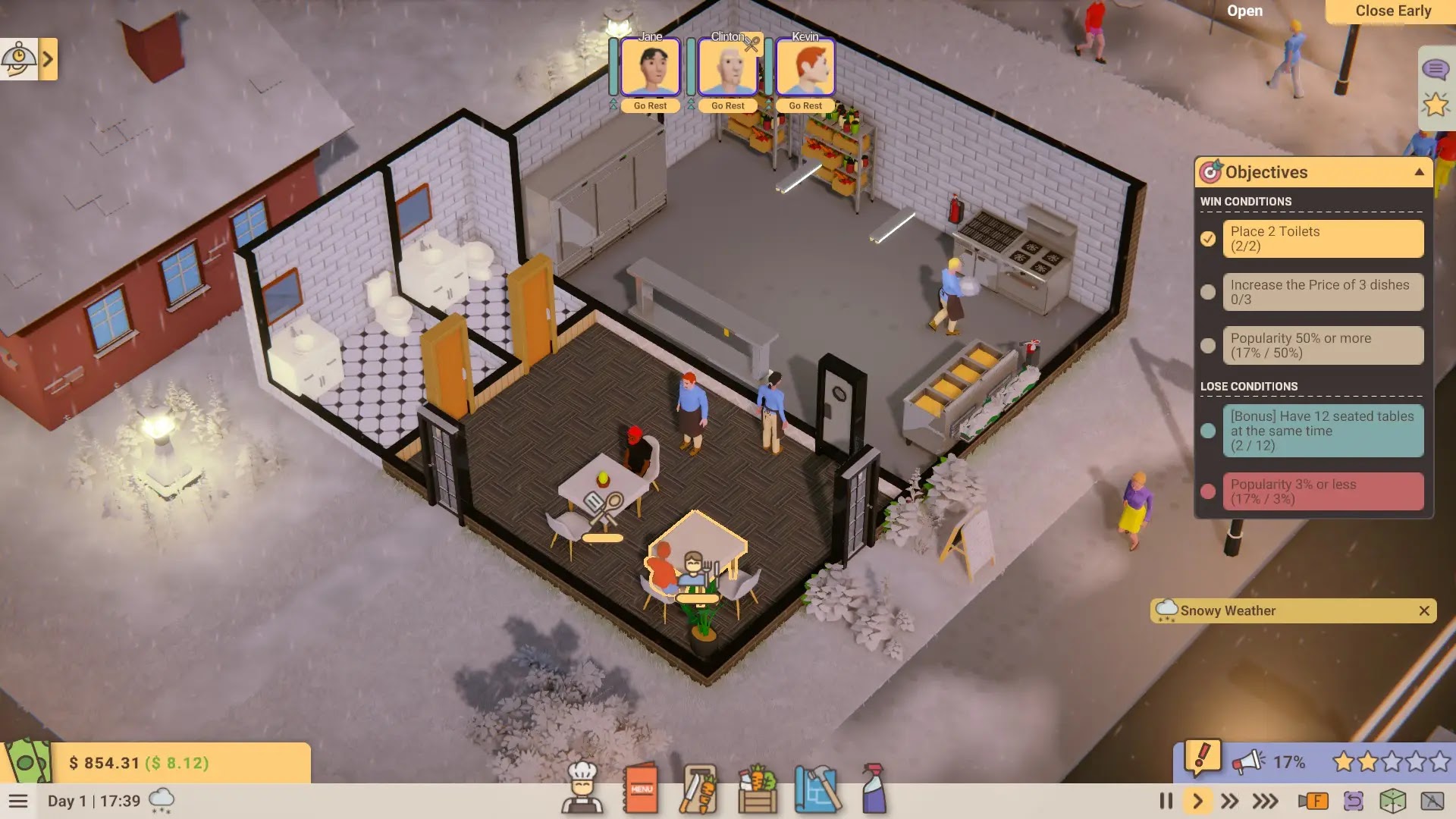
One of the best features that is integral to a player's success is the end-of-day report. Players are able to see what dishes were popular, what ones aren't selling, how much time staff spent working, and a list of your reviews. From this, players can adjust their strategy and menu accordingly.

Recipe for Disaster has a lot of replayability with the free play option. Players can begin a custom set of objectives or they can choose between easy, medium, and hard modes. Choosing a difficulty mode provides a specific gradual set of objectives to complete. As an example, one is having 15 positive reviews. If the custom setting is chosen, the player gets to create their own challenges. Really the sky is the limit here. Also, did I mention we get to have a bar in the restaurant now? No? Well, you know now!

Graphics and UI

Among the first noticeable features were the slight changes to the building menu. At first, it didn't seem like it was different, but after placing walls and customizing designs, I knew something changed. See, originally, I recall the building to be frustrating for reasons that I don't quite remember. However, the building mechanic operates similarly to the Sims games making it easy to manage. For me, it's a much smoother process than I remember, and while I can't put my finger on it, I love its simplicity.

Another feature that wasn't in the game before, is the addition of weather effects! The first snowfall was stunning. And even though weather conditions pass quickly, they were beautiful. Beyond that, the game is graphically amazing even as a low-poly animated design. Nearby street lights and buildings are detailed bringing life to the game. All in all, Recipe for Disaster is visually stunning.
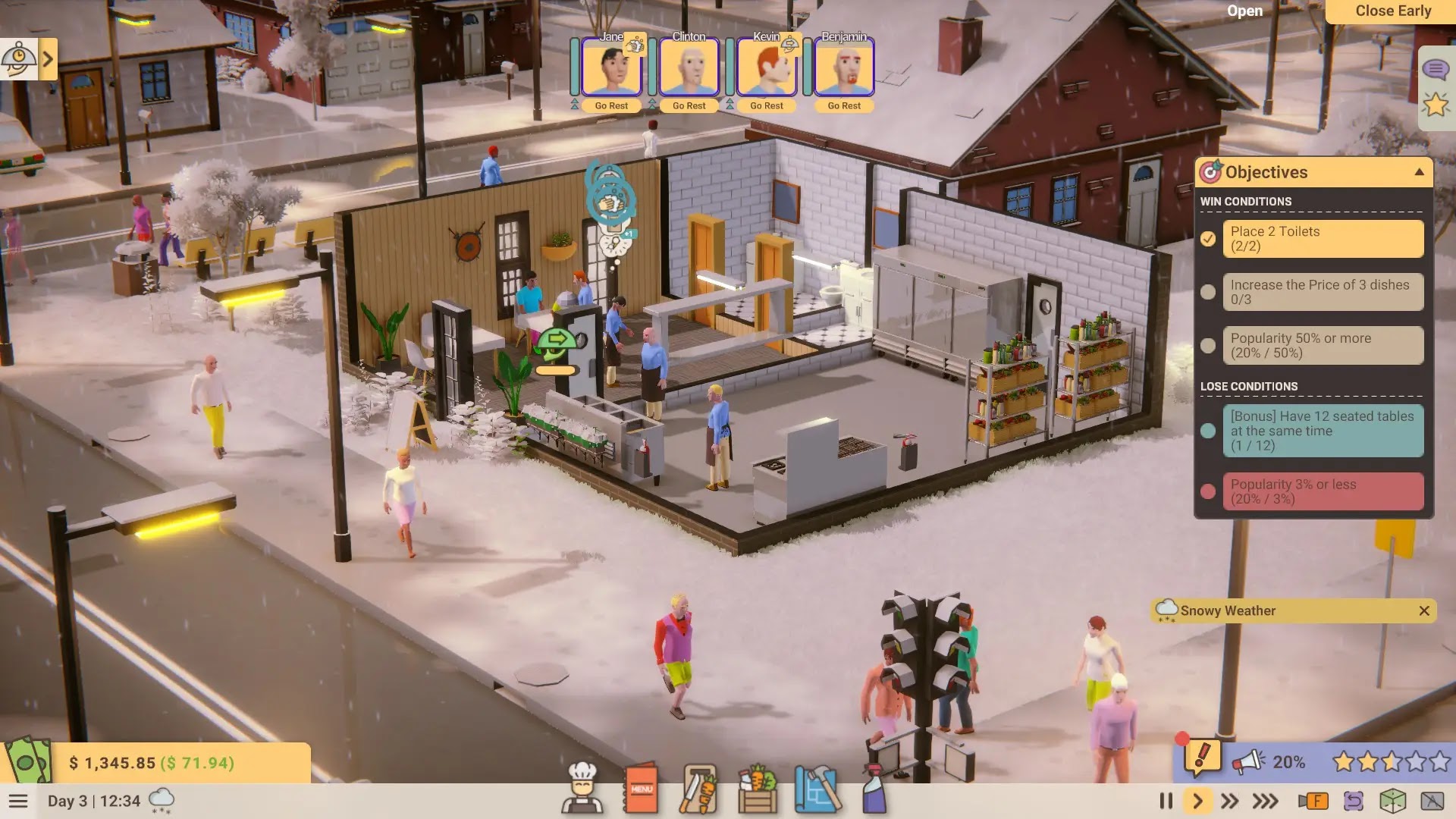

The UI, though unobtrusive, is designed intuitively. Players can easily designate cleaning areas, decorate their restaurants on a whim, or check out the overlay that shows restaurant attractiveness. In fact, there isn't a lot that I dislike about the game.

Final Thoughts

This restaurant sim has come a long way from the Early Access stage. The staff traits are fun to balance, the customization options are numerous, and the challenges keep players on their toes. I love that players can customize their restaurants and the menu on a whim, instead of waiting until the end of the day. Also, players can create their own restaurants without needing to go through the campaign in a free-play mode! In that mode, the sky is the limit. So, create your five-star restaurant from scratch and see how well you do. It'll be a great time. Trust me.

Summary

Tell your friends about Recipe for Disaster. It's either going to be interesting to see how they breeze through it, OR you will laugh at them while they HILARIOUSLY fail. Either way, with the new features and replayability, this game is an awesome time sink. After all, the game is called Recipe for Disaster.

So, LET CHAOS REIGN! Honestly, it's too entertaining not to. Are you up to the task?

Score: 9 / 10


Share:

City of Gangsters: Shadow Government (DLC) Review

City of Gangsters by developer SomaSim and publisher Kasedo GamesPC (Steam) review written by Susan N. with a copy provided by the publisher.

Estimated Reading Time: 7 minutes. 


In August of 2021, Kasedo Games published City of Gangsters, a simulation management game that revolves around the prohibition era of the 1920s. Players begin as a new gangster trying to make their mark by driving rival gangs out of business. After our original preview SomaSim released a few DLCs like Atlantic City, Bourbon Bootlegging, Criminal Record, and a few different outfits for players to choose from. On June 15th, SomaSim released Shadow Government where players get to meddle in political affairs. This is where the fun begins.

NB: Before continuing, I will acknowledge that the original preview of the game had some criticism about the graphics. After the game dev reached out to us, we were informed that my graphics issue came from an AMD driver problem that they rectified. Since I run an AMD GPU, I had a graphics bug where assets didn't appear as intended, and I had based some of my impressions on that fact. Any image contained in this review displays the proper nicer-looking assets.

Gameplay

My general feelings about this title have not changed since my original look at City of Gangsters. Its core gameplay loop gets to be tiresome rather quickly, the management aspect of the game relies on the production and distribution of goods, and the vehicle maintenance aspect adds a unique element to the genre. While all of this makes for a decent foundation, it's not enough to hold my interest for very long.

One reason for that is the leveling system seems to be relatively random. There is no way to track how much experience a character has gained. It also doesn't have a character sheet or skill tree. Thus, there's no way to effectively plan out your gangster abilities, making it feel like an afterthought to the game. Unlike Empire of Sin where I felt like the game had too much micromanagement of individual characters, City of Gangsters tells you nothing until the character levels up.

Another point about City of Gangsters is that it suffers from a lack of urgency and interest. Sure, it becomes more complex as time progresses, but the beginning gameplay is dull. Players spend a lot of turns driving around to pick up resources and they sell what they have for cash. Generally, this isn't bad, it just boils down to a random chance of finding the resources needed. Unfortunately, that means clicking on every establishment possible.

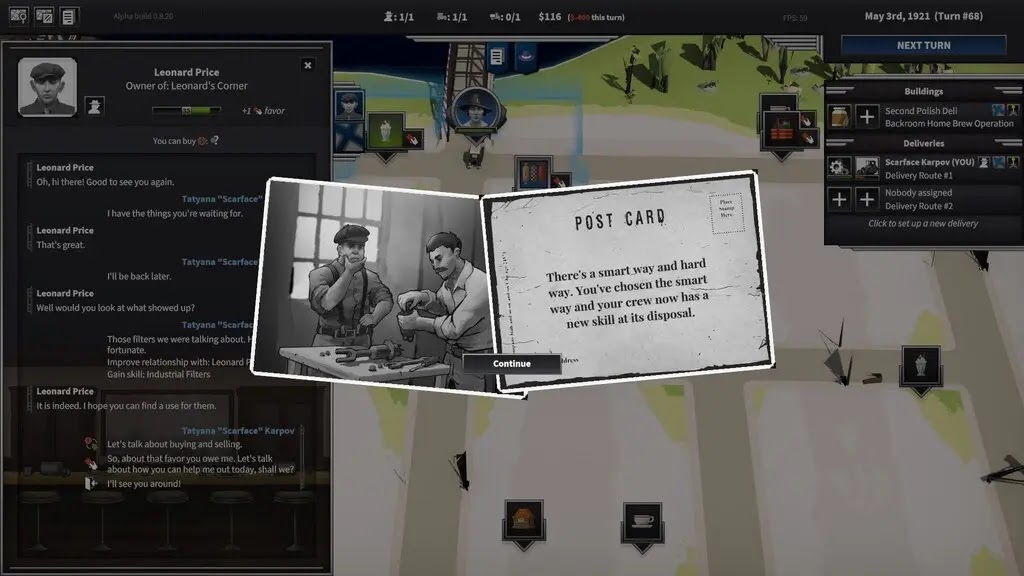
One of the aspects I do like is building connections with the NPCs. Players must increase their standing before they can make deals with the shop owners. And once standing is high enough, you can call in favors. The only downside is that it's done for each person which negatively draws out the experience. That said, I enjoyed the game but found myself bored with it early on because it takes too long to get going.

Aside from the general impressions of City of Gangsters, let's talk about the Shadow Government DLC in specific and what it brings to the table.

What the DLC Adds

Interest.

The DLC brings in some actual stakes to the game and does so incredibly early on. I felt more interested in generating funds to invest in the local political candidate. At first, it seemed a bit steep as it takes a couple of grand to sponsor a candidate, but this aspect has many future implications. Ultimately, this is an element that makes me more enthused to play the game.

To initiate the Shadow Government storyline, players need to start in New York. Not only will players build their empire on the largest map available, but they can play the new content immediately. As we received a review copy of the game, our player received the start-up cash freely without having to earn it. That said, in other maps, players may have to save up money for political donations. Again, I love this concept but I don’t believe there is enough starting cash to make a real impact. While adding a political system to the game speeds up gameplay, it only accomplishes that for a short time. Let me elaborate.

Shadow Government Gameplay

The Shadow Government DLC gives players the chance to foster and bolster political connections to both meddle in the affairs of other gangs but can potentially lead to the removal of problematic legislation or perhaps abolishing prohibition. And adding this DLC to the mix certainly creates an urgency that the game was so desperately missing before. Players now have a time limit to earning money for contributions which will increase the heat value of your operation. Not only that, but the other rival gangs will be more interested in taking you out. Also, if your candidate loses the election, then there will be dire consequences as other gangs will take notice.

Players need to build up funds not only to maintain their operations but to save money for bribes and contributions. Each political term will transpire over a certain amount of time when candidates are nominated. During a political term, players can pull up information about the candidate, which displays their type of leadership, traits, total elections won, and nationality. This is useful information to the player because it allows them to determine their next course of action. Not only that, but in certain cases, the candidate will request favors from you to complete! Fulfilling those requirements will affect how the vote goes. In fact, some of those requirements carry additional leg work for the player which adds to the complexity of the strategy, which is something I appreciate.

Once the political term ends, players go back to the normal grind of building an empire of illegal goods. After that, I felt like I was more interested in the political aspects than engaging in the regular gameplay loop. I just wanted to skip the constant back and forth of buying and selling. Unfortunately, that is a clear indicator that City of Gangsters is not quite ready yet. If it had an influx of cash or an employee requirement before engaging in the political landscape, it would be better. Essentially, you really have to understand the game first before appreciating Shadow Government and that is a shame.

Final Thoughts and Summary

City of Gangsters is a great game on the surface. It has the makings of an incredible game set during the prohibition era but, even with the Shadow Government DLC, it just misses the mark. There is nothing wrong with the gameplay loop except that it needs more urgency. Even with the DLC adding more complex strategies, it's not enough to hold interest for very long. Despite that fact, Shadow Government does a great job of forcing players to think about their connections and rivalries. Unfortunately, to appreciate the title and this DLC, players need to fully understand the game first. 

Summary

People that are in the market for a relaxing strategy game can feel confident in the Shadow Government DLC. It changes the entire landscape of the game by letting players influence legislation that can hinder other gangs or abolish laws that impede your supremacy.

As such, Shadow Government is a great addition to City of Gangsters as it adds more strategies for the player. For those reasons, this DLC adds enough of a unique spin to receive an 8 out of 10!

Score: 8 / 10


Share:

IXION - PC (Steam) Preview


IXION by developer Bulwark Studios and publisher Kasedo GamesPC (Steam) preview written by Robert with a copy provided by the publisher.

Estimated reading time: 3 minutes 


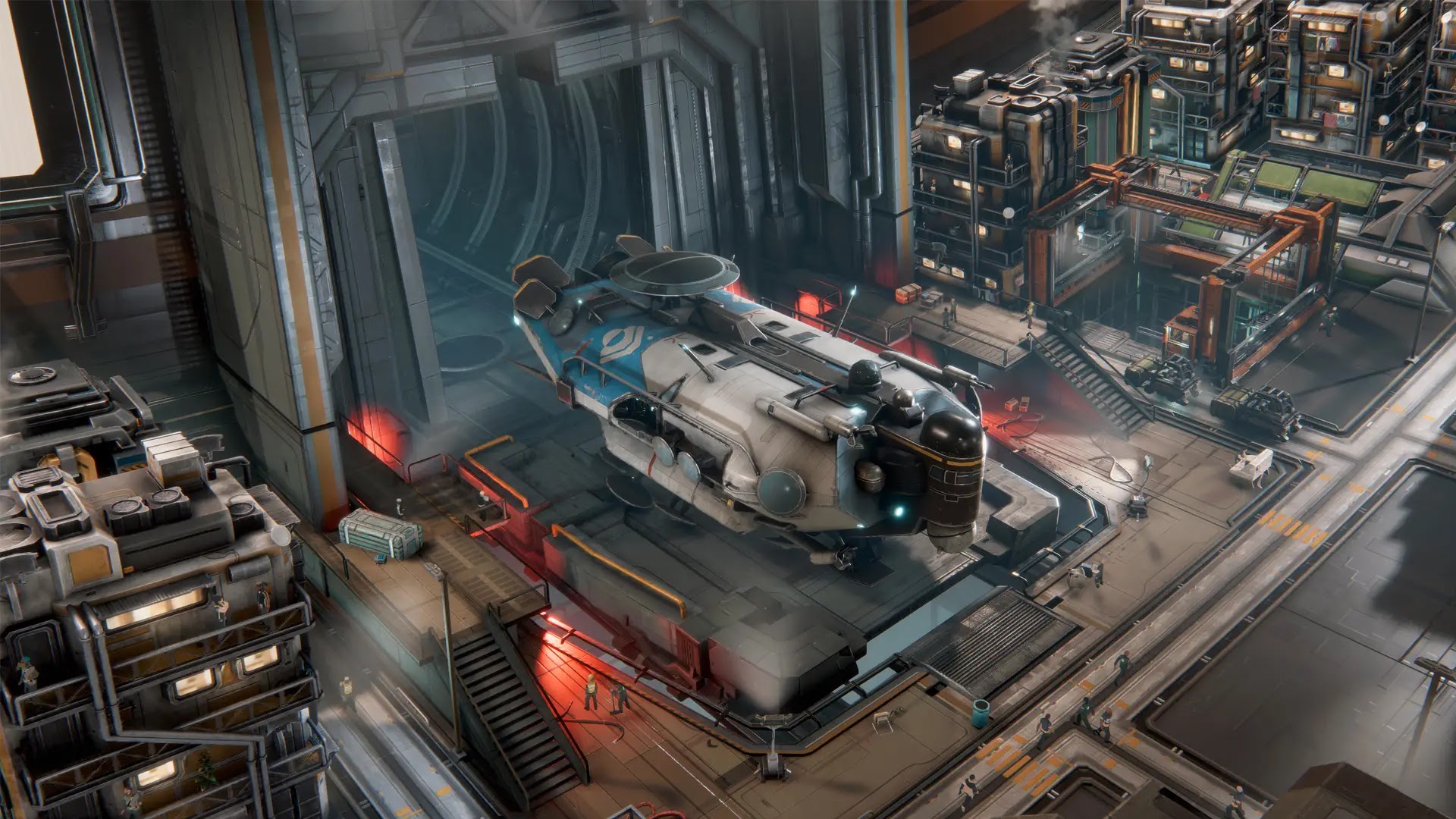
IXION, by Bulwark Studios is self-described as “Frostpunk in space” and that could not be a more honest statement, one I find refreshing in today’s politically-charged social world. That wasn’t the only thing that I was somewhat blindsided by, as upon launching IXION's demo (something I strongly recommend you do) and giving it a go, the brutal honesty of that statement will hit you square in the face. You see, IXION is, almost literally, “Frostpunk in Space.”

Check out:

Robert's PC Review, Nick's XB1 Console Edition Review, and Mylène's PS4 Complete Collection Review

I have to confess that this preview was one of the harder ones for me to write, in part because only a few minutes into it and I felt like I’d already put 50 hours into it (coincidentally, the amount of hours I have in the base Frostpunk game) and in part because, even knowing that… I still want more. Bulwark Studios has managed to do something relatively rare in the gaming industry… unashamedly cloning a game that essentially perfected the survival city-builder genre right out of the gate… Frostpunk.

“What’s special about that,” you ask? Bulwark was honest about it. That’s huge in my book.

On to the game, though- IXION is a narrative city-building survival management title where you’re in charge of building and maintaining the interior of a colony ship. After humanity screwed up good ol’ Mother Earth, we decided to launch a but of folk into space and hope they land somewhere safe. Queue our entrance and the start of IXION's short demo… and by short, I mean short. I completed it slowly in about 45 minutes which, if I’m being honest, is a bloody shame because what they have of the game so far is just so. Flipping. Good.

First, the aesthetic- I’m a sucker for science fiction and the dark, dank walls of your colony ship, the Tiqquan really lend to that hard science fiction feel that is established in IXION's (stunning) opening cutscenes. I love the metallic, harsh, and highly controlled environment that’s showcased throughout the entirety of the demo- but above all? IXION's designs and aesthetic simply feel real. That very element was a part of what makes Frostpunk so terrifyingly good- they are a very believable future. That helps lend itself to the heavy responsibility of managing the colony ship.

Just as you learn the ropes of managing the needs of the colony against the restrictions of resources, it fades to black and … that’s it. I legitimately had to walk away from my computer in disbelief. Now, don’t get me wrong, in no way is this bad. In fact, it’s brilliant and I have to applaud Bulwark Studios on this because IXION is literally the only game I’ve thought of since I finished the demo.

Summary

Well done, Bulwark, well done indeed.

Score: N/A


Share:

Recipe for Disaster - PC Early Access Review


Recipe for Disaster
by developer Dapper Penguin Studios and publishers Kasedo Games and Kalypso Media Digital Ltd.PC Early Access review written by Susan N. with a copy provided by the publisher.

Estimated reading time: 7 minutes


Recipe for Disaster is a hilarious test of micromanagement skills. Players must run an entire restaurant like a true business owner by building and altering the establishment, hiring staff, creating the menu, and managing customer expectations. With all of that, players must complete objectives to advance to the next level.

Let's toss the fish in a barrel and light some kitchens on fire, shall we?

Gameplay

There's a reason that restaurants tend to fail within the first five years of opening. That is because it's one of the hardest professions to have due to the cost. Having worked within the fast-food environment, I'm no stranger to the basic principles of keeping a restaurant running. Unlike other businesses where people can simply return a product for a refund or a replacement, the restaurant business also has to make sure that customers aren't having allergic reactions to food, adhere to safety principles, and manage the high cost of waste. Never mind the fact that your equipment can fail in a variety of ways. It may not seem like that is much, but when you work in the foodservice industry, there tend to be a million aspects that staff have to consider.

Now that we've got that out of the way, Recipe for Disaster is exactly what you expect it to be. Players are tasked with completing various objectives while paying attention to the minutia of owning a restaurant. The game begins with an easy level where the objective is to serve a certain amount of customers. The restaurant doesn't have much going for it in terms of menu options or any of the complicated situations at this point in the game, but your staff are newbs. They set things on fire because they are bad cooks.

After playing the game for a decent amount of time I find myself strangely addicted to the early access game. It is well balanced in terms of the staff personality traits and tasks, your ability to change and add restaurant features with ease, and checking the user reviews immediately after they leave the establishment. These gameplay aspects help the player to create the best restaurant experience possible as they fight fires in the kitchen, decorate their dining area, and fight with staff to complete their tasks. Regardless, I had a ton of fun playing the game.

However, despite the amazing foundation that Recipe for Disaster has, there are some minor flaws and quality of life features that I would personally like to see fixed or added.

Heating Up the Grill (Minor Issues)

For one thing, I'd love to have a little more variety in the build menu. A cooking game that excels at this is the Cook, Serve, Delicious series which rewards players with decorations and upgrades. After every level, players earn money that they can use to purchase recipes or items. While I do really love that players can create their own masterpiece recipes, I felt underwhelmed with the decoration options. Unlike management games like the Sims, Recipe for Disaster only has one toilet option. What the developers have done is opted to allow players to put a stall door on a wall instead of a bathroom stall being its own item. When working with limited space, it would be amazing to have a little more variety in the build menu.

Another minor grievance about the build menu is how unintuitive it can be at times. As an example, I built a customer bathroom because there wasn't one available (a point I'll get into momentarily). It wasn't until much later that I discovered that I had placed the ceiling light outside of the wall! Not only did the customers not complain about it, but I felt that the lack of camera control was frustrating at times. Additionally, in many countries, sit-down restaurants MUST have public washrooms otherwise they aren't allowed to open. Just keep that in mind.

Finally, players can't designate a break area for staff that I know of. There is often a predesignated bench located outside that staff can take breaks at. The problem is that players cannot build additional benches for the staff. Nor can they place a table because the game treats those as customer-only usage. Essentially, I think what the game lacks, in this case, is simply a small menu to create a break room.

Incidentally, the build menu isn't the only minor grievance I have about the game. There were several points where staff idled in the middle of the dining area, without having a server stand or cash register. Furthermore, there were times where the staff would idle in the bathroom! Not only did that not go over well with the customers, but I found that the staff would sometimes return to the same location. Yes, we can move the staff but the customers would ignore the presence of others until after they left. Yikes.

Graphics and UI

Recipe for Disaster is graphically neat with its cartoonish style and relatively easy UI. The characters have different personalities as well as likes and dislikes. At any time, players can view the thoughts of their staff, look at the desires of their customers, and manage their restaurant accordingly. It has a decent variety of wallpaper colors and textures to choose from. Plus, when the kitchen catches fire, it is comedy gold for a short time.

What really makes Recipe for Disaster an amazing title is the UI design. Players are able to switch to build mode to modify features while in the middle of a level. They are also able to designate cleaning areas in and out of the restaurant giving the game a more realistic feel. In fact, there is an adjustable sliding bar that indicates how dirty a location has to be before a staff member will go over the area. But despite that, it was mildly annoying to have to click on individual tables to get staff to clean them.

Pros and Cons

For the pros of the game, I have a list of excellent aspects of Recipe for Disaster.

     Players control everything including the uniform look

     Excellent foundation for an Early Access title

     Graphically pleasing

     Well balanced gameplay that gives players tons of useful information

     Has a roadmap that will include features like a bar area and future Twitch integration (I have horrific visions of this already!)

     Staff level up over time. They get perks based on the most used job function, which is a great addition in my opinion

The cons in Recipe for Disaster are mostly minor issues that are not game-breaking in the least. Among them are:

     Cannot setup a break room

     Needs more item customization

     The physical building of the restaurant is a bit of a pain

     The UI size cannot be adjusted. This can be an accessibility issue

     There isn't yet a sandbox or free play mode however, this is being actively worked on according to this dev update post

Final Thoughts

Recipe for Disaster is a wonderful time sink that I thoroughly enjoyed. It has everything needed to create a fun and challenging gameplay experience. I had a fun time managing the tasks, customizing my restaurant, and puzzling out the needs of customers.

Of all the cooking based simulators out there, Recipe for Disaster is quite high on my list. It is both challenging and enjoyable to play. The UI is well laid out, the game has a great aesthetic, and it is quite entertaining. It is complex enough to keep players invested in their restaurants, and yet the game is rather relaxing to play. It is my opinion that despite the fact that Recipe for Disaster is in the Early Access stage, the game is spectacular. Management sim fans do yourself a favor and grab this game. You will love it!

Score: 9/10


Share:

Distant Kingdoms - PC Preview


Distant Kingdoms
by developer Orthrus Studios and Kasedo Games PC preview written by Robert.

Estimated reading time: 5 minutes


Distant Kingdoms is a fantasy-based city-builder that eschews the traditional modern-day city-building setting for a fantastical setting with Orcs, Elves, Dwarves, and Humans. Each race has their own unique Gods that they worship that gives some semblance of “direction.” For example, Humans worship a God that’s focused on agriculture whereas Dwarves focus more on Engineering; these differences, at the time of this writing are minimal, but if progress continues in the manner that I believe it will, each race will be far more unique. Though just released into Early Access, Orthrus Studios have been pushing out regular updates with many more to come, but what is there is engaging, interesting, and a fresh take on city-building.

In all honesty, I am surprised it has taken this long to get a city-building set in a fantasy setting; joining the ranks of games like Foundation and Driftland: The Magic Revival, Distant Kingdoms brings a nostalgic twist that others in its genre seem to lack. Throughout the 11 hours I put in as the Elves (who worship Isolus, the God of academia and progress, giving a bit of a boon to research), I couldn’t help but feel nostalgic for the original SimCity, which I first played on the Super Nintendo back in the early 90s. It may be the heavy focus on grid-based building mechanics in Distant Kingdoms, but the feeling was certainly there.

Where Distant Kingdoms differs from its (possible) SimCity inspirations and instead pulls from colony-survival titles like the absolutely stellar Frostpunk and the criminally underappreciated Banished. In Distant Kingdoms you will need to manage resources like wood, stone, metal, and various food types and while wood is almost more valuable than actual gold as every building requires a hefty chunk of wood to build, I am an absolute sucker for city-building games that offer various methods farming. There is something so peaceful and heartwarming about farms that stretch as far as the eye can see, with the horizon broken only by the slow yet enchanting Windmills and the occasional chimney smoke of the various bakers the are dotting the various fields. However, placing your bakers in the middle of your farms may result in slow goods processing times, which leads into the single most important element of Distant Kingdoms… city-planning.

Similar to other titles in the genre, Distant Kingdoms is all about placement of core resources; for example, you will want your warehouse to be centrally located to your production buildings (like bakers or tree farms), but you’ll need to keep your resource gathering buildings close at hand to both the production buildings and your trade buildings (marketplace) and the actual resource gathering, and with the relatively small building areas, planning out where you’re putting these buildings is key. Then to add in an additional layer of complexity, you have various runes/magic buildings that help protect your colony, increase happiness, increase tax income, and a host of other benefits- including research

Though a bit linear at the time of this article’s writing, research has the potential to significantly change how the colony is grown; the downside to what is currently in place is that all research is in some way, unlockable. I would love to see research options that force you to choose which way to go. For example, as Humans, if you want to double-down on grain farming / breadmaking, maybe make a branch of research that improves those farming/production types, but at the expense of say, hops farming/brewing/tavern production. This would force the player to be strategic and thoughtful in their research paths. As it stands currently, all research options can be researched, making it a very linear and relatively mindless progression concept.

As your colony grows and you begin manually upgrading your various buildings, a method/concept made popular by Ubisoft’s fantastic Anno series (but also found in most colony-survival sims), which in turn improves happiness, tax income, and will increase the number of peasants available for work (which will help with improving resource generation). I did find, though, that there are a few plateaus that are hit with each of the different races; there will be plenty of times where you will set the speed to x2 or even faster … and you’ll sit and wait. In fact, there is a LOT of waiting to be done in Distant Kingdoms as you’ll constantly be running out of wood or stone, so you’ll have nothing really interesting to do while those resources are collected. To help break up that monotony, I would love to see an option where you can zoom in on a citizen and watch them go about their daily routines- sure, you’ll still be waiting, but you’ll be able to enjoy your budding colony from a closer, more intimate perspective (while you can zoom in, it would be nice to “lock on” to a peasant or citizen, in a similar vein to how you can follow people in Cities: Skylines).

Summary

Though early in it’s Early Access phase, Distant Kingdoms has received a slew of updates and hotfixes from Orthrus Studios, who released a patch nearly every week (sometimes multiple per week) since mid-April. Though I suspect this will slow down a bit as the studio works on largely, more complex mechanics, what they’ve been pushing out in comparison to the amount of feedback they are receiving, is quite astonishing.

Given how stable and well-optimized Distant Kingdoms is, even this early in, the devs have been hard at work implementing feedback, balancing resources, and generally adding new and better features, I can only see Distant Kingdoms improving with time. Many Early Access titles launch in a rough state with poor optimization, however, Distant Kingdoms breaks from that mold and is in a good place, stability wise, and that is why I fully recommend diving into it now.

Score: N/A


Share:

City of Gangsters - PC Preview


City of Gangsters
by developer SomaSim and publisher Kasedo GamesPC preview written by Susan N. with a copy provided by the publisher.

Estimated reading time: 8 minutes


City of Gangsters is a mafia management simulator that is simple in design and quite addicting. It is not to be confused with Omerta - City of Gangsters which is also a simulation game set in the same era. While there are similar elements, the combat system in this title is not part of the core experience. Overall, City of Gangsters has a solid foundation. It will be a great addition to the mafia simulation genre but it needs added features to knock it out of the part. Either way, I'm here for it.

Gameplay:

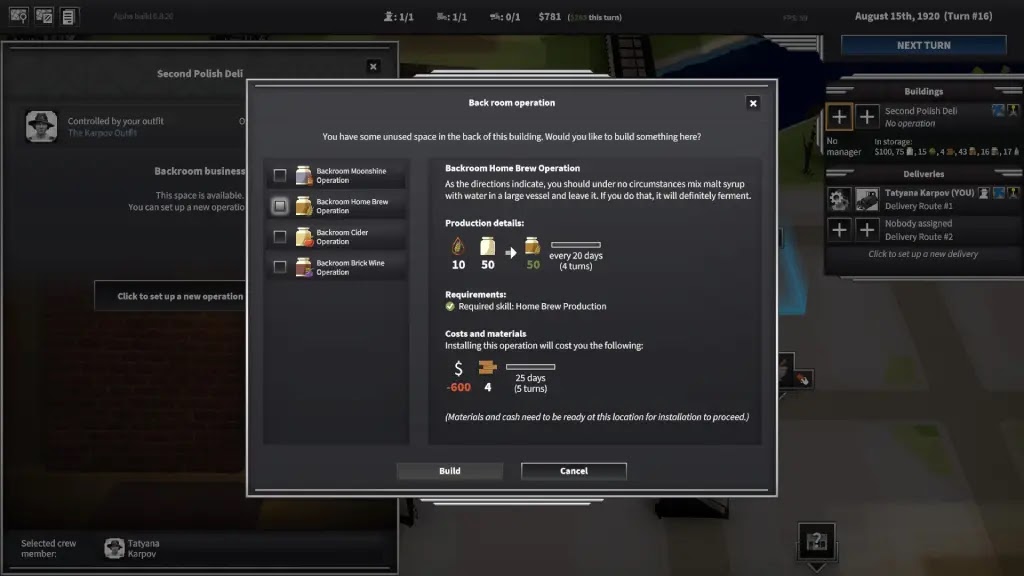
Unlike Empire of Sin (reviewed here), which tried to fit into too many boxes, City of Gangsters is simple. As the new mafia boss in town, players begin building their reputation by buying and selling products. At first, the gameplay loop is a bit slow because players need to manually do this, but as time progresses, that task can be delegated. Either way, players need to supply their production. And without supply, production halts, causing players to scramble for money in the early game stages.

Reputation and Expansion

In City of Gangsters, players build their reputation through word of mouth. This is achieved through calling in favors as their reputation builds with a character. Favors are represented by tickets which are used for introductions to helpful characters or starting a front for your empire. Each of those actions uses one ticket. If players use a ticket for an introduction, then a new building will be revealed on the map. However, if players use the reputation to turn the person's business into a front, then players will likely pay a monthly fee. This is how players begin to expand their empire.

Over time, players need to add members to their crew. This is so that automatic transactions can be set up, and the mafia boss can focus on bigger issues. And by bigger issues, I mean protecting their new empire from rival crews and pesky police. Thankfully, this hasn't hindered my game too much. Perhaps they will be a nuisance later, but my empire will crumble from lack of supply before that happens!

Leveling and Maintenance

As players progress through the game, they are able to level skills like fast driving or dealing extra damage. Instead of bogging down the gameplay with too many elements, City of Gangsters keeps it simple. Players click on which skill they want to upgrade and it's done. They don't need to worry about outfitting armor and weapons to characters like in an RPG.

Another interesting feature that City of Gangsters has over others is vehicle maintenance. Most of the time, players pay a maintenance cost as part of their empire expenses. In City of Gangsters, as your car breaks down, players must head to a car shop for repairs. However, players aren't told this until the car begins to breakdown. Thankfully, they are given the time to find a shop before significant damage is done. I believe it took about 15 turns to find a repair shop and the car was only at half health.

Other Gameplay Features

Unlike Empire of Sin where players can level individual crew members, City of Gangsters takes a simple approach to combat. Players start with a baseball bat as a weapon, but they can buy others to outfit their crew members with. Where most games have separate screens dedicated to combat actions, this one doesn't. Everything can be seen and executed through the overhead map. And when players drive into the range of an enemy outfit, either they will take damage immediately, or they can initiate a fight through dialogue. Since City of Gangsters is not really meant to be a combat-focused game, I'm glad that this is how combat is managed. It doesn't take away precious management time. After all, we're mafia bosses, not common street thugs!

Graphics and UI:

Since we were given an early press version of City of Gangsters, I found that the graphics are not fantastic. It really has the indie impression down to a tee, and that isn't a bad thing. City of Gangsters is a top-down management simulator where players need to delegate tasks more than anything. It gets the concept of management sim right. Sure, it would be great to have better graphics, but it's not inherently required. Nor should it. Personally, I would just like a little bit more variety in this regard.

When driving around the city, I found that the vehicle pathing is strange. A player could click to move from one corner to another that is two blocks away. The game will sometimes take an indirect path, thereby wasting movement points. While this isn't an issue at the outset, I can see this being complicated in late gameplay. It could potentially be an issue if players are evading pursuit from cops or enemy crews. In fact, there were a few times where my car drove through enemy territory, causing me to be attacked! Shesh.

User Interface

Let's talk about the clean UI for a bit. On the left side of the screen are buttons that display various useful overlays. Players can view information overlays like recent transactions, police precincts, and respect. Next are resource overlays that display the item and ingredient locations like hops, bottles, and weapons. Finally, players can review report dialogues. It contains data on their finances, crew list, fronts and territory, crew skills, rival outfits, notification history, and missions.

Along the top bar, players see total crew members, total vehicles, available parking spaces, and total cash. One thing to note about the cash is that the amount will display the total cash. This is important because some money has to stay at your safehouse for upgrades.

On the right of the screen, players see crew members out in the field, fronts they own, and scheduled deliveries. From the right display, players are able to add delivery routes so that their empire can run. I assume that over time, this display will grow as players add more crew members to their outfits.

Audio:

Unfortunately, City of Gangsters has lackluster music and audio design. This isn’t really an issue but since the graphics aren't amazing, I had hoped that players would get something out of the audio design. Not only is music and audio important for setting the tone of the game, but the only ways players know about the prohibition era are from trailers or the title screen! Beyond that, there is one core music loop that endlessly repeats and it gets tiresome after extended gameplay periods. In fact, the music doesn’t change when entering a rival crew’s territory nor when police are on high alert. To me, adding a little bit extra by changing the music up would be a tremendous addition to City of Gangsters.

If that wasn't enough, there also lacks voice acting in the game, and City of Gangsters is strictly a text-based game, I suppose that is less important, but come on. Give us something! This would be less of an issue if the dialogue had more punch and was witty, but it isn't. The writing is also generic and it is one element that Empire of Sin has over this title. And while the game isn’t focused on the audio, I’m disappointed that there isn’t more that lends itself to the 1920's feel. Overall, this title could really use a bit of seasoning. 

Pros and Cons:

Pros:

     Simple UI

     The game has a simplistic design

     Doesn't try to push too many gaming elements into one

     Empire expansion is done through introductions from people you know

     Doesn’t require a high-end gaming computer to run

     Combat is simple, allowing focus on empire management

Cons:

     No tutorial

     Local Saving Only (for the time being)

     Music is Repetitive

     No Voice Acting

     The car pathing is odd

     Unsure of the barricade purpose since they don’t appear to hinder anything at this stage

     Pre-generated maps make the game a bit predictable

Final Thoughts:

I really enjoy City of Gangsters because it doesn’t try to drown players with too much at once. However, it is missing some features that could really go a long way in making this title spectacular. Yes, it is still in the early stages of development as the retail version isn't releasing until later this year, but right now it needs some more features and elements. Otherwise, it could fall into obscurity as 'just another management simulator.' I hope it doesn't end up like that.

I look forward to the full release of City of Gangsters because it has a solid foundation. City of Gangsters is an easy game to load as the maps are randomly generated and not graphically intensive. However, some of the travel pathing could be cleaned up, more music loops added, and it could use a tutorial. Once some of those features are added, then this title will be able to stand firmly with others in its genre. It's just not there yet. So, keep your eyes on this one because there could be a new Mafia boss in town!

Score: N/A


Share:

Random posts

Our Streamers

Susan "Jagtress" N.


S.M. Carrière

Aldren


Affiliates

JenEricDesigns – Coffee that ships to the US and Canada

JenEricDesigns – Coffee that ships to the US and Canada
Light, Medium and Dark Roast Coffee available.

Blog Archive

Labels