• Kingdom's Return: Time-Eating Fruit and the Ancient Monster - PS5 Review

    Kingdom's Return: Time-Eating Fruit and the Ancient Monster is Inti Creates latest project. Blending 2D side-scrolling and town building simulation, you'll be venturing through a small interesting world as you try to restore a kingdom whose time has been stolen from it.

  • Minos - PC (Steam) Review

    The tower defense genre is one that doesn't tend to innovate much with static maps, various traps, and its simple to grasp gameplay loops. At least, that is until Minos with a mighty laugh to prove you wrong.

  • Decollate Decoration - PS5 Review

    Hello everyone and welcome to a new KEMCO title! But wait a moment, this one is different to the retro JRPGs that you’re probably expecting when you hear KEMCO from me by this point. Instead what we have is a sort of point-and-click style visual novel! Something a little new and fresh coming out here!

  • Volontes - Nintendo Switch Review

    Have you ever grown up feeling like you don't belong? For our Heroine, that's the feeling she lives with everyday in her small farming village. But it's not her only secret...

  • John Carpenter's Toxic Commando - PC Review

    Toxic Commando harkens back to video games years ago when they were fun and innovative while giving the player freedom to explore among the waves of enemies in a 4 player chaotic onslaught of combat and driving mechanics.

  • Dread Delusion - Xbox Series X|S Review

    Today we’re looking at what has rapidly become an absolute favorite in the open-world RPG genre for me. An interesting story, memorable NPCs, stunning visuals, and a setting absolutely dripping with flavor, Dread Delusion sets its tone immediately and sticks with it.

  • People of Note - PS5 Review

    ...I love music in general. After playing the People of Note demo, I knew I had to play the full game.

  • Valor of Man - PC (Steam) Review

    Valor of Man, by Legacy Forge and Numskull Games, is a turn-based roguelite RPG where you guide a party of four through ever increasing difficult situations. Achieving victory is never assured and the randomness of the roguelite nature will either be your best friend or your worst enemy.

  • Starship Troopers: Ultimate Bug War - XBXS Review

    Are you ready to do your part for the United Federation and join in the most realistic depiction of war ever created? Today we join General Johnny Rico and Major Samantha Dietz as they present the first ever game created under supervision by FedDev for the enjoyment of those on the path to citizenship. Ultimate Bug War follows the path of Dietz during the First Bug War 25 years ago.

  • Soulmask - PC Review

    Soulmask enters the increasingly crowded world of multiplayer-capable survival crafting games with a launch that has bundled its first DLC pack as a free download for anyone buying it within the first month. Featuring some striking Egyptian-style graphics...

Showing posts with label Management Game. Show all posts

Dog Rescue Game 'To The Rescue!' Races to PC and Steam on November 4th!

LITTLE ROCK, Ark. – Oct. 11, 2021To The Rescue!, the heartfelt dog shelter management simulator from developer Little Rock Games and publisher Freedom Games, jumps into the loving arms of Windows PC and Mac via Steam on Thursday, Nov. 4, 2021. The Nintendo Switch version goes up for adoption in Q1 2022. 20% of proceeds from both versions will be donated to The Petfinder Foundation to support real-world animal shelters.

Take charge of the local animal shelter to help stray pups find new and loving forever homes. In between belly rubs and sessions of playing fetch, ensure that the inner workings of the shelter are running properly. Foster a warm and welcoming environment for future pet parents to come and meet their soon-to-be companions.

Ensure people and puppers find their perfect fit by matching between four dog sizes, seven breed types, and dozens of individual personality traits for adopters and doggos. It’s a bittersweet day when furry friends leave the shelter, but the happiness on their faces knowing they’ve found their families warms the heart every time.

Taking care of adorable fuzzy butts isn’t all fun and games; there’s inevitably more to be done. Balance feeding, grooming, and exercise schedules for all of the dogs. Treat, pun intended, any illnesses that may arise to keep the pups in tip-top shape for the next game of tug-of-war. Manage shelter resources by upgrading facilities and replenishing inventory, all on a tight budget. Keep up good standing with other members of the neighborhood to keep the shelter support strong. It may take an army, but those fuzzy faces make it more than worth it.

“To The Rescue! balances the wholesome feel of a loving and cozy animal game with some of the hectic realities of running a real animal shelter,” said Olivia Dunlap, co-founder, Little Rock Games. “We wanted to pay respect to all of the hardworking volunteers running actual animal shelters and raise awareness for their profession through the power of video games!”

To The Rescue! will be available for $19.99 USD. The development team will pledge 20% of all profits from the game to The Petfinder Foundation.

For more information on To The Rescue!, check out the Little Rock Games website and join the community on Twitter, Facebook, Instagram, and Discord.

https://www.youtube.com/embed/nJjPP-AzuxQ

About Little Rock Games

Little Rock Games is a community-based tabletop game development studio and To The Rescue! is their first digital project. Focusing on making projects that emphasize local, ethical, and impactful elements, the studio aims to raise awareness of social issues as well as donate to organizations whose work inspires the subject matter of their games.

To learn more, check out the official Little Rock Games website.

About Freedom Games

Freedom Games is a publisher dedicated to offering best-in-class services to partners and providing players around the world with unique and memorable experiences. With over 50 years of combined industry experience at the executive level, Freedom Games seeks to leverage its expertise to facilitate great games and even better publishing experiences.

For more information, visit the official Freedom Games website.


Article by: Susan N. 

Share:

City of Gangsters - PC Preview


City of Gangsters
by developer SomaSim and publisher Kasedo GamesPC preview written by Susan N. with a copy provided by the publisher.

Estimated reading time: 8 minutes


City of Gangsters is a mafia management simulator that is simple in design and quite addicting. It is not to be confused with Omerta - City of Gangsters which is also a simulation game set in the same era. While there are similar elements, the combat system in this title is not part of the core experience. Overall, City of Gangsters has a solid foundation. It will be a great addition to the mafia simulation genre but it needs added features to knock it out of the part. Either way, I'm here for it.

Gameplay:

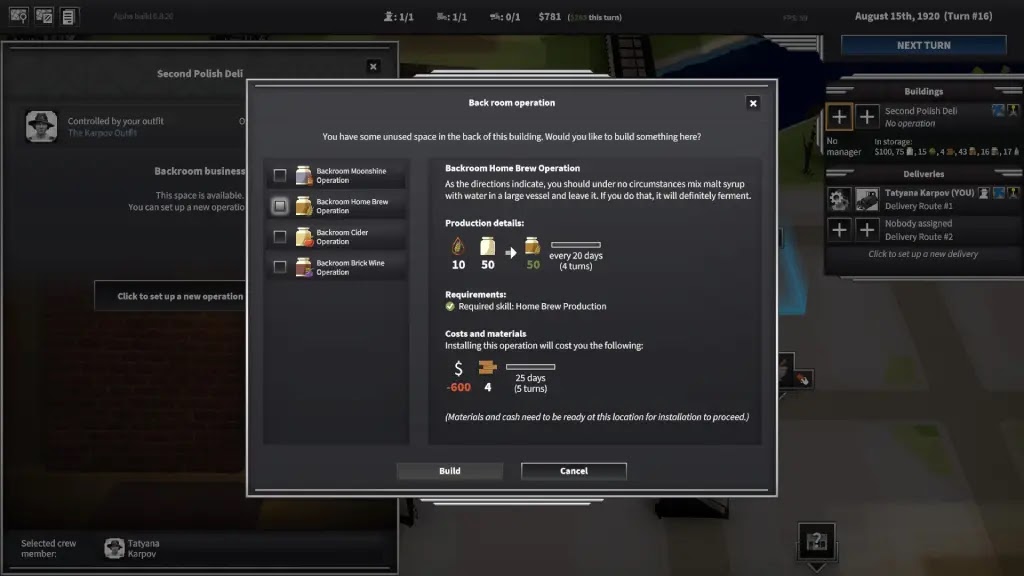
Unlike Empire of Sin (reviewed here), which tried to fit into too many boxes, City of Gangsters is simple. As the new mafia boss in town, players begin building their reputation by buying and selling products. At first, the gameplay loop is a bit slow because players need to manually do this, but as time progresses, that task can be delegated. Either way, players need to supply their production. And without supply, production halts, causing players to scramble for money in the early game stages.

Reputation and Expansion

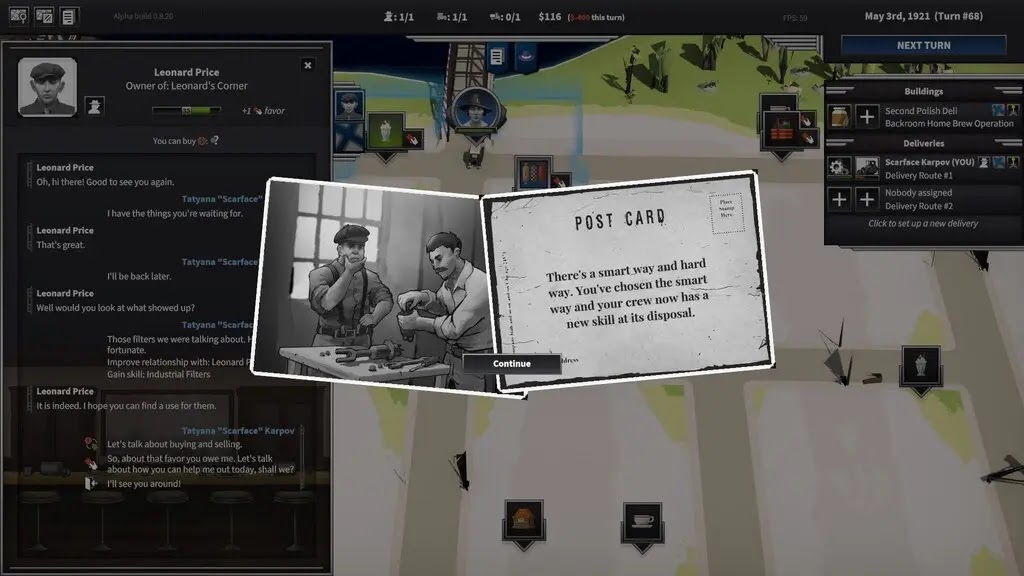
In City of Gangsters, players build their reputation through word of mouth. This is achieved through calling in favors as their reputation builds with a character. Favors are represented by tickets which are used for introductions to helpful characters or starting a front for your empire. Each of those actions uses one ticket. If players use a ticket for an introduction, then a new building will be revealed on the map. However, if players use the reputation to turn the person's business into a front, then players will likely pay a monthly fee. This is how players begin to expand their empire.

Over time, players need to add members to their crew. This is so that automatic transactions can be set up, and the mafia boss can focus on bigger issues. And by bigger issues, I mean protecting their new empire from rival crews and pesky police. Thankfully, this hasn't hindered my game too much. Perhaps they will be a nuisance later, but my empire will crumble from lack of supply before that happens!

Leveling and Maintenance

As players progress through the game, they are able to level skills like fast driving or dealing extra damage. Instead of bogging down the gameplay with too many elements, City of Gangsters keeps it simple. Players click on which skill they want to upgrade and it's done. They don't need to worry about outfitting armor and weapons to characters like in an RPG.

Another interesting feature that City of Gangsters has over others is vehicle maintenance. Most of the time, players pay a maintenance cost as part of their empire expenses. In City of Gangsters, as your car breaks down, players must head to a car shop for repairs. However, players aren't told this until the car begins to breakdown. Thankfully, they are given the time to find a shop before significant damage is done. I believe it took about 15 turns to find a repair shop and the car was only at half health.

Other Gameplay Features

Unlike Empire of Sin where players can level individual crew members, City of Gangsters takes a simple approach to combat. Players start with a baseball bat as a weapon, but they can buy others to outfit their crew members with. Where most games have separate screens dedicated to combat actions, this one doesn't. Everything can be seen and executed through the overhead map. And when players drive into the range of an enemy outfit, either they will take damage immediately, or they can initiate a fight through dialogue. Since City of Gangsters is not really meant to be a combat-focused game, I'm glad that this is how combat is managed. It doesn't take away precious management time. After all, we're mafia bosses, not common street thugs!

Graphics and UI:

Since we were given an early press version of City of Gangsters, I found that the graphics are not fantastic. It really has the indie impression down to a tee, and that isn't a bad thing. City of Gangsters is a top-down management simulator where players need to delegate tasks more than anything. It gets the concept of management sim right. Sure, it would be great to have better graphics, but it's not inherently required. Nor should it. Personally, I would just like a little bit more variety in this regard.

When driving around the city, I found that the vehicle pathing is strange. A player could click to move from one corner to another that is two blocks away. The game will sometimes take an indirect path, thereby wasting movement points. While this isn't an issue at the outset, I can see this being complicated in late gameplay. It could potentially be an issue if players are evading pursuit from cops or enemy crews. In fact, there were a few times where my car drove through enemy territory, causing me to be attacked! Shesh.

User Interface

Let's talk about the clean UI for a bit. On the left side of the screen are buttons that display various useful overlays. Players can view information overlays like recent transactions, police precincts, and respect. Next are resource overlays that display the item and ingredient locations like hops, bottles, and weapons. Finally, players can review report dialogues. It contains data on their finances, crew list, fronts and territory, crew skills, rival outfits, notification history, and missions.

Along the top bar, players see total crew members, total vehicles, available parking spaces, and total cash. One thing to note about the cash is that the amount will display the total cash. This is important because some money has to stay at your safehouse for upgrades.

On the right of the screen, players see crew members out in the field, fronts they own, and scheduled deliveries. From the right display, players are able to add delivery routes so that their empire can run. I assume that over time, this display will grow as players add more crew members to their outfits.

Audio:

Unfortunately, City of Gangsters has lackluster music and audio design. This isn’t really an issue but since the graphics aren't amazing, I had hoped that players would get something out of the audio design. Not only is music and audio important for setting the tone of the game, but the only ways players know about the prohibition era are from trailers or the title screen! Beyond that, there is one core music loop that endlessly repeats and it gets tiresome after extended gameplay periods. In fact, the music doesn’t change when entering a rival crew’s territory nor when police are on high alert. To me, adding a little bit extra by changing the music up would be a tremendous addition to City of Gangsters.

If that wasn't enough, there also lacks voice acting in the game, and City of Gangsters is strictly a text-based game, I suppose that is less important, but come on. Give us something! This would be less of an issue if the dialogue had more punch and was witty, but it isn't. The writing is also generic and it is one element that Empire of Sin has over this title. And while the game isn’t focused on the audio, I’m disappointed that there isn’t more that lends itself to the 1920's feel. Overall, this title could really use a bit of seasoning. 

Pros and Cons:

Pros:

     Simple UI

     The game has a simplistic design

     Doesn't try to push too many gaming elements into one

     Empire expansion is done through introductions from people you know

     Doesn’t require a high-end gaming computer to run

     Combat is simple, allowing focus on empire management

Cons:

     No tutorial

     Local Saving Only (for the time being)

     Music is Repetitive

     No Voice Acting

     The car pathing is odd

     Unsure of the barricade purpose since they don’t appear to hinder anything at this stage

     Pre-generated maps make the game a bit predictable

Final Thoughts:

I really enjoy City of Gangsters because it doesn’t try to drown players with too much at once. However, it is missing some features that could really go a long way in making this title spectacular. Yes, it is still in the early stages of development as the retail version isn't releasing until later this year, but right now it needs some more features and elements. Otherwise, it could fall into obscurity as 'just another management simulator.' I hope it doesn't end up like that.

I look forward to the full release of City of Gangsters because it has a solid foundation. City of Gangsters is an easy game to load as the maps are randomly generated and not graphically intensive. However, some of the travel pathing could be cleaned up, more music loops added, and it could use a tutorial. Once some of those features are added, then this title will be able to stand firmly with others in its genre. It's just not there yet. So, keep your eyes on this one because there could be a new Mafia boss in town!

Score: N/A


Share:

StartUp Panic - PC Review

StartUp Panic by developer AlgoRocks and publisher TinyBuild GamesPC (Steam) review written by Susan N. with a copy provided by the publisher.

Estimated reading time: 6 minutes


StartUp Panic is a simulation game that lets players launch a tech business. Our character quits their crappy job, to embark on their entrepreneurship journey. But this is only the beginning.

My character begins her journey from her home computer. I decided to take on odd jobs so that I had a financial buffer. Once I started my business, I fell quickly in love with StartUp Panic, because of its nods to the beginning of the tech boom. I'm talking about a familiar and trusty paperclip - our helper in Microsoft Word. 'Clippy' would explain how to use different features as it recognized input patterns. While many may have blissfully forgotten about 'Clippy' from Office 97, I appreciated this addition.

Some players might have stopped there, having remembered the early days of computing before Microsoft employed malware-like practices in the launch of Windows 10 - but I digress. The memories of Clippy and the simpler times made me appreciate StartUp Panic.


StartUp Panic Gameplay

StartUp Panic is an indie management simulator that amused me. My amusement stems from the subtle nods to things I grew up with. I absolutely adore this title even though I find it boring over time - which in no way speaks to the overall score. But, I can only handle so much of a management game before I am bored.

The game has a couple of levels of strategies that players need to pay attention to. At the outset, it is important to work on odd jobs to make money. These vary in difficulty as you hire more employees and allow for players to turn a profit even if your company is in the red for a time.

An important aspect to pay attention to is the rating your company has in each of the features developed. So, if your rating in the tech tree is less than 6 points, then you’re company is spending more money on maintenance than it is bringing in. For players to make a profit each month, they will need to make sure each feature is profitable. Sometimes this means hiring or training more people with higher skills to do a post-mortem on their features.


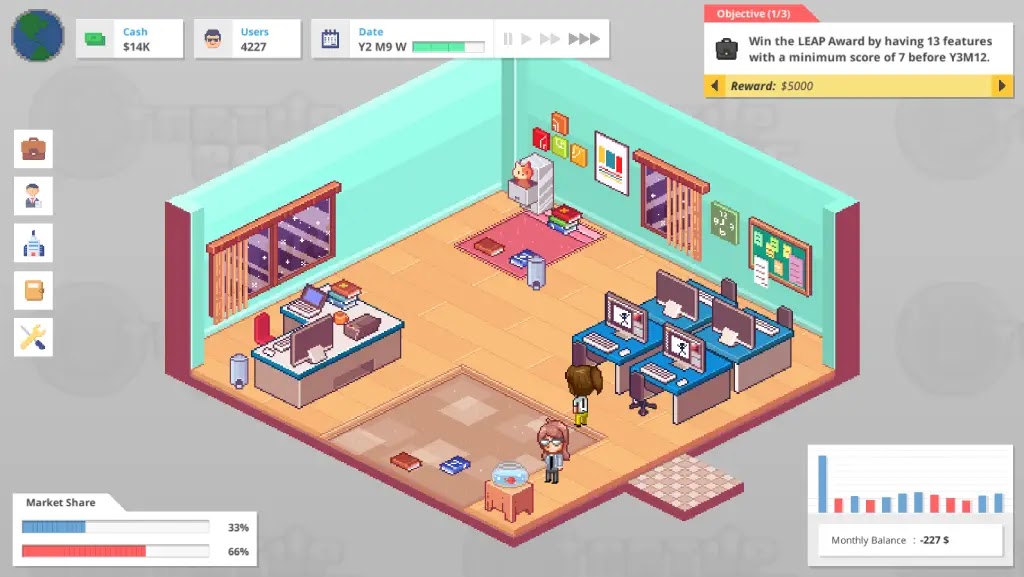
Another big thing that players need to be mindful of is the international standing of their application. On the top left of the screen is a globe that players can click on which allows players to conduct market research. Important information about demographics, preferred marketing methods, and total population will be displayed here. Having this information is key to your marketing strategy, which is crucial to pleasing your investors! Another useful benefit is that it also displays the market share of your competitors. When you beat out the first competitor, Johan Allberg, you will have a bigger fish to fry.

StartUp Panic List for Success

  1. Take on odd jobs to keep a positive financial balance

  2. Market your product in other countries

  3. Make deals with investors and stay out of debt

  4. Advance your services in the tech tree

  5. Manage character salaries and stress levels

  6. Manage employee vacation time and train them

  7. Upgrade the office with shinies!

  8. Buy traits to cut costs and provide extra perks

  9. Don't get kidnapped!

When a player takes on new contracts for cash or when they are developing new features on their app, a popup will present itself. On this popup will be three bars that represent Technology, Usability, and Aesthetics. The employees you assign to a job should have high enough stats to fulfill the requirements of the task. For example, using an employee with a high score in technology will not be useful to a t-shirt design job. When players are working on their own app, they will have to be mindful of what stats are most beneficial to the task. Regardless of the total stats, the sliding bars have to equal 100%. This does not change despite the number of workers nor the stat level. Those two aspects will help the overall success rate of the task but don’t change the difficulty level for the player.


Graphics and UI

StartUp Panic is an indie game that is well done. It has a realistic feel without too much focus on graphical fidelity. If I were to scale StartUp Panic like we do in-game, I’d devote 45% Technology, 35% Usability, and 20% to Aesthetics.

Players must use all the icons to gather information and graphs about their company and its rivals. There is a tech tree, a trait tree, and a decent amount of micro-management. One of the useful elements in StartUp Panic is the international map. So long as players have a rough idea of the population size and country location, they can aim their marketing to those areas. And because information and options are placed under menus, the UI is minimalistic. If players want to access the vacation option, they have to click the employee menu, then the employee list. In my opinion, it would be easier to have a popup on the individual characters

Algorocks cleverly placed several nods in StartUp panic from the Windows 95 era right up to the present day. I like some of the graphical choices in StartUp Panic like the cat that sporadically pops out of the filing cabinet or the computers that display images. Sometimes the computer will look similar to Adobe Photoshop and one is the old blue screen of death! It’s little details like these that I genuinely enjoy about this title.


Final Thoughts

StartUp Panic had me smiling from ear to ear for multiple reasons. Apart from the nods to the old version of Windows and the references to Clippy going on a date with ‘Seri’, I found another reason to be happy about this title. Early on players are introduced to a musician named AIYU. I was ecstatic at the reference of a real Japanese star in StartUp Panic. I have no idea if this was a deliberate choice but AYU, the shortened name for Ayumi Hamasaki, is a famous Jpop artist. She has released 17 studio albums, several live albums, and over twenty remix albums. This addition definitely increased my enjoyment of StartUp Panic. I was invested in this title - playing it longer than I would normally devote to a management simulator.

StartUp Panic certainly has its charm, but I personally found myself bored over time. Once you know the system of the game, it isn’t too difficult to keep yourself in the green. I would love to have had rejected investors cause more problems (depending on their status / position) or something a little more challenging. As such, I give StartUp Panic an 8 out of 10. It has a lot of merits and plenty of fun for a few hours, but there isn’t a ton of challenge or replayability, in my opinion. Its predictability became a bit of a hindrance even though it's a fantastic game.

Score: 8 / 10


Share:

Strategy and Management Game Empire of Sin is Now Available Worldwide!


STOCKHOLM - Dec 1, 2020
- Paradox Interactive and Romero Games today announced that Empire of Sin is now available for purchase worldwide at a suggested retail price of $39.99 / £34.99 / €39.99. Empire of Sin is a strategy and management game that takes place in the heart of the ruthless criminal underworld of 1920s Prohibition-era Chicago.

This character-driven, noir-inspired game puts players smack dab in the glitz and glamour of the roaring 20s, all while working behind the scenes in the gritty underbelly of organized crime. It’s up to you to hustle, charm, and intimidate your way to the top of the pile and do whatever it takes to stay there. Empire of Sin’s gameplay is structured around three pillars:

  • Roleplay: Choose one of fourteen unique bosses based on fictional and real-world gangsters, then set out to build and manage your criminal empire in Chicago’s infamous Prohibition era. Go to the mattresses as Al Capone or Goldie Garneau and send the rest of Chicago’s underworld to sleep with the fishes!

  • Empire Management: Build your Empire of Sin and run Chicago’s underworld economy with business savvy, brutality, or city-wide notoriety. Strategically manage your establishments such as speakeasies, supply chains, casinos, and more.

  • Turn-Based Combat: Assemble a killer gang from Empire of Sin’s more than fifty recruitable gangsters and slug it out in turn-based combat to defend and expand your territory – or send a message to opposing gangs.

“Empire of Sin is a labor of love, a game I’ve wanted to make for 20 years," said Brenda Romero, game director, Romero Games. “If games are about wish fulfillment, anyone who’s ever wished to run a criminal empire is in for a treat. We designed the game to put you right there in the thick of the action, at the very beginning of Prohibition. It goes without saying, but I’ll say it — the Empire of Sin team can’t wait to get this game into players’ hands.”

“Empire of Sin is the perfect video game cocktail: it fuses together the strategy and management gameplay that Paradox is known for with new flavors like turn-based combat, all set in the meticulously recreated world of 1920’s Chicago,” said Ebba Ljungerud, CEO, Paradox. "Bringing this ambitious project to the finish line has been a wonderful collaboration with Romero Games, and we’re thrilled for players to take their first steps into Prohibition today!”

Purchase Empire of Sin today at the links below. In addition to the base game, there are additional pre-order upgrade packs that contain a wide range of perks. Wiseguys who want to outfit their Empire can grab the Deluxe and Premium Editions that include stylish cosmetics, recruitable crewmates, weapon sets, and more.

Join the family on social:

About Paradox Interactive

Paradox Interactive is a leading global publisher of strategy games for PC and console. The company has developed and published a world-renowned catalog stretching back to 1999, with players hailing from all around the world.

The publisher’s steadily-growing portfolio includes firmly established franchises such as the critically acclaimed Europa Universalis, Crusader Kings, Hearts of Iron, and Stellaris series created by Paradox Development Studio, the Age of Wonders series created by Triumph Studios, as well as award-winning titles such as Cities: Skylines, Pillars of Eternity, and more from a network of partner studios. Paradox is the owner of the World of Darkness IPs and is publishing Vampire: The Masquerade - Bloodlines 2. Today, over four million people play a Paradox game each month, and the number of registered Paradox users is over twelve million.

Paradox’s head offices are located in Stockholm, Sweden. Our development studios are located in Stockholm, Malmö, and Umeå, Sweden, in Delft, The Netherlands, in Seattle, Washington, and in Berkeley, California. We share a passion for gaming and gamers, and our goal is to provide deep and challenging games with hours of gameplay and endless variety to our ever-growing community.

For more information, please visit our forums and follow us on Facebook, Twitter, and Instagram.

Comet sighted!


Article by: Susan N.


Share:

Rise of Industry - PC Review


Introduction

Rise of Industry is a management game that is interesting in principle because it has a tech tree, a neat low-poly graphics style, and the potential for complex strategies to keep your industry from falling beneath the AI titans. I found that Rise of Industry's launch out of Early Access might have been jumping the gun, but in no way does this take away from my general enjoyment of it.

Gameplay

Like with most games, I tend to start with the tutorial, especially since this particular title has an emphasis on micromanaging your city to buy and sell goods to make a profit. Thusly, the tutorial seemed like a good idea at the time, but I found that going through it was actually somewhat frustrating. It's going to seem backward when I say that the tutorial felt too long. Maybe too long isn't what I mean here. Perhaps what irked me about the tutorial was that it didn't go into details about certain things and included other things that I didn't find necessary. What I mean is, the game doesn't explicitly tell players about the massive cost difference between trucks delivering goods versus trains or blimps. And when players are engaged in the campaign, there are a lot of things that players need to discover on their own, which is all well and good but I never progressed far enough to see some of these features. In fact, I went bankrupt several times, even though I was keeping up with sales to the various shops and not selling to the state.

Also with the tutorial, there were some explanations that were lacking. In a campaign, the assistant would guide players into upgrading, which was often too quick. At one point, I was made aware of the fact that the headquarters building could be upgraded, but to what end? What is also not really explained much is the concept that each upgrade is going to cost a ton of money and a ton of time. While this is not a surprising feature, it is frustrating to know that players have to spend a crap ton of waiting time to be able to save themselves from bankruptcy - even on an easy 35% map! Needless to say, I had a rough time playing Rise of Industry.

That said, let's talk about the game itself. Rise of Industry has a couple of features that I do really enjoy, even if they were also features that bothered me. First up is the tech tree. Now, some management style games have a tech tree style of progression, but their time frame is not infuriating like I find this one to be. Tier 1 requires only 60 days. Tier 2 takes 120 days. Tier 3 is 540 days to research new technology. Keep in mind that the number of days listed is per research item. Minus the first three choices which are freebies (hallelujah), if you want all of the produce unlocked at tier 1, it would take more than 400 days of time! Yikes! Now, don't get me wrong, time does need to pass for things to be researched, but the time it takes to complete a couple of research tiers gets to be so long that just thinking about it makes me feel like *I* will be bankrupt before progress can be made. Even with the ability to increase the game speed, the time length still seems bonkers. However, the idea behind unlocking certain features has its appeal. Especially considering that to win the game, players have to build one of the two major items (the computer or a car). This is the ultimate goal of the game.

Another feature that I enjoy is that players get the opportunity to sell products for profit. Players can view the different city's supply and demanded goods. As such, they can then tailor their industry to produce the most profitable items. This allows for playing freedom where players in one playthrough can specialize in toy creation, while in another, they can focus on making the coveted cars or computers. And, not only is there potential to make money in another industry than your competitors, it means that players can challenge themselves by producing different types of products. Though, it should also be said that I don't recommend selling to the state, because it buys products at wholesale cost - meaning that you don't make a profit. So, only sell to the state if you have taken on a mission to do so, otherwise, there is no point. And don't go producing an asstonne of product you can't sell well or can't use to make a higher value items. Though, all told, I do enjoy being able to change which products I will sell to the various stores.

I also like the fact that players can bid on auctions to get contracts. This feature allows players to feel like this world is realistic. In one playthrough, I was sending a neighboring town a large amount of food because they had a massive shortage. While the map didn't reflect any kind of flooding or infestation, the fact that this is included in the game made it feel a little more realistic. Make no mistake though, I did have a playthrough where some of my crops were plagued by bugs and I have no idea how I should have eliminated the problem. (This was also in the playthrough that I went bankrupt. I wasn't streaming at the time it happened but I did stream stream that particular city and it was well on its way to failing before the end of stream.)

This is what leads to my issues with the game. The fact that while I found the tutorial to be too long (because it went into detail about things I didn't need to know), it didn't cover the most relevant basic points like:

  1. How does one upgrade the HQ building and what purpose does that serve? It's not explained from what I can recall. Furthermore the assistant tells players that they should upgrade the HQ, but I never achieved that before failing (I should mention that I attempted not to become bankrupt multiple times. I've no idea what I'm doing wrong actually...) 
  2. Is it worth buying shares in a neighboring city? I mean, it is a neat feature and all, but you need a fair amount of coin to buy them out. Even then, they don't seem threatening at all - especially when you specialize in production of items they don't sell. 
  3. How much does each transport vehicle cost? It makes sense that transport trucks cost less than trains but it takes far longer to make a profit this way. 

After playing through the campaign on the easiest difficulty I could manage, I failed most of them because, even though I could track my profits and losses, some of the information isn't clear. The only other issue I had with the game was in the campaign, players can only seem to place their HQ in one region of the map. I don't know if this was an error on my part but, I did receive notifications that an HQ has to be placed in a region with four shops.

Furthermore, I was never able to get a permit to build in another region. Again this might have been my own failing but, there was never a point where I was able to harvest oil or anything in another region. Did I fail the RNGeesus lottery? I don't know, but being restricted in this way bugged the crap out of me.

The last major point I want to touch on with respect to my issues with Rise of Industry is the space it takes. Upon starting a new campaign map, when players are able to customize their difficulty level, there is an option to increase the map size. For a medium sized map, it tells you that it takes 15GB of RAM. Hawt damn! In all of the management games I have played, none of the maps have ever taken up that much space. I don't even want to fathom what a large map would take.

Now, I know I've done a bit of dumping on Rise of Industry, but it's because I care about the direction of this game. It has a great foundation with some strange irritations that aren't present in other management games. I've spent more than 40 hours in Rise of Industry trying to figure out how to make my industry sustainable. I've also looked at the charts and restarted the game several times just to improve and I'm still not able to keep my industry alive. In fact, I even stopped playing my 2130 playthrough because I felt like I didn't know enough about the game. And the reality is, I do really like the concept of Rise of Industry. Despite all the questions I have and my frustrations due to lack of progression, I can see this game doing extremely well. I wouldn't say it's quite there yet, but I have high hopes. 

2130 Maps

Before talking about the graphics and UI, I did receive a game code for both the base game and the newly launched DLC titled 2130. It is considerably harder given that 2130 has a completely different style than the base game. It is set in the future where pollution has overtaken the area. Humans have destroyed their planet from pollution. (A point that is highly relevant in today's society.) In 2130, players research different algae types and sell those in place of normal food types like vegetables or wheat. In order to harvest the algae, air purifiers have to be placed first. That said, not all buildings operate with no pollution. Some of them require there to be air pollution to filter out the necessary nutrients for other uses. Most notably, players will need some of these strains to create medication for the citizens.

In other words, while the principle of Rise of Industry remains the same, the concept of the 2130 maps is completely different in how your industry can survive. Instead of growing foods and raising cattle, 2130 has a potentially futuristic bend, using our knowledge of geneticly modified foods. Algae is used to make medicine in 2130 and to profit in this DLC, players have to harvest ruins and make other items.

Not only does this make Rise of Industry feel different, releasing the 2130 DLC puts a whole new spin on the game. And unlike other city management games, 2130 has put players in a futuristic new world that is less familiar to them. Honestly, I've spent a ton of time playing this game. Perhaps one day I will get gud.

Graphics and UI

At beginning of this review, I mentioned that Rise of Industry has a low poly style of graphics, and that isn't wrong. Looking at the trailer will showcase exactly what I mean. The game is as realistic to management games like minecraft is realistic to other open world builder games. All of the necessary components are there, like graphs, buying and selling goods, traffic management, etc... but the graphics are different from other games in its genre. Although, it still confuses me as to why larger maps require more computer resources than triple A titles. One would think that the graphics style would be less hampering to a computer than others, but I digress...

As for the UI, it takes some getting used to. Some of it is explained through the tutorial of the game, though there is a ton of information in menus which can be found by players easily enough. The top bar has buttons for the tech tree, useful overlays, graphs, and information about the competing companies. On the bottom of the screen are all the buildings that players can use to expand their industrial empire. Each of these are shown under appropriate categories like gatherers and farms.

In the bottom left is a bar that shows a bunch of monetary figures. At first, this bar was confusing. Once you click on it, then you see that on the left side it shows the previous months expenses. This shows the totals for transportation, upkeep of buildings, and profit generated. The right hand figure shows how you are doing for that month, which I found oddly deceptive. The total money you have is listed in the middle and occasionally that figure would drop. That is true even while I was generating profit according to the current monthly figures. I'm not sure why it is displayed this way because it just didn't quite work well for me (despite having dealt with basic accounting in real life).

My issue with the UI is something extremely insignificant. If players are using the assistant, there are times where you can open up a drop down and the assistant will always be in the way. Unlike other games which would shunt a screen over so that everything could be properly displayed, this game keeps the box where it is. I spent a lot of time moving the assistant around just so I could look at the information I wanted. Also, in the top right corner where players can look at how the other corporations are doing, if players are working on a contract, that bar will be covering part of the corporation box. Again, this isn't a big deal, but it bugged me enough to notice.

Final Thoughts

Overall, I do enjoy Rise of Industry, even with its flaws. I'm sure that some of my gripes boil down to things I haven't yet figured out. We could chalk it up to its unique style of management game but I am not sure if that is really the issue here. It has made leaps and bounds since its early access days and I'm thankful for the progress, but for some reason I still feel like the game could use more improvement. The concept is great and the foundation is there for Rise of Industry to be an excellent management game, but it still needs some time. At least for me. But don't worry, I'm still going to be playing this game well after writing this review!

In conclusion, I'm going to give Rise of Industry a 7 out of 10. It has kept my interest despite the number of failed attempts I've had.

Be sure to follow Rise of Industry on Twitter and join the Discord server for tips!

Game Information


Platform:
PC
Developer(s):
Dapper Penguin Studios
Publisher(s):
Kasedo Games,
Kalypso Media Digital
Genre(s):
Management
Mode(s):
Single Player
Other Platform(s):
Mac, Linux

Source:
Provided by Publisher


Article by Susan N.
Share:

Autonauts Launch is Successful According to a New Infographic


London, UK - Thursday, 31st October: Today Curve Digital and Denki have released a new infographic to mark Autonauts’ impressive launch on PC earlier this month.

In Autonauts players are responsible for colonising planets by harvesting natural resources using the power of robot-powered automations which they code on the fly.

It’s clear this unique ‘Playful Programming’ premise has struck a chord with many management game fans around the world with over 57,000 tutorials completed and 88,000 achievements (commonly known as badges) in-game unlocked. The infographic accompanying this press release has more delightfully colourful insights.

This impressive scale is also reflected in Autonauts’ sales since launch according to its publisher, Curve Digital, who have stated that the game has become one of its best sellers.

"Everyone at Curve was totally enraptured with Autonauts the moment we first set eyes on it – so to see it received so well globally has been a genuine thrill,” said Simon Byron, publishing director at Curve Digital. “To become Curve’s fourth highest-grossing Steam game within 7 days of launch is a real endorsement of the game Denki have created. With some significant free updates in the works, this is just the start of our adorable Bots’ adventures."

Priced at £17.99, $19.99 and €19.99 respectively, Autonauts is currently sitting at 79 on metacritic and has over 477 reviews on Steam, 83% of which are positive.

Curve Digital and Denki are also happy to announce an aggressive post-release strategy for Autonauts which will see the game receive meaningful new features and content for at least the next six months and importantly, all of this new content will be added to the game for no extra cost.

"The response to Autonauts has been just phenomenal. We want to thank everyone for supporting the game, not only since its launch on Steam but also back in the old pre-pre-pre-Alpha days on itch.io," said Denki's Creative Director Gary Penn.
My dev bud Aaron and I are amazed by what players are doing with Autonauts: some cunning script ideas, some lovely-looking worlds and some surprising bugs, which we're fixing - and acting on suggestions, too. We're also working on lots of fab new ideas for free future updates, like more technology, machines, structures, vehicles, resources and a whole new Age for the game. We'll share more about all that Autonaut-y goodness real, real soon. Cheers!

To learn more about Autonauts and to stay up-to-date with the game’s continued evolution, please visit the official Steam product page: https://store.steampowered.com/app/979120/Autonauts/


About Curve Digital

Curve Digital is one of the leading publishers of games on PC and consoles. Since 2013, the company has been working with some of the world’s best game developers to help bring their games to the broadest possible global audience; from indie hits like Dear Esther to the likes of the multi-million-selling Human: Fall Flat. In 2017 Curve Digital was recognised by the celebrated Develop Industry Excellence Awards as ‘Publishing Hero’ and crowned ‘Indie Games Publisher of the Year’ at the 2018 and 2019 MCV Awards. Curve Digital was also a 2019 finalist for MCV’s ‘Community Management of the Year’.

About Denki

Denki is a video game developer based in Dundee, Scotland which was founded in 2000 by 4 developers from the now-defunct, DMA Design. Denki has worked extensively in the digital interactive television (DiTV) market, as well as other gaming platforms, and has produced bespoke licensed gaming products with the biggest entertainment brands on the planet. Autonauts is an original IP from the studio and their next big release.


Article by Susan N.

Share:

Automachef - PC Review


Introduction

Ever wanted to create the ultimate automated kitchen where you don't have to worry about pesky employees not being efficient enough? Well, now you can live your dreams in Automachef where you create the best, quickest, and tastiest meals. Just make sure to keep that efficiency rating high and don't anger the food critics! This management puzzle game provides several hours of entertainment as players scratch their heads over the fastest designs possible. Automachef is a great time for all ages and I'm enjoying the heck out of it.

Gameplay

I'm incredibly surprised at how much time I spent playing Automachef. It is a management game that has an intuitive design. Each level has objectives that players need to fulfill in order to succeed. If an objective is not completed then, when looking at the timeline, the circle next to that particular requirement would not be filled. Level requirements will be things like energy usage, orders fulfilled, food critic orders satisfied, total ingredients used, or time limits. In the campaign, completing these objectives opens up the next level, however, there are a couple of other modes that can be played.

Notably, Automachef possesses a Career mode where players begin with a budget to take on contracts. This mode presumes that players have already completed the game or understand what machines are needed to complete various orders. It does not hold your hand by telling you what is required for each contract. The most players receive is the menu list, a budget, a power usage, or total ingredients that can be used. Objectives in each contract changes based on the difficulty level set. While players can complete a contract on easy, they will receive less money, less of a bonus payment, and a lower efficiency target to meet. The objectives will also scale accordingly, allowing players to produce fewer dishes during rush hour times and lower energy use. Overall, this mode is great at providing a challenge once players finish the campaign mode.


There are three other options that are self-explanatory. A scenario mode allows players to make their own challenges with their own objective list that can be published on the Steam workshop. At the moment, there aren't many scenarios available, but there are a few that players can try.

Another option is the test site where players can see how their builds function, apart from testing them out during levels. Players are able to stop the level from completing when something isn't working and because of that, I haven't really needed to use this mode. I imagine that it is useful for players who are looking to build complex kitchen designs for scenarios they will publish at a later point.

Finally, there are mods for Automachef. Currently, there are four available (at the time of writing this review), and each presents different food choices like onion rings or steak. Instead of just cooking a steak to one base rareness level, players have to cook it to the specifications of the order (like medium or well done). With the mods, players will be able to add more management fun to an already entertaining game and I love it.

UI

The UI in Automachef is quite intuitive. On the left is a menu screen with two tabs, one labeled Parts and the other is Blueprints. Under the parts tab, different machines available to you are listed. Once you click on a machine, a drop-down appears that displays the power usage, cost, and description. Under the blueprints tab, players can create machine setups that will be frequently used in their kitchens. This comes in handy when playing the burger frenzy optional level where the objective is to crank out 50 plain burgers in under 2 minutes. Your setup has to be fast and efficient to succeed at this level. Trust me. And when you find the right design, making a blueprint goes a long way.

Above the machine list are four buttons: move, duplicate, recipe, and turn camera. The move button allows players to move whole sections of their automated machines, instead of having to individually click on them. Duplicate is self-explanatory. The recipe button shows players what ingredients are needed to complete an order, though it does not tell you what machines are need - something that needs to be figured out by the players. Lastly, there is the turn camera option which twists the camera 45 degrees on the right then left and back to normal again. To me, the camera option is the most useless feature, but I digress...

After setting up the kitchen and when you begin taking orders, the screen changes to have new information displayed on the left. The Level Progress will appear, displaying objectives to succeed such as, the number of dishes delivered, energy used, total ingredients used, food critic orders satisfied, or time left to complete objectives. Underneath those will be power usage and reputation percentage. Reputation is most important in Contracts mode, where players will bolster the rating by successfully completing contracts. In the campaign, the reputation remains at 100%, and thus far, I haven't determined how important this is in later levels.

When players are fulfilling their objectives, there is a drop-down menu on the right side of the screen which displays useful information like Power Usage, On/Off, Bacteria, Fire Hazard, and Infestation Hazard. All of these display options help determine the success rate of kitchen designs for the player, which is incredibly useful for later levels where some of these kitchen issues are introduced.

Overall, I love how simple and accessible the UI is. It has a lightweight feel to it and I find that because of Automachef's graphics, it is easy to play on older computers.

Pros and Cons

On the good side of automating food:
  • Customers don't complain if you miss their order (in campaign mode)
  • Provides hours of endless entertainment as you perfect your automated kitchen
  • Allows for mind-bending puzzle solving
  • Has Challenge levels that push players kitchens to the limits
  • The companion robot is ambitious and entertaining
  • The game runs rather smoothly, even on a laptop that is several years old
  • Has several different modes: Campaign, Contracts, Scenario Editor, Test Site, and Mods.

On the bad side of food automation:
  • The wait time at the beginning of each level is slightly annoying after a while (especially when you know the level is going to fail and you are trying to troubleshoot the kitchen)
  • No option for flipping a blueprint, only copying of a layout is available
  • The career mode should really be hidden behind the campaign because it assumes that players know everything before going in. As in, DON'T START IN CAREER MODE FIRST.
  • The efficiency rating doesn't have defined terms to achieve 100%. Up until recently, the highest I could ever achieve was 98%. (Eventually, I completed the first level with 100% efficiency, although I'm not sure why. The tips only tell you criteria to boost your efficiency, but it's hard to tell how it is calculated.)
  • When placing machines in the kitchen, there is an arrow that indicates the direction that the items will move. The issue I have with this is that the arrow isn't defined well enough. The green color needs to be more vibrant, because when your kitchen is larger, it gets harder to see the outline. However, this might be an issue with playing on a laptop where its graphics aren't ass good.
  • The game does not seem to cloud save if you are playing it through the Twitch games tab. But, on Steam there is cloud saving so don't panic!

Thoughts on Cooking the Most Efficient Meal

I've been having a great time playing Automachef because it is a challenging management game. Plus it helps that the robot you work with has a lot of ambition and high expectations. There are different modes that players can sink their teeth into and there are all kinds of food options available to satisfy your hungry clients. Even though there are some minor grievances about Automachef, they are not enough to detract me from playing this title a ton.

As such, Automachef has made it past the chopping block and onto our plates with a solid 8 out of 10. So be sure to pick this title up for every gamer you know that love management puzzle simulators on Steam.

Be follow Hermes Interactive on their official webpage, Twitter, and LinkedIn. Keep an eye on Team17 for future published titles on their website as well!

Game Information


Platform:
PC
Developer(s):
Hermes Interactive
Publisher(s):
Team17 Digital Ltd.
Genre(s):
Management,
Puzzle
Mode(s):
Single Player
Other Platform(s):
N/A

Source:
Provided by Publisher


Article by Susan N.

Share:

Random posts

Our Streamers

Susan "Jagtress" N.


S.M. Carrière

Aldren


Affiliates

JenEricDesigns – Coffee that ships to the US and Canada

JenEricDesigns – Coffee that ships to the US and Canada
Light, Medium and Dark Roast Coffee available.

Blog Archive

Labels