• Gobliiins Collection - Switch Review

    In the early 90s, Coktel Vision (which later became Sierra On-Line) released a quirky point and click adventure game titled Gobliiins which had players bouncing between three different Goblins to find a cure for good King Angoulafre.

  • The Core - PC Preview

    Sometimes when you are browsing the internet for information on how to do something, you stumble upon ideas or projects or even games that people might be working on...

  • Cat Mail Co. - PC Review

    What a meow-gnificent evening it is to send your paw-rcels out to those family and friends! Are mew looking to pick up an item or send something out? Well at Cat Mail Co. we can send and receive all your deliveries!

  • Volontes - Nintendo Switch Review

    Have you ever grown up feeling like you don't belong? For our Heroine, that's the feeling she lives with everyday in her small farming village. But it's not her only secret...

  • STARSEEKER: Astroneer Expeditions - PC Preview

    STARSEEKER: Astroneer Expeditions is just that! Massively co-operative and not an MMO! When you first run the game you are instantly into the tutorial...

  • Dread Delusion - Xbox Series X|S Review

    Today we’re looking at what has rapidly become an absolute favorite in the open-world RPG genre for me. An interesting story, memorable NPCs, stunning visuals, and a setting absolutely dripping with flavor, Dread Delusion sets its tone immediately and sticks with it.

  • House Flipper Remastered Collection - PC Review

    I enjoy simulation-type games, and I enjoyed the original release of House Flipper, but I never got around to getting the DLC. When the remastered version of the game was released, I figured it would be the best way to experience the DLC while checking out how the base game was upgraded.

  • GranBlue Fantasy: ReLink Endless Ragnarok - PS5 Review

    GranBlue Fantasy: ReLink released in 2024 bringing the GranBlue universe to an action adventure JRPG format. With a party of up to four members, this band of skyfarers set out for new skies, adventures, and dangers. Two years later, Endless Ragnarok...

  • 70s-Style Robot Anime Geppy-X - PS5 Review

    70s-Style Robot Anime Geppy-X is a mouthful of a title, but you know what? It’s quite the challenging game to describe as well. At its core, 70s-Style Robot Anime Geppy-X is a shooter...

Showing posts with label Brigandine: The Legend of Runersia. Show all posts

Brigandine: The Legend of Runersia Review


Brigandine: The Legend of Runersia
by developer Matrix Software and publisher HappinetPC (Steam) review written by Hayden with a copy provided by the publisher.

Estimated reading time: 7 minutes 


Brigandine: The Legend of Runersia has returned for its third round of release, jumping to PC via Steam. Chalyr’s Game Room has covered the game's original debut on Nintendo Switch (here, in July 2020) and later on PlayStation 4 (here, in December 2020). Both of the previous reviews have gone into detail on the mechanics of the game, which are essentially unchanged. The game is jumping into the PC market, fighting against titles built from the ground up on the PC format. Accordingly, I’m going to focus on the game as a PC title - a different benchmark than it faced on consoles.

English Localization

Players will notice that this is not a game that was designed and built in English for the English-speaking market. What we’re assessing here is both the game’s port from console to PC, and also the English localization in particular. This has added extra difficulty to Matrix Software’s job in moving the game to the English-speaking PC market.

Overall Matrix Software has done a great job on this localization. There are a few areas like voiced character lines (inspirational comments or snide quips, I don’t know) during combat that remain in the original Japanese and don’t have subtitles. These areas are few enough that I was never left feeling that I had missed something critical. Text in the game is expertly translated, with none of the poor spelling or grammatical oddities that betray rushed or cut-rate localization work. Impressively, the game successfully pulls off a variety of double-entendre and other humor. Humor is an area which often does not translate well between languages and cultures, and this shows Matrix Software’s superb efforts to make their game accessible to an English speaking audience.

In-game User Experience

Mechanically, Brigandine: The Legend of Runersia betrays its roots as a console title in how it plays on PC. Brigandine supports keyboard and mouse options, but does not follow through on using the mouse in particular. Indeed, during the time I was reviewing Brigandine: The Legend of Runersia on PC prior to its official release on 11 May 2022, I found myself exclusively using keyboard inputs after a time because using the mouse felt more cumbersome than helpful. Much of this comes from Brigandine’s combat map system, which uses an isometric view of a hex map.

As the player’s units sit on (and in the case of flyers, hover above) the hexes, the instinct of a PC gamer using a mouse is to click on the unit sprite to select it. In Brigandine: The Legend of Runersia, selection is done by clicking the hex, not the unit sprite. This method works fine when you are scrolling the cursor around via d-pad or keyboard-emulating button presses and the cursor highlights which hex it is on. When moving the cursor around with the mouse though, no such hex-highlighting occurs, and clicking on the sprite often ends up selecting the hex behind the sprite instead.
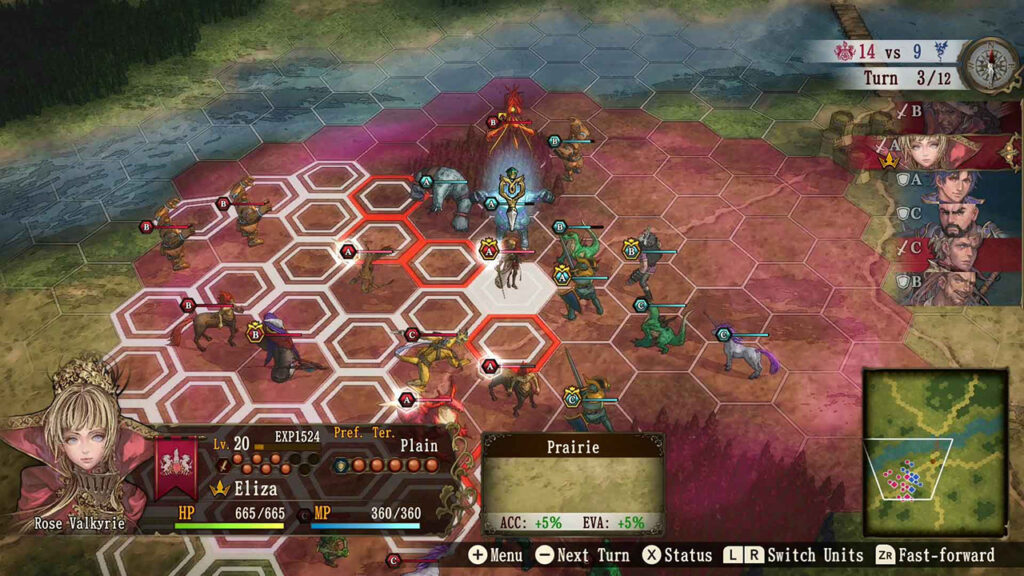
As mentioned earlier, this ended up feeling so cumbersome after a time that I ended up using the keyboard alone as the better option. PC players rapidly select items and navigate the map, so these shortcomings are disappointing. In the end, combat feels much slower and less engaging due to the inefficient selection system. Since the tactical combat system is where players will end up spending the majority of their time, this is a glaring weakness when stacked up against other PC-native titles.

Pet Peeves and Oversights

The performance of Brigandine: The Legend of Runersia on PC was generally quite good. Unfortunately, a few odd behaviors soured the first impression that the game provided. On first entry, many players will try to access the Settings or Options screen off the Main Menu. The game expects players to use "J" or "K" to accept or cancel these screens - with no indication of this at times. These conventions are clearly taught within the gameplay, but these Settings screens are accessible (and frequently accessed) before the tutorial. These windows even lacked the familiar "Accept/Close" buttons or even an “X” to close windows in the top right corners.
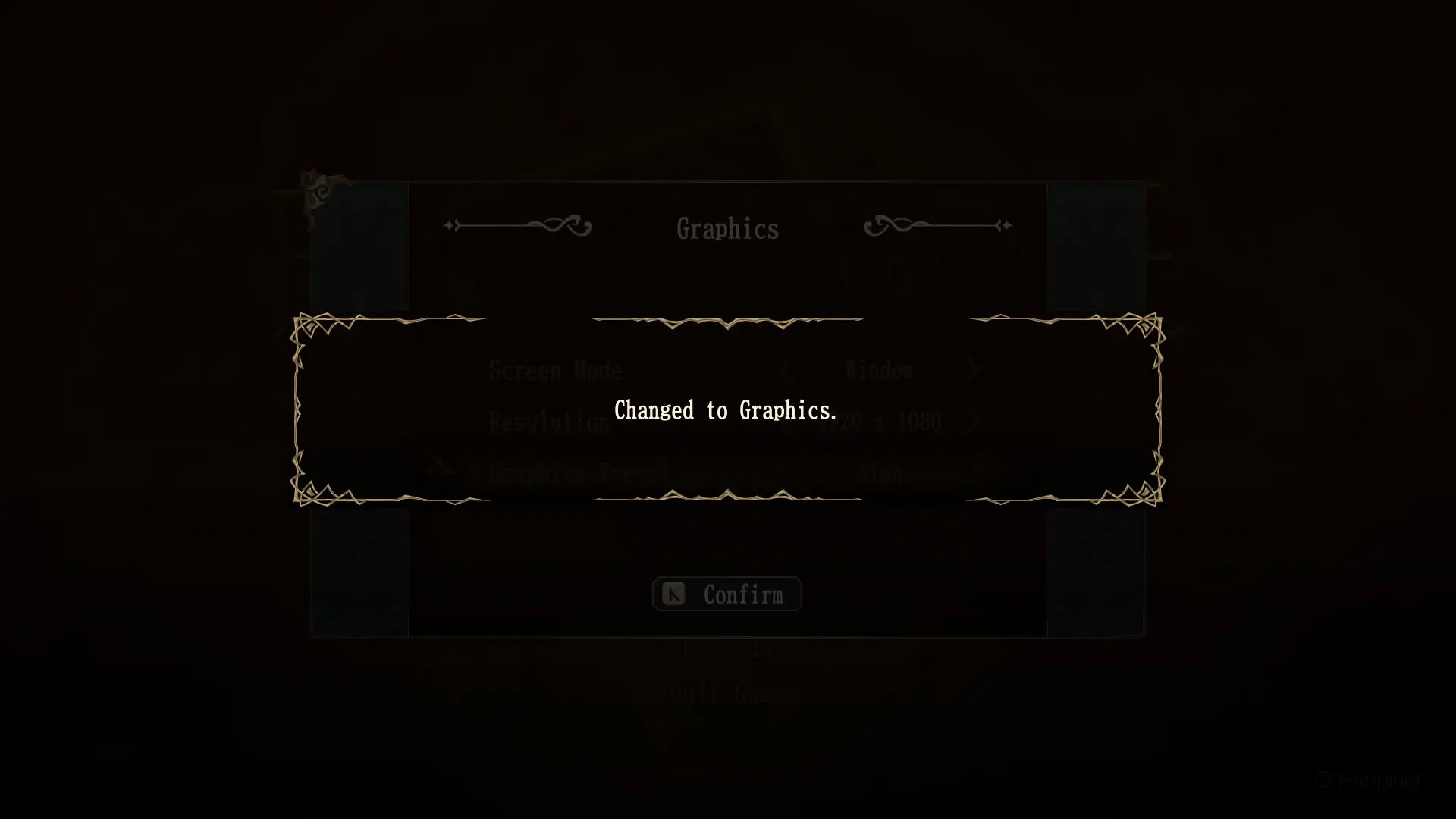

On the heels of this was an item that (while small and silly to obsess over) became a personal irritant through the game - a single missing space. Visible in the image below, it looks like in moving from the button-symbol to a keyboard character, nobody thought to add a space between the input setting and the word “key”. The first time the game asked me to “press the KKey” during the very first tutorial mission raised an eyebrow, the hundredth time this showed up in the main campaign my teeth were starting to grind. To me, this was a clear and repetitive indication that the game was a console-to-PC port, and it wouldn’t let me forget it.

User Interface - PC vs Console

The menu design of Brigandine: The Legend of Runersia betrays its console roots compared to many PC titles. Developers designing user interfaces for consoles have to contend with a very limited number of available buttons. The Nintendo Switch that Brigandine was first released on, for example, has a total of: two sticks; four trigger buttons; and eight standard buttons (of which four normally serve as a directional pad). This effectively gives developers 8 button inputs normally available for use. This leads to a system where the player needs to delve into multiple layers of menus before getting to the item they are seeking.

Games native to PC have a huge number of input options available: 26 alphabet keys; ten number keys; twelve function keys; and modifiers like Ctrl, Alt and Shift. This typically leads to fewer menus, with many hotkeys available to allow the player to rapidly navigate to particular options. The PC version of Brigandine maintains the console-style nested menu system and introduces few hotkeys to the player. The end result is a game that still feels like a console product on the PC. Comparatively slow and difficult to navigate, it comes up short against the optimized user experiences of PC-native titles.


Conclusion

The gameplay mechanics of Brigandine: The Legend of Runersia are still fun, and the game itself is still quite enjoyable. Earlier reviews gave it a 8.25 and 8.5/10, and the game certainly still has merit on the PC. Against other titles designed to use the PC’s broader capabilities and input options, Brigandine feels clumsy and slow to use. Brigandine could compete effectively on PC, but it will require an overhaul of the user experience to get there.

Summary

Originally for Nintendo Switch, Brigandine: The Legend of Runersia comes through PlayStation 4 before now arriving on PC via Steam. The gameplay mechanics are enjoyable, but this port has ignored the mouse and the PC’s range of keyboard inputs. The lack of a streamlined user experience leaves this game feeling slow and clumsy compared to PC-native titles. A good title, but not a great fit for the PC in its current state.

Score: 7 / 10

Share:

Brigandine: The Legend of Runersia - PS4 Review


Brigandine: The Legend of Runersia
by developer Matrix Software and publisher Limited Run GamesSony PlayStation 4 review written by Nick with a copy provided by the publisher.

Estimated reading time: 7 minutes

Brigandine: The Legend of Runersia is a dense strategy / RPG hybrid that successfully pulls together a lot of different elements into a cohesive, entertaining package. It reminds me of some of my favorite older strategy games, while having plenty of modern sensibility. The end result is the kind of deep, enjoyable tactics game I needed for the holidays.

The strategy / RPG genre is one of my most guilty pleasures. These are the types of games I would play over and over again when I was younger. Warsong / Langrisser, Shining Force, Dark Wizard, Master of Monsters and Dragon Force were all games I would tackle in different ways for a variety of reasons. In linear titles like Warsong I simply wanted to try different leader classes or a unique set of tactics on a particularly interest map to see if I could do better the next time. In Shing Force or Dark Wizard I was perhaps looking for some secret item or area I missed the first time around. Master of Monsters had all of these really cool creature evolutions I just wanted to see through.


Most of these games were a bit light on story, though a few like Dragon Force or Dark Wizard would give you a different narrative, thin though it may be, based on whom you selected as your starting ruler. Brigandine: The Legend of Runersia has all of these elements, including a rather meaty story for each kingdom to boot. Each nation has its own motivations for going to war, whether it’s to try and maintain the current rulership, a fiefdom looking for true freedom and more. This creates a sort of unreliable narration however, as the story is heavily slanted to justify your chosen kingdom’s actions. As you progress each kingdom, they fill out a glossary / codex that puts the different pieces together and rather cleverly weaves together the true, overarching narrative of the land. Given that this is an area that was often rather threadbare in my older gaming days, I greatly appreciated how well this aspect of the game was handled.

Beyond the story, there is a great deal to balance. Each season is broken up into three phrases. The first is the busiest as it is the organization phase. During this you send people onto quests, you assign monsters to heroes, summon new monsters (which cost mana to create and to maintain, further continuing that balancing act of balance), moving units from one zone to another and so on. It would be a stretch to compare this to the governing / development stage found in heavy 4X strategy games, but it’s where most of the management happens. The next phase is the most lightweight, where you declare your attack on another adjacent zone. The third and final stage to a season is the actual combat. I found myself only doing one or two in a given season, though higher levels of difficulty come with not only more challenging opponents but also a tighter window for total victory. If you go that route, multiple coordinated seasonal attacks become more important, where as conversely if you go the easiest difficult, there is no time limit at all to win.


Quests are important, as they yield items and can find you new heroes to lead your monster units, but the most important aspect of the game is its hex-style, turn-based combat. It feels like something right out of those classic strategy titles I mentioned before, with a lot of RNG dice rolling in the background that weighs type of attack, range, terrain and more into calculating hits and damage. More powerful monsters have a higher cost, and each general only has so many points available. What this means is you can pile on a bunch of weaker, 20 cost creatures or maybe one or two high cost 100 point creatures. Generally the best teams have a combination of thumpers, range and support abilities while the heroes themselves are often the most powerful – but also significant if they fall – units on the battlefield.

There was very little actually ‘new’ to how combat plays out – but it was easy to pick up and battles certainly require a great deal of thought. If you happen to have a powerful dragon on your team, they may be able to do substantial damage to several enemies without being countered, but their magic is limited and they can usually only unleash that a couple of times or so per battle. Sometimes you can accidentally hit enemies if you are not careful. Get the right unit in the right environment, and they can be very challenging to actually land a shot on. There was almost a ‘comfort food’ type of feeling for me, because I am so familiar with the genre over the years, but even though I picked it up easily enough – the combat can still be challenging if you don’t pause to think through your strategy.


Progression is pretty solid here, with plenty of the usual RPG elements to keep you feeling as though you are progressing. You gain items, experience, levels and characters can evolve into better classes / units when hitting specific levels / criteria. For me, this was particularly entertaining and kept me wanting just one or two more battles.

Despite all of these good points, it is worth discussing some of the areas where Brigandine: The Legend of Runersia could rub someone the wrong way as well. Even having gone through the tutorial, I did not really fully understand some of what happened until later in the game. That makes sense given how much there is to do and how dense the content is, but that combined with the slow pacing and somewhat repetitive (almost grindy) nature of the gameplay will mean that Brigandine: The Legend of Runersia is definitely not going to be for everyone. By the time I finished my first campaign, a little fatigue was starting to set in, as maps began to feel less and less varied (especially the forest ones where movement just felt really slow). Now, that being said, I was excited to kick off a new campaign with a new kingdom upon initial completion, but that repetition and fatigue set in again sooner on the second playthrough. I know I have more patience for these types of games and derive more replay value from them than a lot of people do, so my sneaking suspicion is that very few players will get through all of the campaigns and neatly knit together Runersia’s story any time soon.


Additionally, while the music and visuals are all fine, neither aspect of the presentation blew me away. Audio is not in English, so you’re left reading subtitles, the music was fitting but not particularly memorable and the art style is certainly nice of technically pretty simple (not much movement in the cutscenes to speak of, mostly still images and the battles are efficient but the units and environments are not what I would consider eye-catching either). The menus are well laid out however, and having a menu-driven game work well on a controller can be a tricky thing, but the dev team did a pretty solid job on that front.

Summary

Brigandine: The Legend of Runersia is an excellent strategy / RPG hybrid that recalls some of my favorite old school games of the genre, but benefits from some modern updates and solid storytelling. The presentation didn’t wow me, but the progression is rewarding and the combat meaty enough that I stayed engaged for dozens of hours. This was the perfect holiday gift for me (if not my spare time, which Brigandine: The Legend of Runersia soaked up a lot of).

Score: 8.5 / 10


Share:

Random posts

Our Streamers

Susan "Jagtress" N.


S.M. Carrière

Aldren


Affiliates

JenEricDesigns – Coffee that ships to the US and Canada

JenEricDesigns – Coffee that ships to the US and Canada
Light, Medium and Dark Roast Coffee available.

Blog Archive

Labels