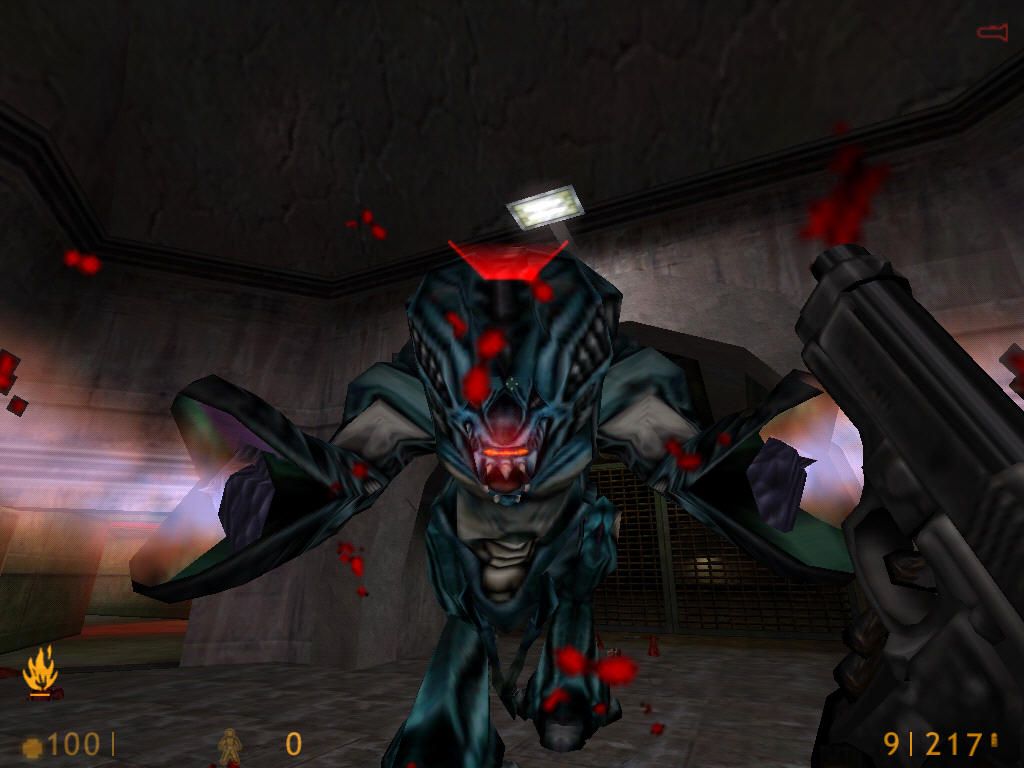
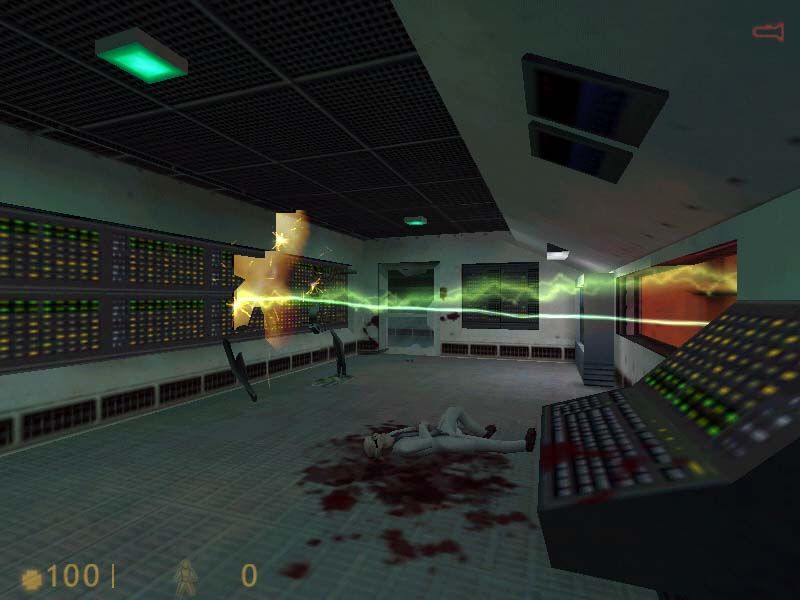
Half-Life
2 by developer and publisher Valve—PC
(Steam) retro reflection written by Hamza
with a purchased copy.
Estimated reading time: 10 minutes
When you get off the tram in the original game, a security guard by
the name of Barney greets you. Among the many things he says in his
short appearance, he mentions something about buying you a beer after
when the shift's over. But, as we all know, the day soon takes an
unexpected turn via the cataclysmic resonance cascade and sets in
motion the raison d'etre of Half-Life proper; thus Barney and his
proposal is all but forgotten. The friendly guard quickly becomes a
distant and unimportant memory the more you progressive into the
game, until comes a point where you cannot remember him unless
reminded so - at which your face takes on the expression of someone
lost in an ancestral memory.
Now, in Half-Life 2, as soon as you get off the train you're taken to
an interrogation room where a Combine soldier is waiting for you.
When the soldier closes the door to the room and turns off the CCTV
cameras, he then takes off his headgear and, while revealing himself
to be Barney, reminds you of his long-due promise of the beer he owes
you. The mere mention of the word 'beer' brings back the nostalgic
memory of meeting him for the very first time. Seeing him again is
like running into an old, dear friend, and given the context it could
not be more fitting and relieving. While this brief surprise is
rather nondescript in front of the bleak and terrorizing world you
get to witness, it is precisely because of this that his unexpected
appearance makes you want to venture on with renewed confidence...
and appreciate the game just a little more for staying true to its
larger than life approach to the Half-Life universe. Just because we
never get to see Barney for the remainder of the original game
doesn't mean he met with the inevitable cliché. Valve's intent was
to make believable, realistic characters, and Barney was one.
Anything could've happened to him, and out of all the scenarios that
come to mind, this one - that he survived - is the one I like best.
You are in City 17. You arrive here from an unknown location with two
other passengers, and with the mysterious G-Man and his cryptic
sentences once again in the picture, you know it's going to be yet
another strange day at the office. Once you step off the train and
witness a Combine soldier harassing a citizen (and then later you),
you realize that the two ends of the spectrum have successfully
balanced out. In the original you were a respectable scientist who
was the cause of the trouble; now you're the victim of it, reduced to
the lowest common denominator. In this introductory level, the signs
are all but clear: an Orwellian nightmare has froze over and there's
nothing you can publicly do about it. You must plan your moves in the
shadows and move with caution. Right from the outset - with the
Combine bullying you, with them forcefully breaking into citizen's
dwelling areas and ram shackling it - the game masterfully conjures
up a deafening silence before the storm.

The second you open the double doors to the majestic looking center
of City 17, you just know you stepped into something both
philosophically and literally bigger than yourself. The tightly
packed tenements are a mix of different era Eastern European
architecture and they palpably invoke a sense of Orwellian society -
which is not far from the truth, given the numerous flying scanners
and Dr. Breen's Big Brother-esque ubiquity over the City. Citizens
with frightened expressions and hunched shoulders slowly make their
way to their destinations while several Combine soldiers stand
uprooted menacingly. Approaching them alerts their awareness of you.
Stay in their line of sight slightly too long and you'll receive a
smack on the head with their electric probes. Since you're not armed,
you cannot hit back - and this marks as prove of the game's unmatched
realism and tangibility. City 17 is easily one of the most impressive
locations in a video game ever. The use of mute colors (ie: brown)
brilliantly accentuate the desolation, forlornness and trapped nature
of the city and its denizens. Never before have I entered a location
and felt exactly like the habitants and have had this euphoric
phenomena called fernweh - where a person becomes homesick for a
place he's never been to. This is great work on Valve's part, and
possible madness on mine!
Right from the outset this game tells you that it will be providing a
much bigger playground to traverse in than the one you were used to
in the original. While Half-Life 2 does have its claustrophobic
moments, the larger areas never feel like they're being replaced nor
do they lose their touch. The only complaint I have regarding the
size of the locations is how vulnerable you suddenly become to enemy
attack. Whenever you emerge from, let's say, a house or underground
dwelling, to a more open landscape you're exposed to enemy attack
like an exposed nerve - because they appear from multiple directions
and often-times one of them would be in a difficult position. This
"invisible shooter" has been a thorn on my side from the
Ravenholm chapter onward, and the number one cause of unfair death
and/or ungodly level of low health.
The primary gameplay remains the same. You make your way through
various locations - and from it - battling enemy forces and
occasionally encountering a rebel hideout. The latter is a new
feature in the game, and through it further portions of the backstory
get uncovered. In the original you had scared-stiff scientists and
lone security guards; here now you get groups of rebel fighters who
are more than capable of holding the fort all by themselves. This is
an interesting change of pace, as it makes the in-game world a little
more alive and varied than it already is. The shooting aspect is now
more refined and aggressive. Compared to the first game, the guns and
hitting power feel more heavy and weighted - but they still have a
slight "floaty" feel to them that makes them far from
robust. While the subtle technicalities make for a better playing
experience the second time around, nothing expresses the power of
freedom more explosively than the driving aspects of the game.

As still one of the few first-person shooters to include driving
sequences from a first-person perspective (others tend to switch to
third-person), the driving parts, though executed in a nice way, have
me sharply divided. You see the game uses the same physics mechanic
for driving as it does for the characters, and the translation
doesn't go over too well. In fact they feel too uncomfortable,
uncontrollable and awkward. The mudskipper (water boat) sequence is
fine, no serious complaints there, but it is when you man the dune
buggy that you acquire in the Highway 17 chapter that the trouble
starts. The physics engine is so sensitive that any bump with a rock
or an Antlion sends it flying across the screen, losing viable health
and time along the way. Just a few minutes into the buggy and already
I had begun loathing it. When I finally had enough of turning it over
via the Gravity Gun - of which you'll have to do constantly - I
ditched it and continued the adventure on foot. Imagine my anger (the
one I usually reserve for the 30 second ads before every YouTube
video) when I found out that in order to proceed to the next area I
had to be on the friggin' buggy. Since I had ditched it a long way
back, I had to travel all the way back to retrieve it, all four
minutes of it. Bringing it to the close-off point took longer than
making coffee. Had it had better physics model, who knows I might be
crying about lack of more driving sequences; but since there aren't
many, all I can say is Good Riddance!!
Graphically the game is beyond awesome looking, even to this day.
Many of the locales look absolutely gorgeous - even if they aren't
gorgeous in the traditional sense, they do invoke a sense associated
with the word. The entire Ravenholm chapter not only stands as
testament to the graphical prowess of the game, but is also perhaps
one of the most intimidating and creepiest areas ever designed for a
video game. To sum it up Ravenholm is a negative copy of City 17.
While the latter isn't exactly flowers and sunshine, it is well
maintained and horrors contained. Ravenholm is like a living carcass,
a rejected Silent Hill location. Crawling to the brim with even
darker versions of zombies and headcrabs, Ravenholm effectively
conjures up a feeling of palpable dread and insecurity only matched
by a certain few, like Doom 3 and F.E.A.R. The heavy use of grotesque
props - such as mutilated bodies and large pools of blood - only add
to the already scary atmosphere. Really, I could go on and on about
this particular chapter but such praise will go pointless if you
don't (or won't) experience it for yourself. It will be like you
stepped into another different game altogether.
The voice acting is simply amazing and definitely an improvement over
its predecessor. Not to say the first game didn't have good voice
overs (it did actually) it's just this time around they've definitely
gotten richer and rounded. The tigress' share of the adulation
obviously goes to Merle Dandridge for her masterful and iconic
portrayal of Alyx Vance, the first female protagonist of the
Half-Life universe, as well as the first fully fledged supporting
character. Merle did such an excellent job that she forever ensured
Alyx's position in the annals of the video game industry as a
legendary character. A job finely done, I must say. The rest of the
supporting cast, major and minor, also provide various shades of
appropriate realistic emotions and tones and they're all worthy of
two thumbs up. Half-Life 2 may very well be one of the very few video
games to have great voice-acting from virtually everyone - something
I last noticed in Broken Sword: Shadow of the Templars and its third
sequel, Angel of Death.

With all being said and done, Half-Life 2 is a technical and
graphical milestone in the video-game industry. It is one impressive
looking shooter that has brains as well as brawns. Rarely has there
been a sequel that is as epic as this one… but still, the original
is miles better in my book. Maybe it's the B-movie feel to it, maybe
it's the cult look to it; I really don't know what is it about the
original that reels me in, but perhaps I've already given a solid
reason: that it reels me in. Whereas this one doesn't.
Score: N/A
Note: Screenshots from all platforms that were available at the time can be found here at Moby Games.