• Gobliiins Collection - Switch Review

    In the early 90s, Coktel Vision (which later became Sierra On-Line) released a quirky point and click adventure game titled Gobliiins which had players bouncing between three different Goblins to find a cure for good King Angoulafre.

  • The Core - PC Preview

    Sometimes when you are browsing the internet for information on how to do something, you stumble upon ideas or projects or even games that people might be working on...

  • Cat Mail Co. - PC Review

    What a meow-gnificent evening it is to send your paw-rcels out to those family and friends! Are mew looking to pick up an item or send something out? Well at Cat Mail Co. we can send and receive all your deliveries!

  • Volontes - Nintendo Switch Review

    Have you ever grown up feeling like you don't belong? For our Heroine, that's the feeling she lives with everyday in her small farming village. But it's not her only secret...

  • STARSEEKER: Astroneer Expeditions - PC Preview

    STARSEEKER: Astroneer Expeditions is just that! Massively co-operative and not an MMO! When you first run the game you are instantly into the tutorial...

  • Dread Delusion - Xbox Series X|S Review

    Today we’re looking at what has rapidly become an absolute favorite in the open-world RPG genre for me. An interesting story, memorable NPCs, stunning visuals, and a setting absolutely dripping with flavor, Dread Delusion sets its tone immediately and sticks with it.

  • House Flipper Remastered Collection - PC Review

    I enjoy simulation-type games, and I enjoyed the original release of House Flipper, but I never got around to getting the DLC. When the remastered version of the game was released, I figured it would be the best way to experience the DLC while checking out how the base game was upgraded.

  • GranBlue Fantasy: ReLink Endless Ragnarok - PS5 Review

    GranBlue Fantasy: ReLink released in 2024 bringing the GranBlue universe to an action adventure JRPG format. With a party of up to four members, this band of skyfarers set out for new skies, adventures, and dangers. Two years later, Endless Ragnarok...

  • 70s-Style Robot Anime Geppy-X - PS5 Review

    70s-Style Robot Anime Geppy-X is a mouthful of a title, but you know what? It’s quite the challenging game to describe as well. At its core, 70s-Style Robot Anime Geppy-X is a shooter...

Showing posts with label PS5 Review. Show all posts

Gunvolt Chronicles: Luminous Avenger iX 1+2 Dual Collection - PS5 Review

 
Gunvolt Chronicles: Luminous Avenger iX 1+2 Dual Collection by developer and publisher Inti Creates Co. LTDSony PlayStation 5 review written by Richard with a copy provided by the publisher.

Estimated Reading Time: 8 minutes.

Are you ready for the package deal for the Azure Striker spin-offs before the third title in the spinoff series drops? Do you love the Megaman X games but want something fresh and musical? Do you wanna feel totally inadequate when you get a crappy score rating after beating what you thought was a tough fight? Well, look no further than Gunvolt Chronicles: Luminous Avenger iX 1+2 Dual Collection.

If you aren’t familiar with the Gunvolt series of games, I’ll tell you right now you’re probably going to be rather confused by the first game in this package deal, and while I totally recommend playing the first two Gunvolt games, they aren’t, strictly speaking, required before going into Luminous Avenger iX. So, what does Luminous Avenger entail? Well, you take on the role of Copen, a researcher turned vigilante fighting against the Sumeragi Institute, a group that has some rather negative history with Copen. Together with his AI partner Lola, he aims to take on Sumeragi. Well, at least in the first game. In the second he is involved in a portal that sucks him into another world and he’s trying to escape.

Both Luminous Avenger iX 1 and 2 behave rather similarly, although they do have a few key differences. Both games involve a 2D side-scrolling adventure through different stages culminating in a boss fight. Making your way though a stage you have a midair dash, a lock-on mechanism to fire homing shots at enemies, different weapons you can earn from bosses, and various upgrades you can purchase if you earn enough currency. You will be making your way through stages by dashing over pits, defeating enemies in your way, and interacting with the environment such as pushing blocks or destroying walls. Each stage culminates in a boss fight where the boss is generally weak to a special weapon earned from another boss.

Stages also have bonus emblems to collect that you may have to replay a stage once you have a new special weapon, and collecting them all may reward you with another special something! In addition to the bonus emblems, you are also scored based on your performance. There are some slight differences between the two games, but for the most part defeating enemies and not getting hit are the keys to getting good scores. In the first title, getting hit too much when not on the easiest difficulty will get rid of your score, called Kudos. There are also checkpoints which record your current score to add to your total that can’t be removed. Getting a piece of a bonus emblem also nets you a decent score. If your score hits 1000, you enter an overdrive mode where your abilities are enhanced. Losing your score gets rid of this overdrive mode. In the second game you are given a healing ability which also cashes out your score when used.

Largely speaking, the Gunvolt games, Luminous Avenger iX titles inclusive, are an interesting take on the traditional Megaman format. There are lots of abilities to help newer players or those struggling, such as the prevasion system in iX1 that negates damage in exchange for two bullits which you can reload, or the healing system in iX2 since the bullits are done away with. That being the case, if you rely on those too heavily your score will be poor. While getting a good score isn’t necessarily required, it does actually present a lot of benefits in the form of overdrive. As mentioned earlier, upon hitting 1000 Kudos Lola will get a new form to join you, singing to buff Copen but losing this mode upon losing score. Playing well lets you keep this mode activated and can make boss fights or even stage completion a lot easier.

If you can’t keep a good score, no need to worry. While I wouldn’t say I’m particularly bad at this style of game, I definitely wouldn’t say I’m the best. I scraped by most stages with an adequate to poor rating most of the time, and still managed to clear almost all of the content provided, barring one bonus stage and DLC fight from iX1 and the endless battle mode from iX2. Clearing the iX2 unlockable mode was certainly rough, and while you do have an assist mode you can activate it that doesn’t decrease the difficulty, just increases survivability, so any content you want to do is relatively well manageable. As an additional deal, sometimes when you die Lola will resurrect you with Anthem mode, so a death isn’t always the end, although it is a little random when it happens.

On the subject of content I didn’t clear, let’s talk about the DLC fights and endless battle mode. The DLC fights are bonuses that were DLC in the originally released games included in the Dual Collection to start. You can basically do those fights right from the start after the tutorial stage, and iX2’s bonus fights will give you some new abilities you can toggle on or off while iX1’s bonus fight will make you cry. The iX2 fights are pretty fun though. In terms of the endless battle mode, it’s basically just a sort of boss roulette that keeps going until you quit or die. Chances are if you’ve cleared the extra stages in either game these won’t be particularly difficult if you go for free play. The restricted mode may be a little more challenging.

So, let’s discuss some of the differences between iX1 and iX2. First up, in iX1 you can midair dash as long as you had bullits. In iX2 there are no bullets, and you can only midair dash once as long as you aren’t in overdrive. Also in iX2, your default blaster attack has been replaced with a melee buzzsaw, which is certainly a choice I wouldn’t have made. It was cool for a little while, but it quickly got a little annoying. In addition a ground-based dash doesn’t lock on to enemies unlike in iX1, so you have to jump and dash into enemies a lot, which also tends to eat any other dashes since you can’t chain them unless you’re in overdrive mode. Both modes have the same point requirement for overdrive and general gameplay for the most part.

Both titles share in an art and sound direction, featuring some interesting locations to explore and a number of songs that Lola can sing when you enter overdrive mode. The songs are catchy, the graphics are retro but not bad retro, and the background music is pretty good. The gameplay is a fun mix of accessible for newer players but still allowing for the more veteran players of the genre to have fun with advanced challenges and score missions. So, should you get the Luminous Avenger iX1+2 Dual Collection? Well, if you’ve played Gunvolt and want to play Luminous Avenger iX, have played iX1 and not iX2, or want a megaman X style game with very little world building or story explanation, I’d definitely say give it a shot. Those who already own both titles probably won't find much different enough to warrant picking up this collection, although there are a few balance adjustments that have been done based on the original releases.

While I did quite enjoy my time with iX1 and 2, there are a few issues that can be seen in both titles. First up is the lack of any real world building. It seems the developers have assumed you either played or remember the story from Azure Striker Gunvolt. Unfortunately I don’t really remember much, so while I could pick up on the key notes, a lot was also going over my head. And then iX2 feels almost like a spin-off to the spin-offs, with a general outline and then very little of anything else substantive. Don’t go expecting any big in-depth storytelling here, gotta play the main-line games for that. My second complaint is that some of the bosses have some pretty arse movesets. More of an issue in iX2 since you can heal, but good god man the special move for the last boss of iX1 took me a long time to learn and figure out how to perfectly dodge! In iX2 there are some moves I just flat out had to take to the face because I couldn’t figure out how to dodge. Final thing to note is that the additional content can be very challenging, so if you aren’t up for it you’re probably going to be very frustrated. While this isn’t an issue if you want the challenge, just be aware if you’re going in wanting the 100% completion that it might get pretty rough at some points.

Overall Gunvolt Chronicles: Luminous Avenger iX 1+2 Dual Collection is a nice combination of two good side-scrolling action games complete with DLC included from the original releases. A good combination of games and content that will give you fun for a while. With some good game tracks and solid gameplay, 2D side-scrolling action fans will be interested to give this a try. While it may be confusing jumping into this spin-off series if you haven’t played the main Azure Striker Gunvolt series, you’ll probably still be able to enjoy the gameplay. 


Score: 8 / 10 


Share:

EA Sports College Football 27 - PS5 Review

EA Sports College Football 27 by developer EA Tiburon and publisher Electronic ArtsSony PlayStation 5 review written by Nick with a copy provided by the publisher.

Estimated reading time: 10 minutes

Share:

R-Type Tactics I • II Cosmos - PlayStation 5 Review

R-Type Tactics I • II Cosmos by developer Granzella and publisher NIS America, IncSony PlayStation 5 review written by Nick with a copy provided by the publisher. #RTypeTactics #keymailer Disclosure: I received a free review copy of this product from https://www.keymailer.co

Estimated reading time: 5 minutes

Share:

Dead or Alive 6 Last Round - PlayStation 5 Review


Dead or Alive 6 Last Round by developer and publisher Koei Tecmo Games Co., LTD.Sony PlayStation 5 review written by Nick with a copy provided by the publisher.

Estimated reading time: 5 minutes

Share:

EA Sports UFC 6 - PlayStation 5 Review


EA Sports UFC 6 by developer EA Sports and publisher Electronic ArtsPlayStation 5 review written by Nick with a copy provided by the publisher.

Estimated reading time: 7 minutes

Share:

Nitro Gen Omega - PS5 Review

Nitro Gen Omega by developer and publisher DESTINYbitSony PlayStation 5  review written by Pierre-Yves with a copy provided by the publisher.

Estimated Reading Time: 6 minutes. 

Share:

NBA 2K22 - PS5 Review


NBA 2K22
by developer Visual Concepts and publisher 2KSony PlayStation 5 review written by Nick with a copy provided by the publisher.

Estimated reading time: 13 minutes


A new year, a new sports game. Last year was a strange year for the world, and it was reflected in both the sporting and video game world. The good news is, just like in sports, every new year brings new hope and promise. By and large, NBA 2K22 capitalizes on that, delivering a robust, entertaining brand of basketball that may well be my favorite in the series over the last few years.

As I mentioned, 2021 was an odd year, and it hurt the NBA 2K21 franchise. Development teams were still trying to cope with the pandemic, three was a new generation of consoles coming out, and that led to a weird end result. NBA 2K21 on the prior generation of consoles felt underwhelming, and the comparatively later release of the game on the new generation of consoles combined with the weird real life schedule of the NBA season just made for a strange, jarring overall experience.

Let’s start with the overall framework of this year’s game. We are reviewing this for the PlayStation 5, and the hardware improvements feel better than ever. Games and scenes load with far more snap than the last generation, and while the 2K games have always had excellent presentations, the visuals in this year’s game continue to impress. The face scans are always just a little hit and miss as there are a ton of players to try and get right, but by and large they are plenty good, with players immediately recognizable. As a sport that doesn’t use helmets or face masks of any kind, and a lower number of players on the court when compared to other sports, that individuality is key to the visuals and NBA 2K22 gets it right the majority of the time.

Sure, there are still some odd collisions and moments out there with the graphics, but there are far more impressive ‘wow’ moments too. I recall one dunk in particular early on that I pulled off where there was mid-air contact, with the defender’s body hitting the deck and my player finishing with authority. It just looked and felt good. The one semi-consistent hiccup on the graphics front comes with wandering the city, where the framerate can dip pretty hard due to all of the players and activities taking place. It’s to be expected given the size of the City, but I find myself hoping that this gets polished up as the developers begin to make better use of the hardware in future years.

It helps that the haptic feedback on the PlayStation 5 just feels good in my hands and also seems a bit more refined than last season. The feedback through the triggers really brings full-bodied defense or collisions to the forefront. All of this is capped off with a strong soundtrack and the usual polish of the commentary. Certainly when you play a title like this as often as I do (I mean, you will play about 100 games in a season with playoffs and such), there will be repetition in the audio and even many of the player animations, but the whole things has an impressive layer of polish to it.

However, all of the bells and whistles in the world wouldn’t mean much if the gameplay itself doesn’t back it up. The usual bevy of modes are here with the card collecting MyTeam, another round of even more detailed WNBA options and of course the primary mode – MyCareer. This is where the 2K titles have been hanging their hat for years now, and the 2021 iteration continues to deliver on that front. It’s got plenty of lightweight RPG elements such as progressing your stats, making decisions and interacting with people. Last year on the new generation of consoles this mode introduced the City versus the prior, smaller neighborhoods of the prior generation of consoles. I do think there’s room to grow the WNBA options further, maybe even into a career mode that parallels the men but with a different set of options along the way.

The idea of the City was an interesting one last year, but it felt a bit rough around the edges. There were numerous things to do, but it still felt very empty at times and it was so large that getting around was rather cumbersome. But the potential was there, and dwhile I don’t think it’s completely realized yet in NBA 2K22, it’s a lot closer. I would appreciate more fast travel options (right now you simply have one – to zip back to your apartment), and if your internet is not strong it can lead to some frustration (I’m up at my cabin where my connection speeds can be a bit sketchy at times and there are certain events like skateboard races that can glitch our or outright disconnect you as a result), but the numerous quests and things to do certainly make the experience more interesting than last year. I do wish however, that quests were a bit cleaner.

Often you’re presented with two options to choose from, but it’s not always clear where those are at. You see two quest makers, but they don’t show up any differently on your screen. In one instance, I took the option I was not planning to, simply because I walked into the wrong building and it triggered that as my choice. But there was no indicator as to which person I was visiting before that. Either tagging the name of the person on the marker icons, or perhaps putting the distance you are in the upper left corner of the screen where your options were listed would provide some much-appreciated clarity on that front.

This all ties into the story in MyCareer as well. It feels considerably less linear, as you kick off with your best friend Ricky in your apartment and make decisions about your future. Sure, you can play your next college / G-League / NBA game or… you can go play some pick-up ball at a variety of different venues. Or you can go skateboard around the city doing timed trials or taking pictures. The way your character progresses is a bit different too, and ties into the story nicely as there is a great focus on a reality of our world today that many people either love or hate: social media.

Your story is less about some tough upbringing or living in your father’s shadow or standing up to your college coach, but more about how you and your best friend are also interested in being social influencers. Your character’s gotten popular via social media for their abilities, and it plus a successful high school career open the door to a variety of opportunities. You still earn VC (the virtual currency that is the backbone of the NBA 2K series, for better or for worse – as you use it for things like buying packs of cards in MyTeam or improving your stats in MyCareer. As one would expect, it’s a microtransaction currency that can be earned through gameplay – but also purchased as an accelerator) by playing games, and your play on the court enables you to unlock badges and other perks along the way, but your style of play trickles into some categories of your player as well.

Admittedly, I wish this was a bit better explained, but it feels like something that could be fleshed out in the years to come to really have an impact on things like conversations, or even on-court interactions with other players. There is some very cool RPG-like potential to this system, though currently it’s primary focus is a means of gatekeeping endorsement opportunities for things like shoe companies. Simply put: the progression was a lot of fun this year, though the grind is real for those who don’t want to spend real life money on VC.

The actual gameplay itself has gotten a kick in the pants this year too. I enjoyed the PS5 version of NBA 2K21, but the AI was incredibly sketchy at times – especially in pick and roll scenarios. I was easily abusing the AI time and time again. Shooting never quite felt right to me either. Also an over-reliance on sprinting had me in the old Madden mindset where you hold the sprint trigger far more often than I should have been. A lot of that is cleaned up this year.

For one, the AI is definitely peskier on defense. Also relying on sprinting too much has a notable impact on things like shot accuracy and your ability to handle the ball. This slows the pace down from last year’s game, but I am okay with it. I tend to lean towards two builds – a three point ace / slick passing point guard and a rugged defensive player with no shooting range but dunking ability for days around the rim. I’ve been building out these two archetypes for a few years now, and did so again this year. I would say that my athletic big man performs similarly to last year, but the gameplay for my point guard is certainly different and requires me to be more thoughtful and strategic than in recent memory. I was happy to see that some of the little tricks I had developed in years past that felt less authentic but more effective are subtly getting worked out of the game. 

Summary

NBA 2K22 is a successful return to form for the series. An extra year on the hardware has certainly helped, and the developers continue to blend lightweight RPG elements with action-packed basketball for an end result that I have sunk a ton of time into already, and will no doubt continue to play throughout the rest of the year. The focus is still on the Career mode, with minor tweaks to Franchise, WNBA and MyTeam, but that’s okay by me – MyCareer is where I’m usually at. There’s still room to improve, but this year’s iteration of the series is worth playing for hoops fans.

Score: 8.25 / 10


Share:

WRC 10 FIA World Rally Championship - PS5 Review


WRC 10 FIA World Rally Championship
by developer KT Racing - Kylotonn and publisher NaconSony PlayStation 5 review written by Pierre-Yves with a copy provided by the publisher.

Estimated reading time: 6 minutes


Celebrating fifty years of racing, Kylotonn's off road racing simulator WRC 10 is doing a lot more than bringing the latest edition over to the newest generation of gaming hardware. Celebrating fifty years worth of epic driving, this latest version has multiple modes and eras to drive in for everyone from novices like me to pros making me wonder just how they do that.

Now this is something that I've been waiting to see both how it looks and how it handles after the WRC 9 upgrade to the latest consoles. Amazing landscapes, crystal clear sound and in the case of the PS5, haptic feedback though the controller which is what really settled for me which console that I wanted to have this experience on. The change in direction of the haptic feedback over the traditional rumble as well as the adaptive triggers are really two elements that help increase the immersion short of building your own bucket seat with pedals and a steering wheel.

For a comparison on this immersion, I had re-downloaded WRC 9 to see how the controller felt in my hands compared to WRC 10. For the most part, what was done within WRC 9 still relatively applies to WRC 10 with more and more feedback being provided on rougher road conditions. You can feel where the car is struggling and adapt to what part of the road you are driving on. This feeling I found helped me concentrate a lot more on what was coming as I was driving down a treacherous road at 135 km/h if I was going to at least meet the bare minimum of the challenge requirements.

What really inspires some panic though is that there are some turns that you’re going to need to take that you really can’t drift through, you’re going to have to actually hit the brakes and not just pull on the handbrake. This would be fine, but panic may start to set in when you’ve got about 80 km/h to drop down and your trigger is fighting you as you’re trying to brake. It’s nuts but like the haptic feedback, these responses from the controller in your hand eventually start to make everything feel more natural and settled in than ever before because you know through a physical response, just how bad that upcoming tight turn is going to be.

Following the same format as before, there are a few modes to experience depending on your personal playstyles. There’s the single player training to get acquainted with driving off road and the types of situations that you can find yourself in. What I really like about this mode is that it doesn’t just teach you how to get the job done, it challenges you to get the job done. Going through the motions isn’t enough, you actually have target times in order to complete the challenge and with each level of bronze, silver and gold, you unlock more points which unlock more training situations.

The added bonus to these situations is that it gives you a chance to really learn how to maneuver one of these cars without having to worry about stress, cash flow for repairs and the mental state of your staff. You don’t need to stop for breaks or worry about relationships with manufacturers like in the campaign mode. You can simply just drive and learn through small circuit drifting challenges or much longer treacherous situations with a half broken car in the rain, at night, in the middle of nowhere. Those were perhaps the most fun as you REALLY need to be paying attention but at the same time, you also need to go fast and these busted up cars? May or may not respond to you in the same ways that they should depending on what’s been busted for the challenge.

WRC 10 screenshot of drifting a modern car through an off road forest track.

Possibly the most interesting addition is that regardless of the mode from training to campaigns, vintage cars from over the course of the last fifty years have been available for you to drive. What makes these cars so interesting is that they offer a new perspective of driving. These are much older vehicles and just taking them out on the same potentially treacherous tracks makes you wonder, as these cars have nowhere near the same level of responsiveness as today and with some of the tracks that they were driven on, how crazy were these people back then?

Now I found myself with a love-hate relationship when it came to driving vintage cars. I loved the idea, and I loved the look and the realism, and I realize some of these cars are fifty years old and that the technology was completely different, BUT, I sucked when it came to taking those out onto the tracks making me wonder what am I doing wrong “this” time. While I’ve now been playing the series for a few entries, I’m still rather a beginner when it comes to taking these cars offroad and sometimes think I know better (clearly don’t) when I drift around a certain corner only to go right past the road.

So when it comes to these vintage cars, they aren’t as powerful, they don’t glide as well, and from that standpoint it falls squarely into realism because they wouldn't handle like brand new cars designed today. My issue though is that for a novice like me, throwing those kinds of cars into both the training sessions as well as your career mode is like asking a brand new person to the Souls series to ace it on their first try. It’s going to be a rough ride and it can cause some frustration. This is especially the case after taking out a manufacturer’s new model in which with just a light touch of the controls has you going from 0-100 in seconds instead of wondering when the trigger is all of the way down why you’re barely breaking 70km/h.

WRC 10 screenshot of drifting a vintage car through an off road mountain track.

Otherwise, everything else is as I've come to expect of the WRC series. The courses are gorgeous to look at, treacherous to drive on and you have to pay so much attention to what you’re doing as well as what you need to do. Whether working with your partner calling out what types of twists and turns are coming up or finding out for yourself through a variety of challenges, the cars, busted or in pristine condition, are responsive and can potentially make you wonder about trying this out yourself one day. Maybe one day… on a closed circuit… with plenty of experts on hand!

Top to bottom though, Kylotonn's latest in the WRC series is worth picking especially if you were on the fence coming over from WRC 9. There’s more content to be found within WRC 10 and the addition of the vintage cars from the offroading history adds an extra layer of challenge to something that’s already challenging enough. It’s fun, it’s gorgeous to look at and the responsiveness from the PlayStation 5 controller from the haptic feedback and the adaptive triggers just increase the immersion all from the safety of your living room.

Score: 9 / 10


Share:

Kitaria Fables - PS5 Review


Kitaria Fables
by developer Twin Hearts and publisher PQubeSony PlayStation 5 review written by Pierre-Yves with a copy provided by the publisher.

Estimated reading time: 5 minutes


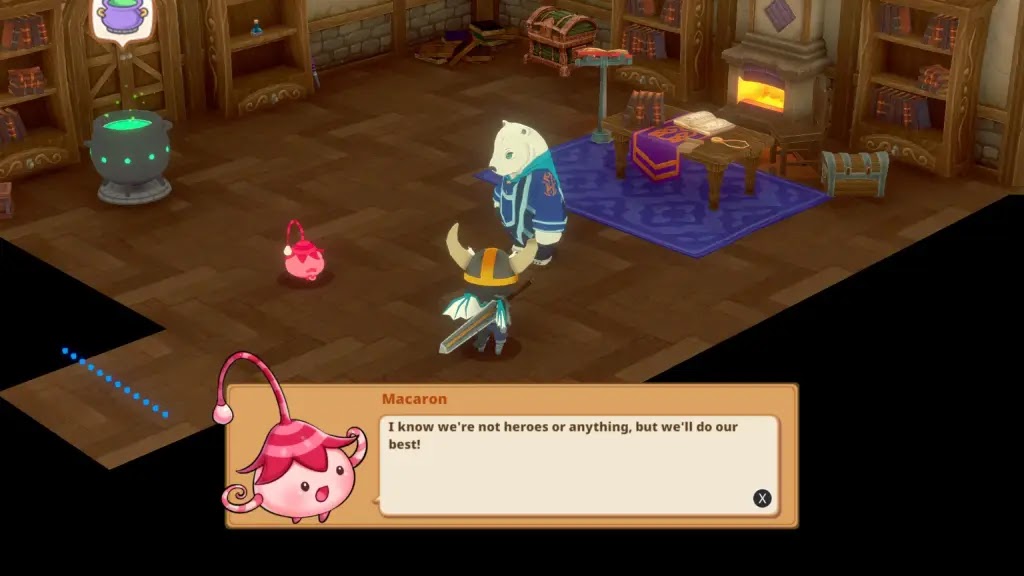
Kitaria Fables by Twin Hearts and PQube is an easy going and adorable action adventure RPG that's fun for the whole family. Sent to a remote village from the Capital in order to protect it from monsters, it doesn't take long for our protagonist Nyanza and their companion Macaron to be drawn into a seperate adventure all while performing their original duties as soldiers to the kingdom.

Channeling a bit of XSEED and Marvellous' Rune Factory (4), Kitaria Fables is a toned down version of their action adventure farming simulator creating a low and easy entry point for anyone interested. With bits of exploration, combat of some special monsters and a bit of farming, the adventure may take a dozen hours depending on how fast you move from main plot point to plot point but there's still enough to do on the side if you want to take your time.

Perhaps the one thing that I really appreciated about Kitaria Fables is that while there is a bit of a lengthy intro, it's not overly hand holding in order to teach you the ropes. In a few ways, it explains what it needs to do but it doesn't feel like it assumes that you've never played a game before. So starting off on the day that our heroes show up in town, you'll soon get a bit of the lay of the land with your first quest to defeat some monsters in order to protect the townspeople.

Split up into several areas that are all interconnected by passageways, moving around is easy enough as you simply need to run in the direction you want or do the Legend of Zelda rolling in order to move faster. Regardless of how you move around though, in almost all of these areas there will also be monsters that do not care if you are there unless you attack them first or they'll aim to attack you on sight. It really doesn't take long to figure which ones are which allowing you to easily figure out how to move through each area.

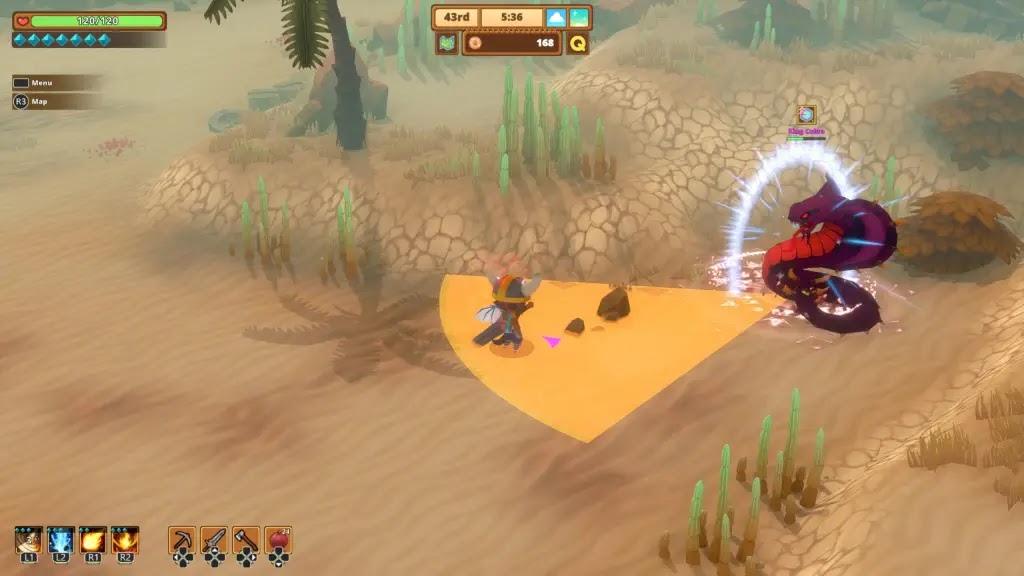
Now one reason that Kitaria Fables is fun for the whole family is that it has a low entry point when it comes to combat. There's no experience grinding in order to get more powerful, instead, you just need to craft new gear found from the various monsters across the land. For the monsters that can be found across the land, whether they be normal or more powerful types granting PSN trophies, they all follow a displayed choreograph of how they are going to attack, and the range of which their attack will be spread out over. This means that at any time you know exactly where to move and where to dodge as there is always time to move out of the way. It felt a bit too easy in the beginning but as you add in numerous enemies, it helps keep things easy.

Aside from all of the adventuring, our protagonist has, like in all good farming simulators, inherited the farm from one of their grandparents. In better shape than most, the fields are already ready to be tended with only a few rocks and tree debris to remove from the way if you really want to plant as much as possible off the bat before even upgrading your farming tools. There’s nothing overly complex and it’s an easy way to make money as you can always sell the final products for much more than you paid for the seeds, but it would have been nice to have a bit to work towards instead of having been given the whole field at the very beginning with nothing to work towards. Because of that, the farming aspect felt more like a small add-on for certain side quests and a way to pad your bank account instead of hunting down materials from monsters that can easily sell for a pretty penny.

Now if there’s one thing that didn’t quite work with this adventure it would be the way in which the checkpoints and portals have been designed as some areas that need to be re-visited often enough had no close points to teleport to. This usually meant that if you were grinding for materials in order to get the Platinum Trophy, every time you needed “one” shell from the turtle boss monster, you had to cross four separate areas each and every time because the closest portal one area away was only to teleport out from and not into. It made this process even over the course of the normal adventure rather repetitive and added nothing to the overall experience.

Summary

Overall though, Kitaria Fables is a fun little adventure which will clock in at about a dozen hours as you explore this cute medieval world. With plenty of side quests in order to help out the local people, several different magic spells to help you out and a giant plot of land to farm on, there’s enough to keep you busy for a little while without the vast time investment that Rune Factory or Harvest Moon would require from you.

Score: 7.75 / 10


Share:

Guilty Gear -Strive- - PS5 Review


Guilty Gear -Strive- by developer and publisher Arc System WorksSony PlayStation 5 review written by Nick with a copy provided by the publisher.

Estimated reading time: 8 minutes


The Guilty Gear series spent years being underappreciated in the fighting community, but I believe Guilty Gear -Strive- is going to completely change that. This release continues the fantastic production values and tight fighting mechanics the series has long been known for, but ups its game with great netcode and broader accessibility than we’ve seen in the past.

Guilty Gear’s humble beginnings saw it as a 2D fighter that was somewhat lost in the genre. It released at a time when fighting games were incredibly common, and many of them adopted a similar anime aesthetic that made it challenging for Guilty Gear to stand out from the pack. Arc System Works developed other fighting games that seemed to draw more attention (such as BlazBlue, which seemed to gain more traction years ago), but Guilty Gear continued to release with notable improvements. Guilty Gear -Strive- seems poised to be the biggest success in the series yet, for multiple reasons.

The timing for this release really couldn’t be better. There’s nothing else really big in the fight genre (outside of the surprise Virtua Fighter release on PS4 for PlayStation Plus users) to muddy the waters. Guilty Gear -Strive- is also available on the PlayStation 5, allowing the fluid animations to really shine on the new platform – which again doesn’t have a ton of titles right now competing for attention. Lastly and most importantly: Guilty Gear -Strive- is just a really damn great game.

We’ll start with the presentation, which is what is most likely to grab eyes and ears right out of the gates. The actual combat is still 2D, but built with fully rendered 3D models. This keeps the combat incredibly smooth (and on the PS5, the fluidity is simply fantastic), with characters cleanly moving from one move into another, flashy collisions and special moves, all set against vibrantly colored and eye-pleasingly animated environments. During certain moments, such as the last move of the fight, the camera spins around giving you a glorious view of the battle’s conclusion in 3D. The Guilty Gear franchise has always had slick visuals, and -Strive- continues that trend. For my money, it’s the best-looking fighting game I’ve ever had the pleasure of playing.

The music is another standout for me. It’s not uncommon for fighting games to have hard-driving musical scores that try to complement the frantic tempo of the combat, but the pacing of the game and the soundtrack here are ramped up to an 11 out of 10. Admittedly, the heavy metal soundtrack, complete with lyrics being yelled in the background, is not likely going to be for everyone – but it suited me perfectly and also fit the vibe of the overall game. The developers boast that the digital soundtrack has over 55 songs, featuring 15 vocal themes and over three dozen background tracks and I believe it. This is an OST I will gladly listen to outside of playing the game.

The combat is the highlight here, however. I mentioned the pacing above, because it is an integral part of what makes Guilty Gear -Strive- tick. Fighting games have a great deal of inherent strategy baked in, but often what separates them is the pacing of the combat. Some games rely more on angles, others focus heavily on counter-attacks and the Guilty Gear series has always tried to push the action. You have some pretty standard attacks – punch, kick, weak and strong slashes. Characters move with different speed, having varying amounts of power to their attacks and create different zones based on their range that provide balance to them. What one character does well allows another character to do something else even better. That’s common in all fighting games, and one of the quibbles someone might raise is that Guilty Gear -Strive- has a somewhat small-ish roster at just over a dozen characters. That being said, the characters are quite unique from one another. Moves might be pulled off in similar fashion in some instances, but their impact and range vary greatly. That being said, I expect the roster to expand through future character / season pass DLC, but it will likely never reach the three dozen or so characters you see in some long-running fighting franchises.

Beyond the characters however, there are systems in place that keep the action driving forward as well. Probably the one that impacts the pace the most is the tension gauge. As a concept, it is not completely unusual: perform actions to build up the bar that allows you to pull off enhanced moves. However, many fighting games differentiate this through how the gauge accumulates. Sometimes it is based on damage taken, but in Guilty Gear -Strive- it is about pressing the action. Moving towards your opponent, landing attacks on your opponent. You can also perform actions in the battle that causes the gauge to fill even more quickly, like breaking an opponent through the wall boundary in the environment.

The other gameplay mechanic that the series is best known for is Roman Cancel. This first debuted in Guilty Gear X. It is a bailing out of your current move by pressing any three attack buttons at once (while having at least half of your tension gauge available). One nice new wrinkle is that the cancel now comes in four different colors / effects. It adds a bit of additional strategy to the mix and is key for setting your opponent up, because they may be planning to counter one of your moves. If you see that starting to happen, Roman Cancel out of it and you can now be the one countering what you opponent had set up. That it’s based around the tension gauge only further incentivizes offensive playstyles.

The Guilty Gear series has never been especially accessible to new players. The mechanics are deep and aggressive. Turtling is seldom a sustainable strategy. Combos are generally not of the ‘mash a button’ variety (though Xrd had a combo system that allowed you to roll through the four different face buttons in a particular sequence). Combos are still doable, but they are strung together in more character-specific ways. That being said, generic attacks feel more damaging than in games past, allowing for a degree of shallower skillset affording a chance of victory. This still does not supplant actual skilled players knowing how to zone and use deeper move sets, but I think Guilty Gear -Strive- may be the most accessible game in the series for some time now.

Like the somewhat smallish roster of fifteen characters, the number of modes might ruffle some feathers as well. Not because any of them are bad – but there are not as many of them as what we find in some series. Games like Tekken often shoehorn in something ‘extra’ like bowling or a 3D brawler, and Mortal Kombat has the puzzle / adventure-like Krypt while Street Fighter has timed attacks and more. That being said, Guilty Gear -Strive- provides plenty to do still. The arcade mode is likely where most of the action will take place, as it can crank out some variant paths for your chosen character and can inject a few surprises into the journey now and again.

The story mode is likely to be the most divisive as it is not a ‘game’ but a mini-movie using the game’s engine. It’s a story – you don’t interact with it at all. It’s not even a visual novel like some of the older BlazBlue spinoffs from years past. It looks and sounds fantastic, and when coupled with the game’s rather large, detailed encyclopedia of terms and characters, provides a pretty solid narrative. Many people use the story mode to learn the basics of fighting games, but you are better off using the combination of training / dojo / missions to learn the broader systems and the skills of specific characters. I am fine with a more coherent, almost movie-quality story mode that doesn’t shoehorn in odd battles that make no sense like say Mortal Kombat.

There is a survival mode, which is exactly what it sounds like as you take on an endless supply of enemies. You can collect and look through artwork and music by spending currency or participating in a rather odd fishing mini-game that links to the online lobbies. This is one of the areas that struck me as really interesting. The netcode supports the experience well so far, which is a huge help. But essentially, you create a sort of 8-bit pixelated avatar that roams about either a ranked tower or wide open park area. In the tower, you will move up and down based on your performances, doing its part to match you against similar skilled opponents. There are various things you can interact with outside of your fellow players, such as clothing rooms, replays of prior matches and the aforementioned fishing game. This mode feels like it could be expanded upon in the future as well, but it is pretty well-constructed.

Summary

One could perhaps fault the roster size or number of modes Guilty Gear -Strive- brings to the table, but this is a case of quality over quantity and to that end the title excels. As a long-standing fan of fighting games, I can confidently say that Guilty Gear -Strive- is my current favorite in the genre. The presentation is excellent all of the way around, the characters are nicely varied, the combat is fluid and most of all it is just a great deal of fun to play.

Score: 9 / 10


Share:

Neptunia: ReVerse - PS5 Review


Neptunia: ReVerse
by developers Compile Heart, Felistella and developer / publisher Idea Factory InternationalSony PlayStation 5 review written by Pierre-Yves with a copy provided by the publisher.

Estimated reading time: 7 minutes


If there's one series that will continually keep me coming back for more it's Hyperdemension Vert... Errr sorry, wrong script, Hyperdimension Neptunia! Celebrating its tenth year anniversary, Compile Heart and Idea Factory have brought the CPU Goddess to the latest generation of gaming consoles in Neptunia: ReVerse and while this adventure isn't a new one as it's basically ReBirth:1 (V3), this transition comes with a few neat twists.

Starting off from the very beginning ten years ago, Hyperdimension Neptunia was an obscure Japanese RPG that itself was all about video games and its tropes and I'm still in some ways surprised that it had been localized. Happy as I own every entry of the series, but surprised as one had to wonder if the niche market was enough to make it worth bringing over. Having now seen sequels, ReBirths, and spin-offs, the series is popular enough that fans like me no longer even need to worry about "IF" we are going to get it, but when.

And so starting back over from the very beginning, before the introduction of the CPU candidates, before the introduction of a whole Neptunia-verse, Neptunia: ReVerse stars our "fifth" wall breaking protag as she's defeated by the other three Goddess and sent plummeting down to Gamindustri. Found and nursed back to health by Compa, it won't be long before Neptune joins her other bff IF (Iffy for short) as the three travel to regain Neptune's memories through a series of shenanigans.

Having continuously evolved over time, and in some cases rolled back, ReVerse is no different as while it's retelling a story told a few times over, the engine under the hood makes things both look and run smooth. Load times, graphics, combat, if there was one thing that I would have a complaint about is that the pre-movie renders looked dated and I have to wonder if that's because they were originally brought over from the PS Vita (before the PS4 port) which uses a much smaller native resolution than the main consoles outputting full 1080p and 4k. Otherwise everything else looks and sounds great.

Coming back time and time again, there's an appreciation for the style of gameplay that the Hyperdimension, Megadimension, Hyperdevotion, MegaTagmension, Superdimension and Cyberdimension all have in common. It’s the balance between a fairly hardcore Dungeon Crawling experience that often times requires a lot of grinding, and a Visual Novel like a approach to tell the rest of the story. It works and it works well as Compile Heart and Idea Factory have not only done it here, but have also pulled it off in Dragon Star Varnir, Death End re;Quest 1 and re;Quest 2 and the various versions of Fairy Fencer F.

These narrative segments are a combination of pure written dialog and loads of voiced over segments for when things are either really important or the punchline was too much to pass up on. From the protagonist Neptune and her closest friends Compa and IF to the various supporting cast and the other Goddesses, there’s more than enough dialog to go around to the point that sometimes the self-awareness drops in as Neptune herself calls out the walls of text or tries to avoid them to get things moving. It’s brilliant, it’s fun, and it adds something more to the sheer amount of time that you may be, or want to be spending, travelling through the various dungeons in their default format for quests, experience and items before using the Plan System to change things up. New enemies, new items, more powerful enemies, each of these will help you move forward in the story.

This is perhaps the one aspect that I forgot about over time while having gone back through the ReBirths on my Vita as well as the remakes and revamps of Megadimension Neptunia VII. The bosses are HARD. I don’t just mean, alright, sprinkle a little more experience and gain a level and come back. I seriously mean that they are brutal and unless you’ve either gone about and ground for some serious level experience or gone farming for items to unlock new equipment that you wouldn’t have access to otherwise? You. Are. Toast. Not just toast, but fully charcoaled and entirely non-edible Toast.

Thankfully there are some ways around this that won’t take too much time mindlessly grinding away experience but will instead be a bit more fun. In the mindless category there are some dungeons that open up or can be opened up which will help on this but the other is brand new to ReVerse and that is the universally loved to have as a minigame, Fishing! I honestly don’t know what it is about fishing as in real life. While I may have done it while I was younger with one of my grandmothers, as an adult I simply do not have the patience for it. Put it into a video game though and I’m all in.

Taking up a fishing line and heading to one of the local fishing holes, Neptune can cast a line and hope for the best once the bait at the end of the line touches the water. The process is fairly quick as there’s no need to play with the line or worry about whether or not something will bite, it will. What you need to worry about is the fish’s stamina versus that of Neptune. Drain the fish’s stamina and Neptune will catch anything from new gear to various local fish. Fail? It’s not as simple as losing out on bait but Neptune and the rest of the party will be attacked by some fairly tough monsters that are basically boss grade for that part of the game. This is where grinding is made easy as you can either fish to catch stuff or fail on purpose and basically go through a boss gauntlet and not have to worry about how long it takes them to respawn.

Making things even easier on that front is the ability to simply skip through all of the attacks and just see the health bars decrease and damage numbers fly across the screen. There’s nothing wrong with seeing how the combinations of attacks all get put together but after a while, you’ll want to start skipping everything to simply get to what it is that you need to such as getting that low rate item drop or defeating a variety of Shampurus from Mugen Souls that have somehow made it into a dungeon within Planeptune.

Finally also along for the ride are some additions that come over time such as the additions of some characters like Plutia and Peashy from Neptunia Victory and then Uzume from Neptunia VII which are available very early on to be added into your party. This alone helped with the grinding and potential boss fights as these three alone were also Goddesses in their own Gamindustris. Add in that Neptune gets her Goddess form back early enough in the adventure and having four Goddesses to face off against tougher foes makes for a much easier time accumulating experience.

Summary

So overall, while I personally would have enjoyed a brand new Neptunia title for the launch of the Goddess shenanigans on the PlayStation 5, Neptunia: ReVerse is a good place to start for those that would actually have no idea of the series. What better way to start off than the beginning? For returning fans though, I would say that if you’ve been wanting to return back to the beginning as it’s been several years Neptunia: ReVerse is worth it especially on a much larger screen and some added bonuses to get the adventure started off faster with some help from the other Neptunia-verse Goddess.

Score: 8.5 / 10


Share:

Resident Evil Village - PS5 Review


Resident Evil Village
by developer Capcom and publisher Capcom USASony PlayStation 5 review written by Pierre-Yves with a copy provided by the publisher.

Estimated reading time: 7 minutes


Following the path set up before it with Capcom's Resident Evil 7: Biohazard, Resident Evil Village, aka Resident Evil 8, returns to Ethan Winters' misadventures through a world filled with mutated horrors. Having moved from the United States to a remote European location, it doesn't take long for life to go sideways and once again pick up a gun in order to attempt to save those that he loves.

While I appreciate what RE7 had done by going to a first person view and adding to the horror elements, Village takes those aspects and blends them with elements reminiscent of RE 4-5-6. There's action, there's horror, there's puzzle solving, and there's metroidvania-ness written all over it with some over the top boss fights that you always have to wonder if you have enough ammo to plow through it. Further upping the ante is the change in location as unlike the wet and humid climate of Louisiana's Bayou, this cold Northern European climate will have a whole new set of challenges including a giant castle filled with Vampires.

Now in a sign of good design, once I loaded everything up I had a really hard time putting it down. While maybe not the longest title once you get your final total on a clear data save where I clocked in right under nine hours, this was more a twenty hour adventure but even then it never felt like it. The adventure as a whole like RE7 is in one location that opens up as you push forwards but there's always something a little new in the places already visited once you come back. New weapons, treasures, and even new enemies at times.

The reason that this is more a twenty hour adventure instead of a nine hour one is because of all the trial and errors of what works or what doesn't. Spent too much ammo? Could always reload to the previous save or auto save to try something else. Died? You won't have the choice but to do the same thing. It adds up but it's a part of the adventure. As for the pacing though, when you're in a segment it can feel proper as you're constantly moving forwards and looking for the way out or the way to the boss. Outside these moments some could find it slow and disjointed if they don't like looking for collectibles and loot but for me? I wanted to stick up and found these moments of reprieve something to look forward to.

One thing that I really appreciated with that overall design is that unlike its predecessor and a lot of other more recent titles out there, it doesn't overstay its welcome. It starts, it tells its story in four parts, it ends. The other thing that I appreciated with its design is that unlike RE7 taking place on a family’s estate, Village takes place in an actual Village containing several other surrounding areas such as a gothic castle, a manufacturing factory, a dam and a creepy ass house up on a secluded hill that often had me wanting to “nope” right out of there. Each of these environments both feel different and offer a different set of challenges in order to make your way through it.

To help making your way through these locations is the return of an actual merchant known as the Duke. The Duke will buy, sell, and even cook you food for permanent upgrades to your health and your defense if you bring him some of the local livestock such as chickens, pigs and fish if you dive into the water to catch them. Most weapons will be stuff that you find between the various locations but the Duke will have access to some upgrades to these weapons as well as a way to increase your inventory space if you feel like you’re starting to run short, or, if you have multiple types of pistols and shotguns, well, sell a few off and you can always buy them back later if you need to.

The real interesting part of the implementation of the Duke is that with the already enlarged inventory space, a safebox has been removed from the equation. If it doesn’t fit, you’ll need to get rid of it or save up a bit of cash to buy one of those expansions. I honestly didn’t realize it until halfway through which is when I realized, if done well, you don’t need the safebox at all. The way around this is that key items, keys, cards, cranks, wheels to turn wells, all of these aren’t part of your default inventory but instead are under another tab never having to make you worry about trying to figure out what you do or do not need on hand. After having come straight in from RE7, this was fantastic.

Perhaps one of the two biggest issues that I had with Resident Evil Village are the same that I had with Resident Evil 7. This issue is that unlike the rest of the series' recurring protagonists of Chris, Jill, Claire and Leon, Ethan gets lost with the rest of the powerful personalities on the stage from both returning voices and the new ones presented with the crew acting as the title’s antagonists. A good first person design will work around this with the dialog and perhaps banter, but Ethan both doesn't really say that much and when he actually does, it’s almost campy and out of place belonging more in an actual B-Horror setting. Ethan for lack of a better everything is your vessel into this world without a personality and the overall experience suffers from this especially with the appearance of series veteran Chris Redfield.

I did until nearly the end of the game have a second issue, however, to get into that would not only be potentially a game breaking spoiler, but it would also spoil a fair amount of Resident Evil 7: Biohazard. That said, this issue was solved with some key information if you get far enough into the title.

Finally, once you’ve made it to the end, watched the credits, and saved your data, you are given points for having completed objectives over the course of the adventure. These points can be used to buy new weapons, unlock infinite ammo, unlock figures and concept art, and finally, unlock the Mercenaries Mode. Mercenaries was… interesting. Take the scary out of the equation and basically throw Ethan into a Resident Evil 6 Chris Redfield like scenario which is all about the running and gunning down of enemies in a certain amount of time. The faster you do it and the better your score. The closer that you take enemies out one after another, the higher your combos and thus the higher your score. It’s a neat little addition to the overall, but it may not be enough to keep people around for long as it really is a single player affair.

Summary

Overall though, Resident Evil Village is a fantastic entry into the realm of Resident Evil. It continues the storyline, it causes more questions than it answers, it allows for future entries to pick up from both the pre and post credits, and it was fun. Do I wish that Ethan Winters had more personality like our once again returning Chris Redfield? Yes. Was it enough to take me away from the gorgeous mountain views and the terrifying creepy haunted mansion on a hill? No, it sadly wasn’t and I really never want to see that house again!

Score: 8.5 / 10


Share:

Random posts

Our Streamers

Susan "Jagtress" N.


S.M. Carrière

Aldren


Affiliates

JenEricDesigns – Coffee that ships to the US and Canada

JenEricDesigns – Coffee that ships to the US and Canada
Light, Medium and Dark Roast Coffee available.

Blog Archive

Labels