• Isle of Reveries - PC Review

    Isle of Reveries is a top down 2D action adventure game that made my nostalgia for old school Zelda games flare up really hard. A good blending of puzzle, exploration, and combat, Isle of Reveries is a wonderful title to experience inside and out.

  • EA Sports Madden NFL 27 - PS5 Review

    It’s that time of the year again – where I revisit what’s arguably my favorite video game franchise. EA Sports Madden NFL 27 returns to the field with its latest batch of changes, some minor and others more notable.

  • Midnight Moments - PC Steam Review

    Midnight Moments is a cozy cyberpunk diorama-building game that is stunning. Unlike games that require you to complete quests or take out assailants or even solve challenging puzzles, this one only requires one thing: imagination.

  • Din's Champion - PC Review

    Are you interested in 2D survival crafting games like Terraria but want something a little grittier and more in-depth? Well then, I might have a game for you! Din’s Champion is an interesting title that could best me summed up as some sort of chimeric cross between Terraria and Diablo.

  • Outbound - PC Review

    Let me tell you about this cozy game my daughter and I are playing together called Outbound. Now, I've been following this game from the initial Kickstarter back in April 2025 to its full release in May 2026. The best Mother's Day gift for myself and my first ever collector's edition in a physical copy!

  • OVER REQUIEMZ - Nintendo Switch Review

    In OVER REQUIEMZ Yuhiru is thrown into the castle of Oz and is immediately accused of trying to assassinate the King and shoved into the dungeon. Not only is she treated like a criminal...

  • Dread Delusion - Xbox Series X|S Review

    Today we’re looking at what has rapidly become an absolute favorite in the open-world RPG genre for me. An interesting story, memorable NPCs, stunning visuals, and a setting absolutely dripping with flavor, Dread Delusion sets its tone immediately and sticks with it.

  • HOT WHEELS Infinite Rush - PS5 Review

    ...Now Milestone, the original developer of the two Hot Wheels Unleashed games, is back, and I was hoping it would be as fun as the last two Hot Wheels games they made...

  • Asdivine Knot - PS5 Review

    Asdivine Knot is the latest title in the Kemco JRPG library. Following protagonist Verselio, who's on the run from the church that they once served, he'll be accompanied by an odd selection of party members as they all find a reason to band together…

  • STEINS;GATE RE:BOOT - PC Review

    Our story begins in Akihabra, Tokyo Japan. The protagonist Okarin… Or rather Rintaro Okabe, (Voiced by Mamoru Minyano) is a recent high school graduate who rents an apartment with his best friend and resident computer hacker, Itaru ‘Daru’ Hashida (Voiced by Tomokazu Seki) during the summer of 2010.

Showing posts sorted by relevance for query Atelier. Sort by date Show all posts

Atelier Mysterious Trilogy Deluxe Pack - PS4 Review


Atelier Mysterious Trilogy Deluxe Pack
by developer Gust and publisher Koei Tecmo AmericaSony PlayStation 4 review written by Richard with a copy provided by the publisher.

Estimated reading time: 1 minute


Having recently released and then having gone through the entire trilogy with one Platinumed Atelier Sophie DX and two more to come shortly, here's a recap of Richard's PlayStation 4 Reviews of the Atelier Mysterious Trilogy Deluxe Pack and each review's scores!

Atelier Sophie: The Alchemist of the Mysterious Book DX – PS4 Review

The Atelier series of games has always been a personal favorite of mine. Dating back all the way to 1997 on the PS1, albeit Japanese only release, the Atelier series has held a rather unique approach to a crafting/combat RPG. The games in the Atelier series are generally grouped in sets of three, and will have a connected theme and style. Originally released in 2015, now rereleasing as a “DX” version, we have...


Atelier Firis: The Alchemist and The Mysterious Journey DX – PS4 Review

Fresh off the platinum from Atelier Sophie DX, we are now moving into the second game in the “Mysterious Trilogy”, Atelier Firis: The Alchemist and the Mysterious Journey DX. Also like Sophie, I am only a few trophies off the platinum for Firis. As a direct sequel to Atelier Sophie, you don't need to actually know anything about Atelier Sophie to play Firis, although it does help. With some changes made, both positive...


Atelier Lydie and Suelle: The Alchemists and the Mysterious Paintings DX – PS4 Review

Here we are again, with the third and final installment in the “Mysterious” Atelier trilogy: Atelier Lydie and Suelle: The Alchemists and the Mysterious Paintings DX. With a pair of new alchemist main characters, the twins Lydie and Suelle, as well as a large cast of returning characters, and some you may recognize from elsewhere, we get to...


This concludes our three reviews for both Gust and Koei Tecmo Games' Atelier Mysterious Trilogy Deluxe Pack for the PS4.

Score for Atelier Sophie DX: 8.5 / 10,

Score for Atelier Firis DX: 8.5 / 10,

Score for Atelier Lydie and Suelle DX: 8 / 10,

Total Score: 8.25 / 10


Share:

Atelier Shallie: Alchemists of the Dusk Sea - PS3 Review

The Atelier series is one that we hear at Chalgyr's Game Room really enjoy. We have been covering the numerous Atelier games for years now and it is one of the most unique and interesting JRPG franchises that we have seen in a long time. Focusing primarily on grinding and crafting, with solid story lines, lovable characters, and a unique twist on the genre, the Atelier series has always tried to be a bit different. With Atelier Shallie: Alchemist of the Dusk Sea they are trying to not only refine the franchise's existing staples, but to bring some of the more standard features of the JRPG genre to the series for the first time. How does Shallie pan out? Read on for more details.


Share:

Atelier Sophie: The Alchemist of the Mysterious Book - PS4 Review


The Atelier games have long been a favorite here. An interesting twist on the more traditional JRPG genre, the Atelier games are about being an alchemist, brewing concoctions, and generally saving the world/solving some big problems/learning alchemy/maintaining an atelier. After a length weight, Atelier Sophie: Alchemist of the Mysterious Book is finally here and is Gusts' first Atelier title built for the PlayStation 4. Does the Atelier series transition well to a next-gen console? Pretty darned well.

Share:

Atelier Rorona Plus: The Alchemist of Arland - PS3 Review

The Atelier games have been around since the late 90's though they have not received much notice outside the JRPG fan base, which is tragic as the games are quite enjoyable. My first encounter with the Atelier games was either Atelier Iris: Eternal Mana or Mana Khemia: Alchemists of Al-Revis, both for the PlayStation 2 (I had picked them up at the same time and played them simultaneously) and I thoroughly enjoyed the break from the traditional JRPG style. When the opportunity to review the recent re-release of Atelier Rorona (the Plus variant) with an updated battle system amongst other items like a bonus stamp card, a handful of new costumes, as well as some reworked special attack scenes, I jumped on it. Does the Atelier Rorona Plus: The Alchemist of Arland re-release build on the already-excellent Atelier Rorona? Read on to find out.


Share:

Memorable Music in Gaming - March Genre - JRPG


Nick: Final Fantasy X - Nobuo Uematsu, along with Masashi Hamauzu and Junya Nakano

 
Let’s be real – Nobuo Uematsu is best known for his contributions to the legendary Final Fantasy series after joining Square back in 1986. That being said, Nobuo has dozens of credits to his name. It is, however, his collaboration with Junya Nakano and Masashi Hamauzu that created arguably my favorite video game soundtrack of all time, Final Fantasy X.

For me, Final Fantasy X is special. It is my favorite game in the long-running series, and I’ve been playing Final Fantasy titles since the first one released on the NES a million years ago. The music in this series has always been spectacular, but the visuals, story, characters and combat that the series has always been known for were introduced to voice acting for the first time and it all came together beautifully. I borrowed a buddy’s PS2 and this game when he went on vacation for a week. I was working a lot of hours back then, I didn’t have time to complete the game, but I enjoyed it so much that a couple of months later my dad, my wife and her aunt got together and gifted me a PlayStation 2 for Christmas – along with my own copy of Final Fantasy X.

The soundtrack ranges from the blistering heavy metal sounds of Otherworld heard in the game’s opening cinematics to the soulful piano playing of Zanarkand we get at the beginning. Some of the music is simply ambient and beautiful such as the subtle softness of Hum of the Fayth as your characters walk around different temples.

I loved the music from this game so much that I went out and bought the vinyl record albums for it. Each side of the two-record set has different beautiful artwork on it. It’s one of the favorites in my record collection. It was also the basis for our site’s second Memorable Music in Gaming article back when I wrote about it in 2014.

With over a dozen songs in the soundtrack, there is a great deal of music to be had in Final Fantasy X. As someone who was very invested in the characters and stories, I still recall many of the game’s more poignant scenes. It was a story of adventure, companionship, happiness and heartbreak and it was beautifully encapsulated in Final Fantasy X.

~~~

Richard - The Atelier collective (Iris, Sophie, Mana Khemia, etc.)

You know, this was a really tough decision for me. I have tons of games where the music has really impacted me from a very large slew of different titles. While I was waffling about what game, or series, to choose, I decided to land on the series I’ve been playing for quite a while and probably has the largest number of tracks stuck in my head: the Atelier series.

Now while the more recent titles such as Atelier Sophie 2 and Atelier Yumia might have more recognition, I started back with Atelier Iris, which I believe was the 6th title in the Atelier series, and we’re up to 24 or so now, not including side series. Straight from the get go the Atelier and Gust games have done a wonderful job in the music department. There have been many amazing tracks over the years, and it all started for me from the opening sequence of Atelier Iris: Eternal Mana. From tracks such as the first town theme in Atelier Iris, Danger Zone from Atelier Iris 2, Tunes of Distant Time from Atelier Iris 3, A Rusted Neigh, Nefertiti, Crystallized all from Mana Khemia, and Beyond Wisdom from Atelier Firis are all some of my more memorable tracks. Of course we can’t forget Sad Vampire either, a track that’s gotten a number of remixes or remasters over the years, and for good reason.


The Atelier series always holds a special place in my heart, whether it be the nice combination of synthesizing paired with the combat segments, creating and outfitting your characters with what you actually make, or the engaging storytelling. That’s all well and good, but a game can really pop when paired with the right music, and considering I’m still occasionally humming some of these tracks 20 years later, I’d say they were pretty dang memorable.

The Atelier series has seen a few composers over the years, including: Daisuke Achiwa, Kazuki Yanagawa, Ken Nakagawa, Tatsuya Yano, Toshiharu Yamanishi, and Hayato Asano. Some of these composers have worked on other titles, such as Ar Nosurge or Knights of Azure as well, and they certainly aren’t slacking there either.

Ultimately we aren’t here for best game or even technically best music, although I would rate the Atelier series in general quite highly in both categories. What we are here for is “Memorable Music”, and there are a lot of Atelier tracks that absolutely refuse to remove themselves from the cavity that is my brain. If the gameplay doesn’t do it for you, at least the music should be good to listen to!

~~~


PY: The Falcom Sound Team JDK - The Legend of Heroes: Trails of Cold Steel (sub-series)

Here I find myself once again gushing praise for perhaps one of my favorite music groups in Japanese RPGs, The Falcom Sound Team JDK.

Responsible for a variety of epic tracks over the last few decades, there's one series that I've continued to have on repeat. The Legend of Heroes: Trails of Cold Steel. The versatility in their approach is one not often seen, and there's a range here that simply continues to surpass my expectations and Atrocious Raid is a prime example.

Original from Trails of Cold Steel
https://youtu.be/YbXAqwxwamE?si=_qBbXNBurP4RCWBg

Super arranged version
https://youtu.be/9JA_4eC4hQ0?si=BvW7N1S64kMFVllO

Remastered for Trails of Cold Steel IV
https://youtu.be/Xo1yMHutXQM?si=FYZ8Hib8QjVVAWyd

Each version builds on one another and while the sound team are epic, the design team knew what they were doing when they expertly placed them within each title. It's the combination of the visuals, the story, and then the range of music.

But they don't just stop there! The sound team is also not afraid to blend genres like synth and orchestra for epic tracks like the other Trails of Cold Steel IV banger To the Future,

https://youtu.be/Hxn65baVPTc?si=oSgd8rNoDZ7mQHeQ

Which plays long after the first upbeat synth track of Synchronicity #23

https://youtu.be/YDHsx5nXE9M?si=Wmz8zrD8G-scrLvv

And that doesn't even begin to cover what they've done with the rest of the Legend of Heroes series or the Ys Series. The best part of it all? They freely drop their tracks on both YouTube and Spotify for everyone to enjoy.


~/~/~
Share:

Atelier Ayesha Plus: The Alchemist of Dusk - PS Vita Review

The Atelier series of games have long been a favorite here at Chalgyr's Game Room. While it still fits within the JRPG realm of games, the Atelier series is something a little more and something quite different. The primary focus of the majority of the Atelier games is actually running / managing an alchemy shop with reagent grinding taking place between orders for potions. A welcome and unique twist, one that sets the Atelier series apart from other roleplaying games. Atelier Ayesha was originally released for the PlayStation 3 back in March of 2013 and is now ported to the PlayStation Vita. While previous Atelier games took place in rich and vibrant worlds, Atelier Ayesha Plus takes place in the Dusk World which is on the brink of ruin. Does the recent port of Atelier Ayesha Plus: The Alchemist of Dusk translate well on the oft-underrated yet extremely awesome PlayStation Vita?


Share:

Koei Tecmo unveils new systems for the upcoming Atelier game


There is really no getting around it - there are several of us who are positively enchanted with the various Atelier games, and the next one in the series looks to keep us under its spell. We have here some systems that will be in place and some pre-order information as well.

Share:

Atelier Sophie: The Alchemist of the Mysterious Book announced


We love the Atelier games around here, so seeing the series break onto PlayStation 4 made several of us smile today.

Share:

Atelier Shallie Plus: Alchemists of the Dusk Sea announced


We enjoyed our time with this game when it first released and now Koei Tecmo has some news for us on the mobile front as well.

Share:

Atelier Sophie 2: The Alchemist and the Mysterious Dream - PS4 Review


Atelier Sophie 2: The Alchemist and the Mysterious Dream by developer Gust, Koei Tecmo and publisher Koei Tecmo AmericaSony PlayStation 4 review written by Richard with a copy provided by the publisher.

Estimated reading time: 10 minutes 


Alchemy, dreams, monsters, material farming! That's right, it's time for another Atelier series title! This time we're looking at a direct sequel to Atelier Sophie: The Alchemist of the Mysterious Book. Graduating from mysterious books, we are now graved with Atelier Sophie 2: The Alchemist and the Mysterious Dream.

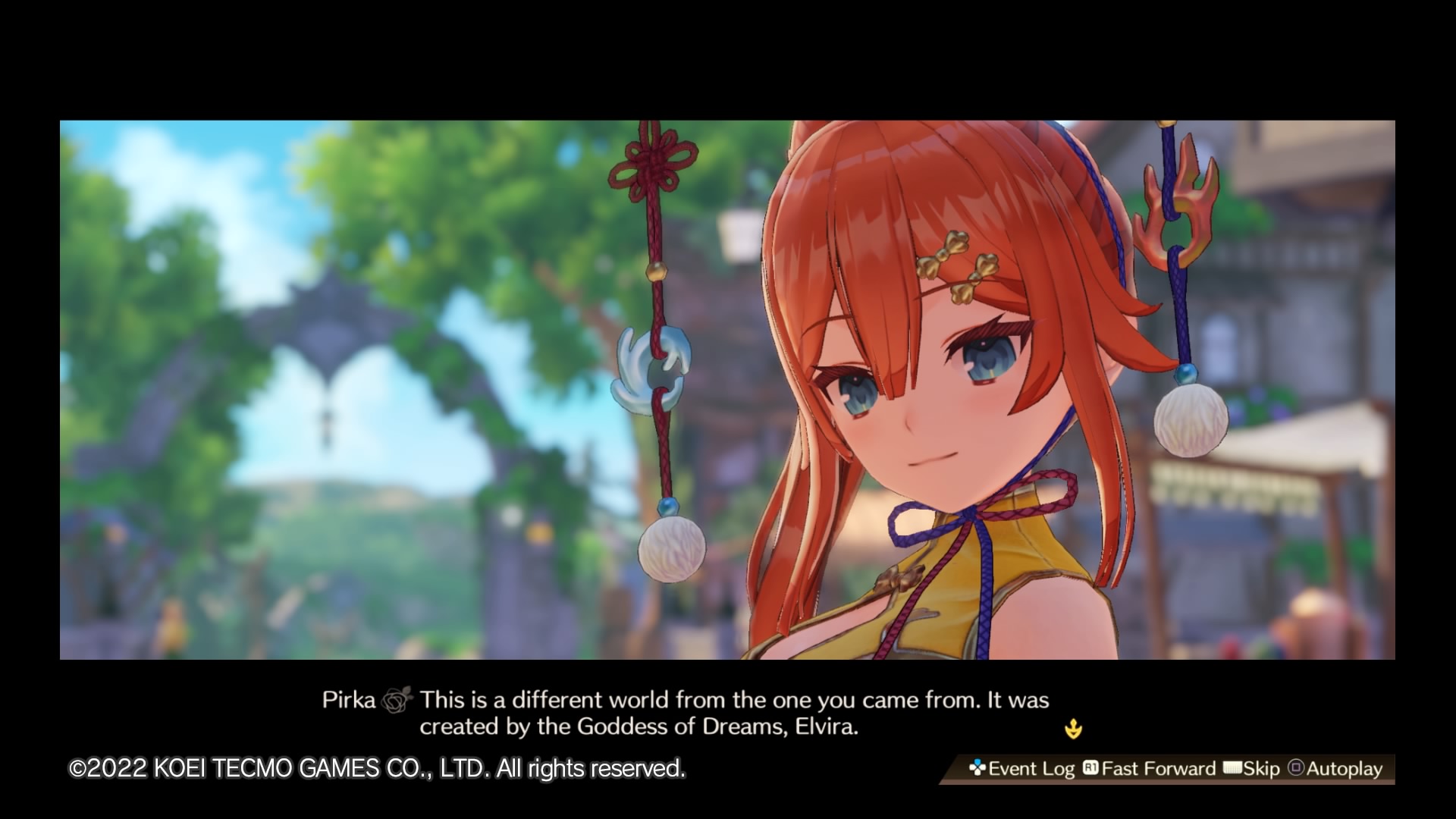
Atelier Sophie 2 takes place directly after Atelier Sophie, and while you don't technically need to have played Atelier Sophie, it will give you some appreciation for some of the characters in the sequel, although there is a "previous game summary" available. Following in the footsteps of her grandmother, Sophie and her alchemy mentor Plachta begin travelling in order to take an alchemist certification exam. Along the way, Plachta is drawn to a large tree, where a vortex appears and draws both Plachta and Sophie in. Upon awakening, Sophie finds herself in a strange town with Plachta nowhere in sight. After talking with the residents that discovered her, Sophie is told that she is a new world, one created based on dreams. All the residents have been called by Elvira, the goddess presiding over the world, in order to fulfill their dreams. Unfortunately, the way Sophie and Plachta arrived was a little bit different from usual.

Sophie, unable to find Plachta, decides to find a way to talk to Elvira, in order to get back Plachta and to leave the world of dreams. Obviously this isn't going to be the easiest of tasks, as Elvira hasn't been seen in a while, and all of Sophie's gear and materials were lost in the vortex that brought her here. So it falls to Sophie and the new friends she makes to go collect materials in order to use her alchemy to find a way of contacting Elvira.

Since Sophie 2 is a direct sequel, I'm assuming you've at least played an atelier title before, but I'll be treating it largely as if you haven't. Atelier titles can be roughly split into two components: the alchemy and the field exploration/combat. Pretty much every Atelier title has these components, and leans either more in favour of combat or alchemy most of the time. Atelier Sophie, and Sophie 2 by extension, tend to take a more middle ground where both aspects are equally highlighted.

First thing you're going too have to learn in Sophie 2 is how to collect alchemy materials. Materials can be found pretty much everywhere: from townsfolk, in the fields, from monsters, purchased in shops, or even just lying around. If you can harvest from a spot, it will sparkle. Some gathering spots may require specific tools however, such as fishing rods or pickaxes. These can be created through alchemy as the story progresses and you unlock their recipes. There will also be major gathering areas where you can play a minigame based on gathering type in order to improve the materials you're harvesting. It should be noted that while out in a field you can only carry so many items until your basket gets full. Thankfully this limit is pretty large, but with the amount of materials you get, it's still a good idea to pay attention to how full your basket is.

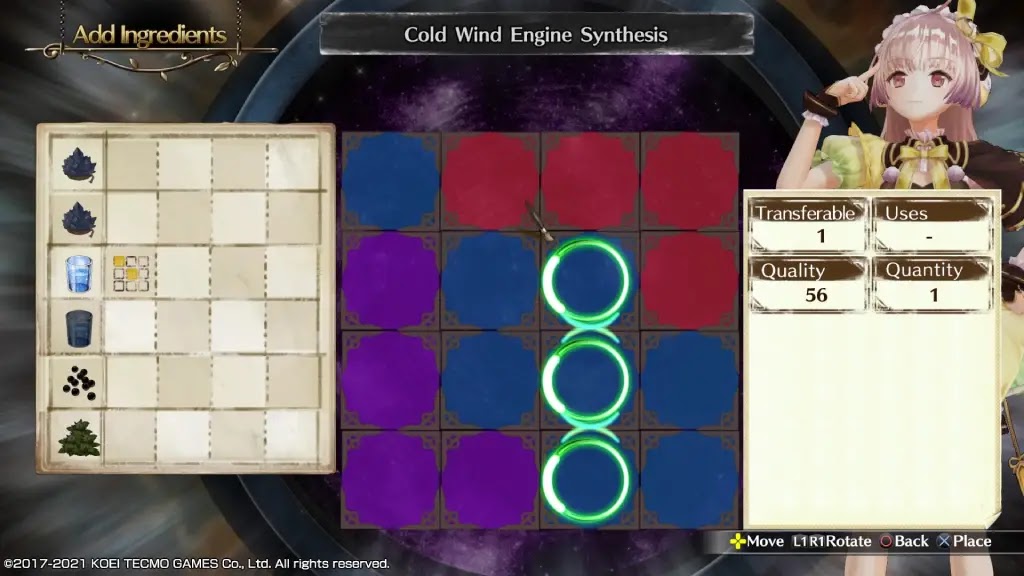
Now that you've picked up some materials, it's time to do some alchemy. Once you're set up in an atelier, you can head on over to your alchemy cauldron in order to start making things. You may then select an item from a recipe you've learned (either through story progression or meeting the recipe requirements on the idea tree) and start selecting your ingredients. There are a lot of considerations when selecting a material to use, so I'll keep away from the advanced considerations and go with the basics for now. Probably your major concerns if you're a new Atelier player will be quality and your colour components. Quality is pretty self explanatory: the higher the better. For equipment this means it provides better stats. For items it will improve effectiveness.

Colour components are a little trickier, and may be a little confusing or frustrating if it's your first time seeing them. Each material has a number of little coloured blocks in a set shape that you will place on a board. Overlapping shapes will remove the full shape under it. The total number of coloured tiles will fill up "gauges" associated to a skill or effect tied to those colours. At certain benchmarks in those gauges are points where the skill or effect evolves.

Let's take a "bomb" for example. The red color tiles, or fire element tiles, will give points towards "fire damage" on the bomb. This can go from "medium" to "large" if you get enough points in fire colors, for example. After you've managed to fill in the board to your liking, you don't need to use every color component if you don't want to, you will then get a chance at a Super Success. Basically you play Bingo while laying your components, and rows and columns that are fully filled provide a boost to the Super Success chance. A Super Success will increase the final quality of your item by a decent amount.

Something interesting about Sophie 2 is that you have more than just Sophie as an alchemist. This is kind of neat, as certain recipes can only be crafted by certain characters, as well as having their own recipe tree. Additionally, Alchemists have an alchemy level which increases as you perform more synthesis. Will you use Sophie for all you alchemy since she starts at a high level, or will your other alchemist see more use in order to train up their level?

Now that we've learned about alchemy, it's time to go explore the world. What does this mean? Fighting monsters, of course! Fighting is a large component in some of the atelier titles, and Sophie 2 embraces this, although you may not really realize it at first. I'm pleased to say that combat has been constantly evolving in the Atelier titles, and Sophie 2 has a system that feels really smooth and well fleshed out. Combat is turn based, with turn order determined by a units speed stat. On your turn you can attack, use a skill, or use an item, if you have some equipped. Items have a limited number of uses though, so be careful on overusing them, although you can restore uses at the main shop back in town.

Enemies have different weaknesses to exploit, which you will want to in order to build up Twin Action Points. These points can be used either offensively or defensively. During your turn, you can expend a point in order to have to have your current character and a backup party member take action at the same time. A Twin action also reduces MP costs for skills, so can be very beneficial. On an enemy's turn, you can use an action point to have a reserve member replace the current member and block an attack. Be careful though, for enemies also build a gauge and will release a powerful attack when full. In addition to this, enemies can have an aura that blocks attacks and reduce damage. Destroying these auras will weaken and stun the enemies, providing you an opportunity to get a lot of damage in.

I'd like to take a bit of time to tell you about how exploring the field maps has evolved since the days of yore, when there were 2D characters on a 2D background but with 3D movement. Of course we have 3D movement now, but I'd like to bring specially mention to the walking animation, as it matches your pace, and also meshes well on stairs. Seriously, do you have any idea how annoying that is to animate and code? Very. Very annoying. Anyway, I digress. After a certain point in the story you will be able to change the weather at certain pedestals in the area.

This will not only affect the monsters that appear, but may also open up or cut off different routes and affect what materials you can gather. For example, making it rainy will raise water levels, which could make a path across a river if there are objects to use as stepping stones, or create new fishing spots. You may see these blue crystals hanging around, which can be used as quick and convenient fast travel points, regardless of whether you set off from town or are already out in the field. Additionally, you may be able to find landmarks throughout the world. These will get registered on your map, as well as provide ability points.

So what are ability points? Well, as with most JRPGs, you earn exp when fighting and you gain levels. At certain levels you unlock abilities and skills. Ability points are a sort of separate system where you earn points from leveling, finding landmarks, and completing character specific challenges. These ability points can then be used to increase stats or provide quality bonuses to gathered materials, among other things. After using so many points, you unlock a bonus ability for free, which usually starts as upgrading your first skill. It adds bonus incentive for exploring and completing tasks, and I was really happy to have these as sub goals. Of course, there's also the typical request board, where you can go to accept up to ten requests at a time in order to earn money from the townspeople. Perform enough requests, and you may be able to improve your ranking within the guild!

I must say, I really appreciate what Gust/Koei Tecmo has done to improve the animations and graphics. Characters have a really large array of different expressions, eye movement is actually a thing, they periodically blink, and the character animations feel a lot more "real" than they used to back in the day. Characters can even look wet! Seriously, if you're in a rainy area, your character models will actually look like they're soaked, which I found amazing. Furthermore, the sound team was on point, because if you're in a cave your characters voices will actually echo. It's these little things that really set a game apart and let you know the developers heart really went into it.

While I was a little skeptical at first about how they would pull off having Sophie start with an alchemy level of fifty and combat level of twenty, they managed it nicely by including a second alchemist and just bumping enemy levels to start at twenty, which is even justified in-universe, so props for sorting that out. My only real two annoyances comes in the form of "veteran desire" and how recipe unlocking isn't retroactive. In the original Sophie you could duplicate items, although at a cost. Not having this at the very start of the game is understandable, but annoying for someone used to it. In regards to unlocking recipes, sometimes you have the requirement of "create 'X' item". Unfortunately this isn't retroactive, so if you've already made one of the item, too bad do it again. Fortunately materials are relatively easy to come by and the required items aren't usually that tough to make.

Summary

Overall, I have to say I absolutely love how they've evolved, and continue to evolve, the Atelier series. Atelier Sophie was probably my favourite post PS2 Atelier title, and Atelier Sophie 2 doesn't disappointed. With a more refined combat and alchemy system, and interesting weather feature, and improved graphics and character animations, Atelier Sophie 2 : the Alchemist and the Mysterious Dream is a must play in the Atelier series.

Score: 9.5 / 10


Share:

Atelier Lydie and Suelle: The Alchemists and the Mysterious Paintings DX - PS4 Review


Atelier Mysterious Trilogy Deluxe Pack: Atelier Lydie and Suelle: The Alchemists and the Mysterious Paintings DX by developer Gust and publisher Koei Tecmo AmericaSony PlayStation 4 review written by Richard with a copy provided by the publisher.

Estimated reading time: 12 minutes


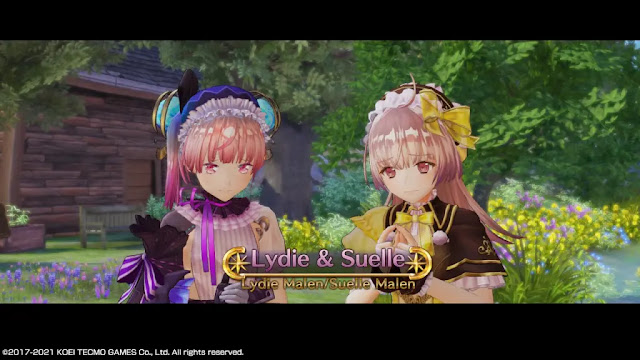
Here we are again, with the third and final installment in the “Mysterious” Atelier trilogy: Atelier Lydie and Suelle: The Alchemists and the Mysterious Paintings DX. With a pair of new alchemist main characters, the twins Lydie and Suelle, as well as a large cast of returning characters, and some you may recognize from elsewhere, we get to delve into the last of the Mysterious DX pack.

Atelier Lydie and Suelle is about the titular main characters, Lydie and Suelle, trying to bring life to their failing atelier, and wallets. Raised by their father after their mother passed away, they've been struggling to make ends meet. Between their not-so-competent alchemist/artist father failing jobs, pushing them off on the twins, or spending all their money on art supplies, and their cousin Lucia who runs a more reputable alchemy atelier, things aren't looking so great. But thanks to the recently announced “atelier ranking system” sponsored by the local royal family, more alchemists are drawn to the city, giving the twins not only a teacher, but also a little financial backing as well.

Atelier Lydie and Suelle takes parts from Atelier Sophie and Atelier Firis and combines them while adding a few unique twists. Both combat and alchemy have been changed from the previous two games in the series, so expect to have to get a little used to things again this time around. The alchemy system has become more refined, and the combat has, well, changed I suppose. In addition, the time limit from Firis has disappeared, meaning you can take your time with things. First up, let's take a look at how game progression works in Lydie and Suelle. Before you can upgrade your atelier ranking, you need to make sure that the townspeople recognize your atelier. To do this, you're given a number of tasks.
These can be pretty much anything, including buying things from shops, beating certain enemies, or collecting certain materials. Once you've completed enough, it doesn't need to be all of them, you will earn three “stars”, which means that you can now take the test to upgrade your atelier ranking. These tests generally involve making an item, or items, and handing in enough of them to pass. Sometimes this may also include defeating monsters. Once you have successfully increased your atelier rank, you gain access to a new mysterious painting that you can explore. Rinse and repeat until you're the best alchemists in the land!

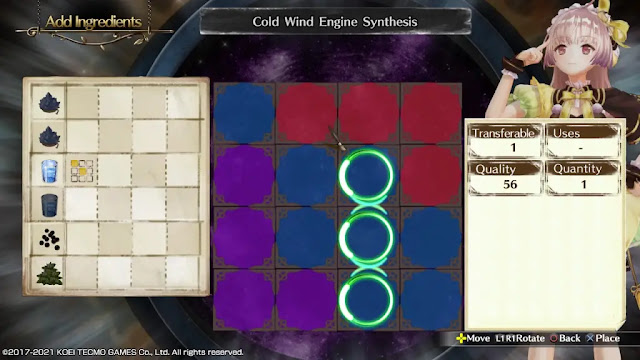
Since the alchemy portion plays such a huge role in the series, let's make it the next item on the list. Alchemy in Lydie and Suelle is pretty similar to Firis, but with a few very noticeable changes. For those who are coming in to Lydie and Suelle without playing the other mysterious titles, alchemy functions by selecting items to throw in a cauldron. These items have different quality levels, as well as traits and different “tile layouts”. After selecting your materials, you place them on a grid and try and fill up colour coded gauges to get certain effects to be produced on the item you're making. Unlike in the previous two games, this time overlapping tiles doesn't completely remove the one you're overlapping, it simply “paints on top of it”, making it a lot easier to not lose large chunks of bonus because you can't fit a small tile on the massive one you needed to place first.

Additionally, items can have multiple tiles associated to them, and you get to place all of them. There are two alchemy techniques you can use to help earn these bonuses on the gauges, one that you can use at the beginning of the alchemy procedure to change the grid you're placing on, which may have bonus points for certain types of gauges, as well as mid-alchemy assistants that can be used to change tile colours. As you perform more synthesis using alchemy, you will earn alchemy exp, allowing you to increase your alchemy level. As you increase alchemy level, you will increase the number of traits that can be transferred from base materials to final products, as well as the base maximum gauge level for the alchemy bonuses.
Now that you've made some items, and hopefully some bombs to take into battle, you can equip those under your harvest equip, as well as any useful equipment for gathering, and head out of your atelier. Exploring the town will have you meet the locals, some you may recognize from Atelier Firis and Sophie, and you can interact with them for special events, visit shops to buy materials and equipment, as well as take requests from the notice board in front of the castle. Once you've paid your neighbours a visit, it's time to set out into the wild! Or at least outside the city walls, or into a mysterious painting.

The areas outside the city walls and inside the painting are pretty similar for the most part. Out here in the wilderness, or inside the painted landscapes you will explore, the sprawling areas are filled with both monsters and materials alike. You can free roam around areas, that may be multiple zones connected through transitions, and pick up as many items as you can carry in your basket. Good news for those coming off Firis, the container has been expanded. While out gathering, you will see glowing spots you can gather from, rocks and crystals and trees you can kick, as well as insect, fishing, and water gathering locations. While the last three require special tools you can make, I am proud to announce the fact that every rock is whackable. For those fresh out of Firis, what I mean is that you have no AP, so you can sit there and kick (as Suelle) or smack (as Lydie) the rocks or crystals until they break, no questions asked. Of course you can use tools to help, but it isn't basically required anymore.

So what about the combat then? Well, as per usual in the Atelier style, combat is turn-based where order is determined by speed, and you have an “order gauge” showing when which character or enemy is making their move. Unlike in both Firis and Sophie, we are down to three party members in a formation. Well, sort of. You have three front line units and three supporters. The supporters can use follow up actions depending on the front line character they are partnered behind, and you can swap between the front or backline on your turn. If a character gets knocked out, the supporter will also come in to replace them.

Other than that, you have a pretty standard Atelier style combat, with: normal attacks, skills, items, defense, change, and flee commands. Items can only be used by certain characters, so make sure you know who can use what before you suddenly are no longer able to throw bombs. Like the other DX titles, you can speed combat up to 2x speed, which is really nice for the longer adventurer level grind. Like in Firis, other characters can protect the twins if they're on the front lines by guarding them, and also enemies have thankfully become a little more balanced. No longer are item spamming strategies basically required like in Firis, although having a number of things to throw certainly helps a lot. After battle you get your money, exp, and hopefully some items, or maybe a chest if you're lucky.

The brand new aspect, and a very interesting draw for Lydie and Suelle, is the function for Battle Mix and Repainting the battlefield. Essentially, after set points in the story you unlock these abilities, and they allow you to synthesize mid battle and tune the battlefield t a mysterious painting effect respectively. Battle mix will take some anima that you earn in paintings, and you can combine it with other items to create new one-off type items mid battle. These can be pretty strong, and are fairly useful as they are incredibly easy to make, at least for the lower tier items. In regards to the repainting, it should be noted that each painting you visit has a passive effect in the background. For instance, a volcano area may cause rocks to fall whenever a fire move is used. Repainting allows you to change the “background” to suit your needs.
Good news everyone, Corneria is back again, and this time she's offering both her services once more! That's right, not only will she refill item uses for a small fee, she will also duplicate certain items for you again! One of the major things that annoyed me from Atelier Firis was having to remake distilled water everytime I needed more. In addition to Corneria's full service coming back, the recipe ideas have returned to the Sophie style, thankfully. All the recipes you can learn will be noted in a book you can find in the main menu, and performing certain actions or gathering set materials will unlock the recipe. After making an item, the unlock conditions for adjacent items will become clear. No more wandering around picking things up with no idea how to actually unlock those thunder bombs anymore. Weapons and armour have a bit of a mix between Firis and Sophie. You make them with the assistance of the local blacksmith, Hagel, a friendly returning face that I haven't seen in far too long. You give him the materials, select the traits you want, and congrats, your gear quality is the material average. Other than the standard crafting, you can also equip two different sub-cores to your weapons that will provide different effects based on the sub cores used.

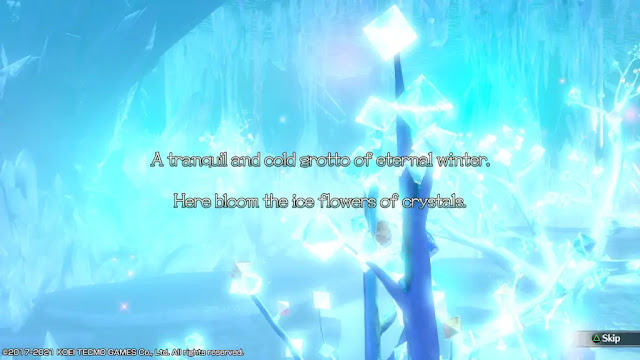
As you may expect from a title focusing on paintings, the art style and scenery really does feel quite improved from Firis' journey. There are many unique and well-painted environments to explore, and with the mysterious paintings, this means you can travel through flower gardens, volcanoes, or frozen mansions and it doesn't feel out of place. There are a bunch of cut-in CGs that are really nice to look at, and probably most important of all: the character animations feel and look a lot smoother, and seem to have much more variation than the previous titles. Also, I'm very pleased to announce that the music, as I've come to love and expect from the Atelier series, is once again really great. If it's one thing I can't stand, it's listening to an awful soundtrack for five hours while trying to grind out rare materials or levels. Thankfully that isn't an issue here. Also as a bit of an aside, I'm pretty sure that the area themes are slightly different depending on whether you have Lydie or Suelle as the on-screen character.

If there's anything to really complain about, it's that I don't know how to feel about all the items included at the start of the DX version. Yes, it's nice having a high quality Dunkelheit with some really good traits, but the amount of times I was tempted to use the gifted items in the early game was a little much. Although based on the boss in chapter 6, there may be a reason for that, good lord that was tough. As a sort of last comment, I'd like to talk a bit about Lydie and Suelle, the characters. While Lydie is a very traditional alchemist (low defence and damage, primarily support and item user), Suelle is very much the opposite. She is a good front line fighter, active, and her battle skills are really handy. She can also chuck a lot of different item types as well. She's also the only main character in the Atelier series to use guns instead of a staff as her weapon. Together I found that it was really easy to draw traits or aspects from one of the twins to complement the other, or to introduce ideas or concepts that may not fit with just one of their character traits.

As my last notes here, I'd like to talk about the mysterious trilogy as a whole. I really enjoyed this trilogy from start to finish. Even as I was getting alchemical burnout from going for the platinum trophy for all three games, it still had enough draw to keep me around without getting exasperated. And considering the end game grind is pretty similar across all three? I'd consider that pretty impressive. The voice acting across the trilogy is a bit all over the board though, as Sophie was great, Firis was disappointing, and Lydie and Suelle had no English option. The characters were all pretty unique and interesting in their own right however, and it was really nice to see so much cohesion between the characters across the trilogy. In terms of what the DX version has to offer? Well, all the DLC if you hadn't picked that up with the initial releases, and a few bonuses and costumes. The real big part though? The run button and increased battle speed. As much as I love the Atelier series as a whole, sometimes the battles can drag on and attack animations can start grating on you the third or fourth time you're attempting a boss. With up to 2x battle speed though? Not an issue. While some of my favourite music from the series has to be from Mana Khemia, the Mysterious trilogy is right up there in second place. Hands down some of the best full OST lists I've heard.

Summary

Overall, I quite enjoyed my time with Atelier Lydie and Suelle: the Alchemists and the Mysterious Paintings DX. While it was disappointing to be the only title in the trilogy without English voiceovers, the changes to the battle system and alchemy synthesis were very well appreciated. Combat was fun, synthesis felt good to perform, and the recipe book was a lot nicer than what you had to contend with in Firis. The increased battle speed was a welcome gift, the returning characters were great, and it was wonderful to see Hagel again after such a long time. While I would suggest playing the previous two titles before this one if you haven't before, you still won't go wrong picking this title up on it's own.

Score: 8 / 10


Share:

Nelke & The Legendary Alchemists: Ateliers of the New World - PS4 Review


Nelke & the Legendary Alchemists: Ateliers of the World is an interesting side story taking place in the Atelier games’ universe. Something of an off-shoot, Nelke is a strange combination of a lite roleplaying game mixed with a lite town management game that takes place in the Atelier games’ setting. One thing to keep in mind is that this is not a traditional Atelier game; thinking it is will lead to some serious disappointment.

In fact, when I first received Nelke I was a bit disappointed in it; not that I was expecting a standard Atelier game, but rather that it was so very different from what I was used to out of the Atelier franchise that I was, for lack of a better term, turned off by it. I gave Nelke a go after a bit of a break (surgery; it sucked) and came to a different conclusion; Nelke & The Legendary Alchemists: Ateliers of the World is a fun, casual experience that is wildly different from the primary Atelier games.

Nelke starts out from their capital with orders from her father to manage a small town in the wilderness; from there you meet the various characters, from the town mayor to carpenters to locals just going about their business. After the initial introductions you will be walked through the process of starting up and managing your town. From placement (and color) of local shops will be up to you, as will the types of goods that they sell. The goal? Make the town prosper.


In order to achieve that goal you will be navigating the surrounding wilderness and this is where I struggle a bit with how different it is. With other Atelier games it felt far more like a traditional RPG where you have something of a dungeon, you navigate through it grabbing resources / fighting enemies, then you return to brew your potions. With Nelke you are plopped on a self-propelled “road” and the characters that you have chosen to bring with you on your “walk” will chat amongst themselves; you will have the option to run, walk, or head back to town (thus ending the expedition to the local area).

If you encounter enemies on your walk (you will), battle commences; truthfully I am not a fan of the battles, largely because they feel a lot like a cheap mobile game. To me they are just not fun and the game could work just fine without them. They almost feel like an afterthought and it cheapens the experience. As your town grows and more buildings are built, shops created, and the need for micro and macro management increases, you will find that Nelke is even further from traditional Atelier games. Sure, you might see/meet Alchemists that you are familiar with, but by-and-large Nelke is more reminiscent of a vision novel meets spreadsheets. Now this is not a bad thing, but certainly not something many may have been expecting.

I have long loved the Atelier franchise, but maybe I am in something of a small subsect of Atelier fans, but I have been more invested in the characters and the type of gameplay it offers, and far, far less in the actual world. When I reflected on it, it is this type of outlook / enjoyment that I have had with the franchise that is likely at the center of why I am just incapable of connecting with the odd, almost mobile game-like experience that is Nelke & The Legendary Alchemists.


Where I struggle, too, is that Nelke is a mix between light city-builder, Alchemist game, visual novel, and side-scrolling, turn-based RPG-lite, and while it does each adequately, it does none perfectly or even exceptionally. I really do hope this is an experiment in branching out from the mainline Atelier games, as it does not captivate nor does it have the heart, the way that the mainline titles do.

Nelke & The Legendary Alchemists: Ateliers of the World is a unique look at the Atelier franchise’s worl outside of the mainstream titles. Lighthearted as it may be, it still feels shallow, though well-designed and full of things do to on a casual level. While fun, interest easily wanes after an hour or two, though its art, voice acting, and overall scope should not be taken lightly. Nelke & The Legendary Alchemists: Ateliers of the World is a niche title best suited to those that are deep in the fandom of the Atelier Franchise.

Game Information

Platform:
Sony PlayStation 4
Developer(s):
Gust
Publisher(s):
Koei Tecmo
Genre(s):
Simulation
RPG
Mode(s):
Single Player
Other Platform(s):
PC

Source:
Provided by Publisher


Article by Robert
Share:

Atelier Ryza 3: Alchemist of the End & the Secret Key Review

Atelier Ryza 3: Alchemist of the End & the Secret Key by developer Gust Co. Ltd. and publisher Koei Tecmo AmericaSony PlayStation 5 review written by Pierre-Yves with a copy provided by the publisher.

Estimated Reading Time: 8~10 minutes

The end of the trilogy is upon us. From the Ever Darkness & the Secret Hideout to the Lost Legends & the Secret Fairy, join back up with Ryza, Tao, Lent, Bos and Klaudia as they welcome the Alchemist of the End & the Secret Key.

Trilogies, like sequels, always have a raised bar to meet. Is the story as good as the previous entry? How directly do the prior events affect the latest and do they make sense? Are you following the same characters and cast? Or are they cameos? How do the gameplay systems relate? How do the visuals present themselves? Lots of questions and I'm happy to say that other than one quirk in the camera work, Atelier Ryza 3 is a great way to end this trilogy.

Starting back up on the island that they call home, Atelier Ryza 3 sees a return to where it all started while offering so much more. After the events of Atelier Ryza 2, Ryza, our titular protagonist, has returned home to her rustic farmlike island of Kurken Island off the coast to the mainland. Starting off with an attack by monsters, it doesn’t take long to get back into the swing of things as other islands have mysteriously appeared close by and no one knows why. Adding to the sense of urgency in the matter is that these islands are causing earthquakes to Kurken Island and like always, it’s possible that only alchemy will save the day.

Jumping right back into the thick of things I thought was a great way to start off this adventure as for returning fans, you already know the cast, you already know the location, and what you want to really know is what’s going on. Gameplay is as smooth as it’s ever been with you being able to move Ryza around each location by walking, running, jumping, climbing, crawling or swimming through the various obstacles as they present themselves. As you move around these environments, you can gather resources with your hands, staff, hammer, scythe, axe or fishing rod if you’ve already learnt the recipes to make them and have the materials on hand.

As with the other entries into both this trilogy and the series as a whole, alchemy plays both minor and major roles. Minor and major? Wouldn’t one immediately cancel out the other? Not particularly as sometimes you can get away with doing the absolute bare minimum. Simply need an item or a new piece of equipment to progress? You make it if you have the ingredients on hand and then simply continue on your journey. For anyone that’s played any of the Atelier series though, you already know what this means. You aren’t going to be making it very far as that trademark difficulty curve will inevitably show up and make you cry whether you’re ready for it or not. I wish I could say I was kidding…

Thankfully in Atelier Ryza 3 that curve took a good 20~30 hours before it started to really show its fangs. After that point however, it was almost on an hourly basis with enemies getting stronger, appearance of new major foes on the field which couldn’t currently be defeated, and then the latest mandatory boss fight(s). So because of this, performing alchemy is a must for new character equipment and usable items. To do this however, you’ll have to get pretty used to not immediately going to where you’re supposed to go next, as you’ll have to explore fairly high and low in order to find those better ingredients to turn your equipment from something mediocre to something absolutely fabulous.

This is perhaps one of the things that I really enjoyed compared to some of the other entries in the series. Atelier Ryza 3 allows you to explore the world fairly early on even to the point of giving you just about the entire set of locations from the original before going into the newer areas. Do you have to? No. But having these spaces allows for a fairly decent collection of materials early on as well as a way to level up your party before they head onto new lands and tougher foes.

If this approach were to have one issue, it would be the same as any of the more open world experiences. Anything “pressing”, like the fate of Kurken Island, doesn’t feel as important as it should be while you’re out and about picking flowers, breaking rocks and collecting bugs. If you can get past that point though? Atelier Ryza 3 paces itself rather well and I would even say encourages this side exploration as plenty of side quests can be found as well as plenty of party based cutscenes that expand the character’s relationships with each other.

As you’re exploring, you’ll also come across “random” quests given to you either by NPCs or from your own party members. While less important towards the overall adventure and each character’s journey, the rewards can be the difference between having to grind out some money and experience or getting it the quick and easy way. By completing random quests! These quests can range from defeating a pack of monsters that have appeared to handing in various materials of different grades for rewards. What’s really cool about these though, is that the random quests given by your own party can raise that party member’s actual stats outside of leveling and acquiring new gear. So very much worth doing.

Like its predecessors however, the title plays a role in the adventure and the Alchemist of the End & the Secret Key is no exception! Ranging from modifications in alchemy and equipping characters for better stats to exploring the vast reaches available, keys can now be made. Following into one of the various elemental categories, story based locked doors or color coded exploration barriers can be unlocked by using alchemic keys. It took a while for this feature to really kick into high gear, but once it did, it made me have to rethink a variety of ways that I was approaching… well everything.

Keys can be made in one of two ways. The first, is that the party must find a vein of power on the map that is happily and conveniently placed by quick travel points. From there, you can make up to a certain amount of keys before having to return to your Atelier to “rest”, don’t actually have to use the rest function but you do have to head back. The second way to make keys can be done in battle against enemies once the tactics gauge is high enough, more on its return shortly. Once that’s done however, how you use them is up to you but I do wish that it had been mentioned that you can store other keys off to the side in order to more appropriately fill up your active “key chain”.

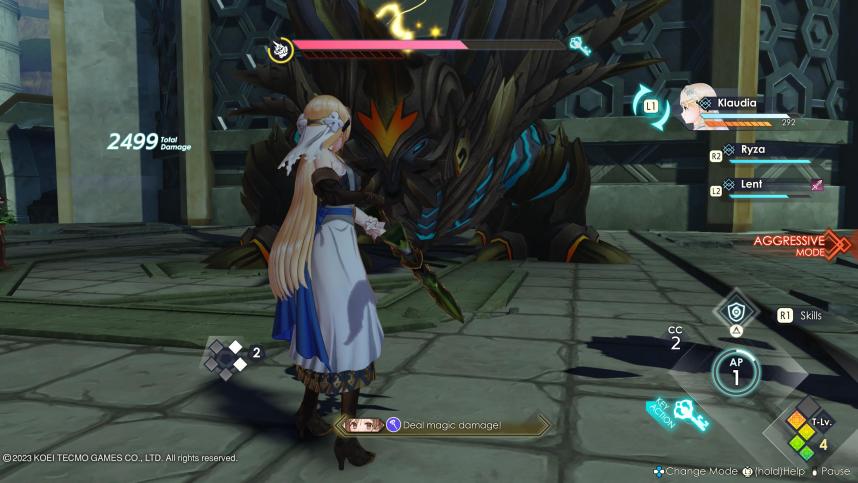
Finally, the other element that you’ll be spending a lot of time with is the battle system that once again changed from the previous entry. Less drastic than from Atelier Ryza to Atelier Ryza 2, Atelier Ryza 3 has made some updates to the system that I really enjoyed. Starting off with a basic tactics gauge, characters all have a basic string of attacks alongside being able to use action points (AP) to do some real damage. The more points that you use, the more you’ll level up the gauge and the faster that AP will accumulate. 

What’s neat about this is that whoever you are not in control of will be acting independently between one of two states, passive or aggressive. Passive will help you to accumulate AP to do more special attacks yourself and to answer your allies call to perform physical or magical attacks for some rather neat follow ups. Aggressive will have your allies use that AP themselves to perform those abilities which can often leave you without any to do special moves yourself, however, this is where things got to be a lot of fun.

With all of the alchemy being done, odds are that you’re going to make a few interesting items. Curatives, bombs, ice bombs, lightning bombs, explosives in general that can either target one or more enemies in battle. Where Atelier Ryza 3 truly shines in this respect is that item usage is now a “free for all” in which ALL characters can independently accumulate craft points (CP) to use whenever you want them to. So while I originally have a decent spread of healing and damage items on Ryza, I eventually went full attack power while giving Klaudia the healing gear and Lent a mix of the two.

While these three eventually formed my main party, I was also careful to ensure that both Tao and Bos were just as well equipped as it’s super easy to swap characters in and out of a party of five. You will have more characters than that available over time, new to the series and returning alike, but those have to be set up before battle. This makes things a lot of fun as everyone in your party levels up, and if you need to catch some of your other characters up? They can be swapped into those reserve spaces allowing you to still rock the battlefield without having to worry about your characters themselves getting rocked. You are being rocked though its back to the Atelier with a penalty of losing a portion of your accumulated items while out exploring.

Interestingly enough as a near final note, unlike the rest of the trilogy, you can make new Ateliers in the different locations which can end up serving different purposes. The main purpose is obviously to perform alchemy, rest up and save your game, but the other factors are really neat. In addition to the core functions, you can choose whether your Ateliers boost effects for exploration, the quality and trait modifiers of items you gather, or the amount of SP gained while also increasing the likelihood of merchants visiting your Ateliers. And once you’ve potentially outlived the usefulness of certain exploration effects like seeing items on the map, you can redesign them into another type!

If I had one actual issue with Atelier Ryza 3, it would be in some of the camera work. I think the best way to describe it at times would be a hybrid between the Blair Witch Project and Cloverfield. The camera isn’t steady, it moves all over the place and a few times even gave me motion sickness in the heavier storied portions of the adventure. I also found the camera to be too close in battle, often not letting me know that there was more than the enemy that I was focusing on as you also often cannot see your two partners because they are just out of sight depending on their own movements. This would be the only reason to not be sitting between 8.5 and 9 / 10.

All of this said though, the storytelling continues to provide a fun adventure and I’m really happy to have finally had a full trilogy where you get to travel with the same principle cast. Seeing the characters grow over the course of time, 3 years between Atelier Ryza and Atelier Ryza 2, and then 1 year between Atelier Ryza 2 and Atelier Ryza 3, was fun as it allows you to better enjoy the banter especially when they are talking about the past and how much or how little has changed over the years.

Summary

Overall, this final chapter in the trilogy was worth the wait and I look forward to seeing what comes next. Between the various gameplay elements and the fun to tag along the story, Atelier Ryza 3: Alchemist of the End & the Secret Key has once again set a new bar on the series.

Score: 8.25 / 10
Share:

Random posts

Our Streamers

Susan "Jagtress" N.


S.M. Carrière

Aldren


Affiliates

JenEricDesigns – Coffee that ships to the US and Canada

JenEricDesigns – Coffee that ships to the US and Canada
Light, Medium and Dark Roast Coffee available.

Blog Archive

Labels