Urbek City Builder by developer Estudios
Kremlinois and publisher RockGame S.A.—PC (Steam) review written by Hayden
with a copy provided by the publisher.
Estimated Reading Time: 8 minutes.
Urbek City Builder is an enjoyable,
approachable and lightweight city builder that gives the player remarkable
freedom to build while hiding a remarkable depth of complexity. Using a
pixel-block style that brings to mind the original line of SimCity games, Urbek
challenges the player to balance population, production and pollution. Players
will progress through a variety of biomes with unique buildings and challenges
seeking to overcome constraints to build cities that thrive in different ways.
Before getting into the meat of the
review, however, I want to address something that has already been coming up in
the Steam discussions of the game during these times of conflict - this is a
developer out of Chile (and publisher out of Poland), not Russia. From the
developer’s own post:
With a friend we used to make games
when I lived in Paris, in Le Kremlin-Bicêtre neighbourhood, and as we are
Spanish speakers, instead of "studio" we call it "estudio"
(you know, we say stadium or star and not stadium, star, like the other languages).
So we called it Estudios Kremlinois (the people from Le Kremlin-Bicêtre are
called Kremlinois).
In fact, when you press the button to
choose the name of the city at random, that neighbourhood appears :)
Then I went back to Chile and started
making games, my friend did something else but I wanted to keep the name. Now I
regret the choice of the name, but it's a bit late :/ "
Starting Out
Moving the focus back to Urbek City
Builder, it’s time to jump into the new player experience. Out of the gate,
Urbek will block all but the basic biome for new game selection. Designed with
balanced resources, and lots of buildable or farmable area, this biome really
is a good place to start new players and comes with a fairly soft-touch
tutorial.
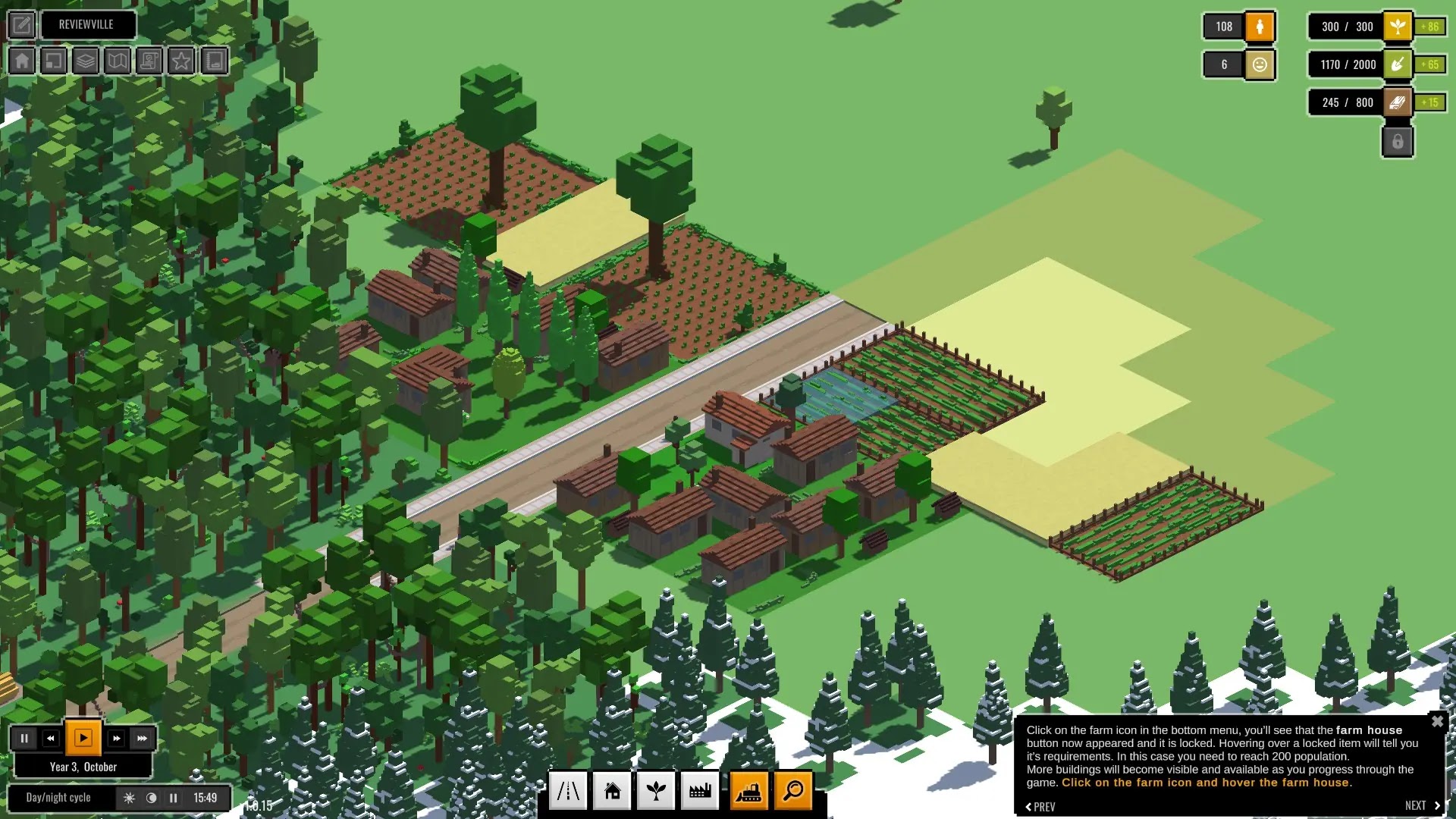
Tutorial goals are presented in an unobtrusive
banner in the lower right of the screen and are context sensitive, progressing
automatically as each is completed. Often, these will take the form of goals
for the next thing to do - increase population to X to unlock this next
building upgrade, for instance. Detection of completion for tutorial steps was
quite reliable even in the pre-release review copy that the developer provided,
and didn’t leave me feeling like I had to do things in one specific way.
Starting small, with the
tutorial banner visible in the bottom right corner.
Location, Location,
Location
As seems to be a trend in colony and
building sims that I have been reviewing recently, Urbek leverages the idea of
adjacency - although it uses a radius proximity rather than locking the player
into specific side-by-side placements. For example, residential areas won’t
increase in density unless there are enough other residential areas at a
similar level of density within a certain radius. This ends up creating a very
natural-looking progression of city buildings, with multi-story buildings
occurring only where they form the core of a developed area. The edges of these
areas will naturally begin to taper off in density (and building height) as
they cannot fulfil the proximity requirements to upgrade.
You can see how the
taller, more developed buildings tail off as we move away from the core.
Proximity detection applies to many of
the systems in the game. Resource buildings have their own special types of
housing that will evolve next to them, lending a distinct feel to the area.
Pollution-producing buildings will impact what types of farms can be placed
nearby, as well as directing housing evolution towards high-density
tenement-style buildings instead of glittering high-rises. Even abundances of
night life or religious buildings will impact what evolves nearby! All in all,
Urbek has very successfully leaned into this idea, and it really gives the
player great control over how their city looks as it grows.
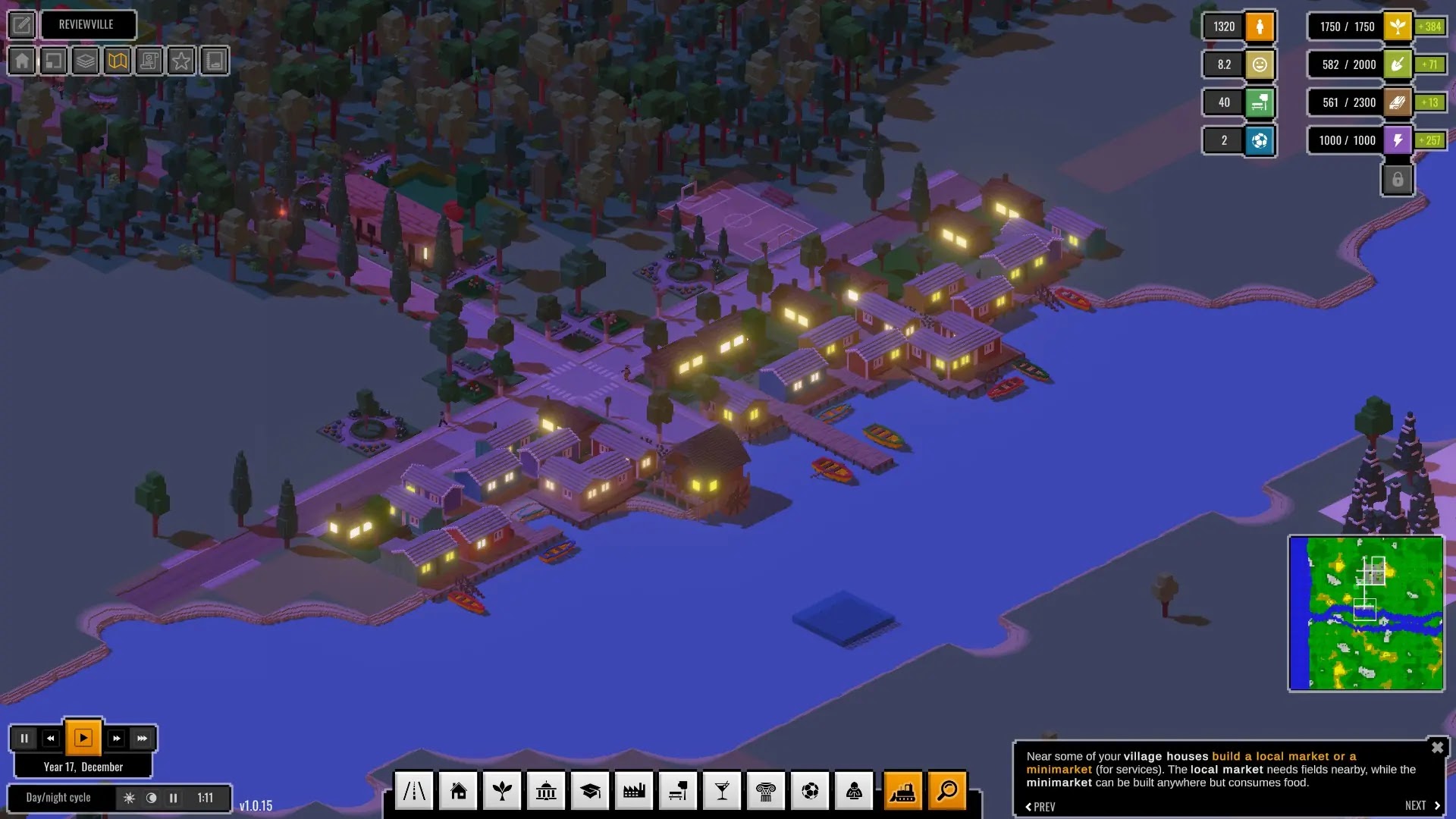
The fisherman's houses
here look different from normal houses thanks to the nearby dock.
Progression and Victory
Progression within Urbek is primarily
population based. New buildings and upgrades for existing buildings will often
be gated behind population values, with a secondary condition requiring the
presence of a certain number of another particular building type. To unlock the
hospital requires the player achieve specific population and that three medical
clinics have been placed in the city, for example. Housing upgrades occur
automatically as their needs are met, and this can lead to waves of redevelopment
at times that provide a sudden “wow” factor and sense of achievement for the
player. Seeing everything come together and ripple across the city is
definitely gratifying, and helped keep me engaged for hours at a time.
Winning a map in Urbek can be done via
three distinct paths in any biome, depending on what the player chooses to
build first in the early game. Wealth, Leisure and Productivity are all options
that can be chosen, based on what the player wants to do. A path towards
wealth, for example, will require the player to build a certain amount of
high-density/high-value commercial areas. This multi-path approach adds to the
freedom that Urbek provides the player, and also helps to ensure replayability
for each biome.
Nice Touches
Urbek City Builder ships with mod support
at release, a great addition that helps to boost the longevity of many games.
The developer’s Tumblr (https://urbek.tumblr.com/) goes through mod
creation, and shows a pretty straightforward system that potential content
creators should be able to pick up quickly. Directions on how to make new
buildings within the game’s artistic style can also be found here along with
step-by-step instructions on how to validate and load mods. It will be quite
interesting to see what the community comes up with for the game in the weeks
and months ahead.
You can even zoom in and
stroll around with your Sims...er...Urbekites? Urbekians?....citizens.
Urbek’s developer has obviously put a lot
of thought into the little things that affect quality of life in the game. The
UI layout rarely feels crowded, with a minimum of the popups and dialogue
windows that other games stack and tile over the playing area. Information
windows on buildings always include links to potential upgrade paths that the
player can check. Future buildings of the next tier show as greyed-out items in
the menus - but tooltips still work on them and show the unlock requirements
for fast referencing. Hotkeys are set up by default to navigate to menus and
submenus in a consistent fashion, and building options never reorder within
their menu once they appear in the greyed-out hint form.
What its Not
Urbek is not a hardcore, super-detailed
urban planning simulation that is going to challenge a Cities Skylines or
Cities In Motion. Roads are modelled to the level of needing them within a
particular radius of a block, and having to have your road network connected
into, well, a network - no isolated chunks. Traffic simply is not something you
need to manage in Urbek. Sewage, pipes for plumbing, poles for power - none of
that is a level of detail that Urbek requires the player to deal with.
Pollution doesn’t accumulate, your sea level isn’t going to rise, nothing like
that. Urbek is a lightweight, accessible city builder, and seems to be
well-developed in that niche.
Conclusion
Urbek City Builder is a great entry from
a small developer that is well worth the time to play. This is a game that
feels like the developer knew their resource limits and kept themselves focused
on what was achievable - and delivered really, really well within that.
Urbek feels well balanced and fairly
polished at release, and provides ample re-playability for its maps. The player
has the freedom to create and grow their city without having to worry about the
nitty-gritty that some other city builders focus on. The result is a very
enjoyable game that you can intend to play for 15 minutes and put down an hour
later wishing you had just a bit more time available.
Summary
Urbek City Builder is a light,
approachable city builder that eschews micromanagement of utilities in exchange
for creative freedom for the player. Well balanced and polished at release,
this game offers multiple victory paths for its various biomes and includes
modding support from the outset. This is a game that knew what it aimed to
deliver and hit that target in the bullseye.
Easy to learn, fun to play, and hard
to put down - grab this one on Steam and dive right in.
Score: 9
/ 10