• STARSEEKER: Astroneer Expeditions - PC Preview

    STARSEEKER: Astroneer Expeditions is just that! Massively co-operative and not an MMO! When you first run the game you are instantly into the tutorial...

  • The Core - PC Preview

    Sometimes when you are browsing the internet for information on how to do something, you stumble upon ideas or projects or even games that people might be working on...

  • Cat Mail Co. - PC Review

    What a meow-gnificent evening it is to send your paw-rcels out to those family and friends! Are mew looking to pick up an item or send something out? Well at Cat Mail Co. we can send and receive all your deliveries!

  • Volontes - Nintendo Switch Review

    Have you ever grown up feeling like you don't belong? For our Heroine, that's the feeling she lives with everyday in her small farming village. But it's not her only secret...

  • Astro Colony - PC Review

    Astro Colony is a space base building game with three modes: survival, construction, and sandbox. From the intro cinematic right into...

  • Dread Delusion - Xbox Series X|S Review

    Today we’re looking at what has rapidly become an absolute favorite in the open-world RPG genre for me. An interesting story, memorable NPCs, stunning visuals, and a setting absolutely dripping with flavor, Dread Delusion sets its tone immediately and sticks with it.

  • House Flipper Remastered Collection - PC Review

    I enjoy simulation-type games, and I enjoyed the original release of House Flipper, but I never got around to getting the DLC. When the remastered version of the game was released, I figured it would be the best way to experience the DLC while checking out how the base game was upgraded.

  • GranBlue Fantasy: ReLink Endless Ragnarok - PS5 Review

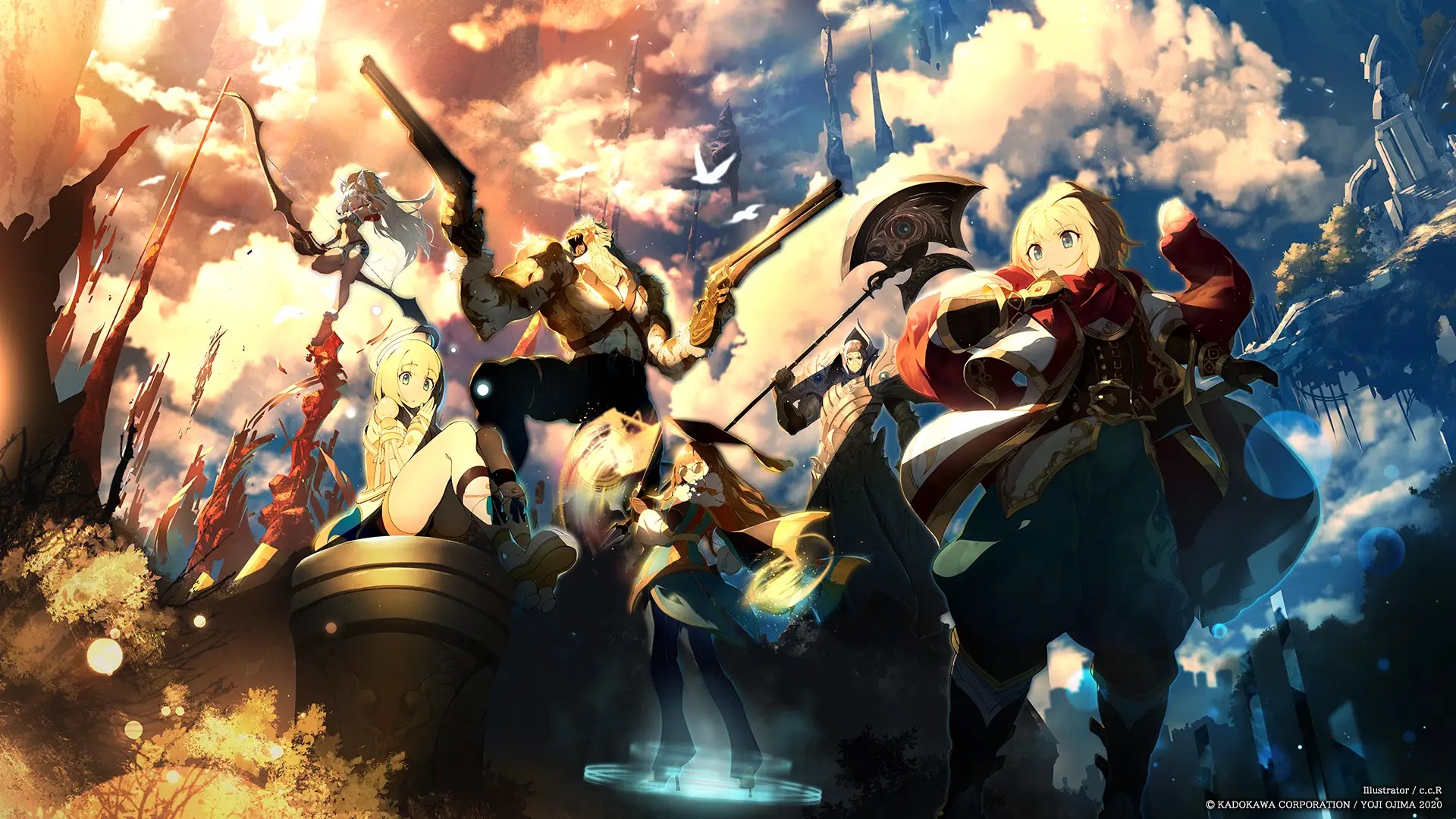
    GranBlue Fantasy: ReLink released in 2024 bringing the GranBlue universe to an action adventure JRPG format. With a party of up to four members, this band of skyfarers set out for new skies, adventures, and dangers. Two years later, Endless Ragnarok...

  • 70s-Style Robot Anime Geppy-X - PS5 Review

    70s-Style Robot Anime Geppy-X is a mouthful of a title, but you know what? It’s quite the challenging game to describe as well. At its core, 70s-Style Robot Anime Geppy-X is a shooter...

  • Net.Attack() - PC Review

    Net.Attack() is dangerously fun. From thinking that I could dip my toe into the tutorial during a lunch break to having put more hours into the game on my first day with it than I did my full-time job, Net.Attack() smoothly pulled me into a ‘just one more level’ mindset.

The Suicide of Rachel Foster - PS4 Review

The Suicide of Rachel Foster by developer ONE-O-ONE GAMES and publisher Daedalic EntertainmentSony PlayStation 4 review written by Izzy with a copy provided by the publisher.

Estimated reading time: 6 minutes

Before I begin, I want to explain why it’s wrong for adults to have emotional and/or sexual relationships with teenagers. It’s because you’re an adult and they’re a teenager. The concept of an “age of consent” is inherently flawed as it presupposes that because something is legal, it is moral. Now, while I’m certainly not here to be anyone’s moral barometer, I do feel obligated to point this out, as the concept is very much at the core of everything that is wrong with The Suicide of Rachel Foster.

The titular character’s tale is recounted by Nicole, the protagonist whose middle-aged father, Leonard, had an affair with sixteen year old Rachel ten years prior to the game’s beginning. As a result of their tryst, Rachel became pregnant and subsequently committed suicide. The narrative follows Nicole as she returns to her father’s hotel for the first time since those events, and begins to harbour suspicions that there may be more to the young woman’s death than she’d originally believed.

If you’re only interested in the game play aspects involved, then I’ll make it quick. The Suicide of Rachel Foster is a perfectly average walking simulator that doesn’t overstay its welcome in terms of playtime, handles fine mechanically, has perfectly average voice acting, perfectly average dialogue, perfectly average action, a perfectly average setting, and a perfectly average (i.e. predictable) conclusion.

There you have it. If you’re able to ignore the fact that the game attempts to excuse and explain a grown man exhibiting and acting upon predatory behaviour towards a teenager less than half his age, it’ll kill a couple hours, give you a couple decent jump scares, and nab you a few trophies. (Editor's Note: Even if the last one didn't unlock for the Platinum)

If, however, that premise doesn’t immediately put you off, I should let you know that it gets worse. The game goes to great lengths to insist that this was no simple affair. Leonard was “very much in love” with Rachel. So much so, in fact, that he was obviously willing to put his marriage, and his relationship with his daughter on the line, which brings us to the next issue with tSoRF.

Much of Nicole’s personal journey in the narrative is not about trying to reconcile Leonard as her father from Leonard as a sexual predator whose actions and impulses ultimately caused two different families to fracture. No, instead Nicole spends a few days realizing how jealous she was that Rachel was able to command so much of her father’s attention, and how much she resented her for it. The resentment towards Rachel is echoed through Clair, Nicole’s mother, who is also painted as someone who simply couldn’t, or wouldn’t, understand the complexity of Leonard’s feelings.

Despite the fact that the game attempts to paint Leonard as a sympathetic character whose only flaw was his own humanity, it repeatedly reminds you that womens’ humanity is not worthy of any consideration; Rachel exists only as Leonard’s proverbial apple, Clair exists only as a manifestation of jealousy, and Nicole exists only to expose the truth and absolve Leonard of any wrongdoing, even going as far as to try and make Nicole understand how deeply her father truly “loved” this sixteen year old girl.

The only other major character in the game is Irving, a FEMA agent communicating with Nicole by cellphone. Nicole finds herself back at the hotel for the purposes of conducting an inspection in preparation to sell it after her father’s death. Her hopes of getting out of there as soon as possible are dashed when the helpful Irving informs her that a severe snowstorm is on the way and she would surely not be able to make it through the mountain roads alive if she were to hop back into her car now.

Luckily, Irving, the FEMA agent and weatherman, is also incredibly knowledgeable about the hotel’s backstory, layout, condition, supplies, and about both Nicole and Rachel’s family history.

Irving convinces Nicole to stay and conduct the inspection herself rather than wait for the attorney hired to handle her father’s affairs. With his help, she navigates the halls of the old Timberline hotel, becoming increasingly concerned that she may not be there alone. She receives strange phone calls from a supposedly disconnected line. She hears strange sounds coming from the other floors. She gets locked into rooms after doors seemingly slam behind her. She finds objects inexplicably placed within the hotel’s walls. She discovers areas of the hotel that were previously completely unknown to her.

All this bizarre phenomena culminates into questions; Is Rachel really dead? Is some manifestation of her still roaming the hallowed halls of the Timberline? Is someone trying to show Nicole something? Is someone just trying to frighten her? It’s hard to say much more than that without spoiling the conclusion of The Suicide of Rachel Foster, so I’ll just say that if you’ve read this far and have a guess about how it ends and who is behind all the strange things Nicole experiences, you’re probably right.

In terms of narrative storytelling, however, nothing is made whole by Nicole uncovering the truth. Now, I like a convoluted ending. I enjoy stories that aren’t wrapped neatly with a little bow where the hero triumphs and everybody lives happily ever after. While it seems like this is what was attempted in tSoRF, where it falls short is in its execution.

The game’s end sequence (where you will have a choice to make on Nicole’s behalf) feels much more like something that was meant to shock players rather than something that is true to Nicole as a protagonist. Then again, I made the shocking choice so I guess it was effective.

Summary

I know it may seem difficult to believe, but I didn’t actually hate the game. Aside from the issues I have with it from a narrative standpoint, it was fine, and therein lies my struggle to recommend it outright: It’s just fine. There is nothing particularly special or interesting or revolutionary in The Suicide of Rachel Foster that you couldn’t get in any other walking simulator without having to simultaneously excuse a story that explores predatory behaviour in a way that is questionable at best, and seriously harmful at worst.

Score: 6 / 10


Editor's Note (2023): If you think you or someone you know is at risk, trained counselors with the 24/7 National Suicide Prevention Lifeline could help you work through any signs you’re experiencing or seeing. To increase its accessibility, every state will roll out 988 as the new lifeline starting July 16, 2023. The current number is 1-800-273-8255 (TALK), and it will always remain available to people in emotional distress or suicidal crisis, according to the Substance Abuse and Mental Health Services Administration.

National Alliance on Mental Illness: 1-800-950-6264 or text NAMI to 741741
National Youth Crisis Hotline: 1-800-448-4663
Crisis Line in Canada: 1-866-996-0991
Share:

Vaporum: Lockdown - PC Review

Vaporum: Lockdown by developer and publisher Fat Bot GamesPC (Steam) review written by Pierre-Yves with a copy provided by the publisher.

Estimated reading time: 6 minutes

Having originally released for the PC back in 2017 and then the consoles last year in 2019, Fat Bot Games’ Vaporum took the classic First Person Dungeon Crawling style and made it its own. With real time elements making you really have to think on the fly or otherwise die, Vaporum: Lockdown makes a return to the world before everything happened showing us what we’ve been really wanting to know. What exactly happened when things went to hell?

The original Vaporum had a winning formula like Mary Skelter: Nightmares that managed to inject new life into a fairly old style that works so well, almost no innovations had been seen in a long time. Why fix it if it ain’t broke? Taking what they learned from the original, Lockdown for the most part looks and feels like the original while also adding in some quality of life improvements to how you go about manipulating the world especially when using a controller.

Unlike the original where you had to decipher who you were while exploring a place that you “didn’t know”, Lockdown puts you in the shoes of the scientist Ellie Teller who goes from testing out equipment to running for her life. Equipped with a basic Exo Rig before getting her hands on a more powerful one, Ellie is going to have to explore the various parts of the Arx Vaporum to find what she needs to get a submarine back into working order if she plans to live through the mess that she now finds herself within.

What continues to make Vaporum, and now Vaporum: Lockdown, stand out from the crowd is the implementation of real time into a world that generally only sees movement when you decide on it. Most first person dungeon crawlers act like most roguelikes in that everything within only moves when you do. Some move two spaces for your every one, others move one for your every two, but the general rule of thumb is that if you move one space, they move one space. Adding real time elements to this and you no longer need to move for the world to move, it does it on its own. Still square based in its movements though, this still allows for you to plan ahead of where you’re going to move and what you’re going to do.

Between the various puzzles that require you to unlock doors, throw switches, move crates and trigger floor panels, Ellie will have to fight for her life against the mechanical beings that hunt her as she moves through their territories. Small spiders, roaches, flying robots or large brutes with mauls or shotguns, each of these foes all have their own attack patterns from up close and personal, jumping straight for you or spreading acid, fire or electricity over a specific area. Like any good strategist, sometimes running away is the best course of action in order to get into a space that is easier to manage as the Arx Vaporum is full of tiny spaces and tight corridors making frontal attacks is often not the best course of action until you plan on spending all of your limited healing packs.

Now while everything moves in real time, the option exists to stop everything in its tracks to give you a breather and plan out your next move. What I really appreciated about this is that even if everything stops, things will get to move as you move. So turning left or right? Those are partial time movements allowing an enemy to start to close in on you. Moving a full space will allow them to do the same. Attacking, like moving, takes a whole “time segment” so if you’re going to get hit, you may want to move out of the way instead. It’s effective in keeping your enemies where you can see them especially when there are more than two coming at you. In a large room with four? Stop time and check things out. In a small space and there are five swarming you? Lay a few traps and move out of the way just make sure that you don’t get caught from behind as the AI is smart enough to take other routes if the main one to you is blocked off.

It sounds like a lot, but combat is generally over in seconds allowing you to get back to doing what you’re supposed to be doing, escaping the Arx Vaporum. What I found interesting this time around as Ellie is that as you find notes, as you find tape recorders of her colleagues and even of her own, she has a personal input or retrospective thoughts on what happened. What she thought was a good idea back then, she may regret now as it could have easily led to the current circumstances. It adds a more human element to this mechanical and steampunk world especially when you see everything from a first person point of view.

If I were to have an “issue” with the latest Vaporum, it would be from a minor technical standpoint. The visuals are smooth, the audio is fantastic, making me cringe often enough to check if something is behind me, and the combat is just fun. Where things could have a bit of an issue is in the controls when it comes to a controller. The layout, when visually looking at it makes sense but when you move from a mouse and keyboard over to a controller? Things feel backwards. Abilities on the right need to be triggered with the left trigger. Healing which is on the left needs the right trigger. Main hand and off hand while mapped to the bumpers, are going to be backwards in your head as no one really uses the left bumper to attack, you use the right. Thankfully there’s no penalty for putting things in your off hand as long as you’re either dual wielding or have a shield.

From a gameplay perspective, my only real complaint is that some of the “puzzles” are a bit too tricky to figure out at times, but that could have just been me over complicating it. Throwing switches, finding keys, needing to block balls of light from hitting receptacles, they all work well but sometimes the amount of time that it took to figure it out made me question if what I was doing was even the right thing. It’s a challenge, but I wonder if sometimes it wasn’t too much so.

Summary

While it may act as a prequel to the original, Vaporum: Lockdown is an excellent return to the Arx Vaporum tower. Capitalizing on the features of the original while also making some minor adjustments to how you interact with the environment, this was hard to put down as I tried my best to help Ellie on her journey to escape this scientific wonder turned deathtrap.

Score: 8.25 / 10


Share:

Kingdoms of Amalur: Re-Reckoning - XB1 Review

Kingdoms of Amalur: Re-Reckoning by developer KAIKO and publisher THQ NordicMicrosoft Xbox One review written by Nick with a copy provided by the publisher.

Estimated reading time: 8 minutes


I was completely surprised by the announcement of Kingdoms of Amalur: Re-Reckoning – surprised and excited, because I was a big fan of the game when it first released. Most aspects of this game have aged rather well over the last decade, though not everything. Still, I found myself quite excited to dive back into this action-RPG experience and once more explore this unique world.

When the game first came out, Amalur was rather well-received, but the studio behind it famously went under shortly after its troubled release. I originally covered it for the Xbox 360 and sunk over 100 hours into the title and enjoyed almost every aspect of the game. By and large, I’d say the same feelings persist today despite the time that has passed.

The tale gets off to a fairly unique start as your protagonist is dead – only to be revived and realize that he is part of a much larger destiny. Of course there is a bit of amnesia involved with this rebirth, giving you a blank slate character that can hear about the world as thought it was the first time. And what a world it is, famously created by R.A. Salvatore of Forgotten Realms / Drizzt fame (I’ve actually been rereading numerous works of his lately due to a Drizzt Humble Bundle I purchased a couple of months ago).

The visual style of the game is also unique, in that it’s a sort of chunky, but vibrant fantasy setting brought to life by Todd McFarlane (known largely for his work on the Spawn comics). That is a heavy-hitting pair of talents to help flesh out the world, and those fingerprints are still all over the original product, even if the visual update are perhaps not as robust as I had hoped and some of the clunkier UI / menu choices are not updated to improve overall quality of life.

This is a massive and beautifully fleshed out world. There are countless books, scrolls and conversations to be had if you really want to get a sense of the world building that took place here. There is enough text to fill a visual novel, but almost all of it can be skipped if you don’t have the interest. I remember clicking every… last… dialog… choice the first time around. I was surprised at how nearly a decade later, I still remembered a lot of the details and admittedly began to bypass most of those after about a dozen hours with the game this time. Still, for those who like to delve into lore and really immerse themselves in a fantasy world, that can be done here.

While the visual updates were a bit underwhelming given where technology is at now, the basic art style itself still aged rather well. Small bits of visual flare such as Reckoning mode or how certain items in the environment respond to your presence are certainly appreciated and gives the world a sort of mysterious beauty that I can still appreciate today. The sound effect and music are all solid and go nicely to wrap up a pleasant presentation.

One of the primary things I recall from back when I first played the game was how much I enjoyed the combat. I wound up playing this title and Skyrim rather close to one another, and while there were many things about Skyrim that I enjoyed more at the time, I certainly preferred the fast, fliud and often meaty combat that Amalur presented. That aspect still holds up today. There are three basic playstyles here, with magic focusing on powerful arcane attacks, might focusing on slower, heavy-hitting and better armored attacks and the ninja-like finesse build that focuses on quick strikes and avoidance. I was focused on the finesse build, sneaking up on enemies to perform brutal backstabs.

Progression is one of the highlights here, as you are not forced down a particular path – you can spend points across the three different branches as you see fit. This unlocks hybrid classes as well, instead of penalizing you for not specializing in just one area. The combat itself is pretty shallow when you really think about it, but it’s enjoyable because of the various tweaks in the progression system. Very little of what Amalur does now hasn’t been addressed by other games over the last several years: blacksmithing, alchemy, gem crafting, lots of loot and more are all pretty standard in action-RPGs these days, but they’re still well done in this game.

It is worth noting that there were some rough spots with the initial Xbox One release, but a recent patch has cleaned most of those up. I say most – but not all – because the game has crashed on me three times now. Usually when I’m in very busy / populated regions where combat is happening and I haven’t fast-travelled in a while. I’m not sure if it’s a memory thing or what, and thankfully each time the fairly generous auto-save got me back to within about five minutes of the crash, but there’s still a few kinks to be worked out evidently.

There is some future DLC slated for sometime in 2021 that is supposed to provide several hours of additional content, and that will be interesting to view when it releases. That being said, this release does package all of the DLC that came with the original such as Teeth of Naros. However, fans should keep in mind that this is a remaster – not a remake, and that is probably the biggest bone that some people will pick. There were a handful of missed opportunities to streamline and improve quality of life here, but there were really no major changes to speak of under the hood.


PY's Thoughts on the Re:Reckoning

While I wish I could say that I had spent as much time with the original as Nick, the unfortunate reality is that life got in the way after a good twenty or thirty hours so I never did finish my original adventure through this expansive world. Excited to be able to dive back into it, and to challenge Nick's Monthly Gamer Score, I pre-ordered Kingdoms of Amalur Re:Reckoning with the upcoming DLC on the Xbox so that I could play starting on launch day at 11am while on vacation.

Things for the most part were great, however it soon came to my attention that there were a few items that didn't quite seem to jive. I found out soon after that the Day 1 patch which not only added some quality of life improvements but also stability and achievement unlocking, was not present. So after about a good dozen hours, I restarted once this patch was done and I'm pleased to say that since then, I've had no more crashes, quick slotted abilities have been increased from the original four to eight which is fantastic, and Reagents / Crafting Materials now have "bags" that they sit in no longer taking up your entire inventory space.

Back to where I was and even past it, the return to Amalur while a bit rough at the very beginning has been a great one and my only regret is not having gone further in the original version when I picked it up for my PS3.

Kingdoms of Amalur: Re-Reckoning is a fun way to revisit a game that I have fond memories from the last generation. By and large, the game has aged pretty well. Some fans might be disappointed that there weren’t larger changes made, but I’m happy to see the game back in any form and can once again hold out hope that maybe, just maybe, we’ll get more titles that allow us to revisit this fascinating world in the future as well.


Score: 7.5 / 10


Share:

Ary and the Secret of Seasons - Switch Review

Ary and the Secret of Seasons by developers eXiin, Fishing Cactus and publisher Modus GamesNintendo Switch review written by Pierre-Yves with a copy provided by the publisher.

Estimated reading time: 7 minutes

Starting off in a rather peaceful time, Ary, daughter to the Guardian of Winter, aims to set out on a journey to find out what happened to her brother who has been missing for several weeks. Told to stay put and nor do anything rash, obviously our protagonist is going to do anything but. Stealing her brother’s clothes, cutting her hair and “borrowing” her father’s Orb of Winter, Ary soon finds herself on a much greater journey as the balance of the four realms are thrown out of whack.

Like A Knight’s Quest last year, Ary and the Secret of Seasons finds itself in a bit of a comfortable “niche” spot where it manages to both evoke those nostalgic adventure days on the Nintendo 64 while still bringing modern day quality of life aspects to the journey. Having most of the core mechanics from the beginning, Ary can run, jump, climb, and swim if neebe. As any good adventure title goes, as time moves on new abilities come into play through items such as double jumping, being able to dive under the water, pull large objects along for the ride and climb up the vines to the top of a wall or platform.

Adding a bit more flair like in Seasons After Fall, Ary will be able to start affecting the environment with the powers of Fall, Winter, Spring and Summer. Integrated into the plotline, the four regions that make up this land are out of whack as the eternal climates have been changed by corrupted crystals turning summer into winter, winter into summer, spring to fall, and fall to spring. To cross through these, Ary will have to create seasoned bubbles that can melt ice, wilt vines or drain water to move across to her location.

For the most part, all of these mechanics work fairly well on their own but unfortunately when you start to mix and match a few of these together things don’t always jive as well as I would have liked. Climbing up vines for example sometimes don’t let you reach the ledge and pull yourself up instead needing you to jump off and then somehow jump back up to the platform. In other cases you have to find a way in order to get several seasonable bubbles to “play nice” with one another. Unfortunately it was more often than not a chore and getting lucky in something working than actual skill. In the simplest of terms, often it was possible to have done something right off the bat but because of how the sphere formed it led you to try a ton of different ideas instead and in the end, you just wind up doing the very first thing you tried and it worked just ‘cause.

In these cases, Ary’s adventure could have used a bit more polish as separately, using just one seasonal sphere works just fine, the platforming for the most part works fine until you bring vines into the mix as there’s no real mechanic to jump off of them and the combat? It’s simple but it works fine. Throughout the world, Ary is going to have to defend herself and she can do so with coffee cups, wooden or mechanical swords, sticks and a variety of other objects for flavour. The weapons themselves didn’t really seem to do much of a difference so a wooden spoon was an obviously legitimate choice when fighting hyenas that have invaded the lands.

Like a lot of other adventures, Ary’s is not one of accumulating experience points and leveling up. Instead, there is a sensei that can teach Ary new abilities such as being able to cause more damage, being more agile while in combat, do more damage while parrying a blow and a few other little things. The main issue with this is that it costs money, and money, can only be found in chests so when you are only getting 13 to 56 coins, it’s going to take a while to be able to buy these training sessions especially when the cheapest is 200 coins and then jumps up to 400. Having enemies drop a bit as they respawn could have really helped in this department especially since the large chests were rare and sometimes? You could even get a big fat “0” coins in a chest. Already rare enough to find, giving me nothing really irked me especially with how hard it was to get to.

The adventure isn’t all about how well it works though. While yes, you’ll be spending your time running, jumping, climbing, and changing the broken seasons around, this is still the journey about family and not giving up on one that was lost. Even with the world thrown out of whack and her brother missing, the narrative is still light and fun with plenty of nonsense to make one smile which helps ease a bit of the more mechanical issues that Ary has while going through the trials to basically save the world.

Now unfortunately, there are currently loads of glitches with Ary's adventure from parrying not working to glitching through doors, walls and other things making you need to reload the title over and over again. While I could never figure out why the parrying would come and go, at least you could dodge in the meantime. As for the other? It could be brutal as the cost of progress was annoying especially since, and the last major issue is this, even if you've saved, it doesn't mean everything you've done has saved. Often it would be close enough but you would have to do it all over again.

Summary

So overall, while Ary and the Secret of Seasons does need some patches to fix some rather large issues on the Switch, the adventure itself is light and fun even if it doesn't really do anything new. This isn’t exactly a bad thing as what it sets out to do it does well, but, until it gets patched be warned that you may have to do the same thing a few times over.

Score: 7.5 / 10


Share:

Rogue Legacy 2 - PC Preview

Rogue Legacy 2 by developer and publisher Cellar Door GamesPC (Steam) preview written by Marc L. with a purchased copy.

Estimated reading time: 6 minutes

Over the last couple of years there have been some great roguelikes, but even with all of these releases, it’s hard to top Rogue Legacy, a platformer taking you through a family lineage of all sorts.

It has been 7 years since that release and now we are graced with a 2nd part to the series. It’s smooth, looks fantastic, feels more refined and looks great. Sadly, it isn't done yet, but it's but I already see so much promise! At this rate I would bet on it being better than the first. Currently the game is a bit short as it is in early access but I really hope it’s worth the wait.

After a bout 5 hours worth and a couple of attempts at the “dungeons” that grant you boons such as double jumps or air strafes, and even after hitting an funny message from our devs.

I still wanted more. The sudden urge to go back and back again to fail and attack and get all the hidden chests reminded me so much of why I loved the first, but even more so. This one is someone even more addicting to the first one.

The first area is finished (I believe) with enough content to give you a few hours of good fun and progress, along with the trials. All the gold and blueprints / runes you gain are carried over to your next generations endlessly allowing for tons and tons of replay value with some twists! Maybe they have IBS, maybe they are colorblind? Could be a dwarf, or even have gigantasism!

Dying is a huge part of this series, going for a no death run is likely to be impossible for most (I sure some crazy person will prove me wrong) but that’s one of the charms and excitement of the game. It does feel bad sometimes to barely make any progress and fail to traps or simple mistakes… but all these attempts will eventually add up and unlock more features and classes to try, and even a safe to stop Carron from stealing all of your money. Slowly but surely you will become stronger and progress until you have reached the boss and beat the first zone. Then its one down and more to go.

The more you play the more everything just starts making sense. Someone might say “no duh” but what I mean is each enemy, each trap, each room. They all have flaws secrets things that damage you just with a small misplay. But it all helps train you and the next generations to get smarter, stronger more tuned to the environment and just overall better at reading the pace of the game and making it further and further each time and starting fresh with each new encounter.

There are a few different classes that have come up so far in early access. You have a typical knight (sword and shield) you then have access to the tanky and hard hitting barbarian (giant axe), very limited in mana but hits like a coke machine with legs, a ranger (bow) used for attacking from a distance, also has crazy mid-air shots that can be really clutch against some mobs, and lastly the mage (big boom booms) A mix of close and long ranged attacks at a mana cost, extremely strong but lacking in some sort of tankyness. More classes are planned for the future but once again. Early Access.

After a few hours and a few deaths you will likely find both of your Heirlooms along with their trials, which by the way are amazing. Each trial was completely different and had its own unique setup making it a lot more challenging and interesting than simply opening a chest and “DA – NA – NA - NA!” crazy abilities.

Just like in Rogue Legacy we get a cool story line hidden in the journals that you can find lying around. If you search and find all of the clues there are some that can actually lead to secrets, and these secrets can give you permanent buffs against certain bosses or enemies. So far, I have found one to increase the damage given to the Estuary Lamech but I am sure there will be more to come.

The lineage is not as simple as it use to be, before it was a choice of 3 with random good or bad aspects to them also known as their “traits”. But now, they have incentivised hard mode as some of these more treacherous talents now come with huge bonuses like tons of extra gold. You are likely not to make it very far but the promise of all that extra gold really entices you, and who doesn’t like a good power up or 2 between runs.

As in the first one there is plenty of unlocks (more after early access). Currently there is not a whole lot except for the classes I mentioned and a few things such as health armor damage a blacksmith a rune enchantress and a shopkeep. Of course not forgetting your over time free cash saved away from a big meanie in a boat.

The only thing I can say that I have had issues with for Rogue Legacy 2 is FPS drops. It has never been anything game breaking but it can be frustrating if you get hit or die to something that isn’t your own fault…for once...

Summary

Being in early access I have nothing but high hopes for future content. I hope fans will pitch in and help create something amazing and this should be a must play if everything else is as solid as the first area. The limited content did not change my opinion after seeing how great the game looks and feels and once we have a full product this game will be one not to miss as I have faith that Cellar Door Game’s will bring us something amazing!

Score: N/A


Share:

Madden NFL 21 - XB1 Review

Madden NFL 21 by developer EA Sports and publisher Electronic ArtsMicrosoft Xbox One review written by Nick with a purchased copy.

Estimated reading time: 10 minutes

Football is back! My natural enthusiasm for the fall sports season has me incredibly excited to pick up the controller and juke some defenders with this latest iteration of the Madden series. However, there are some undeniable issues with this year's Madden NFL 21 release that won’t discourage those gamers who feel that the yearly releases are little more than glorified roster updates.

I am a fan of the yearly releases in sports video games, because it matches the cadence of the annual sports season. There is always a sense of renewed hope that comes with a new season, the deep hope of fans such as myself that this year will be better than last year. I have been playing the Madden series since its earliest days on the SEGA Genesis, and unfortunately a trend has emerged over the years that holds true this year as well: the series generally struggles during years when there is a new console generation being introduced.

I am not entirely sure why this is, but my theory is that the developers are having to split time and resources between the current gen and next generation consoles and that leaves them too thin to make sizable improvements with the tight one year timeline. That is how it felt again this year. From a core gameplay perspective, Madden NFL 21 is fine. The gameplay is still exciting, and the generally authentic presentation has me itching for the regular season’s kickoff. There are numerous modes here and ways to play as well, but the issue is that most of them feel very similar to last year.

One exception to that rule is The Yard, which is sort of a backyard take on football with family and friends with a shortened (60 yard) field that is more focused on arcade action than an authentic simulation experience like Franchise Mode. It is fun, but a mode I struggled to really get invested in. The other heavily updated feature is Face of the Franchise, which I generally enjoyed quite a bit. It is a mixture of the narrative-heavy Longshot story mode that Madden introduced a few years ago, and last year’s take on your custom quarterback going through a story mode that leads to a franchise experience.

Here Face of the Franchise finds your raw athlete having to sub in at quarterback for the local star (very Varsity Blues in that sense). However, your story doesn’t end in high school and goes to college and then to the pros. One of the things I really liked was that unlike last year, I wasn’t boxed into just being a quarterback, but I had the option to play a running back or wide receiver if I preferred. Seeing as I generally play a running back in my career modes, I welcomed that particular change. It will be interesting to see if this mode can mature into other roles such as defense as well (I tend to like to play a defensive lineman or linebacker as well).

The actual story is hardly revolutionary, but I liked the sense of ownership over the different decisions and how your pro team evolves based on some of the choices made along the way (even if they did not always make a lot of sense. For example in my Lions franchise, my player backed a stud receiver as well as two other really good ones on the roster and the big roster move presented to me was either another stud wideout or a subpar tight end – neither of which really made much sense when weighed against the roster’s current construction). The way it jumps from one big moment to another, interlacing story around these events actually kept me invested in how my player developed while the related achievements felt far less grindy than the Legacy achievements in prior versions of the game. All in all, this mode is a win with potential for growth that I’m pretty excited about.

Outside of these two modes however, not much else has changed. I liked the way everything kicked off with creating your avatar right away (similar too what UFC 4 did as well), but otherwise Madden Ultimate Team (MUT) still feels a bit like a money grab (over and beyond the premium $60 price tag the game costs). For those unfamiliar with this mode, it’s basically a combination of fantasy football and card collection. It has made some nice strides over the last couple of years and my favorite of EA’s ‘Ultimate Team’ modes found in FIFA, NHL and NBA (if that series ever gets back on its feet), but it’s still not my favorite mode.

Outside of career mode, I spend the majority of my team with franchise mode. My Detroit Lions might be terrible in real life, but here I can make them the champions that the real-life football gods will never seem to allow. It is a deep mode, with lots of options that… is pretty much where it was at near the end of the PlayStation 3 / Xbox 360 era. Over the last few years some ‘new’ things were added like owner mode… that had existed last generation. For being the most popular and robust feature in the Madden series, Franchise is starting to feel very neglected at this point and is in dire need of some innovation at this point.

The core gameplay is fun, as linebackers seem less superhuman and running backs have ample entertaining animations while blockers seem to lock-in properly – all things that you expect but often go underappreciated because a lot of effort goes into them. When you have 22 players smashing into one another on a field as big as this, there are numerous physics in play that the series had generally handled rather well. Still, there seemed to be more bugs than usual in this year’s release. Some of them are pretty cosmetic, some more annoying. For example, a weird animation occurred after my team recovered a fumble and my player wound up in sort of a crouched / hopping animation that the other team showed no interest in tackling. I sort of three-point stanced myself into the endzone. It was truly weird and I wish I had recorded it in retrospect.

Other odd bugs surfaced during gameplay, such as one of the times in Face of the Franchise, my team was lining up for a punt return except instead of it being my special teams – it was my starting offense. Equally odd, Matthew Stafford (my quarterback) jumped offsides immediately and the other team’s 4th and 3 turned into a first down. It was a really buggy sequence. Simple text errors show up as well, such as when in Face of the Franchise my goal is two rushing touchdowns but the update tracker at the bottom of the screen said ‘receiving touchdowns’ in two different games. It still tracked properly based on rushing, but seems like a weird, simple oversight.

The commentary also struggles mightily this year. I enjoy the team they have bene using the last several years, but there is just wrong or too often repeated commentary. In one game, my running back Swift (which is just a fantastic running back name, by the way) had already had a reception for a touchdown in the first quarter. But each subsequent RUSHING touchdown triggered a line from the commentator that it was the running back’s first receiving touchdown… all three times. Repetition is particularly problematic at times also.

For example, there was a line about how the front office had made a concerted effort to improve the defense and how they have to be liking their returns. It was triggered by fumble recoveries for touchdowns – something that should be a relatively rare event, but I was playing the Bears and they suck – and I had three of those events. Each time I heard the same line. Other lines I heard sometimes two or three times in the same game as well. These kinds of on-field glitches really take away from what should be a polished, AAA experience by now, especially given how little actually changed from last year to this one.

Issues popped up off of the field for me as well. Voice acting is weirdly not there at times during Face of the Franchise, replaced by oddly flickering text splashes as questions and answers are dealt with. I get that they can’t voice players like Matthew Stafford but reporters and faux GMs? Also, for some reason my franchise mode’s save file went from my name (Nick Herber) to my FB turned TE (Nick Bawden). I have no idea how that happened, but it has me a bit concerned about the file save integrity as that’s just really weird.

Other glitches like an inability to train (selecting start training just kept kicking me back to the main hub screen in Franchise Mode) forced me to fully quit the game and restart on three separate occasions now. None of these is a deal breaker in and of itself, but it’s a solid sampling of issues for a game I’ve only been playing for about a week so far and that I generally expect much better from. It will be interesting to see if these kinds of issues persist on the next generation consoles in a couple of months.

None of these offenses in and off themselves is that big of a deal, but taken as a whole, they do detract from what is still a deep, entertaining sports simulation with a ton of things to do. Progressing through Face of the Franchise was really fun. I still spent hours tweaking my roster to fit my playing style in Franchise Mode. While The Yard is shallow, there is undeniable appeal in its fast-paced arcade style of gameplay. The visuals are better than ever. In particular I love the slick feeling of chaining together moves in the running game or delivering bone rattling hits with the right control stick. Some of the new ideas here are interesting, if some missed opportunities are visible as well.

Summary

Madden NFL 21 is a fun game of football, and as someone who has been missing the normalcy of sports this year, I am still excited to play it. However, looking past my longstanding affection for the series, this year’s release is not a strong one. Limited improvements and multiple bugs enforce the impression that the development team had to split their focus between current generation consoles and next, leading to a lackluster and only slightly above average result.

Score: 6.25 / 10


Share:

RPG Maker MZ - Software Review

RPG Maker MZ by developer KADOKAWA, Yoji Ojima and publisher DegicaPC review written by Pierre-Yves with copies provided by the publisher to both P.Y and Nick.

Estimated reading time: 11 minutes

We all love to play games and explore the far reaches of fantastic worlds offering us that break from modern life. With all of the choice out there, there's probably been a point in all of our lives where we think, I can do that. So we scribble a few things on paper here, type up a few notes there, and then when we think “let's do this” we realize how little we have, and with the little we have, that we don't know the first thing of coding (generalized statement). Thankfully there are systems out there to help with that issue, and on that subject, the latest of the RPG Makers is finally available!

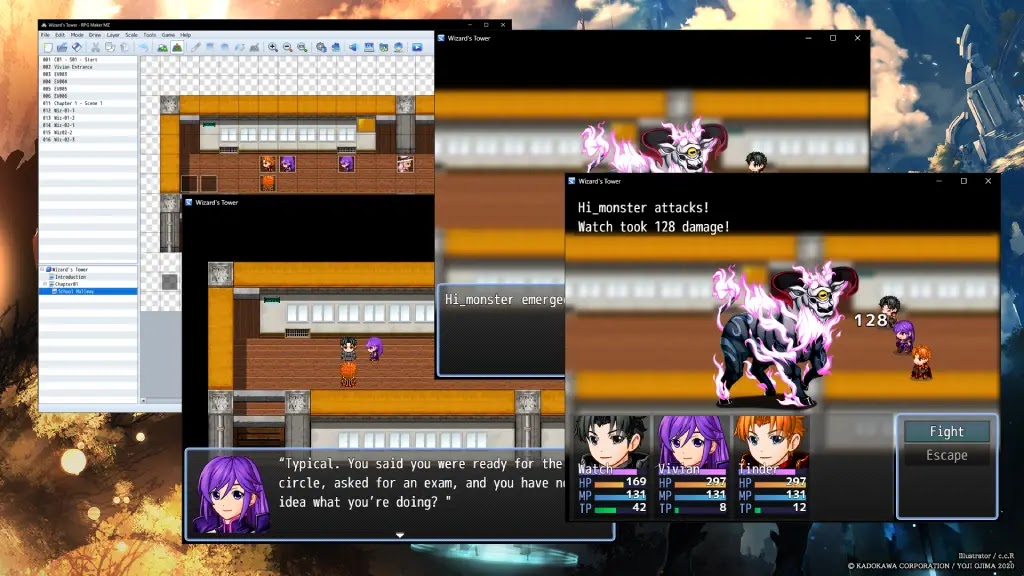
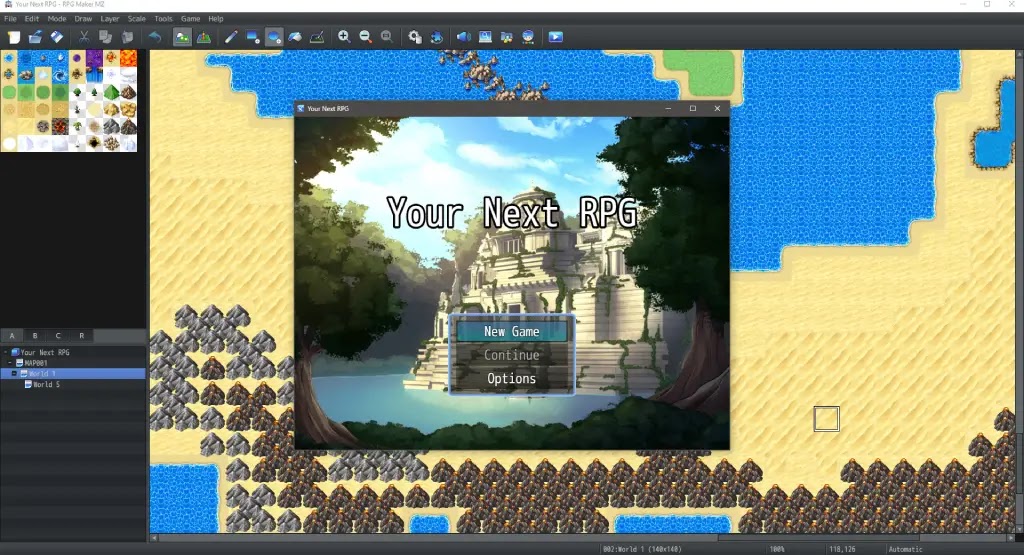
Following on the back of RPG Maker MV from back in 2015, MZ is the latest in the line of engines to help make that potential indie hit for both fame and potentially cash influx. From the outset, it may not look like much as you are treated to a toolbar, a sidebar and a workspace but from here, the world is your oyster. Set out in front of you is a robust engine with just about everything you need to make your own custom RPG, OR, everything you need to make your own action or adventure RPG with help from various pretty active communities online.

At its core though, RPG Maker MZ is designed by default for turned based RPGs. For the first time without loads of extra coding and plugins, designers now have a couple choices to pick from before getting started. Making its return, there are the standard Hero Portraits at the bottom of the screen and the enemies above. New to the engine without having to go through a few extra hoops though is the option to have the character sprites on the right side of the screen like the old school Final Fantasy entries.

More than just that, there’s also now an option to select with a Wait style in which nothing else will happen until a player has input their selection, or, an Active style that will keep on going to make everything smoother and take less time. This may not sound like much, but for someone like me who’s not well versed into this style of coding and doesn’t want to rummage through the internet archives for a plugin style that could maybe give me what I want? It was fantastic.

Now like everything, you’ll have some hits and misses through the various iterations of softwares. I mean I get to see that all the time with the constant updates of the Adobe Creative Cloud and wonder… why? So taking away one of the previous why’s from MV, MZ has now re-enabled designers to select the layer that they want to place an object on manually while also still keeping the automatic option in place. Quick and dirty or slow and calculated, each is there but the level of control from the manual was a pleasure to have back.

Heavily updated, though a tad convoluted to save your work at first, is the revamped character sprite creation suite. While you could technically create characters in MV, you knew that the characters came from the software as they all had that static RPG Maker look. It’s not a bad thing especially if it’s your first time using the suite and you would rather get everything into place before spending the vast hours creating each character, but, this time around the amount of options are a lot more varied giving your stage actors a bit more depth.

Newly present within the looks department is the ability to change the shapes of faces which helps to give more variety and really showcase youth versus age as you design the cast of your title. Male, Female, and Kid, these three options have a fair amount of options for the avatar portrait as well as the character sprites. Whether moving around the map, in battle, or “damaged”, you can do a fair bit to edit both what a character is wearing such as adding a clock to adventuring gear or a cloak on top of robes making them truly wizardly. All of these options will help a developer on a budget or a developer without design skills though, as mentioned, it’s a bit convoluted to get right at first.

Unlike the rest of the RPG Maker, you can’t just “save” your work when it comes to sprites. Instead, you have to export. This wouldn’t be so bad, but you have to export your work separately. Facial Avatars, Generic Sprites and Damaged Sprites each have to be saved to an external file that the RPG Maker will then call in. If you want to add multiple characters to one sheet, you’ll have to select the slot that you want them to be in. There are a total of eight slots and in order to fill it out, you’ll have to systematically move across the spots as you save which worked fine when working on the project, but if you stop, close the software, and resume? It took a bit in order to get my new sprites into place without overwriting those already present. The system’s upgrades are great, I just wish they made saving your custom cast easier.

Otherwise, the rest of the returning features are exactly where returning designers would expect them to be though I did find myself looking for things as it’s been a decent while since I had loaded up either MV or VX Ace. Other than painting your canvas and its layers which can take a good deal of time to do, the rest of the workload is going to be behind the events that you create in order to essentially “make the game”. Transitions from one map to another, initializing combat sequences or setting up the random encounter percentiles, or adding and removing party members. All of these actions will be handled by an event which takes a fair amount of figuring out “what does what” and “what can be done with what”.

Those with coding knowledge will feel fairly at home with these as a lot of it comes down to variables and If / Then statements. Has the party done “X”? No? Then the gate won’t open. Has the party done “Y”? Yes? The allow NPC Wizard Unit #2 to say the following when talked with. These variables are all rather powerful and the system to generate them is easy enough though you’ll want to use a proper naming system as it’s fairly easy to get lost once you start creating loads of them to get your game on the way.

At this point though, the events options I wonder if they shouldn’t start revamping its look and feel as there’s no search option and everything is split into groups under three tabs and unless you know what you are looking for, you’ll have to reach each and everyone individually. Maybe it is because it had been a while, but I did find myself having a hard time to find what I was looking for at first and that’s before adding in that you need to make sure that if you are going to be putting in triggers and variables, that they work in the location that you want them to. Once you get going it’s not so bad, but I wonder if it’s as accessible to brand new users than it is for returning designers wanting to check out the latest version.

RPG Maker MZ is a powerful tool and one that is easy to recommend for anyone thinking of breaking into game design. This isn’t just because it’s a suite that comes with plenty of built in goodies, but it’s because it’s a powerful enough engine that can easily also run your custom scripts. A few examples of titles that didn’t feel like RPG Maker titles, but were, are Stegosoft Game’s Ara Fell which is now available on the Nintendo Switch and the PS4 which was designed with RPG Maker 2003. Following that is Dancing Dragons Games’ Echoes of Aetheria which used RPG Maker VX Ace. Finally, because this list could go on, the upcoming 8-bit Adventure 2 from Critical Games uses RPG Maker MV. When asked in an open AMA on Discord back in late June, the lead designer stated that while MV and MZ are similar, projects of this scope would require a blank slate so even if they are more powerful, already established devs would really have to make a conscious plunge compared to new ones.

Finally, as a side note from me, I do want to add that the current tutorial system was a great asset as it helped me get back into the groove fairly quickly. Offering a vast amount of subjects to get someone started, or like me re-acquainted, the tutorial works off of a project that can be seen from start to finish turning that blank canvas into a decent enough demo to fairly understand what can be done with the basic engine before adding in any other plugins to turn this standard RPG into something else entirely.


Nick's Thoughts

PY's thoughts and review score are the final word on this article, but I wanted to take a few moments to touch on one of the series aspects that is often quite important to me: collaboration.

Very few of my projects over the years have been completed (though I've started oodles of them), and most of them have been solo efforts, but every now and then I get the opportunity to work with another person on a project and some versions of RPG Maker have handled project and asset sharing better than others.

I worked with Chris for this segment of the review, just to see how smoothly we could pass the overall project back and forth and also how easy it was to import a variety of assets. There was a bit of frustration on Chris' part that the tileset were again locked in at a size of 48. He likes to tinker with scale when messing with maps and sprites, and while he had not necessarily expected this part to change, he was a little disappointed all the same. That being said, many of the quality of life features PY talks about above really lend themselves to larger projects.

Importing assets works pretty similarly to MV, and that's a good thing. Chris did a handful of custom sprites, music files and backgrounds for us to play with and port back and forth and we never had any issues with those manual files. Using the Steam Workshop seemed to go smoothly as well as I pulled down a handful of files without any issue. One feature that might be happy in the future is a simple 'zip project' that pulls all of your assets into an easily shared project file (similar to how you deploy) to send to your fellow collaborator. It's not real hard to sync up if two people are sharing a single project, but it's not real intuitive either.

My impressions from working with RPG Maker MZ is that there are a lot of similarities to MV, but plentiful quality of life improvements for larger projects. Certainly, I have seen some of the features in MV as plug-ins, so the wheel is not getting reinvented here. That being said, collaborating with another user went rather smoothly from my perspective.

Summary

So overall, RPG Maker MZ is a great tool for those thinking of starting to break into game design. With plenty of newer elements to make life easier, you can just as easily import your own assets designed in Photoshop to create the game that you’ve been thinking of. With plenty of assets available through Steam, bundled or individual, and plenty of community resources, while it’s not as colossal as the Unreal or Unity Engines, you don’t need to know how to write code to get started here!

Score: 8 / 10


Share:

Marvel's Avengers - PS4 Review

Marvel's Avengers by developer Crystal Dynamics, Eidos Montreal and publisher Square EnixSony PlayStation 4 review written by Nick with a purchased copy.

Estimated reading time: 5 minutes

Flashier than Thor’s lighting bolts, Marvel’s Avengers brings together top-notch voice talent and talented developers for an adventure that knows how to set up major set pieces, but often feels flat during the lulls between. The adventure is undeniably entertaining, especially in its primary campaign – however the endgame (pun intended) has plenty of room for improvement.

Perhaps the biggest issue with Marvel’s Avengers is that is suffers from a bit of an identity crisis – which is actually pretty thematically on-point given the superhero theme of it all. It wants to tell a story, it wants to be bombastic and exciting, it wants to offer you a reason to keep playing after the campaign draws to an end, and by and large it hits all of those points – just some better than others.

Things open with a fairly typical but no less effective story that sees Kamala Khan attempting to pull the Avengers back together after an event called A-Day. I know there have been some grumbles questioning this choice, but I think having Kamala at the center of the narrative works beautifully here. She’s fresh to those who have been watching the exploits of Cap, Thor, Iron Man and so on via the Marvel Cinematic Universe over the last decade. She’s also a bit more relatable as a one-time awkward teenager who is struggling to find her place in the world. I suspect there are a lot more gamers who can relate to that than Tony Stark the billionaire genius, or a thunder god or an enhanced soldier out of time. Those are all perfectly good stories, but the characters are less relatable to the average person I suspect.

The major set pieces here are absolutely gorgeous, rife with big action, towering buildings and scenic landscapes that are absolutely worth experiencing. That the myriad Avengers also manage to play quite differently from one another is also a huge win. Sure, there have been a lot of comic book based video games over the years, but most of the time the differences are relatively minimal. In Marvel vs Capcom you have different types of attacks, and in games like Ultimate Alliance you may have different skills that vary from ranged to melee, or healing factor versus the ability to fly, but those differences feel more like a palette swap after getting the hang of the different characters in Marvel’s Avengers. There is a world of difference in handling Black Window’s nimble skillset versus just how weighty Thor’s attacks play out.

With video game voice acting veterans such as Nolan North, Troy Baker and Laura Bailey (to name some – there’s plenty of other notables in the cast), it should come as no surprise that characters sound fantastic. The motion capture and line delivery are impactful and make the cut scenes and banter something genuinely entertaining. This helps to drive the story forward and kept me invested in what was happening. Where things started to come off of the rails a bit for me were introduction of multiplayer and the looter loop gameplay that are meant to keep gamers invested long after the core story concludes.

Look – I get it. I see exactly what Crystal Dynamics was going for here. It doesn’t take a genius to figure out that games that focus on a storyline tend to hit the bargain bins far more quickly than those that have additional content and online modes. The publisher makes a lot less money if people beat the game and trade it into Gamestop within the first few weeks, than if they hold onto it for several months instead. To that end, what the developers were trying to do with their endgame that turns into a rather repetitious grind to unlock more cosmetics and costumes. I did have some fun working with my son towards some of the cooler, more iconic character missions, but the connectivity is definitely a bit laggy, and that choppiness is a detractor from the overall experience. It will get better, I’m sure – but I tried to give it a week and change from the release to see if it would be addressed and so far it’s still a pretty inconsistent experience.

That is part of what makes Marvel’s Avengers so hard to judge at the moment. The core combat with its brawler / juggling style is a good deal of fun and the presentation is top-notch to help support an enjoyable story. It’s just hard for me to get invested in the endgame content right now. It feels like this portion of the game is just not fully baked yet. I know there are plans to treat this like a living game, which no doubt means we’ll see tons of patches, improvements and there has already been a lot of discussion about the upcoming DLC packs. Because this somewhat incomplete feeling multiplayer gets embedded into the single player campaign, the core campaign suffers for it a bit.

Right now Marvel’s Avengers is an enjoyable single player experience. Where it starts to show some cracks is in the multiplayer / endgame missions that add nothing significant to the narrative and still has room to improve. That is the game plan for this title, as the developers have laid out a road map of DLC and things to come, but that only gives the impression that the games is not yet fully baked in the end.

Score: 6.75 / 10


Share:

Random posts

Our Streamers

Susan "Jagtress" N.


S.M. Carrière

Aldren


Affiliates

JenEricDesigns – Coffee that ships to the US and Canada

JenEricDesigns – Coffee that ships to the US and Canada
Light, Medium and Dark Roast Coffee available.

Blog Archive

Labels