• STARSEEKER: Astroneer Expeditions - PC Preview

    STARSEEKER: Astroneer Expeditions is just that! Massively co-operative and not an MMO! When you first run the game you are instantly into the tutorial...

  • The Core - PC Preview

    Sometimes when you are browsing the internet for information on how to do something, you stumble upon ideas or projects or even games that people might be working on...

  • Cat Mail Co. - PC Review

    What a meow-gnificent evening it is to send your paw-rcels out to those family and friends! Are mew looking to pick up an item or send something out? Well at Cat Mail Co. we can send and receive all your deliveries!

  • Volontes - Nintendo Switch Review

    Have you ever grown up feeling like you don't belong? For our Heroine, that's the feeling she lives with everyday in her small farming village. But it's not her only secret...

  • Astro Colony - PC Review

    Astro Colony is a space base building game with three modes: survival, construction, and sandbox. From the intro cinematic right into...

  • Dread Delusion - Xbox Series X|S Review

    Today we’re looking at what has rapidly become an absolute favorite in the open-world RPG genre for me. An interesting story, memorable NPCs, stunning visuals, and a setting absolutely dripping with flavor, Dread Delusion sets its tone immediately and sticks with it.

  • House Flipper Remastered Collection - PC Review

    I enjoy simulation-type games, and I enjoyed the original release of House Flipper, but I never got around to getting the DLC. When the remastered version of the game was released, I figured it would be the best way to experience the DLC while checking out how the base game was upgraded.

  • GranBlue Fantasy: ReLink Endless Ragnarok - PS5 Review

    GranBlue Fantasy: ReLink released in 2024 bringing the GranBlue universe to an action adventure JRPG format. With a party of up to four members, this band of skyfarers set out for new skies, adventures, and dangers. Two years later, Endless Ragnarok...

  • 70s-Style Robot Anime Geppy-X - PS5 Review

    70s-Style Robot Anime Geppy-X is a mouthful of a title, but you know what? It’s quite the challenging game to describe as well. At its core, 70s-Style Robot Anime Geppy-X is a shooter...

  • Net.Attack() - PC Review

    Net.Attack() is dangerously fun. From thinking that I could dip my toe into the tutorial during a lunch break to having put more hours into the game on my first day with it than I did my full-time job, Net.Attack() smoothly pulled me into a ‘just one more level’ mindset.

Torchlight III - XB1 Review

Torchlight III by developer Echtra Inc. and publisher Perfect World EntertainmentMicrosoft Xbox One review written by Pierre-Yves with a copy provided by the publisher.

Estimated reading time: 7 minutes


Words that I had never thought I would hear after the development team behind Torchlight and Torchlight II said that they were moving on from the genre. Hack & Slashes are a dime a dozen, but good Hack & Slashes are hard to come by. With the original two Torchlight entries being “homages” to Diablo and Diablo II respectively, I personally think they were better which is a polarizing statement to be sure. So when Torchlight Frontiers was announced I did get excited but also had to wonder if it could live up to its predecessors especially after being renamed Torchlight III.

I’ll get one of the biggest things out of the way. Is Torchlight III worth picking up? Yes. It offers a decent Hack & Slash experience with four classes and five sub skill subsets to mix and match your characters with during creation. It even works really well on the console which is a good thing especially after Torchlight II made its console debut earlier this year. Is Torchlight III as good or better than its predecessors? No. I felt like a lot of aspects just weren’t there in terms of the magic that Torchlight and Torchlight II brought about. It’s not that it isn’t good, but I felt like it played it a bit too safe.


Torchlight III starts off with our four possible heroes on a boat to a continent rife with danger and hordes of Goblins this time around instead of Ratlin. Picking from either a Sharpshooter, a Dusk Mage, a Forged automaton or a Railmaster, you then get to select from one of the following Relics to supplement your character / class. Flaming Destroyer (Fire), Coldheart (Ice), Electrode (Electricity), Bane (Poison) or Blood Drinker (Bleeding) skill trees are available adding some degree of customization so that not exactly two Railmasters would be the same based off of their Relics.

Sure there are probably going to be tons of guides for the “best spec”, but honestly? Never been one to follow those so with my Forged on Normal and my Railmaster on Hard, I set out on my adventure! I also made a Sharpshooter and a Dusk Mage to see which class I really wanted to play but then settled on a second Railmaster on normal after a hefty patch that added some stuff in and fixed some issues that I had been having.

From a gameplay perspective, Torchlight III offers a pretty standard experience. You accept quests, head out of town, beat up a bunch of enemies, level up, rinse and repeat. It’s a Hack & Slash, that’s what you do. While you’re doing this though, you are treated to various environments that are nice to look at while you travel through them. Littered with sub-domains that can either be explored at your leisure (Blue Gates) or locked off until you have the appropriate quests (Red Gates) there’s no shortage of action.
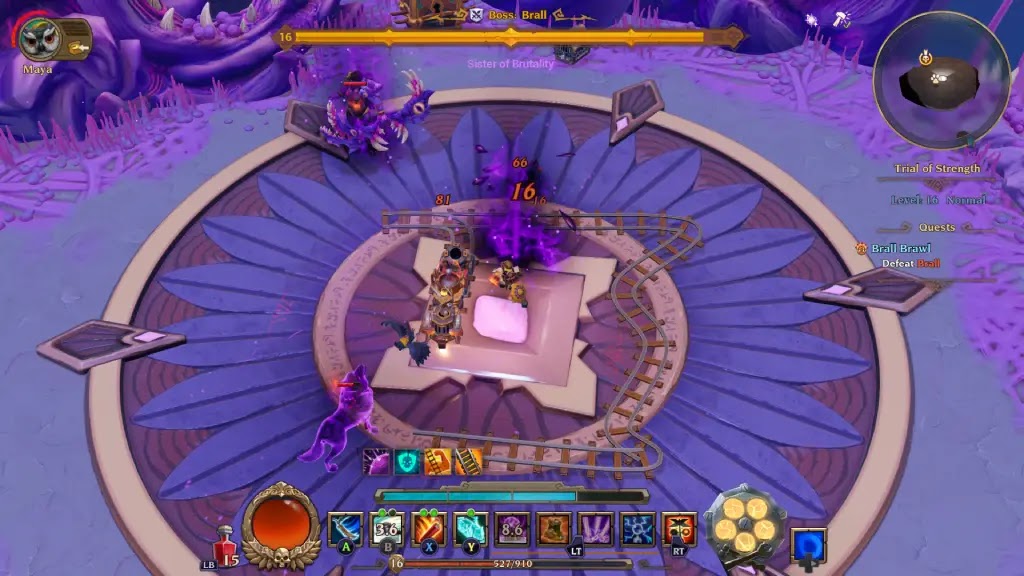

Making a return are your animal companions (pets) that follow you around, help attack enemies and carry extra loot saving you from constantly having to go back to town or your fort every couple minutes. A little different from before though, your companions no longer have a behaviour loadout to prioritize attack, defense, or staying back and out of harm’s way. While not leveling up per say, falling a little more in line with The Incredible Adventures of Van Helsing which used the beefed up idea of the original Torchlight’s animal companions, and your companions can now be loaded out with skills that are unlocked as you find other companions. Starting off with a Dog, Owl or Llama, you’ll soon have a variety of cats, birds, lizards or Fae depending on whoever was captured in those nasty cages often found by a boss' loot chests. They don’t level up like Katarina, but having skills is nice.

In an interesting approach, instead of having all of the main features residing inside of the main town that you visit, some of these such as re-allocating skill points or making lumber, ingots or stone bricks are done within your fort that is yours to fully customize. Shared loot stash, animal housing and certain elements to give you an edge on the adventure as time moves on such as bonuses to loot and fire resistances can be had. What was neat about the fort is that it falls along the world map “journey line” that you follow from one main zone to the other.

Otherwise, the gameplay is rather smooth. You can allocate skills to A, B, X, Y as well as those four while holding down the Left Trigger. Adding a ninth through the right trigger and most abilities are at your fingertips including potions, town portals to town or your fort, or sending your animal companion back to town to sell off some gear if you don’t plan on sacrificing it for upgrades. In an interesting change though, your characters no longer have access to a mana bar or sphere. Instead, certain abilities rely on runic energy that can be filled by normally attacking enemies. Other abilities use charges instead allowing for a fair variety in terms of combat strategy if you mix and match them well enough.
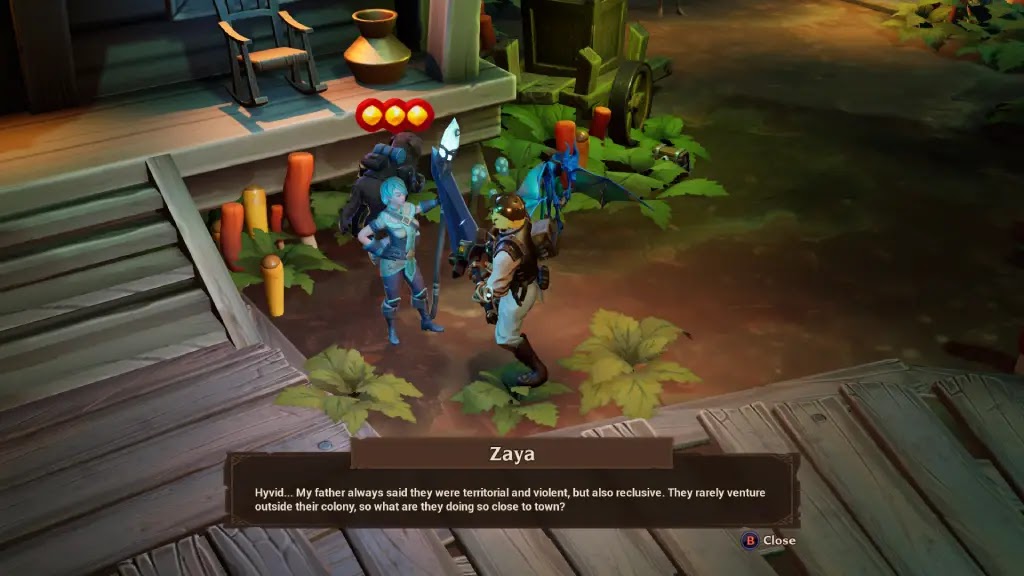

Now probably one of my bigger problems with Torchlight III is that the story feels lackluster and hidden behind a more generic MMORPG approach that is more about taking quests, ignoring NPCs and getting loot. Lots and lots of loot. There are some cutscenes, but you don’t really get the sense of “story” from those back in town that give you your quests. It just didn’t feel as involved as the others did, and to make sure, I reloaded my console version of the first and re-re-bought Torchlight II but for my XB1. Both of these were heavy on the story, had plenty of random people with dialog while Torchlight III gives you a bare minimum in order to point you on your merry Hacking & Slashing way.

The other issue, and this will hopefully be patched, is the response time on certain things. Switching between tabs, especially your fame tab, can lock the game making you wonder if it crashed or not. Otherwise, sometimes looking at your loot you won’t see any images or stats of your gear for several seconds making the management a bit tough. Compounding that, for some odd reason, there’s only one weapon set while most Hack & Slashes offer you two in order to be more adaptable to your situation. Finally, I found it odd that you actually didn’t have the ability to compare gear stats from what was equipped versus what you had in your inventory. You had to either math or equip it and see how much it affected it.

Summary

So overall, while Torchlight III doesn’t surpass its predecessors or do anything revolutionary* for the genre, it was a fun return to the ember filled world. With loads of enemies, challenges and class combinations in both single and multiplayer, if you’ve been needing a Hack & Slash fix, Torchlight III will have you covered.

*Victor Vran let you jump and wall jump… still blown away by that.

Score: 6.75 / 10


Share:

Tamarin - PC Review

Tamarin by developer and publisher Chameleon GamesPC (Steam) review written by Susan N. with a copy provided by the publisher.

Estimated reading time: 6 minutes


Tamarin is a cute single-player adventure platformer that follows monkey king Tamarin. His village was ravaged by insects and evil ants who set him home ablaze and kidnapped his family. Our mission is to save the wildlife and our family from the grips of the savage bugs.

Tamarin's Gameplay

From the beginning of the game, players are led through a short tutorial on gun usage, jumping, and targeting. We can leap around the area to find red mask currency and birdhouses. Redmasks are used to purchase new weapons and upgrades from a friendly hedgehog. Birdhouses are drop off points where players can successfully save 3 birds at a time. Therefore, it is important to find all the birdhouses to give them shelter.

Once we enter a combat zone, a number of abilities used in the overworld are disabled. Often, this is true in the Insekt Factory and not when Tamarin runs around the overworld. Disallowing access to the double jump ability or backflip ensures that players don't cheat their way into areas they don't have access to. We must find another way!


Early on, we are introduced to a hedgehog who serves as a guide. The spiked fellow keeps himself hidden from the ants and often pops up to trade currency for weapons or abilities. Each weapon has specific uses throughout the game and gives access to new locations. I like the hedgehog because he's helpful and pops up right when you need him.

There are a couple of different weapons players can use for gameplay. To start, Tamarin is given the Uzi, a precise weapon that is great for taking out one or two enemy ants. Next, the machine gun which shoots quickly but is inaccurate. And later grenades and rocket launchers used to open doors and pathways that can't otherwise be accessed.

Graphics and UI

Overall the graphics in Tamarin are beautiful. The scenery in many places reminds me of a watercolor painting with excellent lighting and depth. Even on medium graphics, the aesthetic is serene. However, in some sections of the game, the graphics did feel off. During one of the first tunnel areas, I strafed to the sidewall to hide behind a crate. Unfortunately, because of the controls, the auto-targeting would jerk the camera in such a way that I began to feel almost seasick. This is partly due to the fact that when players were against the wall, the camera location and character POV would sometimes glitch through the wall.

As for the UI/controls, there were times where my controller wasn't sensitive enough to target creatures properly. And, there is no option to change the field of view nor controller sensitivity, both of which would make for a much better gameplay experience. Another gripe about the game is that there is no keyboard/mouse support, although you can use the WASD keys. It's almost as though the developer deliberately reversed the mouse targeting and speed to a ridiculously high DPI to deter players. If this was intentional, I hate it. There's no reason to force controller only gameplay when there is actual input received from a keyboard and mouse.


Pros and Cons

Tamarin Pros:

  • Neat premise.

  • A great way to kill a couple of hours, though I wish there were more levels.

  • For the most part, the graphics are quite stunning.

  • The gameplay is fairly smooth. There was no lag between zones or cutscenes. However, the firefly animation did drop to 30 FPS at times.

  • In terms of audio, when Tamarin snuck across certain bridges there was no sound, but when he ran across there was a distinct wooden sound.

  • The game is designed so that it covers a broad age range.

  • Landing in water doesn't automatically kill the player, though the toxic water gave less time to escape.

  • Reminiscent of old school platforming.


Cons:

  • General Issues

    • Some of the firefly challenges are far too long. In fact, there is no timer carry over to make these a slight bit easier. (I have words for the person who came up with these...)

    • Sometimes there is momentum where it shouldn't be.

    • Enemy hitboxes are not consistent - sometimes you clearly hit them but the game doesn't think you did!

  • Options Menu

    • No KBM support! In fact, there is the ability to move and shoot on the keyboard and mouse but the targeting with the mouse is reversed (up is down, down is up.)

    • No sensitivity sliders for camera movement or aiming!

  • Camera

    • The camera work is abysmal at times. Occasionally it would get stuck on walls or reveal areas in behind them.

    • Camera controls are inconsistent.

  • Targetting

    • Targeting foes is sometimes a challenge. The auto-targeting doesn't focus on the creatures intended.

    • Also on that note, the targeting on the controller is painful. When using the targeting on an enemy, its radical would return to the center if you strafed. This made targeting almost useless, in my opinion.

  • Graphics

    • Sometimes collecting fireflies would lock its animations to 30 frames a second, but not consistently.

    • Also, running at the highest graphics settings revealed texturing on the monkey's head. It is reminiscent of old arcade simulated 'fluffiness' and I hated it.

This is a screenshot in 4k. Everything is beautiful except for the monkey's texturing.


Final Thoughts on Tamarin

This title had the potential to be fun, exciting, and cute. However, I almost echoed other reviews of Tamarin based on a short playthrough that left me feeling sick to my stomach. The camera controls and targeting comprise the bulk of my issues with the title. Also, as I'm a keyboard and mouse player, I struggled to play Tamarin because of the aforementioned issues. But, after trying my hand again and seeing the gameplay of others, I changed my initial impression of the game.

Overall, the game is a relaxing and fun platformer with easy puzzles and a decent amount of mayhem. Despite the fact that I struggled to play the game, I found myself enjoying it once I ignored some of its blatant issues.

Tamarin is a cute platformer with shooter elements that serve as a great time sink. It doesn't require a lot of thinking and the concept is straightforward, allowing players to pick up a controller to enjoy a couple of hours of fun. Beyond that, the game doesn't provide much else except for excellent graphics, awesome audio, and a cuteness factor. Unfortunately, the game doesn't quite reach the high standards of other games in its genre. As such, I give Tamarin a 7 out of 10. It was a fun experience once players get past some of its drawbacks. Besides, if we were given the option to play on a keyboard and mouse, I would be a lot happier with this title!

Score: 7 / 10


Share:

The Dungeon of Naheulbeuk - PC Review

The Dungeon of Naheulbeuk by developer Artefacts Studio and publisher Dear VillagersPC (Steam) review written by Richard with a copy provided by the publisher.

Estimated reading time: 5 minutes


A tale as old as time itself. A tale of adventure, loot, intrepid (mostly) party members, and the mediocrity of poor business administration and legislating of company internal affairs.

The Dungeon of Naheulbeuk is adapted from a French audio series, something I believe P.Y. could tell you a bit more about (Editor's Note: Loved listening to this series while on the bus between college and work), but can easily be seen as a parody of Dungeons and Dragons. Or perhaps maybe even just a wacky campaign from a particular session. In DoN you take the role of guiding hand for a party of ragtag adventures, tasked with finding the twelfth... seventh?...thirteenth?...well, a statuette that definitely isn't the first, that is supposedly in the bottom of the Dungeon of Naheulbeuk, a place rarely visited where no adventurers have returned from! Except it's actually run by a co-op, and is apparently a fairly popular, or at least populated, place.

It even has an inn built-inn! (#SorryNotSorry).

Either way, your team consists of a number of different and fairly clear cut roles that you commonly see in D&D campaigns, such as: the cowardly thief, the egotistical ranger, the ditzy archer elf, and a dwarf (just a dwarf). Somewhat ironically, I'm actually playing a D&D campaign with some friends right now that matches the characters in DoN pretty close. Yes, it's full of shenanigans and jokes, both DoN and my campaign.


As is usual in these style of things, your group of eclectic adventurers travel through the dungeon in search of the statuette in order to complete their quest! Obviously enough this is met with resistance that you must get rid of. This is done in combat that is very much similar to how a D&D encounter would play out, with a few notable exceptions. Upon engaging in combat, you may orient your party members as you desire in the space provided before beginning combat.

The combat itself is turn based on a movement grid, where characters with higher bravery values get to perform their actions first. Each character has two basic actions they can perform per turn: movement and "action". These can be performed in any order, but you are generally only allowed one of each, or two movements that count as dashing, and will use up your "action". Your action may be a melee attack, ranged attack, skill, or item use. Now, the two most notable differences to playing something like tabletop D&D are the introduction of what I like to call "the bullshit bar" and the ability to delay your turn.

The turn delay is exactly what you would expect: you push your characters turn to the end of the turn bar. This is actually way more useful than I thought it would be, as you can wait for enemies to take their turns before moving into a better position to attack them from. The "bullshit bar", on the other hand, feels like it was made specifically for people with awful luck, like me. Basically, whenever something unlucky happens, such as missing an attack or getting hit by a critical strike, the gauge will start to fill up. It has four tiers based on how much "un-luck" you may have, and remains after battle. Each tier provides a different effect when used, allowing you to maybe salvage a fight where you've missed an enemy thirteen times in a row. Yes that actually happened, and no, I wasn't happy about it.


So, on that note let's talk about something here: game is hard. Like seriously, I almost had a full party wipe in the tutorial. On the plus side, the game autosaves a lot, so chances are you have a save you can fall back on if things get too hairy. After scrabbling through an encounter, you are rewarded with cash, experience, and loot! Glorious loot with some great flavour text.

Characters can be equipped with new gear to help increase their stats, and potions can be used, as health doesn't recovery between battles. Upon leveling up, characters will gain stat points and skill points, which can be used to increase their bases status, such as constitution and charisma, and to unlock new skills respectively. This is very much in the same vein as Dungeons and Dragons, so those familiar will probably feel right at home. One nice difference from traditional D&D is that skills and magic use mana or stamina points, which recovery at a set rate each turn, meaning no "once per day" spells or actions.


The game itself is modeled in a more comicalized style, which is really representative of the games humour. While the main focus of Dungeon of Naheulbeuk is on its weird cast of characters and the misadventures they get into, the developers definitely didn't skimp on the graphical side of things. Environments aren't exactly "sprawling", but are well put together and rendered quite nicely, giving a nice sense of the area you are in, instead of just the same generic tone. One particular example is walking into a dirty bathroom, and you get a very visibly different style inside the bathroom as opposed to the rest of the dungeon, something you don't usually see all that often.

Ultimately whether or not you will enjoy Dungeon of Naheulbeuk is probably directly related to how you find the humour. While I quite enjoyed it on a standard basis, there are a few gags or jokes that definitely fell flat for me, and would no doubt fall flat for others as well. That being said, the combat is incredibly well done, and at no point did I think an encounter was particularly unfair, or that the combat mechanics were awful. Tough yes, but not unfair.

Summary

Overall, I have to say the The Dungeon of Naheulbeuk was a really fun delve into a funny cast in the style of a Dungeons and Dragon campaign where the storyline isn't at all serious. It's full of wacky characters, funny situations, and a combat system that doesn't make you regret getting in a fight. Colourful flavour text is abundant, and each character has their own role that feels like it compliments the party well. Naheulbeuk is as fun to play as it is hard to pronounce.

Score: 8.5 / 10


Share:

Prinny 1 and 2: Exploded and Reloaded - Switch Review

Prinny 1 and 2: Exploded and Reloaded by developer Nippon Ichi Software and publisher NIS AmericaNintendo Switch Review written by Richard with a copy provided by the publisher.

Estimated reading time: 6 minutes


Do you like penguins? Hilarious cartoony characters? Games that don't take themselves too seriously? Smashing your face into a wall 1,000 times before failing spectacularly? Well then, NIS has two titles for you, and they're both about the lovingly-volatile-when-handled-roughly prinnies.

Prinny: Can I Really be the Hero? and Prinny 2: Dawn of Operation Panties are very similar, so these two titles come as a package deal for this review. Prinny 1 and 2 sees you as a Prinny, the exploding penguin mascot type characters of the Disgaea series. They are the souls of human sinners stuffed in penguin suits and forced to work off their sins in the Netherworld.

Both games are part of the "IF" route from the first Disgaea, where Etna has more or less taken over as ruler of the Netherworld. In both games, Etna has something stolen from her, and the Prinnies (all 1,000 available ones) are tasked with retrieving said item. In the first game this is "the ultimate dessert", and in the second, it's her panties.


Taking a step away from the traditional Disgaea formula of turn-based grid tactic style combat, Prinny 1 and 2 are more 2D action RPG style games in the same vein as Super Ghouls and Ghosts. And yes, it is just as hard. Now, those fans of the series may recall that the prinnies are prone to explosion. Well, that hasn't changed, but Etna has bequeathed them a scarf that will let them take up to three hits before exploding, depending on selected difficulty. You have 1,000 prinnies with which to complete Etna's task, which may seem like a lot at first, but really isn't. So how can the Prinnies complete Etna's tasks? Well, both games are divided up into stages and hours. As you complete a stage, the hours you have left to complete Etna's task decreases, and the stages get harder. Once you complete a stage, you must move on to another to collect items that will help you in completing the game.

So how does a Prinny go about completing these stages? Well, stages consist of a platforming slog that may at times seem like a masochists Eden, followed by a boss that can be anywhere from "annoying" to "*unintelligible screaming*" in terms of difficulty. Prinnies aren't exactly the most robust of demons, so their available skillset is fairly minuscule: they can walk, spin to dodge, dash, jump, double-jump, and throw machete blades while in the air. Jumping and double jumping are set upon starting a jump by the way, no changing direction even remotely while airborne, unless you use your second jump to do so.

The Prinnies also have a ground pound, which will allow them to stun enemies, making them easier targets. As you attack enemies, you fill up a combo gauge. Upon filling, in Prinny 1 you get a bonus item, and in Prinny 2, you enter a sort of over limit mode, where you deal enhanced damage, and have access to a few new special moves. Combat will probably only really be a focus in the boss battles at the end of each stage though, as you need to ground pound bosses a set number of times to deplete their "shield", before you can really lay into them. Most bosses in Prinny 1 are quite reasonable. I don't want to talk about Prinny 2. grumble grumble tank arse lady. What is probably more in the forefront, and frustrating, is the platforming required to reach the bosses. It's tough. In Prinny 1 it's mostly difficult but fair. Prinny 2 though? Good god man, some of the stages are so egregiously difficult your first twenty attempts you may as well just take your whole first run of Prinny 2 as "practice".


Expect to die. A lot. There's a reason they give you 1,000 Prinnies, and it isn't hand holding. I consider myself rather partial to these style games, so when I say it's tough, I really do mean. As of writing this, Prinny 1 took me 188 Prinnies, which I feel was quite good. Prinny 2, admittedly I haven't finished, but I was already down 300 Prinnies halfway through the game. So yeah, take that into consideration when considering the purchase. As far as plot and storyline go, both games are pretty funny, and the characters you meet are all pretty interesting in their own ways.

Gameplay is solid, if not frustrating at times, and while there were a few moments I thought I got carpal tunnel from sucking the machete blades at the last boss in Prinny 1, I was...pleased with the execution, if not some of the stage requirements. Fun fact, there are rideable machines that you can drive that took me until a quarter of the way through Prinny 2 to learn how to exit. You can "jump up" out of them. As is Disgaea tradition, there are plenty of hidden items, endings, and little secrets to collect, whether it be hidden bosses, game modes, or just medals for completing certain objectives.


Now, Prinny 1 and 2 originally came out for PSP in 2008, and while the music holds up, it still really screams "2008 handheld". Is that bad? No. Does it work with gameplay and style? Yes. Would it have been nice to see a bit more of an upgrade? Definitely. The humour is well appreciated, and I really like the way that stages and bosses will differ depending on what "hour" you complete them on. There's tons of joke references, and while some points make you want to throw something out a window, the sense of accomplishment when you complete it is definitely worth it.

Summary

Overall, Prinny: Can I Really be the Hero? and Prinny 2: Dawn of Operation Panties are titles that are tough as Orichalcon, but full of flavour and love. These games are for masochists through and through, but are still fun even if you are using more than half your Prinny lives. The gameplay has held up well, and although difficult, it was a lot of fun, even if it feels like smashing your face against a brick wall at times.

Prinny 1 and 2 are hard, but full of character. If you think you've got what it takes to triumph over the levels designed to melt through 1,000 lives, check out Prinny 1 and 2.

Score: 7.5 / 10


Share:

Spiritfarer - PC Review

Spiritfarer by developer and publisher Thunder Lotus Games—PC (Steam) Review written by Susan N. with a copy provided by the publisher.

Estimated reading time: 8 minutes

Spiritfarer is a game that lets players take the place of Charon who ferries souls between the living and the spirit worlds. Players learn that each person has demons to confront before they reach the Everdoor, the portal to the afterlife. After playing through this charming and disheartening title, I feel relieved that the subject of death is handled with care, especially since I struggle with certain people's passing.

Gameplay

We are introduced to Charon at the beginning and he is exactly what we expect. This is a surprise because all the other characters change forms where we do not. No matter, we are thrown into the thick of things with Charon's boat, a special light granting us powers, and our first passenger kicks things off.

Before we can progress, we have to tidy up the boat. Getting rid of the boxes and leftover items serve to build a guest house for new passengers. Though, later on, each character will want their own.

Our next trip is to Albert's Shipyard for boat upgrades, which includes everything from speed boosts, to light additions, and to enlarge the vessel. At this point, we know that each upgrade requires specific items collected from various locations in this world.

Spiritfarers' gameplay is unique in that farming, cooking, logging, mining, and fishing are all required to succeed. First and foremost, the characters need food to survive. Then we have to cut logs into planks to construct or improve buildings. Finally, each character has objectives to complete before they can be brought to the Everdoor.

Early on, Gwen (the first passenger) introduces players to one of the mini-games. Most mini-games are initiated by individual characters while in certain areas of the map. For example, there are black circles on the map with a shooting star image. It contains bright jelly, an upgrade material for the kitchen. To activate the mini-game for bottled ectoplasm, players need to have discovered a different character. And should a player enter an area without having unlocked the event, they won't be able to get the resource!

A Couple of Pros and Cons

One of my primary issues of Spiritfarer is the idea that in the late game, the pacing is off. I don't mind the fact that players can take their time with different quests, but spending hours traveling the world without having the ability to get some of the resources is what slows its pacing. Notably, ectoplasm can't be found unless players have discovered a particular character that is not found by normal means. Thus, Stanley did not come onto my ship until many weeks had passed in the game.

I also love that there are D&D references in Spiritfarer!

One of the best features of Spiritfarer is arguably the character's stories. We learn that not all characters are proud of their choices in life. Others are content with themselves by the time they reach the end. We learn that characters are crass, or quick-witted, or fell in love with the wrong person. Each character has their charm which leads to our personal feelings about these people when we take them to the Everdoor. I laughed with Gwen's dialogue because of lines like this: "People like you are the reason we have middle fingers." (That biting wit... LOVE IT.) I cried with the departure of Alice. And I was shocked at the passing of another character.

All told, Spiritfarer is a fantastic game. Thunder Lotus not only brought a game to the market that positively sheds light on the subject of death, but they did something even more remarkable. They paid tribute to their staff by remembering friends and family members who had traits like the characters in the game. Talk about caring about your employees, their dedication to Spiritfarer surpasses many games because of what it means to their people. How can one not appreciate this kind of action?

Graphics and UI

Players can use a keyboard or controller for their experience. I opted to play on the controller since I used a TV for much of my playthrough. It's easy to access the quest menu and the inventory because of the keybind layout. It took some getting used to holding up on the analog stick to catch a zipline.

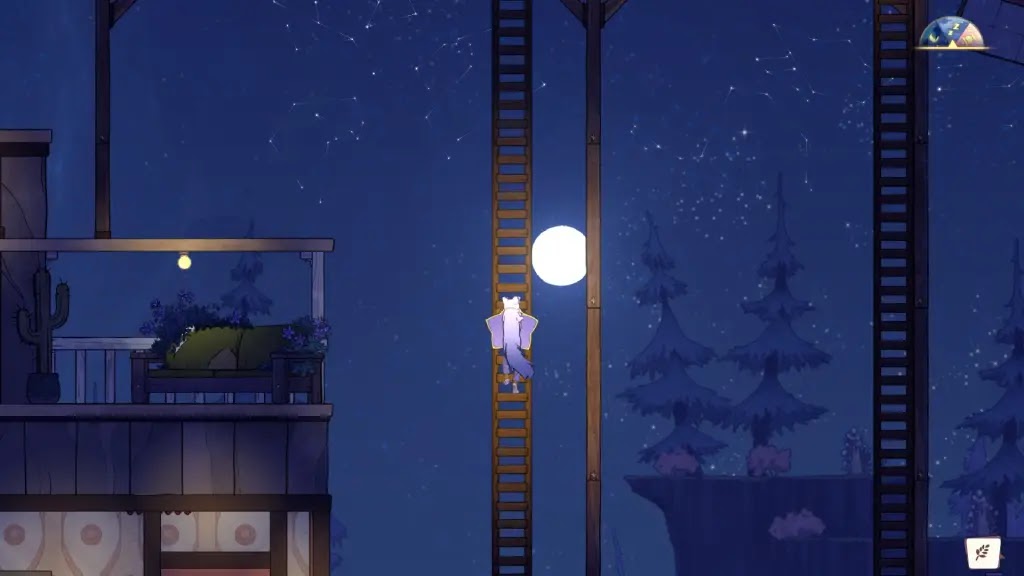
The top right-hand side of the screen shows the day-night cycle. This is useful for knowing when Stella (your character) needs to wake up her guests. It's also useful to know when players can set the boat to travel (for some reason, it isn't allowed to travel at night.) Because of this, players can't see the world map unless they are at a bus stop or able to access ship navigation - another minor nuisance.

I appreciate Spiritfarer's graphics style. When Stella meets different characters, they look like a humanoid covered with a sheet. Upon arrival on the ship, they can transform into a frog, a hedgehog, a lion, a bird, or a snake. All characters are genderless and are defined by their dialogue and demeanor. This is because there is no voice acting. For some reason, I always thought of Atul, your uncle, to be a woman. He just had the enthusiasm and outlook on life that seemed more feminine. I don't know why I assumed that considering he tells you he's your Uncle.

Another element of the graphics that I enjoy is the attention to detail. When players are inside mines, there are visual indicators that there is a hidden pathway leading to collectibles or other characters. After a character passes through the Everdoor, they are commemorated in the sky as a constellation. Depending on where players are on their boat, at night time you can visibly see these constellations.

Music and Audio

The first thing to note about Spiritfarer is the fact that there is no voice acting, meaning that players have to read the dialogue. The most we get are small noises from the characters like a 'hmm' sound when interacting with them. However, what sells the game, other than the subject matter, is the music.

Max LL (Maxime Lacoste-Lebuis) is a Canadian composer who has been in the music industry for nearly a decade. His music has been played by the Montreal Metropolitan Orchestra and has been featured in games, films, and other projects around the world. Max LL is a long time composer for Thunder Lotus Games and has worked on other notable soundtracks like Jotun and Sundered. His experience with music and sound design is a brilliant addition to Spiritfarer and I'm here for it.

I found that his compositions never outshine the serious theme of the game yet it is fitting and beautiful. The music pops out during key moments like bringing characters to the Everdoor for maximum emotional effect. It's no wonder that his compositions appear in several games developed by Thunder Lotus. Below, I've linked the soundtrack to Spiritfarer. Have a listen!

Spiriting Final Thoughts

I find that Spiritfarer is an amazing game that almost flew under my radar. It tackles the topic of death with care and this made me appreciate more because I'm still affected by a family members' passing. I love that each character has a story and a personality, sucking you into their world. However, the greatest feature of Spiritfarer is the fact that the entire game is a tribute to their staff by modeling the characters after Thunder Lotus family and friends who've passed on.

Also, I'd like to add that Thunder Lotus took care of another aspect of game development, especially with a topic like death, and that is developing a game that is ambiguous about religious belief. Even though we take characters to the Everdoor, the game developers don't assume what players believe exists about the afterlife. And as a person who doesn't believe in the normally accepted vision of 'God', I appreciate the fact that the developers don't make assumptions for its players.

Summary

Spiritfarer is a fantastic game that deals with the topic of death but it's much more than that. It is an unforgettable experience. Players connect with the characters before taking them to the Everdoor, or their final resting place. Thunder Lotus treats the subject with care and Spiritfarer serves as a special tribute to the developers' friends and family who have already passed. Overall, I found myself enjoying my 40-hour playthrough of this somber and amazing game. Thus, I give it a 9 out of 10 so don't miss the boat on this title!

Score: 9 / 10


Share:

Inertial Drift - XB1 Review

Inertial Drift by developer Level 91 Entertainment and publisher PQube LimitedMicrosoft Xbox One review written by Nick with a copy provided by the publisher.

Estimated reading time: 5 minutes

Inertial Drift is best described in a single word: slick. That being said, that hardly encompasses everything, but this arcade racer offers lots of fantastic modes and plenty of thrills, all wrapped up in a somewhat simple but appealing visual package.

First, I just need to talk about the visuals. It’s interesting, because they are not the most technically accomplished graphics in the world. You don’t get photorealistic lighting effects and reflective surfaces like you see in many of the AAA racing games out there, but there is something distinctively gorgeous about the neon-soaked world of Inertial Drift, which somehow has both a retro and futuristic vibe going on at the same time. It is all just incredibly distinctive and the thing that first stood out to me even when the game’s initial announcement and trailers came out.

However, whether a racing game is going to hold up ultimately boils down to how it handles, and to that end Inertial Drift manages to be really unique, but loads of fun at the same time. I will say that the control scheme while being intuitive, still sometimes took a bit of adjustment on my part. It’s simple to learn – your left stick serves almost more as a strafe, moving you left and wright without actually turning you. The right stick is what aims the nose of your car and creates the ‘drift’ effect in the game’s title. The effect is in no way realistic, but that’s not the point in Inertial Drift – the focus here is an arcade-style brand of fun, and to that end it succeeds wildly.

There were definitely times however, old racing reflexes kicked in, so while it was an easy concept to pick up and learn (I won my first handful of races with no difficulty at all), there were absolutely times where I would let off of the right stick and accidentally skid into a wall because… well – my fingers started manipulating the controls just like they did almost every other racing game from the last couple of decades. Those hiccups aside however, I found the core gameplay rewarding – if at times perhaps threatening to become just a bit repetitive due to the lack of nuance.

There are different cars that can be used, and they certainly feel different from one another in the typical ways: handling, speed, acceleration and so on. However, this is not a simulation racer, and you don’t spend oodles of time under the hood tinkering with settings to create the perfect glove-like fit to your racing style. That may irk purists looking for more serious racing titles. Here it is all about the actual racing – so much so that I was stunned the first time I had an opponent on the track with me. Why? Because I tend to be a bit of a ‘paint rubber’ – in other words sideswiping my opponents is a pretty common strategy for me. So imagine my surprise that first time I was leaning into a curve, waiting to throw my weight into the car next to me and knock them silly only to cruise right on through them. There are competitive racing modes – but you are meant to focus on actually outracing your opponent, not beating them to a pulp. It makes perfect sense, even if it was a bit disappointing due to my desire for carnage.

There is an actual story mode, which works quite well due to its length, variety of modes and how it also serves as a fully functional tutorial. You run into a variety of different race types, such as endurance (keep hitting checkpoints to extend your timer), duel where you time spent in the lead earns you points and the first one to a specific score wins, time trials, ghost trails and more. Probably the most unique of these modes is Style – where you earn points for various types of tricks like extended drifting, driving close to rails, things of that nature. The core story can be played with a variety of drivers, which helps since it only takes a few hours to complete any one racer’s story. That being said, since all of the cars handle differently (and in particular drift differently), you get some nice variety in playing through with the different characters.

All of that being said, the variety of modes and cars that can be unlocked still doesn’t provide quite as much content out there as some of the other bigger name racing titles. You will burn through this considerably faster than say a Forza title, but that’s okay because Inertial Drift’s pick up and play nature makes it perfect for short sessions where you just need a quick burst of racing goodness. The tracks provide good variety, and the online and offline modes should suite everyone from those who like to just plug away at single player content or those who like to test their mettle against other players.

Summary

Inertial Drift is just about an ideal arcade racing game. The visuals are colorful and smooth, the gameplay is unique and easy to pick-up with just enough variety in cars to keep you learning and improving throughout the game’s varied if somewhat brief content. Fantastic to pick up and play in short bursts, even if it lacks some of the depth found in more polished AAA simulation racing games.

Score: 8.25 / 10


Share:

Adventure in Aellion - PC Preview

Adventure in Aellion by developer and publisher The Game Production CompanyPC (Steam) preview written by Pierre-Yves with a copy provided by the publisher.

Estimated reading time: 4 minutes

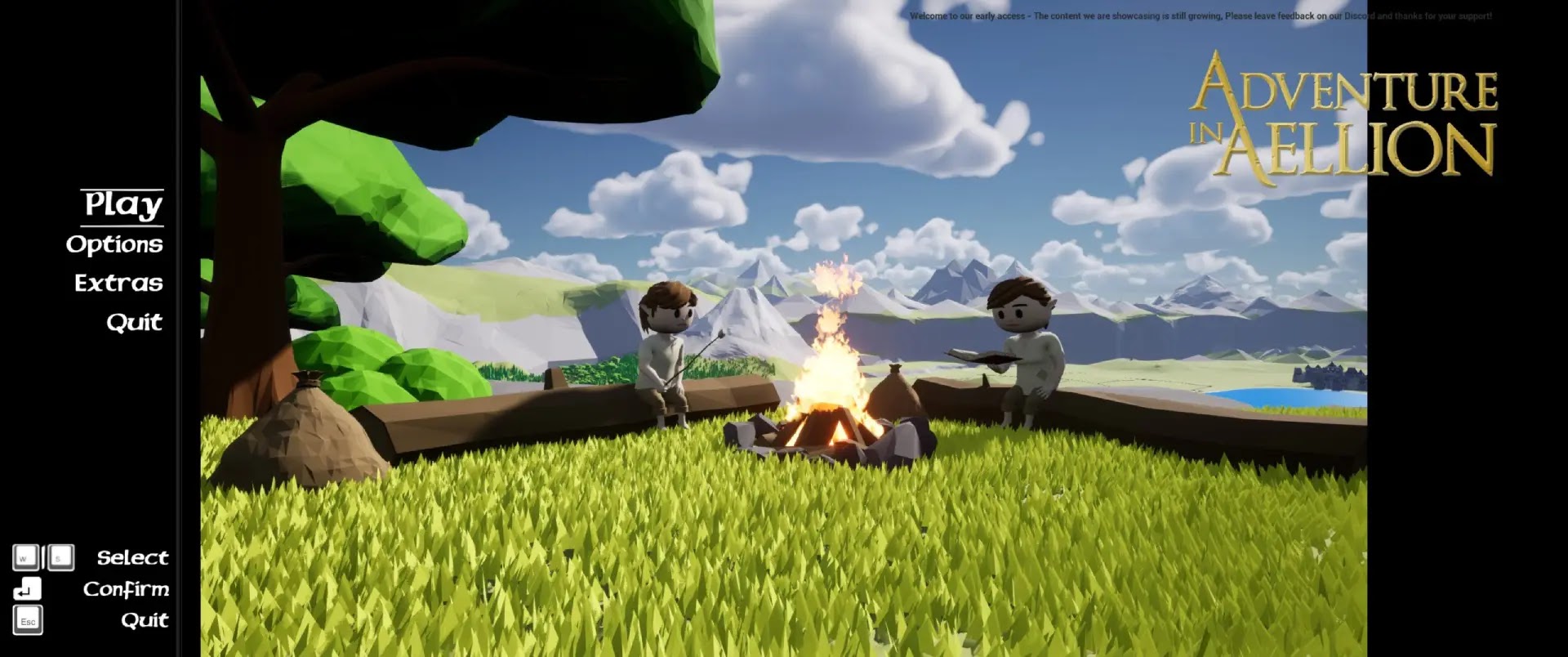
Having launched its Alpha state over the summer, The Game Production Company have brought both their Single Player and Coop Adventure In Aellion to Steam’s Early Access. “Open world” and just waiting for you to explore its reaches, you’ll first have to make your way out of the tower that you find yourself in that acts as the tutorial familiarizing yourself with all of the basics.

Still fairly early in its development cycle, Adventure in Aellion is perfectly playable but still a little rough around the edges. This is the perfect example of what I meant in my RPG Maker MZ review with Nick, video game design takes a lot of work and if you know how to code go for it. Whether using your own engine or someone else’s though, it’s going to be a fair amount of work and it’ll take some time to get it right. It’s this aspect that is showing through the cute chibi graphics of your characters as the main actions are present, but the rest that is along for the ride still needs some polish.

Right now, especially in the very beginning, if you don’t follow the dialog chain to the letter, you won’t be able to move forwards and even have to restart. Oftentimes, like me, you’ll think alright I know what to do as I’ve already done it a hundred times before, and in this case over the summer, but then you’re stuck standing around because certain event triggers did not activate. In order to leave the tower, you need to talk to the various bi-ped bulls standing around which give you the direction that you need to grab your sword, throw a switch and defeat some goblins. IF, if, you defeat those goblins before finding out about the gear though, the gear won’t pop up and even talking and asking around, it won’t hit the necessary trigger keeping you there until you restart.

This isn’t the end of the world especially so early in the adventure and that being able to save your progress has now roughly been implemented as it hadn’t over the summer. Unfortunately, in regards to this progress, once you go into a dungeon, like the first one for example and if you accidentally leave it (yes it’s possible) ALL your progress is erased. The unlocked doors? The keys? The Puzzles in between? Reset and you have to do them all over again which leads to something else that needs to be fixed. Right now, if you die, if you fall off of a ledge, you’ll start back at the entrance and depending on how your camera angle was placed? You’ll walk right out instead of forward like you were anticipating. So waiting a few seconds is almost a must if you don’t want to lose your progress in the dungeon.

These sound like really big things, and they are, but otherwise? The rest is smooth enough. Walking, running, jumping, swinging your weapon, blocking, shield bashing, hell, having your shield out for defense while your lantern is out. All of these actions and others like throwing switches or riding horses across the landscape, it feels comfortable so the developers already have that going for them. It is still early, and from what I’ve recently seen even just from this past summer, the progress is clear to see.

Still very much in its early stages and a bit rough around its edges, there’s the premise of something great to come if the necessary polishing and adjustments can be done. Otherwise, if you want to start experiencing Aellion now, there’s enough to do and with more to come you can’t go wrong especially with its current price tag.

As a final note, it is possible to play online with others but for our current preview, we are only covering the single player aspect of Adventure in Aellion. We’ll be back next time with an updated look at the world and how it works in online coop!

Score: N/A


Share:

Bounty Battle - XB1 Review

Bounty Battle by developer Dark Screen Games and publisher Merge GamesMicrosoft Xbox One review written by Nick with a copy provided by the publisher.

Estimated reading time: 5 minutes

Bounty Battle has one of the best ideas I have seen in a long time: gather up favorite characters from various indie video games and put them together in a Smash Bros.-like fighting game full of arcade hijinks. Unfortunately, the developers squander all of that promise with sloppy controls, boring gameplay and a terrible presentation destined to make this my most disappointing game of 2020.

Sometimes when I play a game, I find myself frustrated early on because it was not quite what I had been expecting. I think as gamers, we’ve all been there. However, I stick with it, because generally with a little extra time and effort on my part, I can see where the developers were trying to go with things. I might not always agree with it, but if I squint hard enough, I can at least understand intent and glean some silver linings.

Things open in promising fashion. When I fired up Bounty Battle I was greeted with a slick movie that quickly showcased so many favorites from different games like Guacamelee!, Darkest Dungeon, Dead Cells, Awesomenauts, Axiom Verge, SteamWorld Dig, Battle Chasers Nightwar and more. It is an inspired roster filled with colorful characters ripe for creating unique move sets that should fuel many hours of gameplay.

That’s our silver lining – and from here it all goes downhill.

It’s interesting to see that this title claims to be inspired by such games as BlazBlue, Injustice, Street Fighter and Skullgirls, because the only thing it really has in common with those mainstays of the fighting genre is that… well, it’s a video game. I know this is a harsh critique, and I hate coming down on something that someone else spent long hours working on, but the fact of the matter is, Bounty Battle feels half-baked at this point. There were warning signs in it being pushed back from its initial release date, but I generally try not to read too much into delays. 2020 has been a really weird year that has impacted people in a variety of ways, and if the devs felt that they needed a bit of extra time to make sure they got things just right? My thought process was: more power to them.

Now I’m wondering what that extra time was spent on. Despite listing those notable 1-on-1 fighting games as the inspiration for Bounty Battle, I think Super Smash Bros. is a much more apt (attempted) comparison. Sometimes battles are 1-on-1, but sometimes you’re taking on multiple characters. You’re trying to knock your opponents off of a platform, generally made easier by racking up damage against them in the process. As a core system, that’s fine. It’s worked exceedingly well for Nintendo’s Smash Bros. games, but this is the end of that comparison, because the combat in Bounty Battle is a murky, slog of a mess by comparison.

For one, the characters feel horrifically unbalanced. It was as though the developers had ideas for the characters and threw them together without really giving any careful consideration to the powerful back and forth aspects of combat gameplay. Some of the characters just feel more fully fleshed out than others, which is a serious no-no in a fighting game to begin with. Visually the art style itself works, but the animations are rough and combat lacks umph, relying heavily on overdone particle effects that seem as much flashy as they appear to be trying to mask the subpart character movements.

It does not help that this game is not very friendly to newcomers. Often these battler games have an element of ease with ‘pick up and play’ for groups to just settle in and wallop on one another. The control scheme just feels chunky and unwieldy from the beginning. There is a ‘minion’ system baked in there that sounds cool in practice, but in execution is pretty lacking. The framerate struggles whenever there are several characters playing at once, and without that smoothness in the controls it becomes a nightmare to string together combos. There is a neat idea buried in here about penalties and bonuses for unique attacks, but given how shallow some of the move sets are (especially for range-heavy attackers), if found myself often feeling panelized for doing what I had to just in order to survive.

Were the combat actually fun, the shallow single player content could be more easily forgiven. However, there is no story mode – just a tournament one that brings together a series of increasingly difficult battles. Each of the five events deserves credit for shaking things up a bit by giving different objectives along the way. It is the best option for breaking up the monotony of the others 1-on-1 battles and training arena.

Summary

Unfortunately Bounty Battle is a series of missed opportunities almost destined to be a candidate for our site's yearly awards – but not one of the good ones. Horribly unresponsive controls, shallow move sets and game modes and a clunky presentation all squander the goodwill that comes from bringing together so many awesome indie characters from across numerous other video games.

Score: 2.5 / 10


Share:

Paper Mario: The Origami King - Switch Review

Paper Mario: The Origami King by developer Intelligent Systems and publisher Nintendo of AmericaNintendo Switch review written by Natasha with a purchased copy.

Estimated reading time: 11 minutes

I can't tell you how excited I was to hear that we were getting a new Paper Mario game back in the month of May AND that I only had to wait a month and a half to be able to purchase it. That's impressive. I've always had a soft spot for the Mario RPG-style games since way back on the SNES when Super Mario RPG: The Legend of the Seven Stars came out. With Thousand Year-Door being my favorite out of the Paper Mario series, I couldn't wait to start playing this new and stylish looking game.

Paper Mario was developed by Intelligent Systems and published by Nintendo for the N64 back in 2001. Acclaimed for being one of the best RPG's on the console and having a refreshing and somewhat strategic battle system this was the start to a charming 2D folding adventure. The unique look is what makes this Mario series different then other. Unlike when The Legend of Zelda: The Wind Waker decided to change it's appearance and everyone was like WTF? Paper Mario was able to draw in a curious crowd of gamers that fell hook, line and sinker for it's new fashion choices. Even to this day I'm still impressed that they can still surprise me with new and creative ways to FOLD our Moustachioed friend.

The Story

The story starts off with Mario and Luigi driving (Really? Driving? No air ships or warp pipes?) into the Mushroom Kingdom on their Go-Kart (Must have just finished a race in Mario Kart: Double Dash) to celebrate the Origami Festival near the castle in Toad Town. But upon arrival the place is a ghost town. Worried, the two brothers rush to see the Princess at the castle only to find that Peach has been FOLDED into a mindless follower by King Olly and his FOLDED Soldiers. Desperate to save her Mario teams up with Olivia, his origami companion, and runs around the kingdom in search of the coloured streamers that surround Princess Peach's castle. Will they unFOLD this tragedy?

The Open World

One thing that stays consistent in Paper Mario games is that they always have a large open world experience. As mentioned earlier, Mario starts off in the Mushroom Kingdom and from there he visits all kinds of geographical environments. Forests, Oceans, Desserts, Tundras and the odd Modern Cultural town or city. Over the years I find this to be a bit repetitive, however with each instalment comes a different piece of that echo-system. Remember that Forest segment in the last game? Whelp, we've added dancing trees. Very little Ocean time in the last game? Let's give you the wheel and have you explore the surrounding area. Do you recall that Western?... It's still there, but with more empty dessert. (Editor's Note (Richard): normally there are seven or so areas in a Paper Mario title, but they dropped that down to five for Origami King)

It's about a 50/50 chance of you either enjoying it or grumbling that it's the same thing as the last time.

For Origami King they have taken the idea of paper and multiplied it by ten-FOLD. Characters, locations, and most items are all made out of paper. This time around Mario is given something called a confetti bag. This bag will hold any pieces of loss paper that are found throughout the game. Shaking trees, smashing rocks or foliage, defeating enemies and finding specific items that'll drop paper is a must in this game. You'll also come across missing areas of the map and when I mean 'Missing' I mean that something has literally torn a chunk of paper out of the picture. Mario can take damage if you fall through. (ED note: a surprising amount of damage at that) So with your handy-dandy scrap bag you can throw out the pieces of paper you've been collecting in the game and repair these holes that are scattered around the world. Fixing missing areas or defeating enemies will also drop coins which you can collect and save in order to help you buy weapons or badges.

Speaking of collecting, this game has plenty to collect from finding all the hidden Toads, to repairing all the tears in the map, to finding trophies that represents an item or enemy in the game. Everything that you find will be logged in your menu, as well as the museum in Toad Town. There you can take a stroll and figure out what you've collected and what items you're still missing. For being a trophy hunter myself I am driven to go through each area with a fine toothed comb and a magnifying glass, trying to find each exciting way they could have hidden something in the environment. (ED note: I just finished the 100% completion recently, and while most of the hidden ? Blocks are reasonable, some of them made me want to flip a table. Thankfully you can pick up an item that will indicate direction and proximity to toads and ? Blocks.)

Combat

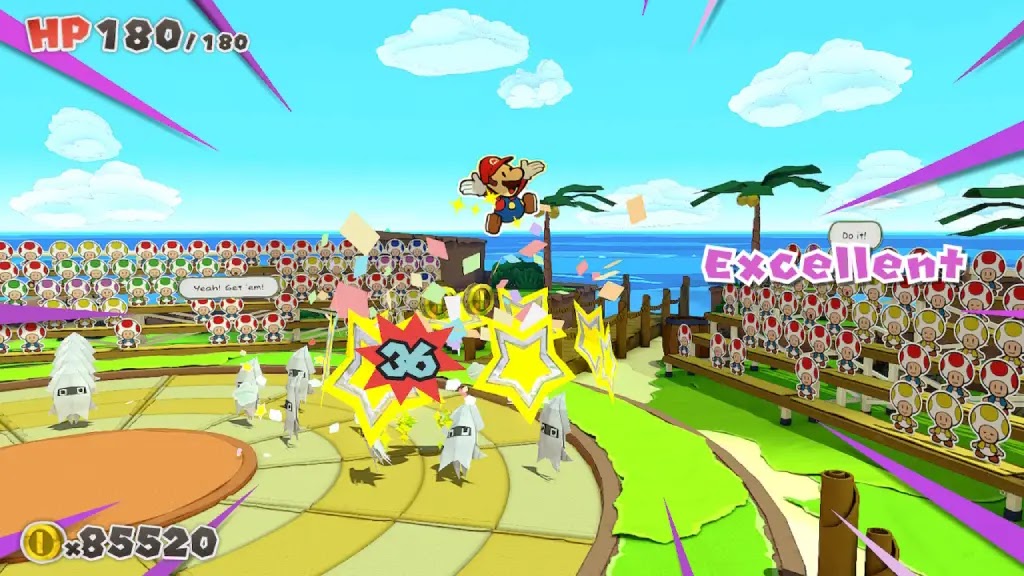
Here's something that I haven't got a sweet spot for in this game. The combat has changed a lot since the last Paper Mario I've played and I'm sad to say that I'm not impressed. Let's say that Russian Roulette decided to have a baby with a Rubik's Cube. The results... are not pretty. Enemy encounters happen when you engage them by either running into them or getting in a preemptive strike by bopping them on the noggin with your hammer or jumping on their heads. At the start of the battle the enemy will jump somewhere within the perimeter of the field. It's up to Mario (You) to solve a 1-3 move action to either line them up like domino's or bunch them together like a sandwich. If you succeed you get a power boost on your next attack. Fail and your dealing less damage.

OH!... You also have a timer to run against. So not only do you have to waste time figuring out a puzzle, but you also have to do it quickly. You CAN offer up coins to increase the timer, but I find this to be quite annoying when I just wanna get the battle done and over with. Have fun with that. (ED note: on the positive side, I actually found the battle system grew on me the more battles I fought. You can also get accessories that increase your battle time by a lot. The toad for the battle house also can give you an item to turn on that will help simplify the battles if you're having trouble)

Mario can choose to attack with either his hammer, boots or items. They did leave in the ability to deal max damage by making sure to hit the attack button at just the right moment, which is a nice bonus. You can also payout Toads (The ones you rescue in the game will become spectators during your fights) to help solve battle puzzles, so if you find yourself scratching your head over how to solve it just flash some of that Mulla you've been saving up and watch the mushroom folk go to town on the enemies. (ED note: the toads will also toss items at you depending on how much cash you drop on them, possibly even filling up your health)

However I believe the developers decided to take a page out of Breath of the Wild because all of your weapons have durability. Come on... REALLY! Other then your primary Boots and Hammer, Mario can find or buy stronger equipment to help him in battle, but they have a limited amount of use before they break. (Editor's Note (Richard): you actually get a fair number of uses out of the breakable weapons, and you get enough that by the end of the game I had about 35 weapons just sitting around in my inventory. You can also swap weapons mid battle at no penalty, which was rather kind. I still don't like the durability, but at least they made it manageable)

With your FOLDED sprite companion Olivia along for the ride she can use powers from ancient god-like beings known as the Vellumental. These 'Beasts' control one of 4 elements in the game and if you gain their blessing, Olivia can learn their abilities. She can use them both inside and outside of battles, which is another small detail that I find fun to add into the combat, but the chances of these powers becoming available to use are rare and are mostly seen during boss fights.

During your travels Mario will come across some helpful new friends. Unlike in past games these teammates aren't permanent. They are strictly tied to the story and will come and go when scripted. When they do tend to stick around they will aid you in battle, but you have no control over their action. They are random and most time they will either trip on their own feet and do absolutely nothing for you during a fight. I get that they where going for a more comedic approach for your sidekicks, but at one point whenever I had another round of enemies coming in, my partner would kill a single enemy off, causing the other bad guys to immediately call for BACK-UP! I'M LOOKING AT YOU BOBBY!

Lastly, there are a paper-mache-y type of baddies known as Paper Macho Soldiers. These types of enemies are special in the fact that you have to find their very obvious weak spot. Once you do you can run up and pull at it. This will cause the gigantors to become confused and weak. They'll try to hurt you in return, but a couple of whacks with your hammer will causes them to explode.

Visual and Music

Colour is everywhere in this game and there is no shortage of it. The blend that you get with the confetti-like scenery is beautiful and for some strange reason Nintendo has perfected the water effects in most of its scenes. Seriously, how do they make me so thirsty? Not only is the look of the game popping, but the script and music is just as theatrically catchy.

From the moment I started the game to when the credits rolled the story was a roller coaster of feelings. I mostly spent my time laughing my head off with how funny most scenarios turned out, but I also had moments that usually followed with.... Wait? WHAT? I could tell right off the bat that this game was meant to be directed at a younger audience, with silly dance numbers and musical tunes, but Paper Mario Origami King made sure to throw in some heavy moments that would have gown adults weeping behind the couch while their kids were twisting their heads back and forth trying to figure out why mommy and daddy where crying their eyes out. It was both fun and sad.

But for every great script, it must be accompanied by a memorable score. Boy, does this game have such a great soundtrack. It fluctuates from heavy bass guitar used during battles, to solemn piano pieces when the going gets tough. I don't think there was a second I wasn't tapping my foot to the beat or taking a long deserved break to just sit and listen to the score pieces of certain areas. Even the fight music was given extra care. Depending on the area you're in, like the dessert or ocean for example, the composers would change the tempo of the original song to fit the environment. Genius, I tell you. And I could tell they put some time and thought into every jingle.

Another thing that stuck out to me was the amount of Easter eggs or cameos I'd come across. A few being from Mario Kart, Donkey Kong, Metroid and Zelda. (Editor's Note (Richard): I loved the Metroid reference) The quest to unravelling the purple streamer, later in the game, is a nice homage to the Zelda Series especially. So if you keep your eyes peeled you might find other hidden surprises from other games, which is always a refreshing treat to discover.

To conclude, Paper Mario: The Origami King was a charming and cute experience. The story was both silly and heart warming at every moment. The comedy was on point at all times and the trophy hunting keeps me starving for more. Yes, the combat system is repetitive, but since Mario doesn't need to level up in this game you can easily avoid fights. Overall, I had a fun time with these colorful batch of characters. I will gladly give this game a 8 out of 10 for being such a sweet reminder that the Paper series is comedic gold.

Score: 8 / 10


Share:

Random posts

Our Streamers

Susan "Jagtress" N.


S.M. Carrière

Aldren


Affiliates

JenEricDesigns – Coffee that ships to the US and Canada

JenEricDesigns – Coffee that ships to the US and Canada
Light, Medium and Dark Roast Coffee available.

Blog Archive

Labels