• Gobliiins Collection - Switch Review

    In the early 90s, Coktel Vision (which later became Sierra On-Line) released a quirky point and click adventure game titled Gobliiins which had players bouncing between three different Goblins to find a cure for good King Angoulafre.

  • The Core - PC Preview

    Sometimes when you are browsing the internet for information on how to do something, you stumble upon ideas or projects or even games that people might be working on...

  • Cat Mail Co. - PC Review

    What a meow-gnificent evening it is to send your paw-rcels out to those family and friends! Are mew looking to pick up an item or send something out? Well at Cat Mail Co. we can send and receive all your deliveries!

  • Volontes - Nintendo Switch Review

    Have you ever grown up feeling like you don't belong? For our Heroine, that's the feeling she lives with everyday in her small farming village. But it's not her only secret...

  • STARSEEKER: Astroneer Expeditions - PC Preview

    STARSEEKER: Astroneer Expeditions is just that! Massively co-operative and not an MMO! When you first run the game you are instantly into the tutorial...

  • Dread Delusion - Xbox Series X|S Review

    Today we’re looking at what has rapidly become an absolute favorite in the open-world RPG genre for me. An interesting story, memorable NPCs, stunning visuals, and a setting absolutely dripping with flavor, Dread Delusion sets its tone immediately and sticks with it.

  • House Flipper Remastered Collection - PC Review

    I enjoy simulation-type games, and I enjoyed the original release of House Flipper, but I never got around to getting the DLC. When the remastered version of the game was released, I figured it would be the best way to experience the DLC while checking out how the base game was upgraded.

  • GranBlue Fantasy: ReLink Endless Ragnarok - PS5 Review

    GranBlue Fantasy: ReLink released in 2024 bringing the GranBlue universe to an action adventure JRPG format. With a party of up to four members, this band of skyfarers set out for new skies, adventures, and dangers. Two years later, Endless Ragnarok...

  • 70s-Style Robot Anime Geppy-X - PS5 Review

    70s-Style Robot Anime Geppy-X is a mouthful of a title, but you know what? It’s quite the challenging game to describe as well. At its core, 70s-Style Robot Anime Geppy-X is a shooter...

Mayhem Brawler - XB1 Review


Mayhem Brawler by developer and publisher Hero ConceptMicrosoft Xbox One review written by Nick Herber with a copy provided by the publisher.

Estimated reading time: 5 minutes


Mayhem Brawler is a good but not great beam-‘em-up game that reminded me of Streets of Rage 4, just with a bit less polish. That’s certainly solid company to be in, even if it never quite reaches the same heights. Fans of the side scrolling brawling genre should enjoy their time with this one, but I doubt it will bring in new fans to the beat-‘em-up genre either.

The plot is set up by a rather sharp looking comic book style of presentation that pops up to progress the narrative as you play the game. It’s a nice aesthetic that carries over well to the game’s bright, colorful visuals. The inner city setting is a common one for these types of games (Final Fight, Double Dragon, the aforementioned Streets of Rage and more), and works well enough here, even if it feels a bit unoriginal. One nice twist is there is a bit of a supernatural element tossed in.

The plot revolves around picking one of three supernatural police officers that are part of a group named Stronghold. You have the three usual archetypes here: Dolphin is the large, lumbering heavy-hitter (my least favorite style). Star is the speedy female character with telekinetic ability and Trouble is a werewolf who lands in the middle stat-wise. While there’s plenty of standard-issue thugs here, the enemies have a supernatural vibe as well, which aligns nicely with the theme here. These characters tend to have relevant special attacks that make them a bit more challenging than the typical punching and kicking street thug in these games, and it definitely makes Mayhem Brawler more challenging than the average brawler.

In terms of the overall gameplay, it’s pretty standard stuff for the genre. You mostly kick and punch and kill guys to pick up weapons with a limited number of uses. I liked how the special attack had its own bar instead of draining your health, and there is a block button as well. For years there have been enemy types who can block – so it’s nice to finally return the favor. Unfortunately despite these little wrinkles, the gameplay itself just feels kind of stiff. Maybe it’s that weapons don’t get knocked out of hands on impacting enemies, but requiring you to best them first. Or just because the animations feel a little on the stiff side.

Adding to the difficulty is that from about mid-game on, it sure feels like every enemy has a string of combos they can unleash or grappling moves that render you helpless unless you break out your special attack and they largely negate the value of the block button. That’s probably the biggest knock on Mayhem Brawler. You spend most of your time fighting, and the actual combat just feels unpolished and very rough around the edges. It’s enjoyable enough, but it could have been better.

One of the key things to a good brawler is replay value, so while the actual combat left me a little frustrated, I could appreciate several other aspects of Mayhem Brawler. For one, there’s pretty solid enemy variety. The aforementioned supernatural characters do a great job of creating opportunities for new enemies. Instead of just color and name swaps of the same six basic enemies, there’s actually a pretty healthy variety to be had here.

Furthermore, I mentioned the comic book style narrative presentation. Aside from just looking and sounding really slick, there’s a faux twitter feed along the side that kept me interested in what was being said as the followers ‘react’ to events. Additionally, while a single playthrough is not terribly long, you get to make some choices during these between stage scenes. This not only impacts which level you play through, but the ending you get as well. All of these things as well as three distinctive main characters to choose from help Mayhem Brawler’s replay value than most games in the genre.

In terms of the overall presentation, Mayhem Brawer is a pretty sound entry. While the character animations are a bit on the stiff side, the environments look awesome. That same comic strip style for the narrative scenes actually caries over quite nicely to the core gameplay as well. The sound effects and music are decent. None of the songs from the soundtrack struck me as terribly memorable, but the tunes fit the action and visuals well enough.

Summary

Mayhem Brawler is a solid beat-‘em-up game that manages to do something few games in the genre do: make the narrative interesting. This is handled through a bevy of excellent comic book style panels and the ability to choose your own path to different endings. I do wish the combat was just a bit smoother, since that is what the core gameplay is all about, but the oodles of variety and fun supernatural theme make Mayhem Brawler fun despite its flaws.

Score: 7 / 10


Share:

Starbase - PC Preview


Starbase
by developer and publisher FrozenbytePC preview written by Robert with a copy provided by the publisher.

Estimated reading time: 6 minutes


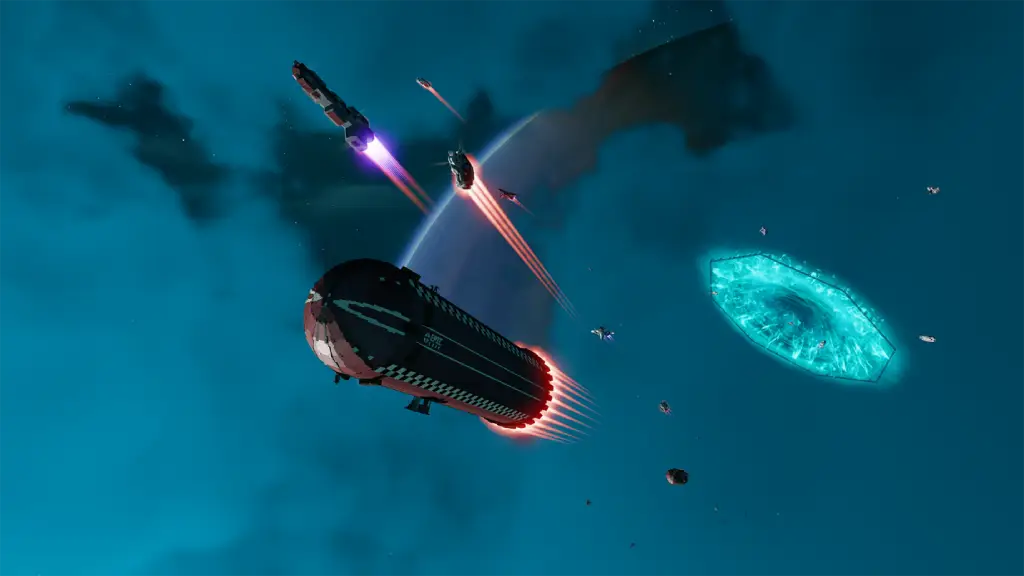
Starbase is an incredibly deep and complex MMO that’s still in the very early stages of development. First premiered in mid-2019, Starbase generated quite the buzz in various communities; from traditional MMOs like Eve: Online to voxel-based builders like Space Engineers to exploratory giants like Elite: Dangerous and No Man’s Sky, communities were awash in excitement.

With little more than an announcement trailer to a hair over 2 years later, Starbase released into a technical alpha / early beta state on July 29, 2021 to great fanfare. Rooted deep in its voxel/vertex-based building mechanics and six  degrees of freedom, Starbase is an exceptionally complex game that runs the risk of alienating more casual gamers, but incredibly satisfying to those that muscle through the usual trappings found in very Early Access titles.

In my just-shy of 100 hours of play time, I’ve run into a bit of duality here- I definitely feel like I still know precious little about the true depths of customization within Starbase, but on the other hand … feel like I have a solid grasp of what Frozenbyte is working to accomplish with Starbase. What I do know with certainty, though, is that more than many of the other Early Access/technical alphas that I’m a part of, I am most looking forward to the potential of Starbase. The customizability of panels to allow for individual thruster control may sound tedious to some, but to others, can bring about moments of absolute hilarity (too much power or thrust in one direction and whoosh there you go, spinning off into space) to frustration in the lack of maneuverability.

The ground work for something truly special is certainly there, and the open world, sandbox-style approach encourages experimentation amidst the honeymoon phase with Starbase- the down side is that not all features or functions have been fleshed out, or even created in some cases. Patience is required with Starbase, though I do have to hand it to Frozenbyte- they are absolutely gobbling up player feedback and are regularly updating with new features and fixes and are staying relatively true to their published Starbase roadmap. 

While the level of control within Starbase is deep, interesting, and an entire gameplay loop in its own right, it’s not all sunshine and rainbows. Desync is a regular issue, pop-in is pretty drastic at times, and boy, Starbase makes my computer hit thermal temps I’ve not seen sustained on it before- where I normally run between 56-63 degrees on my CPU under load (Ryzen 9 3900x w/ Kraken X63), and maybe an occasional GPU spike up to 72-73 degrees, I run fairly constant in Starbase at 70-72 degrees for the CPU and a worrying 79-81 degrees on my RTX 2080 Super. I imagine that lesser machines (not that my machine is exceptional by today’s standards) or those with poor thermals, will see significant chug. As briefly mentioned, the desync can get bad at times, and is likely a major factor in some of the performance issues I’ve run into while running Starbase at 1440p; I’ve learned to spend more time in game during non-peak hours (though that can be tough these days, given its popularity- always seems to be busy) as the game just runs smoother. I’m confident though, that in time, Frozenbyte will iron out those issues by the time it launches out of Early Access.

I have to admit that while gunplay is still relatively early, the FPS foundations are there, even leading to small platform-like ships floating around with players on mounted light machine guns as a sort of … small-scale, space-based technical. It’s actually fairly ingenious, if a wee-bit dangerous. What shocked me most about combat, though … was just how raw combat can be. Rounds slamming into ships have a surprisingly robust sound (one that I love) but when components are hit (like thrusters or powerplants) there are these absolutely beautiful explosions and chip-damage. It’s actually mesmorizing, and when you’re freaking out and trying to run about a ship that’s taking fire, it’s incredibly suspenseful- I am absolutely looking forward to the continued development in these areas- “atmosphere” in space is incredibly important and Starbase simply oozes it at times.

On the flipside, though, there are definitely things I’m looking forward to that really put a damper on things. Ship-building, for one, is relatively simplistic and often yields ships that are generally quite “same-y.” Frozenbyte’s definitely acknowledged this in their various foums posts and on their roadmap and are working towards simplifying the process, along with adding new features and capabilities to make ship and station-building a more enjoyable experience. Given the number of regular updates that Starbase has received, and the hyper-active development team mixed with a community that is just brimming with excitement, I’m eagerly awaiting the next great build- after all, I can’t be the only one thinking that they could build a to-scale Death Star … right?

Starbase will inevitably be compared to genre giants like Space Engineers, No Man’s Sky, Elite: Dangerous, Dual Universe, and Star Citizen, but I found it often felt like a far more mature, far-reaching, massively-multiplayer version of the criminally-underappreciated and seemingly unknown Avorion (an indie single-player space-based voxel-builder) with a healthy dose of Space Engineers thrown in for good measures. This is not a bad thing- far from it; if anything, I hope we continue to see titles with the reasonable scope and intensity that we’ve seen out of the team behind Starbase.

However, where I think Starbase will differ is in its inherent difficulty- there are an absolute metric ton of things that you’ll want to learn up on, from best resources to mine for, to control schemes, to just understanding the universe of Starbase and there’s no better place to learn than on its Wiki. Trust me when I say this … It’s okay to feel a bit overwhelmed- Starbase is incredible, if massive in scale, and it can be a bit much and if you run into the proverbial wall that leaves you wondering, “okay, what now?” simply ask in game- the community will help you along the way.

Summary

Even in its early stages, there are some fantastic bits here and there that constantly bring me back for more- I was out mining an asteroid, minding my own business in my tiny little starter ship, in the zone with a good audiobook running in the background and I was just taking things in when I saw one ship come ripping up, followed by gunfire and a couple of small ships giving chase. Completely ignored me, for which I’m thankful- Starbase’s open pvp model has seen the rise in roving bands of ne’er-do-wells that could lead to destruction of your ship and the loss of your resources- it’s all a part of the excitement and energy surrounding Starbase. In fact, there’s something I see daily in Starbase that has long died out in other massive Early Access/Technical Alphas that I near-religiously follow.

And that’s “Hope.”

Score: N/A


Share:

Prinny Presents NIS Classics Volume 1: Soul Nomad & the World Eaters - Switch Review


Prinny Presents NIS Classics Volume 1:  Soul Nomad & the World Eaters
by developer Nippon Ichi Software and publisher NIS America Inc.Nintendo Switch review written by Pierre-Yves with a copy provided by the publisher.

Estimated reading time: 9 minutes


As the start of something new in order to bring older titles back to the forefront of today's gaming platforms, Nippon Ichi Software has created a new label dubbed "Prinny Presents: NIS Classics". Taking two PS2 era Strategy RPGs, the first of these volumes is also concentrating on a title that is bringing a rather niche title back from almost obscurity with certain gameplay elements that I would like to see again within a NIS strategy RPG. This is Soul Nomad & the World Eaters.

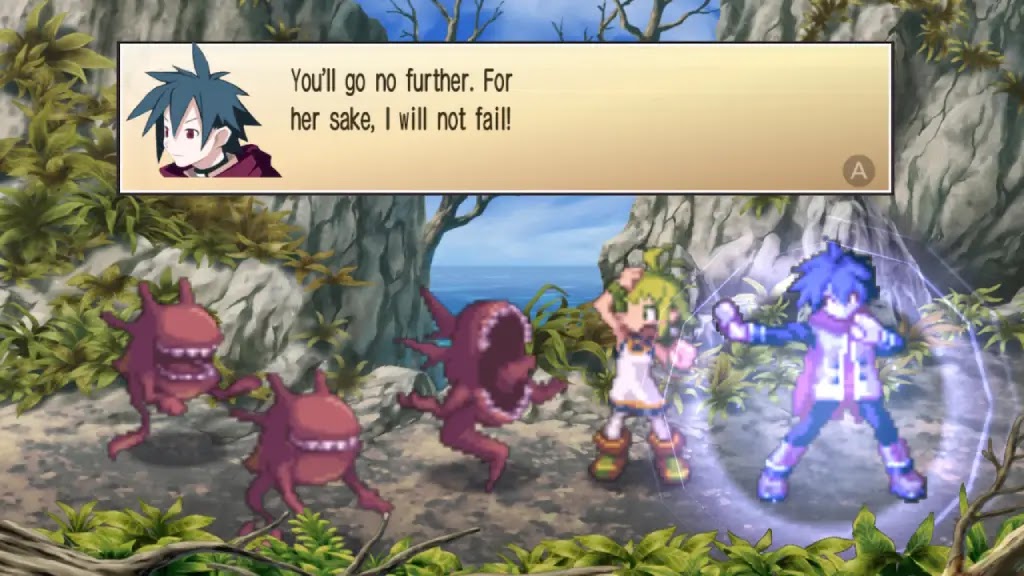
Unlike its counterpart Phantom Brave, until now Soul Nomad & the World Eaters had never seen another release outside of Sony's Playstation 2. There was no PSP or PSVita port and unlike the Disgaea series which continued onto the PS3, PS4 and Nintendo Switch, this crazy adventure had remained hidden in the shadows. Back again for another appearance though, this more hardcore strategy RPG while worth it may end up punching your ticket more than a few times.

Now, getting the biggest issue out of the way first, like Phantom Brave there’s been no graphical upgrade done to the experience. Unlike Phantom Brave that eventually saw widescreen support, Soul Nomad has remained in its original 4:3 format with the ability to stretch it out if you did back in the day find yourselves with one of the first wide screen television sets. In a way though, not having been stretched out in a way did do a bit of a service for the quality of the sprites but I would have liked to have anything to the left and the right of the screen instead of just blank television screen. Ah kids have it so well these days in a world of wide and ultrawide resolutions!

What had me excited for this dual pack is that I’ve never actually got to truly play Soul Nomad & the World Eaters when it was released. Instead, I was doubly cursed with both a PS2 in which had been used to the point of the optical drive dying as well as my first TV that I bought on a payment plan die on me one night while playing Growlanser: Heritage of War that has been released a week prior. Eventually getting a PS3 to replace the dead system, for some reason Soul Nomad remained something unplayed until the last several weeks and I had to wonder a few things. Why had NIS never revisited some of the elements showcased and does it have too high of an entry fee for those not prepared for the realm of SRPGs.

Taking an approach only seen here by NIS, Soul Nomad & the World Eaters stars a nameless protagonist that gets the "honor" of becoming a vessel for a crazy and crazy powerful god-like figure known as Gig. In English voiced by Yuri Lowenthal who really sells just how vicious Gig can be verbally, your protag will soon find out just how vicious Gigs powers are capital IF you decide to use them. Playing the choice game, you can decide whether or not to use godly powers or go about it the good old fashioned way. By grinding experience points.

Where Soul Nomad differs from the other SRPG titles that NIS / NISA have done over the years is that there’s no actual easy way to grind experience and level up your units. Instead, the story follows a path and unless you look into a specific side feature that’s mentioned and then never really mentioned again, you’ll spend plenty of time polishing off just how badass you can be with limited forces until a boss stomps you flat in a totally unfair manner. Really annoying and awful especially if you’ve been at it a few times.

Taking it from the top though, once our nameless protag takes on a sword and becomes a vessel for Gig, the journey to put down Gig’s World Eaters begins. In a way because I really played Compile Heart and Idea Factory International’s Trillion: God of Destruction first, I found some similarities in going up against a foe of immeasurable power knowing that you could easily die in the process. I guess it’s also the same concept as Z.H.P. but that’s another story entirely. To take on these world eaters though, you’re going to need to level up and to build an army from next to nothing and manage your bank account all the while as nothing is free in this world and that includes summoning your troops onto the field.

This in a lot of ways is where I was getting a bit disconnected with Soul Nomad as in order to survive battles, you’re going to need to build up a variety of teams to be summoned to the field. In order to summon teams to the field, you’re going to need money. But you also need money to buy the units to bring them into the field and it goes without saying that level 1 units are fairly useless even two chapters into most SRPGs so what the hell are you supposed to do short of stacking your main force and hope for the best? That’s where a previously mentioned and not really explored upon feature comes into play, Room Inspection.

Taking a few pages out of Intelligent Systems’ Fire Emblem where you can partner up your units for more oomph, Soul Nomad works with this concept by immediately putting units into what are known as rooms with a front, middle, and back row. Random in how the room will be composed as you could have one front spot, nothing in the middle and three back row openings, there will be some mixing, matching, and hoping that a room will give you enough of these slots in order to actually make something worthwhile once summoned to the field as this process is anything but cheap.

So by inspecting rooms, you can go into a series of fights that allow you to level up your current troops much past anything that the main story could allow you to do and also do it for free. While inspecting rooms, any and all squads summoned to the field are free allowing you to finally really let loose and grind monsters for all of the glorious experience points as well as cash, loads of cash, which in turn, will let you finally survive some of those battles “in the real world” as you’ll have both the experience and the bank rolling to pull it off.

The system once you get the hang of it, and like a lot of NIS titles know how to abuse it to make it work in your favor, works but the cost of entry is so damned high especially if you simply read the “hey you can inspect a room” but then never actually looked into it. The other page that is taken out of Fire Emblem is more in the battle in which you get to see whoever is on the right battle whoever is on the left in either a short or long form animation. Archers and mages will shoot arrows and fire spells differently depending on their position while front line warriors will have different approaches whether in the front or the middle lines. There’s a LOT of experimenting to do such as a healer will heal one unit very well while deployed on the middle line but they will also to a reduced capacity heal the entire team if stationed on the back row.

From that standpoint, Soul Nomad is amazing to get to understand as it’s not just a game of numbers at this point where you can say to yourself, I’ve got level 10 knights in front with my protag and a level 8 mage in the back with a level 9 healer. It's an actual game of strategy. You need to worry about how the enemy is composed as just a few mages throwing full column fire spells will easily knock your front line forces out before you’ve even had the chance to heal whoever is hopefully left over.

Only adding in another stress to this whole process is that if a unit designated as the leader is taken out, the whole squad perishes. This makes moves that target leaders so brutally nasty when used against you, but absolutely amazing to hold onto if you do that that ace up your sleeve. It also creates stress especially if the battle has been dragging on as you really have to ask yourself is it worth putting your main unit up? Or do you potentially sacrifice another just to deprive the last unit standing of potentially taking you out in one go?

And it's this level of combat tactics that make Soul Nomad so enticing to lovers of the genre, especially the ones who are constantly seeking tougher challenges. So Catch-22, Souls Nomad's difficulty by this very aspect could also alienate newcomers due to how tough it is, but again, packages with Phantom Brave while also a tougher title in a lot of ways, has a lower barrier of entry to introduce new players to the crazy phase that NIS had with these two titles and Makai Kingdom. 

Summary

So while Soul Nomad & the World Eaters hasn’t been upgraded from it’s PS2 version and is a direct port over to the Nintendo Switch, it’s an SRPG that I had wished had sat down years ago. As a whole package alongside Phantom Brave though, I wish that the graphics had been polished up in order to better suit the newer platforms. Both are incredible titles offering countless hours of strategy and combat and I look forward to what we can come to expect with Prinny Presents NIS Classics Volume 2.

Fingers crossed for a combination of Makai Kingdom and La Pucelle.

Score for Soul Nomad: 7.5 / 10,

Score of Phantom Brave: Score: 8 / 10,

Total score of Prinny Presents NIS Classics Volume 1: 7.75 / 10


Share:

Prinny Presents NIS Classics Volume 1: Phantom Brave: The Hermuda Triangle Remastered - Switch Review


Prinny Presents NIS Classics Volume 1: Phantom Brave: The Hermuda Triangle Remastered
by developer Nippon Ichi Software and publisher NIS America Inc.Nintendo Switch review written by Pierre-Yves with a copy provided by the publisher.

Estimated reading time: 6 minutes


As the start of something new in order to bring older titles back to the forefront of today's gaming platforms, Nippon Ichi Software has created a new label dubbed "Prinny Presents: NIS Classics". Taking two PS2 era Strategy RPGs, the first of these volumes is concentrating on a title that has seen several other ports over the years such as the Nintendo Wii, the PlayStation Portable and the PC. This is Phantom Brave.

Phantom Brave is one of those titles that not only have I played every iteration of, I never seem to get tired of it. Having had the pleasure and for me the honour of reviewing it for the PC several years back, I was excited to see it back again and on a platform style that it should fit well on having both visited the home and portable based console environments.

I'll start off with perhaps my only issue with the package that Nippon Ichi Software has put out for us. Unlike the other iterations of Phantom Brave that had a bit of reworking and upscaling for the platforms that they were targeting, this version looks really great until you look at the sprites themselves. For some reason, while everything else is clean and crisp, the sprites, combat or story in their 2D animated status, are blurry and just don't fit the rest of the world. Bottom line is that they haven't been reworked, just ported in.

If you can get past this however, there's an incredible strategy RPG to be found. Taking place in the fictional world of Ivoire, Phantom Brave follows the story of a young Chroma (mercenary) named Marona as she works towards saving enough money in order to buy the island that she calls home. Aided by Ash, a phantom that used to be a friend and Chroma alongside Marona’s parents, the two of them will go from job to job and face some rather impossible situations together.

The story, unlike a lot of other entries into the Makai universe such as Disgaea, Makai Kingdom, the attached Soul Nomad & the World Eaters, La Pucelle and more, is a more serious one even if we are dealing with loads of supernatural elements and talking wolves. Unfortunately due to her ability to see those that are still around Marona even in her early teens have lived with a stigma which has resulted in the “normal” people shunning her. In a world that has talking wolves, owls, and other creatures, this was apparently where the line was drawn for the normal folk and the story while well written and paced is hard to stomach at times as you wonder why people are so cruel to someone who just happens to be a little bit different.

It’s this that keeps Phantom Brave both grounded and worth coming back to time and time again because unlike the more slapstick and dark as hell / hilarious humour, jokes will only be funny for so long before they lose their luster. A well written story will continue to be enjoyable for years to come and it’s with this that I was more than happy to sit back down to Phantom Brave yet again on another (PS2), another (Wii), another (PSP), another (PC) platform.

Merging the narrative concepts into gameplay is another area that makes this title stand out just a little bit more. Surrounded by phantoms that can be summoned to the field, Marona who may be the only living person on her team will always have plenty of support as long as objects exist in order to help bind the phantoms into the real world. Rocks, trees, swords, minecarts, bombs and flow pots, each of these can act as a temporary vessel for a phantom but like everything else in existence, there’s a cost.

Depending on the phantom and their power, they can only stay in the real world for a limited time before having to phase back out and rest up a little while. Well rounded, Ash can stick around for five turns while a soldier unit can stick around for seven but they aren’t exactly the most powerful. Fighters, Valkyrie, Witches, Owl Ninjas will range the four to five turn range while other much more powerful beasts may only be able to stick around for two turns but the damage that they can pull off is incredible.

Now where Phantom Brave takes this concept up a notch is that phantoms count as “one” to the total count of what can be summoned to the field but then so do any weapons that they hold. So working generally off of a count of “two”, it doesn’t take long to max out who’s been summoned to the field in order to do battle. A good way to manage this concept is that because anything that a phantom can be bound to can be used as a weapon, over time, you can establish tactics that will have phantoms summoned later in battle summoned into the weapons left behind by the first wave that are no longer present. It adds a level of strategy and it can really help out on stages where the difficulty is already higher due to a lack of objects or due to enemies targeting these objects as soon as they are able.

A bonus to this package is that it contains everything that has been published up to this point from the Nintendo Wii “We Meet Again” to the Sony PSPs “The Hermuda Triangle”. Continuing on the bonus is that Phantom Brave works just as well full screen in the dock attached to a TV as it does comfortably in the palm of your hand. Adding another layer physically (which I’ll be honest that I did order a copy to showcase my support as always to NIS / NISA), there’s an artbook and OST alongside a collector’s box.

Summary

So overall, even if the quality of the sprites have not been updated to be as clear and crisp as the rest of the world and the interface, Phantom Brave alone is a worthwhile reason to pick up this package especially if you’ve never sat down to it. With a well written story and a great combat system that has a variety of quirks to master, there’s more than enough strategy here alone before getting into the second half of the package Soul Nomad & the World Eaters.

Score: 8 / 10


Share:

The Vale: Shadow of the Crown - XBSX Review


The Vale: Shadow of the Crown
by developer Falling Squirrel Inc. and publishers Falling Squirrel Inc. and Creative Bytes StudiosMicrosoft Xbox Series X review written by Pierre-Yves with a copy provided by the publisher.

Estimated reading time: 7 minutes


There are certain titles out in the world that can only be described as an experience. Coming from developer and publisher Falling Squirrel Inc., The Vale: Shadow of the Crown is one such title as you’ll be exploring a medieval world with nothing more than the sounds of the world as your guide.

Blind from birth, you’ll be helping to guide our protagonist Alex home after her escort was ambushed by an invading horde as she was on her way to her new home after her brother ascended to his crown. Second-born, blind, and wanting to give her more than he had, Alex’s uncle found a place that could be hers but unfortunately with tragedy striking and having no idea where this place is, Alex turns around to where they traveled from to make a five hundred mile journey home with nothing more than the clothes on her back and the blade from a dead soldier that she stumbled upon in her hand.

The Vale from the very beginning is different from anything that I’ve ever sat down to as there is next to nothing to see past the opening credits of the developer, publisher and of the main menu. From this point, just about everything short of a map and particle effects is audio only with clear, crisp enunciations and sound effects that are only heightened by the fact that there’s nothing else for you to see as you begin to help guide Alex home. Playing with your eyes closed, the television off, or with a blindfold, each of these and a VERY good pair of headphones will almost be necessary as you’ll want to cut out any other noise source such as fans, cars driving by, air conditioning units or cats complaining that food time is still an hour away.

Starting out alone and with nothing more than a blade, Alex soon comes across a wounded shepherd running from the invading horde that caused this whole adventure for her in the first place. After taking out those that would have killed her and then the shepherd outright, Alex promises the shepherd an almost immeasurable reward if he can help to bring her home. Setting out together, you’ll soon have to make choices for the now party of two as one has an injury and the other can only go by what she hears in the world.

Not being able to see anything as you move about the world is an interesting concept that was very well detailed from the side of the developer. Set up in a form of situations that will follow each other from being out of the road to being inside of town or a cave, the space that you can move about is generally contained to the task at hand. This lets you only have to worry about what’s around you as you could also easily be attacked at a moment’s notice. Sounds of running water, the ring of a smith’s hammer on the anvil, a herbalist calling out, the buzzing of bees, each of these is honed in on will help guide you forward.

Having these almost bite sized areas alleviated what would have been my biggest worry and question going into this. How do you find your way forward when you can't see and you yourself have never had to live a day in those shoes? Where do you even start? So it's with this in mind that you are almost hand held through the early parts of the adventure as you are guided to how to move around, how to interact and most importantly for this adventure, how to fight and defend yourselves as Alex will unfortunately often have to draw steel.

On that note, combat while simplistic in its approach steadily gets more complicated as you add in more and more "noise". While Alex has been trained to listen for particular sounds, eventually there will be more than you know how to deal with as the odds are you've never been in these shoes. The sound of one set of feet crunching on the ground quickly becomes many alongside the sounds of creaking armor as someone heads in for a swing. Add in the sound of whistling arrows and the variety of attacks to block and I wouldn't blame someone for falling the first few times. It's very well done, but it's not easy and that I believe was the point.

For combat itself, you'll be navigating both your left and right thumb sticks. The left stick controls your Shield whether it be protecting you from a centered, left or right position while the right thumbstick does the same but for your sword. Being the best way of defense, your Shield will often allow you to parry an enemy's attack leaving you an opening to strike back. You can of course strike first however as you get more and more enemies involved it was usually better to turtle a bit and return strikes instead of striking first.

It works very well and I often found myself closing my eyes to concentrate on nothing more than the sounds around me. If there is perhaps one thing that would have made everything so much more complicated, and would have been more realistic, it would have been to have sounds coming from behind you and have to worry about protecting yourself from behind. On that note though, I'm happy I only had to worry about the absolute positions of center, left and right.

While combat is a big part of the experience, it really comes down to everything that has been perfectly described from items in the inventory and items in the main settings to the conversations that Alex will have with others. Alex has never seen what the world looks like so the concept of color is lost when the shepherd was trying to describe what a hill looks like at sunset. Just that alone is something we probably also never even considered as we do take our sight for granted most days. So it’s with this, the lengthy descriptions of the items in Alex’s inventory, and referring to portions of the controller as what they are and not “A” “X” “Y” but left sticks and triggers that can easily allow someone without their sight to sit down and enjoy The Vale as it’s an adventure that takes visual disabilities to the forefront of the thought process.

As a side note, having used assistive software such as JAWS and NV Access (NonVisual Desktop Access) to check various accessibility aspects of HTML and forms, I found myself blown away at the level of clarity that the narrator had in describing everything. I had an idea of what to expect based off of previous tools designed to aid those with visual disabilities but what Falling Squirrel Inc. have done was simply incredible and adaptable as you move through menus from one item or system setting to another.

Summary

Overall, I can’t recommend Falling Squirrel Inc.’s The Vale: Shadow of the Crown enough. It’s more than just a video game, it’s an experience that blends in a real world issue with a well balanced gameplay system that just works. Well written and narrated story mixed with an easy to pick up yet hard to master combat system all while seeing nothing more than particle effects on a screen, it’s a reminder that there’s still so much more we can do for those with disabilities.

Score: 8.75 / 10


Share:

Claire De Lune - PC Review


Claire De Lune
by developer and publisher Tactic Studios Inc.—PC Review written by Susan N. with a copy provided by the publisher.

Estimated reading time: 9 minutes


Claire De Lune is a sci-fi puzzle game that takes us on a journey through an alien planet full of hostility, acid, and terrifying beasts. The puzzles range in difficulty from logic gates to portal-esque solutions. Not only do players need to players need to survive the harsh environment through cunning wit, but they have to save Claire. And yes, the famous Clair De Lune song by Debussy is part of the official soundtrack.

Gameplay

When new puzzle games appear in our review list, you better believe I'm not far away. Claire De Lune is a neat sci-fi game that has a plethora of different puzzles to solve.

We begin with a dialogue between John (you) and Arturo (the computer) on a ship while sitting in a restricted zone. We get a sense of business as usual when Arturo chimes in with his 'fun facts' that come complete with a little fanfare. Claire, your daughter, joins you on the bridge. After getting some food and exploring the ship we get a sense of the characters. We live on a ship, we're on the run, and we have a teenager with us. Before we can digest this information, our ship is hit by space debris or something, and we have to act fast. We tell Claire to head to the emergency escape pod before we crash on an alien planet. After landing successfully, we must fix the ship before finding Claire who is stranded somewhere nearby.

In the beginning puzzle section, Arturo and John banter back and forth. It left me wondering how important Claire is to John. Anyways, despite that, I enjoyed solving logic gate problems and stopping coolant from flooding the ship. Though, that is where the game's uniqueness ends for me because as we leave the ship, we unlock a Nanogun.

Here's the thing: Claire De Lune is a puzzle game that relies on solving environmental puzzles, similar to Myst, Portal, or Antichamber. Each game requires observation and understanding of the world around you. And unlike the three mentioned games, sometimes titles miss the mark by imitating too many elements of others. For example, the Nanogun is a modified Portal Gun that forms matter into different shapes. So let's talk about the puzzles.

The Puzzles

I enjoy the puzzles but I have two points to make.

  1. Puzzles are easy to solve but can be inconsistent and
  2. Puzzles easy to spot but difficult to execute

Once you leave the ship, the path to Claire is straightforward. We can produce matter to reach difficult places but sometimes the objects don't appear. Other times the cube or trampoline will appear too far away allowing the aliens to get to you. Even then, if you're trying to use the trampoline with the cube, one of them may not appear where you intend. Plus, walls need to be flat so that players can use the beams, but not all walls work. And even if you are targeting the ground, a location can be invalid because the ground is *slightly* slanted. This is particularly frustrating because it requires players to have pinpoint accuracy.

The second challenge is that puzzles are easy to see but are difficult to execute. Players can only create one block, trampoline, and gravity beam at a time. One can use the cube, trampoline, and beam together to solve puzzles, but cannot spawn two cubes. (Technically, there is enough matter to use the three in combination.) While it is easy to see your destination, being forced into using one object each presents its own challenge.

These two points showcase my issue with Claire De Lune which is that it needs a hint system. This could be achieved through Arturo's database of knowledge or it could be a cool gadget that highlights useful surfaces. Maybe the devs could implement a radar or a compass. Anything to help players would really elevate the gameplay experience. And while some of the puzzles (like the slingshot one) are innovative, the difficulty ramps up too quickly.

Alien Lifeforms

This planet is evil. When we start, there's nothing to worry about (other than falling to our doom.) We quickly discover alien spiders that remind me of facehuggers. Yep. These little bastards look like spikey rocks that burrow underground. And Arturo's 'fun facts' are all but useless other than for comedic effect. Facehuggers, or whatever they are called, are obstacles for the player and they happen to be fast! I can't tell you the number of times I died to one because the game doesn't think that a broken leg would slow them down. True story. Plus, they jump at your face and are accompanied by the most unnerving sounds. Let it be known: THIS IS NOT A HORROR GAME. Still, these suckers had me on edge throughout the game. (Also, why'd it have to be spiders? Can we move away from spiders? WE DON'T LIKE THEM!)

Thankfully, once you pass the spiders, there are other alien lifeforms to be afraid of. There are KILLER PLANTS that remind me of spine crawlers in Starcraft 2. They stab at you if you happen to be on the ground, and I don't even want to know what that death animation looks like. I'd rather jump off a cliff, thanks.

If we aren't dying to face-hugging spiders, plants, acid, or chasms, there is THE BEAST and some ridiculously powerful turrets that will melt you in a fraction of a second. So while Claire De Lune is a really neat sci-fi puzzle game, the alien lifeforms are smart, fast, and sometimes terrifying. I humbly give this aspect an A+. The deceptively dangerous atmosphere is extremely well done.

Graphics

Claire De Lune has some excellent graphics for a puzzle game. The alien planet has a rocky landscape that showcases its beauty. It's green and lush with familiar flying wildlife. And while I didn't think of it at the time, there are no land creatures to speak of, presumably due to the spider things, acid pools, and bloodthirsty plantlife.

While the game is graphically pleasing, there is one thing to note about the game. Its minimum specs require an NVIDIA GTX 660 or AMD Radeon 7850 for graphics, which isn't bad. The thing is that my Radeon RX 570 can run Claire De Lune on max settings with the exception of the shadows. They had to be on the lowest setting so that the game wouldn't look like this:

Sure, that is a minor issue, but since this was an issue at the start of the game, I'm going to notice it. Otherwise, the graphics were only a problem in terms of being able to shoot the Nanogun at specific locations. It's not that anything is wrong, it's that matter can only be created on certain surfaces, which as we've discussed is inconsistent. So take that as you will.

That said, the rest of the aesthetics are wonderful. Despite my best efforts, I was not able to make it off the map, nor was I able to glitch through any walls. This is a high mark when it comes to environmental puzzle games.

Music and Audio

The music and audio are Claire De Lune is extremely well done. I've already mentioned how unnerving the facehugger sounds are, but there are other elements of the audio that is wonderful. The soundtrack artist is Colm R. McGuinness who is an Irish composer, although you wouldn't be able to tell from the game audio. Claire De Lune's soundtrack sets the tone as a sci-fi futuristic game. Many of the compositions have a blend of a grand piano, violin, and synthesized reverberations. Not only do the calming effects of the piano sound creates a serene atmosphere, but the addition of reverberations add the impression of danger lurking around the next bend.

When the music is combined with the audio of the skittering facehuggers, conveniently placed birds, and deadly plants rustling, Claire De Lune shines. One shouldn't be surprised as Colm McGuinness has his master's degree in music composition and has not only worked on this title but is featured on Critical Role. Mr. McGuinness composed the theme to Exandria Unlimited, a short 8 episode tabletop RPG run by Aabria Iyengar set in Matthew Mercer's world of Exandria.

For more details about Colm McGuinness and his musical masterpieces, check out IMDB, SoundCloud, Bandcamp, and YouTube. He can also be found on social media like Twitter, Facebook, Ko-Fi, and Instagram pages!

Final Thoughts

Claire De Lune is a great sci-fi adventure puzzle game that could have done much better with more options for puzzles, more emphasis on Claire's well-being, or more player assistance. The puzzles themselves were great and interesting but were sometimes either much too easy or much too difficult. The narrative story with Claire left me uncertain about John's abilities as a father. There didn't appear to be any focus on the moral questions about his job. Finally, players are left fending for themselves without any real sort of direction. After Arturo gives his usual fun facts or explanations about the Nanogun's new features, players have no hint system or indication of what needs doing. This is particularly frustrating when players reach the section of gameplay that requires using the beam and gravity as a way to slingshot themselves over a large chasm.

Overall, Claire De Lune is a fun experience that could have used a little more edge. The core gameplay loop is good and it is occasionally terrifying when dealing with aliens, which is why I give it an 8 out of 10. It has some amazing graphics and musical accompaniment which adds a lot of value to the title. The fact that there aren't any real bugs to speak of gives the game a higher rating. The game is not a bad title by any means, but it's not a stand-out performer in the puzzle genre for me. However, since Claire De Lune was created by a small indie studio, this is a great start for Tactic Studios. I can't wait to see what they come up with next.

Score: 8/10


Share:

Kitaria Fables - PS5 Review


Kitaria Fables
by developer Twin Hearts and publisher PQubeSony PlayStation 5 review written by Pierre-Yves with a copy provided by the publisher.

Estimated reading time: 5 minutes


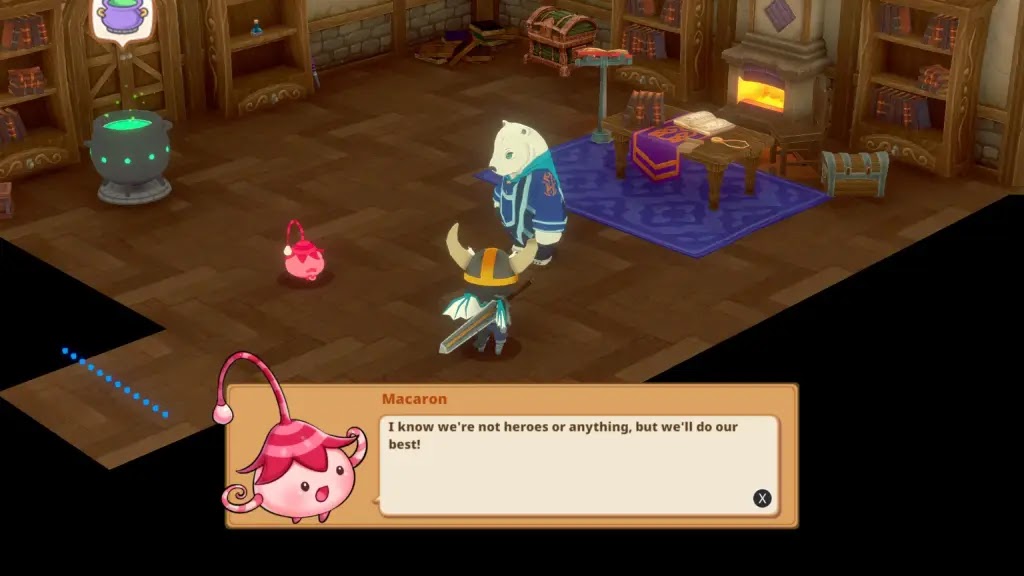
Kitaria Fables by Twin Hearts and PQube is an easy going and adorable action adventure RPG that's fun for the whole family. Sent to a remote village from the Capital in order to protect it from monsters, it doesn't take long for our protagonist Nyanza and their companion Macaron to be drawn into a seperate adventure all while performing their original duties as soldiers to the kingdom.

Channeling a bit of XSEED and Marvellous' Rune Factory (4), Kitaria Fables is a toned down version of their action adventure farming simulator creating a low and easy entry point for anyone interested. With bits of exploration, combat of some special monsters and a bit of farming, the adventure may take a dozen hours depending on how fast you move from main plot point to plot point but there's still enough to do on the side if you want to take your time.

Perhaps the one thing that I really appreciated about Kitaria Fables is that while there is a bit of a lengthy intro, it's not overly hand holding in order to teach you the ropes. In a few ways, it explains what it needs to do but it doesn't feel like it assumes that you've never played a game before. So starting off on the day that our heroes show up in town, you'll soon get a bit of the lay of the land with your first quest to defeat some monsters in order to protect the townspeople.

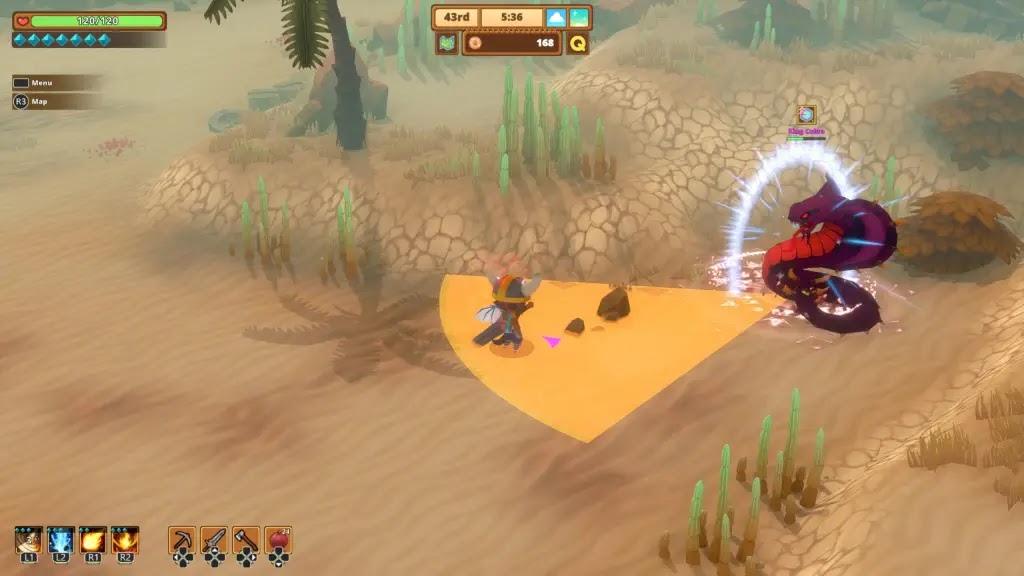
Split up into several areas that are all interconnected by passageways, moving around is easy enough as you simply need to run in the direction you want or do the Legend of Zelda rolling in order to move faster. Regardless of how you move around though, in almost all of these areas there will also be monsters that do not care if you are there unless you attack them first or they'll aim to attack you on sight. It really doesn't take long to figure which ones are which allowing you to easily figure out how to move through each area.

Now one reason that Kitaria Fables is fun for the whole family is that it has a low entry point when it comes to combat. There's no experience grinding in order to get more powerful, instead, you just need to craft new gear found from the various monsters across the land. For the monsters that can be found across the land, whether they be normal or more powerful types granting PSN trophies, they all follow a displayed choreograph of how they are going to attack, and the range of which their attack will be spread out over. This means that at any time you know exactly where to move and where to dodge as there is always time to move out of the way. It felt a bit too easy in the beginning but as you add in numerous enemies, it helps keep things easy.

Aside from all of the adventuring, our protagonist has, like in all good farming simulators, inherited the farm from one of their grandparents. In better shape than most, the fields are already ready to be tended with only a few rocks and tree debris to remove from the way if you really want to plant as much as possible off the bat before even upgrading your farming tools. There’s nothing overly complex and it’s an easy way to make money as you can always sell the final products for much more than you paid for the seeds, but it would have been nice to have a bit to work towards instead of having been given the whole field at the very beginning with nothing to work towards. Because of that, the farming aspect felt more like a small add-on for certain side quests and a way to pad your bank account instead of hunting down materials from monsters that can easily sell for a pretty penny.

Now if there’s one thing that didn’t quite work with this adventure it would be the way in which the checkpoints and portals have been designed as some areas that need to be re-visited often enough had no close points to teleport to. This usually meant that if you were grinding for materials in order to get the Platinum Trophy, every time you needed “one” shell from the turtle boss monster, you had to cross four separate areas each and every time because the closest portal one area away was only to teleport out from and not into. It made this process even over the course of the normal adventure rather repetitive and added nothing to the overall experience.

Summary

Overall though, Kitaria Fables is a fun little adventure which will clock in at about a dozen hours as you explore this cute medieval world. With plenty of side quests in order to help out the local people, several different magic spells to help you out and a giant plot of land to farm on, there’s enough to keep you busy for a little while without the vast time investment that Rune Factory or Harvest Moon would require from you.

Score: 7.75 / 10


Share:

Random posts

Our Streamers

Susan "Jagtress" N.


S.M. Carrière

Aldren


Affiliates

JenEricDesigns – Coffee that ships to the US and Canada

JenEricDesigns – Coffee that ships to the US and Canada
Light, Medium and Dark Roast Coffee available.

Blog Archive

Labels